
A hundred towns to move to.
We started from the 1,000 towns on this site and cut every town that failed one of these:
- Fast internet. Full fibre to at least half the homes. Where it is missing, getting a line put in is slow work, and harder still in a second language.
- A real town. At least 5,000 people, so the bar, the pharmacy and the school stay open in January. And under 100,000: no big cities.
- A hospital near. An emergency room within 15 km and a hospital within 30 km.
- A way home. An airport within two hours by car.
- Solid ground. Below 900 meters, and outside zone 1, the highest of Italy's four earthquake zones.
- A working local economy. Average declared income above 20,000 euros a year.
- Then the judgment calls. No commuter suburbs, few of the famous tourist towns, and where two good towns sit side by side, only one of them. No quota per region.
19 of them have their letter already.
Abruzzo5 towns
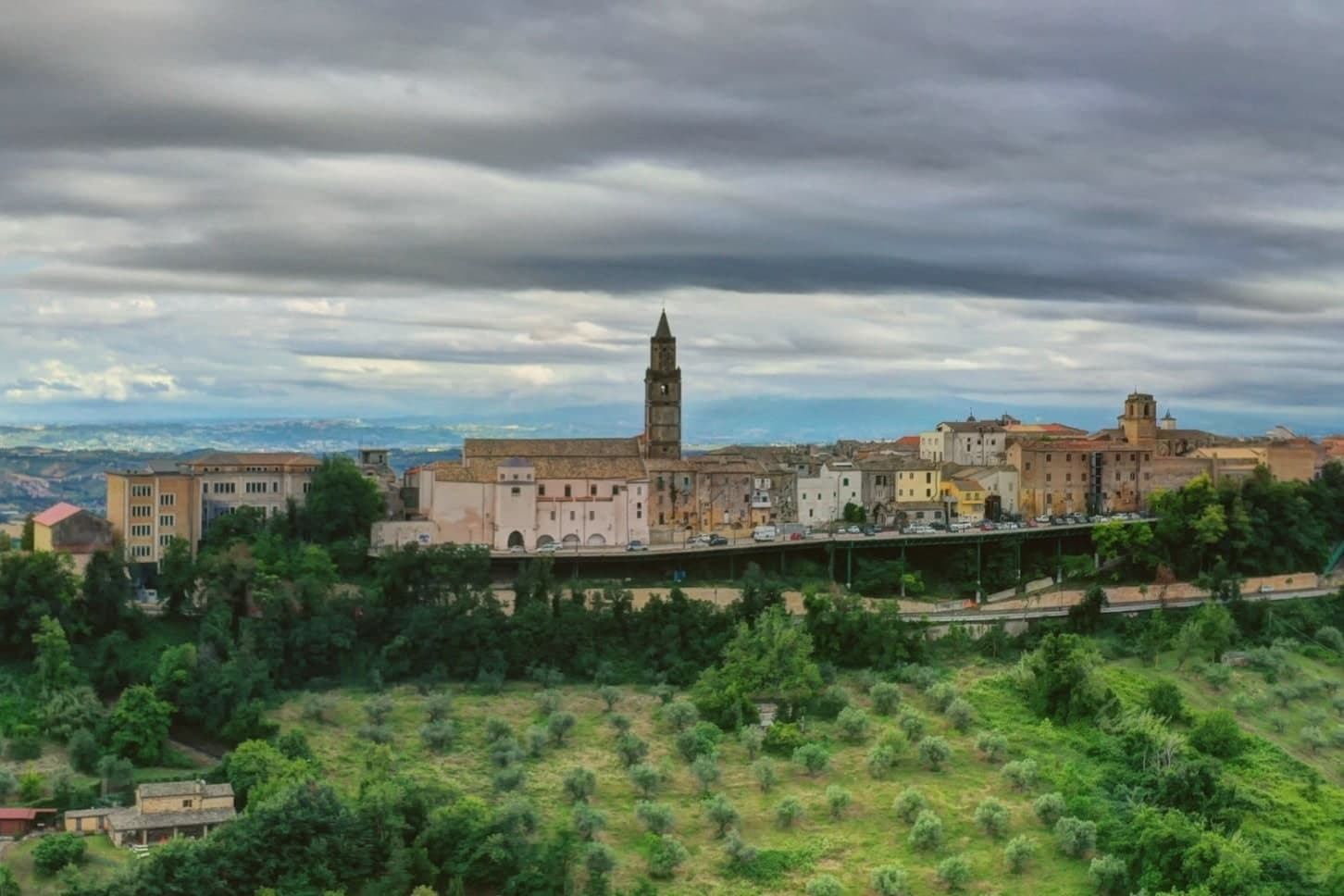
Città Sant'Angelo
Region: Abruzzo · 320 m
A hilltop borgo at 320 meters between the Vestina hills and the Adriatic, named for the Archangel and home to a Collegiata since 1353.
Ortona
Region: Abruzzo · 72 m
A working Adriatic port under an Aragonese castle, where the cathedral holds relics venerated as those of the apostle Thomas and the ridge above the harbor was fought over street by street in December 1943.
Penne
Region: Abruzzo · 438 m
The brick city at 438 meters between the Tavo and Fino, ancient capital of the Vestini, rebuilt after Allied bombing and awarded the Silver Medal of Civic Merit.
Roseto degli Abruzzi
Region: Abruzzo · 8 m
An Adriatic beach town of 25,500 with ten kilometers of low-rise sand, a hilltop frazione at 285 meters, and Blue Flags every year since 1999.
Vasto
Region: Abruzzo · 144 m
At 144 meters on a hill above the Adriatic, Vasto is home of the brodetto vastese, a fish stew born in the nineteenth century.
Campania3 towns
Mercogliano
Region: Campania · 550 m
A 550-meter Irpinia town on the slope of Partenio, gateway to the Montevergine Sanctuary 1,270 meters above.
Piano di Sorrento
Region: Campania · 96 m
The quieter Sorrentine plain four kilometers from Sorrento, autonomous since 1808, with prehistoric Gaudo pottery and a black-sand marina at the foot of the cliff.
Pozzuoli
Region: Campania · 28 m
A Roman port on a volcanic caldera, the Greek Dicearchia and the Roman Puteoli, where a market's columns first proved that the ground itself rises and falls.
Emilia-Romagna4 towns
Collecchio
Region: Emilia-Romagna · 112 m
A Parma-cintura town on the Via Francigena, known today for a dairy multinational's headquarters and a football club's training ground.
Faenza
Region: Emilia-Romagna · 34 m
The city that gave its name to faïence, with a tin-glazed maiolica tradition since the fourteenth century and the world ceramics museum since 1908.
Imola
Region: Emilia-Romagna · 47 m
Bologna's Romagna twin, a medieval brick centro anchored by the Caterina Sforza-fortified Rocca, with the Autodromo Enzo e Dino Ferrari (the Imola F1 circuit) wrapping the Santerno river at the southern edge of town.
Verucchio
Region: Emilia-Romagna · 330 m
A spur over the lower Marecchia valley, cradle of the Villanovan civilization and birthplace of the Malatesta lordship of Romagna.
Friuli-Venezia Giulia7 towns
Cividale del Friuli
Region: Friuli-Venezia Giulia · 138 m
The Lombard capital on the Natisone, founded as Forum Iulii by Julius Caesar, where an eighth-century chapel still holds six stucco saints.
Cormons
Region: Friuli-Venezia Giulia · 51 m
The capital of the Collio wine zone at the foot of the Friulian-Slovenian hills.
Gorizia
Region: Friuli-Venezia Giulia · 84 m
Border city below the Julian Alps, split from its neighbor by a 1947 wall and rejoined only after decades of division.
Muggia
Region: Friuli-Venezia Giulia · 13 m
The only town on the Istrian peninsula still inside Italy, a small Venetian port on the Gulf of Trieste five kilometers from the Slovenian border.
Palmanova
Region: Friuli-Venezia Giulia · 26 m
A nine-pointed Venetian star fortress on the Friuli plain, its geometry closed three centuries after it began.
San Vito al Tagliamento
Region: Friuli-Venezia Giulia · 30 m
A medieval Tagliamento-plain town inside three rings of moats and three towers.
Udine
Region: Friuli-Venezia Giulia · 113 m
The historic capital of Friuli, built around a man-made castle hill.
Lazio9 towns · 2 with a letter
- Written about. No. 67.
Cerveteri
Region: Lazio · 81 m
An Etruscan capital seven kilometers inland from the Tyrrhenian coast, with the Banditaccia necropolis holding 1,000 tombs in the largest ancient cemetery in the Mediterranean.
- Written about. No. 66.
Viterbo
Region: Lazio · 326 m
The medieval capital of the Tuscia, papal seat from 1257 to 1281, when five popes were elected here, and home to the longest conclave in Church history.
Bracciano
Region: Lazio · 280 m
The Lazio lake town with the eighth-largest lake in Italy below it and one of the best-preserved Renaissance castles in the country above it.
Montefiascone
Region: Lazio · 590 m
A 590-meter hill town on the highest hill of the Volsini, source of Est! Est!! Est!!!.
Nettuno
Region: Lazio · 11 m
A Tyrrhenian town 60 km south of Rome, with a walled medieval borgo above the sea, a Borgia fortress and the 1944 landing beaches.
Rieti
Region: Lazio · 405 m
The Sabine capital on the Velino, claimed as the center of Italy, under Monte Terminillo and the Franciscan sanctuaries of the Valle Santa.
Sabaudia
Region: Lazio · 17 m
A rationalist city built in 253 days on drained Pontine marshland, founded 15 April 1934 between Lago di Paola and the Tyrrhenian dunes.
Terracina
Region: Lazio · 24 m
The Volscian Anxur, where a temple to Jupiter sits above a port cut through stone.
Tivoli
Region: Lazio · 235 m
A travertine town on the Aniene falls twenty-five kilometers east of Rome, holding two separate UNESCO sites: Hadrian's villa below and the Villa d'Este above.
Liguria7 towns · 2 with a letter
- Written about. No. 25.
Chiavari
Region: Liguria · 3 m
The Tigullio capital between Portofino and the Cinque Terre, a 27,000-person Genoese trading town built around a thirteenth-century grid of porticoed streets.
- Written about. No. 20.
Sarzana
Region: Liguria · 21 m
The unofficial capital of the Lunigiana on the Magra plain, birthplace of Pope Niccolò V.
Diano
Region: Liguria · 70 m
A twin destination on the Riviera dei Fiori: a medieval hilltop borgo above and a beach resort below, sharing one bay and one olive valley.
Pietra Ligure
Region: Liguria · 4 m
A Riviera di Ponente town named after the rock castle above its center, known today for one of the largest triennial flower carpets in Europe.
Recco
Region: Liguria · 5 m
A coastal town rebuilt from 90 percent destruction in 1943, known for IGP cheese focaccia and Pro Recco water polo.
Savona
Region: Liguria · 4 m
A working port city with two Della Rovere popes, a Sistine Chapel of its own, and a fortress on the old town.
Taggia
Region: Liguria · 40 m
The Argentina valley's medieval seat above the Riviera dei Fiori, the town that gave its name to the Taggiasca olive grown across western Liguria.
Lombardia5 towns
Iseo
Region: Lombardia · 198 m
The main town on the southeast shore of Lake Iseo, gateway to the Franciacorta sparkling wine country.
Laveno-Mombello
Region: Lombardia · 200 m
The eastern Lake Maggiore port town that produced Lombardia's industrial ceramics for a century, under the cliff that hangs over it.
Lonato del Garda
Region: Lombardia · 188 m
A hilltop commune on the southwestern Garda morainic ridge, with a Visconti castle and a private library of 52,000 volumes.
Mantova
Region: Lombardia · 19 m
A Gonzaga capital at 19 meters, encircled on three sides by lakes the Mincio formed in the twelfth century, UNESCO-listed together with Sabbioneta since 2008.
San Benedetto Po
Region: Lombardia · 19 m
A former river island whose entire existence traces back to the Benedictine abbey founded on it in 1007.
Marche11 towns
Ascoli Piceno
Region: Marche · 154 m
The travertine city at 154 meters where the Tronto meets the Castellano, capital of the Piceni and host of the Quintana joust.
Cingoli
Region: Marche · 631 m
The Balcone delle Marche at 631 meters, a hilltop borgo where on clear days the view runs from the Sibillini to the Croatian coast.
Fabriano
Region: Marche · 325 m
The Italian paper town at 325 meters, trading handmade paper since 1264 and marking it with watermarks since the late thirteenth century.
Fermo
Region: Marche · 319 m
The provincial capital on the Sabulo hill at 319 meters, with 2,200 square meters of Augustan Roman cisterns running under the centro storico.
Fossombrone
Region: Marche · 116 m
An inland Marchigiano town on the Metauro river, layered over a Roman colony with a Renaissance ducal court rising above it.
Gabicce Mare
Region: Marche · 8 m
The northernmost Marche seaside on the Adriatic, where the coast meets the cliffs of the Parco del San Bartolo at the Romagna border.
Macerata
Region: Marche · 315 m
The provincial capital at 315 meters between the Chienti and Potenza, home to Italy's oldest university and the Sferisterio open-air opera arena.
Mondolfo
Region: Marche · 144 m
A walled hill borgo at 144 meters above the Adriatic, with the frazione of Marotta and its beach below.
Recanati
Region: Marche · 296 m
The hill town at 296 meters overlooking the Musone valley toward the Adriatic.
San Severino Marche
Region: Marche · 235 m
A two-level town where a 224-meter elliptical piazza in the lower city looks up at a fortified hill crowned by a medieval tower and Salimbeni-painted churches.
Treia
Region: Marche · 342 m
A Macerata hill town at 342 meters, the Roman municipium Trea, renamed by Pope Pius VI in 1790 after centuries as Montecchio.
Molise1 town
Piemonte9 towns
Acqui Terme
Region: Piemonte · 156 m
A Roman spa town at 156 meters on the Bormida, where a sulphurous spring still surfaces at 74.5 degrees under an 1879 pavilion.
Alba
Region: Piemonte · 172 m
The Langhe capital at 172 meters on the Tanaro, world reference for white truffle and Nebbiolo, headquarters of Ferrero.
Arona
Region: Piemonte · 212 m
A town at the southern tip of a lake, watched over by a colossus finished in 1698.
Biella
Region: Piemonte · 417 m
A wool city at 417 meters in the Alpine foothills, where the medieval Piazzo sits above the modern Piano, connected by a funicular since 1885.
Bra
Region: Piemonte · 290 m
A Roero town at 290 meters where the world's first gastronomic university now teaches food systems.
Canelli
Region: Piemonte · 157 m
The Asti Spumante town at 157 meters in the Belbo valley, where 20 kilometers of underground tuff cellars hold millions of bottles at constant temperature.
Casale Monferrato
Region: Piemonte · 116 m
The historic capital of the Marchesato del Monferrato at 116 meters on the Po, where the Paleologi castle and the Baroque synagogue still stand.
Ivrea
Region: Piemonte · 267 m
Roman Eporedia, Olivetti's twentieth-century industrial city, UNESCO since 2018, where every February three hundred tons of oranges are thrown.
Omegna
Region: Piemonte · 295 m
The Lake Orta town at 295 meters where Bialetti, Lagostina and Alessi turned a steel valley into Italy's household-goods capital.
Puglia6 towns
Conversano
Region: Puglia · 219 m
A pre-Murge hill town at 219 meters, three centuries seat of the Acquaviva counts, with the abbey-monastery once called the Wonder of Puglia.
Galatina
Region: Puglia · 78 m
The Salento town at 78 meters where the cult of San Paolo bred tarantism and gave the pizzica its origin myth.
Gallipoli
Region: Puglia · 12 m
The Ionian beach city on a limestone island, Greek Kallipolis meaning beautiful city, tied to the mainland by a seventeenth-century bridge.
Lecce
Region: Puglia · 49 m
The Baroque capital of the Salento, ninety-four thousand people on the Lecce-stone plain, carving its façades in honey limestone since 1500.
Martina Franca
Region: Puglia · 431 m
A Baroque and Rococo town on the Itria ridge at 431 meters, with an opera festival in its ducal courtyard since 1975.
Trani
Region: Puglia · 7 m
The Adriatic port whose pink-white Romanesque cathedral stands on the water, built for a Greek pilgrim who died here in 1094.
Sardinia4 towns
Alghero
Region: Sardinia · 7 m
The Catalan city of northwest Sardinia, repopulated by Peter IV of Aragon in 1354.
Carloforte
Region: Sardinia · 10 m
A Ligurian-speaking fishing town on the Isola di San Pietro, founded in 1738 by coral fishers returning from Tunisian Tabarka.
Iglesias
Region: Sardinia · 200 m
Sardinia's medieval mining capital: a 25,000-resident Pisan-Aragonese walled town in the Sulcis-Iglesiente metalliferous district, with an intact Gothic centro storico and UNESCO-recognised mining heritage at Monteponi just outside town.
Oristano
Region: Sardinia · 5 m
The old capital of the Giudicato di Arborea, city of Eleonora and the Carta de Logu, host of Sa Sartiglia equestrian joust at Carnival.
Sicily3 towns
Cefalù
Region: Sicily · 16 m
A Norman cathedral at the foot of a 270-meter rock on the Tyrrhenian coast, founded in 1131.
Riposto
Region: Sicily · 6 m
The Ionian port whose name comes from the Sicilian for cellar, where the wine of Mascali and Giarre was stored before shipping.
Taormina
Region: Sicily · 204 m
A terrace on Monte Tauro above the Ionian, with Etna on the southern horizon.
Trentino-Alto Adige4 towns
Borgo Valsugana
Region: Trentino-Alto Adige · 380 m
The valley town built on both banks of the Brenta in lower Valsugana, with a hilltop castle above and a contemporary art project in the side valley.
Levico Terme
Region: Trentino-Alto Adige · 520 m
A Habsburg spa town in the Valsugana at 520 meters, built on arsenic-iron thermal waters.
Riva del Garda
Region: Trentino-Alto Adige · 73 m
The north tip of the lake at 73 meters, where the Trentino mountains close in on the water and a Habsburg port town stayed bilingual into the twentieth century.
Rovereto
Region: Trentino-Alto Adige · 204 m
The Vallagarina city at 204 meters where a Venetian-Austrian castle holds the Italian war museum and a domed contemporary art museum holds Italy's largest collection of its kind in the Alps.
Tuscany11 towns · 8 with a letter
- Written about. No. 36.
Arezzo
Region: Tuscany · 296 m
Tuscany's other set-piece: a 96,000-resident Etruscan-Roman-medieval hilltop city 80 km southeast of Florence.
- Written about. No. 2.
Camaiore
Region: Tuscany · 34 m
The Versilia commune that runs from the mountains to the sea, a Roman Campus Maior on the Via Francigena with a beach at its western end.
- Written about. No. 12.
Lucca
Region: Tuscany · 19 m
The provincial capital ringed by four kilometers of intact sixteenth-century walls, birthplace of Puccini and the only fully walled Italian city of its scale.
- Written about. No. 33.
Monteriggioni
Region: Tuscany · 274 m
A circular Sienese fortress built between 1213 and 1219 on a natural hill, fourteen towers on a 570-meter wall, intact and unbroken.
- Written about. No. 3.
Pietrasanta
Region: Tuscany · 14 m
The marble-processing town under the Apuan Alps, worked by Michelangelo, Henry Moore, Joan Miró and Fernando Botero.
- Written about. No. 39.
Piombino
Region: Tuscany · 21 m
A promontory port facing Elba across the channel, founded by refugees from Etruscan Populonia and now the Tuscan archipelago's ferry capital.
- Written about. No. 21.
Pistoia
Region: Tuscany · 67 m
Italy's nursery capital and the medieval Tuscan rival that gave its name to the pistol, a quietly extraordinary centro storico 30 minutes from Florence by train and Italy's Capital of Culture 2017.
- Written about. No. 4.
Viareggio
Region: Tuscany · 2 m
The Versilia capital, a Carnival city on the Tuscan coast that turned into a Belle Époque resort when the railway arrived.
Anghiari
Region: Tuscany · 430 m
A walled medieval town at 430 meters over the upper Tiber valley, where Florence beat Milan in 1440 and Leonardo started the fresco he never finished.
Pontremoli
Region: Tuscany · 236 m
The capital of Lunigiana at the confluence of the Magra and Verde, holding the prehistoric stele statues and the oldest book prize in Italy.
Vinci
Region: Tuscany · 97 m
The hill town on Montalbano where Leonardo was born in 1452, with a ship-shaped castle that now holds his machines.
Umbria7 towns · 5 with a letter
- Written about. No. 75.
Amelia
Region: Umbria · 406 m
A pre-Roman hilltown ringed by polygonal walls, with ten barrel-vaulted Roman cisterns beneath its main square.
- Written about. No. 91.
Gubbio
Region: Umbria · 522 m
Pre-Roman Ikuvium of the Umbri, where seven bronze tablets carry the longest text of the Umbrian language.
- Written about. No. 81.
Montefalco
Region: Umbria · 472 m
The hilltop wine capital of Umbria at 472 meters, where Sagrantino is grown almost nowhere else.
- Written about. No. 83.
Orvieto
Region: Umbria · 325 m
Etruscan Velzna on a 325-meter tufa butte, later a medieval refuge of popes.
- Written about. No. 72.
Todi
Region: Umbria · 398 m
A walled hill town at 398 meters on the Tiber, with Etruscan, Roman, and medieval rings stacked one above the other.
Città di Castello
Region: Umbria · 288 m
A walled town of 38,000 in the upper Tiber valley where Raphael painted his first independent commissions and the white truffle season is the year's headline food event.
Spello
Region: Umbria · 280 m
Augustan Hispellum sits at 280 meters on Monte Subasio, its Roman gates still standing over streets that Pinturicchio once painted a chapel for.
Veneto4 towns · 2 with a letter
- Written about. No. 92.
Chioggia
Region: Veneto · 2 m
Italy's second fishing port, on an island at the south end of the Venetian Lagoon, called Little Venice for its canal.
- Written about. No. 93.
Treviso
Region: Veneto · 15 m
The walled provincial capital at 15 meters between the Sile and Botteniga rivers, Venice's first mainland conquest in 1339 and the birthplace of tiramisu.
Conegliano
Region: Veneto · 65 m
The Prosecco capital at 65 meters, birthplace of the painter Cima and home of Italy's first oenology school, opened in 1876.
Peschiera del Garda
Region: Veneto · 68 m
The Venetian fortress town on a Mincio island at the southern outlet of Lake Garda.