
Tuscany · Siena
Monteriggioni
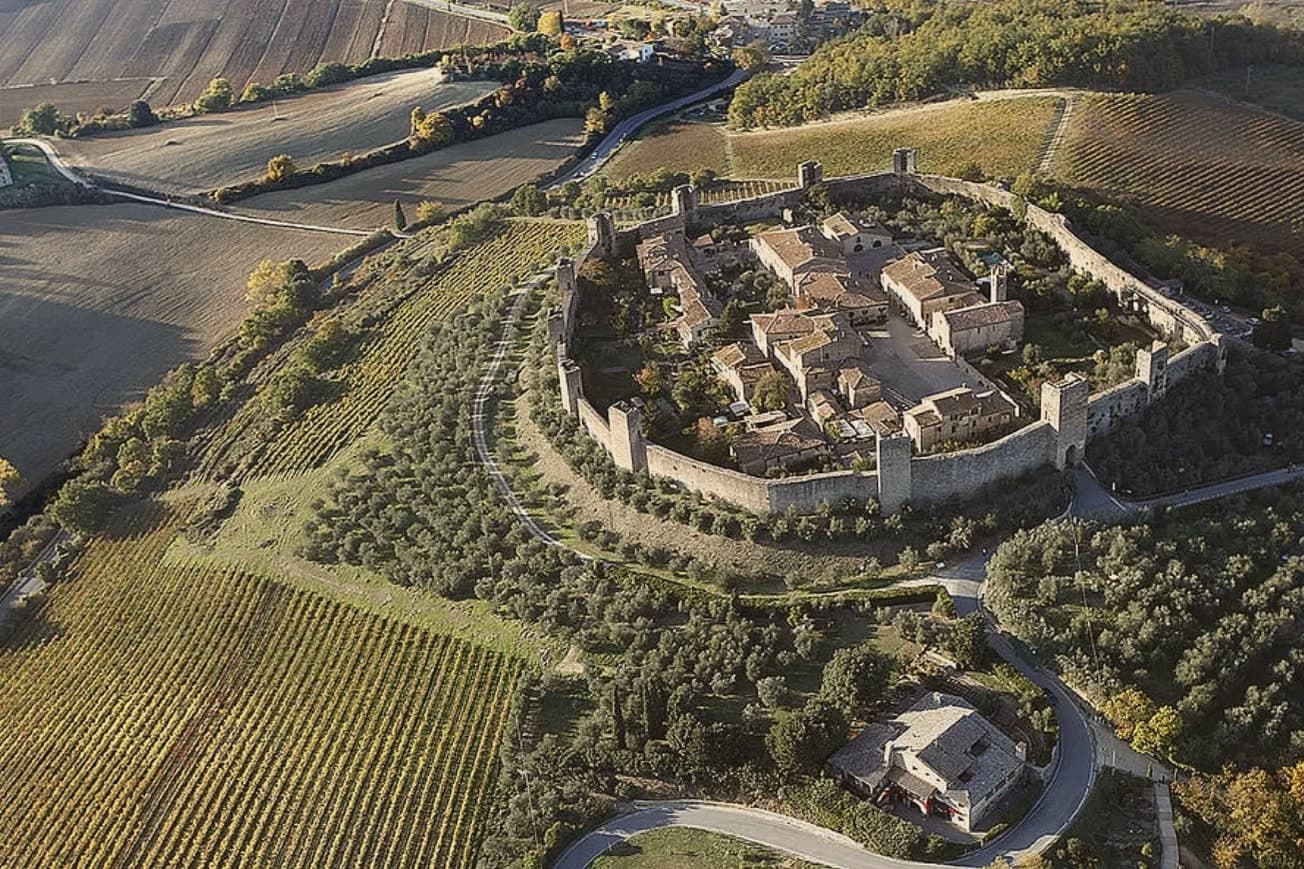
A circular Sienese fortress built between 1213 and 1219 on a natural hill, fourteen towers on a 570-meter wall, intact and unbroken.
By Peter Benei
Written about. No. 33.
The letter
Monteriggioni got its letter. One town at a time, free. The photo, the food, the festa.
Visiting
- Best time
- Apr–Oct
- By car
- 22 min from Siena
- By train
- Station in the comune
- Population
- 9,950
- J10°
- F13°
- M14°
- A18°
- M22°
- J28°
- J32°
- A32°
- S26°
- O21°
- N15°
- D11°
- Best
- Hot or crowded
- Quiet
- Mostly closed
Daytime air temperature, averages for 2020–2024. Weather data by Open-Meteo.com.
Why come
Monteriggioni sits on a natural hillock between Firenze and Siena, eleven kilometers from the Sienese gates. The walls were built between 1213 and 1219, when Siena ran them up as a frontline garrison facing Florentine expansion north. They are still there.
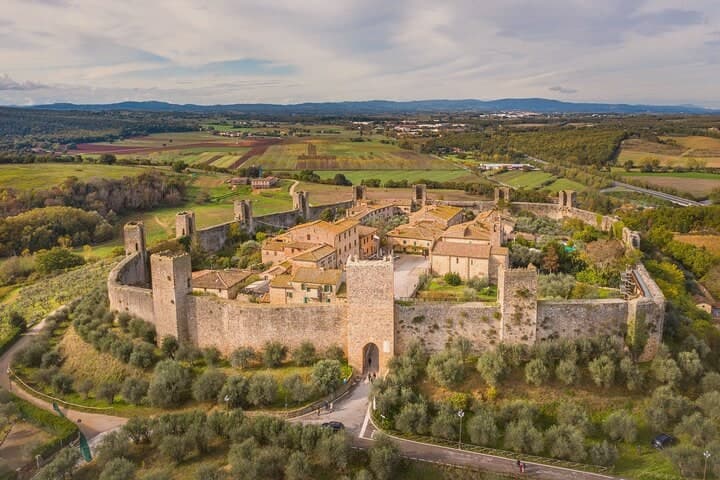
Fourteen square towers, 570 meters of curtain wall, ten meters tall, two gates: Porta Fiorentina to the north, Porta Romana to the south. Dante used the towers in Inferno XXXI as the image for the giants ringing the central pit of Hell. The fortress was never breached by storm.
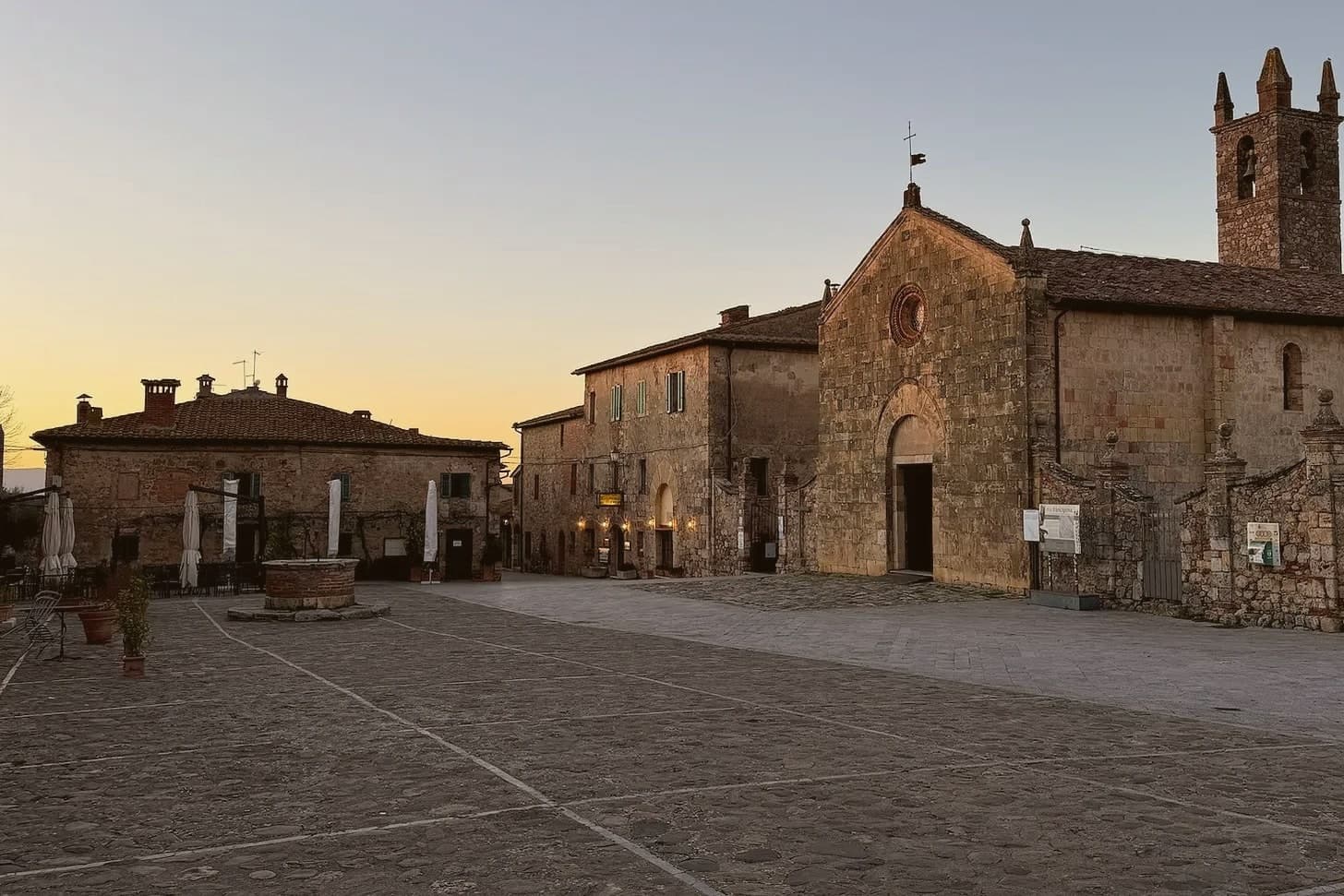
Inside, the village is a single irregular Piazza Roma, a Romanesque parish church of Santa Maria Assunta, a few streets that take fifteen minutes to walk end to end. The Via Francigena runs past the southern wall. The town hosts a medieval festival in early July, when the population inside the walls multiplies for a weekend. The rest of the year, the silence inside the gates is the point.
How to get there
From Bologna (BLQ), about 1 h 52 min by car.
Pisa (PSA) is about 1 h 52 min away.
By car from the center of Siena 22 min, Florence 59 min or Perugia 1 h 41 min.
There is a railway station in the comune, so you can arrive without a car.
Coming from Florence, Pisa or Bologna?
Coming by train into Firenze Santa Maria Novella? Monteriggioni is about 56 min away by road.
Every town within reach of Bologna airport.
First time driving in Italy? Read our complete manual.
What to see
Mura di Monteriggioni
Circular 570-meter wall built 1213-1219 by the Sienese, fourteen square towers on equidistant bases, ten meters high, intact.
Piazza Roma
Single main square inside the walls, ringed by stone houses, with the Romanesque parish church on the north side.
Chiesa di Santa Maria Assunta
Romanesque parish church on Piazza Roma, plain stone façade, single nave, the only significant religious building inside the walls.
Camminamento delle mura
Walkway along the parapet of the walls, accessible at two points, with views across the Val d'Elsa to the surrounding ridges.
Via Francigena
The medieval pilgrim route from Canterbury to Rome runs past the southern wall, with Monteriggioni a documented overnight stop since the twelfth century.
From the guides
Where to eat
Not our picks, but places the guides put their name to: a Michelin star, a Gambero Rosso fork, a Slow Food snail, a Michelin Key for the hotels. Worth a table, a counter, or a night when you pass through.
Futura OsteriaTrattoria
Futura Osteria carries a Michelin Bib Gourmand, plus three Gambero Rosso prawns.
Osteria Bottega dell'AbateTrattoria
Osteria Bottega dell'Abate carries one Gambero Rosso prawn.
Before you sit down: how to order at a restaurant, how to spot a tourist trap, what aperitivo is and how the Italian bar works.
Living here
Could you live here?
Monteriggioni meets both of our rules for a small town.
- 9,950 people, inside our sweet spot of 5,000 to 20,000: a real town, still one community.
- Siena, a city of 52,990, is 22 min by car. Closer than our 30 to 60 minutes: handy for everything, so check the town still keeps a life of its own.
- A station of its own. Trains are the overlooked way to get around Italy: no parking, straight into the center.
The rules come from our series Where to Move in Italy, written from the places we have lived: Part 1, The End of the Road · Part 2, The Small Town · Part 3, The City · Part 4, The Postcard · Part 5, The Other Half. The towns we would pick are in Part 6, The Best Towns.
- Population 9,950, up 2.6% since 2015
- Nearest city Siena, 22 min drive
- Train station in the comune
- Nearest national health service hospital Poggibonsi, 9 km as the crow flies · how healthcare works in Italy
- Homes in the center: €1,500 to €2,250 per m² to buy, €4.90 to €6.80 per m² a month to rent
Weighing a move here? See the moving year.
All the numbers Common questions, designations, lists and sources.
More about living here
- Commuter belt
- Pharmacy in town
- Nearest high school over ~30 minutes away
- Full fibre reaches 74% of homes
- Primary school in the comune
- Earthquake zone 3, low hazard
- Florence airport (FLR), 1 h 5 min drive, the nearest with scheduled flights
- Regional capital Florence, 59 min drive
If you are moving here
Who lives here
11% of residents are foreign citizens, most often from Albania, Romania and Ukraine, against 9% across Italy. 50 of them come from English-speaking countries or western and northern Europe, mostly Germany, France and the United States. There are 191 people over 65 for every 100 children under 15, against 216 across Italy. 17% of homes have no resident, holiday homes and empty ones counted together, against 27% across Italy. Siena province ranks 21st of 107 in Il Sole 24 Ore's quality of life ranking for 2025.
Health and schools
The nearest emergency room is in Poggibonsi, 9 km as the crow flies. The nearest major one is in Siena, 13 km away. The nearest children's emergency room is in Florence, 43 km away. The nearest IB school is International School of Siena, 9 km as the crow flies.
Information, not medical advice. Confirm with a professional.
Working from here
Poste Italiane has finished a coworking room in the comune, on its register of 30 September 2026. Check that it is open on Poste's booking site before you count on it.
Taxes
A home that is not your main one pays 1.06% a year in property tax, charged on the cadastral value rather than the price. A main home pays none unless it is in a luxury category. The town adds between 0.55% and 0.65% to your income tax, depending on your income, with nothing due on income under €15,000. 7% pensioner tax: this town is not in a qualifying area.
Information, not tax advice. Confirm with a professional.
What it costs
The average household in Tuscany spends about €2,410 a month, €540 of it on food, against about €2,170 across Italy. A family of three pays about €770 a year for water, on the Tuscany average. In Siena, the provincial capital, in September 2026, an espresso cost €1.28, a meal in a pizzeria €17.81 and a man's haircut €25.49.
Climate and risk
It is in climate zone D, on a scale from A, the warmest, to F, the coldest, and heating may run from November 1 to April 15, up to 12 hours a day, unless the mayor changes it. 2% of residents live in a zone the national maps rate high for floods, 5% in a high or medium one. 2% live in a zone rated high or very high for landslides.
These shares cover the whole comune, not any one street. Check an address on IdroGEO.
Moving from abroad? Which visa you need. Sources: ISTAT, the Ministry of Health, ISPRA, the Finance Ministry, the Ministry of Enterprise, Poste Italiane, the comuni, the IB, International Schools Database, Il Sole 24 Ore, Cittadinanzattiva.
Known for
THE WALLS
Fourteen square towers and 570 meters of curtain wall, intact since 1219, the most complete medieval enceinte in central Italy.
DANTE'S GIANTS
Inferno XXXI compares the giants ringing the central pit of Hell to the towers of Monteriggioni seen from below.
VIA FRANCIGENA
Medieval pilgrim route from Canterbury to Rome runs past the southern wall, a documented stop since the twelfth century.
Common questions
- What is Monteriggioni known for?
- Monteriggioni is a circular Sienese fortress built between 1213 and 1219 on a natural hill, fourteen towers on a 570-meter wall, intact and unbroken.
- Where is Monteriggioni?
- Monteriggioni is a comune in the province of Siena, in Tuscany, at 274 meters above sea level.
- What is the nearest airport to Monteriggioni?
- The nearest airport with scheduled flights is Florence (FLR), about 1 h 5 min by car.
- Can you get to Monteriggioni without a car?
- Yes. There is a railway station in the comune, so you can arrive by train.
- How long is the drive from Siena to Monteriggioni?
- About 22 min by car.
- When is the best time to visit Monteriggioni?
- Best in Apr–Oct. July is the warmest month, averaging 32 degrees, and May the wettest, with about 13 rain days.
- Which other towns are like Monteriggioni?
- Morrovalle, Spello and Montecosaro.
- How many people live in Monteriggioni?
- 9,950 residents, by ISTAT's count on 1 January 2025.
- Is Monteriggioni a good place to live?
- By the rules in our Where to Move in Italy series, Monteriggioni is a small town that meets both of our rules. The nearest city, Siena, is 22 min away by car. The nearest national health service hospital is in Poggibonsi, 9 km as the crow flies. Full fibre reaches 74% of homes.
Tags & data designations · numbers · sources
Recognized as
Landscape
The numbers
- Elevation: 274 m
- Population: 9,950
- Surface area: 99.72 km²
These figures were compiled from public directories: ISTAT, OpenStreetMap and Wikidata, and from the official listings of the guides named on this page. Town details change; verify with official sources before you travel.
The ranked lists
Lists Monteriggioni appears in
- The 6 best towns on a walking route that eat well in the province of SienaSiena provinceon a walking routeeats well6 towns · smallest 1,421 residents
- The best hill towns you can reach by train within 90 minutes of FlorenceNear Florencehill townby trainwithin 90 min6 towns · smallest 5,744 residents · closest 24 min away
- The best towns you can reach by train in the province of SienaSiena provinceby train7 towns · smallest 2,479 residents
- The best towns you can reach by train within an hour of FlorenceNear Florenceby trainwithin 60 min7 towns · smallest 4,402 residents · closest 24 min away
- The 8 best hidden hill towns on a walking route in TuscanyTuscanyhill townon a walking routehidden8 towns · smallest 1,044 residents
- The best olive oil towns within 90 minutes of FlorenceNear Florenceolive oilwithin 90 min8 towns · smallest 2,605 residents · closest 24 min away
Near here, with a letter
- Written about. No. 35.
Siena
Province: Siena
The medieval rival of Florence at 322 meters on three hills, with a shell-shaped piazza where seventeen contrade race bareback horses twice a year.
24 min by car
- Written about. No. 30.
Castellina in Chianti
Province: Siena
A Chianti hill town at 578 meters on the watershed between the Arno and the Ombrone, with an Etruscan tumulus, a Brunelleschi-reinforced wall and a covered medieval walkway around its edge.
33 min by car
- Written about. No. 29.
San Gimignano
Province: Siena
A walled hill town at 334 meters with 14 surviving medieval towers, UNESCO listed since 1990 and the home of Vernaccia.
33 min by car
The letter
Monteriggioni got its letter. One town at a time, free. The photo, the food, the festa.
Paid plans, the moving year and the books are on the membership page.