
Umbria · Terni
Orvieto
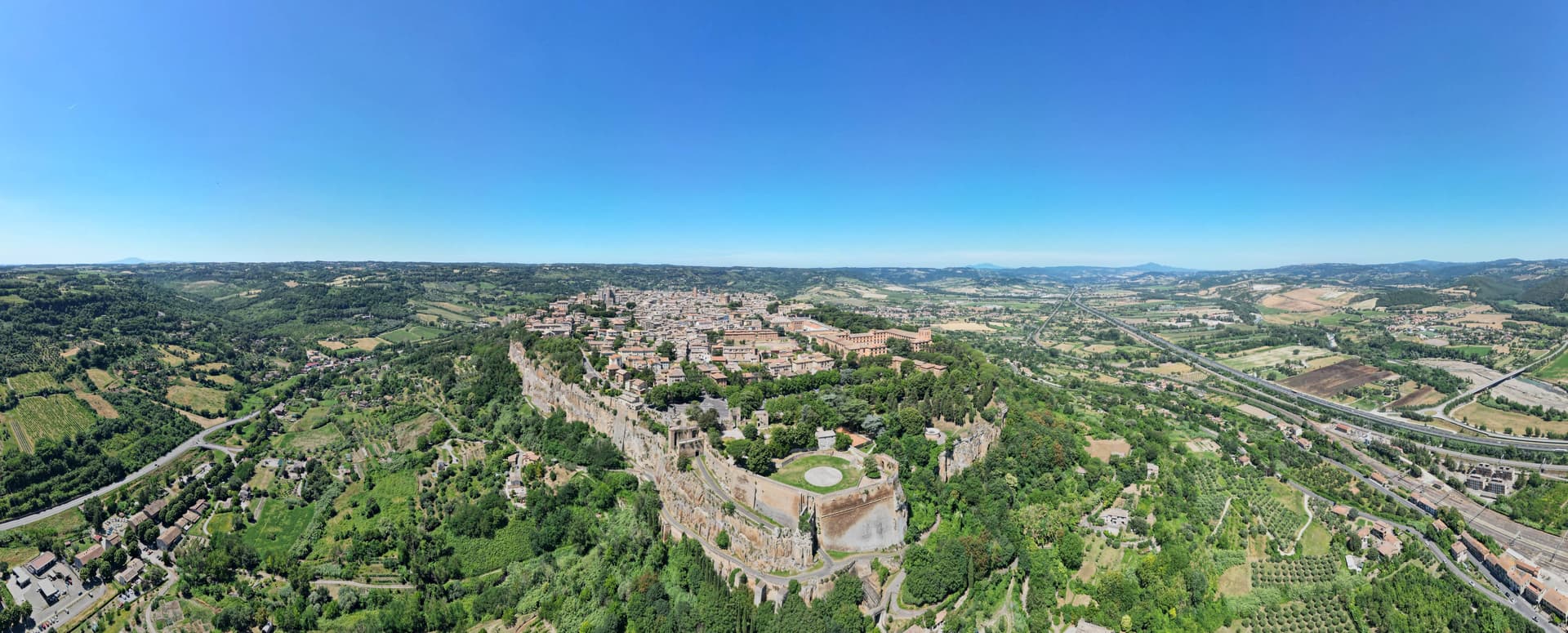
Etruscan Velzna on a 325-meter tufa butte, later a medieval refuge of popes.
- Best time
- Apr–Oct
- By car
- 1 h 14 min from Perugia
- By train
- Station in the comune
- Population
- 19,461
Known for
THE DUOMO
Gothic cathedral begun 1290, Maitani's polychrome façade and Signorelli's San Brizio Last Judgment of 1499-1504, the cycle Michelangelo studied.
POZZO DI SAN PATRIZIO
Double-helix well of 1527-1537 by Antonio da Sangallo the Younger, two spiral ramps so mules going up never met mules coming down.
ETRUSCAN VELZNA
Identified with the seat of the Fanum Voltumnae, federal sanctuary of the Etruscan League, destroyed by Rome in 264 BC.
When to visit
Best · Apr–Oct
- J10°
- F13°
- M14°
- A17°
- M22°
- J28°
- J32°
- A32°
- S26°
- O21°
- N15°
- D11°
- Best
- Hot or crowded
- Quiet
- Mostly closed
Daytime averages, 2020–2024. Weather data by Open-Meteo.com.
Why come
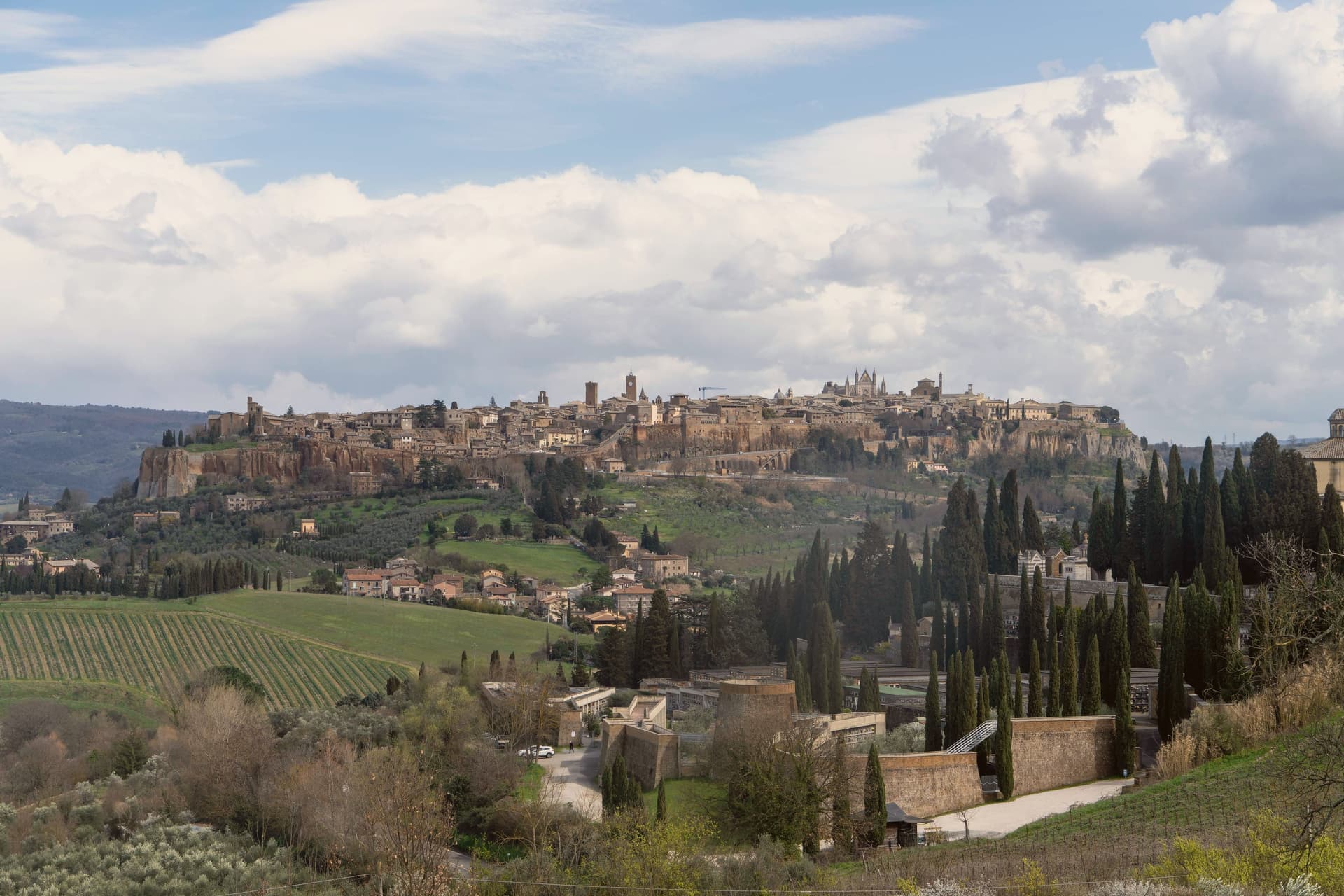
Orvieto sits on a flat-topped butte of volcanic tuff, the cliffs 195 meters above the surrounding plain. The town began as Velzna, a flourishing Etruscan metropolis, and the Romans destroyed it in 264 BC. The medieval town that replaced it on the same plateau became a papal refuge in the 13th century, when popes left Rome for the safety of the height.
The town's layers sit one below the other rather than side by side: the cliff face is honeycombed with Etruscan and medieval cavities, cisterns and pigeon roosts cut into the same tuff that the necropolis at its foot was carved into during the 6th century BC, while the cathedral and its chapel occupy the surface above, and the well descends back down through the rock to reach water. What looks from a distance like a single stone crown is in fact three towns stacked in the same column of tuff: the dead below, the popes and their cathedral on top, and a passage cut straight through the middle to keep the town supplied.
The Sunday letter
Orvieto is on our list. Its letter is still to come.
We are writing about all 1,000 of these towns, one at a time, in a free letter every Sunday: the photo, the food, the festa. That is our mission. Sign up and you will be there when Orvieto comes up. By Peter & Sophia, from Pietrasanta.
Read on
Orvieto in our articles
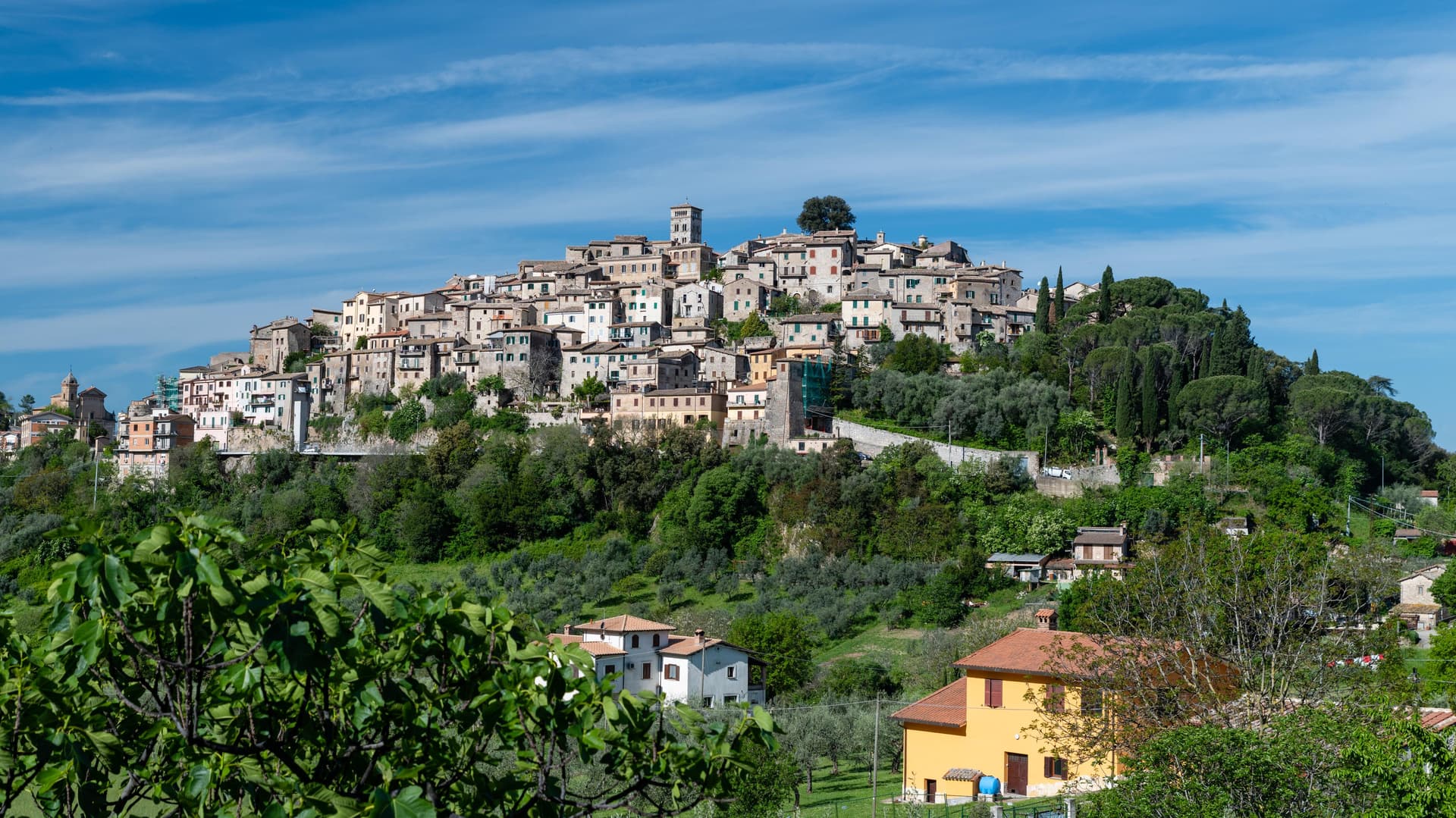
 The best towns you can reach by train in the province of Terni6 towns, Orvieto among them.
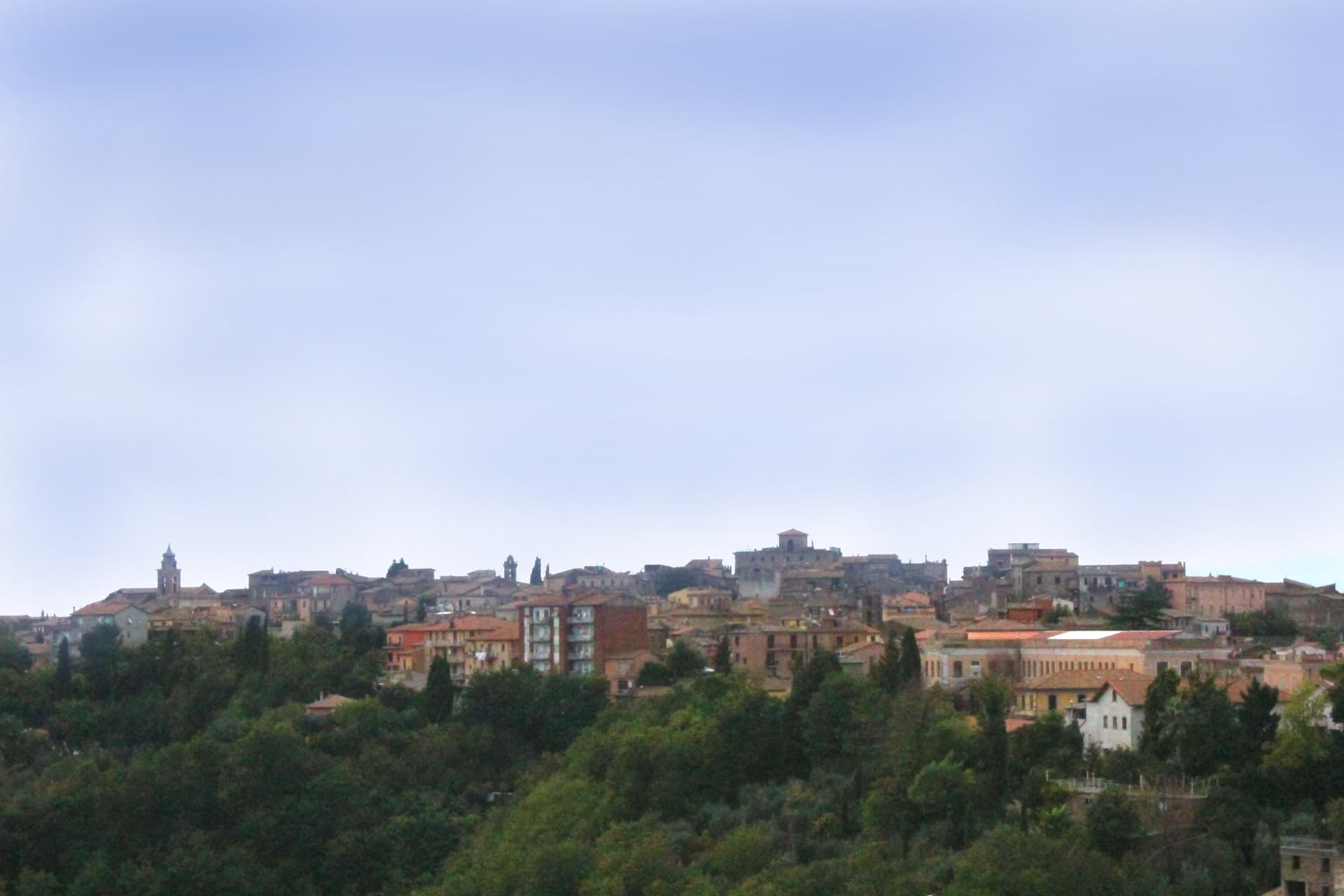
 The best hill towns with a food festival within 90 minutes of Terni7 towns, Orvieto among them.
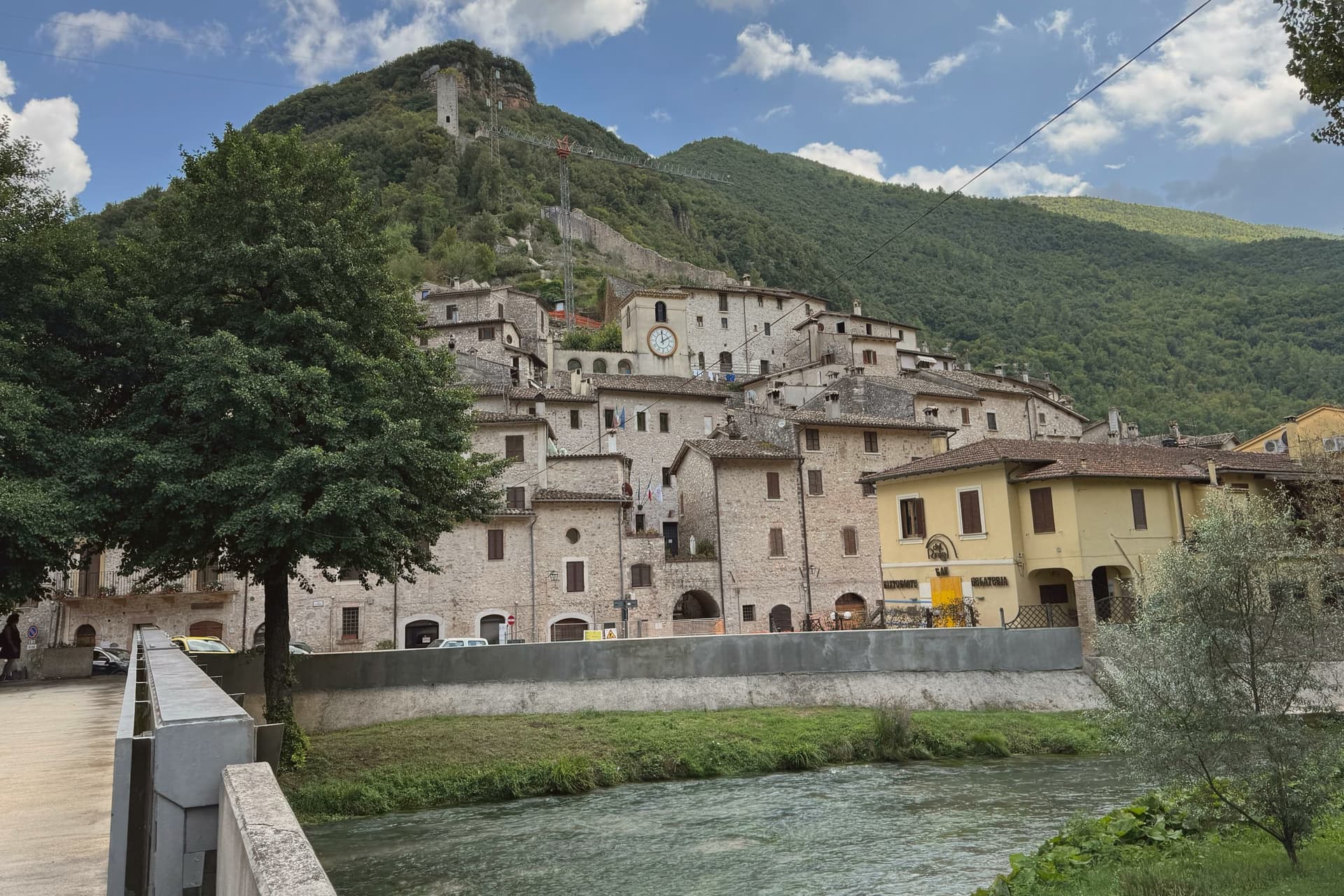
 The best hill towns with a serious restaurant within 90 minutes of Terni7 towns, Orvieto among them.
 The 8 best hill towns on a walking route within 90 minutes of Terni8 towns, Orvieto among them.
How to get there
From Rome (FCO), about 2 hours by car.
Ancona / Pescara (AOI) is about 2h 40m away.
By car from the centre of Perugia 1h 14m or Siena 1h 33m.
There is a railway station in the comune, so you can arrive without a car.
Coming by train into Perugia? Orvieto is about 1h 14m away by road.
What to see
Duomo di Orvieto
The polychrome marble façade rises in tiers of mosaic and sculpture, the decorative Gothic worked into bands of color rather than left plain stone.
Cappella di San Brizio
The Last Judgment fills the chapel wall to wall, figures twisting and falling across the vault and lunettes inside the cathedral.
Pozzo di San Patrizio
Sunk for Pope Clement VII, the shaft drops 53 meters, lit by windows cut into the walls of the two ramps so the descent is never dark. Antonio da Sangallo the Younger designed it to move water and mules at once, without either crossing the other's path.
Orvieto Underground
Tunnels, cisterns and pigeon roosts cut into the tuff cliff below the town, over 1,200 cavities mapped to date, layered from Etruscan into medieval use.
Necropoli del Crocifisso del Tufo
A grid of stone tombs at the foot of the cliff, laid out in regular streets, with inscriptions in Etruscan cut into the lintels above the doors.
Fortezza Albornoz
A papal fortress built at the edge of the cliff, now a public garden, with views open across the Paglia valley below.
The slow-trip planner
Building a trip? Find where Orvieto fits in a slow Italy circuit.
Answer five questions. We will shape a geographically coherent slow trip from the 1,000 Italian towns most travelers skip. Yours to save and share.
We recommend
Where to eat and stay
Not our picks, but places the guides put their name to: a Michelin star, a Gambero Rosso fork, a Slow Food snail, a Michelin Key for the hotels. Worth a table, a counter, or a night when you pass through.
CoroRistorante
Coro has two Gambero Rosso forks (83/100), a place in L'Espresso's Top 300 and a spot in the Michelin Guide.
Da GregorioTrattoria
Da Gregorio carries a Michelin Bib Gourmand, plus two Gambero Rosso prawns.
I Sette ConsoliRistorante
I Sette Consoli has two Gambero Rosso forks (81/100) and a spot in the Michelin Guide.
La PalombaRistorante
La Palomba carries a Slow Food snail, plus a spot in the Michelin Guide.
ArsoRistorante
Arso carries two Gambero Rosso forks (80/100).
Sale e PepeBistrot
Sale e Pepe holds one Gambero Rosso table.
Trattoria Da CarloTrattoria
Trattoria Da Carlo holds two Gambero Rosso prawns.
Altarocca Wine ResortHotel
Altarocca Wine Resort has a place in the Michelin hotel guide to its name.
Locanda PalazzoneHotel
Locanda Palazzone holds a place in the Michelin hotel guide.
Palazzo PetrvsHotel
One Michelin Key, at Palazzo Petrvs.
Through the year
What happens here
Feasts and festivals that come back year after year. We give the month rather than the date, because the date moves and the month rarely does. Check with the source before you plan a journey around one.
Sagra del Boscofood festival
usually held in September. Sagre Umbre
Living here
- Population 19,461
- A local hubi
- Pharmacy in town
- High school within a 30-minute drive
- Train station in the comune
- Nearest airport Rome, 2 h 2 min drive
- Regional capital Perugia, 1 h 14 min drive
Common questions
- What is Orvieto known for?
- Etruscan Velzna on a 325-meter tufa butte, later a medieval refuge of popes.
- Where is Orvieto?
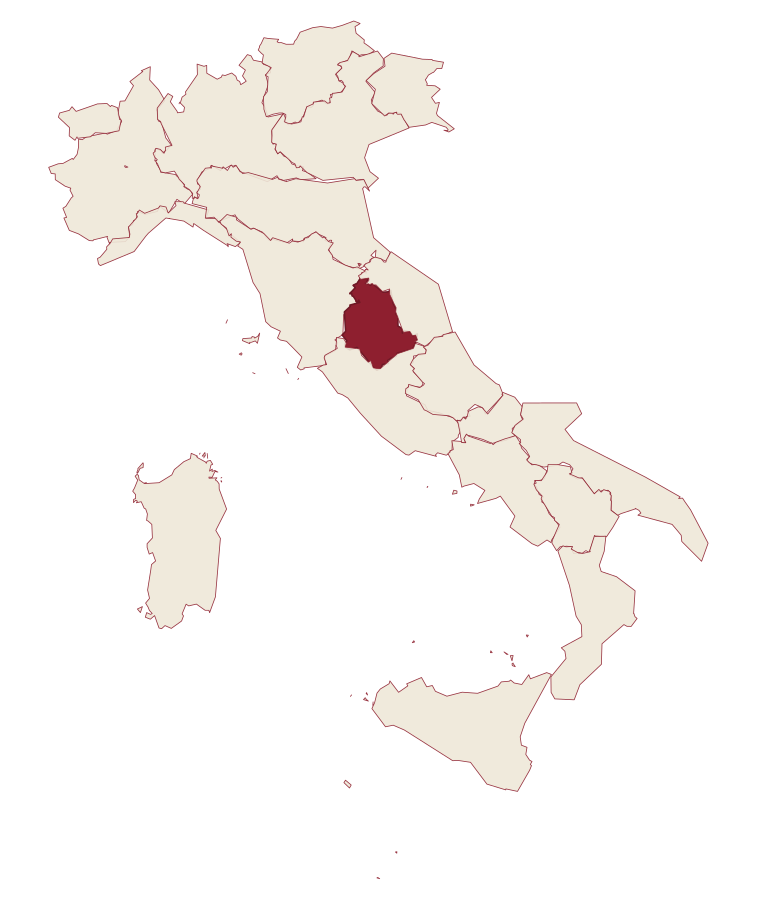
- Orvieto is a comune in the province of Terni, in Umbria, at 325 meters above sea level.
- What is the nearest airport to Orvieto?
- Rome (FCO), about 2 hours by car.
- Can you get to Orvieto without a car?
- Yes. There is a railway station in the comune, so you can arrive by train.
- How long is the drive from Perugia to Orvieto?
- About 1h 14m by car.
- When is the best time to visit Orvieto?
- Best in Apr–Oct. July is the warmest month, averaging 32 degrees, and May the wettest, with about 12 rain days.
- Is there a sagra or a festival in Orvieto?
- Yes. Sagra del Bosco. September is when the first of them falls.
- Which other towns are like Orvieto?
- Velletri, Rieti and Tivoli.
- How many people live in Orvieto?
- 19,461 at the 2023 count.
Tags & datadesignations · numbers · sources
The numbers
- Elevation: 325 m
- Population: 19,461
- Surface area: 281.27 km²
These figures were compiled from public directories: ISTAT, OpenStreetMap and Wikidata, and from the official listings of the guides named on this page. Town details change; verify with official sources before you travel.
Similar
Towns like Orvieto
Velletri
Province: Roma
both inland, away from the coast · both over 10,000 people
Rieti
Province: Rieti
both inland, away from the coast · both over 10,000 people
Tivoli
Province: Roma
both inland, away from the coast · both over 10,000 people
Spoleto
Province: Perugia
both inland, away from the coast · both over 10,000 people
Foligno
Province: Perugia
both inland, away from the coast · both over 10,000 people
Feltre
Province: Belluno
both inland, away from the coast · both over 10,000 people
🐌 Cittaslow
More Cittaslow towns in Umbria
Amelia
Province: Terni
A pre-Roman hilltown ringed by polygonal walls, with ten barrel-vaulted Roman cisterns beneath its main square.
Città della Pieve
Province: Perugia
A red-brick hill town at 508 meters above the Valdichiana, the birthplace of Perugino and the home of Italy's narrowest alley.
Monte Castello di Vibio
Province: Perugia
A fifteenth-century walled village at 422 meters above the Tiber, home to the world's smallest all'italiana theatre with 99 seats.
Montefalco
Province: Perugia
The hilltop wine capital of Umbria at 472 meters, where Sagrantino is grown almost nowhere else.
Norcia
Province: Perugia
Birthplace of San Benedetto at 604 meters on a Sibillini plateau, leveled by the 2016 earthquake and rebuilt stone by stone.