
Umbria · Perugia
Montefalco
The hilltop wine capital of Umbria, where Sagrantino is grown almost nowhere else.
- Best time
- Apr–Oct
- By car
- 51 min from Perugia
- Population
- 5,357
Known for
SAGRANTINO
Thick-skinned native red grape, cultivated almost exclusively here, DOCG since 5 November 1992 in both dry Secco and sweet Passito styles.
GOZZOLI
Fresco cycle on the Life of Saint Francis, painted 1450-1452 in the apse of San Francesco, now the civic museum.
RAILING OF UMBRIA
Single belvedere takes in seven Umbrian hill towns, the reason the medieval chronicles called Montefalco la ringhiera dell'Umbria.
When to visit
Best · Apr–Oct
- J9°
- F12°
- M14°
- A17°
- M22°
- J28°
- J32°
- A31°
- S25°
- O20°
- N15°
- D11°
- Best
- Hot or crowded
- Quiet
- Mostly closed
Daytime averages, 2020–2024. Weather data by Open-Meteo.com.
Why come
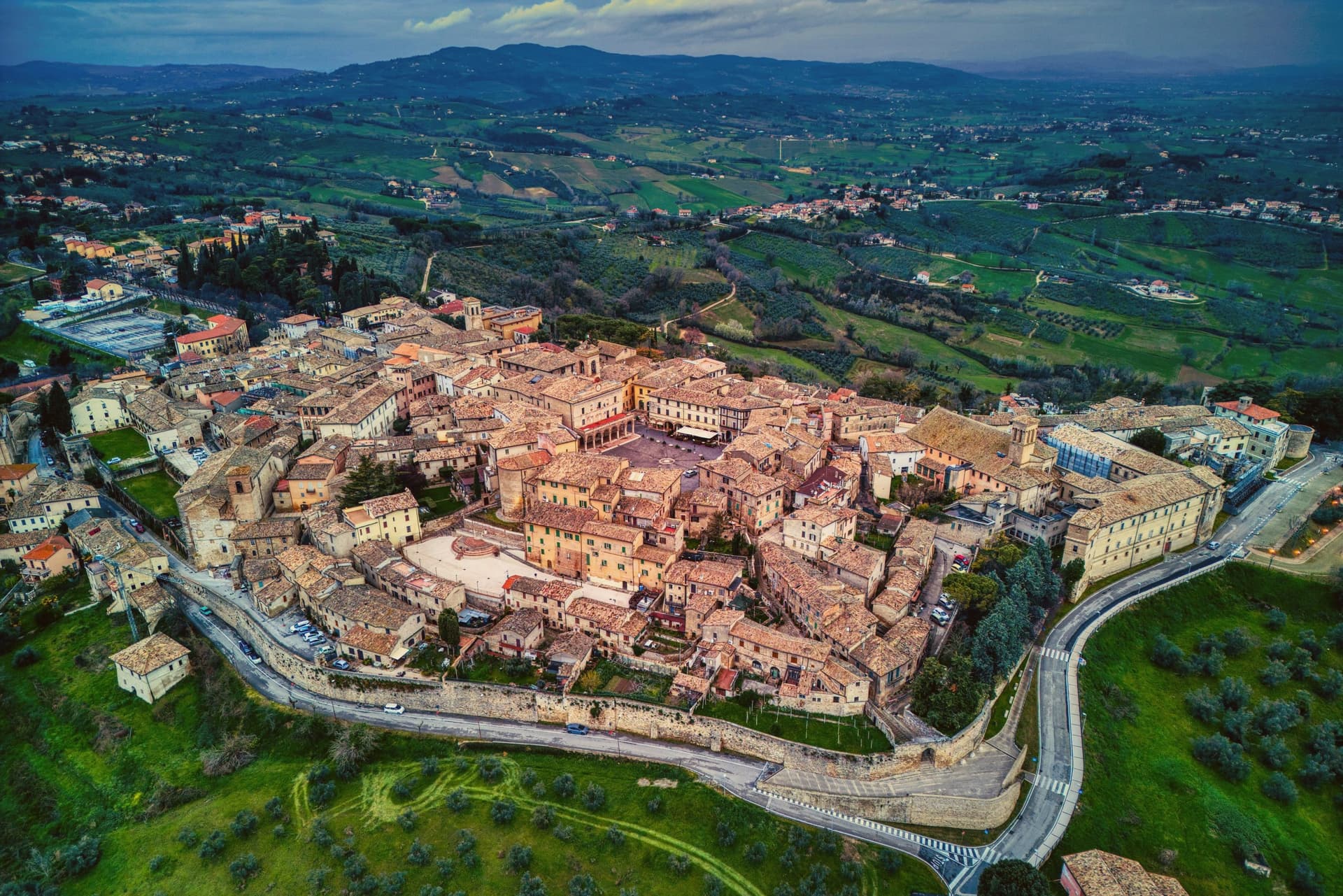
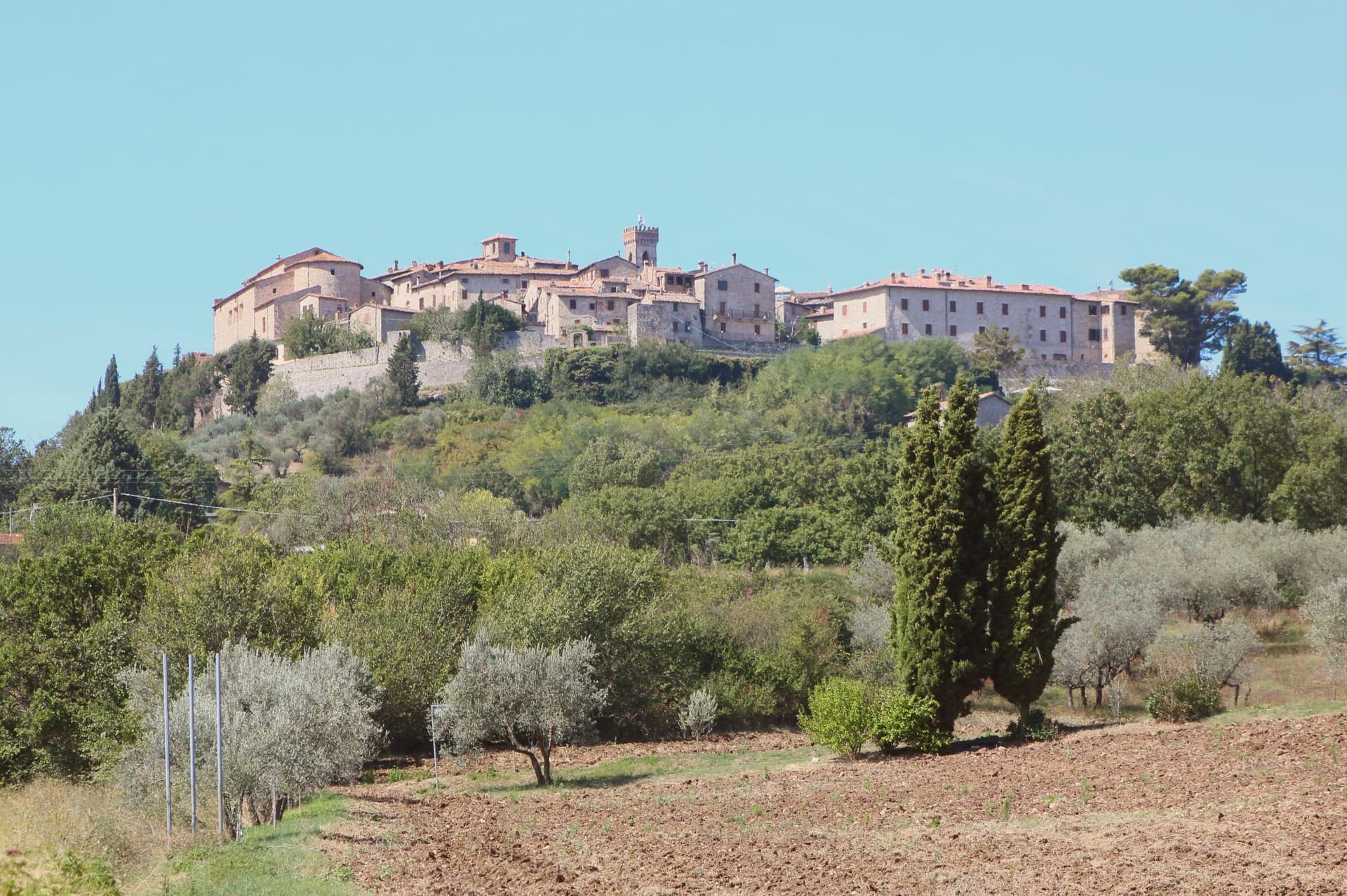
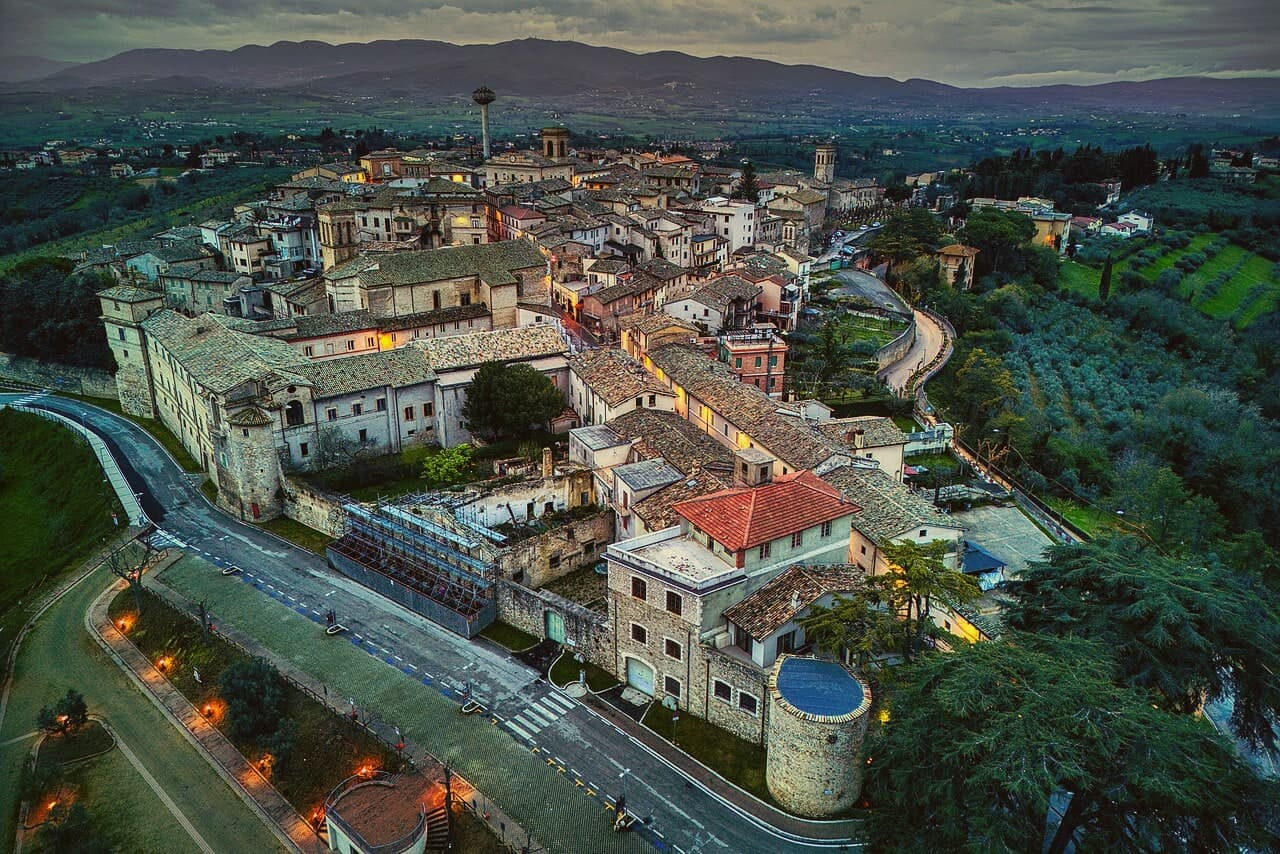
Montefalco sits on a hill above the Umbrian valley, its walls laid out in two concentric medieval circuits with five gates, the inner ring still complete and the outer ring added in the 14th century by the Trinci. At the top, the circular Piazza del Comune gathers four converging streets around the Palazzo Comunale, the high point from which the rest of the town falls away toward the walls and the vineyards beyond them. The name Sagrantino belongs to the slopes right around those walls, where the grape has been traced back to the 1st century AD, and three of the largest producers, Caprai, Antonelli and Adanti, keep cellars within four kilometers of the centro storico.
The harvest runs late September into October. The fresco cycle Gozzoli painted in the apse of the former church of San Francesco is counted among his most complete surviving works, and the town's own name for itself, the railing of Umbria, describes the same eastern walls where the belvedere gathers seven hill towns into one view. Wine on the slopes, frescoes in the old church, a view of the valley from the walls: a hill town whose economy, art and setting all sit within walking distance of each other.
The Sunday letter
Montefalco is on our list. Its letter is still to come.
We are writing about all 1,000 of these towns, one at a time, in a free letter every Sunday: the photo, the food, the festa. That is our mission. Sign up and you will be there when Montefalco comes up. By Peter & Sophia, from Pietrasanta.
Read on
Montefalco in our articles
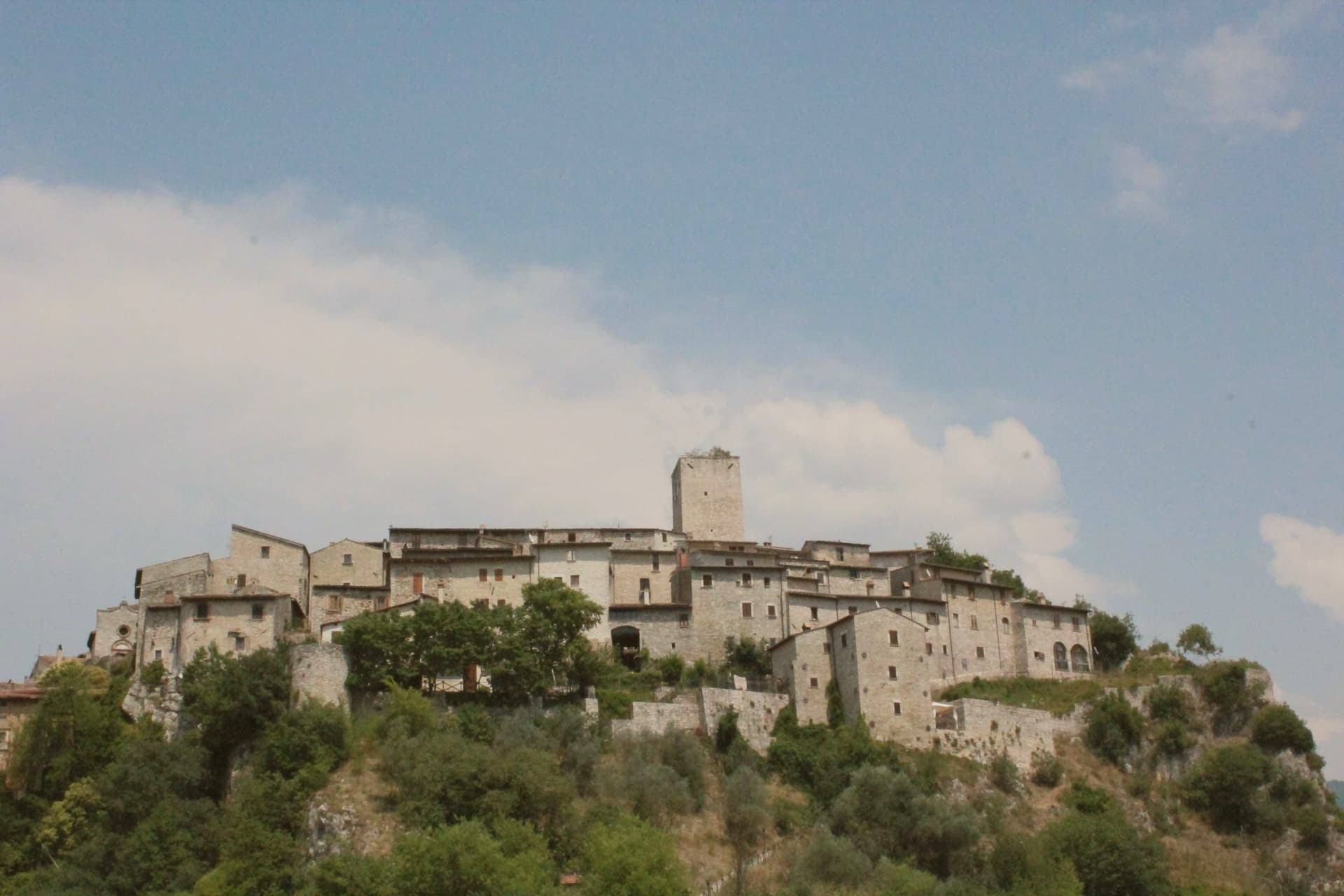
 The best hill towns that live slowly within 90 minutes of Perugia6 towns, Montefalco among them.
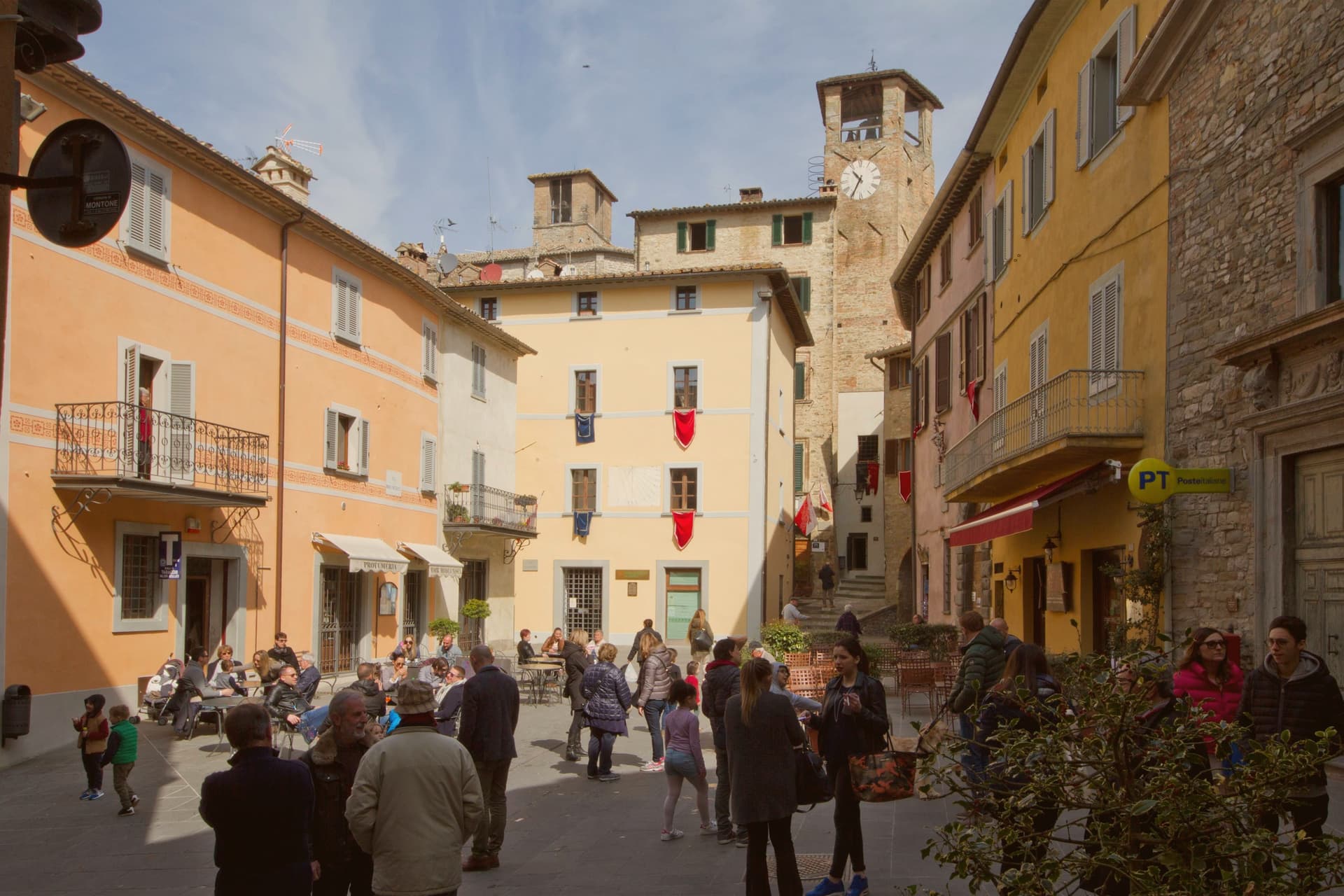
 The best hidden olive oil towns that eat well in Umbria7 towns, Montefalco among them.
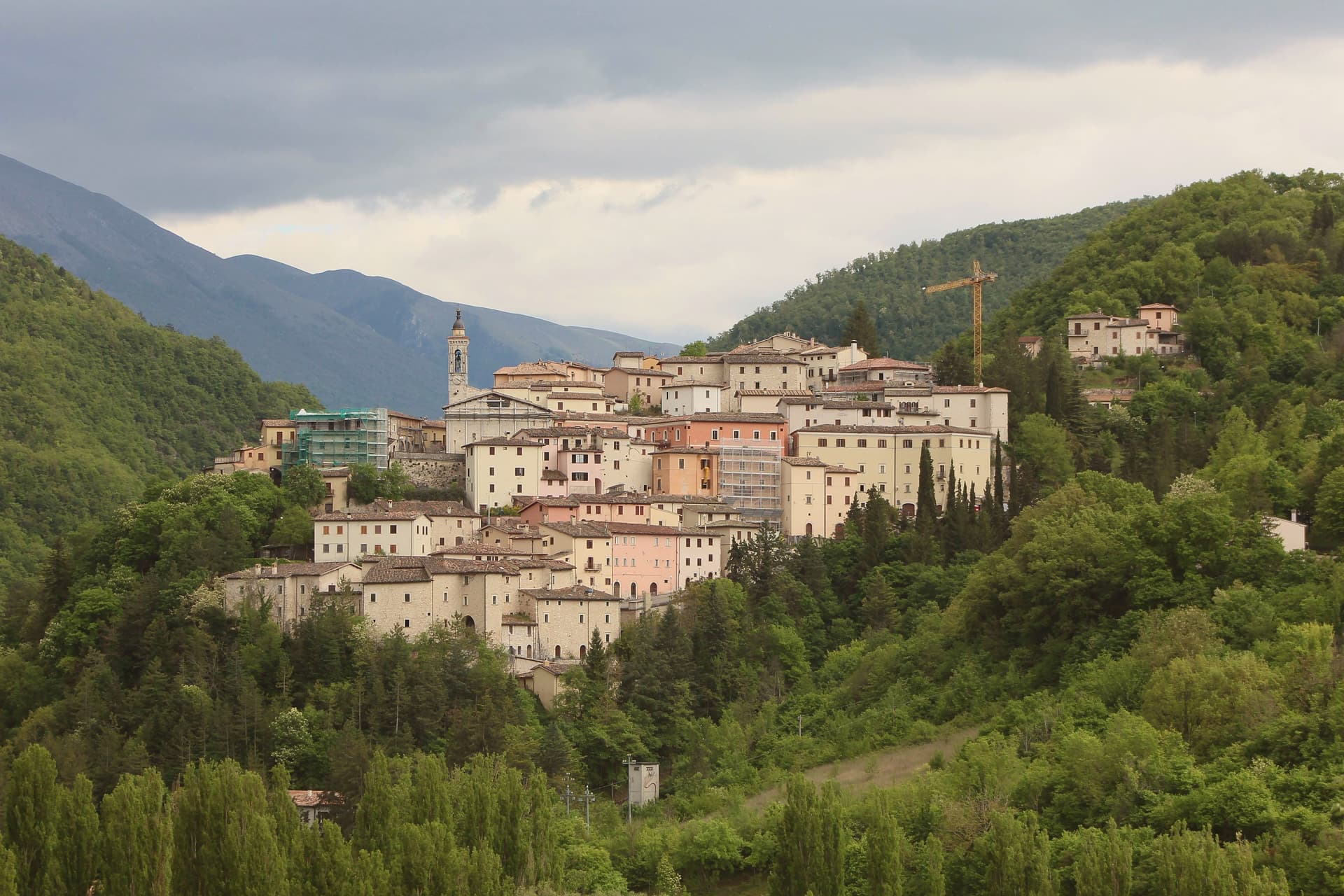
 The best hidden towns with a serious restaurant in the province of Perugia7 towns, Montefalco among them.
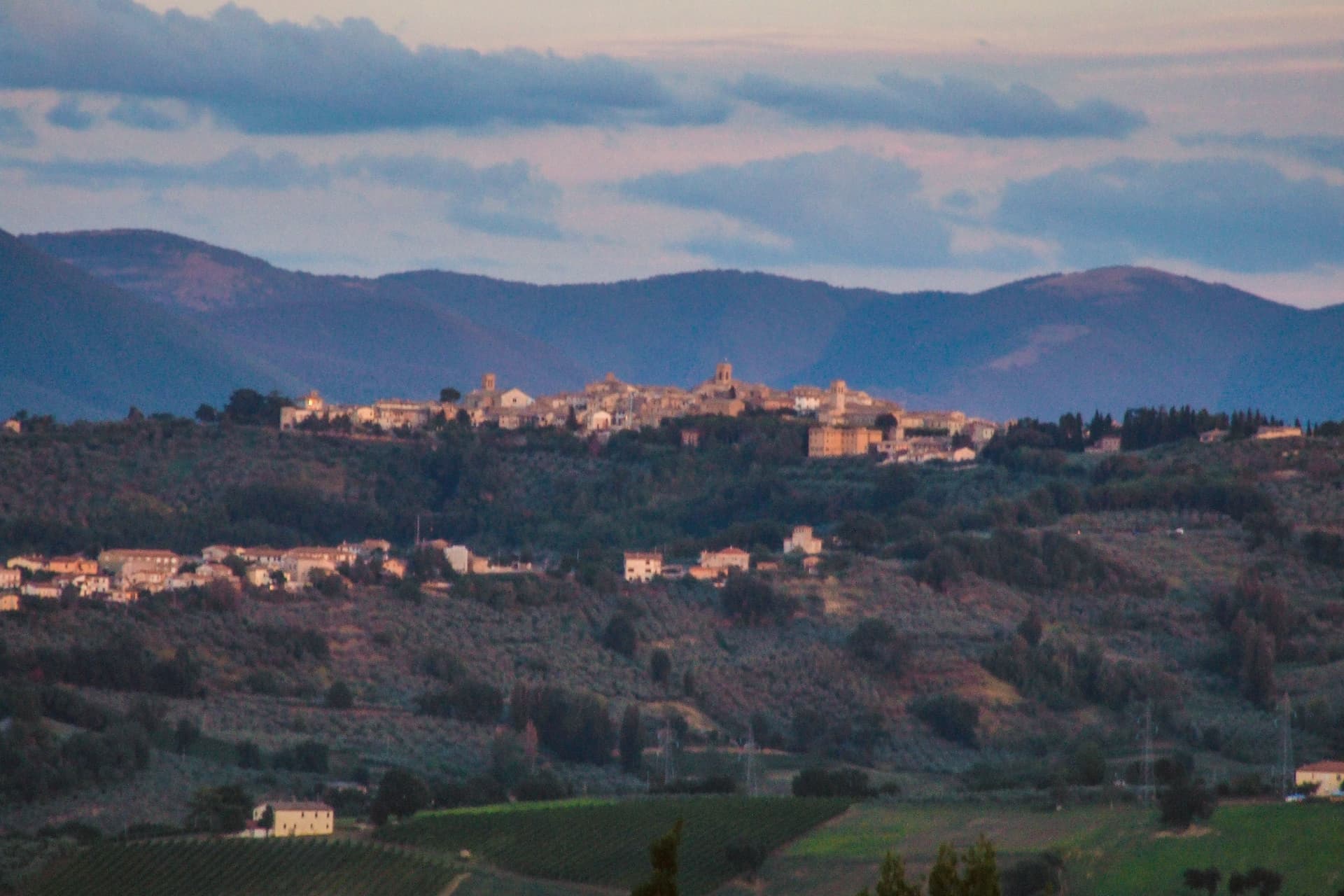
 The best towns that live slowly in the province of Perugia7 towns, Montefalco among them.
How to get there
From Ancona / Pescara (AOI), about 2 hours by car.
Rome (FCO) is about 2h 41m away.
By car from the centre of Perugia 51 minutes or Ancona 2 hours.
Coming by train into Perugia? Montefalco is about 50 minutes away by road.
What to see
Museo Civico di San Francesco
Former Franciscan church holding Benozzo Gozzoli's fresco cycle, plus works of the Umbrian school, in a building that has stood as the town's museum since deconsecration.
Piazza del Comune
Circular medieval square at the top of the hill, ringed by the Palazzo Comunale, the Oratorio di Santa Maria di Piazza and four converging streets.
Belvedere of Umbria
Panoramic walk on the eastern walls that takes in Perugia, Assisi, Spello, Foligno, Trevi, Spoleto and Todi from a single viewpoint.
Chiesa di Sant'Agostino
Fourteenth-century Augustinian church on Corso Mameli, with Gothic façade, holding frescoes of the local school and the body of Beato Pellegrino.
Walls of Montefalco
Two concentric medieval circuits of walls and five gates, the inner ring still complete, the outer ring built in the 14th century by the Trinci.
The slow-trip planner
Building a trip? Find where Montefalco fits in a slow Italy circuit.
Answer five questions. We will shape a geographically coherent slow trip from the 1,000 Italian towns most travelers skip. Yours to save and share.
We recommend
Where to eat
Not our picks, but places the guides put their name to: a Michelin star, a Gambero Rosso fork, a Slow Food snail, a Michelin Key for the hotels. Worth a table, a counter, or a night when you pass through.
Alla Via di Mezzo da GiorgioneTrattoria
Alla Via di Mezzo da Giorgione has two Gambero Rosso prawns to its name.
Camiano PiccoloRistorante
Camiano Piccolo carries a Michelin Bib Gourmand.
L' AlchimistaRistorante
L' Alchimista holds one Gambero Rosso fork (78/100).
Locanda del TeatroRistorante
Locanda del Teatro holds one Gambero Rosso fork (77/100).
Osteria Il SagrantinoTrattoria
Osteria Il Sagrantino has one Gambero Rosso prawn to its name.
Through the year
What happens here
Feasts and festivals that come back year after year. We give the month rather than the date, because the date moves and the month rarely does. Check with the source before you plan a journey around one.
Enologica Montefalcofood festival
usually held in September. sagritaly.com
Living here
- Population 5,357
- Commuter belti
- Pharmacy in town
- High school within a 30-minute drive
- Nearest airport Ancona / Pescara, 1 h 54 min drive
- Regional capital Perugia, 51 min drive
Common questions
- What is Montefalco known for?
- Montefalco is the hilltop wine capital of Umbria at 472 meters, where Sagrantino is grown almost nowhere else.
- Where is Montefalco?
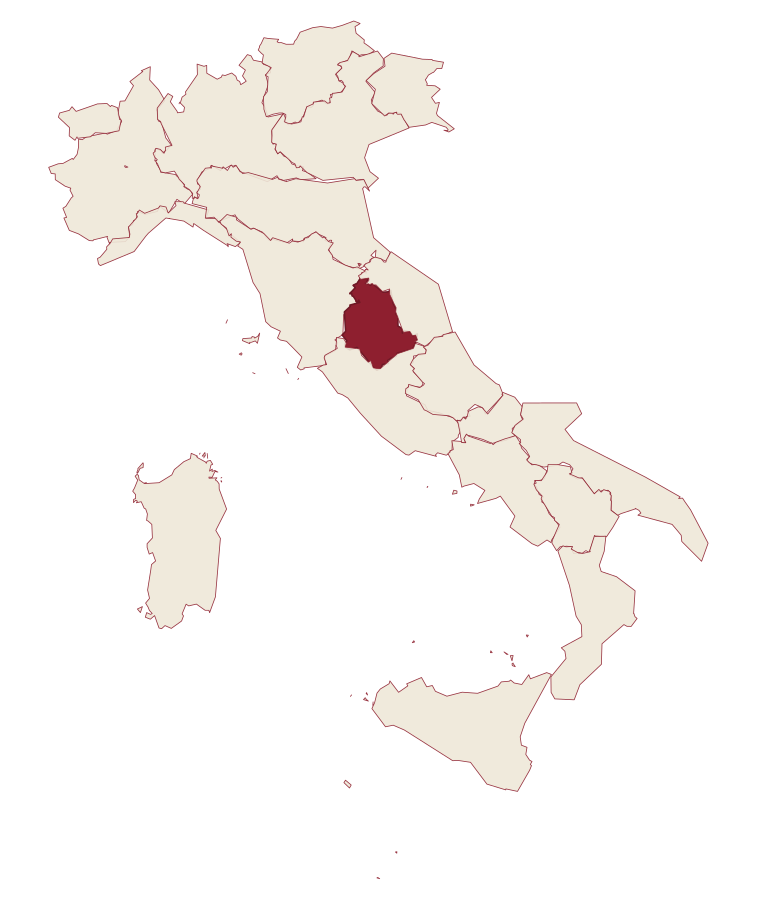
- Montefalco is a comune in the province of Perugia, in Umbria.
- What is the nearest airport to Montefalco?
- Ancona / Pescara (AOI), about 2 hours by car.
- How long is the drive from Perugia to Montefalco?
- About 51 minutes by car.
- When is the best time to visit Montefalco?
- Best in Apr–Oct. July is the warmest month, averaging 32 degrees, and December the wettest, with about 12 rain days.
- Is there a sagra or a festival in Montefalco?
- Yes. Enologica Montefalco. September is when the first of them falls.
- Which other towns are like Montefalco?
- Nocera Umbra, Bettona and Trevi.
- How many people live in Montefalco?
- 5,357 at the 2023 count.
Tags & datadesignations · numbers · sources
Recognised as
The numbers
- Elevation: 472 m
- Population: 5,357
- Surface area: 69.51 km²
These figures were compiled from public directories: ISTAT, OpenStreetMap and Wikidata, and from the official listings of the guides named on this page. Town details change; verify with official sources before you travel.
Similar
Towns like Montefalco
Nocera Umbra
Province: Perugia
both inland, away from the coast · both between 3,000 and 10,000 people
Bettona
Province: Perugia
both inland, away from the coast · both between 3,000 and 10,000 people
Trevi
Province: Perugia
both inland, away from the coast · both between 3,000 and 10,000 people
Bevagna
Province: Perugia
both inland, away from the coast · both between 3,000 and 10,000 people
Ripatransone
Province: Ascoli Piceno
both inland, away from the coast · both between 3,000 and 10,000 people
Offida
Province: Ascoli Piceno
both inland, away from the coast · both between 3,000 and 10,000 people
🎨 Borghi più belli d'Italia
More Borghi più belli d'Italia towns in Umbria
Acquasparta
Province: Terni
A hill town at 350 meters above the Naia valley, where a Renaissance duchy briefly became the seat of Europe's first scientific academy.
Allerona
Province: Terni
A stone borgo at 472 meters between the Paglia valley and the Valdichiana, an Orvieto outpost whose Monaldeschi castle fell to Charles V.
Arrone
Province: Terni
Medieval castle village on the left bank of the Nera at 243 meters, upstream from the largest man-made waterfall in the world.
Bettona
Province: Perugia
A hill town at 353 meters between the Topino and Chiascio rivers, the only Etruscan settlement ever built east of the Tiber.
Bevagna
Province: Perugia
Roman Mevania on the Umbrian plain at 225 meters, four medieval quarters that compete every June in a reconstructed market of the 13th century.