
Tuscany · Lucca
Viareggio
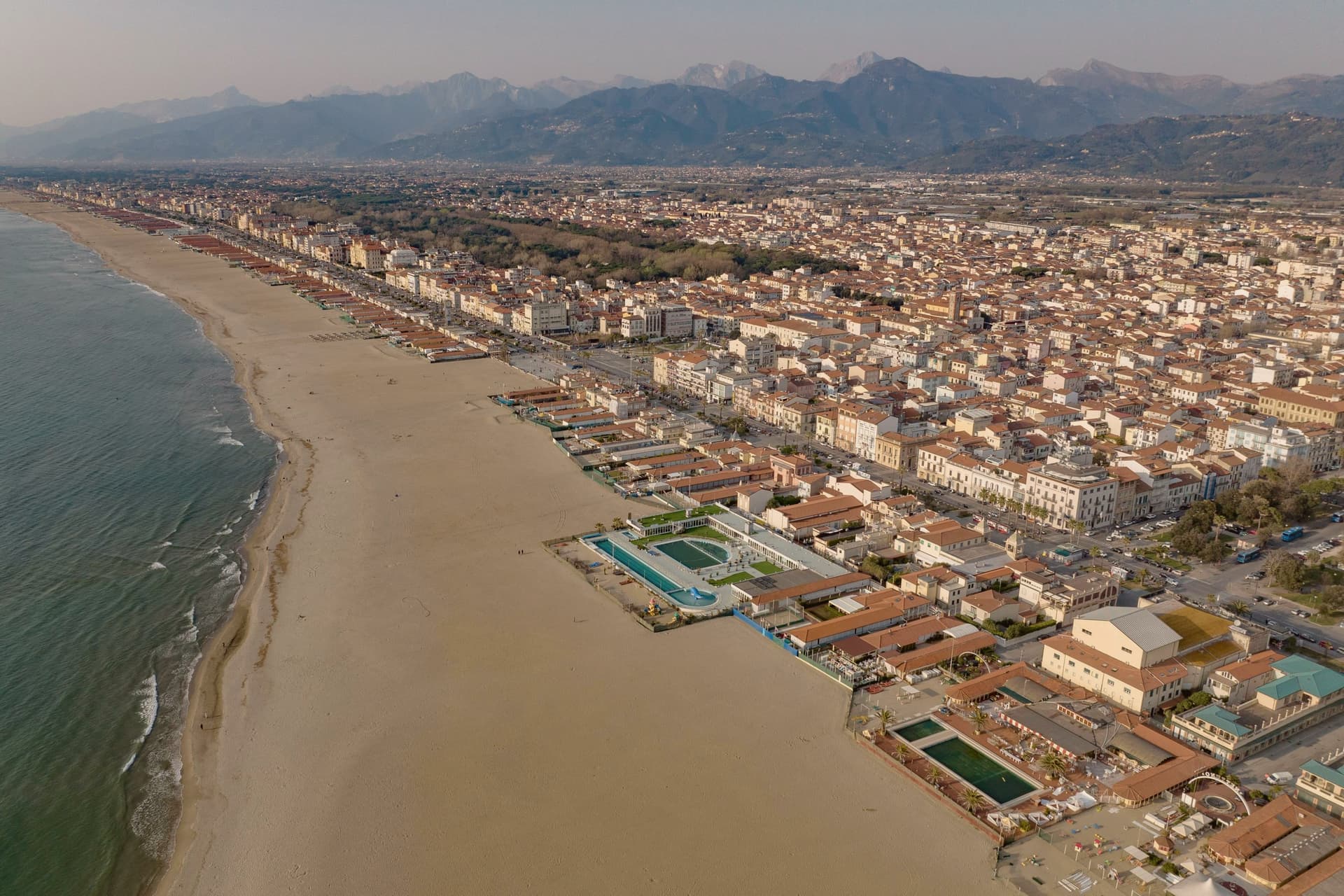
The Versilia capital, a Carnival city on the Tuscan coast that turned into a Belle Époque resort when the railway arrived.
- Best time
- May–Sep
- By car
- 29 min from Pisa
- By train
- Station in the comune
- Population
- 60,579
Known for
THE CARNIVAL
Running since 1873, with papier-mâché floats up to 254 kg and 14 meters, drawing half a million spectators each February.
LIBERTY ARCHITECTURE
Three-kilometer Stile Liberty seafront promenade built between 1890 and 1925, including Caffè Margherita and Villa Argentina.
BURLAMACCO
Carnival mascot designed by Uberto Bonetti in 1931, named after the Burlamacca canal and coloured like the beach umbrellas.
When to visit
Best · May–Sep
- J12°
- F13°
- M14°
- A17°
- M21°
- J25°
- J28°
- A29°
- S25°
- O21°
- N16°
- D13°
- Best
- Hot or crowded
- Quiet
- Mostly closed
Daytime averages, 2020–2024. The sea is warmest in August at 29° and coldest in February at 12°. Weather data by Open-Meteo.com.
The festa: Assunzione di Maria, 25 March
Why come
Viareggio sits at sea level on the Versilia coastal plain, the largest commune on the Tuscan riviera. The first parade ran in 1873, organized by middle-class residents as a float procession down the seafront; the masked protest against tax policy that followed gave the event its character. The mascot's colour scheme, red and white, was taken from the beach umbrellas that line the shore, a detail that ties the Carnival's invented figure back to the town's own beach culture rather than to any outside tradition.
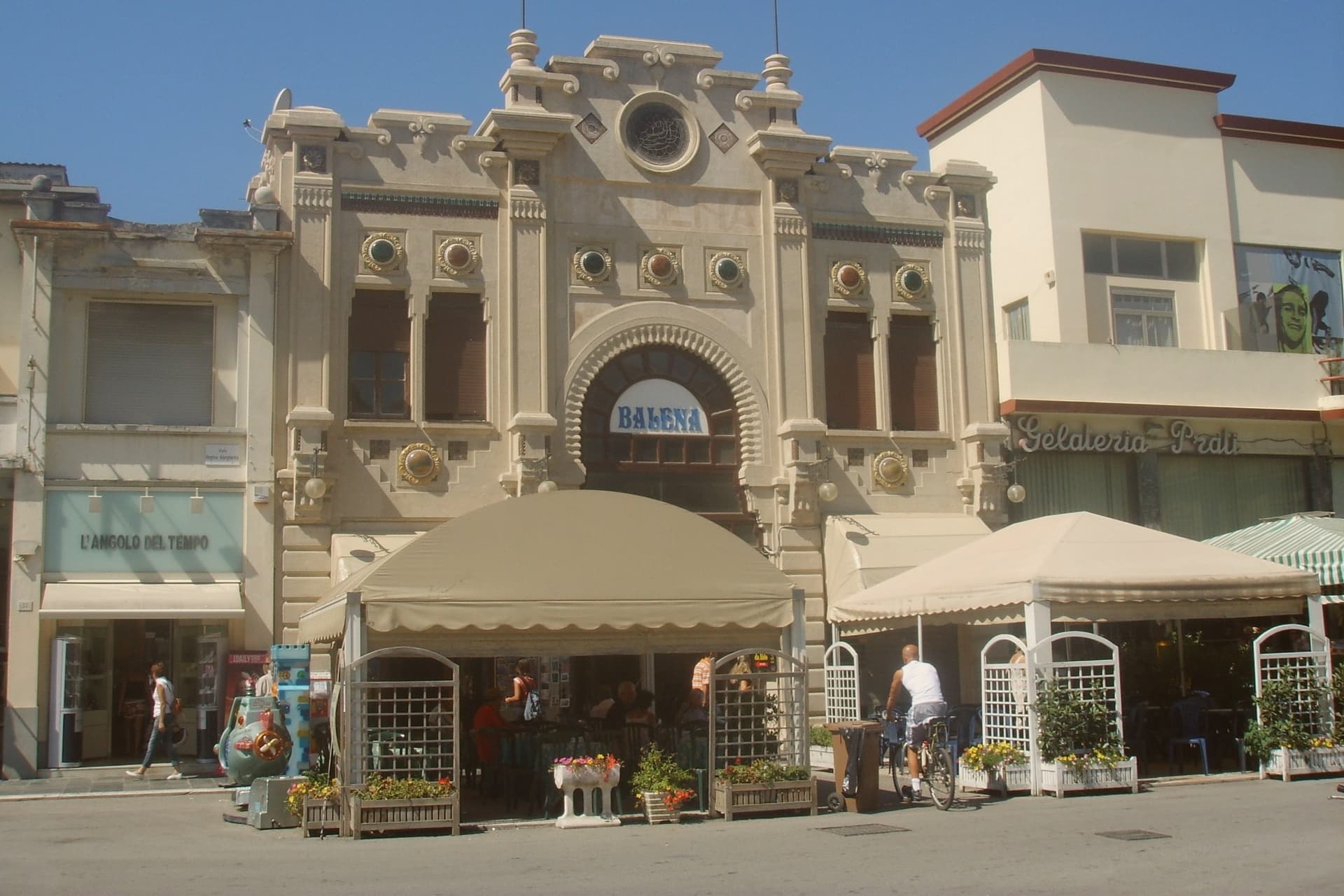
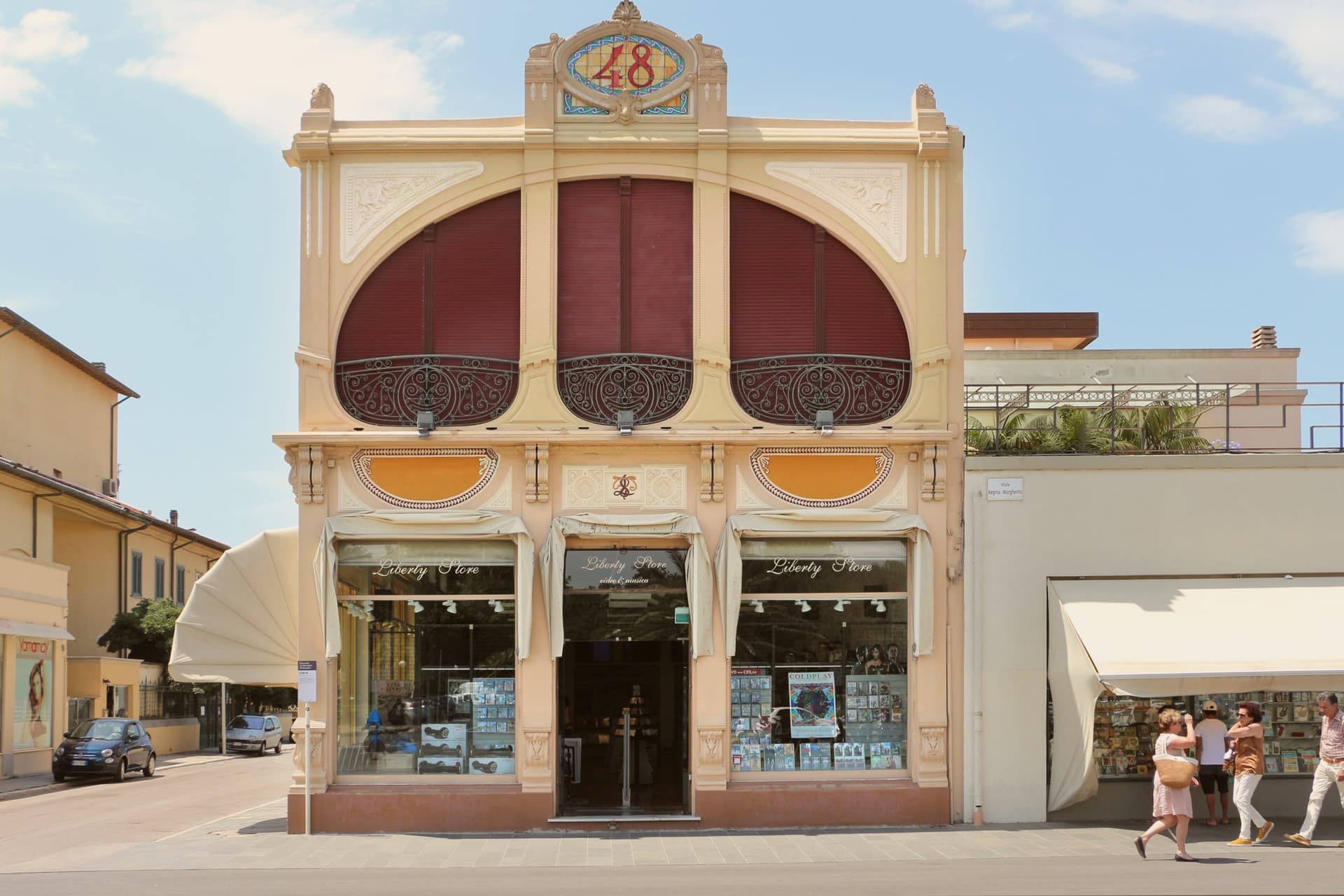
The rail link to Lucca and Florence arrived in 1890, and the city turned into a Belle Époque resort in response: the seafront was rebuilt in the ornamented style of that era over the following decades. The Magazzini Duilio 48 along Viale Margherita, together with the promenade's other survivors, mark out where that resort-era rebuilding is still legible today. The city's two identities sit side by side on the same stretch of shore: one built by a rail-borne resort economy, the other by a homegrown winter festival that turned into the town's defining export.
Read on
Viareggio in our articles
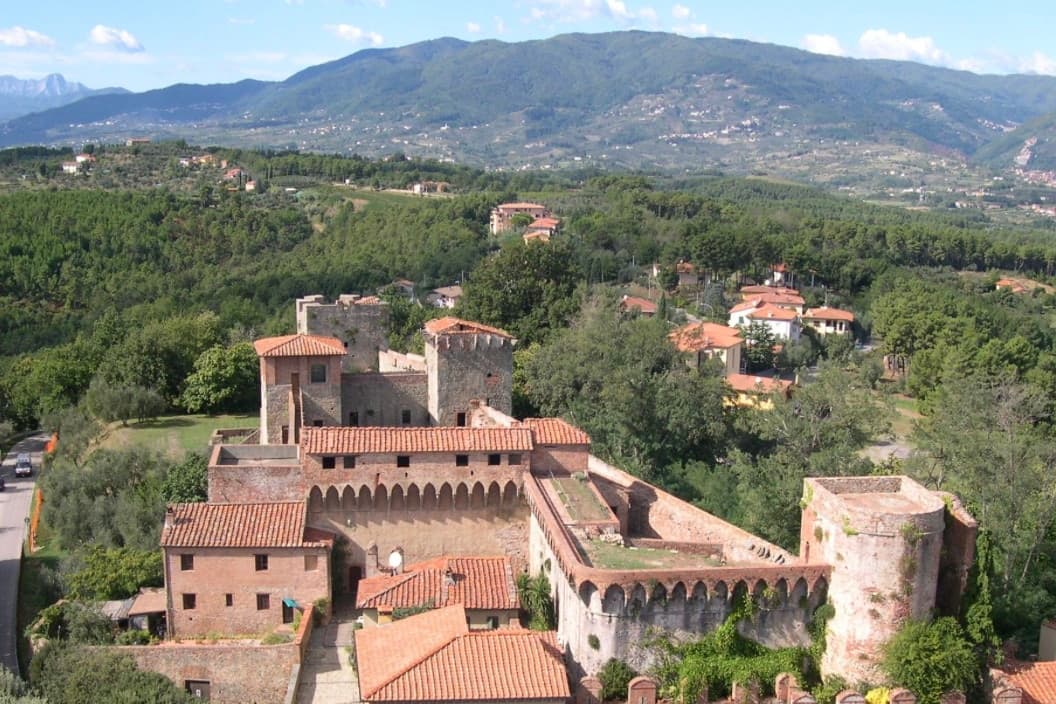
 The 6 best coastal towns inside a nature park in Toscana6 towns, Viareggio among them.
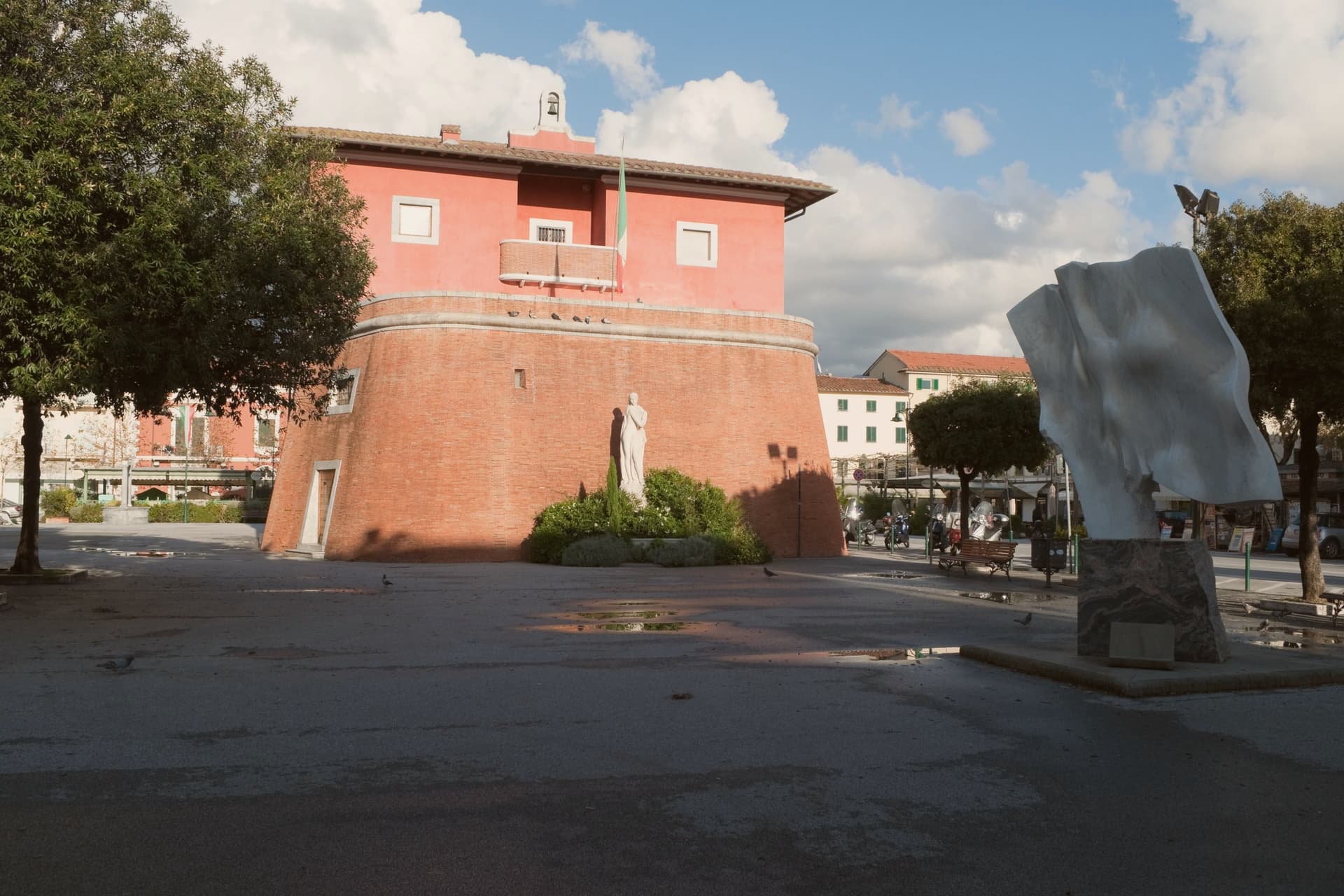
 The 6 best towns with a serious restaurant in the province of Lucca6 towns, Viareggio among them.
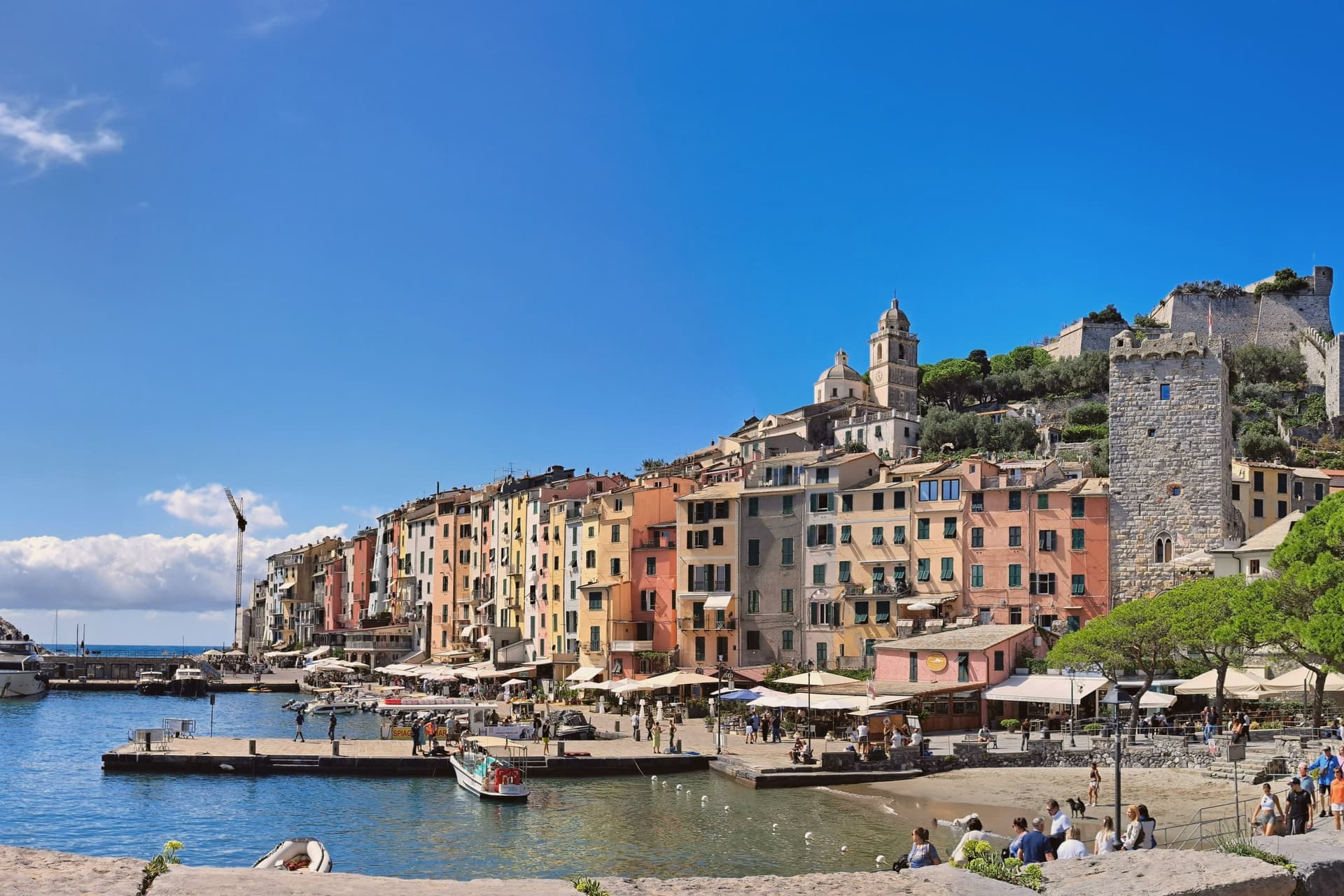
 The best beach towns within 90 minutes of Pisa6 towns, Viareggio among them.
 The best coastal towns inside a nature park within 90 minutes of Pisa6 towns, Viareggio among them.
How to get there
From Florence / Pisa (PSA), about 44 minutes by car.
Genoa (GOA) is about 2 hours away.
By car from the centre of Pisa 29 minutes or Florence 1h 18m.
There is a railway station in the comune, so you can arrive without a car.
Coming from Pisa, Florence or Genoa?
Coming by train into Livorno Centrale? Viareggio is about 36 minutes away by road.
What to see
Passeggiata Liberty
Three-kilometer Belle Époque seafront promenade lined with Stile Liberty villas, cafés and bath houses built between 1890 and 1925.
Cittadella del Carnevale
Sixteen vast hangars where the papier-mâché floats are built year-round, with the Museo del Carnevale and the float-construction workshops open to visitors.
Spiaggia di Viareggio
Ten-kilometer Bandiera Blu beach lined with the original bagni concessions of the Belle Époque, fine sand and shallow seabed.
Caffè Margherita
Seafront café opened 1929 by Galileo Chini, the surviving icon of the promenade's design and once the social center of summer.
Parco di Migliarino San Rossore Massaciuccoli
Regional park around Lago di Massaciuccoli south of the city, with Puccini's villa at Torre del Lago on the lake's eastern shore.
Piazza Mazzini
Seafront square named for Giuseppe Mazzini, with the mascot statue and the central kiosks of the promenade.
The slow-trip planner
Building a trip? Find where Viareggio fits in a slow Italy circuit.
Answer five questions. We will shape a geographically coherent slow trip from the 1,000 Italian towns most travelers skip. Yours to save and share.
We’ve tried
What we got up to
Restaurants, walks, swims — the things we actually did in Viareggio, each with the piece we wrote about it.
Where Puccini came to hunt and everyone else came to be left alone: Torre del Lago.
The tordello, the meat-stuffed pasta that is Versilia telling you it isn't Lucca.
We recommend
Where to eat and stay
Not our picks, but places the guides put their name to: a Michelin star, a Gambero Rosso fork, a Slow Food snail, a Michelin Key for the hotels. Worth a table, a counter, or a night when you pass through.
Il Piccolo PrincipeRistorante
Il Piccolo Principe has two Michelin stars, three Gambero Rosso forks (90/100) and a place in L'Espresso's Top 300, among other nods.
RomanoRistorante
One Michelin star for Romano, along with two Gambero Rosso forks (88/100) and a place in L'Espresso's Top 300, among other nods.
Da Miro alla LanternaRistorante
Da Miro alla Lanterna holds one Gambero Rosso fork (77/100) and a spot in the Michelin Guide.
LunasiaRistorante
Lunasia holds one Michelin star and two Gambero Rosso forks (88/100).
BuonumoreRistorante
A Slow Food snail, at Buonumore.
Giardino di MariRistorante
Giardino di Mari holds a spot in the Michelin Guide.
Henri RestaurantRistorante
Henri Restaurant has a spot in the Michelin Guide to its name.
Il BuonumoreTrattoria
Il Buonumore holds two Gambero Rosso prawns.
Il PortoRistorante
Il Porto has one Gambero Rosso fork (78/100) to its name.
MaMe RestaurantRistorante
MaMe Restaurant has a spot in the Michelin Guide to its name.
Pesciolino BriacoTrattoria
Pesciolino Briaco holds two Gambero Rosso prawns.
Pivot Bistrò di MareBistrot
Two Gambero Rosso tables, at Pivot Bistrò di Mare.
Grand Hotel Principe di PiemonteHotel
Grand Hotel Principe di Piemonte carries two Michelin Keys, plus a Leading Hotels of the World listing.
The Sunday letter
Viareggio got its letter. One town every Sunday, free. The photo, the food, the festa.
Living here
- Population 60,579
- A local hubi
- Pharmacy in town
- High school within a 30-minute drive
- Train station in the comune
- Nearest airport Florence / Pisa, 44 min drive
- Regional capital Firenze, 1 h 18 min drive
Common questions
- What is Viareggio known for?
- Viareggio is the Versilia capital, a Carnival city on the Tuscan coast that turned into a Belle Époque resort when the railway arrived.
- Where is Viareggio?
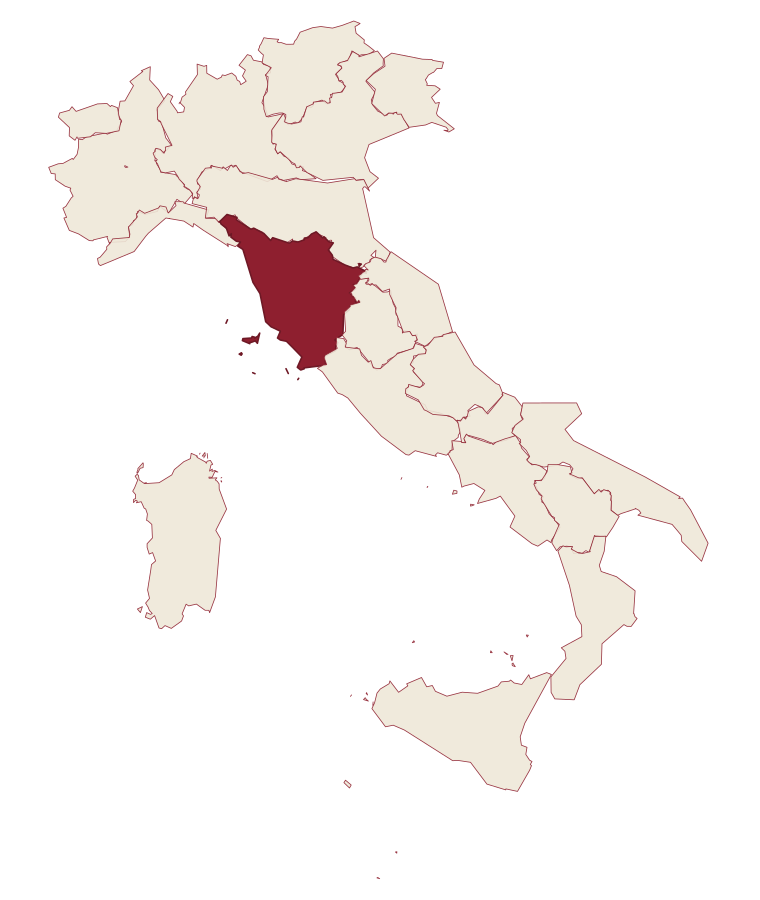
- Viareggio is a comune in the province of Lucca, in Tuscany, at 2 meters above sea level.
- What is the nearest airport to Viareggio?
- Florence / Pisa (PSA), about 44 minutes by car.
- Can you get to Viareggio without a car?
- Yes. There is a railway station in the comune, so you can arrive by train.
- How long is the drive from Pisa to Viareggio?
- About 29 minutes by car.
- When is the best time to visit Viareggio?
- Best in May–Sep. August is the warmest month, averaging 29 degrees, and December the wettest, with about 16 rain days.
- Is there a sagra or a festival in Viareggio?
- The town keeps its patron saint's day: Assunzione di Maria, 25 March.
- Which other towns are like Viareggio?
- Camaiore, Torre Annunziata and Carrara.
- How many people live in Viareggio?
- 60,579 at the 2023 count.
Tags & datadesignations · numbers · sources
Recognised as
The numbers
- Elevation: 2 m
- Population: 60,579
- Surface area: 32.42 km²
These figures were compiled from public directories: ISTAT, OpenStreetMap and Wikidata, and from the official listings of the guides named on this page. Town details change; verify with official sources before you travel.
Similar
Towns like Viareggio
Camaiore
Province: Lucca
both on the Tyrrhenian coast · both over 10,000 people
Torre Annunziata
Province: Napoli
both on the Tyrrhenian coast · both over 10,000 people
Carrara
Province: Massa-Carrara
both on the Tyrrhenian coast · both over 10,000 people
Grosseto
Province: Grosseto
both on the Tyrrhenian coast · both over 10,000 people
Pisa
Province: Pisa
both on the Tyrrhenian coast · both over 10,000 people
Nettuno
Province: Roma
both on the Tyrrhenian coast · both over 10,000 people
🟦 Bandiera Blu
More Bandiera Blu towns in Tuscany
Bibbona
Province: Livorno
An Etruscan-origin hill village above the Costa degli Etruschi, with a Romanesque parish church and a Lorraine-built coastal fort eight kilometers down the road at Marina di Bibbona.
Camaiore
Province: Lucca
The Versilia commune that runs from the mountains to the sea, a Roman Campus Maior on the Via Francigena with a beach at its western end.
Carrara
Province: Massa-Carrara
The marble town at the foot of the Apuan Alps, with over 650 quarry sites in the valleys above and the stone that built the Pantheon, the Pietà and Michelangelo's David.
Castagneto Carducci
Province: Livorno
A hilltop borgo at 194 meters above the Costa degli Etruschi, renamed for the poet Carducci in 1907 and the home of Bolgheri and Sassicaia.
Castiglione della Pescaia
Province: Grosseto
A Maremma seaside town under an Aragonese castle, with the Vetulonia necropolis behind it and Italo Calvino buried on the hill.