
Lazio · Viterbo
Viterbo
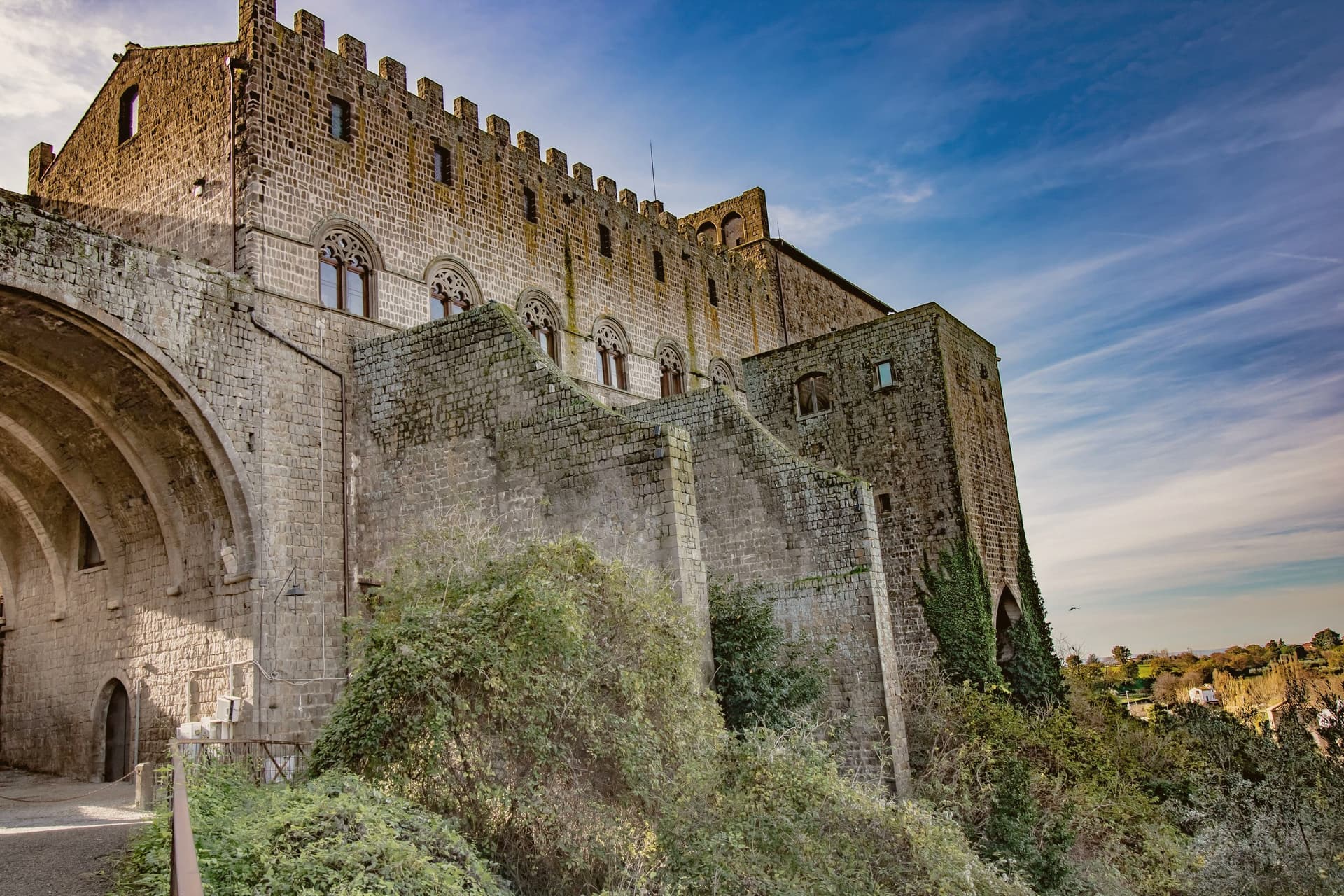
The medieval capital of the Tuscia, papal seat from 1257 to 1281, when five popes were elected here, and home to the longest conclave in Church history.
By Peter Benei
Written about. No. 66.
The letter
Viterbo got its letter. One town at a time, free. The photo, the food, the festa.
Visiting
- Best time
- All year
- By car
- 1 h 33 min from Rome
- By train
- Station in the comune
- Population
- 66,393
When to visit
Best · All year
- J10°
- F13°
- M14°
- A17°
- M22°
- J28°
- J32°
- A31°
- S26°
- O21°
- N15°
- D11°
- Best
- Hot or crowded
- Quiet
- Mostly closed
Daytime air temperature, averages for 2020–2024. Weather data by Open-Meteo.com.
Why come
Viterbo sits in the Tuscia, surrounded by the volcanic Cimini hills and the thermal springs the Etruscans and Romans already used. The city became the favorite papal residence under Eugene III in the twelfth century; between 1257 and 1281, five popes were elected here, and the conclave of 1268-1271 ran nearly three years, the longest in Church history. To end it, the city's people locked the cardinals inside the Palazzo dei Papi, tore the roof off, and reduced their rations.
The decisive conclave is still the reason the word means a place under lock and key. The San Pellegrino quarter, often called one of the largest intact medieval districts in Italy, is lined with profferli, the external stone staircases that climb to first-floor doorways. The Terme dei Papi outside the walls still draws sulfur-water bathers. On 3 September the Macchina di Santa Rosa, a thirty-meter illuminated tower weighing five tons, is carried through the streets by a hundred Facchini, a tradition listed by UNESCO since 2013.
How to get there
From Rome Fiumicino (FCO), about 1 h 36 min by car.
Ancona (AOI) is about 3 h 15 min away.
By car from the center of Perugia 1 h 49 min or Siena 2 h 19 min.
There is a railway station in the comune, so you can arrive without a car.
Coming from Rome?
Every town within reach of Rome Fiumicino airport.
First time driving in Italy? Read our complete manual.
What to see
Palazzo dei Papi
Thirteenth-century papal palace with Gothic loggia and the Sala del Conclave, where the 1268-1271 conclave ran for nearly three years.
Quartiere San Pellegrino
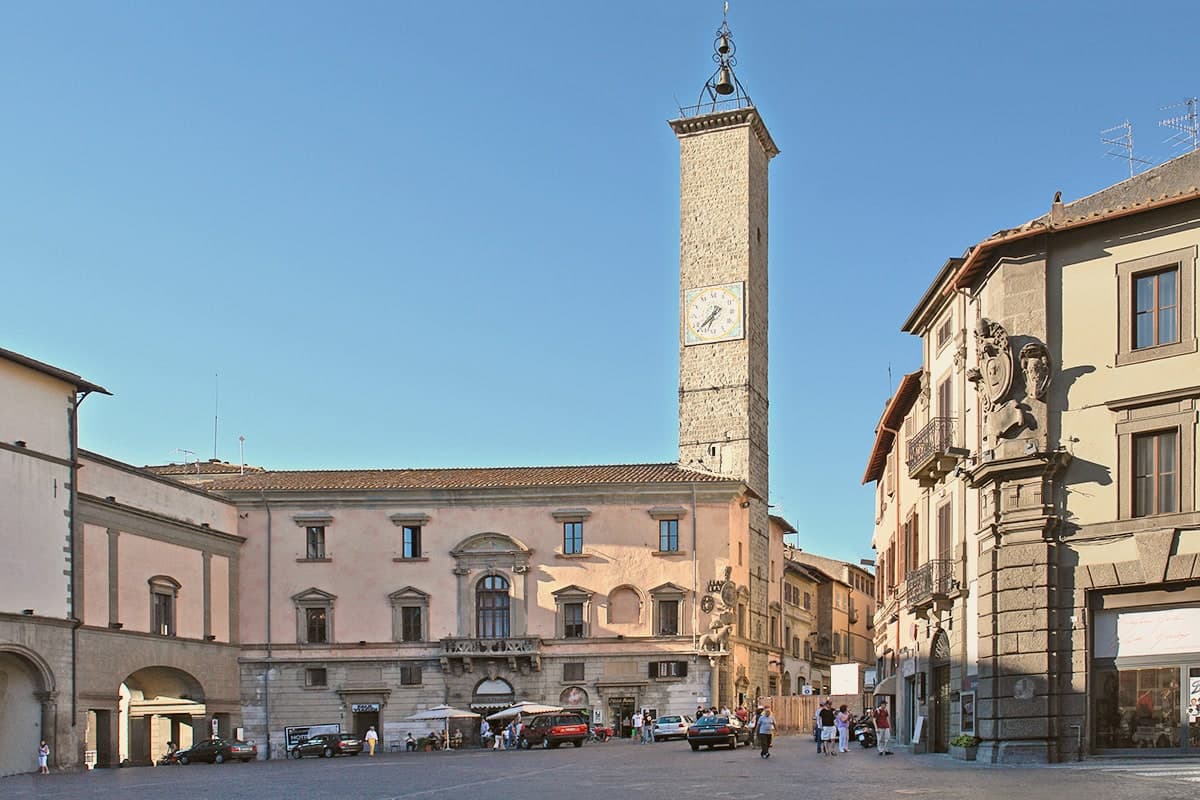
Well-preserved medieval quarter, often called one of the largest in Italy, with stone profferli staircases, towers and the Piazza San Pellegrino.
Terme dei Papi
Thermal complex outside the walls, fed by sulfur springs used since Etruscan times and named for the medieval popes.
Duomo di San Lorenzo
Romanesque cathedral adjoining the Palazzo dei Papi, on the site of an earlier temple of Hercules, with cosmatesque pavement.
Macchina di Santa Rosa
Thirty-meter illuminated tower carried each 3 September by a hundred Facchini, UNESCO Intangible Heritage since 2013.
From the guides
Where to eat and stay
Not our picks, but places the guides put their name to: a Michelin star, a Gambero Rosso fork, a Slow Food snail, a Michelin Key for the hotels. Worth a table, a counter, or a night when you pass through.
Il CasalettoAgriturismo
A Slow Food snail for Il Casaletto, and a Gambero Rosso listing.
BistrotRistorante
Bistrot holds one Gambero Rosso fork (77/100).
Osteria del Vecchio OrologioTrattoria
Osteria del Vecchio Orologio holds two Gambero Rosso prawns.
1 more place the guides name in Viterbo
Terme di Vulci Glamping & SpaHotel
Terme di Vulci Glamping & Spa carries a place in the Michelin hotel guide.
Before you sit down: how to order at a restaurant, how to spot a tourist trap, what aperitivo is and how the Italian bar works.
Living here
Could you live here?
Viterbo is a city.
- A city of 66,393 people, and a provincial capital: the services are here, not a drive away.
- A station of its own, so the rest of Italy is a train ride away.
The rules come from our series Where to Move in Italy, written from the places we have lived: Part 1, The End of the Road · Part 2, The Small Town · Part 3, The City · Part 4, The Postcard · Part 5, The Other Half. The towns we would pick are in Part 6, The Best Towns.
- Population 66,393, up 1.8% since 2015
- Train station in the comune
- A national health service hospital in the comune · how healthcare works in Italy
- Homes in the center: €800 to €1,250 per m² to buy, €6.00 to €8.00 per m² a month to rent
All the numbers Common questions, designations, lists and sources.
More about living here
- A local hub
- Pharmacy in town
- High school within a 30-minute drive
- Full fibre reaches 93% of homes
- Primary school in the comune
- Earthquake zone 2, medium hazard
- Rome Ciampino airport (CIA), 1 h 29 min drive, the nearest with scheduled flights
- Regional capital Rome, 1 h 33 min drive
If you are moving here
Who lives here
11% of residents are foreign citizens, most often from Romania, Sri Lanka and Nigeria, against 9% across Italy. 161 of them come from English-speaking countries or western and northern Europe, mostly Germany, the United Kingdom and France. There are 227 people over 65 for every 100 children under 15, against 216 across Italy. 19% of homes have no resident, holiday homes and empty ones counted together, against 27% across Italy. Viterbo province ranks 71st of 107 in Il Sole 24 Ore's quality of life ranking for 2025.
Health and schools
There is an emergency room in the comune. The nearest major one is in Terni, 49 km away. The nearest IB school is Viterbo International School, 1 km as the crow flies.
Information, not medical advice. Confirm with a professional.
Working from here
Poste Italiane has finished a coworking room in the comune, on its register of 30 September 2026. Check that it is open on Poste's booking site before you count on it.
Taxes
A home that is not your main one pays 1.06% a year in property tax at the 2025 rate, charged on the cadastral value rather than the price. A main home pays none unless it is in a luxury category. The town adds between 0.75% and 0.8% to your income tax, depending on your income. 7% pensioner tax: this town is not in a qualifying area.
Information, not tax advice. Confirm with a professional.
What it costs
The average household in Lazio spends about €2,270 a month, €580 of it on food, against about €2,170 across Italy. A family of three pays about €647 a year for water, on the Lazio average.
Climate and risk
It is in climate zone D, on a scale from A, the warmest, to F, the coldest, and heating may run from November 1 to April 15, up to 12 hours a day, unless the mayor changes it. The national maps show no residents in a high or medium flood zone. Under 1% live in a zone rated high or very high for landslides.
These shares cover the whole comune, not any one street. Check an address on IdroGEO.
Moving from abroad? Which visa you need. Sources: ISTAT, the Ministry of Health, ISPRA, the Finance Ministry, the Ministry of Enterprise, Poste Italiane, the comuni, the IB, International Schools Database, Il Sole 24 Ore, Cittadinanzattiva.
Thermal baths in town: Bagnaccio, Tuscia Terme, Sorgenti San Cristoforo, Sorgenti dell’Asinello, Pozzo Cacciabella, Pozzo San Valentino.
Known for
CITY OF POPES
Five popes elected in Viterbo between 1257 and 1281; the 1268-1271 conclave was the longest in Church history and gave the word its meaning.
MACCHINA DI SANTA ROSA
Five-ton thirty-meter illuminated tower carried through the streets on 3 September by a hundred Facchini, UNESCO listed since 2013.
TERME DEI PAPI
Sulfur thermal complex used since Etruscan times and rebuilt under the popes, still the largest bathing pool in central Italy.
TUSCIA
The commune lies inside the Tuscia DOP production zone.
Common questions
- What is Viterbo known for?
- Viterbo is the medieval capital of the Tuscia, papal seat from 1257 to 1281, when five popes were elected here, and home to the longest conclave in Church history.
- Where is Viterbo?
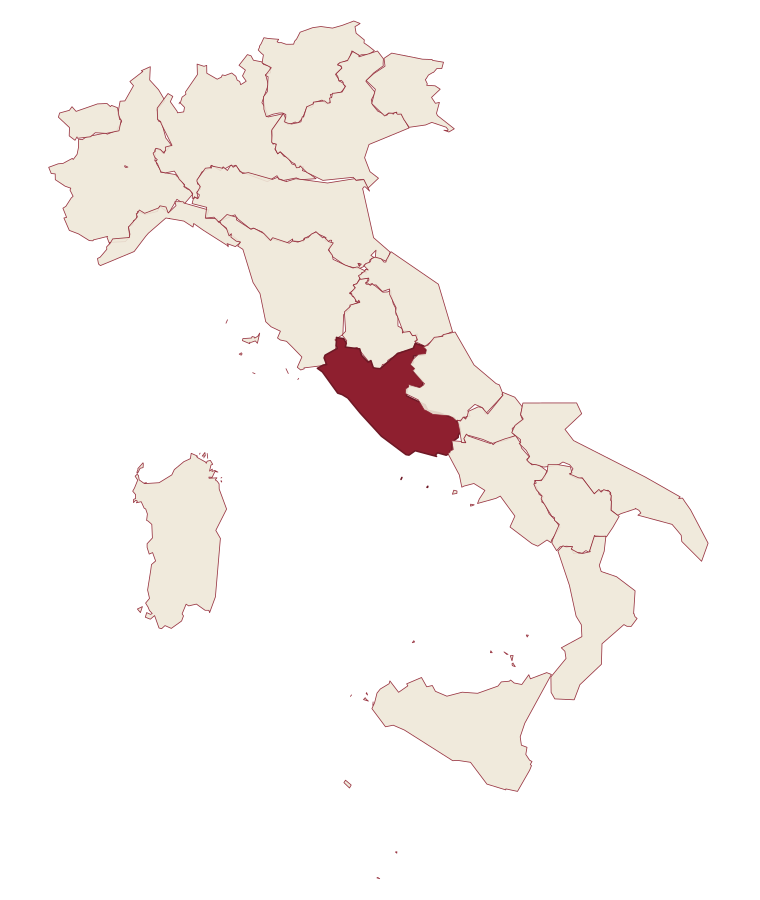
- Viterbo is a comune in the province of Viterbo, in Lazio, at 326 meters above sea level.
- What is the nearest airport to Viterbo?
- The nearest airport with scheduled flights is Rome Ciampino (CIA), about 1 h 29 min by car.
- Can you get to Viterbo without a car?
- Yes. There is a railway station in the comune, so you can arrive by train.
- How long is the drive from Perugia to Viterbo?
- About 1 h 49 min by car.
- When is the best time to visit Viterbo?
- Any month of the year works. July is the warmest month, averaging 32 degrees, and May the wettest, with about 12 rain days.
- Which other towns are like Viterbo?
- Velletri, Tivoli and Rieti.
- How many people live in Viterbo?
- 66,393 residents, by ISTAT's count on 1 January 2025.
- Is Viterbo a good place to live?
- Viterbo is a city of 66,393 people, the kind of place Part 3 of our Where to Move in Italy series is about. There is a national health service hospital in the comune. Full fibre reaches 93% of homes.
Tags & data designations · numbers · sources
Landscape
The numbers
- Elevation: 326 m
- Population: 66,393
- Surface area: 406.23 km²
These figures were compiled from public directories: ISTAT, OpenStreetMap and Wikidata, and from the official listings of the guides named on this page. Town details change; verify with official sources before you travel.
The ranked lists
Lists Viterbo appears in
- The best hot-spring towns within two hours of RomeNear Romehot springswithin 2 hours6 towns · smallest 1,396 residents · closest 31 min away
- The best towns on a walking route in the province of ViterboViterbo provinceon a walking route6 towns · smallest 3,690 residents
- The best towns you can reach by train in the province of ViterboViterbo provinceby train6 towns · smallest 3,696 residents
- The best towns that eat well in the province of ViterboViterbo provinceeats well9 towns · smallest 902 residents
- The best towns on a walking route that you can reach by train in LazioLazioon a walking routeby train10 towns · smallest 6,341 residents
Near here, with a letter
- Written about. No. 58.
Ronciglione
Province: Viterbo
A tufa-brick borgo above Lake Vico, fortified by the Prefects of Vico and crowned Borgo dei Borghi in 2023.
17 km away
- Written about. No. 64.
Capranica
Province: Viterbo
A medieval hill town on the old Via Cassia, taken by the Anguillara family in 1305 and remembered as the place Petrarch stayed in 1337.
19 km away
- Written about. No. 63.
Caprarola
Province: Viterbo
A Cimini hill town above Lago di Vico, dominated by the pentagonal Villa Farnese that Vignola built for the Farnese cardinals between 1559 and 1573.
35 min by car
The letter
Viterbo got its letter. One town at a time, free. The photo, the food, the festa.
Paid plans, the moving year and the books are on the membership page.