
Tuscany · Lucca
Pietrasanta
The marble-processing town under the Apuan Alps, worked by Michelangelo, Henry Moore, Joan Miró and Fernando Botero.
- Best time
- May–Sep
- By car
- 41 min from Pisa
- By train
- Station in the comune
- Population
- 22,870
Known for
MARBLE SCULPTURE
Working center for marble sculpture since the fifteenth century, with over a dozen active studi inside the centro storico.
BOTERO
Fernando Botero bought a house here in 1983, became an honorary citizen in 2001, and held an 80-work town-wide exhibition in 2012.
MARINA DI PIETRASANTA
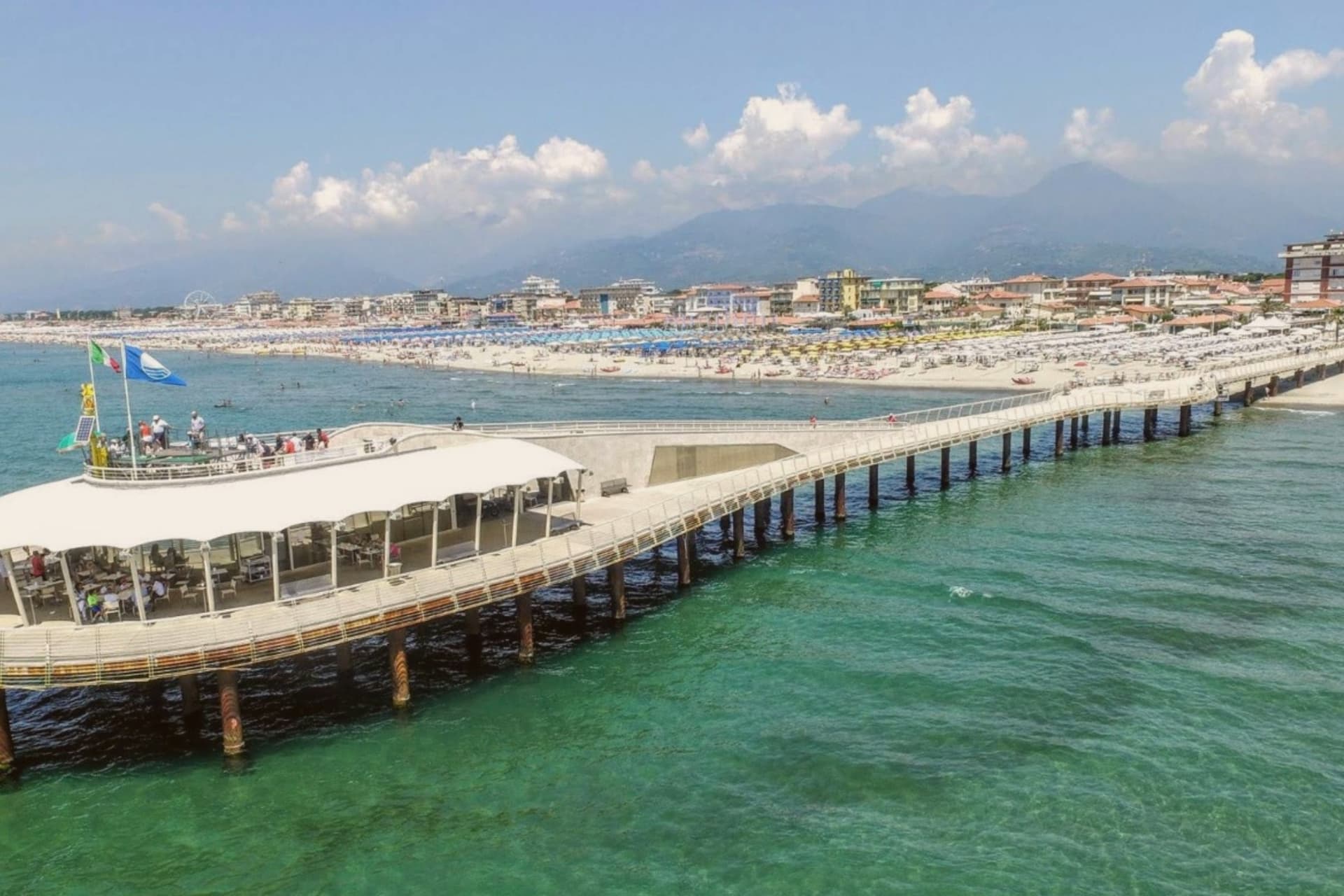
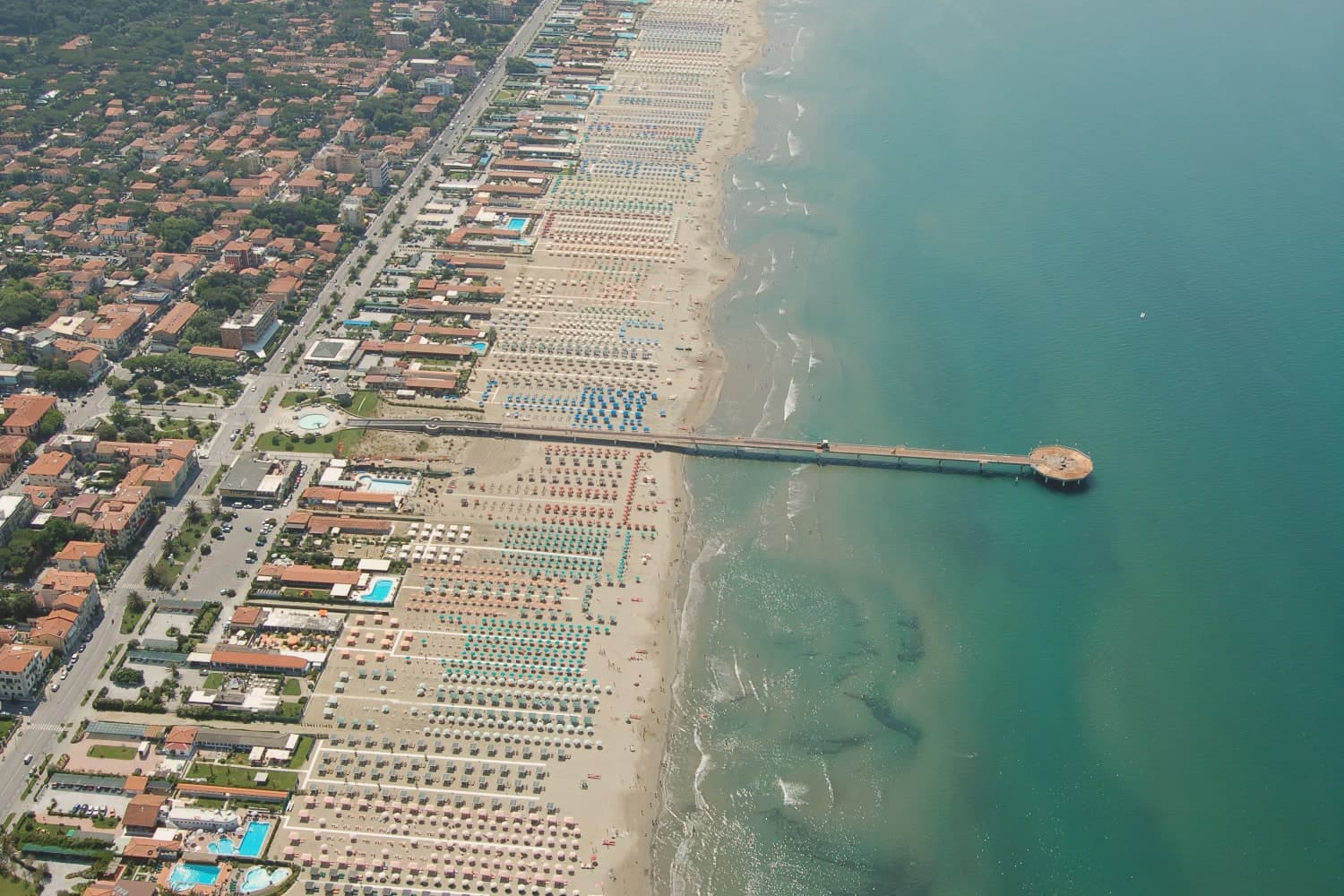
Three-kilometer Bandiera Blu beach with the Versiliana pinewood and a summer cultural festival running since 1980.
When to visit
Best · May–Sep
- J12°
- F13°
- M14°
- A17°
- M21°
- J25°
- J28°
- A29°
- S25°
- O21°
- N16°
- D13°
- Best
- Hot or crowded
- Quiet
- Mostly closed
Daytime averages, 2020–2024. The sea is warmest in August at 28° and coldest in February at 12°. Weather data by Open-Meteo.com.
The festa: Martino di Tours, 11 November
Why come
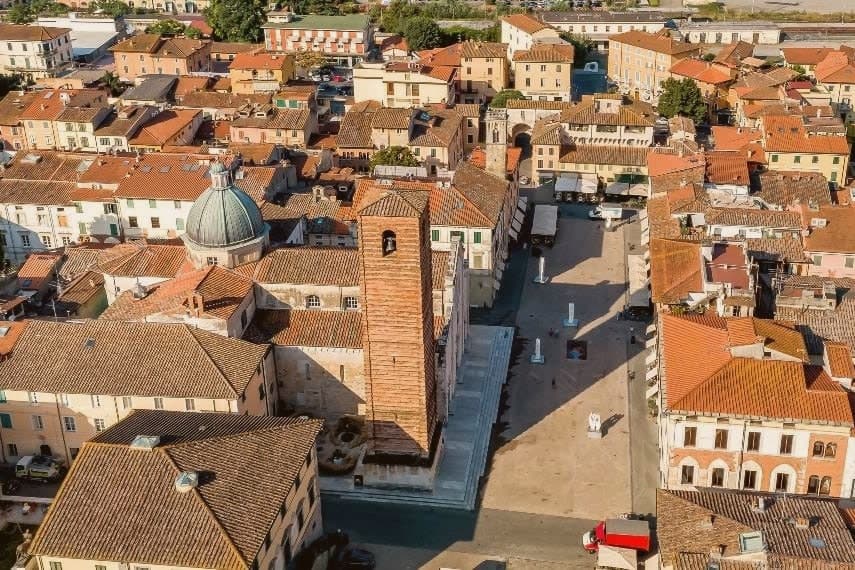
Pietrasanta sits at the foot of the Apuan Alps, two kilometers from the Tyrrhenian, close enough to the quarries behind it and the coast in front of it that stone and sea both shape the town. It was founded in 1255 by Luca Guiscardo da Pietrasanta on the older fortress that already stood on the hill, and it grew through the fifteenth century into the processing center for marble cut from the mountains at its back. The centro storico, where the studi and foundries still work, sits inland; the beachfront with its pinewood park lies on the coast, a separate register of the same town, one built for stone and one for summer.
Michelangelo arrived in the early 1500s to work the local stone, and Henry Moore, Joan Miró and Damien Hirst followed in the twentieth century, drawn by the same studios and foundries that cut marble for the Duomo's façade centuries earlier. The Mariani foundry on the outskirts now casts work for sculptors who order remotely from New York and Beijing. What began as a quarry town for one church has become a place where the working of stone, not the display of it, is the thing on view.
Read on
Pietrasanta in our articles
 The 6 best towns with a serious restaurant in the province of Lucca6 towns, Pietrasanta among them.
 The best beach towns within 90 minutes of Pisa6 towns, Pietrasanta among them.
 The best coastal towns within 90 minutes of Florence6 towns, Pietrasanta among them.
 The best towns with a serious restaurant that sit on a walking route within 90 minutes of Pisa6 towns, Pietrasanta among them.
How to get there
From Florence / Pisa (PSA), about 50 minutes by car.
Genoa (GOA) is about 1h 49m away.
By car from the centre of Pisa 41 minutes or Florence 1h 27m.
There is a railway station in the comune, so you can arrive without a car.
Coming from Pisa, Florence or Genoa?
Coming by train into Livorno Centrale? Pietrasanta is about 42 minutes away by road.
What to see
Duomo di San Martino
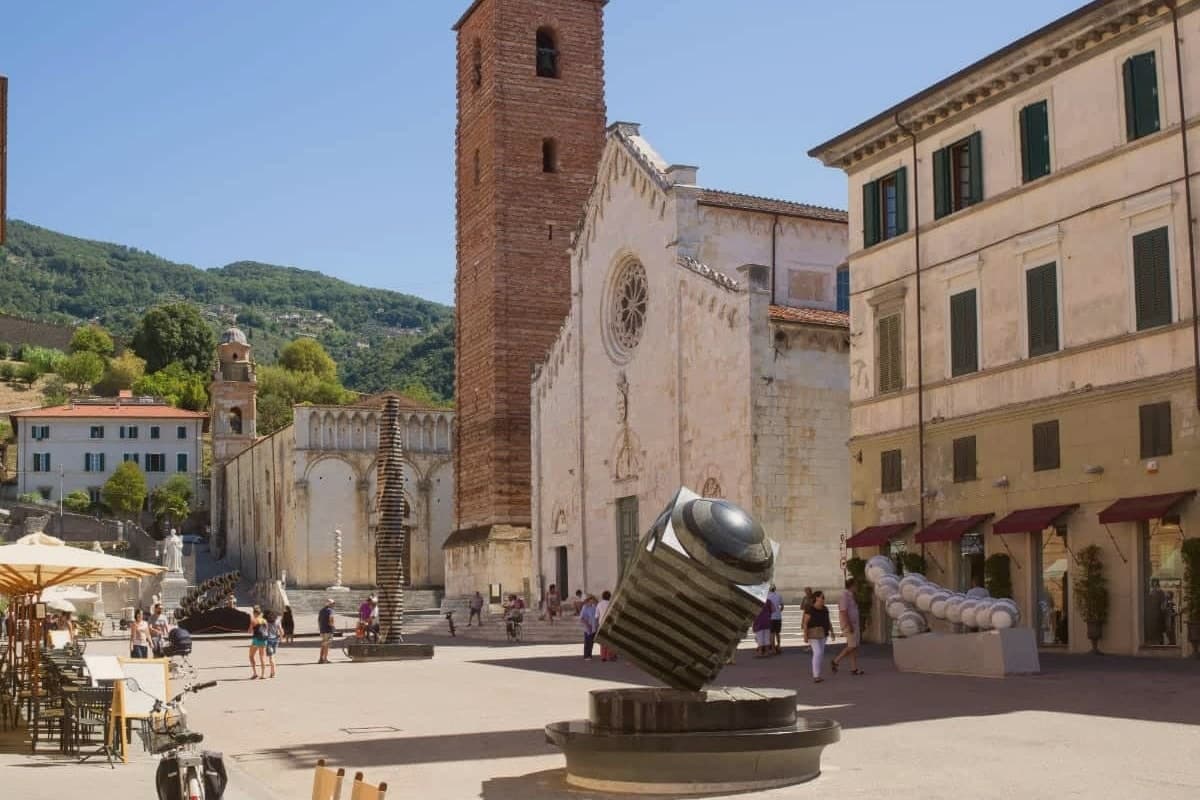
White-marble façade on the collegiate church, first documented in 1223 and enlarged in 1330 and 1387. It faces the square that still functions as the town's civic center.
Piazza Duomo
Main square with the Marzocco column celebrating Florence's 1513 reacquisition and a statue of Grand Duke Leopold by Vincenzo Santini.
Museo dei Bozzetti
Civic museum holding 700 plaster models and clay sketches from sculptors who have worked in the local studios since the 1960s, a record of process rather than finished work.
Studi e Fonderie
Active sculptor studios and bronze foundries in the centro storico, including the Mariani foundry where Botero cast his Pietrasanta bronzes.
Marina di Pietrasanta
Three-kilometer Versilia beachfront with Bandiera Blu status and the pinewood Versiliana park where the summer literary festival runs.
Rocca di Sala
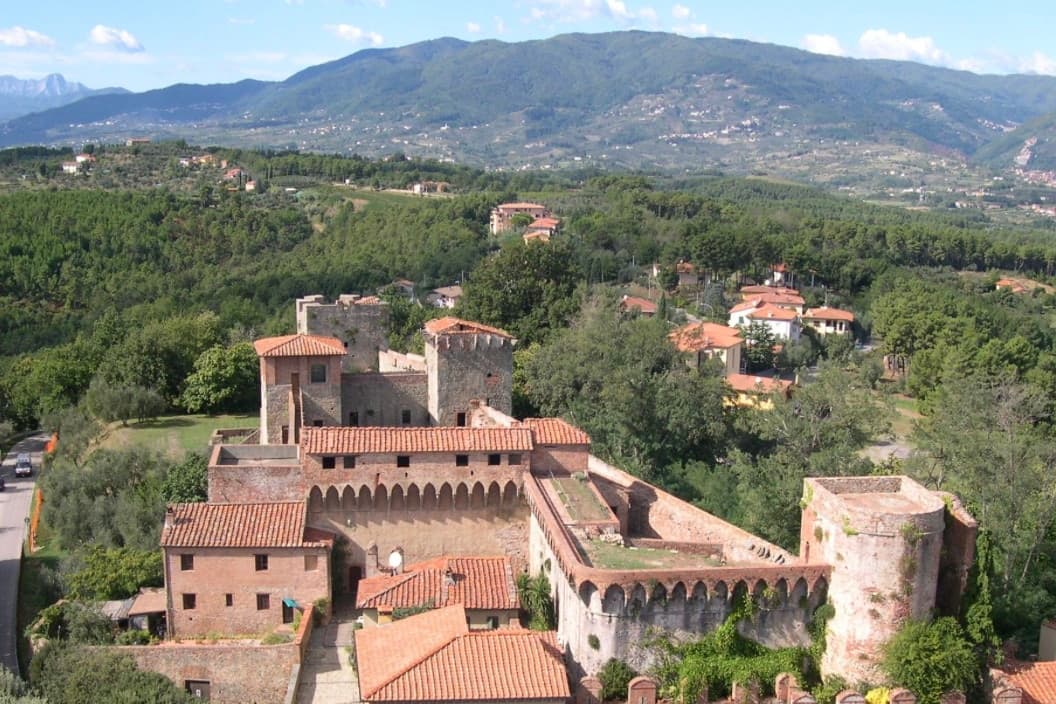
Pre-1255 fortress on the hill above the centro storico, the original castle around which the town was founded.
The slow-trip planner
Building a trip? Find where Pietrasanta fits in a slow Italy circuit.
Answer five questions. We will shape a geographically coherent slow trip from the 1,000 Italian towns most travelers skip. Yours to save and share.
We’ve tried
What we got up to
Restaurants, walks, swims — the things we actually did in Pietrasanta, each with the piece we wrote about it.
The best trippa in Versilia, in the room I'd bring her to: Trattoria Gatto Nero.
The vongole and the worldview behind it at Trattoria da Carlino, Tonfano.
The tordello, the meat-stuffed pasta that is Versilia telling you it isn't Lucca.
Erbe, the bitter boiled greens that make a kilo of rare beef sit like a virtue.
We recommend
Where to eat
Not our picks, but places the guides put their name to: a Michelin star, a Gambero Rosso fork, a Slow Food snail, a Michelin Key for the hotels. Worth a table, a counter, or a night when you pass through.
FilippoRistorante
Filippo has two Gambero Rosso forks (82/100) and a spot in the Michelin Guide.
La MartinaticaRistorante
La Martinatica holds one Gambero Rosso fork (79/100) and a spot in the Michelin Guide.
PeposoTrattoria
Two Gambero Rosso prawns for Peposo, and a Slow Food snail.
AlexRistorante
Alex holds a spot in the Michelin Guide.
Da GigiRistorante
A Gambero Rosso listing, at Da Gigi.
L'Enoteca MarcucciWine Bar
Three Gambero Rosso bottles, at L'Enoteca Marcucci.
Osteria StappasogniTrattoria
Osteria Stappasogni holds two Gambero Rosso prawns.
ParadisRistorante
Paradis holds one Gambero Rosso fork (79/100).
SementisBistrot
Sementis holds two Gambero Rosso tables.
Through the year
What happens here
Feasts and festivals that come back year after year. We give the month rather than the date, because the date moves and the month rarely does. Check with the source before you plan a journey around one.
Pietrasanta Medievale a Pietrasantahistorical re-enactment
usually held in October. Borghi Toscana - Eventi
The Sunday letter
Pietrasanta got its letter. One town every Sunday, free. The photo, the food, the festa.
Living here
- Population 22,870
- Commuter belti
- Pharmacy in town
- High school within a 30-minute drive
- Train station in the comune
- Nearest airport Florence / Pisa, 50 min drive
- Regional capital Firenze, 1 h 27 min drive
Common questions
- What is Pietrasanta known for?
- Pietrasanta is the marble-processing town under the Apuan Alps, worked by Michelangelo, Henry Moore, Joan Miró and Fernando Botero.
- Where is Pietrasanta?
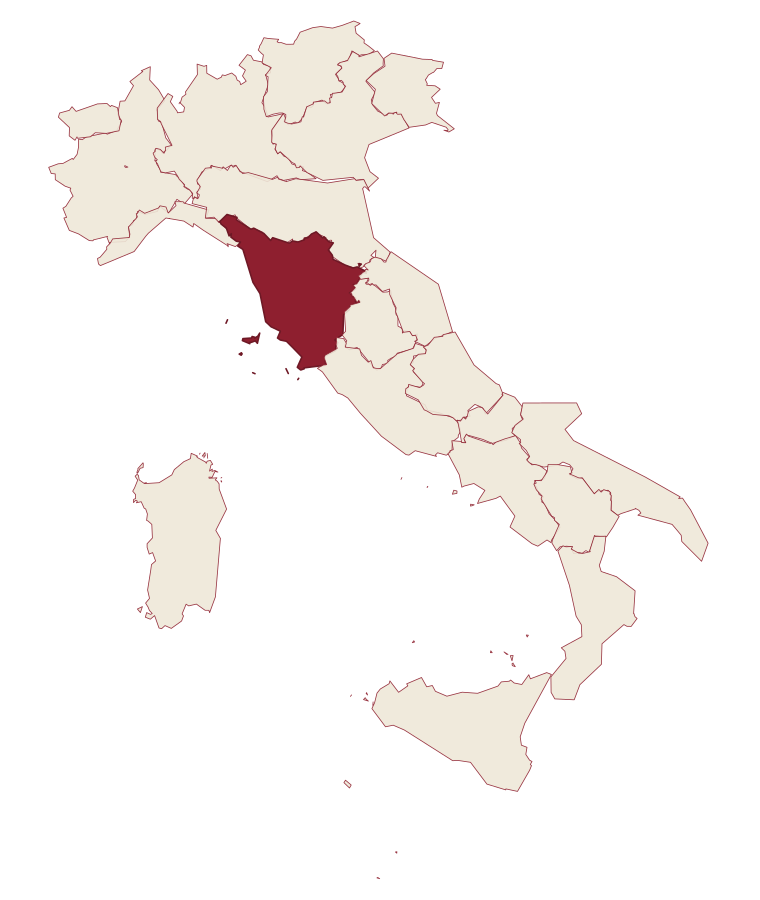
- Pietrasanta is a comune in the province of Lucca, in Tuscany, at 14 meters above sea level.
- What is the nearest airport to Pietrasanta?
- Florence / Pisa (PSA), about 50 minutes by car.
- Can you get to Pietrasanta without a car?
- Yes. There is a railway station in the comune, so you can arrive by train.
- How long is the drive from Pisa to Pietrasanta?
- About 41 minutes by car.
- When is the best time to visit Pietrasanta?
- Best in May–Sep. August is the warmest month, averaging 29 degrees, and December the wettest, with about 16 rain days.
- Is there a sagra or a festival in Pietrasanta?
- Yes. Pietrasanta Medievale a Pietrasanta. October is when the first of them falls.
- Which other towns are like Pietrasanta?
- Seravezza, Carrara and Montignoso.
- How many people live in Pietrasanta?
- 22,870 at the 2023 count.
Tags & datadesignations · numbers · sources
Recognised as
The numbers
- Elevation: 14 m
- Population: 22,870
- Surface area: 41.6 km²
These figures were compiled from public directories: ISTAT, OpenStreetMap and Wikidata, and from the official listings of the guides named on this page. Town details change; verify with official sources before you travel.
Similar
Towns like Pietrasanta
Seravezza
Province: Lucca
both on the Tyrrhenian coast · both over 10,000 people
Carrara
Province: Massa-Carrara
both on the Tyrrhenian coast · both over 10,000 people
Montignoso
Province: Massa-Carrara
both on the Tyrrhenian coast · both over 10,000 people
Pompei
Province: Napoli
both on the Tyrrhenian coast · both over 10,000 people
Bacoli
Province: Napoli
both on the Tyrrhenian coast · both over 10,000 people
Gaeta
Province: Latina
both on the Tyrrhenian coast · both over 10,000 people
🟦 Bandiera Blu
More Bandiera Blu towns in Tuscany
Bibbona
Province: Livorno
An Etruscan-origin hill village above the Costa degli Etruschi, with a Romanesque parish church and a Lorraine-built coastal fort eight kilometers down the road at Marina di Bibbona.
Camaiore
Province: Lucca
The Versilia commune that runs from the mountains to the sea, a Roman Campus Maior on the Via Francigena with a beach at its western end.
Carrara
Province: Massa-Carrara
The marble town at the foot of the Apuan Alps, with over 650 quarry sites in the valleys above and the stone that built the Pantheon, the Pietà and Michelangelo's David.
Castagneto Carducci
Province: Livorno
A hilltop borgo at 194 meters above the Costa degli Etruschi, renamed for the poet Carducci in 1907 and the home of Bolgheri and Sassicaia.
Castiglione della Pescaia
Province: Grosseto
A Maremma seaside town under an Aragonese castle, with the Vetulonia necropolis behind it and Italo Calvino buried on the hill.