
Umbria · Perugia
Todi
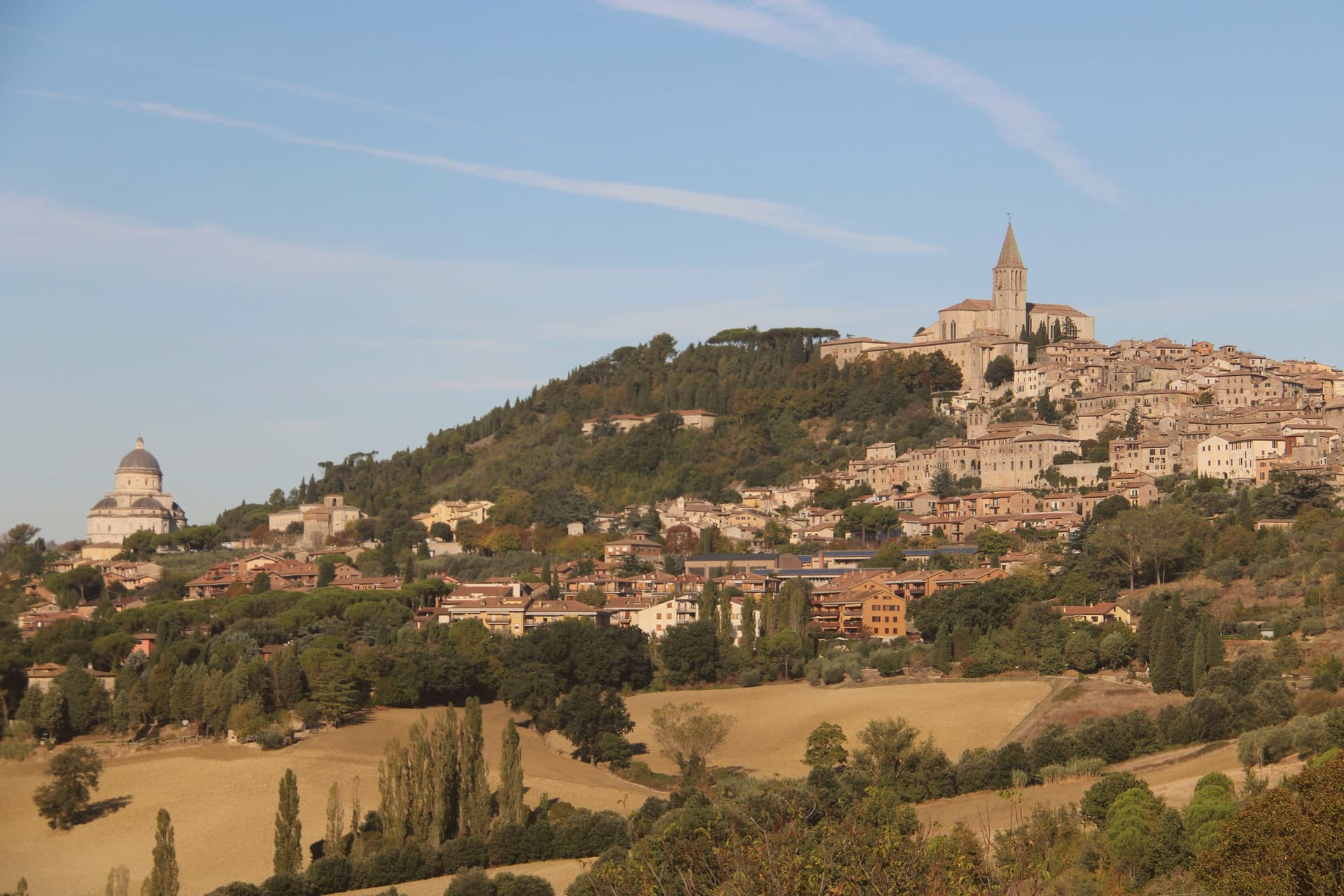
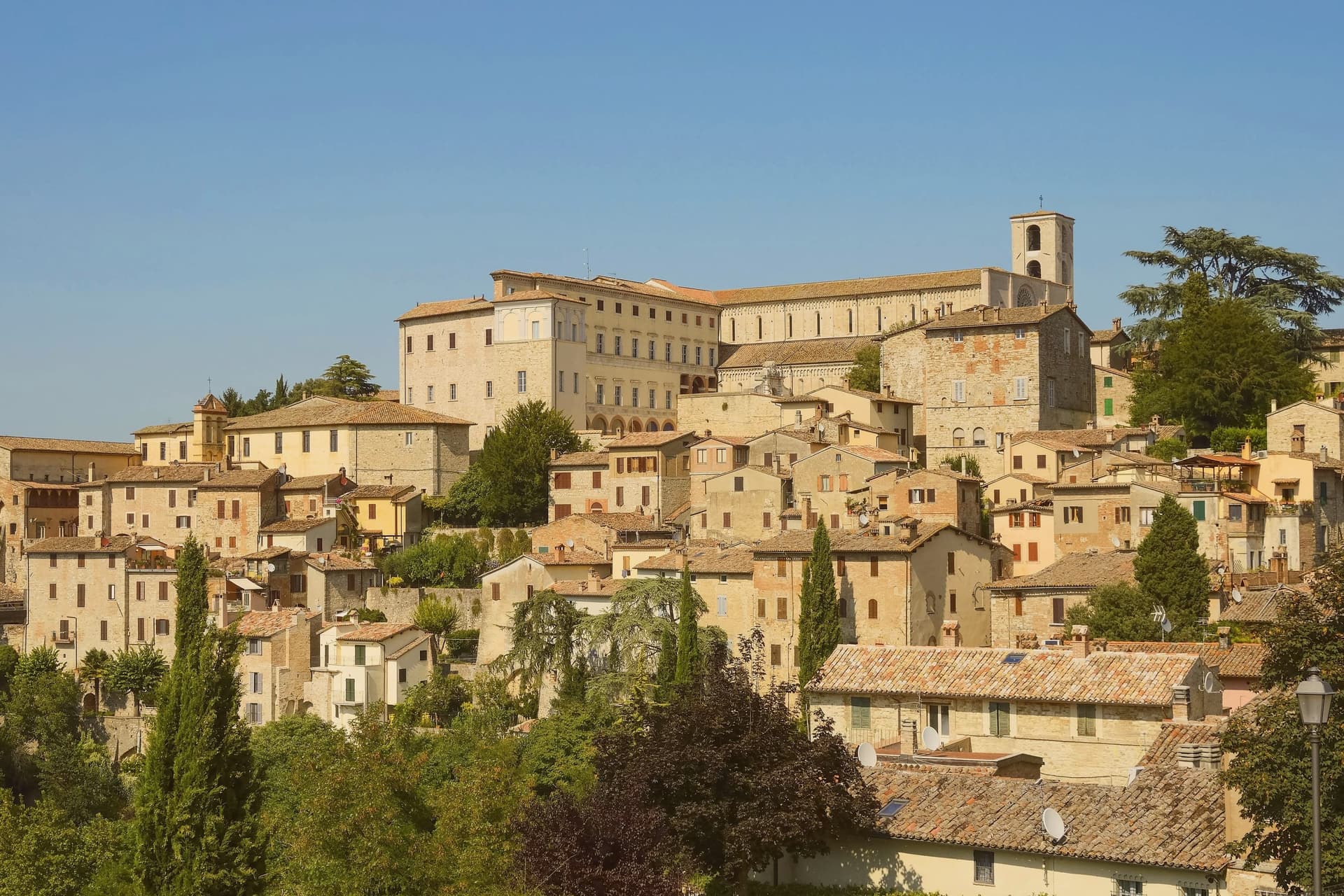
A walled hill town on the Tiber, with Etruscan, Roman, and medieval rings stacked one above the other.
- Best time
- Apr–Oct
- By car
- 38 min from Perugia
- By train
- Station in the comune
- Population
- 15,682
Known for
LA CONSOLAZIONE
Greek-cross Renaissance temple attributed to Bramante, built 1508-1607, one of the most rigorous central-plan churches in central Italy.
JACOPONE
Jacopone de Benedetti, the 13th-century poet of nearly one hundred vernacular laudi, was born here in 1236 and is buried in San Fortunato's crypt.
PIAZZA DEL POPOLO
Medieval square on top of Roman cisterns still working, with cathedral, Palazzo dei Priori, and Palazzo del Capitano on three sides.
PAMPEPATO DI TERNI
The commune lies inside the Pampepato di Terni IGP production zone.
When to visit
Best · Apr–Oct
- J9°
- F12°
- M14°
- A17°
- M22°
- J28°
- J32°
- A32°
- S25°
- O20°
- N14°
- D10°
- Best
- Hot or crowded
- Quiet
- Mostly closed
Daytime averages, 2020–2024. Weather data by Open-Meteo.com.
The festa: Fortunato di Todi, 14 October
Why come
The hill the town occupies, Colle Nidoli, rises above the middle Tiber, and the settlement is built as three concentric ring walls rather than one: Etruscan and Roman courses at the base, a medieval circuit at the summit, the whole sequence readable from the hills around it. The square at the top sits directly over a Roman forum, and the cisterns cut beneath that forum still carry water and drainage for the town today, so the working infrastructure underfoot is as old as anything visible above ground. The building on the square with the triple window keeps that window from the thirteenth century.
The lower ground beyond the medieval walls holds the Roman niches, the surviving wall of a first-century BC public building, set at the foot of the town rather than within its defended core, a reminder that the settlement's Roman life extended past what the medieval walls later enclosed. Outside the walls in the other direction stands the Renaissance temple, built over a century between 1508 and 1607, deliberately separated from the dense center it complements. Todi's layout is less a single town than a stack of settlements, Etruscan, Roman, medieval, Renaissance, each occupying its own ring or its own ground beyond the walls, none erasing what came before it.
The Sunday letter
Todi is on our list. Its letter is still to come.
We are writing about all 1,000 of these towns, one at a time, in a free letter every Sunday: the photo, the food, the festa. That is our mission. Sign up and you will be there when Todi comes up. By Peter & Sophia, from Pietrasanta.
Read on
Todi in our articles
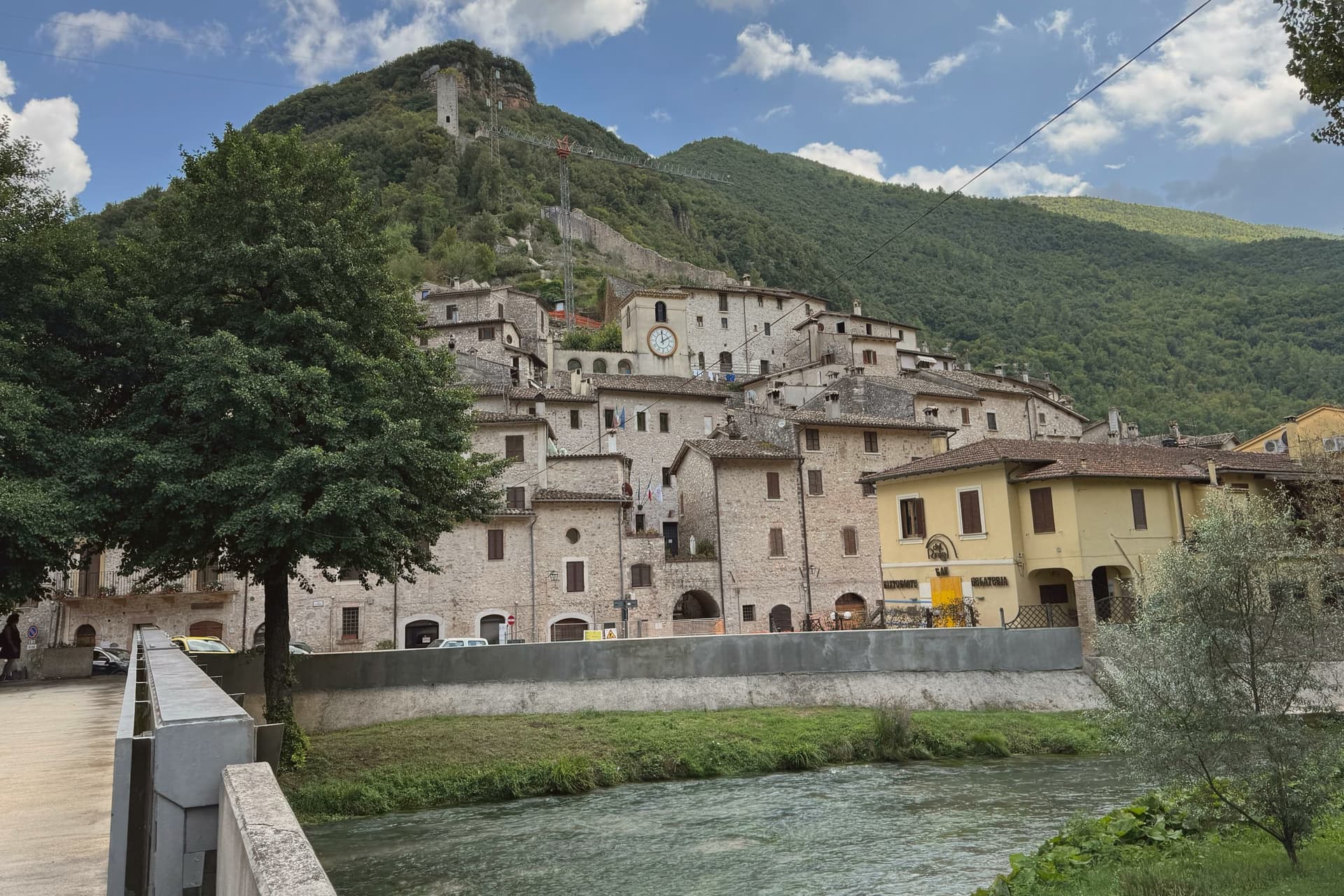
 The best towns with a serious restaurant that you can reach by train in the province of Perugia6 towns, Todi among them.
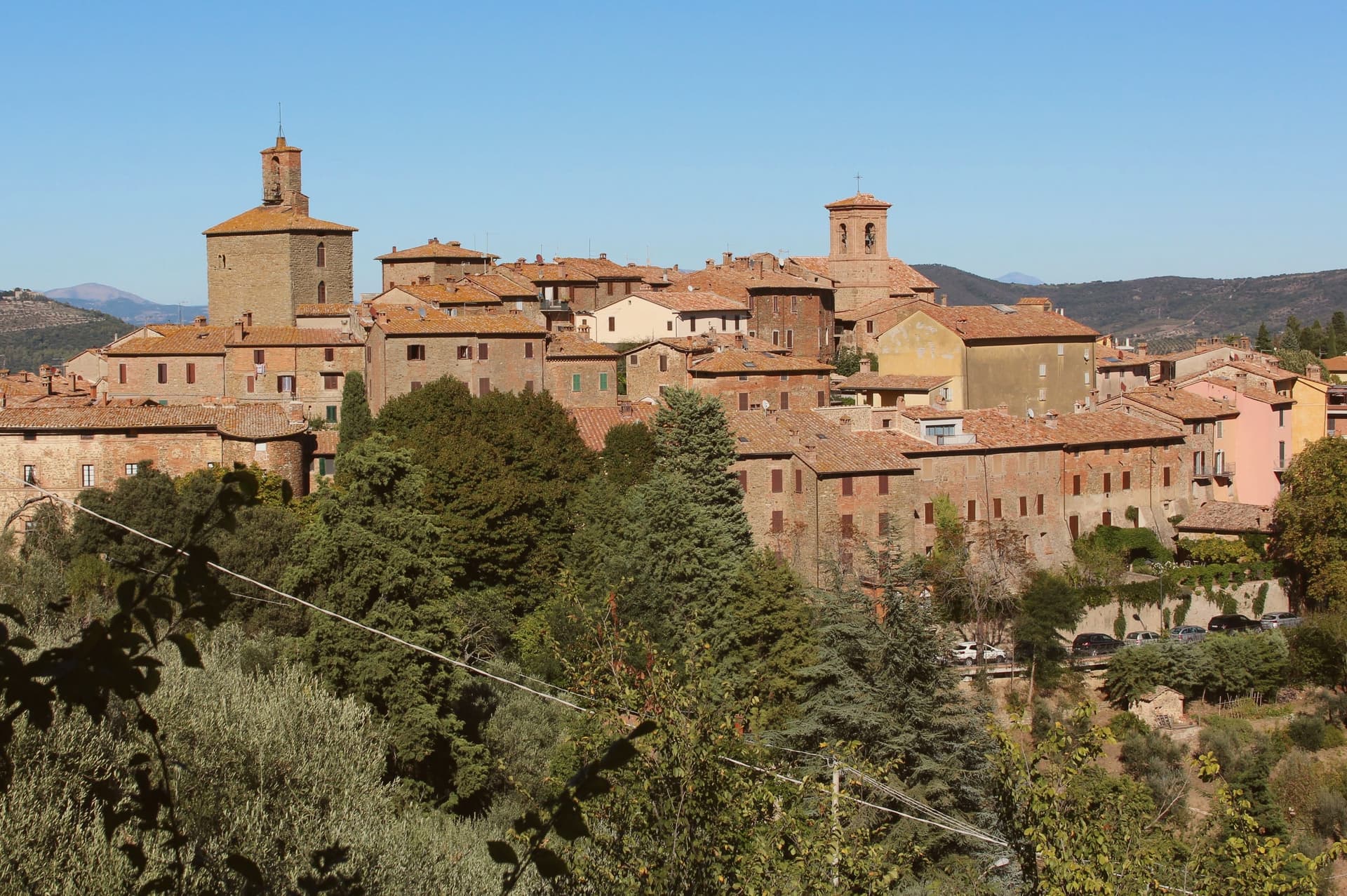
 The best towns worth staying overnight in the province of Perugia6 towns, Todi among them.
 The 7 best towns with a serious restaurant that sit inside a nature park in the province of Perugia7 towns, Todi among them.
 The best hill towns with a serious restaurant within 90 minutes of Terni7 towns, Todi among them.
How to get there
From Ancona / Pescara (AOI), about 2 hours by car.
Rome (FCO) is about 2h 19m away.
By car from the centre of Perugia 38 minutes or Siena 2 hours.
There is a railway station in the comune, so you can arrive without a car.
Coming by train into Perugia? Todi is about 38 minutes away by road.
What to see
Piazza del Popolo
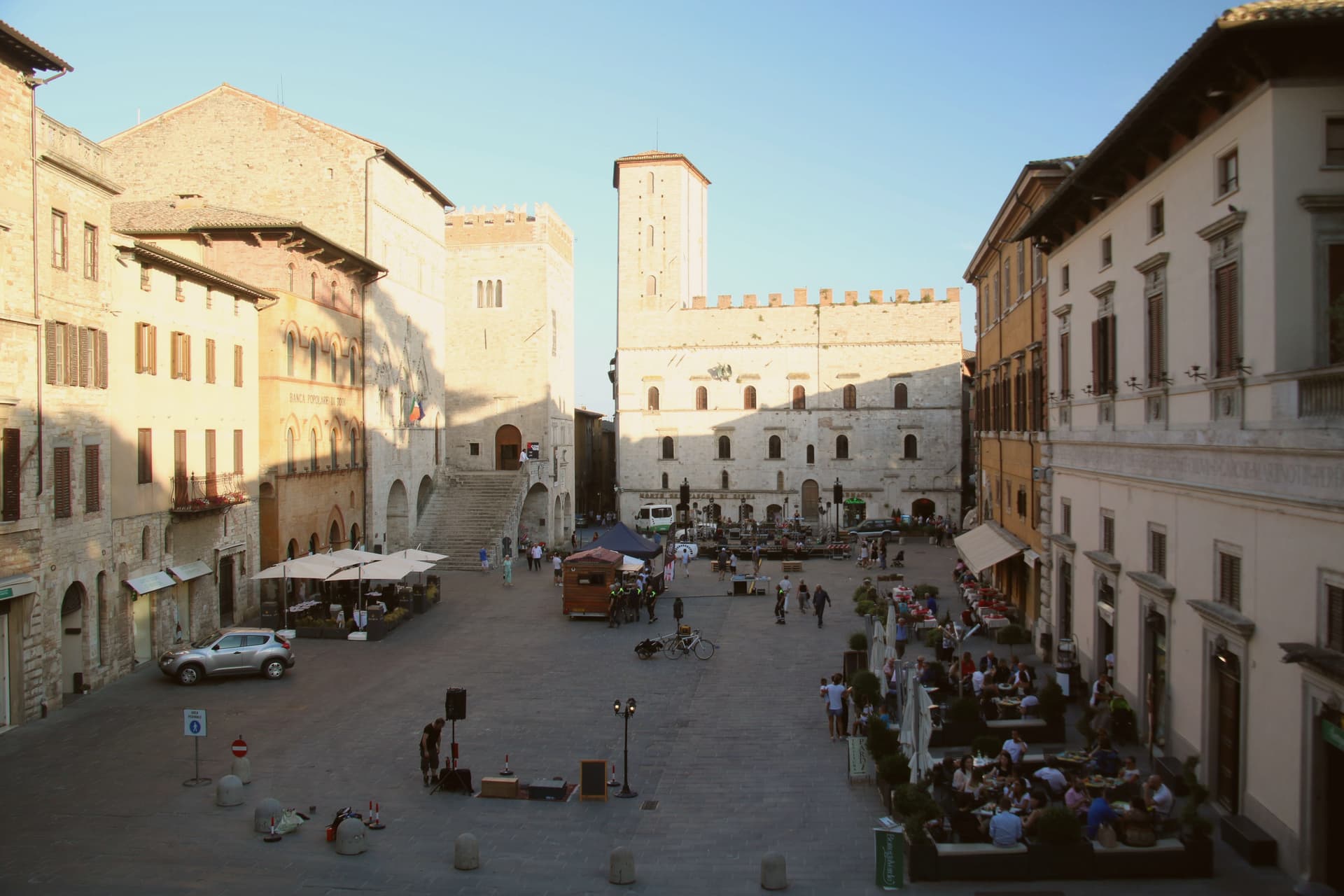
Square on the highest point of Colle Nidoli, built over Roman cisterns still in use, ringed by cathedral, Palazzo dei Priori, and Palazzo del Capitano.
Cattedrale della Santissima Annunziata
Twelfth-century cathedral on the site of a Roman temple, north end of Piazza del Popolo, Gothic rose window and a fresco of the Last Judgment by Faenzone inside.
Tempio di Santa Maria della Consolazione
Outside the walls rather than within the medieval fabric of the center, its dome fifty meters high, a solitary geometric mass against the surrounding hillside.
Chiesa di San Fortunato
Gothic-Renaissance church on Piazza Umberto I, holding 14th-century Giotto-school frescoes and the crypt tomb of Jacopone da Todi.
Palazzo dei Priori
Town hall built 1334-1347 on the south side of Piazza del Popolo, trapezoidal tower with the 1339 bronze Eagle of Todi by Giovanni di Giliaccio.
Nicchioni Romani
Four colossal Roman niches at the foot of the medieval town, the surviving wall of a 1st-century BC public building beside the Roman forum.
The slow-trip planner
Building a trip? Find where Todi fits in a slow Italy circuit.
Answer five questions. We will shape a geographically coherent slow trip from the 1,000 Italian towns most travelers skip. Yours to save and share.
We recommend
Where to eat and stay
Not our picks, but places the guides put their name to: a Michelin star, a Gambero Rosso fork, a Slow Food snail, a Michelin Key for the hotels. Worth a table, a counter, or a night when you pass through.
FiorfioreRistorante
Fiorfiore carries a spot in the Michelin Guide.
Tenuta di CanonicaHotel
Tenuta di Canonica holds a place in the Michelin hotel guide.
Living here
- Population 15,682
- In-betweeni
- Pharmacy in town
- High school within a 30-minute drive
- Train station in the comune
- Nearest airport Ancona / Pescara, 2 h 4 min drive
- Market day Monday and Saturday
- Regional capital Perugia, 38 min drive
Common questions
- What is Todi known for?
- Todi is a walled hill town at 398 meters on the Tiber, with Etruscan, Roman, and medieval rings stacked one above the other.
- Where is Todi?
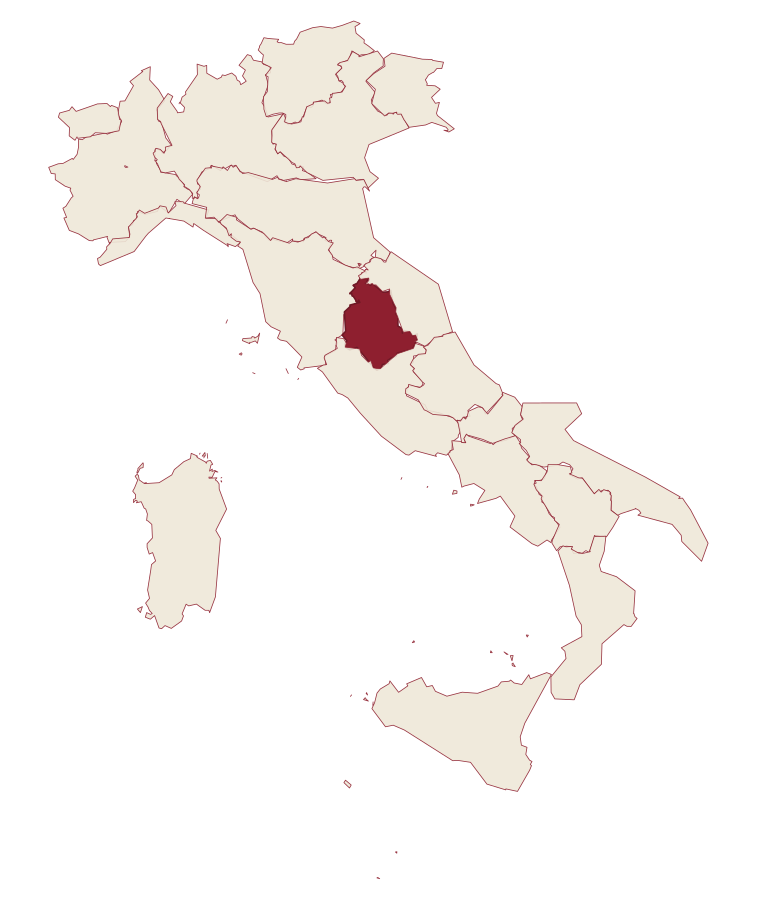
- Todi is a comune in the province of Perugia, in Umbria.
- What is the nearest airport to Todi?
- Ancona / Pescara (AOI), about 2 hours by car.
- Can you get to Todi without a car?
- Yes. There is a railway station in the comune, so you can arrive by train.
- How long is the drive from Perugia to Todi?
- About 38 minutes by car.
- When is the best time to visit Todi?
- Best in Apr–Oct. July is the warmest month, averaging 32 degrees, and May the wettest, with about 12 rain days.
- Is there a sagra or a festival in Todi?
- The town keeps its patron saint's day: Fortunato di Todi, 14 October.
- Which other towns are like Todi?
- San Severino Marche, Urbino and Anagni.
- How many people live in Todi?
- 15,682 at the 2023 count.
Tags & datadesignations · numbers · sources
Recognised as
The numbers
- Elevation: 398 m
- Population: 15,682
- Surface area: 222.86 km²
These figures were compiled from public directories: ISTAT, OpenStreetMap and Wikidata, and from the official listings of the guides named on this page. Town details change; verify with official sources before you travel.
Similar
Towns like Todi
San Severino Marche
Province: Macerata
both inland, away from the coast · both over 10,000 people
Urbino
Province: Pesaro e Urbino
both inland, away from the coast · both over 10,000 people
Anagni
Province: Frosinone
both inland, away from the coast · both over 10,000 people
Castiglion Fiorentino
Province: Arezzo
both inland, away from the coast · both over 10,000 people
Nizza Monferrato
Province: Asti
both inland, away from the coast · both over 10,000 people
Sermoneta
Province: Latina
both inland, away from the coast · both over 10,000 people
🐌 Cittaslow
More Cittaslow towns in Umbria
Amelia
Province: Terni
A pre-Roman hilltown ringed by polygonal walls, with ten barrel-vaulted Roman cisterns beneath its main square.
Città della Pieve
Province: Perugia
A red-brick hill town at 508 meters above the Valdichiana, the birthplace of Perugino and the home of Italy's narrowest alley.
Monte Castello di Vibio
Province: Perugia
A fifteenth-century walled village at 422 meters above the Tiber, home to the world's smallest all'italiana theatre with 99 seats.
Montefalco
Province: Perugia
The hilltop wine capital of Umbria at 472 meters, where Sagrantino is grown almost nowhere else.
Norcia
Province: Perugia
Birthplace of San Benedetto at 604 meters on a Sibillini plateau, leveled by the 2016 earthquake and rebuilt stone by stone.