
Hill towns
Hill towns in Umbria
41 towns
The ridge and hilltop borghi, sitting around 400 metres. Vineyards below, one road up, walkable once you are there. Good in almost any season.
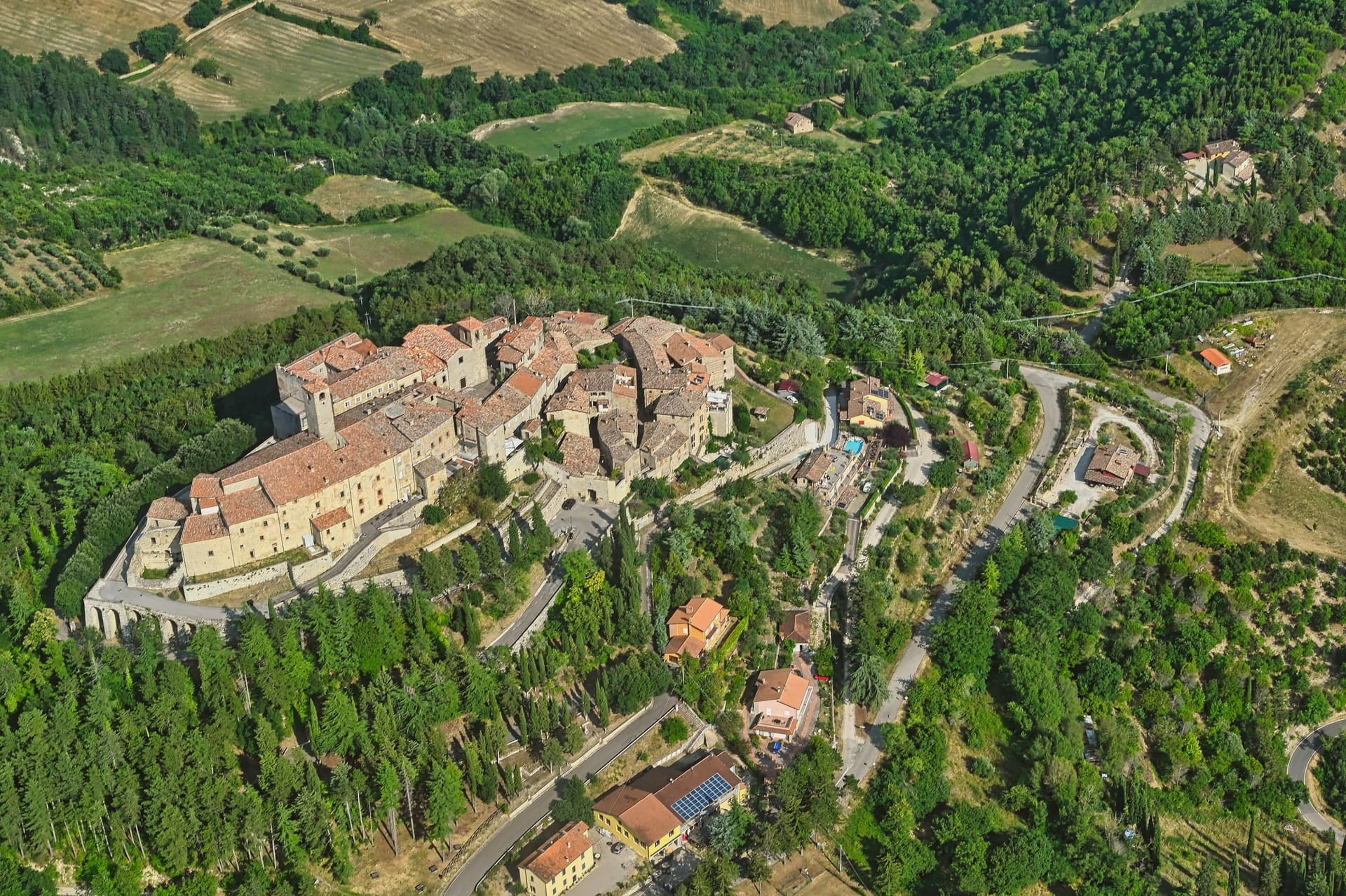
Monte Santa Maria Tiberina
Province: Perugia · 688 m
An imperial-fief borgo at 688 meters, held by the Bourbon del Monte marquises from 1250 to 1815.
Norcia
Province: Perugia · 604 m
Birthplace of San Benedetto at 604 meters on a Sibillini plateau, leveled by the 2016 earthquake and rebuilt stone by stone.
Fossato di Vico
Province: Perugia · 581 m
A medieval village on Mount Mutali at 581 meters, where the Via Flaminia's Roman waystation Hellvillum became a tenth-century castle still threaded by covered alleyways.
Pietralunga
Province: Perugia · 566 m
A pre-Apennine hill town at 566 meters on the northeast Tiber ridge, ringed by truffle woods and white-potato fields.
Giano dell'Umbria
Province: Perugia · 547 m
A hill commune between Foligno, Spoleto and Todi, anchored by a Romanesque abbey built over the tomb of a fourth-century martyr.
Gubbio
Province: Perugia · 522 m
Pre-Roman Ikuvium of the Umbri, where seven bronze tablets carry the longest text of the Umbrian language.
Nocera Umbra
Province: Perugia · 520 m
A hill town at 520 meters on the Apennine slope, leveled by the 1997 earthquake and rebuilt, with mineral springs flowing since the sixteenth century.
Città della Pieve
Province: Perugia · 508 m
A red-brick hill town at 508 meters above the Valdichiana, the birthplace of Perugino and the home of Italy's narrowest alley.
Montone
Province: Perugia · 482 m
A walled medieval hill town at 482 meters above the upper Tiber, birthplace of the condottiero Braccio Fortebracci.
Citerna
Province: Perugia · 480 m
A medieval borgo at 480 meters above the upper Tiber valley, holding the only sculpture by Donatello in Umbria.
Allerona
Province: Terni · 472 m
A stone borgo at 472 meters between the Paglia valley and the Valdichiana, an Orvieto outpost whose Monaldeschi castle fell to Charles V.
Montefalco
Province: Perugia · 472 m
The hilltop wine capital of Umbria at 472 meters, where Sagrantino is grown almost nowhere else.
Vallo di Nera
Province: Perugia · 467 m
Castle village of 345 people at 467 meters in the upper Valnerina, granted by Spoleto in 1217 and barely changed since.
Stroncone
Province: Terni · 451 m
A walled medieval borgo at 451 meters eight kilometers south of Terni, with a Franciscan convent traditionally founded by Francis himself in 1213.
Lugnano in Teverina
Province: Terni · 441 m
A ridge town at 441 meters above the lower Tiber valley, with a 1230 Romanesque collegiata and a late-Roman infant cemetery on the hill below.
Panicale
Province: Perugia · 431 m
A walled hill town at 431 meters on Monte Petrarvella, where a 1505 Perugino fresco covers the back wall of San Sebastiano.
- ✷ We've been
Assisi
Province: Perugia · 424 m
A pink limestone town at 424 meters on the western flank of a mountain above the plain, the birthplace of Francis and a UNESCO site since 2000.
Monte Castello di Vibio
Province: Perugia · 422 m
A fifteenth-century walled village at 422 meters above the Tiber, home to the world's smallest all'italiana theatre with 99 seats.
Trevi
Province: Perugia · 412 m
A walled town at 412 meters above the Spoleto valley, ringed by 200,000 olive trees that make it the Umbrian capital of olive oil.
Corciano
Province: Perugia · 408 m
A walled medieval castello at 408 meters eight kilometers west of Perugia, where Saint Francis stopped on his way back from a Lent spent fasting on the island in 1223.
Amelia
Province: Terni · 406 m
A pre-Roman hilltown ringed by polygonal walls, with ten barrel-vaulted Roman cisterns beneath its main square.
Todi
Province: Perugia · 398 m
A walled hill town at 398 meters on the Tiber, with Etruscan, Roman, and medieval rings stacked one above the other.
Spoleto
Province: Perugia · 396 m
Lombard ducal capital at 396 meters under the Rocca Albornoziana, where a 230-meter aqueduct bridge crosses to Monteluco and Menotti founded the Festival in 1958.
Paciano
Province: Perugia · 391 m
Walled hill town of 957 people at 391 meters above the lake, three parallel streets, eight towers and three medieval gates intact.
Montecchio
Province: Terni · 377 m
A small hill commune at 377 meters above the Tiber, sitting on top of one of Umbria's largest Etruscan-tied necropolises.
Bettona
Province: Perugia · 353 m
A hill town at 353 meters between the Topino and Chiascio rivers, the only Etruscan settlement ever built east of the Tiber.
Massa Martana
Province: Perugia · 351 m
Umbria's Via Flaminia BPB, a 3,613-resident borgo on the original Roman consular road between Rome and Rimini, with the intact 9th-c Abbazia dei Santi Fidenzio e Terenzio above town, a network of Roman-era catacombe Cristiane (Catacombe di Villa San Faustino, the only ones in Umbria), and the Borghi più belli inscription restored after the 1997 Marche-Umbria earthquake.
Acquasparta
Province: Terni · 350 m
A hill town at 350 meters above the Naia valley, where a Renaissance duchy briefly became the seat of Europe's first scientific academy.
San Gemini
Province: Terni · 337 m
A medieval borgo at 337 meters above ancient Roman paving, four kilometers below the ruins of Carsulae.
Orvieto
Province: Terni · 325 m
Etruscan Velzna on a 325-meter tufa butte, later a medieval refuge of popes.
- ✷ We've been
Magione
Province: Perugia · 299 m
A hill town east of Trasimeno built around a medieval Order's fortified base.
Campello sul Clitunno
Province: Perugia · 290 m
Springs of the Clitunno and the Lombard Tempietto on the valley floor at 290 meters, the temple inscribed by UNESCO in 2011.
Città di Castello
Province: Perugia · 288 m
A walled town of 38,000 in the upper Tiber valley where Raphael painted his first independent commissions and the white truffle season is the year's headline food event.
Scheggino
Province: Perugia · 280 m
Triangular castle village on the banks of the Nera at 280 meters, where the first commercial Italian truffle company was founded in 1928.
Spello
Province: Perugia · 280 m
Augustan Hispellum sits at 280 meters on Monte Subasio, its Roman gates still standing over streets that Pinturicchio once painted a chapel for.
Arrone
Province: Terni · 243 m
Medieval castle village on the left bank of the Nera at 243 meters, upstream from the largest man-made waterfall in the world.
Narni
Province: Terni · 240 m
Narni is a hilltop town on a travertine outcrop above the Nera valley whose Latin name, Narnia, gave C.S. Lewis a word for a fictional kingdom he never set foot in.
Foligno
Province: Perugia · 235 m
A valley town at 235 meters on the Topino, where Dante's Divine Comedy was first printed in 1472.
Bevagna
Province: Perugia · 225 m
Roman Mevania on the Umbrian plain at 225 meters, four medieval quarters that compete every June in a reconstructed market of the 13th century.
Torgiano
Province: Perugia · 219 m
A walled river town at 219 meters at the confluence of the Tiber and the Chiascio, the first DOC and DOCG zone in Umbria.
Deruta
Province: Perugia · 218 m
A hill town at 218 meters on the left bank of the Tiber, the maiolica capital of central Italy since the late thirteenth century.
The slow-trip planner
Plan a slow trip across the towns travelers skip.
Answer five questions. We will shape a geographically coherent slow trip from the 1,000 Italian towns most travelers skip. Yours to save and share.
From elsewhere in Italy
Five more towns to discover
Biccari
Province: Foggia
A Subappennino Dauno borgo at 450 meters under Monte Cornacchia, the highest peak in Puglia at 1,151 meters, with a Byzantine tower at its core.
Sirolo
Province: Ancona
A clifftop borgo at 125 meters, above the Due Sorelle sea stacks of the Adriatic.
Penne
Province: Pescara
The brick city at 438 meters between the Tavo and Fino, ancient capital of the Vestini, rebuilt after Allied bombing and awarded the Silver Medal of Civic Merit.
Palazzolo Acreide
Province: Siracusa
An 8,000-resident hilltop town on the Iblei plateau at 670m, rebuilt entirely in late Baroque after the 1693 earthquake and founded over the Greek Akrai colony in 664 BC, with a Greek theatre and a cluster of rock carvings unlike anything else nearby.
Verucchio
Province: Rimini
A spur over the lower Marecchia valley, cradle of the Villanovan civilization and birthplace of the Malatesta lordship of Romagna.