
Umbria · Perugia
Assisi
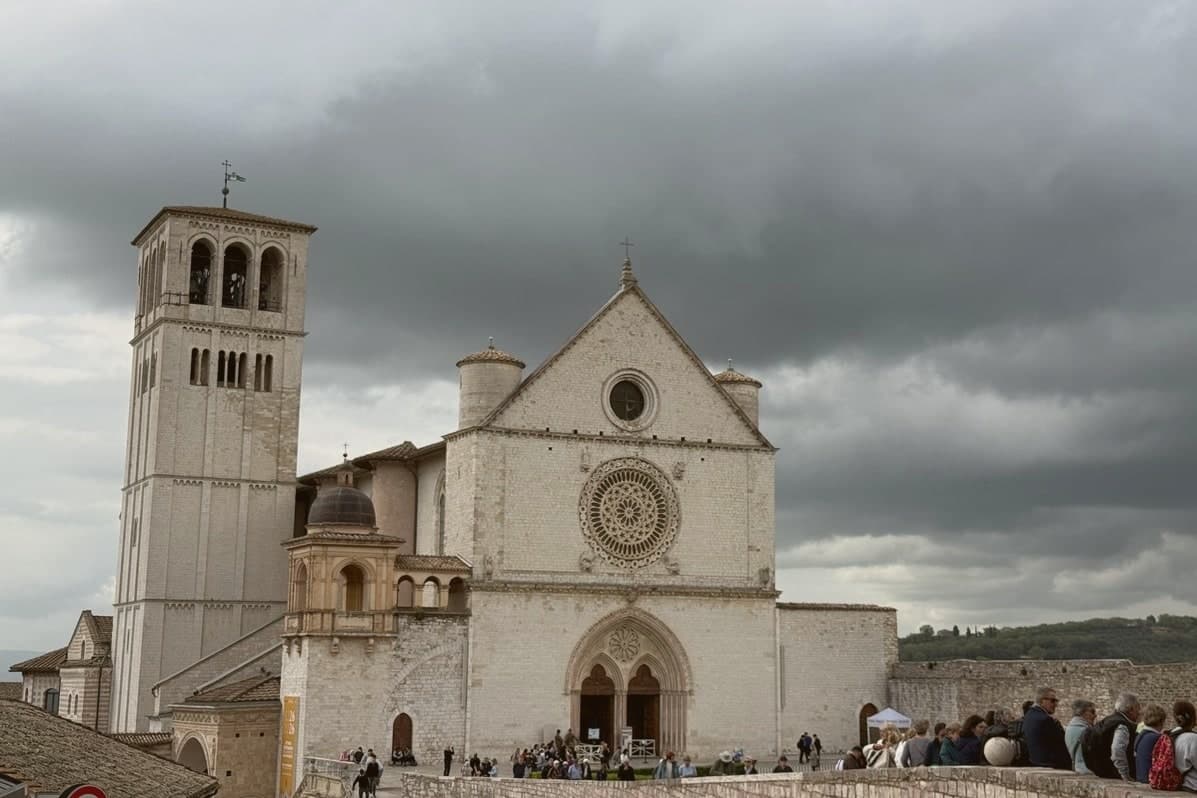
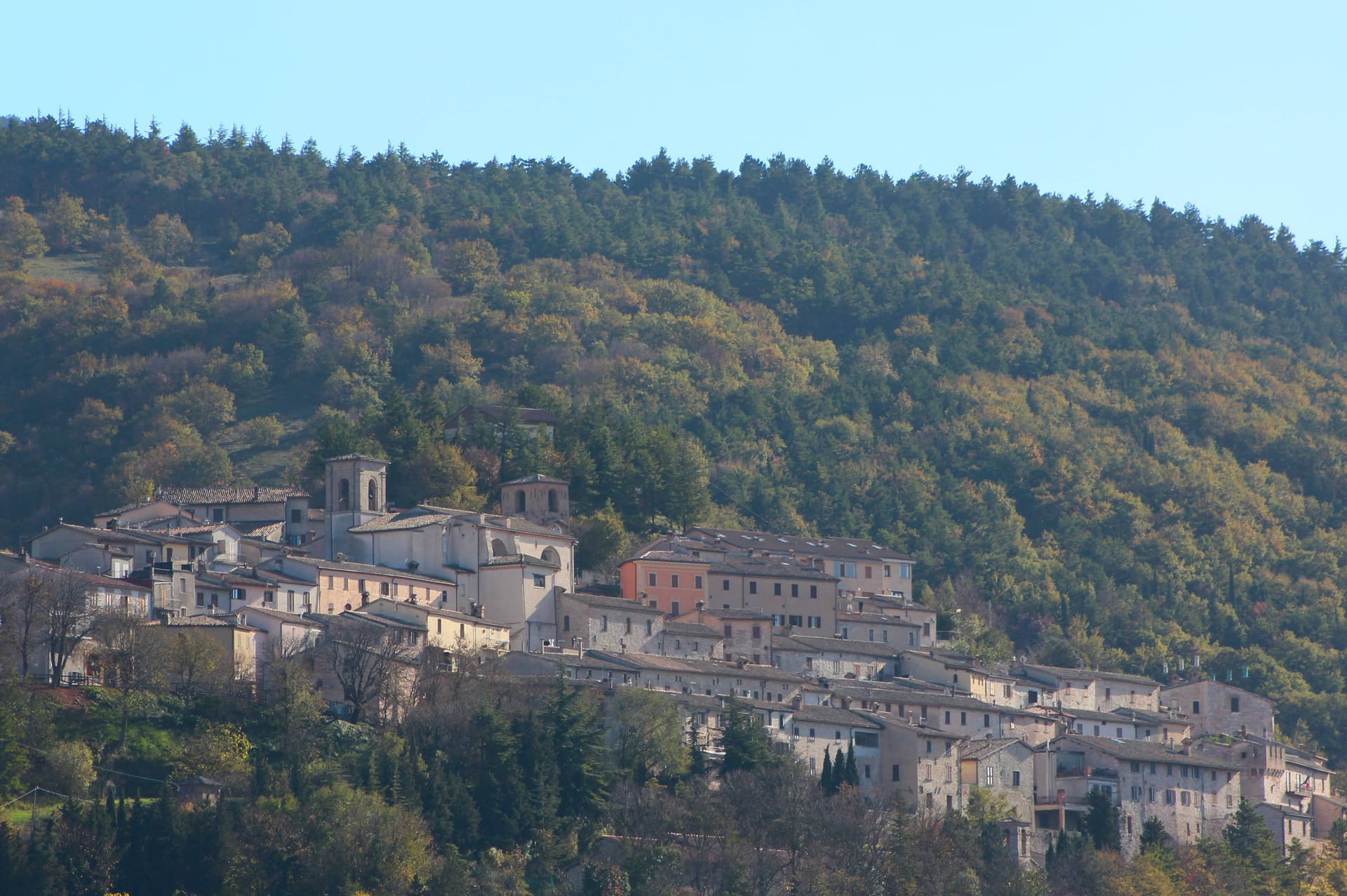
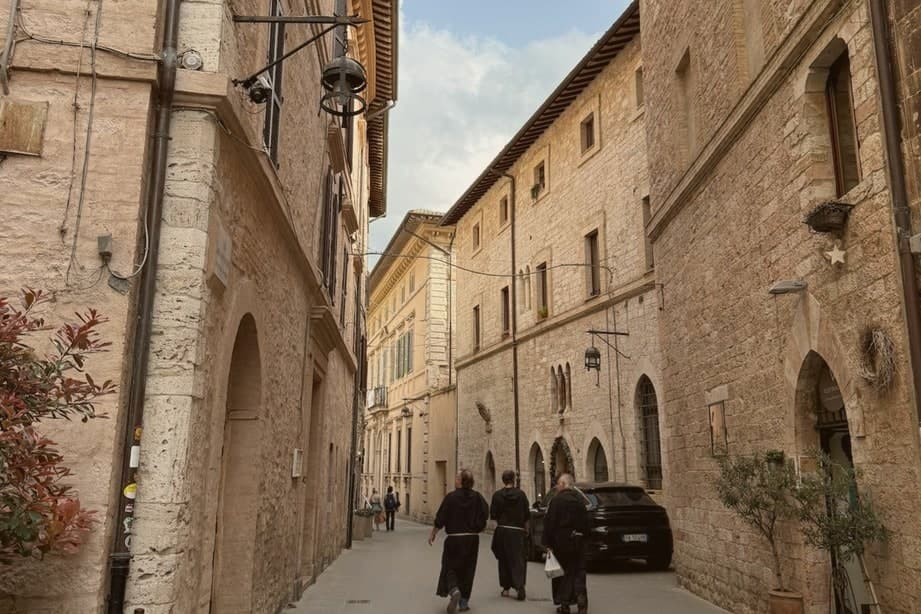
A pink limestone town on the western flank of a mountain above the plain, the birthplace of Francis and a UNESCO site since 2000.
- Best time
- Apr–Oct
- By car
- 33 min from Perugia
- By train
- Station in the comune
- Population
- 27,605
Known for
UNESCO 2000
Inscribed in 2000 for the basilicas, the medieval centre and the Franciscan sites that shaped Italian painting between 1280 and 1320.
FRANCIS AND CLARE
Born here in 1182 and 1194, founders of the Franciscan and Poor Clare orders; their relics anchor the two ends of town.
1997 EARTHQUAKE
September 1997 quakes brought down part of the upper basilica's vault; the church reopened in under two years.
When to visit
Best · Apr–Oct
- J9°
- F12°
- M13°
- A16°
- M22°
- J27°
- J31°
- A31°
- S25°
- O20°
- N14°
- D10°
- Best
- Hot or crowded
- Quiet
- Mostly closed
Daytime averages, 2020–2024. Weather data by Open-Meteo.com.
The festa: Rufino di Assisi, 12 August
Why come
Assisi sits on a terraced spur twenty kilometers east of Perugia, the town built into the western flank of Monte Subasio where it drops toward the plain below. The Umbri settled the site before the Romans came, and the municipium of Asisium grew up around what is now Piazza del Comune, the square that still forms the civic center of the medieval town. The centro storico runs between two poles: the basilica holding Francis's tomb at one end and the church holding Clare's relics at the other, with the Roman square and its temple facade sitting between them as the oldest layer beneath the medieval one.
Below the town, on the plain, stands the basilica built around the chapel where Francis founded his order and died. Further up the mountain, past the town walls, the hermitage occupies a beech wood where Francis and his companions withdrew from all of it. The layout traces the life it commemorates: birth and burial at the center, founding and death on the plain below, retreat in the wood above. The town has arranged itself, over centuries, around the geography of one man's biography.
Read on
Assisi in our articles
 The best towns with a food festival that you can reach by train in the province of Perugia6 towns, Assisi among them.
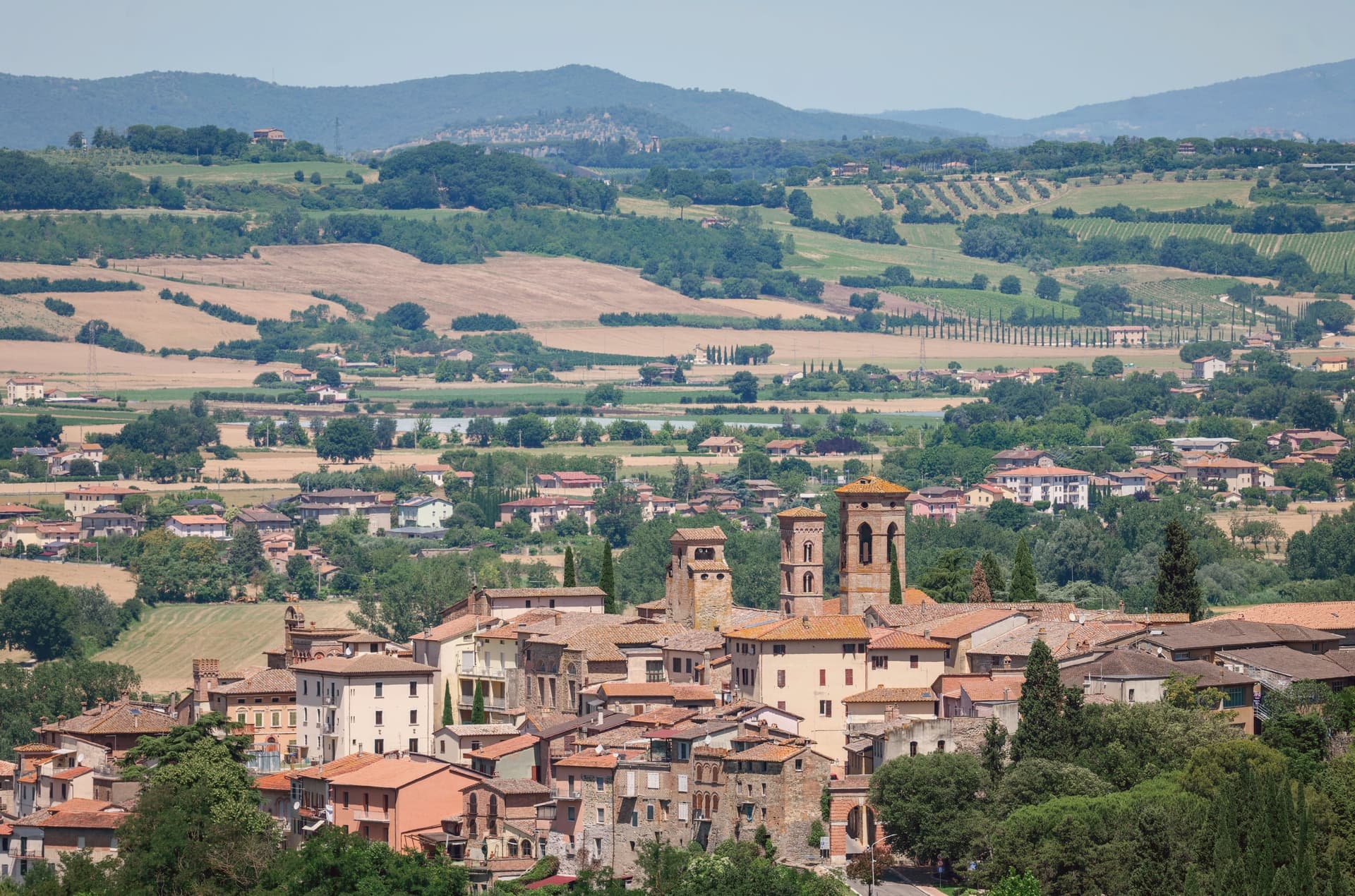 The best towns with a serious restaurant that you can reach by train in the province of Perugia6 towns, Assisi among them.
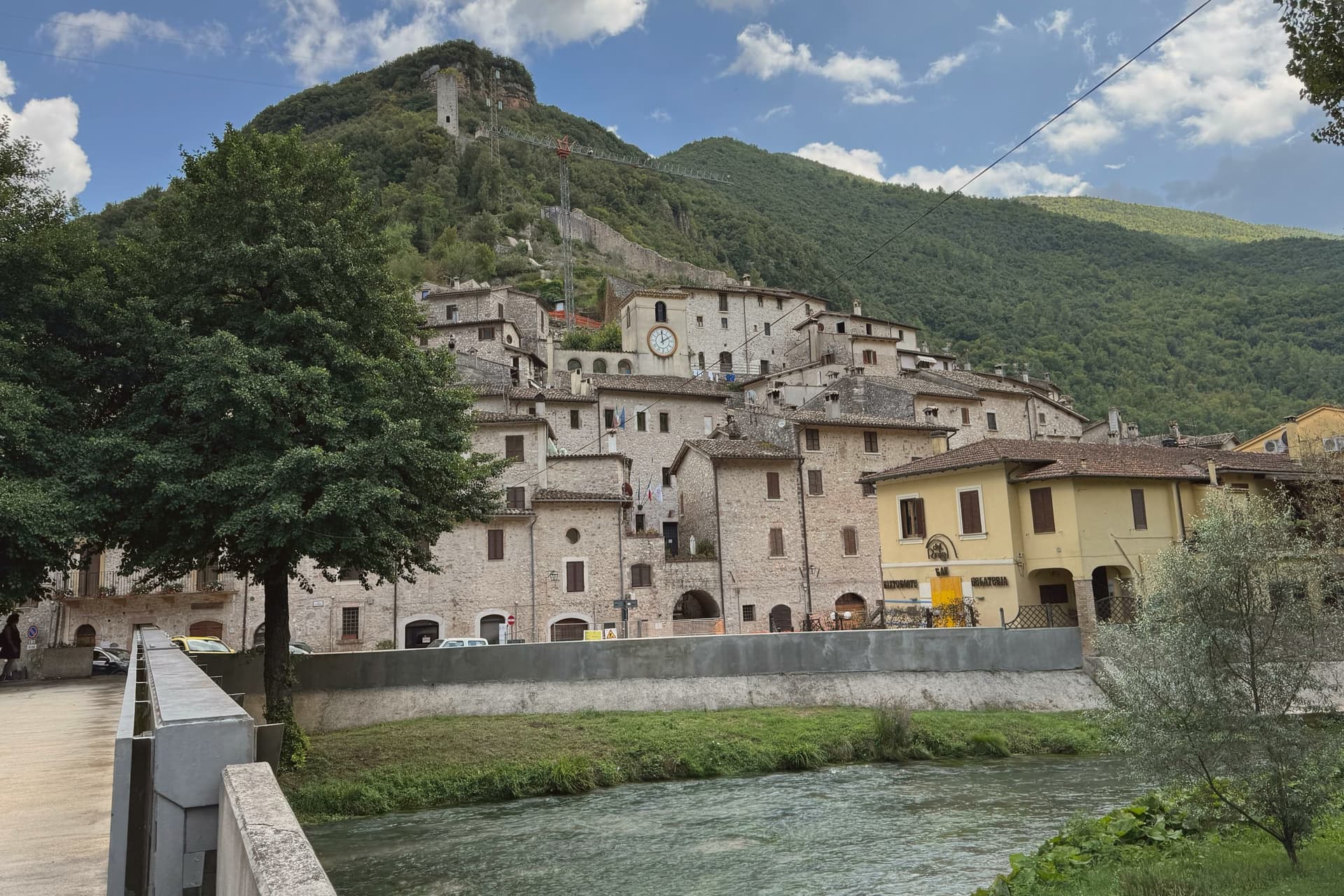 The best towns worth staying overnight in the province of Perugia6 towns, Assisi among them.
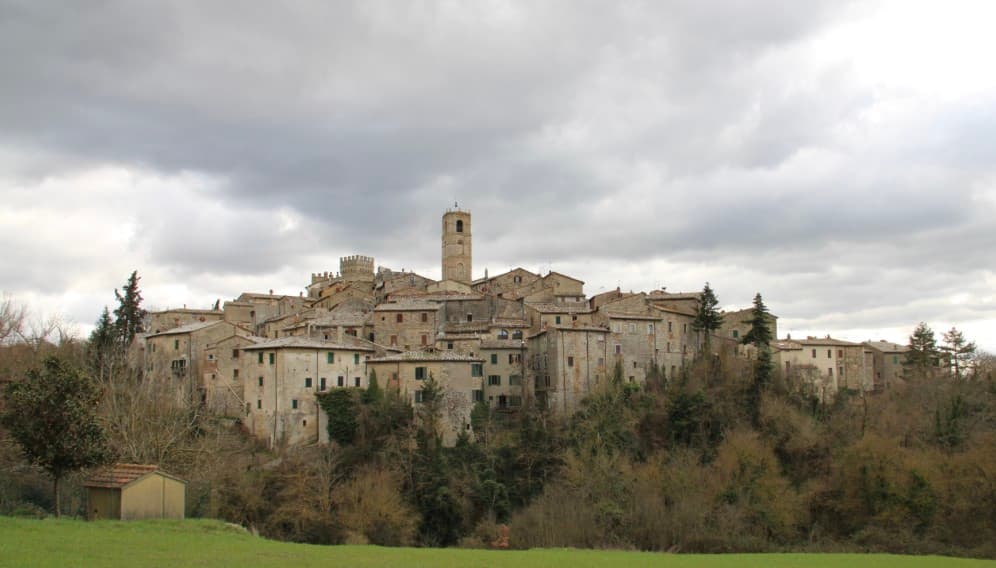 The best towns worth staying overnight that eat well within 90 minutes of Perugia6 towns, Assisi among them.
How to get there
From Ancona / Pescara (AOI), about 1h 46m by car.
Rimini (RMI) is about 2h 52m away.
By car from the centre of Perugia 33 minutes, Siena 2 hours or Ancona 2 hours.
There is a railway station in the comune, so you can arrive without a car.
Coming from Florence?
Coming by train into Perugia? Assisi is about 32 minutes away by road.
What to see
Basilica di San Francesco
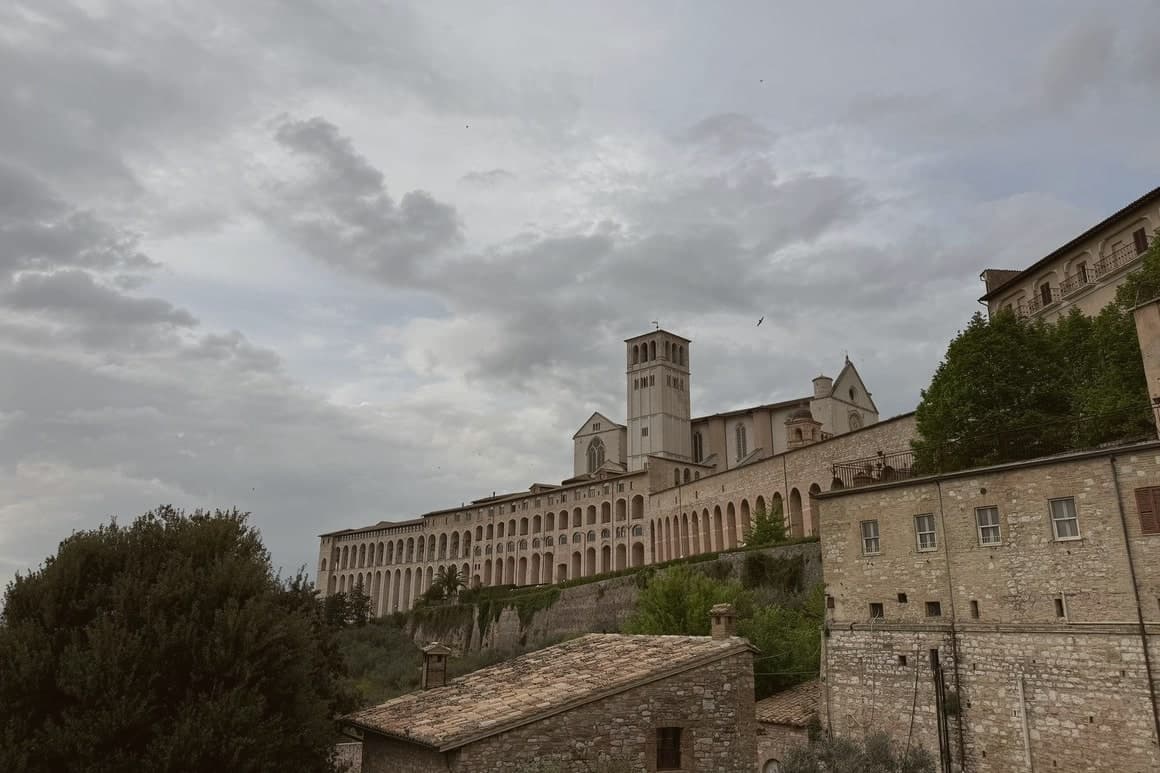
Two superimposed churches over the saint's tomb, frescoed by Cimabue, Giotto, Simone Martini and Pietro Lorenzetti.
Basilica di Santa Chiara
Church at the eastern end of the centro storico, holding the relics of Saint Clare and the San Damiano Crucifix.
Tempio di Minerva
Roman temple on Piazza del Comune, six Corinthian columns intact, one of the best-preserved temple façades in the country, converted to a church in 1539.
Rocca Maggiore
Fortress above the town first recorded in 1174, rebuilt by Cardinal Albornoz in 1367, with a panoramic walk along the Tescio valley.
Santa Maria degli Angeli e Porziuncola
Basilica in the plain below the town, built around the small chapel where Francis founded the Franciscan order and died in 1226.
Eremo delle Carceri
Hermitage four kilometers up Monte Subasio in a beech wood, the caves where Francis and his companions retreated to pray.
The slow-trip planner
Building a trip? Find where Assisi fits in a slow Italy circuit.
Answer five questions. We will shape a geographically coherent slow trip from the 1,000 Italian towns most travelers skip. Yours to save and share.
We recommend
Where to eat and stay
Not our picks, but places the guides put their name to: a Michelin star, a Gambero Rosso fork, a Slow Food snail, a Michelin Key for the hotels. Worth a table, a counter, or a night when you pass through.
La Locanda del CardinaleRistorante
La Locanda del Cardinale carries one Gambero Rosso fork (78/100), plus a spot in the Michelin Guide.
BenediktoRistorante
Benedikto carries a spot in the Michelin Guide.
Re Tartù agli OrtiRistorante
Re Tartù agli Orti holds two Gambero Rosso forks (81/100).
UneRistorante
Une has one Michelin star to its name.
Tenuta San MasseoHotel
A place in the Michelin hotel guide, at Tenuta San Masseo.
Through the year
What happens here
Feasts and festivals that come back year after year. We give the month rather than the date, because the date moves and the month rarely does. Check with the source before you plan a journey around one.
Festa di Sant'Annapatron saint's feast
usually held across July and August. itinerarinelgusto.it
Antichi Saporifood festival
usually held in August. TrovaSagre
Festa delle salvie e del Giardino - Assisifood festival
usually held across September and October. itinerarinelgusto.it
The Sunday letter
Assisi got its letter. One town every Sunday, free. The photo, the food, the festa.
Living here
- Population 27,605
- Commuter belti
- Pharmacy in town
- High school within a 30-minute drive
- Train station in the comune
- Nearest airport Ancona / Pescara, 1 h 46 min drive
- Regional capital Perugia, 33 min drive
Common questions
- What is Assisi known for?
- Assisi is a pink limestone town at 424 meters on the western flank of a mountain above the plain, the birthplace of Francis and a UNESCO site since 2000.
- Where is Assisi?
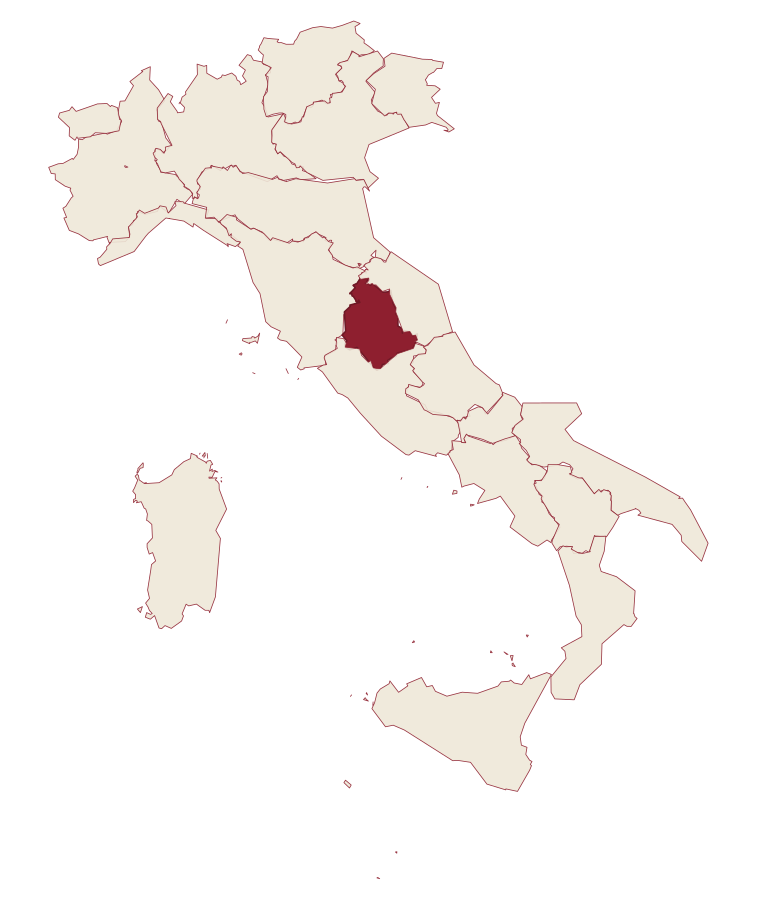
- Assisi is a comune in the province of Perugia, in Umbria.
- What is the nearest airport to Assisi?
- Ancona / Pescara (AOI), about 1h 46m by car.
- Can you get to Assisi without a car?
- Yes. There is a railway station in the comune, so you can arrive by train.
- How long is the drive from Perugia to Assisi?
- About 33 minutes by car.
- When is the best time to visit Assisi?
- Best in Apr–Oct. July is the warmest month, averaging 31 degrees, and December the wettest, with about 14 rain days.
- Is there a sagra or a festival in Assisi?
- Yes. Festa di Sant'Anna, Antichi Sapori and Festa delle salvie e del Giardino - Assisi. July is when the first of them falls.
- Which other towns are like Assisi?
- Magione, Monteprandone and Bra.
- How many people live in Assisi?
- 27,605 at the 2023 count.
Tags & datadesignations · numbers · sources
Recognised as
The numbers
- Elevation: 424 m
- Population: 27,605
- Surface area: 187.19 km²
These figures were compiled from public directories: ISTAT, OpenStreetMap and Wikidata, and from the official listings of the guides named on this page. Town details change; verify with official sources before you travel.
Similar
Towns like Assisi
Magione
Province: Perugia
both inland, away from the coast · both over 10,000 people
Monteprandone
Province: Ascoli Piceno
both inland, away from the coast · both over 10,000 people
Bra
Province: Cuneo
both inland, away from the coast · both over 10,000 people
Venaria Reale
Province: Torino
both inland, away from the coast · both over 10,000 people
Avigliana
Province: Torino
both inland, away from the coast · both over 10,000 people
Fiesole
Province: Firenze
both inland, away from the coast · both over 10,000 people
🏛️ UNESCO
More UNESCO towns
Matera
Province: Matera
Cave dwellings carved into limestone since the Paleolithic, called the shame of Italy in the 1950s and made European Capital of Culture in 2019.
Amalfi
Province: Salerno
The first Italian maritime republic and the coast it named, six meters above the sea between cliffs that close around the duomo's steps.
Ascea
Province: Salerno
Two villages, a hilltown at 230 meters and a Cilento marina, with Parmenides and Zeno's Eleatic school in the ruins of Greek Velia below.
Atrani
Province: Salerno
The smallest commune in Italy by area, twelve hectares of stacked houses where the Amalfi Coast pinches shut around a single piazza.
Benevento
Province: Benevento
Sannio capital at the Calore-Sabato confluence, with a 114 AD Trajan arch and a Lombard rotunda on the UNESCO list.