
Umbria · Perugia
Foligno
A valley town on the Topino, where Dante's Divine Comedy was first printed in 1472.
- Best time
- Apr–Oct
- By car
- 40 min from Perugia
- By train
- Station in the comune
- Population
- 55,226
Known for
DANTE 1472
The first printed edition of the Divina Commedia was produced here on 5-6 April 1472 by Numeister and Angelini, in the Palazzo Orfini.
LA QUINTANA
Jousting tournament first recorded 1448, revived 1946, with ten rioni racing horseback against a wooden Mars to spear three rings.
GENTILE DA FABRIANO
Palazzo Trinci frescoes of 1411-1412 by Gentile and Jacopo Bellini count among the major late-Gothic cycles in central Italy.
PATATA ROSSA DI COLFIORITO
The commune lies inside the Patata Rossa di Colfiorito IGP production zone.
When to visit
Best · Apr–Oct
- J10°
- F13°
- M14°
- A18°
- M23°
- J28°
- J32°
- A32°
- S26°
- O21°
- N15°
- D12°
- Best
- Hot or crowded
- Quiet
- Mostly closed
Daytime averages, 2020–2024. Weather data by Open-Meteo.com.
The festa: Feliciano di Foligno, 24 January
Why come
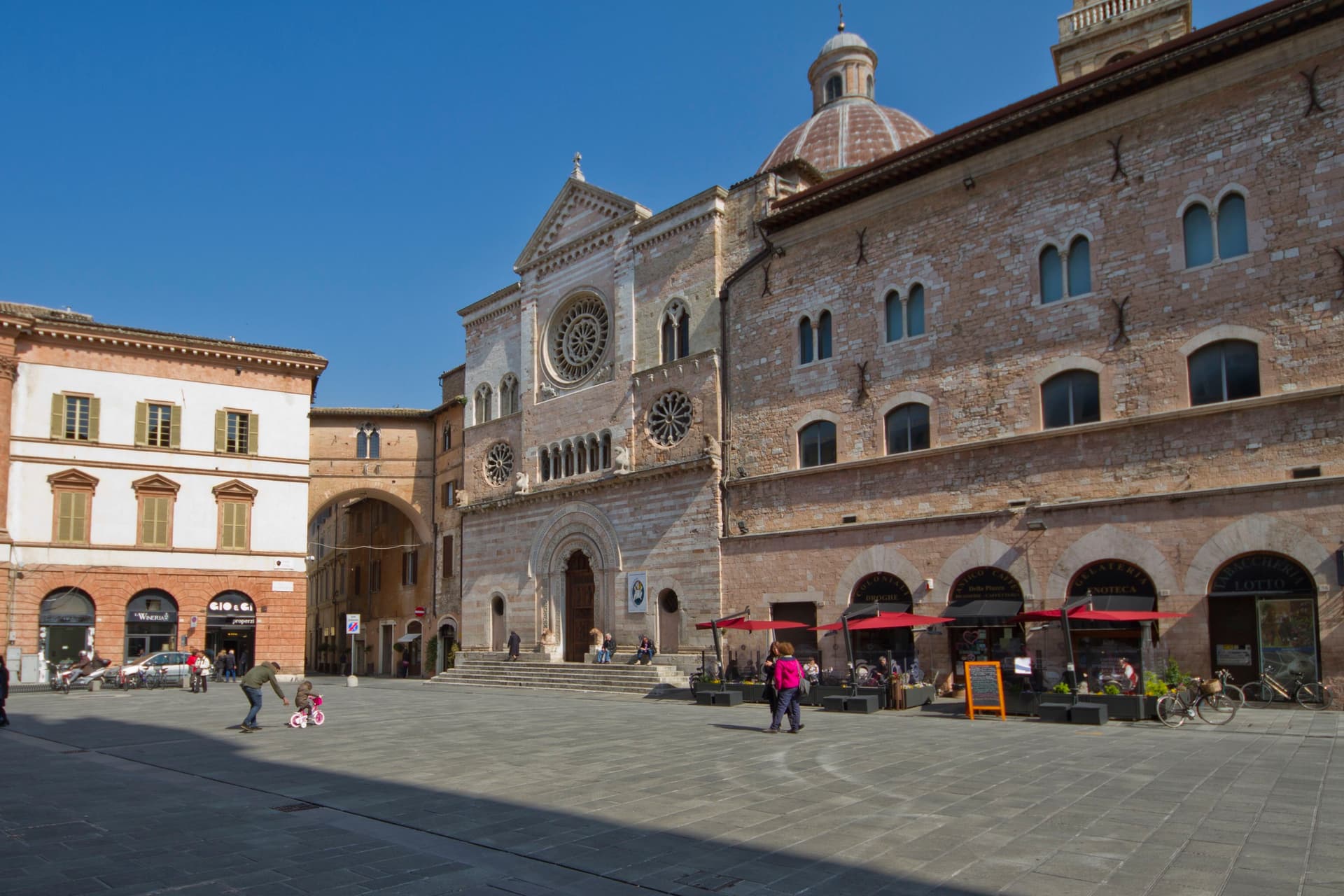
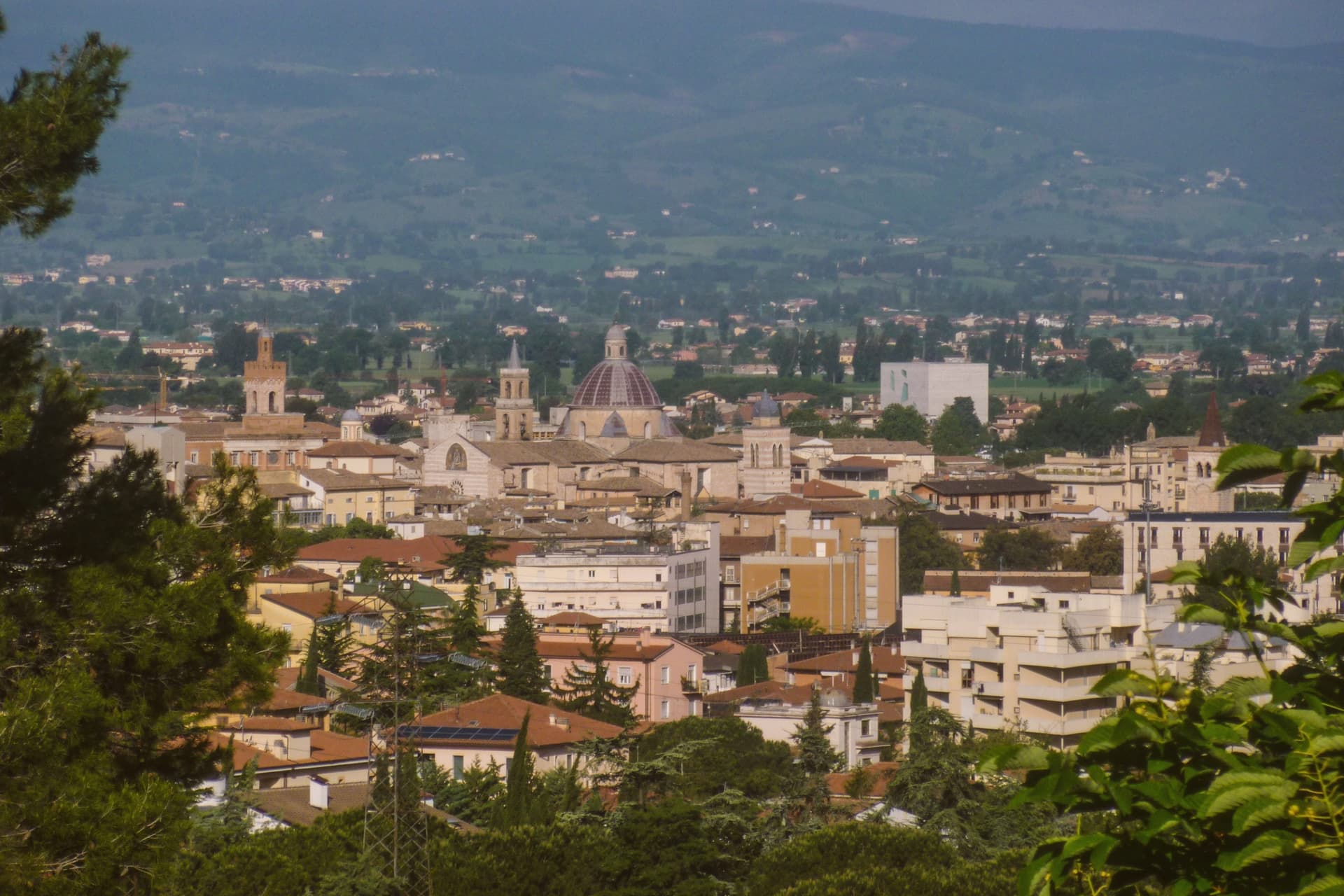
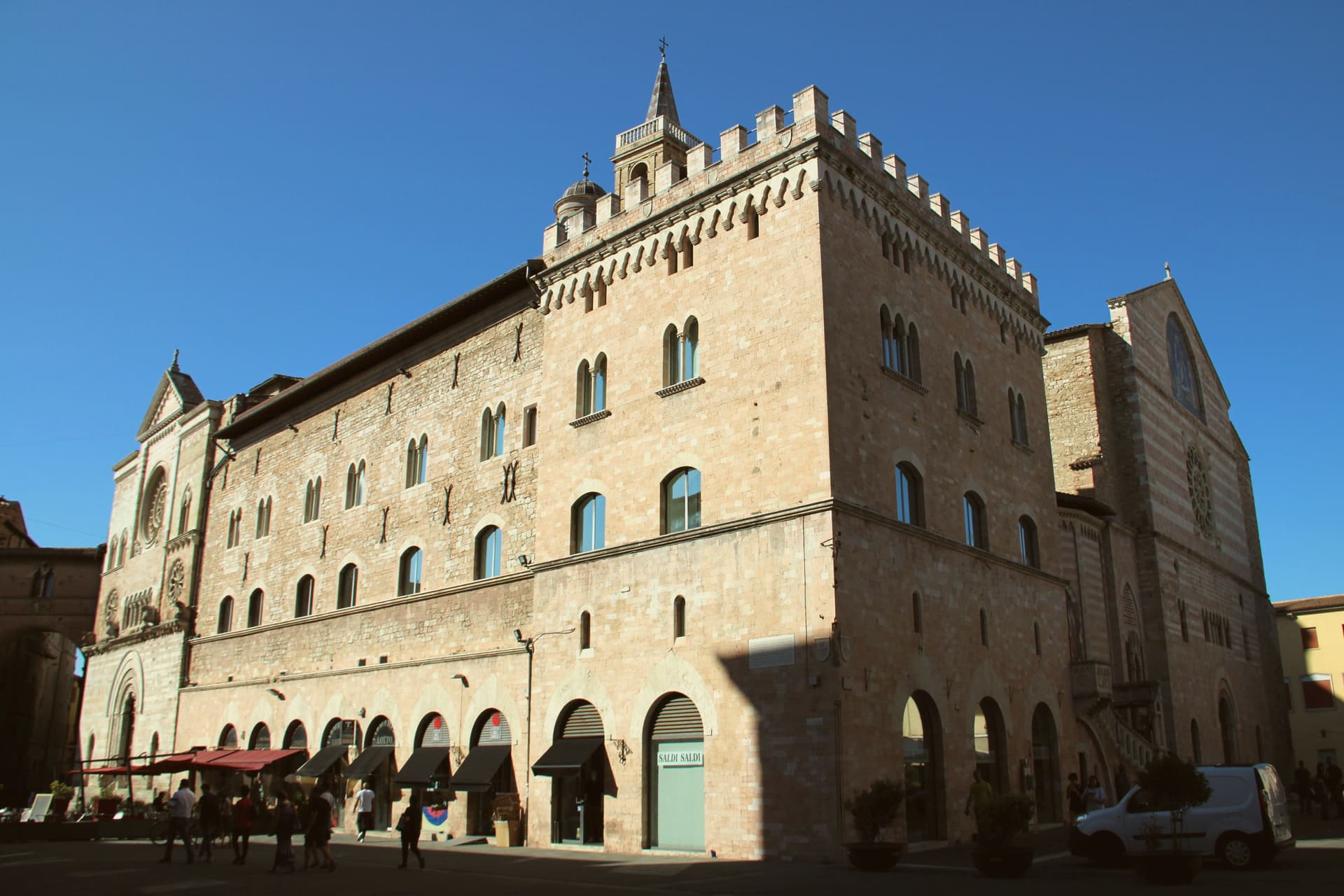
Foligno sits on the left bank of the Topino where the river leaves the Apennines and meets the plain of the Clitunno, the point at which the mountains give way to the Umbrian Valley. The town was called Fulginium in antiquity, and Cicero mentions the prefecture in two surviving fragments. The Trinci ruled the town from 1305 to 1439, and the palace that carries their name still stands at its center, with the cathedral facing the same square where the town's tournament has run twice a year since its revival.
The city's oldest church predates the Trinci period by centuries, its site going back to an 8th-century chapel, while the abbey in the hills above town was founded still earlier, in 1084, its cloister finished in 1229. Between the ancient prefecture, the medieval abbey, the Trinci court, and the print workshop that put Dante into type, Foligno reads as a valley crossing point where successive centuries each left a building rather than displacing what came before.
The Sunday letter
Foligno is on our list. Its letter is still to come.
We are writing about all 1,000 of these towns, one at a time, in a free letter every Sunday: the photo, the food, the festa. That is our mission. Sign up and you will be there when Foligno comes up. By Peter & Sophia, from Pietrasanta.
Read on
Foligno in our articles
 The best towns with a food festival that you can reach by train in the province of Perugia6 towns, Foligno among them.
 The best olive oil towns you can reach by train in the province of Perugia7 towns, Foligno among them.
 The best towns known for what they grow within 90 minutes of Perugia7 towns, Foligno among them.
 The best olive oil towns that eat well in the province of Perugia8 towns, Foligno among them.
How to get there
From Ancona / Pescara (AOI), about 1h 40m by car.
Rimini (RMI) is about 2h 47m away.
By car from the centre of Perugia 40 minutes, Ancona 1h 52m or Siena 2 hours.
There is a railway station in the comune, so you can arrive without a car.
Coming by train into Perugia? Foligno is about 39 minutes away by road.
What to see
Palazzo Trinci
Seat of the Trinci signoria 1305-1439, frescoed by Gentile da Fabriano and Jacopo Bellini, now holding the Pinacoteca and archaeological museum.
Cattedrale di San Feliciano
Romanesque cathedral on Piazza della Repubblica, built over the tomb of the bishop-martyr buried here in 251 AD.
Basilica di Santa Maria Infraportas
Oldest church in the city on the site of an 8th-century chapel, frescoes by Nelli, Ugolino di Gisberto, Alunno and Mezzastris.
Abbazia di Sassovivo
Benedictine abbey founded 1084 in the hills above town, with a Romanesque cloister of 128 columns completed in 1229.
Giostra della Quintana
Contested twice a year in June and September, the race fills Piazza della Repubblica as riders from each rione take turns against the wooden Mars.
Calamita Cosmica
Twenty-four meter Gino De Dominicis skeleton sculpture installed in the deconsecrated Chiesa della Santissima Trinità in Annunziata.
The slow-trip planner
Building a trip? Find where Foligno fits in a slow Italy circuit.
Answer five questions. We will shape a geographically coherent slow trip from the 1,000 Italian towns most travelers skip. Yours to save and share.
We recommend
Where to eat
Not our picks, but places the guides put their name to: a Michelin star, a Gambero Rosso fork, a Slow Food snail, a Michelin Key for the hotels. Worth a table, a counter, or a night when you pass through.
UneRistorante
Two Gambero Rosso forks (86/100) for Une, and a place in L'Espresso's Top 300.
CucinaaBistrot
Cucinaa holds one Gambero Rosso table.
GUS Bottega AlimentareBistrot
GUS Bottega Alimentare carries a Gambero Rosso listing.
Osteria BacerottiTrattoria
Osteria Bacerotti has one Gambero Rosso prawn to its name.
Osteria Dodici RondiniBistrot
Osteria Dodici Rondini holds two Gambero Rosso tables.
Through the year
What happens here
Feasts and festivals that come back year after year. We give the month rather than the date, because the date moves and the month rarely does. Check with the source before you plan a journey around one.
Festevolezzepatron saint's feast
usually held in July. TrovaSagre
Sagra della di San Giovanni Profiammafood festival
usually held in July. TrovaSagre
Giostra della Quintanahistorical re-enactment
usually held in September. TrovaSagre
Living here
- Population 55,226
- A local hubi
- Pharmacy in town
- High school within a 30-minute drive
- Train station in the comune
- Nearest airport Ancona / Pescara, 1 h 40 min drive
- Regional capital Perugia, 39 min drive
Common questions
- What is Foligno known for?
- Foligno is a valley town at 235 meters on the Topino, where Dante's Divine Comedy was first printed in 1472.
- Where is Foligno?
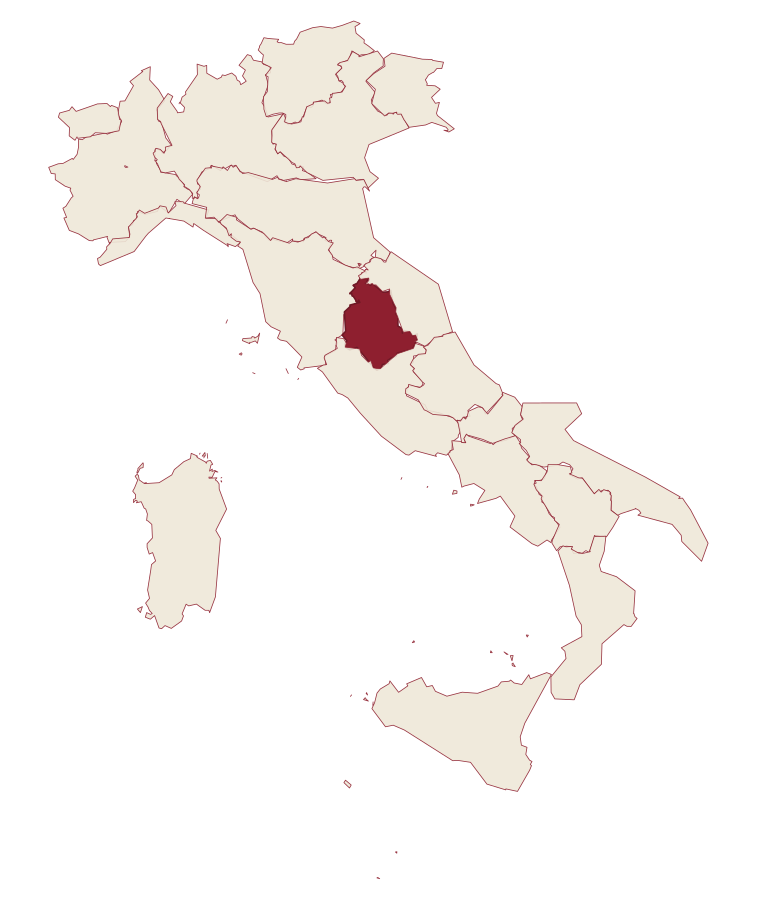
- Foligno is a comune in the province of Perugia, in Umbria.
- What is the nearest airport to Foligno?
- Ancona / Pescara (AOI), about 1h 40m by car.
- Can you get to Foligno without a car?
- Yes. There is a railway station in the comune, so you can arrive by train.
- How long is the drive from Perugia to Foligno?
- About 40 minutes by car.
- When is the best time to visit Foligno?
- Best in Apr–Oct. July is the warmest month, averaging 32 degrees, and May the wettest, with about 13 rain days.
- Is there a sagra or a festival in Foligno?
- Yes. Festevolezze, Sagra della di San Giovanni Profiamma and Giostra della Quintana. July is when the first of them falls.
- Which other towns are like Foligno?
- Spoleto, Macerata and Orvieto.
- How many people live in Foligno?
- 55,226 at the 2023 count.
Tags & datadesignations · numbers · sources
The numbers
- Elevation: 235 m
- Population: 55,226
- Surface area: 264.67 km²
These figures were compiled from public directories: ISTAT, OpenStreetMap and Wikidata, and from the official listings of the guides named on this page. Town details change; verify with official sources before you travel.
Similar
Towns like Foligno
Spoleto
Province: Perugia
both inland, away from the coast · both over 10,000 people
Macerata
Province: Macerata
both inland, away from the coast · both over 10,000 people
Orvieto
Province: Terni
both inland, away from the coast · both over 10,000 people
Tivoli
Province: Roma
both inland, away from the coast · both over 10,000 people
Siena
Province: Siena
both inland, away from the coast · both over 10,000 people
Velletri
Province: Roma
both inland, away from the coast · both over 10,000 people
🌳 Parco Regionale
More Parco Regionale towns in Umbria
Arrone
Province: Terni
Medieval castle village on the left bank of the Nera at 243 meters, upstream from the largest man-made waterfall in the world.
Assisi
Province: Perugia
A pink limestone town at 424 meters on the western flank of a mountain above the plain, the birthplace of Francis and a UNESCO site since 2000.
Bettona
Province: Perugia
A hill town at 353 meters between the Topino and Chiascio rivers, the only Etruscan settlement ever built east of the Tiber.
Castiglione del Lago
Province: Perugia
Trasimeno's western promontory, once the lake's fourth island, fortified in 1247 and later frescoed for a marquis of Corgna.
Città della Pieve
Province: Perugia
A red-brick hill town at 508 meters above the Valdichiana, the birthplace of Perugino and the home of Italy's narrowest alley.