
With events
Sagre and feste in Tuscany
50 towns
Each town page lists what happens there and the month it happens in, with the source. Always check with the town before you travel.
- ✷ We've been
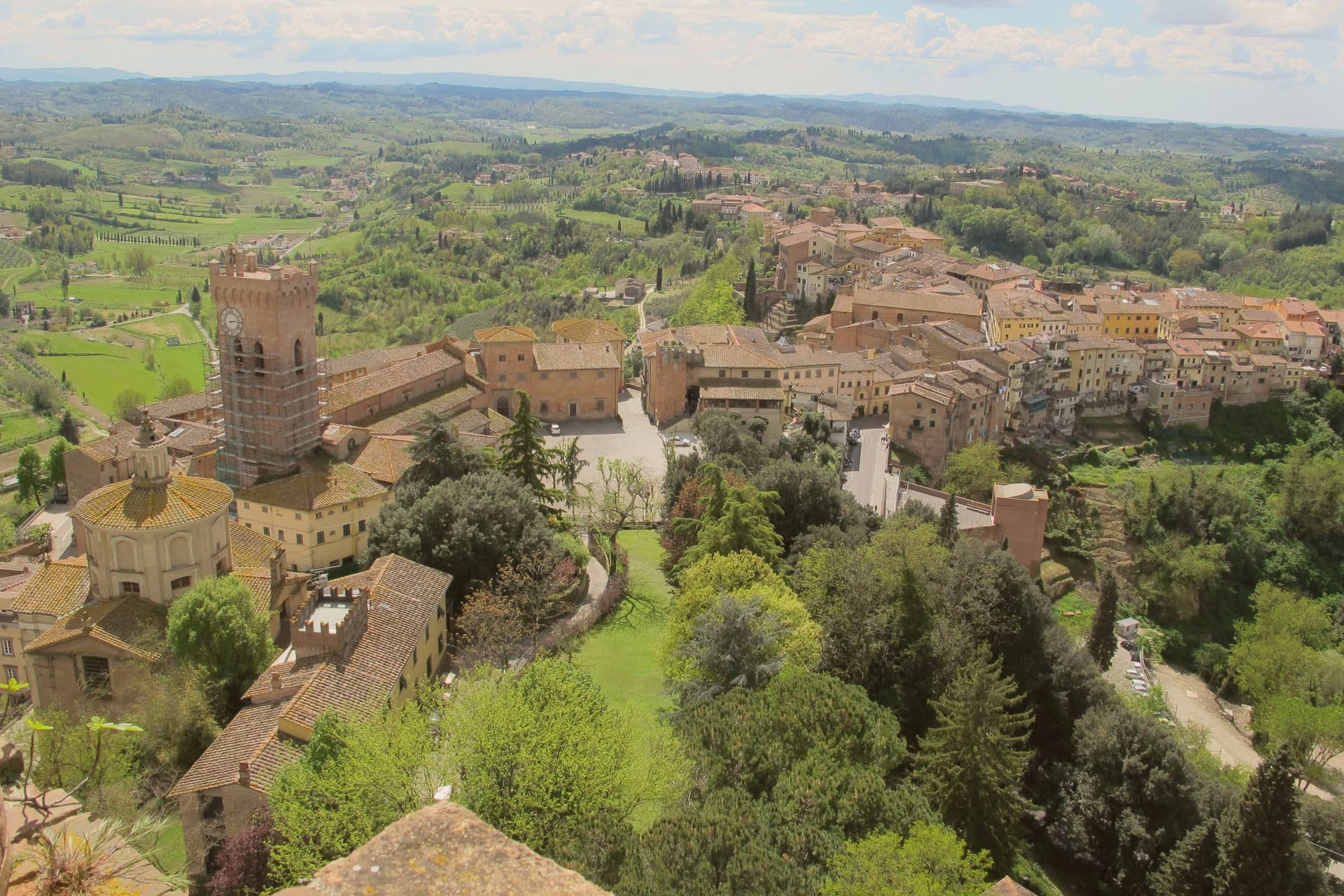
San Miniato
Province: Pisa · 150 m
The hilltop town between Pisa and Florence that produces a quarter of Tuscany's white truffles and once held the imperial seat of Otto I.
- ✷ We've been
Volterra
Province: Pisa · 531 m
The Etruscan acropolis of Velathri at 531 meters, the alabaster town that has been carving the same stone for three thousand years.
Cortona
Province: Arezzo · 494 m
An Etruscan lucumonia at 494 meters, with two kilometers of walls older than Rome.
- ✷ We've been
Montepulciano
Province: Siena · 605 m
A Renaissance hill town at 605 meters on a limestone ridge, aging its Sangiovese-based red in vaulted cellars beneath the palazzi.
Piancastagnaio
Province: Siena · 772 m
A chestnut-belt borgo at 772 meters on the southern slope, where four contrade still race for the Palio delle Contrade each August.
- ✷ We've been
Castiglione della Pescaia
Province: Grosseto · 4 m
A Maremma seaside town under an Aragonese castle, with the Vetulonia necropolis behind it and Italo Calvino buried on the hill.
Lucignano
Province: Arezzo · 400 m
A walled elliptical hill town at 400 meters between Siena and Arezzo, planned in medieval concentric rings around the goldsmith's reliquary called the Tree of Life.
- ✷ We've been
Manciano
Province: Grosseto · 444 m
A market town at 444 meters in the southern Maremma, with a Sienese fortress of 1424 and the thermal frazione of Saturnia in its territory.
- ✷ We've been
Pisa
Province: Pisa · 4 m
Maritime republic on the Arno, twelve kilometers from the Ligurian Sea, with the leaning bell tower at the center of a single UNESCO-listed walled compound.
- ✷ We've been
San Quirico d'Orcia
Province: Siena · 409 m
A walled stop on the Via Francigena at 409 meters in the UNESCO Val d'Orcia, where a twelfth-century Collegiata, a Renaissance garden and the Bagno Vignoni thermal pool sit within fifteen kilometers of each other.
- ✷ We've been
Siena
Province: Siena · 322 m
The medieval rival of Florence at 322 meters on three hills, with a shell-shaped piazza where seventeen contrade race bareback horses twice a year.
Anghiari
Province: Arezzo · 430 m
A walled medieval town at 430 meters over the upper Tiber valley, where Florence beat Milan in 1440 and Leonardo started the fresco he never finished.
- ✷ We've been
Arezzo
Province: Arezzo · 296 m
Tuscany's other set-piece: a 96,000-resident Etruscan-Roman-medieval hilltop city 80 km southeast of Florence.
Carmignano
Province: Prato · 189 m
A Medici village at 189 meters on the Montalbano slopes, where Etruscan tumuli sit below the Renaissance villas.
Castiglion Fiorentino
Province: Arezzo · 342 m
A walled hill town at 342 meters between Arezzo and Cortona, where Etruscan walls support the medieval Cassero.
Cetona
Province: Siena · 384 m
A medieval borgo at 384 meters, sold by Cosimo I to the Vitelli in 1556 and the centro storico still shaped by their fortress reconstruction.
Chiusi
Province: Siena · 398 m
The Etruscan city of King Porsenna at 398 meters above the Val di Chiana, with one of Italy's major Etruscan museums and tunnels carved beneath the streets.
- ✷ We've been
Greve in Chianti
Province: Firenze · 236 m
The market town on the Greve river, with a triangular piazza arcaded since the sixteenth century.
- ✷ We've been
Lucca
Province: Lucca · 19 m
The provincial capital ringed by four kilometers of intact sixteenth-century walls, birthplace of Puccini and the only fully walled Italian city of its scale.
- ✷ We've been
Montalcino
Province: Siena · 564 m
A walled hill town at 564 meters above the Val d'Orcia, the last fortress to hold out for the Sienese Republic and the birthplace of Brunello.
- ✷ We've been
Orbetello
Province: Grosseto · 3 m
A town on a narrow isthmus at the center of its own lagoon, fortified by Spain in 1557.
- ✷ We've been
Pienza
Province: Siena · 491 m
The first Renaissance ideal city, built from 1459 on the Val d'Orcia ridge.
- ✷ We've been
Pistoia
Province: Pistoia · 67 m
Italy's nursery capital and the medieval Tuscan rival that gave its name to the pistol, a quietly extraordinary centro storico 30 minutes from Florence by train and Italy's Capital of Culture 2017.
- ✷ We've been
Radicofani
Province: Siena · 814 m
The Val d'Orcia's basalt watchtower: a 1,060-resident UNESCO-inscribed borgo at 814m on a volcanic outcrop visible across half of southern Tuscany, crowned by an outlaw's fortress that Dante and Boccaccio both wrote into their pages.
San Casciano dei Bagni
Province: Siena · 582 m
A hilltop borgo at 582 meters above 42 hot springs that produced the largest Etruscan bronze hoard of the last fifty years.
- ✷ We've been
San Giuliano Terme
Province: Pisa · 10 m
A thermal spa ten kilometers from Pisa, where the springs were bathed since the Romans called them Aquae Pisanae.
- ✷ We've been
Capalbio
Province: Grosseto · 217 m
A walled hilltop borgo at 217 meters in the southern Maremma, donated to the Abbey of Tre Fontane by Charlemagne.
Capraia Isola
Province: Livorno · 19 m
A volcanic island of 370 residents and one village, a penal colony from 1873 to 1986 and a national park since.
Casale Marittimo
Province: Pisa · 214 m
A concentric stone borgo at 214 meters above the Val di Cecina, built where a seventh-century BC Etruscan outpost of Volterra once stood.
- ✷ We've been
Castiglione di Garfagnana
Province: Lucca · 540 m
A walled medieval town at 540 meters in the Garfagnana, the Lucca outpost that refused to submit to the Este and held the pass to San Pellegrino.
Cerreto Guidi
Province: Firenze · 123 m
The Medici hunting villa above the Padule di Fucecchio, where Cosimo I sent his court for the marshland game and Buontalenti built four ramps of stairs.
Certaldo
Province: Firenze · 67 m
The brick-built upper town in the Valdelsa where Boccaccio spent his last years, twenty-five kilometers from Florence on the medieval road to Siena.
Fiesole
Province: Firenze · 295 m
An Etruscan hilltop above Florence, still looking down on what later replaced it.
- ✷ We've been
Fivizzano
Province: Massa-Carrara · 373 m
The draw here is not the capoluogo but its 92 mountain frazioni, scattered across a Lunigiana commune where a thermal gorge, an intact fortress and a ridge-top hamlet each stand as their own destination.
Isola del Giglio
Province: Grosseto · 405 m
A granite island in the Tyrrhenian Archipelago, walled village on the ridge, port below, where the Costa Concordia ran aground in January 2012.
- ✷ We've been
Livorno
Province: Livorno · 3 m
Tuscany's working port and Medici-planned 'New City', a 16th-century planned town built on reclaimed coast, with a Venice-like canal quarter, the Quattro Mori monument, and a 1.5-km seafront promenade that locals call the world's most beautiful balcony.
Massa Marittima
Province: Grosseto · 380 m
A medieval mining town at 380 meters, free commune from 1255 to 1337, whose cathedral holds the relics of San Cerbone.
- ✷ We've been
Monte Argentario
Province: Grosseto · 5 m
A 635-meter peninsula tied to the mainland by three sand spits, ringed by Spanish forts and marked by Caravaggio's death in 1610.
Montecarlo
Province: Lucca · 163 m
A walled hill village at 163 meters above the Lucca plain, founded by Emperor Charles IV in 1333 and named for him, surrounded by twenty wineries.
- ✷ We've been
Monteriggioni
Province: Siena · 274 m
A circular Sienese fortress built between 1213 and 1219 on a natural hill, fourteen towers on a 570-meter wall, intact and unbroken.
Montescudaio
Province: Pisa · 242 m
A fortified hill borgo at 242 meters, named for a mountain of shields, with DOC wine since 1977 and bread, oil and grape all stamped in its identity.
- ✷ We've been
Pietrasanta
Province: Lucca · 14 m
The marble-processing town under the Apuan Alps, worked by Michelangelo, Henry Moore, Joan Miró and Fernando Botero.
- ✷ We've been
Piombino
Province: Livorno · 21 m
A promontory port facing Elba across the channel, founded by refugees from Etruscan Populonia and now the Tuscan archipelago's ferry capital.
- ✷ We've been
Pontedera
Province: Pisa · 14 m
The Valdera's working capital on the Pisa–Florence line, where Piaggio turned a bombed aircraft plant into the birthplace of the Vespa in 1946.
Pontremoli
Province: Massa-Carrara · 236 m
The capital of Lunigiana at the confluence of the Magra and Verde, holding the prehistoric stele statues and the oldest book prize in Italy.
Poppi
Province: Arezzo · 437 m
The Casentino borgo at 437 meters above the field where Dante fought at Campaldino in June 1289.
- ✷ We've been
San Gimignano
Province: Siena · 334 m
A walled hill town at 334 meters with 14 surviving medieval towers, UNESCO listed since 1990 and the home of Vernaccia.
Seravezza
Province: Lucca · 100 m
The Versilia town where Michelangelo opened the Pope's marble quarries and Cosimo I built his summer palace.
- ✷ We've been
Suvereto
Province: Livorno · 127 m
A stone borgo at 127 meters above the Val di Cornia, named for the cork oaks of its forests and ruled from the Rocca Aldobrandesca since 973.
Vicopisano
Province: Pisa · 12 m
A medieval river port rebuilt by Brunelleschi in 1434 after Florence took the town from Pisa.
The slow-trip planner
Plan a slow trip across the towns travelers skip.
Answer five questions. We will shape a geographically coherent slow trip from the 1,000 Italian towns most travelers skip. Yours to save and share.
From elsewhere in Italy
Five more towns to discover
Biccari
Province: Foggia
A Subappennino Dauno borgo at 450 meters under Monte Cornacchia, the highest peak in Puglia at 1,151 meters, with a Byzantine tower at its core.
Sirolo
Province: Ancona
A clifftop borgo at 125 meters, above the Due Sorelle sea stacks of the Adriatic.
Penne
Province: Pescara
The brick city at 438 meters between the Tavo and Fino, ancient capital of the Vestini, rebuilt after Allied bombing and awarded the Silver Medal of Civic Merit.
Palazzolo Acreide
Province: Siracusa
An 8,000-resident hilltop town on the Iblei plateau at 670m, rebuilt entirely in late Baroque after the 1693 earthquake and founded over the Greek Akrai colony in 664 BC, with a Greek theatre and a cluster of rock carvings unlike anything else nearby.
Verucchio
Province: Rimini
A spur over the lower Marecchia valley, cradle of the Villanovan civilization and birthplace of the Malatesta lordship of Romagna.