
Tuscany · Pisa
Pisa
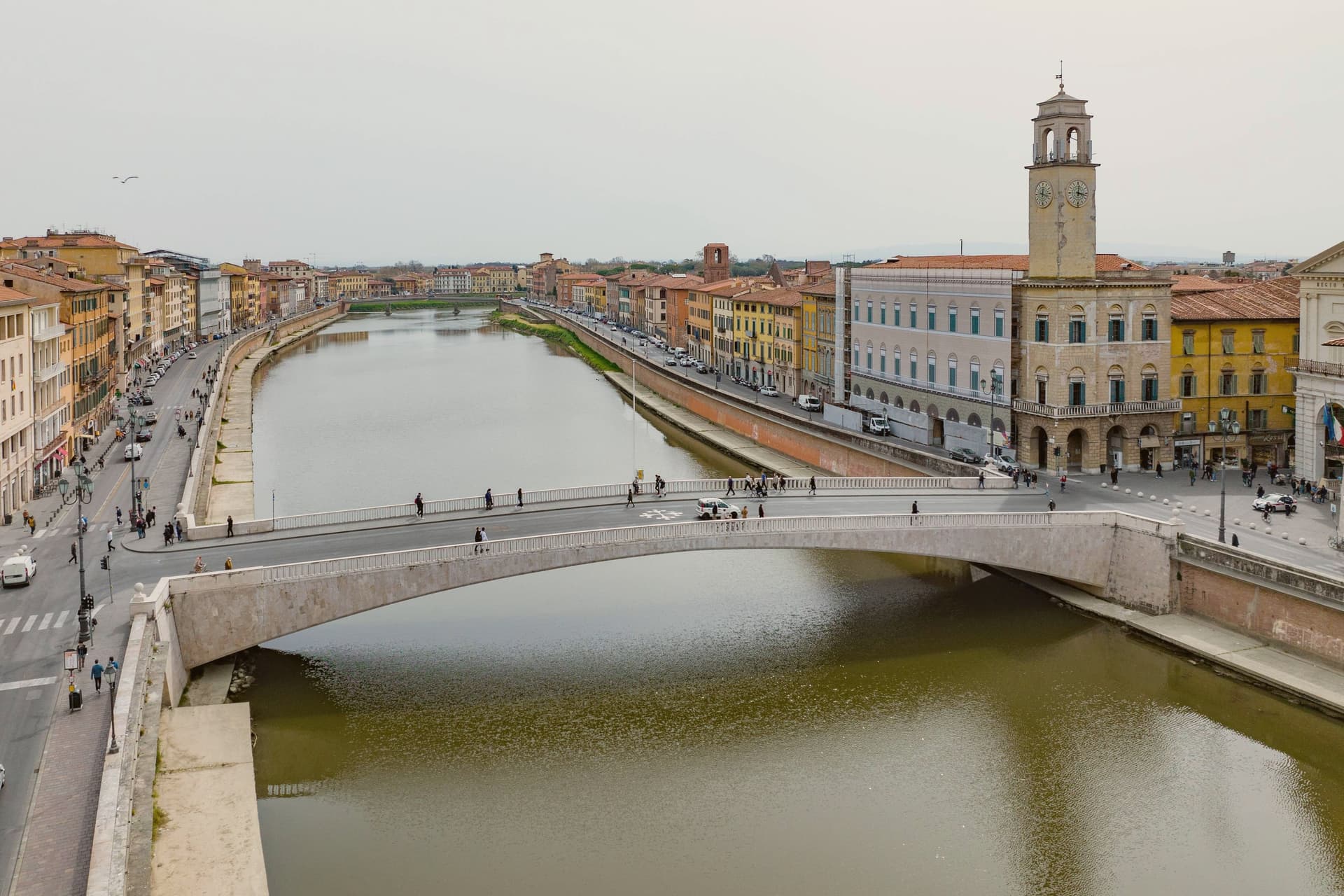
Maritime republic on the Arno, twelve kilometers from the Ligurian Sea, with the leaning bell tower at the center of a single UNESCO-listed walled compound.
- Best time
- May–Sep
- Airport
- In the comune (PSA)
- By car
- 1 h 19 min from Florence
- By train
- Station in the comune
- Population
- 88,737
Known for
TORRE PENDENTE
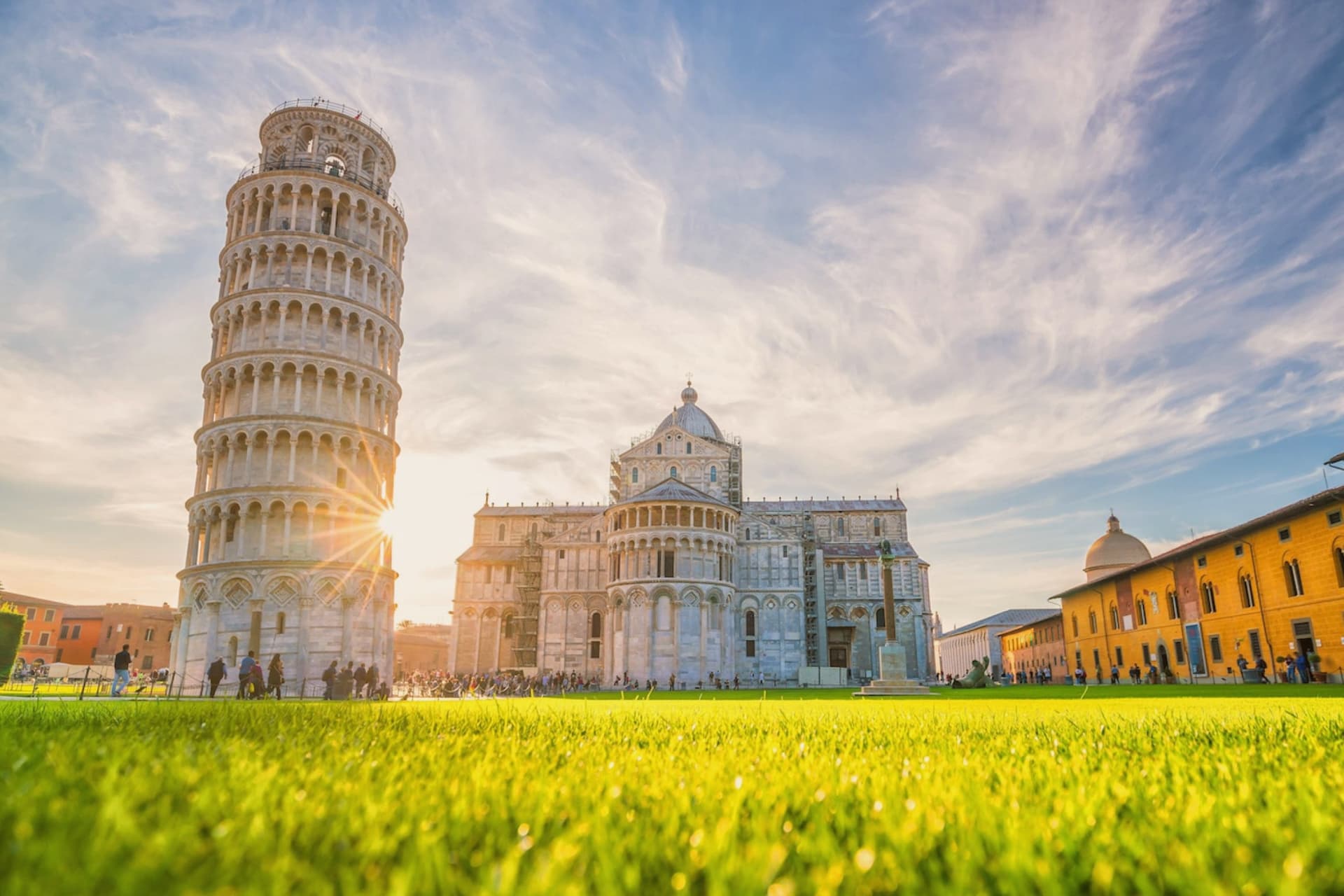
Bell tower of the Duomo begun 1173, leaning four degrees after subsidence on alluvial soil, stabilized by engineering work concluded in 2008.
MARITIME REPUBLIC
One of the four Italian maritime republics from the eleventh to the thirteenth century, with a fleet that took Sardinia, the Balearics and Mediterranean trade routes.
UNIVERSITY
Università di Pisa founded 1343, Scuola Normale since 1810 at Piazza dei Cavalieri, both still central to the working city beyond the tower.
When to visit
Best · May–Sep
- J12°
- F14°
- M15°
- A18°
- M22°
- J26°
- J30°
- A30°
- S26°
- O22°
- N17°
- D13°
- Best
- Hot or crowded
- Quiet
- Mostly closed
Daytime averages, 2020–2024. The sea is warmest in August at 29° and coldest in February at 13°. Weather data by Open-Meteo.com.
Why come
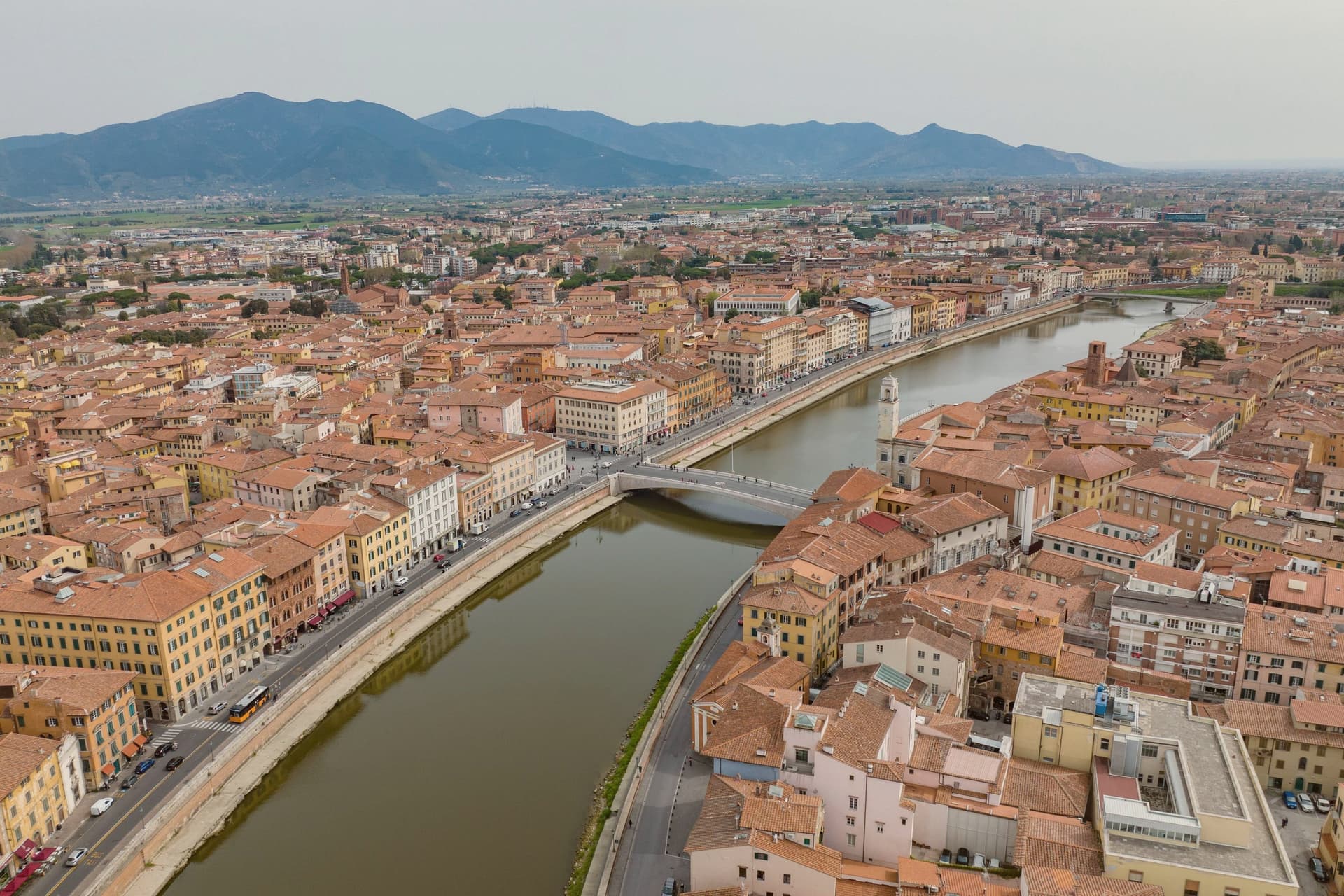
The Arno reaches the Ligurian Sea twelve kilometers past the city, and the river is what built it: an Arsenal on its banks built galleys for the Crusades, and Mediterranean trade paid for the walled compound northwest of the centro. That compound, inscribed by UNESCO as one of the first Italian sites in 1987, gathers four buildings of the same Pisan Romanesque school in one field, the cathedral, the baptistery, the cemetery cloister and the bell tower, close enough to read as a single composition rather than a set of monuments visited separately. The city has a second center away from that field.
Piazza dei Cavalieri became the Medici political seat after the republic fell, and the university founded in 1343 keeps both squares populated with people who live and work there rather than pass through. The Lungarni tie the two halves together physically, two quays following the river on both banks, lined with palazzi spanning the twelfth to the nineteenth century. What this adds up to is a town built in two unequal pieces: a religious and civic compound frozen at its medieval peak, and a working river city around it that never stopped adding centuries to its banks.
Read on
Pisa in our articles
 The 6 best coastal towns inside a nature park in Toscana6 towns, Pisa among them.
 The best coastal towns within 90 minutes of Florence6 towns, Pisa among them.
 The best towns with a serious restaurant in the province of Pisa6 towns, Pisa among them.
 The best towns with a World Heritage site within 90 minutes of Florence6 towns, Pisa among them.
How to get there
Pisa has its own airport (PSA), about 25 minutes from the middle of town.
Bologna (BLQ) is about 2 hours away.
By car from the centre of Florence 1h 19m or Genoa 2 hours.
There is a railway station in the comune, so you can arrive without a car.
Coming from Pisa, Florence or Genoa?
Coming by train into Livorno Centrale? Pisa is about 20 minutes away by road.
What to see
Torre Pendente
Finished 1372, two centuries after it began, the lean is visible from ground level without needing to climb it, south of vertical against the other three white buildings of the square.
Duomo di Pisa
Pisan Romanesque cathedral begun 1064 by Buscheto, financed from the Mediterranean trade, with bronze doors by Bonanno Pisano and a pulpit by Giovanni Pisano.
Battistero di San Giovanni
Largest baptistery in Italy at 54.86 meters tall, begun 1152, Romanesque base and Gothic upper level, with a pulpit by Nicola Pisano.
Camposanto Monumentale
Walled cloister begun 1278 around soil brought back from Golgotha, 43 blind arches, with damaged Trecento frescoes including the Triumph of Death.
Piazza dei Cavalieri
Vasari-designed square at the political center of Medici Pisa, with Palazzo della Carovana, headquarters of the Scuola Normale since 1810.
Lungarni
Riverside quays curving through the city on both banks of the Arno, with palazzi from the twelfth century to the nineteenth and the Luminara festival in June.
Museo dell'Opera del Duomo
Cathedral works museum on the south side of Piazza dei Miracoli, holding sculpture by Nicola and Giovanni Pisano removed from the four monuments.
The slow-trip planner
Building a trip? Find where Pisa fits in a slow Italy circuit.
Answer five questions. We will shape a geographically coherent slow trip from the 1,000 Italian towns most travelers skip. Yours to save and share.
We recommend
Where to eat and stay
Not our picks, but places the guides put their name to: a Michelin star, a Gambero Rosso fork, a Slow Food snail, a Michelin Key for the hotels. Worth a table, a counter, or a night when you pass through.
ErbaluigiaTrattoria
Two Gambero Rosso prawns for Erbaluigia, and a spot in the Michelin Guide.
Caffè dell'UsseroCaffè
Caffè dell'Ussero holds a place on Italy's historic-locali register.
Ristorante PoldinoRistorante
A place on Italy's historic-locali register, at Ristorante Poldino.
Vicolo diVinoWine Bar
Vicolo diVino has a Gambero Rosso listing to its name.
Royal Victoria HotelHotel
A place on Italy's historic-locali register, at Royal Victoria Hotel.
Through the year
What happens here
Feasts and festivals that come back year after year. We give the month rather than the date, because the date moves and the month rarely does. Check with the source before you plan a journey around one.
Gioco del Pontehistorical re-enactment
usually held in June. ToscanaShopping - Sagre in Toscana
Fiera degli Scalzi - Pisamarket
usually held in September. itinerarinelgusto.it
Terre di Pisa Food & Wine Festivalfood festival
usually held in October. sagritaly.com
The Sunday letter
Pisa got its letter. One town every Sunday, free. The photo, the food, the festa.
Living here
- Population 88,737
- A local hubi
- Pharmacy in town
- High school within a 30-minute drive
- Train station in the comune
- Nearest airport Florence / Pisa, 25 min drive
- Regional capital Firenze, 1 h 19 min drive
Common questions
- What is Pisa known for?
- Maritime republic on the Arno, twelve kilometers from the Ligurian Sea, with the leaning bell tower at the center of a single UNESCO-listed walled compound.
- Where is Pisa?
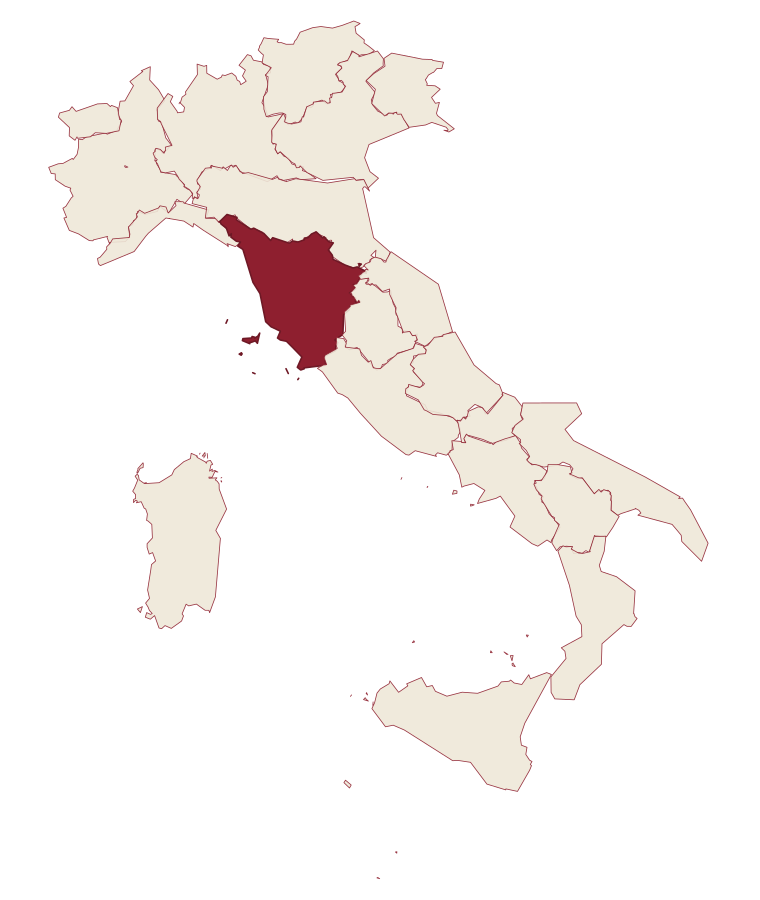
- Pisa is a comune in the province of Pisa, in Tuscany, at 4 meters above sea level.
- What is the nearest airport to Pisa?
- Pisa has its own airport (PSA), about 25 minutes from the middle of town by car.
- Can you get to Pisa without a car?
- Yes. There is a railway station in the comune, so you can arrive by train.
- How long is the drive from Florence to Pisa?
- About 1h 19m by car.
- When is the best time to visit Pisa?
- Best in May–Sep. August is the warmest month, averaging 30 degrees, and December the wettest, with about 16 rain days.
- Is there a sagra or a festival in Pisa?
- Yes. Gioco del Ponte, Fiera degli Scalzi - Pisa and Terre di Pisa Food & Wine Festival. June is when the first of them falls.
- Which other towns are like Pisa?
- Grosseto, Livorno and Pozzuoli.
- How many people live in Pisa?
- 88,737 at the 2023 count.
Tags & datadesignations · numbers · sources
Recognised as
The numbers
- Elevation: 4 m
- Population: 88,737
- Surface area: 185.07 km²
These figures were compiled from public directories: ISTAT, OpenStreetMap and Wikidata, and from the official listings of the guides named on this page. Town details change; verify with official sources before you travel.
Similar
Towns like Pisa
Grosseto
Province: Grosseto
both on the Tyrrhenian coast · both over 10,000 people
Livorno
Province: Livorno
both on the Tyrrhenian coast · both over 10,000 people
Pozzuoli
Province: Napoli
both on the Tyrrhenian coast · both over 10,000 people
Viareggio
Province: Lucca
both on the Tyrrhenian coast · both over 10,000 people
Carrara
Province: Massa-Carrara
both on the Tyrrhenian coast · both over 10,000 people
Nettuno
Province: Roma
both on the Tyrrhenian coast · both over 10,000 people
🏛️ UNESCO
More UNESCO towns in Tuscany
Barberino di Mugello
Province: Firenze
The Mugello gateway at 272 meters where the Medici family kept its first country villas, with Michelozzo's Cafaggiolo and the artificial Lago di Bilancino below.
Carmignano
Province: Prato
A Medici village at 189 meters on the Montalbano slopes, where Etruscan tumuli sit below the Renaissance villas.
Castiglione d'Orcia
Province: Siena
A stone borgo at 540 meters in the UNESCO Val d'Orcia, with two fortresses guarding the road from Amiata to the Via Francigena.
Cerreto Guidi
Province: Firenze
The Medici hunting villa above the Padule di Fucecchio, where Cosimo I sent his court for the marshland game and Buontalenti built four ramps of stairs.
Montalcino
Province: Siena
A walled hill town at 564 meters above the Val d'Orcia, the last fortress to hold out for the Sienese Republic and the birthplace of Brunello.