
Tuscany · Siena
Radicofani
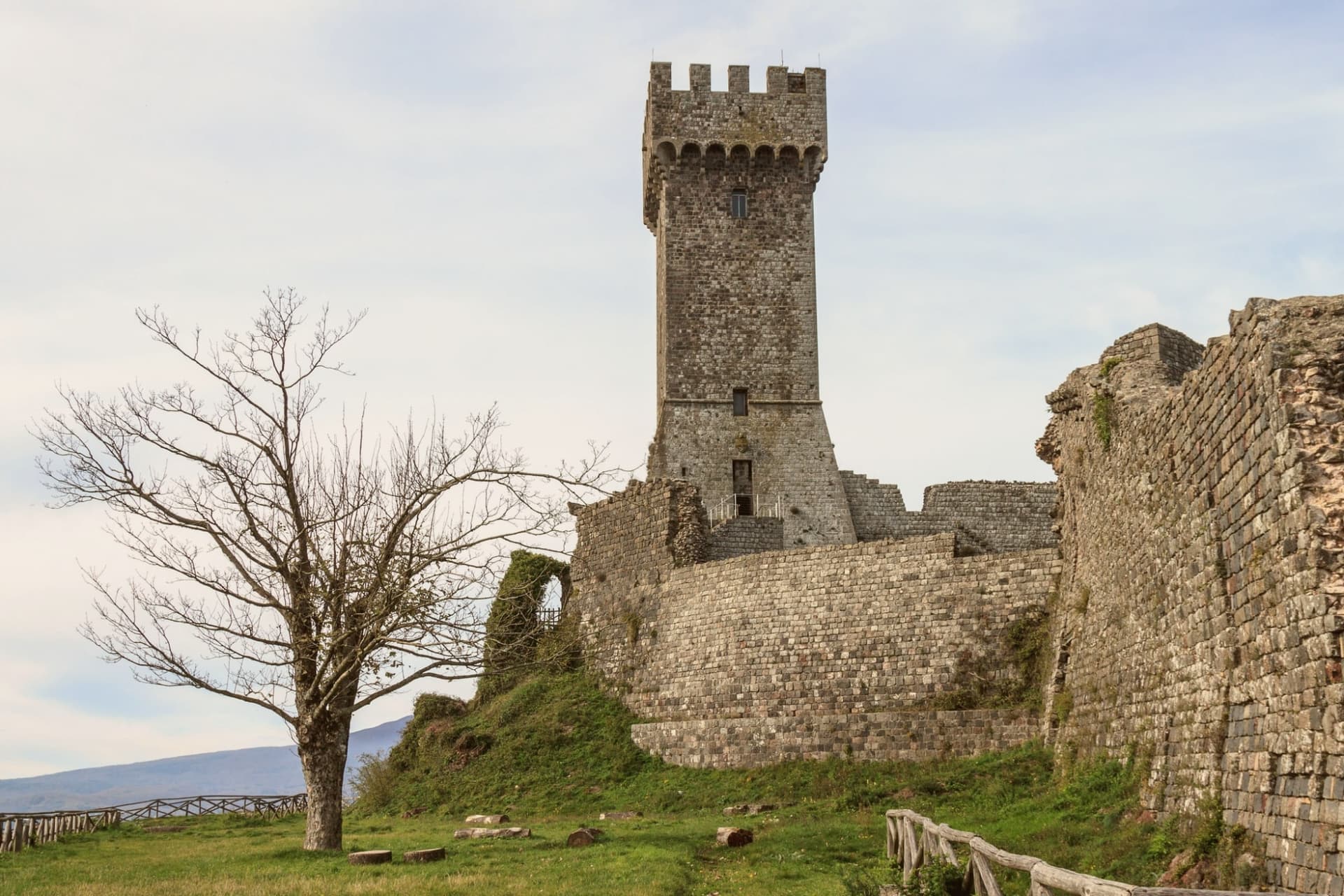
The Val d'Orcia's basalt watchtower: a 1,060-resident UNESCO-inscribed borgo at 814m on a volcanic outcrop visible across half of southern Tuscany, crowned by an outlaw's fortress that Dante and Boccaccio both wrote into their pages.
- Best time
- May–Sep
- By car
- 1 h 28 min from Perugia
- Population
- 1,060
Known for
GHINO DI TACCO'S ROCCA
The 13th-c outlaw and Ghibelline noble who held Radicofani as a raiding base, from 1297 until 1303, robbing pilgrims and churchmen and sending the richest captives back to Pope Boniface VIII with gallows-humour notes. Dante names him in Purgatorio VI, Boccaccio gives him the second novella of the Decameron's tenth day. The fortress on the basalt summit is the iconic Val d'Orcia silhouette.
VIA FRANCIGENA + POSTA MEDICEA
Single most spectacular Italian stop on the Canterbury-to-Rome pilgrim road. The 16th-c stagecoach inn hosted Montaigne, Dickens, and every Grand-Tour traveller between 1500 and 1850.
UNESCO VAL D'ORCIA
Part of the Val d'Orcia World Heritage inscription of 2004. One of the few towns to carry the UNESCO, Bandiera Arancione and Via Francigena marks together.
BASALT OUTCROP
A perfectly conical 814m volcanic outcrop visible from Pienza, Montalcino, Monte Amiata and the Cassia road, as far as Lago Trasimeno 60 km away: the iconic Val d'Orcia silhouette from almost anywhere in southern Tuscany.
When to visit
Best · May–Sep
- J7°
- F10°
- M11°
- A14°
- M19°
- J25°
- J29°
- A28°
- S22°
- O17°
- N12°
- D8°
- Best
- Hot or crowded
- Quiet
- Mostly closed
Daytime averages, 2020–2024. Weather data by Open-Meteo.com.
The festa: Sant'Agata, 5 February
Why come
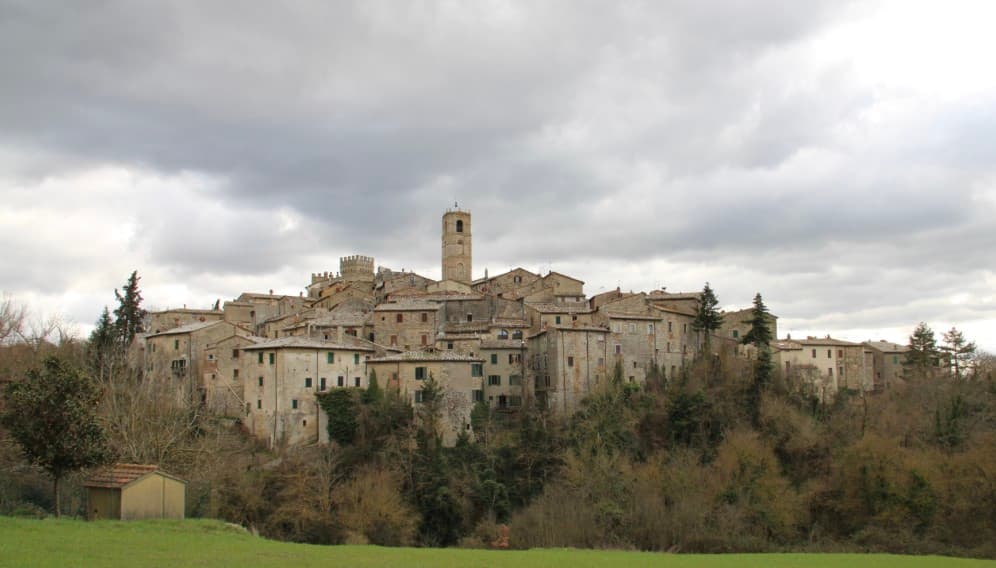
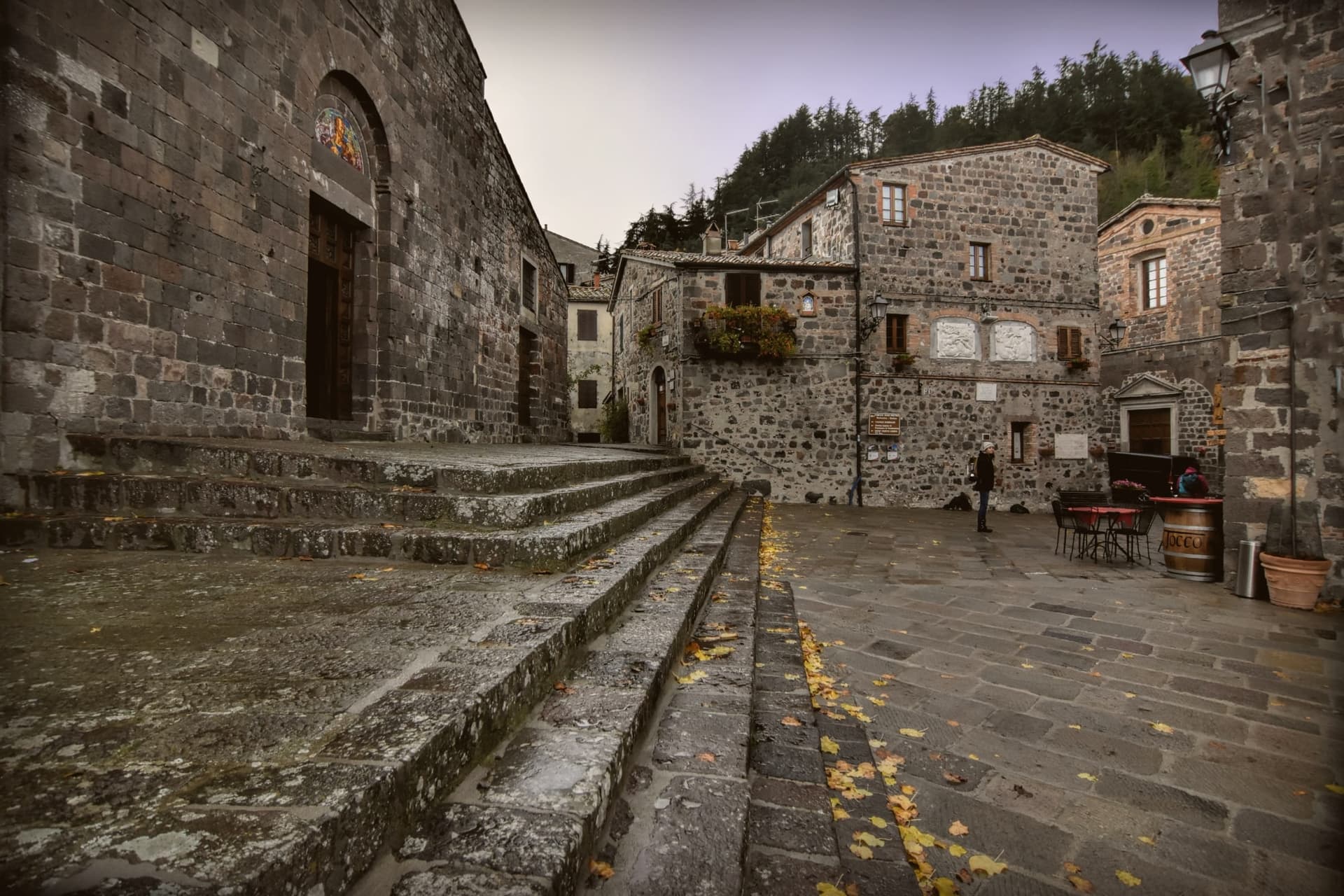
Radicofani sits where the rolling clay hills of the Val d'Orcia give way, abruptly, to a volcanic cone: the town rises straight off the plain rather than sitting among gentler slopes, which is why the rock is visible from Pienza, Montalcino, the Cassia road and points as far off as Lago Trasimeno, 60 km away, and why it reads as a landmark rather than a village from any distance. The medieval centro climbs in the same volcanic-basalt stone as the rock beneath it, narrowing as it rises, so that the streets themselves seem to funnel a visitor upward toward the fortress that caps the summit. That fortress began under the Aldobrandeschi in the 12th century, was expanded by the outlaw and Ghibelline noble who made the rock his raiding base from 1297 to 1303, robbing pilgrims and churchmen on the road below and returning the richest captives to Pope Boniface VIII with gallows-humour notes attached, a story Dante folds into Purgatorio VI and Boccaccio into the Decameron's tenth day. The Sienese extended it again in the 14th century, the Medici in the 16th after Cosimo I bought the territory in 1556, and a powder-magazine explosion in 1735 took off the upper levels, leaving the restored lower fortress and its terrace standing today.
Below the village, at its foot rather than within its walls, sits the old stagecoach inn, a separate register of the town's history: not the fortress and its outlaw but the machinery of travel and hospitality that grew up beneath it to serve the pilgrim road running from Canterbury to Rome, hosting Montaigne, Dickens and Grand Tour travellers moving between Florence and Rome from 1500 to 1850. The town's church, the Romanesque Pieve di San Pietro, and its companion the Chiesa di Sant'Agata, with its Della Robbia altarpiece, belong to the centro itself rather than to the rock above it.
Surroundings widen the picture: Pienza, also UNESCO-listed, lies 30 km north, Montalcino 35 km northwest, and the extinct volcano immediately west offers a cooler, wooded counterpoint of chestnut and beech forest to the bare rock the town is built on, with thermal baths built around a pool 20 km north. The food follows the same Val d'Orcia line as its neighbors: pici with hare ragù, pecorino di Pienza, lardo di Colonnata and finocchiona, with Brunello di Montalcino and Vino Nobile di Montepulciano within easy reach. The Festa Medievale in mid-July recreates the outlaw court that once ruled the summit, and the Festa del Fagiolo in early August celebrates the local cannellini bean. Like other Val d'Orcia hilltop villages, the population has fallen hard, from 2,800 in 1951 to 1,060 today.
The three marks the town carries together, UNESCO, Bandiera Arancione and the pilgrim route, are not separate honors so much as three ways of naming the same fact: a place built for defense and passage that has outlasted both purposes and now stands mostly for itself.
Read on
Radicofani in our articles
 The best small towns on a walking route in the province of Siena6 towns, Radicofani among them.
 The best towns with a World Heritage site in the province of Siena6 towns, Radicofani among them.
 The best towns with a medieval festival that hold a World Heritage site in Toscana7 towns, Radicofani among them.
 The best towns with a World Heritage site within two hours of Perugia8 towns, Radicofani among them.
How to get there
From Bologna (BLQ), about 3 hours by car.
Rome (FCO) is about 3 hours away.
By car from the centre of Perugia 1h 28m, Siena 1h 36m or Florence 2 hours.
Coming by train into Perugia? Radicofani is about 1h 25m away by road.
What to see
Rocca di Radicofani
12th-c Aldobrandeschi origin, expanded by the Sienese in the 14th century and by the Medici in the 16th, after Cosimo I bought the territory in 1556. A 1735 powder-magazine explosion destroyed the upper levels. The restored lower fortress and its panoramic terrace give the most expansive single view in southern Tuscany.
Via Francigena + Posta Medicea
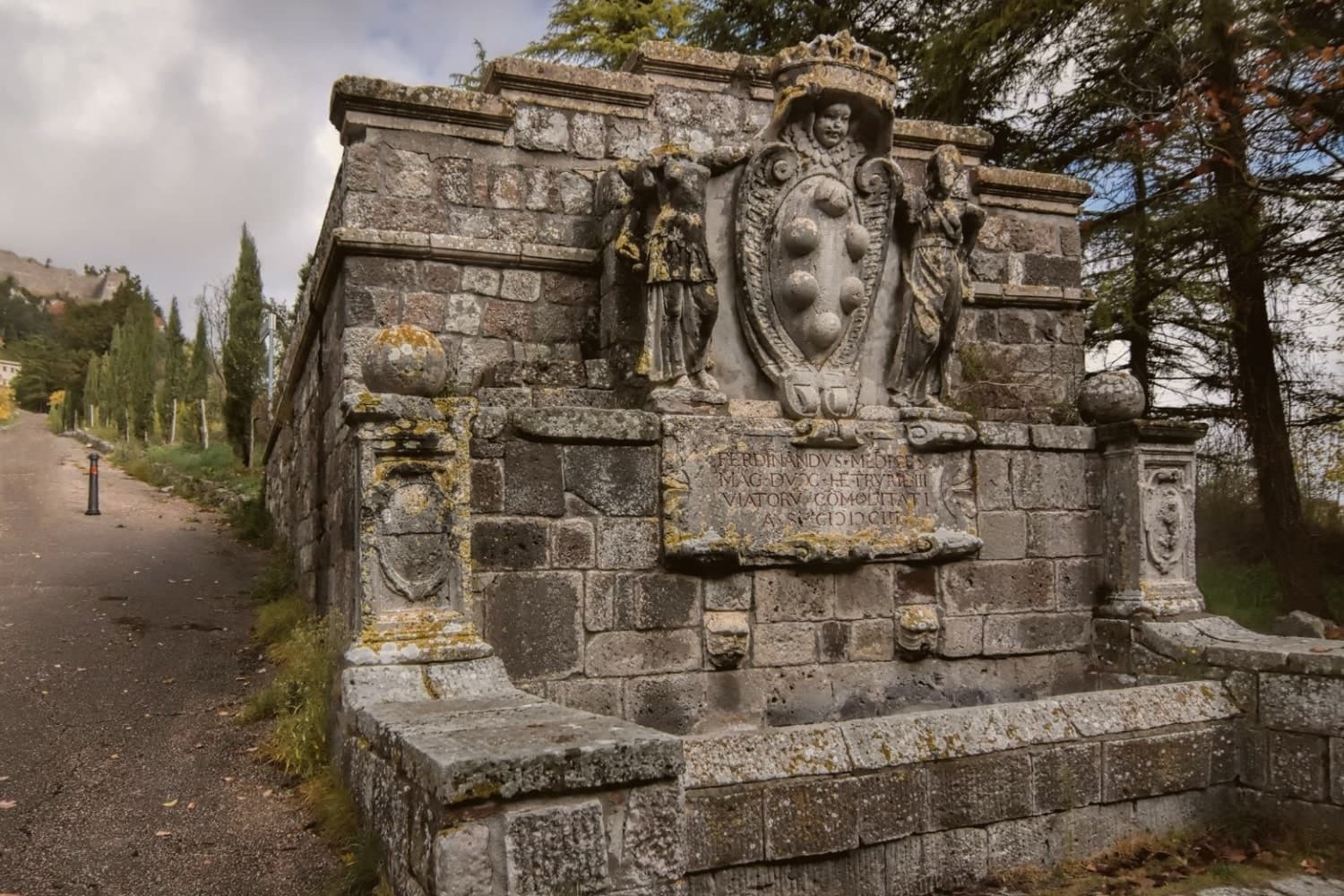
The inn stands at the foot of the village, on the pilgrim road from Canterbury to Rome, where it once put up travellers moving between Florence and Rome for three and a half centuries, among them Montaigne and Dickens.
UNESCO Val d'Orcia centro
An intact medieval centro climbing in volcanic-basalt stone toward the fortress above it. The Pieve di San Pietro is Romanesque; the Chiesa di Sant'Agata holds a Della Robbia altarpiece.
Monte Amiata + Bagno Vignoni
Monte Amiata, an extinct volcano at 1,738m, rises immediately to the west, its slopes given over to chestnut and beech forest and walking trails. The thermal baths at Bagno Vignoni, 20 km north, are built directly around a thermal pool.
Festa Medievale (mid-July)
Recreates the outlaw court of the fortress's most famous occupant, with costumed pageant, archery and falconry. The Festa del Fagiolo in early August celebrates the local cannellini bean variety.
The slow-trip planner
Building a trip? Find where Radicofani fits in a slow Italy circuit.
Answer five questions. We will shape a geographically coherent slow trip from the 1,000 Italian towns most travelers skip. Yours to save and share.
Through the year
What happens here
Feasts and festivals that come back year after year. We give the month rather than the date, because the date moves and the month rarely does. Check with the source before you plan a journey around one.
Festa degli antichi mestieri a Radicofanihistorical re-enactment
usually held in June. Borghi Toscana - Eventi
Palio Del Bigonzohistorical re-enactment
usually held in September. Visit Tuscany - Calendario Ufficiale Eventi
The Sunday letter
Radicofani got its letter. One town every Sunday, free. The photo, the food, the festa.
Living here
- Population 1,060
- Remotei
- Pharmacy in town
- High school within a 30-minute drive
- Nearest airport Bologna, 2 h 55 min drive
- Regional capital Firenze, 1 h 56 min drive
Common questions
- What is Radicofani known for?
- Radicofani is the Val d'Orcia's basalt watchtower: a 1,060-resident UNESCO-inscribed borgo at 814m on a volcanic outcrop visible across half of southern Tuscany, crowned by an outlaw's fortress that Dante and Boccaccio both wrote into their pages.
- Where is Radicofani?
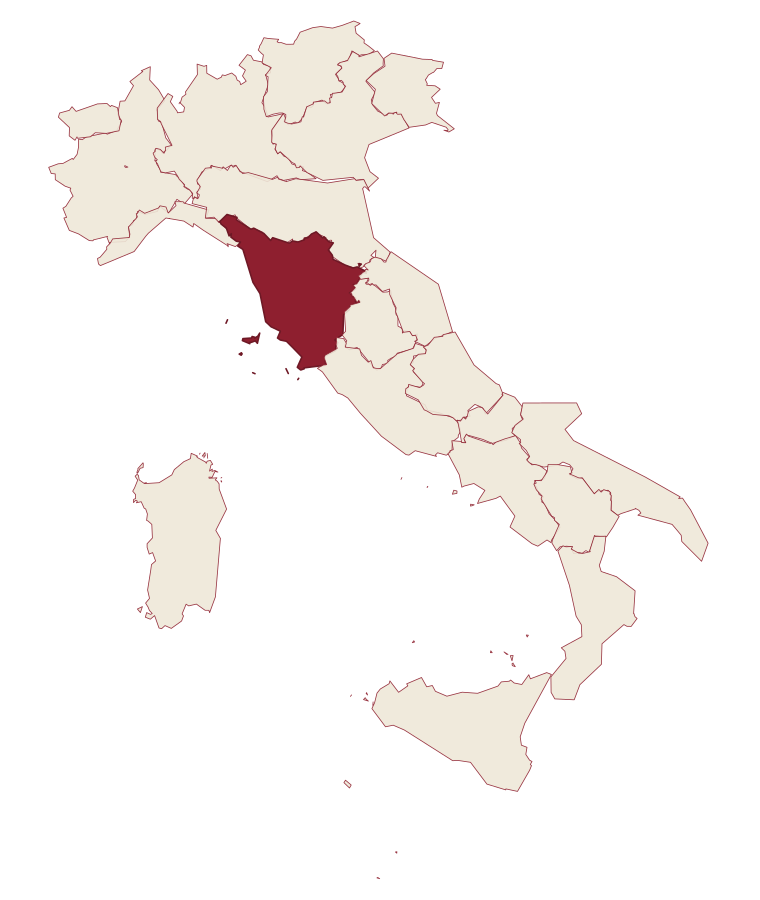
- Radicofani is a comune in the province of Siena, in Tuscany.
- What is the nearest airport to Radicofani?
- Bologna (BLQ), about 3 hours by car.
- How long is the drive from Perugia to Radicofani?
- About 1h 28m by car.
- When is the best time to visit Radicofani?
- Best in May–Sep. July is the warmest month, averaging 29 degrees, and May the wettest, with about 12 rain days.
- Is there a sagra or a festival in Radicofani?
- Yes. Festa degli antichi mestieri a Radicofani and Palio Del Bigonzo. June is when the first of them falls.
- Which other towns are like Radicofani?
- Corniglio, Santa Fiora and Albidona.
- How many people live in Radicofani?
- 1,060 at the 2023 count.
Tags & datadesignations · numbers · sources
Recognised as
The numbers
- Elevation: 814 m
- Population: 1,060
- Surface area: 118.1 km²
These figures were compiled from public directories: ISTAT, OpenStreetMap and Wikidata, and from the official listings of the guides named on this page. Town details change; verify with official sources before you travel.
Similar
Towns like Radicofani
Corniglio
Province: Parma
both under 3,000 people · both high up, between 600 and 1,000 metres
Santa Fiora
Province: Grosseto
both under 3,000 people · both high up, between 600 and 1,000 metres
Albidona
Province: Cosenza
both under 3,000 people · both high up, between 600 and 1,000 metres
Molveno
Province: Trento
both under 3,000 people · both high up, between 600 and 1,000 metres
Castel di Lucio
Province: Messina
both under 3,000 people · both high up, between 600 and 1,000 metres
Savignano Irpino
Province: Avellino
both under 3,000 people · both high up, between 600 and 1,000 metres
🏛️ UNESCO
More UNESCO towns in Tuscany
Barberino di Mugello
Province: Firenze
The Mugello gateway at 272 meters where the Medici family kept its first country villas, with Michelozzo's Cafaggiolo and the artificial Lago di Bilancino below.
Carmignano
Province: Prato
A Medici village at 189 meters on the Montalbano slopes, where Etruscan tumuli sit below the Renaissance villas.
Castiglione d'Orcia
Province: Siena
A stone borgo at 540 meters in the UNESCO Val d'Orcia, with two fortresses guarding the road from Amiata to the Via Francigena.
Cerreto Guidi
Province: Firenze
The Medici hunting villa above the Padule di Fucecchio, where Cosimo I sent his court for the marshland game and Buontalenti built four ramps of stairs.
Montalcino
Province: Siena
A walled hill town at 564 meters above the Val d'Orcia, the last fortress to hold out for the Sienese Republic and the birthplace of Brunello.