
Tuscany · Siena
Montepulciano
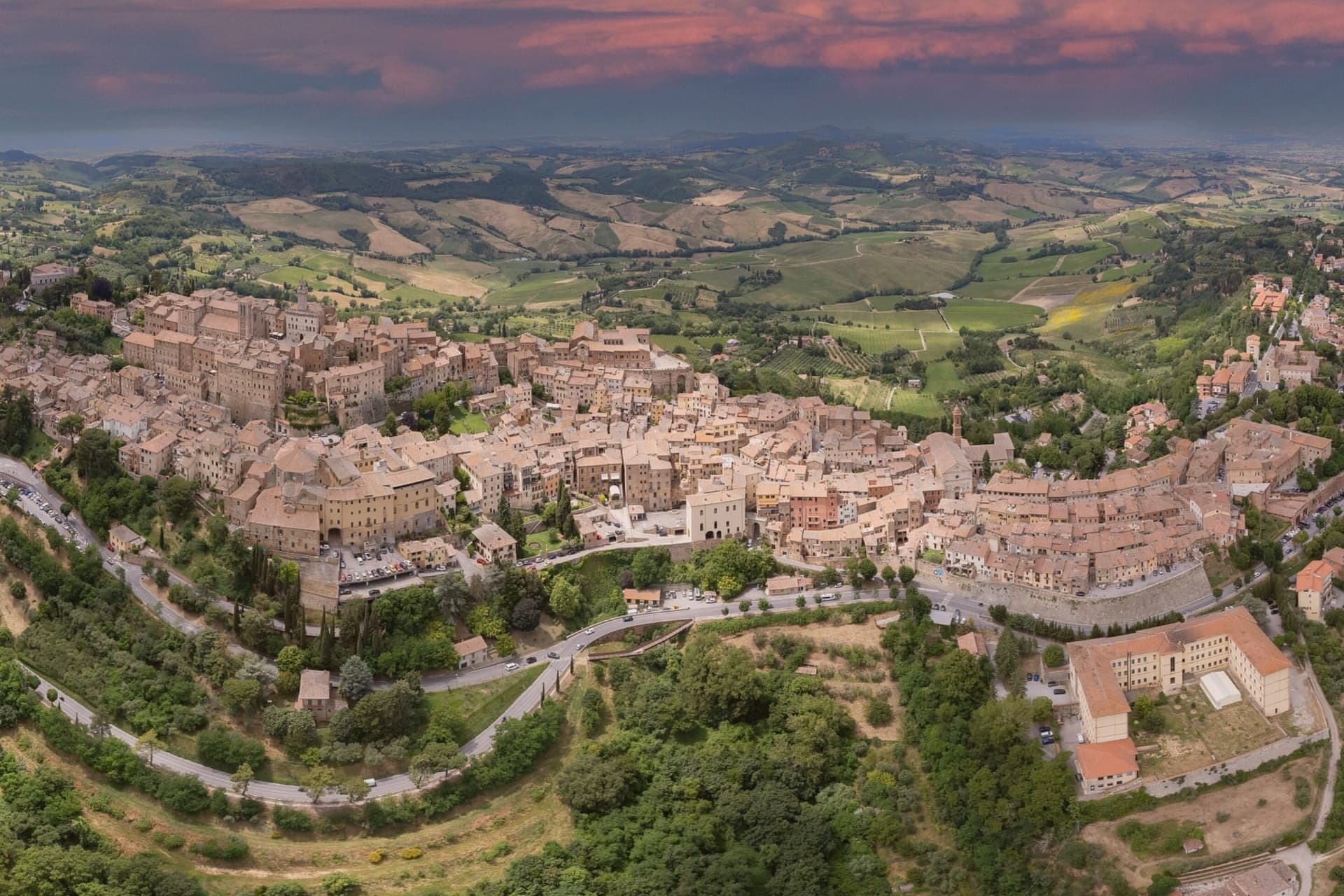
A Renaissance hill town at 605 meters on a limestone ridge, aging its Sangiovese-based red in vaulted cellars beneath the palazzi.
By Peter Benei
Written about. No. 43.
The letter
Montepulciano got its letter. One town at a time, free. The photo, the food, the festa.
Visiting
- Best time
- Apr–Oct
- By car
- 55 min from Perugia
- By train
- Station in the comune
- Population
- 13,032
- J8°
- F11°
- M12°
- A16°
- M21°
- J27°
- J31°
- A30°
- S24°
- O19°
- N13°
- D9°
- Best
- Hot or crowded
- Quiet
- Mostly closed
Daytime air temperature, averages for 2020–2024. Weather data by Open-Meteo.com.
Why come
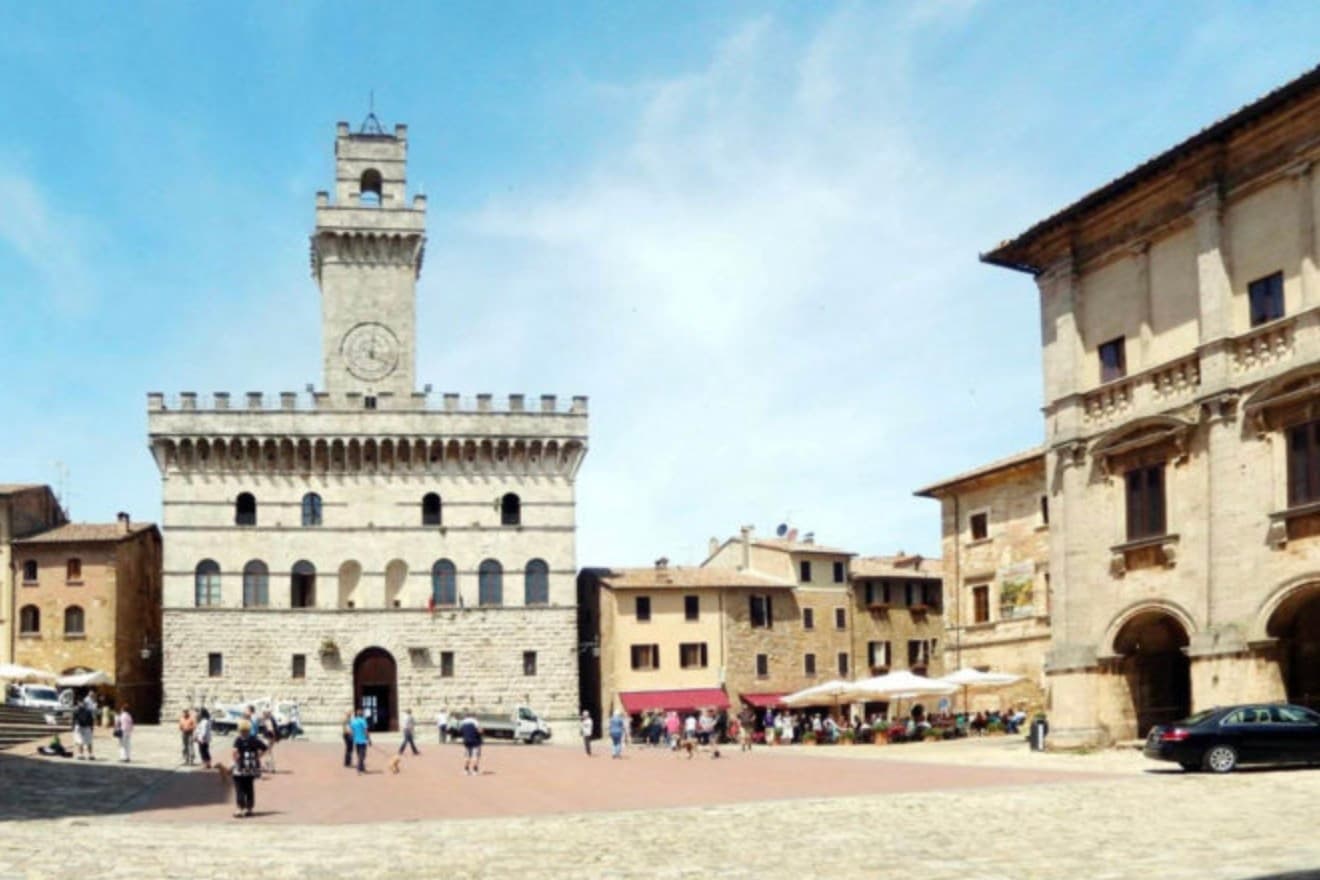
The ridge runs between the Val di Chiana and the Val d'Orcia, 70 kilometers southeast of Siena, and the town follows its spine uphill: streets climb from the gates toward the high point, where the main square sits ringed by the buildings that define the skyline from below. The origin predates the Renaissance fabric by centuries. Etruscan tombs survive in the surrounding hills, though almost nothing of that period shows in the centro storico itself, which was rebuilt wholesale in the fifteenth and sixteenth centuries over whatever came before.
The wine and the festival both use the climb as their setting rather than their subject: the cellars are cut into the rock beneath the palazzi, keeping a constant temperature for aging, and the barrel race each August sends two men from each of the eight contrade hauling an eighty-kilogram cask up the same gradient that every visitor covers on foot, only slower. The steepness that shaped the defensive site nine centuries ago is still what a person feels first, in the legs, before the buildings register at all.
How to get there
From Rome Fiumicino (FCO), about 2 h 26 min by car.
Bologna (BLQ) is about 2 h 28 min away.
By car from the center of Perugia 55 min, Siena 1 h 10 min or Florence 1 h 29 min.
There is a railway station in the comune, so you can arrive without a car.
Coming by train into Perugia? Montepulciano is about 51 min away by road.
First time driving in Italy? Read our complete manual.
What to see
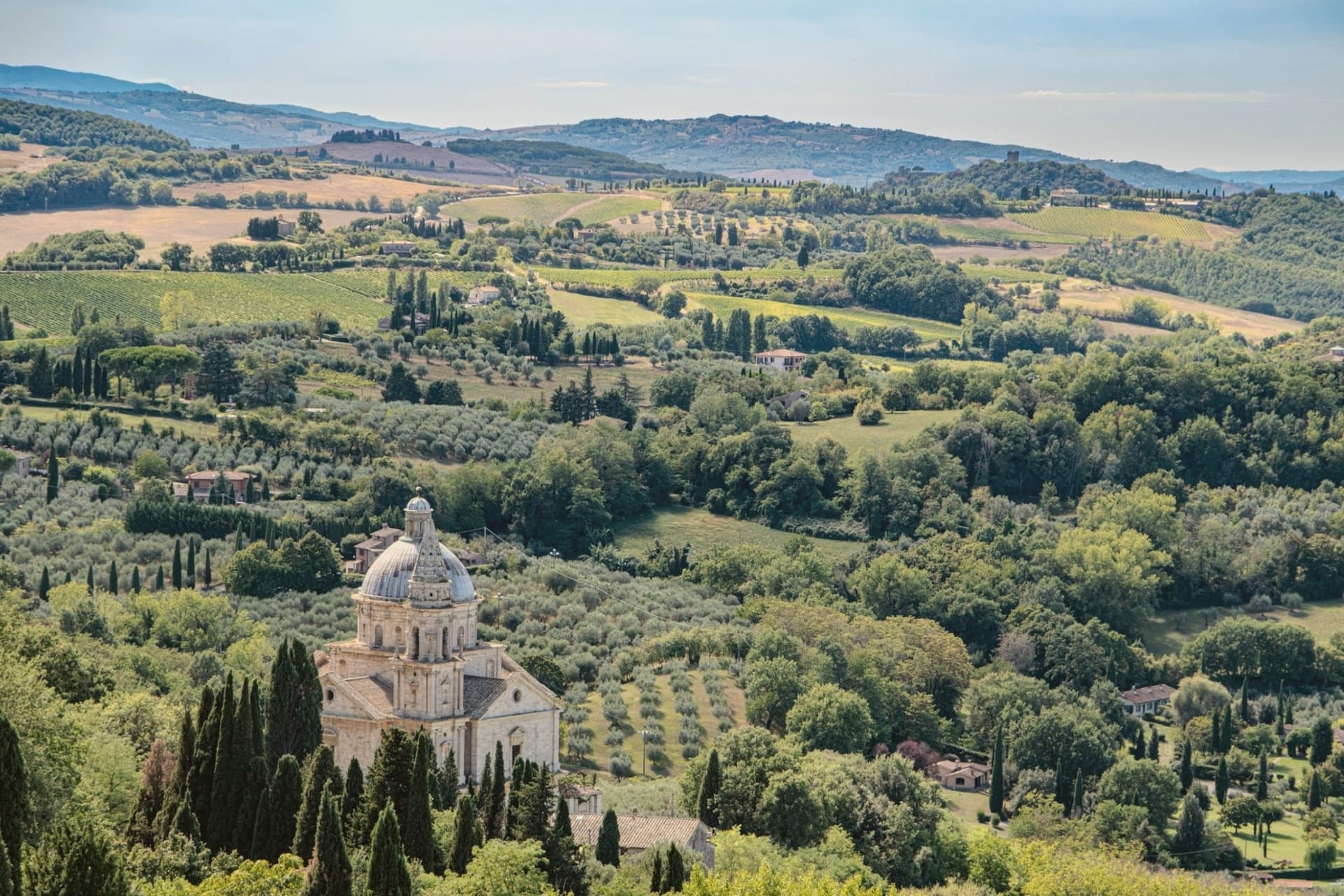
Tempio di San Biagio
A 13-meter dome and travertine façade standing alone outside the walls, the ground falling away below it so the building reads as a single volume against the hillside.
Piazza Grande
The high piazza at the top of the ridge, ringed by the Duomo, the Palazzo Comunale and the Palazzo Tarugi, all rebuilt in the fifteenth and sixteenth centuries.
Palazzo Comunale
Town hall designed by Michelozzo in the fifteenth century, its tower offering a view over the Val di Chiana and Val d'Orcia.
Duomo di Santa Maria Assunta
Cathedral finished in the early seventeenth century, housing the triptych of the Assumption by Taddeo di Bartolo from 1401.
Cantine storiche
Underground brick-vaulted cellars beneath the Renaissance palazzi where the town's red is aged, several open for guided tours.
From the guides
Where to eat and stay
Not our picks, but places the guides put their name to: a Michelin star, a Gambero Rosso fork, a Slow Food snail, a Michelin Key for the hotels. Worth a table, a counter, or a night when you pass through.
IndigenoBistrot
Indigeno carries one Gambero Rosso table, plus a spot in the Michelin Guide.
OsmosiRistorante
One Michelin star for Osmosi, and two Gambero Rosso forks (83/100).
La Bottega del NobileRistorante
One Gambero Rosso fork (78/100), at La Bottega del Nobile.
6 more places the guides name in Montepulciano
Le Logge del VignolaRistorante
Le Logge del Vignola has a spot in the Michelin Guide to its name.
Osteria Porta di BaccoWine Bar
Osteria Porta di Bacco has two Gambero Rosso bottles to its name.
Ristorante Caffè Pasticceria PolizianoPasticceria
Ristorante Caffè Pasticceria Poliziano holds a place on Italy's historic-locali register.
Borgo San VincenzoHotel
Borgo San Vincenzo carries a place in the Michelin hotel guide.
Precise Tale Poggio Alla SalaHotel
Precise Tale Poggio Alla Sala carries one Michelin Key.
VILLA POGGIANOHotel
VILLA POGGIANO holds a place in the Michelin hotel guide.
Before you sit down: how to order at a restaurant, how to spot a tourist trap, what aperitivo is and how the Italian bar works.
Signature product
Vino Nobile di Montepulciano DOCG
Sangiovese-based, aged in oak, named noble in the 1500s when it reached the Vatican cellars.
See the towns we cover in the zone of Vino Nobile di Montepulciano DOCG.
Living here
Could you live here?
Montepulciano meets all 3 of our rules for a small town.
- 13,032 people, inside our sweet spot of 5,000 to 20,000: a real town, still one community.
- Arezzo, a city of 96,479, is 56 min by car. Inside our 30 to 60 minutes: close for the services, far enough to keep its own life.
- A station of its own. Trains are the overlooked way to get around Italy: no parking, straight into the center.
The rules come from our series Where to Move in Italy, written from the places we have lived: Part 1, The End of the Road · Part 2, The Small Town · Part 3, The City · Part 4, The Postcard · Part 5, The Other Half. The towns we would pick are in Part 6, The Best Towns.
- Population 13,032, down 8.3% since 2015
- Nearest city Arezzo, 56 min drive
- Train station in the comune
- A national health service hospital in the comune · how healthcare works in Italy
- Homes in the center: €1,600 to €2,400 per m² to buy, €5.00 to €7.50 per m² a month to rent
Weighing a move here? See the moving year.
All the numbers Common questions, designations, lists and sources.
More about living here
- Remote
- Pharmacy in town
- High school within a 30-minute drive
- Full fibre reaches 17% of homes
- Primary school in the comune
- Earthquake zone 3, low hazard
- Perugia airport (PEG), 1 h 15 min drive, the nearest with scheduled flights
- Regional capital Florence, 1 h 29 min drive
If you are moving here
Who lives here
11% of residents are foreign citizens, most often from Romania, Bulgaria and Albania, against 9% across Italy. 90 of them come from English-speaking countries or western and northern Europe, mostly the United States, France and the United Kingdom. There are 301 people over 65 for every 100 children under 15, against 216 across Italy. 31% of homes have no resident, holiday homes and empty ones counted together, against 27% across Italy. Siena province ranks 21st of 107 in Il Sole 24 Ore's quality of life ranking for 2025.
Health and schools
There is an emergency room in the comune. The nearest major one is in Siena, 44 km away. The nearest IB school is International School of Siena, 47 km as the crow flies.
Information, not medical advice. Confirm with a professional.
Taxes
A home that is not your main one pays 1.06% a year in property tax at the 2025 rate, charged on the cadastral value rather than the price. A main home pays none unless it is in a luxury category. The town adds 0.8% to your income tax. 7% pensioner tax: this town is not in a qualifying area.
Information, not tax advice. Confirm with a professional.
What it costs
The average household in Tuscany spends about €2,410 a month, €540 of it on food, against about €2,170 across Italy. A family of three pays about €770 a year for water, on the Tuscany average. In Siena, the provincial capital, in September 2026, an espresso cost €1.28, a meal in a pizzeria €17.81 and a man's haircut €25.49.
Climate and risk
It is in climate zone D, on a scale from A, the warmest, to F, the coldest, and heating may run from November 1 to April 15, up to 12 hours a day, unless the mayor changes it. 3% of residents live in a zone the national maps rate high for floods, 6% in a high or medium one. 4% live in a zone rated high or very high for landslides.
These shares cover the whole comune, not any one street. Check an address on IdroGEO.
Moving from abroad? Which visa you need. Sources: ISTAT, the Ministry of Health, ISPRA, the Finance Ministry, the Ministry of Enterprise, Poste Italiane, the comuni, the IB, International Schools Database, Il Sole 24 Ore, Cittadinanzattiva.
Thermal baths in town: Terme di Montepulciano.
Known for
VINO NOBILE
DOCG red based on Sangiovese (locally Prugnolo Gentile), one of three principal Tuscan reds alongside Brunello and Chianti Classico.
SAN BIAGIO
Sangallo's Renaissance temple built 1518-1545 on a Greek-cross plan, the iconic image of Montepulciano from below the walls.
BRAVÌO DELLE BOTTI
Annual barrel race up the steep streets to Piazza Grande, run on the last Sunday of August since the fourteenth century.
Common questions
- What is Montepulciano known for?
- Montepulciano is a Renaissance hill town at 605 meters on a limestone ridge, aging its Sangiovese-based red in vaulted cellars beneath the palazzi.
- Where is Montepulciano?
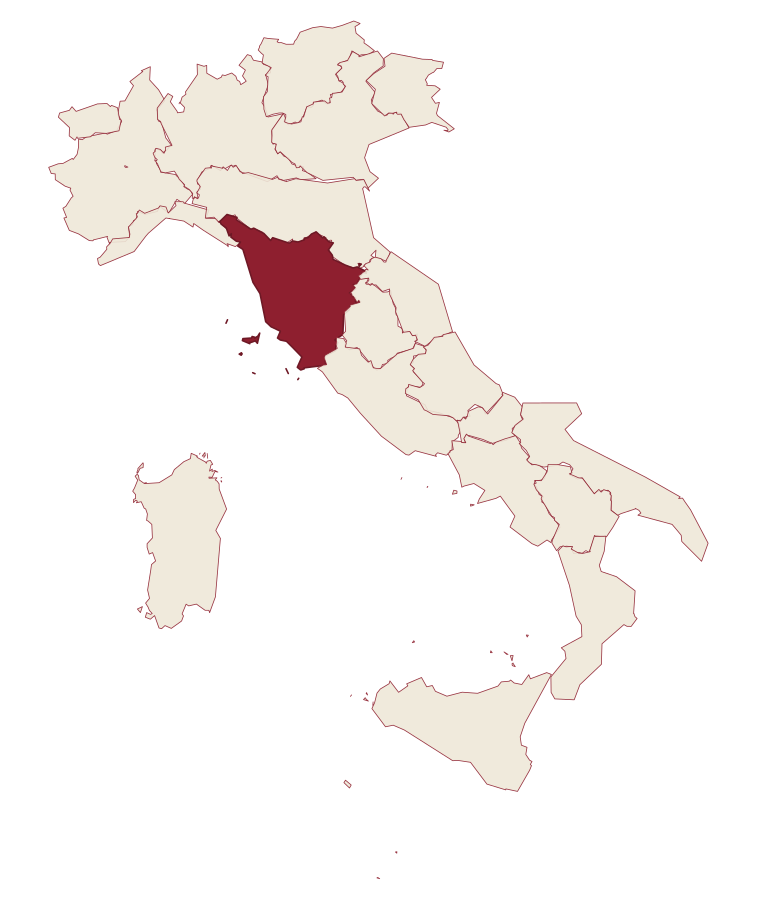
- Montepulciano is a comune in the province of Siena, in Tuscany.
- What is the nearest airport to Montepulciano?
- The nearest airport with scheduled flights is Perugia (PEG), about 1 h 15 min by car.
- Can you get to Montepulciano without a car?
- Yes. There is a railway station in the comune, so you can arrive by train.
- How long is the drive from Perugia to Montepulciano?
- About 55 min by car.
- When is the best time to visit Montepulciano?
- Best in Apr–Oct. July is the warmest month, averaging 31 degrees, and May the wettest, with about 12 rain days.
- Which other towns are like Montepulciano?
- Cortona, Bressanone and Fabriano.
- How many people live in Montepulciano?
- 13,032 residents, by ISTAT's count on 1 January 2025.
- Is Montepulciano a good place to live?
- By the rules in our Where to Move in Italy series, Montepulciano is a small town that meets all 3 of our rules. The nearest city, Arezzo, is 56 min away by car. There is a national health service hospital in the comune. Full fibre reaches 17% of homes.
Tags & data designations · numbers · sources
Recognized as
Landscape
The numbers
- Elevation: 605 m
- Population: 13,032
- Surface area: 165.33 km²
These figures were compiled from public directories: ISTAT, OpenStreetMap and Wikidata, and from the official listings of the guides named on this page. Town details change; verify with official sources before you travel.
The ranked lists
Lists Montepulciano appears in
- The best hot spring towns in the province of SienaSiena provincehot springs6 towns · smallest 1,421 residents
- The best hot-spring towns within 75 minutes of SienaNear Sienahot springswithin 75 min6 towns · smallest 2,560 residents · closest 24 min away
- The best hot-spring towns within 90 minutes of FlorenceNear Florencehot springswithin 90 min6 towns · smallest 3,438 residents · closest 46 min away
- The best towns worth staying overnight that eat well within 90 minutes of PerugiaNear Perugiawithin 90 mineats wellworth staying overnight6 towns · smallest 1,421 residents · closest 35 min away
- The best hidden towns you can reach by train that eat well within 90 minutes of PerugiaNear Perugiaby trainwithin 90 mineats wellhidden7 towns · smallest 5,115 residents · closest 23 min away
- The best hot spring towns worth staying overnight in TuscanyTuscanyhot springsworth staying overnight7 towns · smallest 1,421 residents
Featured on
Montepulciano appears on this themed pick from our Collections:
Near here, with a letter
- Written about. No. 44.
Pienza
Province: Siena
The first Renaissance ideal city, built from 1459 on the Val d'Orcia ridge.
19 min by car
- Written about. No. 46.
San Quirico d'Orcia
Province: Siena
A walled stop on the Via Francigena at 409 meters in the UNESCO Val d'Orcia, where a twelfth-century Collegiata, a Renaissance garden and the Bagno Vignoni thermal pool sit within fifteen kilometers of each other.
15 km away
- Written about. No. 41.
Castiglione d'Orcia
Province: Siena
A stone borgo at 540 meters in the UNESCO Val d'Orcia, with two fortresses guarding the road from Amiata to the Via Francigena.
17 km away
The letter
Montepulciano got its letter. One town at a time, free. The photo, the food, the festa.
Paid plans, the moving year and the books are on the membership page.