
Region
Campania
Campania's 67 towns in our catalogue split across the Salerno, Napoli, and Avellino provinces; 26 carry the Parco Regionale designation.
67 towns · highest: Letino 961m · smallest: Morigerati 608 people
67 of 67 towns
67 of 67 towns
Agropoli
Province: Salerno
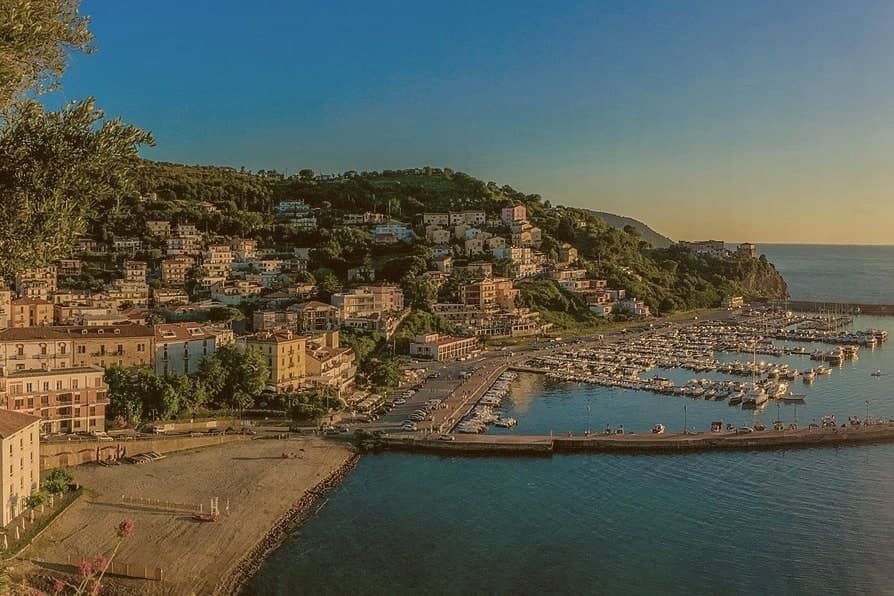
The gateway commune of the Cilento, a Byzantine acropolis on a promontory taken by the Saracens in 882 as a base for raids on Salerno.
Alife
Province: Caserta
A Roman walled town at the foot of the Matese, founded as a 326 BC oppidum, with Italy's fourth-largest amphitheatre still half-buried.
Amalfi
Province: Salerno
The first Italian maritime republic and the coast it named, six meters above the sea between cliffs that close around the duomo's steps.
Anacapri
Province: Napoli
The upper half of Capri, 150 meters above its famous twin.
Ariano Irpino
Province: Avellino
The City of the Three Hills at 788 meters, where Roger II promulgated the Assizes of 1140 and majolica kilns still fire.
Ascea
Province: Salerno
Two villages, a hilltown at 230 meters and a Cilento marina, with Parmenides and Zeno's Eleatic school in the ruins of Greek Velia below.
Atrani
Province: Salerno
The smallest commune in Italy by area, twelve hectares of stacked houses where the Amalfi Coast pinches shut around a single piazza.
Auletta
Province: Salerno
A Tanagro hill town above the Cilento-Vallo di Diano park, fortified by 1000 AD, scene of an 1861 anti-Piedmont massacre and an 1857 earthquake.
Bacoli
Province: Napoli
A town twenty kilometers west of Napoli, the Roman Bauli, where a cistern fed the imperial fleet at Miseno.
Benevento
Province: Benevento
Sannio capital at the Calore-Sabato confluence, with a 114 AD Trajan arch and a Lombard rotunda on the UNESCO list.
Caiazzo
Province: Caserta
A Cittaslow hill above the Volturno, turned by Franco Pepe's pizza into a destination for 800 covers a day in eighteenth-century rooms.
Calitri
Province: Avellino
A ceramic town at 530 meters, half-emptied by the 1980 earthquake and rebuilt around an August festival of music, words and ritual.
Camerota
Province: Salerno
A Cilento hill town of 422 meters above the Costa degli Infreschi, its caves holding one of the longest prehistoric stratigraphies on the southern Tyrrhenian.
Capaccio Paestum
Province: Salerno
Three Doric temples of 550 to 450 BC on the Sele plain, with mozzarella di bufala DOP on the buffalo flats below.
Capri
Province: Napoli
The 142-meter Tyrrhenian island town where Tiberius governed Rome for a decade from twelve villas above limestone cliffs.
Casamicciola Terme
Province: Napoli
Ischia's thermal town on the flank of Monte Epomeo, levelled by the 1883 earthquake and again in 2017, rebuilt on the Gurgitello springs.
Caserta
Province: Caserta
Italy's answer to Versailles, built by the Bourbons on the Campanian plain with 1,200 rooms and a three-kilometer water axis.
Castelcivita
Province: Salerno
A small Alburni hill town at 526 meters in the Cilento national park, the surface entrance to a 4,800-meter karst cave inhabited 40,000 years ago.
Castellabate
Province: Salerno
A hilltown on a 280-meter Cilento ridge, with a Bandiera Blu beach below and the Benvenuti al Sud film.
Centola
Province: Salerno
A Cilento hill village at 336 meters whose seaside frazione carries the name of Aeneas' helmsman.
Cerreto Sannita
Province: Benevento
A Sannio ceramics town at 290 meters, replanned on an orthogonal grid after the 1688 earthquake leveled the old hill.
Cetara
Province: Salerno
The Amalfi Coast's working tuna and anchovy port, where colatura di alici is still aged in chestnut barrels in the cellars behind the marina.
Conca dei Marini
Province: Salerno
A coastal hamlet of 664 people on the Amalfi Coast, home to a monastery pastry and a sea cave that glows green.
Cusano Mutri
Province: Benevento
A Sannio hill borgo at 475 meters on the south face of the Matese, the only town in the area spared by the 1688 earthquake.
Ercolano
Province: Napoli
Ercolano is the modern town built directly over Herculaneum, the Roman seaside resort buried under 25m of pyroclastic mud in AD 79 rather than the ash that fell on Pompeii, which is why its wood, papyrus, and upper floors survive when no other Roman site's do.
Forio
Province: Napoli
The largest Ischia commune by area, a Tyrrhenian coastal town facing the island's only sunset.
Frigento
Province: Avellino
An Irpinia hill village at 911 meters with a Republican-era Roman cistern complex on its summit and four valleys at its feet.
Furore
Province: Salerno
The Amalfi Coast village with no piazza and no center, scattered on rock walls 300 meters above the only fjord in southern Italy.
Gesualdo
Province: Avellino
An Irpinia village at 676 meters built around the castle of the prince of Venosa, madrigalist and murderer.
Lapio
Province: Avellino
An 1,428-resident Irpinia hilltop borgo at 590m in the hills east of Avellino, recognised by a rare four-signal combination (Città del Vino + Olio + Miele + Nocciola) for the whole local agricultural ecosystem.
Letino
Province: Caserta
At 961 meters the highest commune in the province of Caserta, where in April 1877 anarchists declared a Republic of Letino in the village hall.
Maiori
Province: Salerno
The Amalfi Coast town with the longest beach and a grid street plan, rebuilt after the 1954 flood took the medieval lanes.
Massa Lubrense
Province: Napoli
The Sorrentine Peninsula's largest commune by area, stretching from Sorrento across Punta Campanella to the Gulf of Salerno, Capri three miles offshore.
Mercogliano
Province: Avellino
A 550-meter Irpinia town on the slope of Partenio, gateway to the Montevergine Sanctuary 1,270 meters above.
Minori
Province: Salerno
The smaller of the two Rheginnae, where a first-century Roman maritime villa sits four blocks from the Tyrrhenian beach.
Montesarchio
Province: Benevento
Ancient Caudium at 300 meters, a Roman defeat still attached to the name two thousand years later.
Monteverde
Province: Avellino
A 740-meter borgo on the Apulian border of Irpinia, closer to Foggia than to its own provincial capital.
Morcone
Province: Benevento
A Sannite hill town at 600 meters above the Tammaro valley, with 5th-century BC walls and the convent where a future saint took his vows.
Morigerati
Province: Salerno
A 608-person Cilento village above the Bussento gorge, the river surfacing from underground caves directly beneath the cliffs.
Nola
Province: Napoli
The Campanian plain town where Augustus died in AD 14 and Giordano Bruno was born in 1548, famous for the June Festa dei Gigli.
Nusco
Province: Avellino
The Balcony of Irpinia at 914 meters, a ridge town between the Ofanto and Calore valleys, hometown of Prime Minister Ciriaco De Mita.
Padula
Province: Salerno
A hill town at 699 meters, holding the Certosa di San Lorenzo and the world's largest cloister.
Perito
Province: Salerno
A Cilento ridge town at 480 meters above the Alento valley, once a center of black-powder production for hunting, defense and brigands.
Piano di Sorrento
Province: Napoli
The quieter Sorrentine plain four kilometers from Sorrento, autonomous since 1808, with prehistoric Gaudo pottery and a black-sand marina at the foot of the cliff.
Pisciotta
Province: Salerno
A Cilento hilltop town of olive terraces above the Tyrrhenian, where fishermen still pull anchovies with a medieval net.
Pompei
Province: Napoli
The Roman city buried by Vesuvius in 79 AD, dug back up since 1748, and a modern town around Bartolo Longo's 1876 sanctuary.
Positano
Province: Salerno
The vertical village of the Amalfi Coast, terraced houses climbing four hundred meters to the Lattari ridge under a tiled Byzantine dome.
Pozzuoli
Province: Napoli
A Roman port on a volcanic caldera, the Greek Dicearchia and the Roman Puteoli, where a market's columns first proved that the ground itself rises and falls.
Praiano
Province: Salerno
The Amalfi commune between Positano and Amalfi where the doges of the maritime republic kept their summer residences and the Path of the Gods starts.
Procida
Province: Napoli
A four-square-kilometer Flegrean island of pastel fishing houses, the 2022 Italian Capital of Culture.
Ravello
Province: Salerno
A ridge town above the Amalfi Coast where Wagner found Klingsor's garden in 1880.
Roscigno
Province: Salerno
A Cilento ghost town at 570 meters, emptied by a 1902 landslide and known as the Pompeii of the twentieth century.
Sant'Agata de' Goti
Province: Benevento
A medieval town built on a tuff cliff between two gorges, the houses standing flush with the edge over the Isclero river below.
Savignano Irpino
Province: Avellino
A 718-meter stone borgo above the Cervaro valley on the Campania-Apulia border, called Savignano di Puglia until 1963.
Sessa Aurunca
Province: Caserta
Ancient Suessa Aurunca on the south slope of an extinct volcano, with a Romanesque cathedral of Cosmatesque mosaics built in 1103.
Sorrento
Province: Napoli
The Roman Surrentum on a tuff cliff above the Bay of Napoli, sacked by the Turks in 1558.
Summonte
Province: Avellino
An Irpinia hill village at 738 meters on the slope of the Partenio massif, built around a 16-meter Angevin cylinder tower.
Taurasi
Province: Avellino
An Irpinia wine village at 400 meters above the Calore valley, the southern home of Aglianico called Barolo of the South.
Teggiano
Province: Salerno
A ridge town at 635 meters above the valley it once named, held by the Sanseverino for three centuries.
Torre Annunziata
Province: Napoli
Capital of Italian pasta in the interwar period and home of the Roman Villa di Poppea, on the bay at the foot of Vesuvius.
Tramonti
Province: Salerno
The inland side of the Amalfi Coast, thirteen hamlets on the Lattari slopes producing wine and an exported pizza dough.
Trentinara
Province: Salerno
A Cilento balcony at 606 meters on the Cantenna cliff, called the Terrazza del Cilento, with a 1,500-meter zipline that drops 170 meters toward Paestum.
Tufo
Province: Avellino
A 250-meter Irpinia hill town on sulfur-rich limestone slopes, twenty kilometers north of Avellino.
Vairano Patenora
Province: Caserta
A roofless Aragonese castle with four round towers stands over a walled stone borgo in the Volturno valley, on the road that carried emperors and popes between Rome and Naples.
Vico Equense
Province: Napoli
The northern gate of the Sorrento peninsula, a clifftop town of ninety meters above the Bay of Napoli.
Vietri sul Mare
Province: Salerno
The eastern end of the Amalfi Coast at 80 meters, the ceramics town since the fifteenth century, the gateway between Salerno and the cliff road.
Zungoli
Province: Avellino
An Irpinia ridge between the Ufita valley and the Daunian hills, with walls above and tuff caves below the houses.
From elsewhere in Italy
Five more towns to discover
Visso
Province: Macerata
The northern Sibillini gate at 607 meters where the Nera meets the Ussita, holding one of two surviving manuscripts of Leopardi's L'Infinito.
Goriano Sicoli
Province: L'Aquila
At 720 meters in the Subequana valley, a medieval village drawn by M.C. Escher in 1929 keeps a May ritual folklorists trace to Demeter.
Ugento
Province: Lecce
A Messapian-Roman town five kilometers from the Ionian, where a Baroque castle sits on the walls of the ancient city of Ozan.
Fontanellato
Province: Parma
A Parma-plain town built around the Rocca Sanvitale, the moated fortress at its center.
Pescina
Province: L'Aquila
A Marsica town at 735 meters, on the rim of the drained Fucino basin, that lost five thousand of six thousand people in a single morning in 1915.