
Without a car
Campania by train
29 towns
Towns in this region where we confirmed an active station. Check the timetable before you go: a station on the map is not the same as a useful service.
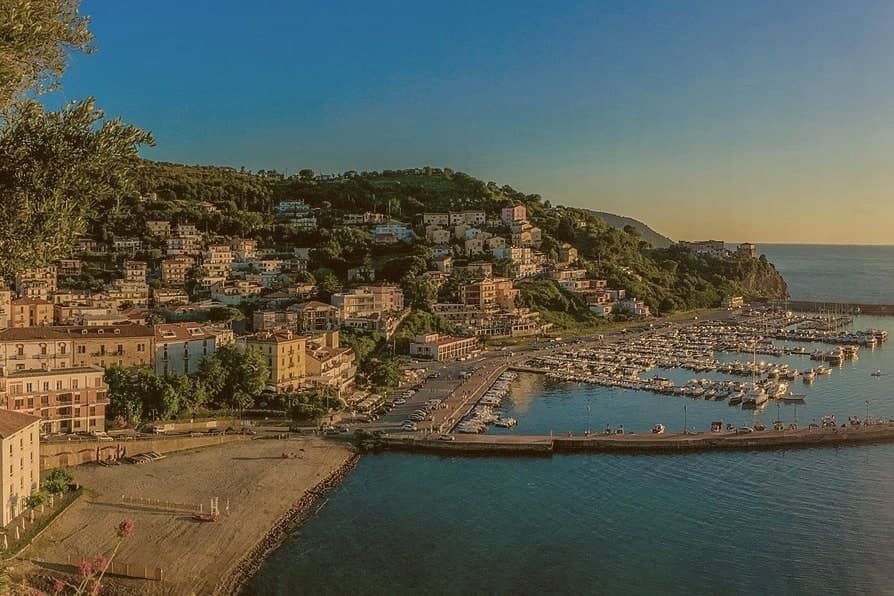
Agropoli
Province: Salerno · 24 m
The gateway commune of the Cilento, a Byzantine acropolis on a promontory taken by the Saracens in 882 as a base for raids on Salerno.
Alife
Province: Caserta · 110 m
A Roman walled town at the foot of the Matese, founded as a 326 BC oppidum, with Italy's fourth-largest amphitheatre still half-buried.
Ariano Irpino
Province: Avellino · 788 m
The City of the Three Hills at 788 meters, where Roger II promulgated the Assizes of 1140 and majolica kilns still fire.
Ascea
Province: Salerno · 230 m
Two villages, a hilltown at 230 meters and a Cilento marina, with Parmenides and Zeno's Eleatic school in the ruins of Greek Velia below.
Auletta
Province: Salerno · 280 m
A Tanagro hill town above the Cilento-Vallo di Diano park, fortified by 1000 AD, scene of an 1861 anti-Piedmont massacre and an 1857 earthquake.
Bacoli
Province: Napoli · 30 m
A town twenty kilometers west of Napoli, the Roman Bauli, where a cistern fed the imperial fleet at Miseno.
Benevento
Province: Benevento · 130 m
Sannio capital at the Calore-Sabato confluence, with a 114 AD Trajan arch and a Lombard rotunda on the UNESCO list.
Caiazzo
Province: Caserta · 200 m
A Cittaslow hill above the Volturno, turned by Franco Pepe's pizza into a destination for 800 covers a day in eighteenth-century rooms.
Calitri
Province: Avellino · 530 m
A ceramic town at 530 meters, half-emptied by the 1980 earthquake and rebuilt around an August festival of music, words and ritual.
Capaccio Paestum
Province: Salerno · 419 m
Three Doric temples of 550 to 450 BC on the Sele plain, with mozzarella di bufala DOP on the buffalo flats below.
Caserta
Province: Caserta · 68 m
Italy's answer to Versailles, built by the Bourbons on the Campanian plain with 1,200 rooms and a three-kilometer water axis.
Ercolano
Province: Napoli · 44 m
Ercolano is the modern town built directly over Herculaneum, the Roman seaside resort buried under 25m of pyroclastic mud in AD 79 rather than the ash that fell on Pompeii, which is why its wood, papyrus, and upper floors survive when no other Roman site's do.
Lapio
Province: Avellino · 590 m
An 1,428-resident Irpinia hilltop borgo at 590m in the hills east of Avellino, recognised by a rare four-signal combination (Città del Vino + Olio + Miele + Nocciola) for the whole local agricultural ecosystem.
Montesarchio
Province: Benevento · 300 m
Ancient Caudium at 300 meters, a Roman defeat still attached to the name two thousand years later.
Nola
Province: Napoli · 34 m
The Campanian plain town where Augustus died in AD 14 and Giordano Bruno was born in 1548, famous for the June Festa dei Gigli.
Nusco
Province: Avellino · 914 m
The Balcony of Irpinia at 914 meters, a ridge town between the Ofanto and Calore valleys, hometown of Prime Minister Ciriaco De Mita.
Padula
Province: Salerno · 699 m
A hill town at 699 meters, holding the Certosa di San Lorenzo and the world's largest cloister.
Piano di Sorrento
Province: Napoli · 96 m
The quieter Sorrentine plain four kilometers from Sorrento, autonomous since 1808, with prehistoric Gaudo pottery and a black-sand marina at the foot of the cliff.
Pisciotta
Province: Salerno · 171 m
A Cilento hilltop town of olive terraces above the Tyrrhenian, where fishermen still pull anchovies with a medieval net.
Pompei
Province: Napoli · 30 m
The Roman city buried by Vesuvius in 79 AD, dug back up since 1748, and a modern town around Bartolo Longo's 1876 sanctuary.
Pozzuoli
Province: Napoli · 28 m
A Roman port on a volcanic caldera, the Greek Dicearchia and the Roman Puteoli, where a market's columns first proved that the ground itself rises and falls.
Savignano Irpino
Province: Avellino · 718 m
A 718-meter stone borgo above the Cervaro valley on the Campania-Apulia border, called Savignano di Puglia until 1963.
Sessa Aurunca
Province: Caserta · 203 m
Ancient Suessa Aurunca on the south slope of an extinct volcano, with a Romanesque cathedral of Cosmatesque mosaics built in 1103.
Sorrento
Province: Napoli · 50 m
The Roman Surrentum on a tuff cliff above the Bay of Napoli, sacked by the Turks in 1558.
Torre Annunziata
Province: Napoli · 15 m
Capital of Italian pasta in the interwar period and home of the Roman Villa di Poppea, on the bay at the foot of Vesuvius.
Tufo
Province: Avellino · 250 m
A 250-meter Irpinia hill town on sulfur-rich limestone slopes, twenty kilometers north of Avellino.
Vairano Patenora
Province: Caserta · 168 m
A roofless Aragonese castle with four round towers stands over a walled stone borgo in the Volturno valley, on the road that carried emperors and popes between Rome and Naples.
Vico Equense
Province: Napoli · 90 m
The northern gate of the Sorrento peninsula, a clifftop town of ninety meters above the Bay of Napoli.
Vietri sul Mare
Province: Salerno · 80 m
The eastern end of the Amalfi Coast at 80 meters, the ceramics town since the fifteenth century, the gateway between Salerno and the cliff road.
The slow-trip planner
Plan a slow trip across the towns travelers skip.
Answer five questions. We will shape a geographically coherent slow trip from the 1,000 Italian towns most travelers skip. Yours to save and share.
From elsewhere in Italy
Five more towns to discover
Biccari
Province: Foggia
A Subappennino Dauno borgo at 450 meters under Monte Cornacchia, the highest peak in Puglia at 1,151 meters, with a Byzantine tower at its core.
Sirolo
Province: Ancona
A clifftop borgo at 125 meters, above the Due Sorelle sea stacks of the Adriatic.
Penne
Province: Pescara
The brick city at 438 meters between the Tavo and Fino, ancient capital of the Vestini, rebuilt after Allied bombing and awarded the Silver Medal of Civic Merit.
Palazzolo Acreide
Province: Siracusa
An 8,000-resident hilltop town on the Iblei plateau at 670m, rebuilt entirely in late Baroque after the 1693 earthquake and founded over the Greek Akrai colony in 664 BC, with a Greek theatre and a cluster of rock carvings unlike anything else nearby.
Verucchio
Province: Rimini
A spur over the lower Marecchia valley, cradle of the Villanovan civilization and birthplace of the Malatesta lordship of Romagna.