
Without a car
Tuscany by train
46 towns
Towns in this region where we confirmed an active station. Check the timetable before you go: a station on the map is not the same as a useful service.
- ✷ We've been
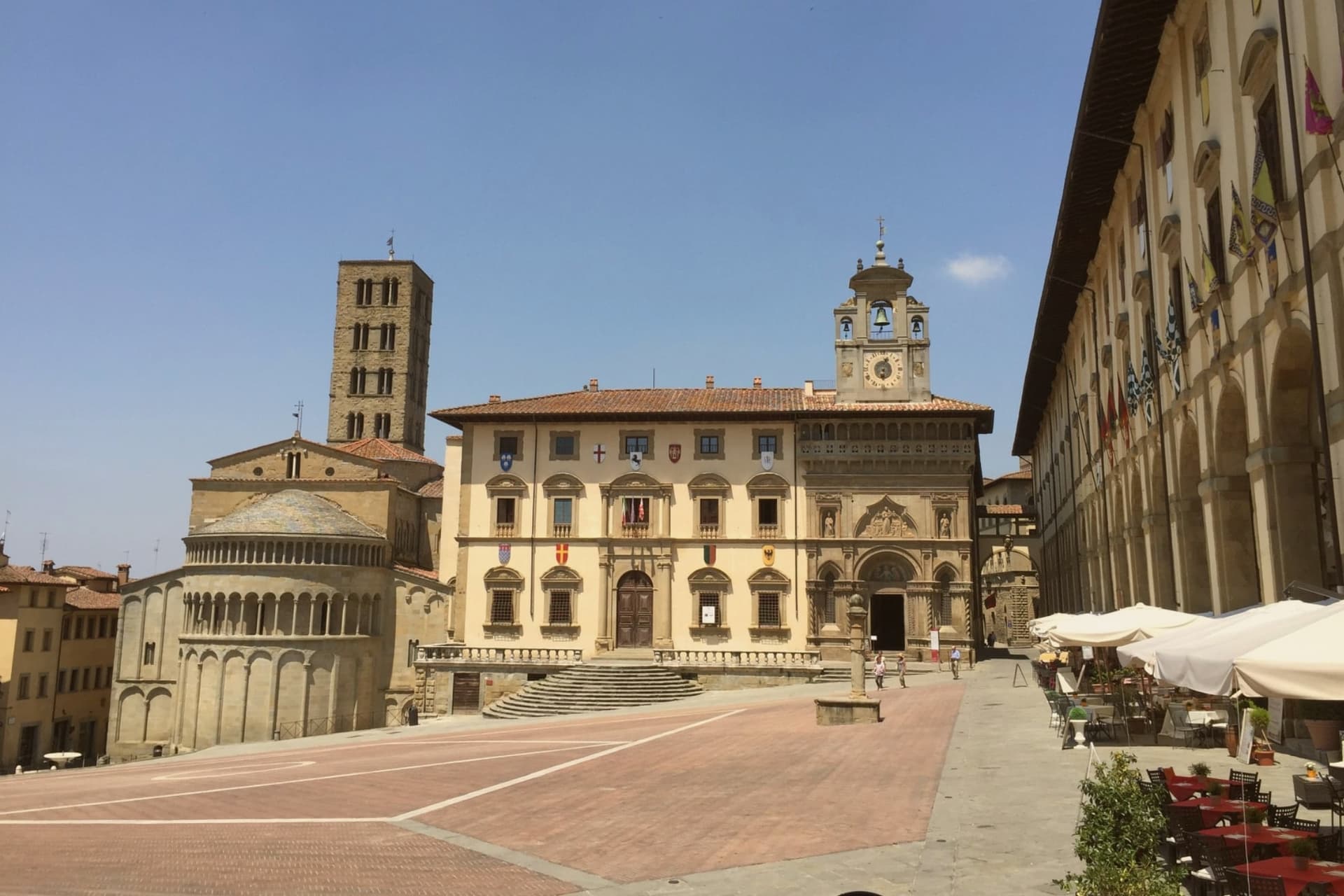
Arezzo
Province: Arezzo · 296 m
Tuscany's other set-piece: a 96,000-resident Etruscan-Roman-medieval hilltop city 80 km southeast of Florence.
- ✷ We've been
Barga
Province: Lucca · 410 m
A medieval hilltop town at 410 meters in the Serchio valley, where Giovanni Pascoli wrote his last poems and the August festival serves fish and chips.
Bibbona
Province: Livorno · 85 m
An Etruscan-origin hill village above the Costa degli Etruschi, with a Romanesque parish church and a Lorraine-built coastal fort eight kilometers down the road at Marina di Bibbona.
Buonconvento
Province: Siena · 147 m
The walled brick borgo in the Crete Senesi where Emperor Henry VII died in 1313, on the Via Cassia at the confluence of the Arbia and Ombrone.
- ✷ We've been
Camaiore
Province: Lucca · 34 m
The Versilia commune that runs from the mountains to the sea, a Roman Campus Maior on the Via Francigena with a beach at its western end.
- ✷ We've been
Campiglia Marittima
Province: Livorno · 231 m
A walled hilltop borgo above the Val di Cornia, where the Rocca tower watches a mining landscape worked from the Etruscans to 1976.
- ✷ We've been
Capalbio
Province: Grosseto · 217 m
A walled hilltop borgo at 217 meters in the southern Maremma, donated to the Abbey of Tre Fontane by Charlemagne.
- ✷ We've been
Carrara
Province: Massa-Carrara · 80 m
The marble town at the foot of the Apuan Alps, with over 650 quarry sites in the valleys above and the stone that built the Pantheon, the Pietà and Michelangelo's David.
- ✷ We've been
Castagneto Carducci
Province: Livorno · 194 m
A hilltop borgo at 194 meters above the Costa degli Etruschi, renamed for the poet Carducci in 1907 and the home of Bolgheri and Sassicaia.
- ✷ We've been
Castelnuovo Berardenga
Province: Siena · 351 m
A commune of 351 meters, the last castle Siena built against Florence, in 1366.
- ✷ We've been
Castelnuovo di Garfagnana
Province: Lucca · 277 m
The Garfagnana capital where the fortified medieval borgo sits at the confluence of the Serchio and the Turrite, where the Tuscan Apennines meet the Alpi Apuane.
Castiglion Fiorentino
Province: Arezzo · 342 m
A walled hill town at 342 meters between Arezzo and Cortona, where Etruscan walls support the medieval Cassero.
Certaldo
Province: Firenze · 67 m
The brick-built upper town in the Valdelsa where Boccaccio spent his last years, twenty-five kilometers from Florence on the medieval road to Siena.
Chiusi
Province: Siena · 398 m
The Etruscan city of King Porsenna at 398 meters above the Val di Chiana, with one of Italy's major Etruscan museums and tunnels carved beneath the streets.
Cortona
Province: Arezzo · 494 m
An Etruscan lucumonia at 494 meters, with two kilometers of walls older than Rome.
Fiesole
Province: Firenze · 295 m
An Etruscan hilltop above Florence, still looking down on what later replaced it.
- ✷ We've been
Fivizzano
Province: Massa-Carrara · 373 m
The draw here is not the capoluogo but its 92 mountain frazioni, scattered across a Lunigiana commune where a thermal gorge, an intact fortress and a ridge-top hamlet each stand as their own destination.
- ✷ We've been
Grosseto
Province: Grosseto · 10 m
The Maremma capital on the Ombrone river, ringed by hexagonal Medici walls of 1564 that now serve as the city's public park.
- ✷ We've been
Livorno
Province: Livorno · 3 m
Tuscany's working port and Medici-planned 'New City', a 16th-century planned town built on reclaimed coast, with a Venice-like canal quarter, the Quattro Mori monument, and a 1.5-km seafront promenade that locals call the world's most beautiful balcony.
- ✷ We've been
Lucca
Province: Lucca · 19 m
The provincial capital ringed by four kilometers of intact sixteenth-century walls, birthplace of Puccini and the only fully walled Italian city of its scale.
Lucignano
Province: Arezzo · 400 m
A walled elliptical hill town at 400 meters between Siena and Arezzo, planned in medieval concentric rings around the goldsmith's reliquary called the Tree of Life.
Massa Marittima
Province: Grosseto · 380 m
A medieval mining town at 380 meters, free commune from 1255 to 1337, whose cathedral holds the relics of San Cerbone.
- ✷ We've been
Montalcino
Province: Siena · 564 m
A walled hill town at 564 meters above the Val d'Orcia, the last fortress to hold out for the Sienese Republic and the birthplace of Brunello.
- ✷ We've been
Monte Argentario
Province: Grosseto · 5 m
A 635-meter peninsula tied to the mainland by three sand spits, ringed by Spanish forts and marked by Caravaggio's death in 1610.
Montecarlo
Province: Lucca · 163 m
A walled hill village at 163 meters above the Lucca plain, founded by Emperor Charles IV in 1333 and named for him, surrounded by twenty wineries.
- ✷ We've been
Montecatini-Terme
Province: Pistoia · 27 m
Eleven thermal springs in a Liberty-style park at the foot of the Apennines.
- ✷ We've been
Montepulciano
Province: Siena · 605 m
A Renaissance hill town at 605 meters on a limestone ridge, aging its Sangiovese-based red in vaulted cellars beneath the palazzi.
- ✷ We've been
Monteriggioni
Province: Siena · 274 m
A circular Sienese fortress built between 1213 and 1219 on a natural hill, fourteen towers on a 570-meter wall, intact and unbroken.
Montignoso
Province: Massa-Carrara · 132 m
A Riviera Apuana commune split between the Cinquale coastal frazione, the Castello Aghinolfi on the hill, and the Lago di Porta wetland on the Versilia plain.
Murlo
Province: Siena · 314 m
A medieval bishops' fief twenty kilometers south of Siena, with an Etruscan princely palace on Poggio Civitate and the Cappellone statue as its symbol.
- ✷ We've been
Orbetello
Province: Grosseto · 3 m
A town on a narrow isthmus at the center of its own lagoon, fortified by Spain in 1557.
- ✷ We've been
Pietrasanta
Province: Lucca · 14 m
The marble-processing town under the Apuan Alps, worked by Michelangelo, Henry Moore, Joan Miró and Fernando Botero.
- ✷ We've been
Piombino
Province: Livorno · 21 m
A promontory port facing Elba across the channel, founded by refugees from Etruscan Populonia and now the Tuscan archipelago's ferry capital.
- ✷ We've been
Pisa
Province: Pisa · 4 m
Maritime republic on the Arno, twelve kilometers from the Ligurian Sea, with the leaning bell tower at the center of a single UNESCO-listed walled compound.
- ✷ We've been
Pistoia
Province: Pistoia · 67 m
Italy's nursery capital and the medieval Tuscan rival that gave its name to the pistol, a quietly extraordinary centro storico 30 minutes from Florence by train and Italy's Capital of Culture 2017.
- ✷ We've been
Pontedera
Province: Pisa · 14 m
The Valdera's working capital on the Pisa–Florence line, where Piaggio turned a bombed aircraft plant into the birthplace of the Vespa in 1946.
Pontremoli
Province: Massa-Carrara · 236 m
The capital of Lunigiana at the confluence of the Magra and Verde, holding the prehistoric stele statues and the oldest book prize in Italy.
Poppi
Province: Arezzo · 437 m
The Casentino borgo at 437 meters above the field where Dante fought at Campaldino in June 1289.
Rapolano Terme
Province: Siena · 334 m
A Sienese thermal town of 38-degree calcium-sulphur waters and travertine quarries feeding facades beyond its borders.
- ✷ We've been
San Giuliano Terme
Province: Pisa · 10 m
A thermal spa ten kilometers from Pisa, where the springs were bathed since the Romans called them Aquae Pisanae.
- ✷ We've been
San Miniato
Province: Pisa · 150 m
The hilltop town between Pisa and Florence that produces a quarter of Tuscany's white truffles and once held the imperial seat of Otto I.
Seravezza
Province: Lucca · 100 m
The Versilia town where Michelangelo opened the Pope's marble quarries and Cosimo I built his summer palace.
- ✷ We've been
Siena
Province: Siena · 322 m
The medieval rival of Florence at 322 meters on three hills, with a shell-shaped piazza where seventeen contrade race bareback horses twice a year.
Trequanda
Province: Siena · 453 m
A village of 1,166 in three hilltop borghi between Crete Senesi and Val di Chiana, with the terracotta workshops of Petroio holding to a five-hundred-year craft.
- ✷ We've been
Viareggio
Province: Lucca · 2 m
The Versilia capital, a Carnival city on the Tuscan coast that turned into a Belle Époque resort when the railway arrived.
Vicopisano
Province: Pisa · 12 m
A medieval river port rebuilt by Brunelleschi in 1434 after Florence took the town from Pisa.
The slow-trip planner
Plan a slow trip across the towns travelers skip.
Answer five questions. We will shape a geographically coherent slow trip from the 1,000 Italian towns most travelers skip. Yours to save and share.
From elsewhere in Italy
Five more towns to discover
Visso
Province: Macerata
The northern Sibillini gate at 607 meters where the Nera meets the Ussita, holding one of two surviving manuscripts of Leopardi's L'Infinito.
Goriano Sicoli
Province: L'Aquila
At 720 meters in the Subequana valley, a medieval village drawn by M.C. Escher in 1929 keeps a May ritual folklorists trace to Demeter.
Ugento
Province: Lecce
A Messapian-Roman town five kilometers from the Ionian, where a Baroque castle sits on the walls of the ancient city of Ozan.
Fontanellato
Province: Parma
A Parma-plain town built around the Rocca Sanvitale, the moated fortress at its center.
Pescina
Province: L'Aquila
A Marsica town at 735 meters, on the rim of the drained Fucino basin, that lost five thousand of six thousand people in a single morning in 1915.