
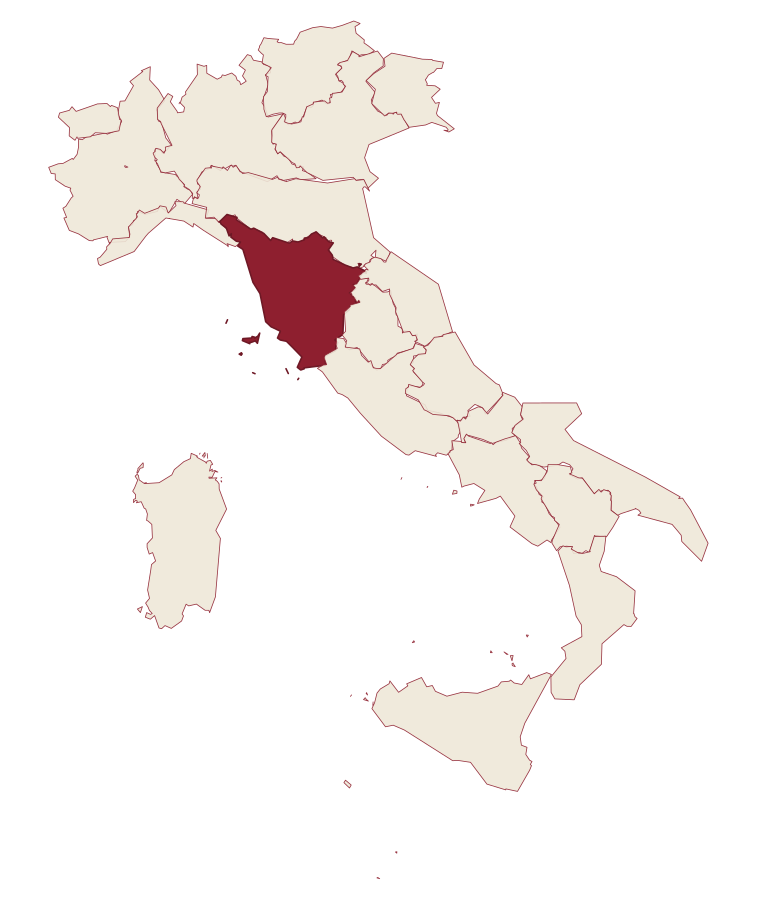
Tuscany · Livorno
Campiglia Marittima
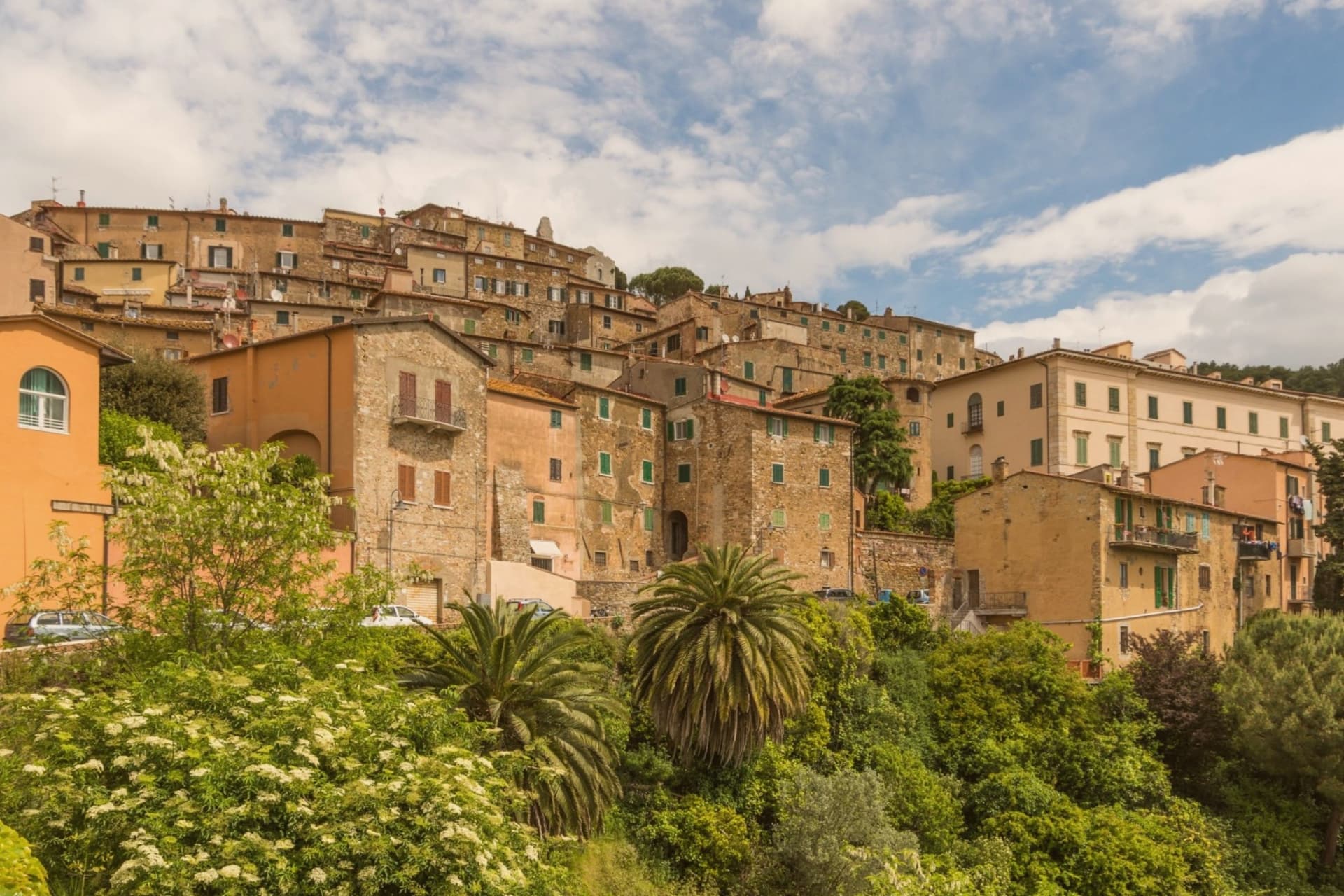
A walled hilltop borgo above the Val di Cornia, where the Rocca tower watches a mining landscape worked from the Etruscans to 1976.
By Peter Benei
Written about. No. 38.
The letter
Campiglia Marittima got its letter. One town at a time, free. The photo, the food, the festa.
Visiting
- Best time
- May–Sep
- By car
- 1 h 14 min from Pisa
- By train
- Station in the comune
- Population
- 12,301
- J11°
- F13°
- M14°
- A17°
- M21°
- J25°
- J29°
- A30°
- S25°
- O20°
- N16°
- D12°
- Best
- Hot or crowded
- Quiet
- Mostly closed
Daytime air temperature, averages for 2020–2024. The sea is warmest in August at 27° and coldest in February at 14°. Weather data by Open-Meteo.com.
Going to the sea? How to find the free beaches in Italy.
Why come
Campiglia Marittima sits on the last slopes of the Colline Metallifere above the Val di Cornia, eight kilometers inland from the Tyrrhenian coast and 60 kilometers southeast of Livorno. The Rocca occupies the highest point, a fortified semicircle whose 14th-century tower and town walls trace the medieval defensive line. The territory has been mined since the Etruscans: copper, silver, lead and tin from the hills behind town, worked continuously until the last galleries closed in 1976.
The Parco Archeominerario di San Silvestro, opened in 1996 on 450 hectares behind the town, centers on Rocca San Silvestro, a tenth and eleventh-century miners' village abandoned in the fourteenth century and excavated since 1984. Visitors enter through restored galleries on a small electric train. Down on the plain the DOC Val di Cornia produces Sangiovese and Cabernet, and the thermal springs at Venturina, the frazione south of town, have flowed since Roman use as Aquae Populoniae.
How to get there
From Pisa (PSA), about 1 h 20 min by car.
Bologna (BLQ) is about 2 h 53 min away.
By car from the center of Pisa 1 h 14 min, Siena 1 h 50 min or Florence 2 h 5 min.
There is a railway station in the comune, so you can arrive without a car.
Coming by train into Livorno Centrale? Campiglia Marittima is about 1 h 4 min away by road.
Every town within reach of Pisa airport.
First time driving in Italy? Read our complete manual.
What to see
Rocca di Campiglia
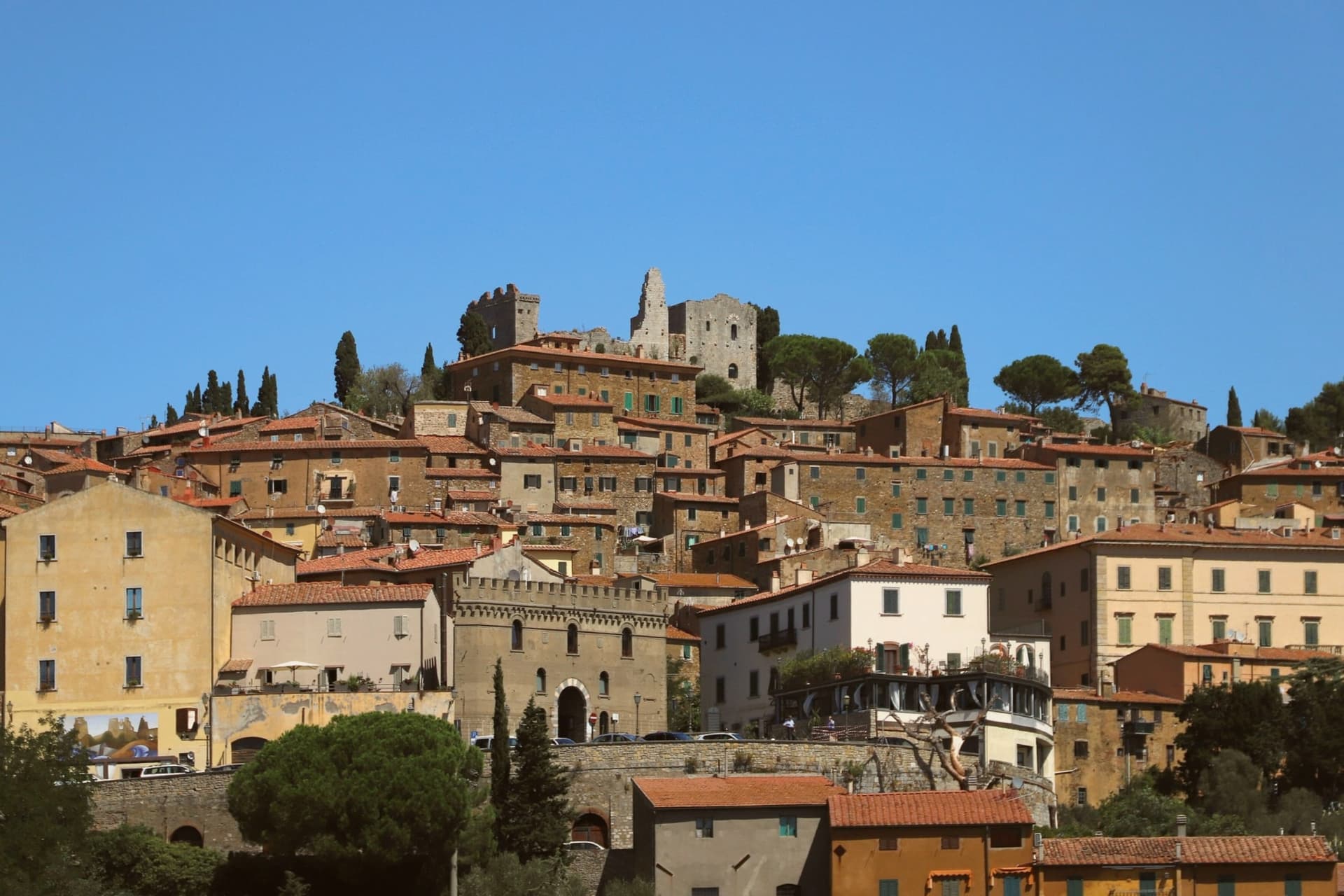
Fortified semicircle at 281 meters with the 14th-century tower, walls and the Pieve di San Giovanni, the highest point of the town.
Parco Archeominerario di San Silvestro
450-hectare park behind town, opened 1996, with restored mining galleries, a small electric train, and the abandoned medieval miners' village of Rocca San Silvestro.
Centro storico
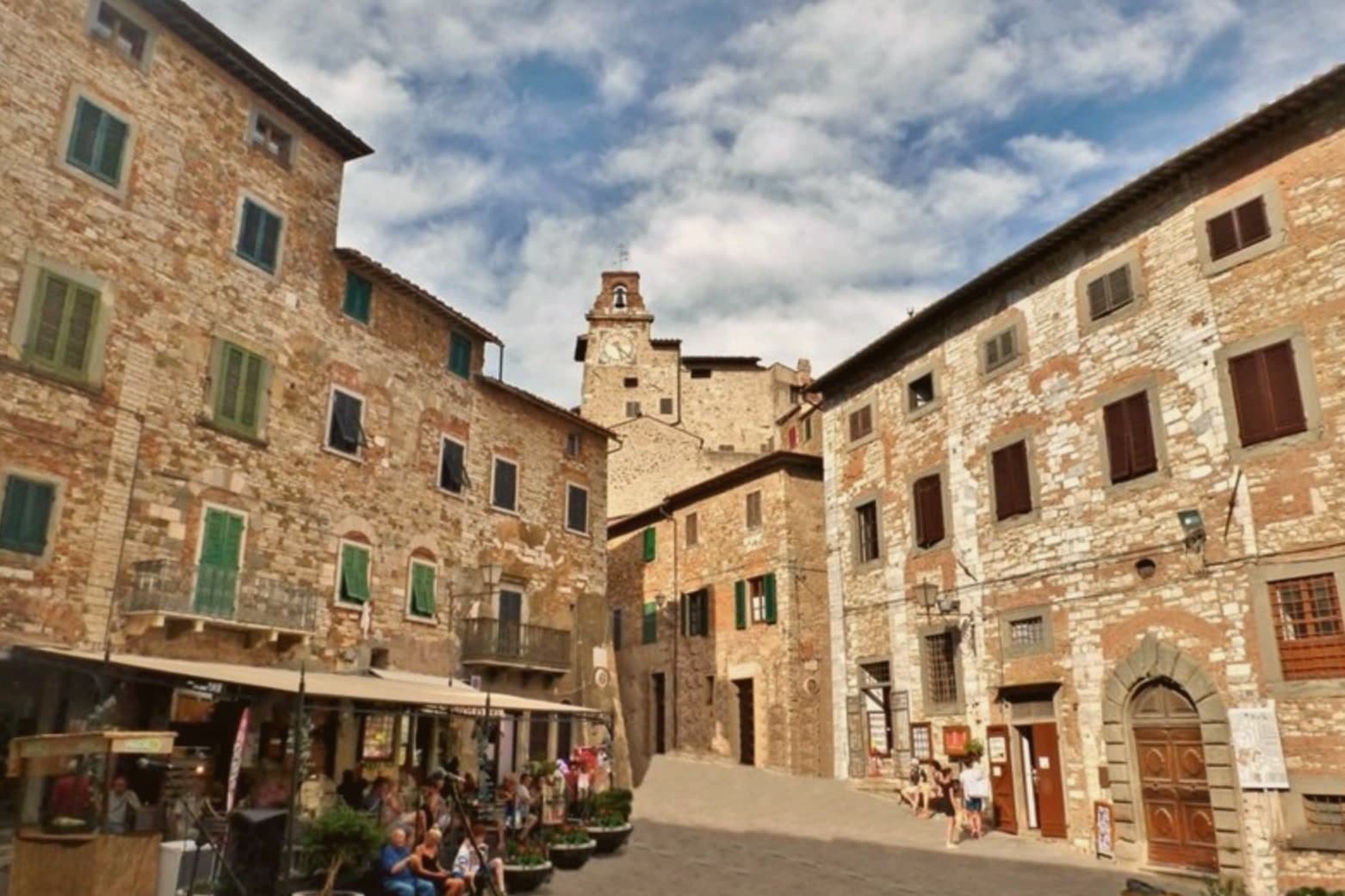
Walled hilltop borgo of stone houses, with Piazza della Repubblica at its center, the medieval gates Porta a Mare and Porta Fiorentina still intact.
Terme di Venturina
Thermal springs in the frazione of Venturina, used since Roman times as Aquae Populoniae, with sulfurous waters at 36 degrees year-round.
Pieve di San Giovanni
Romanesque parish church inside the Rocca walls, twelfth-century origin, with a marble architrave by an anonymous Pisan school sculptor.
Living here
Could you live here?
Campiglia Marittima meets all 3 of our rules for a small town.
- 12,301 people, inside our sweet spot of 5,000 to 20,000: a real town, still one community.
- Grosseto, a city of 81,264, is 53 min by car. Inside our 30 to 60 minutes: close for the services, far enough to keep its own life.
- A station of its own. Trains are the overlooked way to get around Italy: no parking, straight into the center.
The rules come from our series Where to Move in Italy, written from the places we have lived: Part 1, The End of the Road · Part 2, The Small Town · Part 3, The City · Part 4, The Postcard · Part 5, The Other Half. The towns we would pick are in Part 6, The Best Towns.
- Population 12,301, down 7.2% since 2015
- Nearest city Grosseto, 53 min drive
- Train station in the comune
- Nearest national health service hospital Piombino, 10 km as the crow flies · how healthcare works in Italy
- Homes in the center: €1,350 to €1,750 per m² to buy, €6.10 to €8.10 per m² a month to rent
Weighing a move here? See the moving year.
All the numbers Common questions, designations, lists and sources.
More about living here
- Remote
- Pharmacy in town
- High school within a 30-minute drive
- Full fibre reaches 1% of homes
- Primary school in the comune
- Earthquake zone 4, very low hazard
- Pisa airport (PSA), 1 h 20 min drive, the nearest with scheduled flights
- Regional capital Florence, 2 h 5 min drive
If you are moving here
Who lives here
8% of residents are foreign citizens, most often from Romania, Senegal and Morocco, against 9% across Italy. 51 of them come from English-speaking countries or western and northern Europe, mostly Germany, Switzerland and France. There are 330 people over 65 for every 100 children under 15, against 216 across Italy. 26% of homes have no resident, holiday homes and empty ones counted together, against 27% across Italy. Livorno province ranks 49th of 107 in Il Sole 24 Ore's quality of life ranking for 2025.
Health and schools
The nearest emergency room is in Piombino, 10 km as the crow flies. The nearest major one is in Siena, 65 km away. The nearest IB school is International School of Siena, 63 km as the crow flies.
Information, not medical advice. Confirm with a professional.
Taxes
A home that is not your main one pays 0.91% a year in property tax, charged on the cadastral value rather than the price. A main home pays none unless it is in a luxury category. The town adds 0.8% to your income tax. 7% pensioner tax: this town is not in a qualifying area.
Information, not tax advice. Confirm with a professional.
What it costs
The average household in Tuscany spends about €2,410 a month, €540 of it on food, against about €2,170 across Italy. A family of three pays about €770 a year for water, on the Tuscany average. In Livorno, the provincial capital, in September 2026, an espresso cost €1.25, a meal in a pizzeria €10.04 and a man's haircut €18.31.
Climate and risk
It is in climate zone D, on a scale from A, the warmest, to F, the coldest, and heating may run from November 1 to April 15, up to 12 hours a day, unless the mayor changes it. 19% of residents live in a zone the national maps rate high for floods, 57% in a high or medium one. 4% live in a zone rated high or very high for landslides.
These shares cover the whole comune, not any one street. Check an address on IdroGEO.
Moving from abroad? Which visa you need. Sources: ISTAT, the Ministry of Health, ISPRA, the Finance Ministry, the Ministry of Enterprise, Poste Italiane, the comuni, the IB, International Schools Database, Il Sole 24 Ore, Cittadinanzattiva.
Thermal baths in town: piscina termale calidario.
Known for
MINING LANDSCAPE
Continuous extraction of copper, silver, lead and tin from the Colline Metallifere from the Etruscans to 1976, now the Parco Archeominerario di San Silvestro.
ROCCA SAN SILVESTRO
Tenth-century miners' village in the park behind town, abandoned in the fourteenth century, excavated since 1984 and visited through restored mine galleries.
DOC VAL DI CORNIA
Wine appellation on the plain below town, Sangiovese and Cabernet red, Vermentino white, grown on the strip of land between hills and sea.
Common questions
- What is Campiglia Marittima known for?
- Campiglia Marittima is a walled hilltop borgo above the Val di Cornia, where the Rocca tower watches a mining landscape worked from the Etruscans to 1976.
- Where is Campiglia Marittima?
- Campiglia Marittima is a comune in the province of Livorno, in Tuscany, at 231 meters above sea level.
- What is the nearest airport to Campiglia Marittima?
- The nearest airport with scheduled flights is Pisa (PSA), about 1 h 20 min by car.
- Can you get to Campiglia Marittima without a car?
- Yes. There is a railway station in the comune, so you can arrive by train.
- How long is the drive from Pisa to Campiglia Marittima?
- About 1 h 14 min by car.
- When is the best time to visit Campiglia Marittima?
- Best in May–Sep. August is the warmest month, averaging 30 degrees, and December the wettest, with about 13 rain days.
- Which other towns are like Campiglia Marittima?
- Piombino, Capaccio Paestum and Agropoli.
- How many people live in Campiglia Marittima?
- 12,301 residents, by ISTAT's count on 1 January 2025.
- Is Campiglia Marittima a good place to live?
- By the rules in our Where to Move in Italy series, Campiglia Marittima is a small town that meets all 3 of our rules. The nearest city, Grosseto, is 53 min away by car. The nearest national health service hospital is in Piombino, 10 km as the crow flies. Full fibre reaches 1% of homes.
Tags & data designations · numbers · sources
Landscape
The numbers
- Elevation: 231 m
- Population: 12,301
- Surface area: 83.28 km²
These figures were compiled from public directories: ISTAT, OpenStreetMap and Wikidata, and from the official listings of the guides named on this page. Town details change; verify with official sources before you travel.
The ranked lists
Lists Campiglia Marittima appears in
- The 6 best coastal towns inside a nature park in TuscanyTuscanycoastalinside a park6 towns · smallest 12,301 residents
- The 6 best hidden towns inside a nature park in TuscanyTuscanyinside a parkhidden6 towns · smallest 2,892 residents
- The best hidden coastal towns you can reach by train in TuscanyTuscanycoastalby trainhidden6 towns · smallest 3,174 residents
- The best hot-spring towns within 75 minutes of PisaNear Pisahot springswithin 75 min6 towns · smallest 3,438 residents · closest 8 min away
- A 7-day trip through the Tuscan Maremma, based in GrossetoTuscany7-day trip7 towns · base Grosseto · day trips up to 80 min
- The 7 best coastal towns in the province of LivornoLivorno provincecoastal7 towns · smallest 358 residents
Near here, with a letter
- Written about. No. 39.
Piombino
Province: Livorno
A promontory port facing Elba across the channel, founded by refugees from Etruscan Populonia and now the Tuscan archipelago's ferry capital.
16 min by car
- Written about. No. 40.
Suvereto
Province: Livorno
A stone borgo at 127 meters above the Val di Cornia, named for the cork oaks of its forests and first recorded in 973, under a twelfth-century Aldobrandeschi fortress.
18 min by car
- Written about. No. 37.
Castagneto Carducci
Province: Livorno
A hilltop borgo at 194 meters above the Costa degli Etruschi, renamed for the poet Carducci in 1907 and the home of Bolgheri and Sassicaia.
25 min by car
The letter
Campiglia Marittima got its letter. One town at a time, free. The photo, the food, the festa.
Paid plans, the moving year and the books are on the membership page.