
For foodies
Where to eat well in Lazio
32 towns
Towns holding at least one place a guide put its name to. The ones several guides agree on come first.
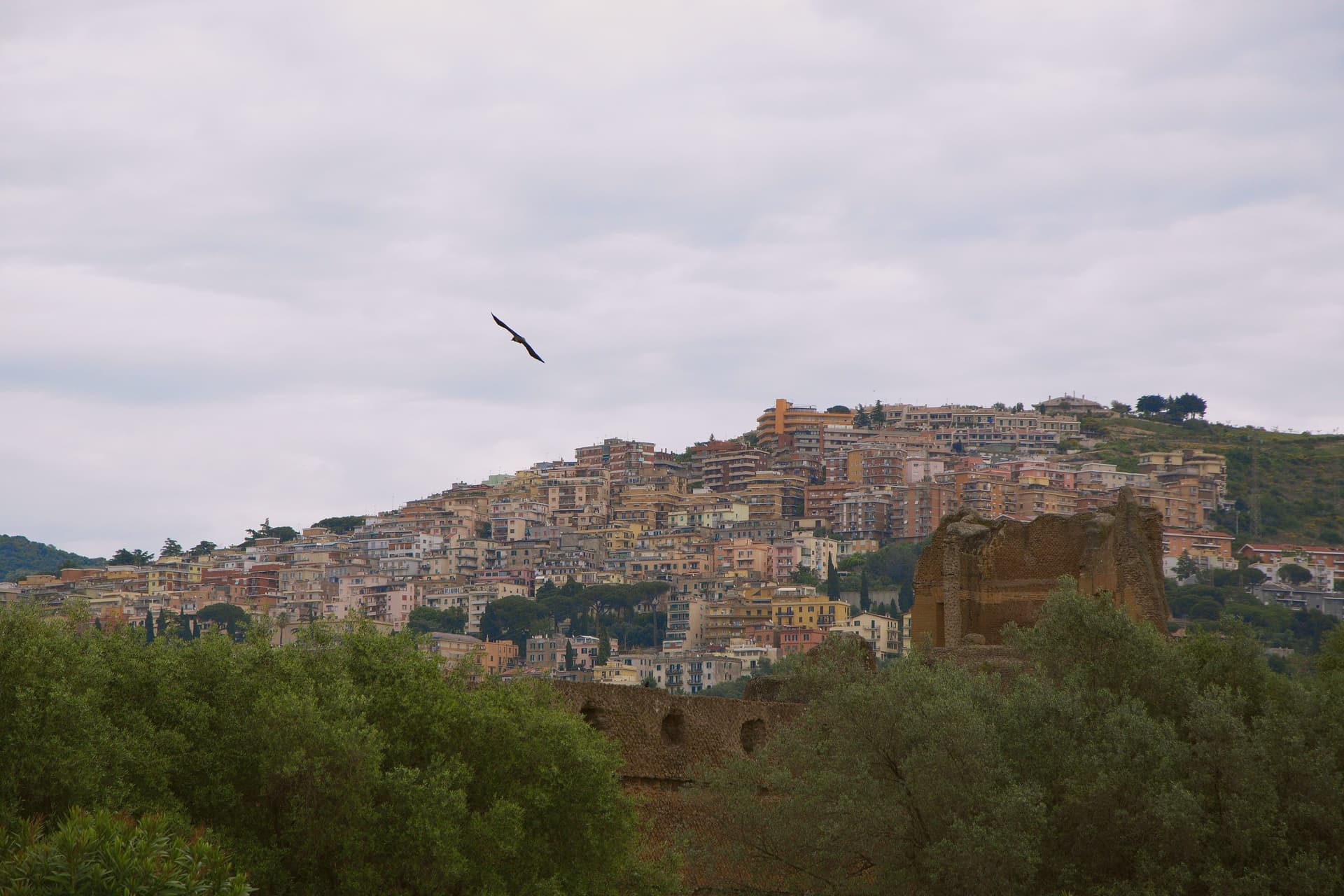
Tivoli
Province: Roma · 235 m
A travertine town on the Aniene falls twenty-five kilometers east of Rome, holding two separate UNESCO sites: Hadrian's villa below and the Villa d'Este above.
- ✷ We've been
Caprarola
Province: Viterbo · 510 m
A Cimini hill town above Lago di Vico, dominated by the pentagonal Villa Farnese that Vignola built for the Farnese cardinals between 1559 and 1573.
Acquapendente
Province: Viterbo · 420 m
The northernmost town in Lazio, at 420 meters above the Paglia, named in 964 for its waterfalls.
Viterbo
Province: Viterbo · 326 m
The medieval capital of the Tuscia, papal seat for five popes between 1257 and 1281 and home to the longest conclave in Church history.
Terracina
Province: Latina · 24 m
The Volscian Anxur, where a temple to Jupiter sits above a port cut through stone.
Arpino
Province: Frosinone · 450 m
The Volscian-Roman hill town in the Liri valley that produced Marius and Cicero, with a pre-Roman acropolis above the modern center.
Castel Gandolfo
Province: Roma · 426 m
A papal town on the rim of Lake Albano's volcanic crater, summer residence of the popes since 1626.
Fondi
Province: Latina · 9 m
The plain town between the Ausoni and Aurunci mountains where the Caetani built a castle in the middle of farmland instead of on a hill.
Gaeta
Province: Latina · 2 m
The promontory port where a Bourbon kingdom fell in February 1861 and the south of Italy stopped existing as a state.
Ponza
Province: Latina · 5 m
The main island of the Pontine archipelago, a volcanic crescent 40 km off Formia with white tuff cliffs, Roman fishpond tunnels at Pilato, Cala Feola's natural pools, and a 3,200-resident borgo curving around a horseshoe harbour painted in 18th-century Bourbon-pastel.
Sabaudia
Province: Latina · 17 m
A rationalist city built in 253 days on drained Pontine marshland, founded 15 April 1934 between Lago di Paola and the Tyrrhenian dunes.
Ariccia
Province: Roma · 412 m
The Castelli Romani town where a single Baroque architect's ensemble sits on a volcanic crater rim above Rome, and Saturday lunch means porchetta.
Capodimonte
Province: Viterbo · 364 m
The lakefront Farnese stronghold on a peninsula jutting into Europe's largest volcanic crater lake, with an extra-virgin olive oil tradition recognized by Città dell'Olio.
Magliano Sabina
Province: Rieti · 222 m
A 222-meter Sabine town on a Tiber terrace, cathedral seat of the Sabina diocese on the Lazio-Umbria border.
Nettuno
Province: Roma · 11 m
A Tyrrhenian town 60 km south of Rome, with a walled medieval borgo above the sea, a Borgia fortress and the 1944 landing beaches.
Bracciano
Province: Roma · 280 m
The Lazio lake town with the eighth-largest lake in Italy below it and one of the best-preserved Renaissance castles in the country above it.
Atina
Province: Frosinone · 500 m
A polygonal-walled town at the foot of the Mainarde, and the DOC that makes Cabernet in central Italy.
Bassano in Teverina
Province: Viterbo · 304 m
A tufa-spur borgo of 1,260 above the Tiber valley between Lazio and Umbria, with a clock tower that hides an eleventh-century animated bell tower.
Calcata
Province: Viterbo · 220 m
A tufa-cliff village forty kilometers north of Rome, condemned and abandoned in the 1930s, then occupied by artists and never left.
Castro dei Volsci
Province: Frosinone · 385 m
A Ciociaria hilltop borgo at 385 meters in the Sacco valley, named for the pre-Roman Volsci.
Cerveteri
Province: Roma · 81 m
An Etruscan capital seven kilometers inland from the Tyrrhenian coast, with the Banditaccia necropolis holding 1,000 tombs in the largest ancient cemetery in the Mediterranean.
Collalto Sabino
Province: Rieti · 980 m
A 980-meter Sabine borgo dominated by a Barberini baronial castle, with a 360-degree panorama from the keep.
Picinisco
Province: Frosinone · 725 m
A medieval village at 725 meters on the eastern edge of Lazio, the source of much of Italo-Scottish emigration.
Rieti
Province: Rieti · 405 m
The Sabine capital on the Velino, claimed as the center of Italy, under Monte Terminillo and the Franciscan sanctuaries of the Valle Santa.
- ✷ We've been
Ronciglione
Province: Viterbo · 441 m
A tufa-brick borgo above Lake Vico, fortified by the Prefects of Vico and crowned Borgo dei Borghi in 2023.
San Donato Val di Comino
Province: Frosinone · 728 m
A medieval village at 728 meters at the gateway to Forca d'Acero, the pass into the Abruzzo National Park.
San Felice Circeo
Province: Latina · 100 m
A medieval borgo on the flank of a promontory that Homer made the home of Circe in the Odyssey.
Subiaco
Province: Roma · 408 m
The Aniene valley town where Benedict spent three years in a cliff cave, and where Italy's first printed book appeared in 1465.
Sutri
Province: Viterbo · 291 m
An Etruscan and Roman town on a tuff spur, with a rock-cut amphitheater carved straight from the volcanic stone of the Cimini.
Tarquinia
Province: Viterbo · 133 m
An Etruscan capital on a Maremma ridge whose 6,000 rock-cut tombs at Monterozzi hold the largest body of pre-Roman painting in the Mediterranean.
Velletri
Province: Roma · 332 m
The Castelli Romani town where Augustus grew up, now the largest wine commune of its hills.
Ventotene
Province: Latina · 18 m
The smaller of the inhabited Pontine Islands, a flat three-kilometer tuff platform southeast of Ponza.
The slow-trip planner
Plan a slow trip across the towns travelers skip.
Answer five questions. We will shape a geographically coherent slow trip from the 1,000 Italian towns most travelers skip. Yours to save and share.
From elsewhere in Italy
Five more towns to discover
Biccari
Province: Foggia
A Subappennino Dauno borgo at 450 meters under Monte Cornacchia, the highest peak in Puglia at 1,151 meters, with a Byzantine tower at its core.
Sirolo
Province: Ancona
A clifftop borgo at 125 meters, above the Due Sorelle sea stacks of the Adriatic.
Penne
Province: Pescara
The brick city at 438 meters between the Tavo and Fino, ancient capital of the Vestini, rebuilt after Allied bombing and awarded the Silver Medal of Civic Merit.
Palazzolo Acreide
Province: Siracusa
An 8,000-resident hilltop town on the Iblei plateau at 670m, rebuilt entirely in late Baroque after the 1693 earthquake and founded over the Greek Akrai colony in 664 BC, with a Greek theatre and a cluster of rock carvings unlike anything else nearby.
Verucchio
Province: Rimini
A spur over the lower Marecchia valley, cradle of the Villanovan civilization and birthplace of the Malatesta lordship of Romagna.