
Lazio · Viterbo
Tarquinia
An Etruscan capital on a Maremma ridge whose 6,000 rock-cut tombs at Monterozzi hold one of the largest bodies of Etruscan painting to survive.
By Peter Benei
Written about. No. 68.
The letter
Tarquinia got its letter. One town at a time, free. The photo, the food, the festa.
Visiting
- Best time
- Apr–Oct
- By car
- 1 h 17 min from Rome
- By train
- Station in the comune
- Population
- 15,856
- J12°
- F14°
- M15°
- A17°
- M22°
- J27°
- J30°
- A30°
- S26°
- O21°
- N17°
- D14°
- Best
- Hot or crowded
- Quiet
- Mostly closed
Daytime air temperature, averages for 2020–2024. Weather data by Open-Meteo.com.
Why come
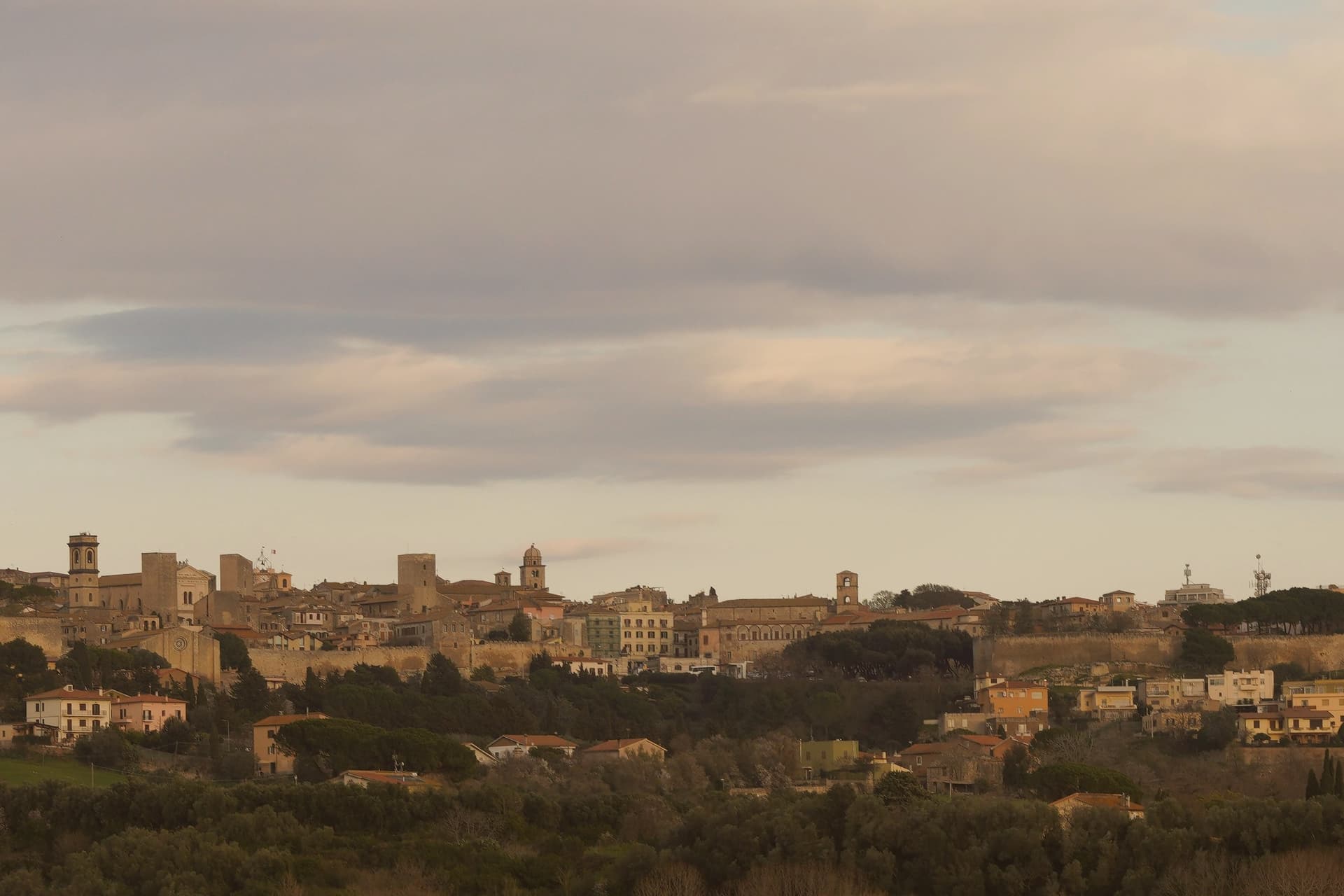
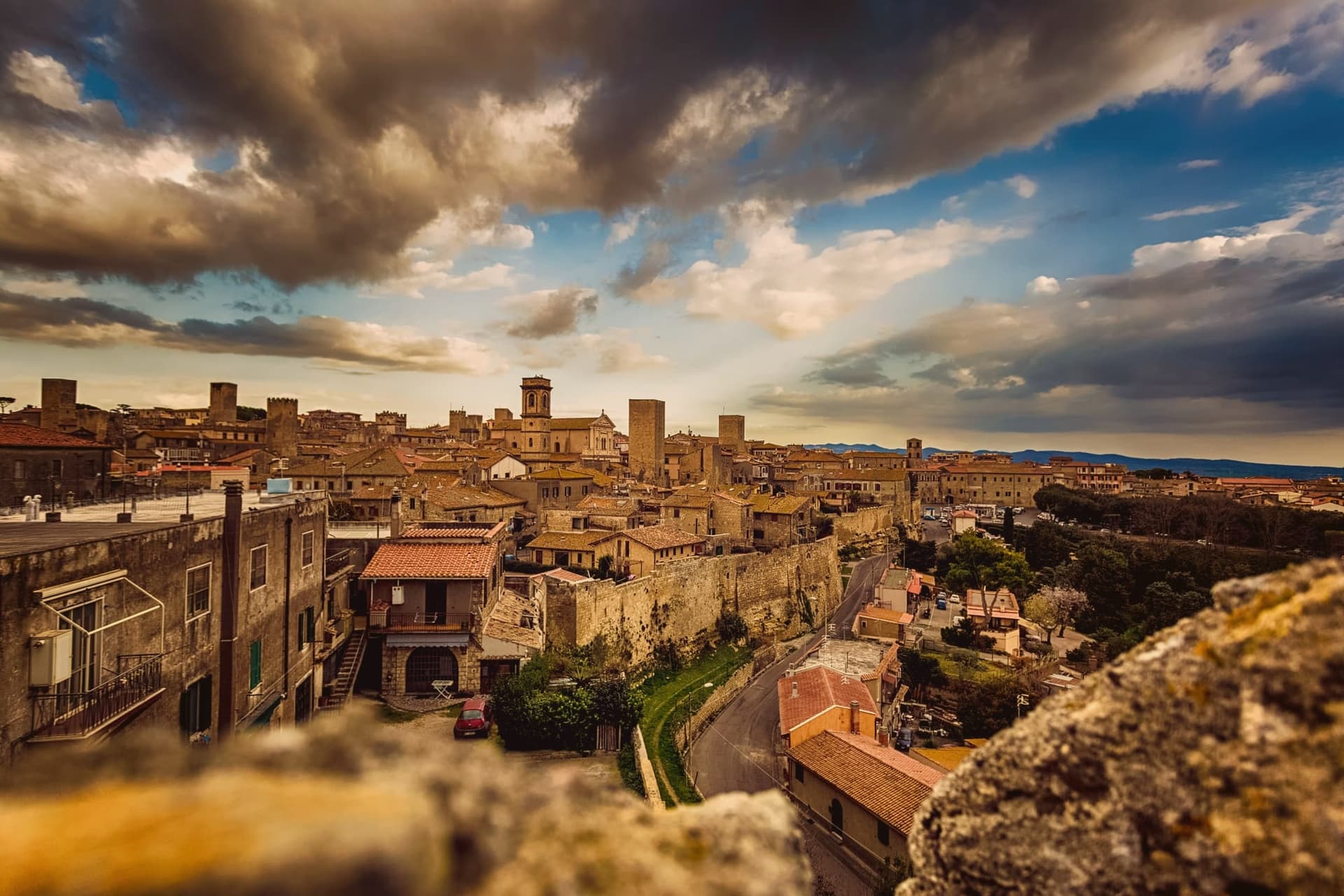
Tarquinia sits on a plateau above the Maremma plain in northern Lazio, six kilometers inland from the Tyrrhenian coast. The Etruscan city of Tarquinii stood on the adjacent Colle della Civita and was one of the twelve great Etruscan capitals, ringed in the fourth century BC by about eight kilometers of walls in blocks of local stone. What survives above ground is mostly medieval: the present town grew here in the Middle Ages as Corneto, became Corneto Tarquinia in 1872 and took the ancient name alone in 1922.
What survives below ground is what made the place a UNESCO site in 2004. The Monterozzi necropolis on the hill east of town holds 6,000 rock-cut tombs from the seventh century BC onward, and around two hundred of them carry painted interiors. The frescoed banquets, dancers, hunters and musicians inside Tarquinia's tombs form one of the largest bodies of Etruscan painting to survive. The Palazzo Vitelleschi in the upper town houses the national museum and the Winged Horses terracottas.
How to get there
From Rome Fiumicino (FCO), about 57 min by car.
Naples (NAP) is about 3 h 16 min away.
By car from the center of Perugia 2 h 26 min or Siena 2 h 31 min.
There is a railway station in the comune, so you can arrive without a car.
Coming from Rome?
Coming by train into Roma Termini? Tarquinia is about 1 h 18 min away by road.
Every town within reach of Rome Fiumicino airport.
First time driving in Italy? Read our complete manual.
What to see
Necropoli dei Monterozzi
UNESCO Etruscan necropolis on the hill east of the medieval town, 6,000 rock-cut tombs with around 200 painted interiors from the 7th century BC onward.
Museo Archeologico Nazionale Tarquiniense
Housed in the 15th-century Palazzo Vitelleschi, with Etruscan sarcophagi, painted slabs and the famous Cavalli Alati terracottas.
Palazzo Vitelleschi
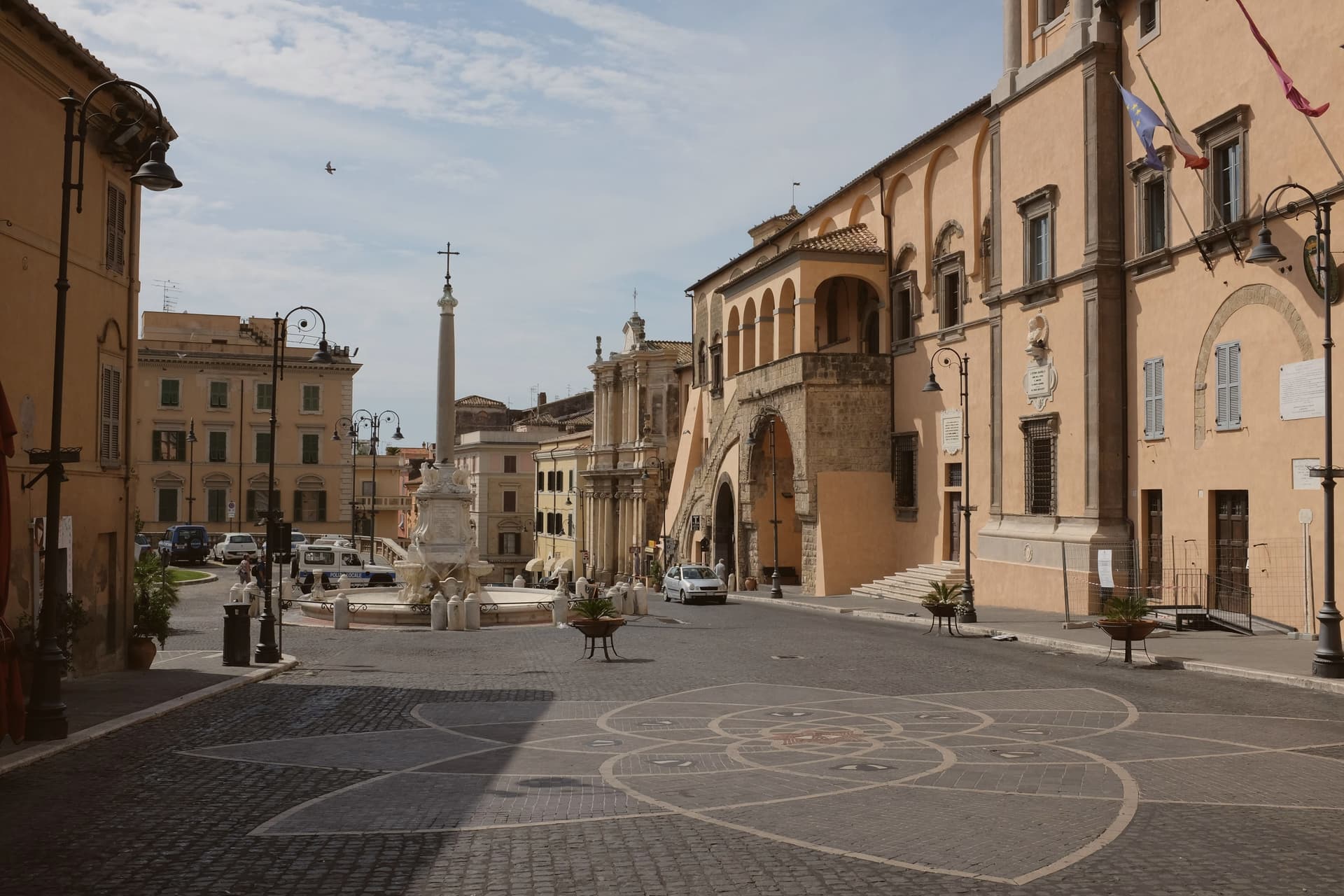
Early Renaissance palace built between 1436 and 1439 for Cardinal Vitelleschi, blending Gothic and Renaissance elements in a single façade.
Chiesa di Santa Maria di Castello
Romanesque-Lombard church begun in 1121 inside the medieval walls, with a cosmatesque pavement and a marble ambo by Giovanni, son of Nicola di Ranuccio.
Civita archaeological area
Remains of Etruscan Tarquinii on the adjacent plateau, with sections of the 4th-century BC walls and the Ara della Regina sanctuary.
From the guides
Where to eat
Not our picks, but places the guides put their name to: a Michelin star, a Gambero Rosso fork, a Slow Food snail, a Michelin Key for the hotels. Worth a table, a counter, or a night when you pass through.
Namo RistobottegaRistorante
Namo Ristobottega holds a Michelin Bib Gourmand.
Before you sit down: how to order at a restaurant, how to spot a tourist trap, what aperitivo is and how the Italian bar works.
Living here
Could you live here?
Tarquinia meets both of our rules for a small town.
- 15,856 people, inside our sweet spot of 5,000 to 20,000: a real town, still one community.
- Civitavecchia, a city of 51,582, is 27 min by car. Closer than our 30 to 60 minutes: handy for everything, so check the town still keeps a life of its own.
- A station of its own. Trains are the overlooked way to get around Italy: no parking, straight into the center.
The rules come from our series Where to Move in Italy, written from the places we have lived: Part 1, The End of the Road · Part 2, The Small Town · Part 3, The City · Part 4, The Postcard · Part 5, The Other Half. The towns we would pick are in Part 6, The Best Towns.
- Population 15,856, down 4% since 2015
- Nearest city Civitavecchia, 27 min drive
- Train station in the comune
- A national health service hospital in the comune · how healthcare works in Italy
- Homes in the center: €1,200 to €1,500 per m² to buy, €4.50 to €5.40 per m² a month to rent
Weighing a move here? See the moving year.
All the numbers Common questions, designations, lists and sources.
More about living here
- Commuter belt
- Pharmacy in town
- High school within a 30-minute drive
- Full fibre reaches 51% of homes
- Primary school in the comune
- Earthquake zone 3, low hazard
- Rome Fiumicino airport (FCO), 57 min drive, the nearest with scheduled flights
- Regional capital Rome, 1 h 17 min drive
If you are moving here
Who lives here
6% of residents are foreign citizens, most often from Romania, Ukraine and India, against 9% across Italy. 49 of them come from English-speaking countries or western and northern Europe, mostly the United Kingdom, Germany and the United States. There are 271 people over 65 for every 100 children under 15, against 216 across Italy. 45% of homes have no resident, holiday homes and empty ones counted together, against 27% across Italy. Viterbo province ranks 71st of 107 in Il Sole 24 Ore's quality of life ranking for 2025.
Health and schools
There is an emergency room in the comune. The nearest major one is in Rome, 71 km away. The nearest IB school is Viterbo International School, 33 km as the crow flies.
Information, not medical advice. Confirm with a professional.
Taxes
A home that is not your main one pays 1.06% a year in property tax at the 2025 rate, charged on the cadastral value rather than the price. A main home pays none unless it is in a luxury category. The town adds 0.6% to your income tax. 7% pensioner tax: this town is not in a qualifying area.
Information, not tax advice. Confirm with a professional.
What it costs
The average household in Lazio spends about €2,270 a month, €580 of it on food, against about €2,170 across Italy. A family of three pays about €647 a year for water, on the Lazio average.
Climate and risk
It is in climate zone D, on a scale from A, the warmest, to F, the coldest, and heating may run from November 1 to April 15, up to 12 hours a day, unless the mayor changes it. 5% of residents live in a zone the national maps rate high for floods, 7% in a high or medium one. 4% live in a zone rated high or very high for landslides.
These shares cover the whole comune, not any one street. Check an address on IdroGEO.
Moving from abroad? Which visa you need. Sources: ISTAT, the Ministry of Health, ISPRA, the Finance Ministry, the Ministry of Enterprise, Poste Italiane, the comuni, the IB, International Schools Database, Il Sole 24 Ore, Cittadinanzattiva.
Known for
PAINTED TOMBS
Around 200 frescoed Etruscan tomb chambers at Monterozzi, one of the largest bodies of Etruscan painting to survive.
WINGED HORSES
The Cavalli Alati terracottas from the Ara della Regina temple, fourth-century BC, displayed in the Palazzo Vitelleschi museum.
CERAMICS
Official Città della Ceramica for the medieval and contemporary workshops in the upper town.
PROTECTED PRODUCTS
The commune lies inside the Tuscia DOP, Asparago Verde di Canino IGP and Carciofo Romanesco del Lazio IGP production zones.
Common questions
- What is Tarquinia known for?
- Tarquinia is an Etruscan capital on a Maremma ridge whose 6,000 rock-cut tombs at Monterozzi hold one of the largest bodies of Etruscan painting to survive.
- Where is Tarquinia?
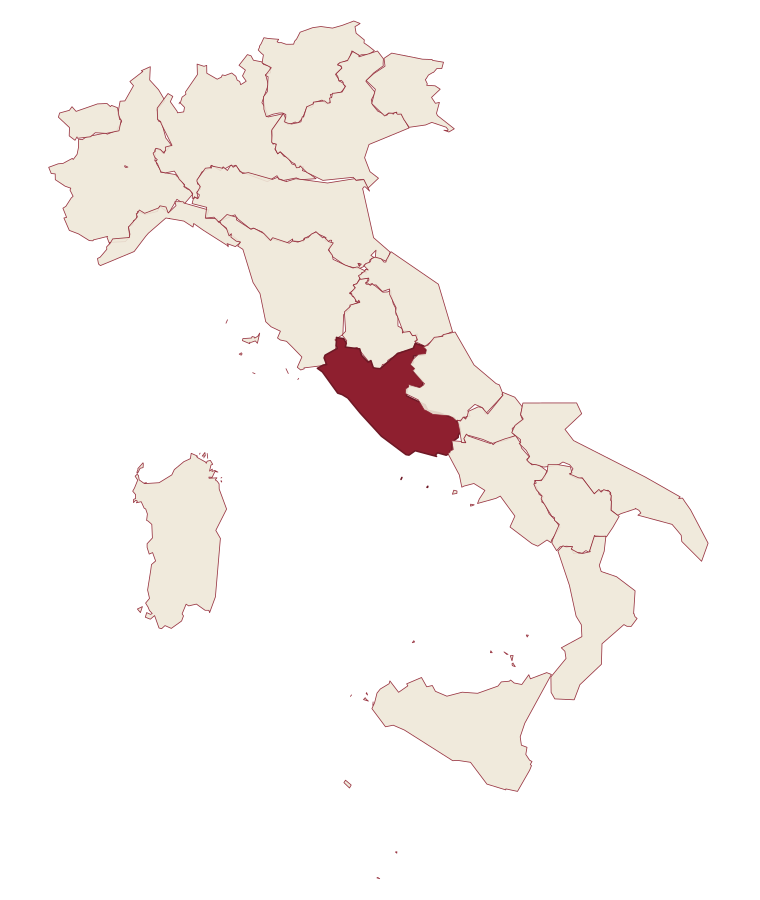
- Tarquinia is a comune in the province of Viterbo, in Lazio, at 133 meters above sea level.
- What is the nearest airport to Tarquinia?
- The nearest airport with scheduled flights is Rome Fiumicino (FCO), about 57 min by car.
- Can you get to Tarquinia without a car?
- Yes. There is a railway station in the comune, so you can arrive by train.
- How long is the drive from Perugia to Tarquinia?
- About 2 h 26 min by car.
- When is the best time to visit Tarquinia?
- Best in Apr–Oct. July is the warmest month, averaging 30 degrees, and December the wettest, with about 13 rain days.
- Which other towns are like Tarquinia?
- Ovada, Vittorio Veneto and San Miniato.
- How many people live in Tarquinia?
- 15,856 residents, by ISTAT's count on 1 January 2025.
- Is Tarquinia a good place to live?
- By the rules in our Where to Move in Italy series, Tarquinia is a small town that meets both of our rules. The nearest city, Civitavecchia, is 27 min away by car. There is a national health service hospital in the comune. Full fibre reaches 51% of homes.
Tags & data designations · numbers · sources
Recognized as
The numbers
- Elevation: 133 m
- Population: 15,856
- Surface area: 279.34 km²
These figures were compiled from public directories: ISTAT, OpenStreetMap and Wikidata, and from the official listings of the guides named on this page. Town details change; verify with official sources before you travel.
The ranked lists
Lists Tarquinia appears in
- The best hill towns that eat well within 90 minutes of RomeNear Romehill townwithin 90 mineats well6 towns · smallest 6,707 residents · closest 31 min away
- The best hill towns you can reach by train within 90 minutes of RomeNear Romehill townby trainwithin 90 min6 towns · smallest 3,696 residents · closest 31 min away
- The best towns you can reach by train in the province of ViterboViterbo provinceby train6 towns · smallest 3,696 residents
- The best towns with a serious restaurant that eat well within 90 minutes of RomeNear Romewithin 90 minserious restauranteats well7 towns · smallest 4,957 residents · closest 31 min away
- The best towns you can reach by train that have a serious restaurant in LazioLazioby trainserious restaurant8 towns · smallest 6,572 residents
- The 9 best hill towns with a serious restaurant in LazioLaziohill townserious restaurant9 towns · smallest 3,452 residents
Near here, with a letter
- Written about. No. 47.
Capalbio
Province: Grosseto
A walled hilltop borgo at 217 meters in the southern Maremma, donated to the Abbey of Tre Fontane by Charlemagne.
43 min by car
- Written about. No. 67.
Cerveteri
Province: Roma
An Etruscan capital seven kilometers inland from the Tyrrhenian coast, with the Banditaccia necropolis holding 1,000 tombs in the largest ancient cemetery in the Mediterranean.
45 min by car
The letter
Tarquinia got its letter. One town at a time, free. The photo, the food, the festa.
Paid plans, the moving year and the books are on the membership page.