
Region
Emilia-Romagna
Emilia-Romagna's 45 towns in our catalogue split across the Parma, Rimini, and Forlì-Cesena provinces; 21 carry the Bandiera Arancione designation.
45 towns · highest: Sestola 1,020m · smallest: Premilcuore 692 people
45 of 45 towns
45 of 45 towns
Bagnara di Romagna
Province: Ravenna
A 22-meter plain commune in the Bassa Romagna, the only fully preserved medieval castrum surviving in the Romagna lowlands.
Bagno di Romagna
Province: Forlì-Cesena
A 491-meter thermal town at the head of the Savio valley, drawing on springs that have run at 47 degrees since Roman times.
Bertinoro
Province: Forlì-Cesena
A 254-meter Romagna-hill borgo above the Via Emilia, with a twelve-ring hospitality column from 1300 and the slopes that grow Albana DOCG.
Bobbio
Province: Piacenza
A 272-meter Trebbia-valley town built around an abbey founded in 614, named Borgo dei Borghi by RAI in 2019.
Borgo Val di Taro
Province: Parma
The Cittaslow capital of the upper Taro valley at 411 meters, where the Fungo di Borgotaro IGP porcini has been protected since 1996.
Brisighella
Province: Ravenna
A Lamone-valley borgo at 115 meters under three selenite hills crowned by a fortress, a clock tower, and a sanctuary.
Busseto
Province: Parma
A 40-meter town where Giuseppe Verdi grew up, with a 300-seat opera house in the Rocca he refused to enter.
Canossa
Province: Reggio nell'Emilia
The Reggiano commune holding the ruined castle where an emperor stood three days in the snow to beg forgiveness in 1077.
Castel San Pietro Terme
Province: Bologna
A 75-meter thermal town east of Bologna, its sulphurous waters in use since 1137.
Castell'Arquato
Province: Piacenza
A 224-meter hilltop borgo in the Val d'Arda, kept intact since the tenth century and crowned by Luchino Visconti's 1342 fortress.
Castelvetro di Modena
Province: Modena
A 152-meter hill borgo south of Modena whose checkerboard piazza sits above the slopes that grow Lambrusco Grasparossa.
Castrocaro Terme e Terra del Sole
Province: Forlì-Cesena
A pairing of two towns: a ninth-century fortress on a hill and Cosimo I de' Medici's planned Renaissance garrison town on the plain below, founded 1564.
Cervia
Province: Ravenna
The Adriatic salt town with 827 hectares of working saline, planned in 1697 around a grid of salt workers' houses.
Cesenatico
Province: Forlì-Cesena
An Adriatic fishing port whose canal was redrawn on commission from a Borgia patron, with ten historic sailboats moored as a floating museum.
Collecchio
Province: Parma
A Parma-cintura town on the Via Francigena, known today for a dairy multinational's headquarters and a football club's training ground.
Comacchio
Province: Ferrara
A canal town on thirteen islets, with brackish lagoons that hold three hundred bird species.
Compiano
Province: Parma
A 519-meter walled borgo over the Taro, ruled by the same family for 425 years.
Corniglio
Province: Parma
A 690-meter Parma-Apennine commune inside the Tosco-Emiliano park, with a thirteenth-century Rossi castle and the Lagdei plateau above.
Dozza
Province: Bologna
A 190-meter painted borgo above the Sellustra valley, where contemporary artists have repainted the house walls every two years since 1960.
Faenza
Province: Ravenna
The city that gave its name to faïence, with a tin-glazed maiolica tradition since the fourteenth century and the world ceramics museum since 1908.
Fanano
Province: Modena
A 640-meter stone-working town set among Monte Cimone, Libro Aperto and the upper Frignano peaks.
Ferrara
Province: Ferrara
A Renaissance capital planned on a grid rather than grown by accident, small enough to cross by bicycle in twenty minutes, and ringed by walls that still stand whole.
Fiumalbo
Province: Modena
A 935-meter stone village in the Modenese Apennines on the Tuscan border, at the confluence of two rivers under Monte Cimone.
Fontanellato
Province: Parma
A Parma-plain town built around the Rocca Sanvitale, the moated fortress at its center.
Gualtieri
Province: Reggio nell'Emilia
A right-bank Po commune in the Reggiana lowlands, built around a hundred-meter-square arcaded piazza and the Bentivoglio palace that holds the Ligabue collection.
Imola
Province: Bologna
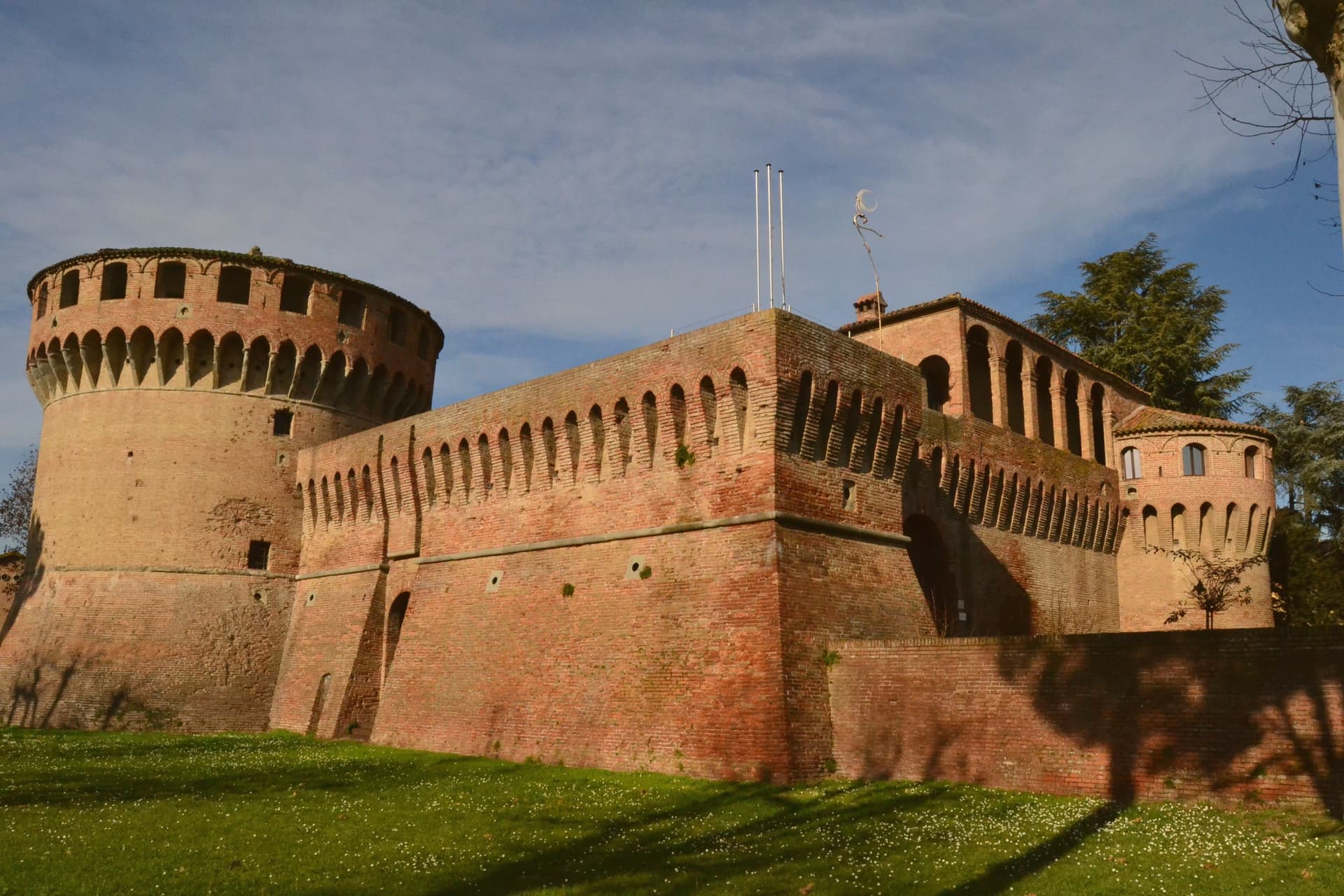
Bologna's Romagna twin, a medieval brick centro anchored by the Caterina Sforza-fortified Rocca, with the Autodromo Enzo e Dino Ferrari (the Imola F1 circuit) wrapping the Santerno river at the southern edge of town.
Longiano
Province: Forlì-Cesena
A 179-meter Malatesta borgo on the hills between Cesena and Rimini, holding a major twentieth-century art collection inside the family castle.
Montechiarugolo
Province: Parma
A Parmigiano-country borgo on the Enza river, built around a fourteenth-century castle that has stayed in the Marchi family since 1864.
Montefiore Conca
Province: Rimini
A 385-meter Malatesta hilltop above the Conca valley, dominated by a fourteenth-century fortress that was once a summer residence of the lords of Rimini.
Montegridolfo
Province: Rimini
A walled borgo of fewer than a thousand residents on the Romagna-Marche border, held alternately by the Malatesta and the Montefeltro through the fifteenth century.
Parma
Province: Parma
A 57-meter Po-plain capital on the Via Emilia, where Correggio painted the Duomo dome and Parmigiano ages in vaults across the province.
Pennabilli
Province: Rimini
A 629-meter Montefeltro borgo between the Roccione and the Rupe, remade as an open-air museum after 1989.
Portico e San Benedetto
Province: Forlì-Cesena
A three-tier medieval borgo at 309 meters on the Montone river, capital of Florence's Romagna territories from 1386.
Premilcuore
Province: Forlì-Cesena
A 459-meter walled borgo on the Rabbi river, an entry point to the Foreste Casentinesi from the Romagna side.
Ravenna
Province: Ravenna
A 4-meter coastal capital of three successive empires, with eight UNESCO mosaic monuments from the fifth and sixth centuries.
San Giovanni in Marignano
Province: Rimini
A walled Conca-valley borgo, granary of the Malatesta state, where the Notte delle Streghe has marked the summer solstice since 1988.
San Leo
Province: Rimini
A borgo of 2,820 residents built on a vertical 583m limestone outcrop in the Montefeltro, 35 km from Rimini, with a frontier panorama over Romagna and Marche from every wall.
Sant'Agata Feltria
Province: Rimini
A 607-meter Montefeltro borgo crowned by a fortress on a sandstone outcrop, host of the national white truffle fair since 1985.
Santarcangelo di Romagna
Province: Rimini
A Via Emilia hill town on the Marecchia plain, with over 150 tufa caves under the centro and a Malatesta fortress on its summit.
Sasso Marconi
Province: Bologna
A 128-meter pre-Apennine town at the confluence of the Setta and Reno, renamed in 1938 for the radio pioneer whose family estate stands in its Pontecchio frazione.
Sestola
Province: Modena
A 1,020-meter Apennine town in the Frignano, with a Lombard-era castle above and central Italy's largest ski domain on the slopes.
Spilamberto
Province: Modena
A 69-meter Po-plain town on the Via Romea, headquarters of the Consorteria that has certified a DOP product since 1967.
Vernasca
Province: Piacenza
A Val d'Arda commune in the Piacenza Apennines, holding the walled village of Vigoleno and one of the most compact castled borghi in Emilia.
Verucchio
Province: Rimini
A spur over the lower Marecchia valley, cradle of the Villanovan civilization and birthplace of the Malatesta lordship of Romagna.
Vignola
Province: Modena
The cherry-and-castle town on the Panaro at 125 meters, where a fortress and a self-supporting 1500s spiral staircase mark the skyline.
From elsewhere in Italy
Five more towns to discover
Visso
Province: Macerata
The northern Sibillini gate at 607 meters where the Nera meets the Ussita, holding one of two surviving manuscripts of Leopardi's L'Infinito.
Goriano Sicoli
Province: L'Aquila
At 720 meters in the Subequana valley, a medieval village drawn by M.C. Escher in 1929 keeps a May ritual folklorists trace to Demeter.
Ugento
Province: Lecce
A Messapian-Roman town five kilometers from the Ionian, where a Baroque castle sits on the walls of the ancient city of Ozan.
Fontanellato
Province: Parma
A Parma-plain town built around the Rocca Sanvitale, the moated fortress at its center.
Pescina
Province: L'Aquila
A Marsica town at 735 meters, on the rim of the drained Fucino basin, that lost five thousand of six thousand people in a single morning in 1915.