
The best towns worth staying overnight that eat well within 90 minutes of Perugia
The country between Perugia and the Val di Chiana is built out of pale limestone and thin brick, laid up into hill towns that hold the heat until well after dark. Autumn is the season the kitchens wait for: porcini from the Apennine slopes, black truffle from the Valnerina, lentils from Castelluccio, roast pigeon, pici pulled by hand and dressed in nothing more than garlic and oil. The wine list follows the geography, Sagrantino di Montefalco on one side of the border, Vino Nobile on the other. Dinner runs long here because there is nowhere else to go afterwards, which is exactly the argument for sleeping where you eat.
The default plan is Florence and Siena, with lunch somewhere in the Chianti in between. Both cities deserve the traffic they get, and both have restaurants that will feed you very well indeed. They also have coach parks, queues at the duomo and hotel rates that climb through the whole of spring and autumn. A great many people driving through Umbria treat it as the road between those two, stopping only for fuel.
The same hills continue east and south, and so do the kitchens. Within an hour and a half of Perugia there are walled towns above Lake Trasimeno, thermal villages on the Tuscan side of the border, and Etruscan terraces looking back across the Chiana. These are places with a table a dining guide has singled out and a hotel a travel guide has vouched for, which is the specific combination that makes a town worth staying overnight rather than passing through before dark.
Of the 41 communes we have mapped within 90 minutes of Perugia, 6 qualify as towns worth staying overnight that eat well: each has a hotel a travel guide has vouched for, and a dining guide has named a table in each. The smallest, San Casciano dei Bagni, has 1,500 residents.
If you are still choosing, we have also written The best towns worth staying overnight in the province of Perugia and The best towns with a medieval festival that eat well within 90 minutes of Perugia.
San Casciano dei Bagni
Why visit San Casciano dei Bagni
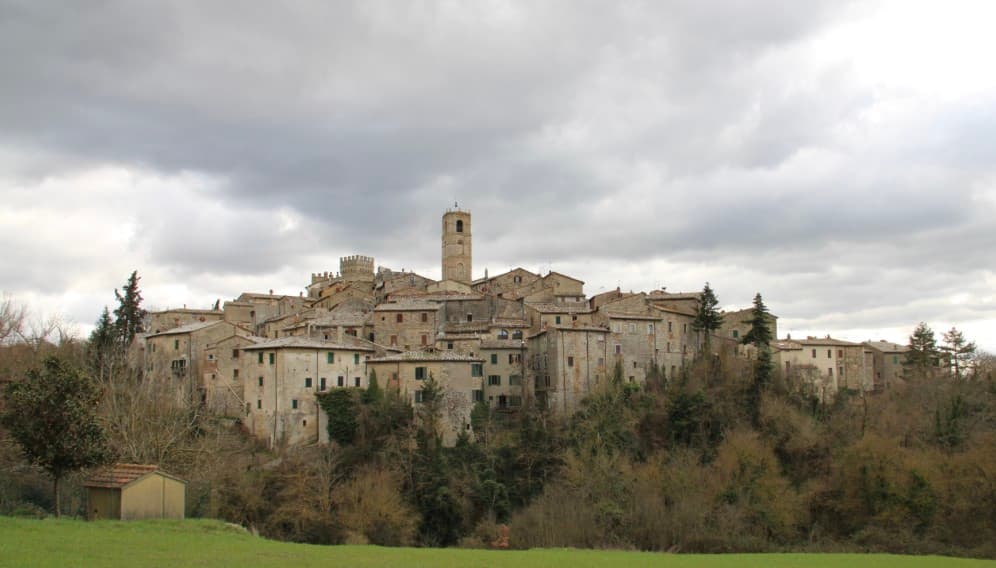
San Casciano dei Bagni sits at 582 meters at the southern edge of the province of Siena, above 42 hot springs that average 42 degrees Celsius. The baths were used continuously from Etruscan through Roman times and again from the Renaissance, when visitors came from across Europe.
In 2022, an excavation that began in 2019 at the ancient sanctuary turned up 24 bronze votive statues protected by mud, with around 6,000 coins in gold, silver and bronze. The find was the largest of its kind in fifty years; most surviving Etruscan votive material is terracotta.
The 1,500 residents live on a basalt outcrop above the Roman thermal complex, in a centro storico of stone houses and three small churches. The borgo joined the Borghi più belli network in 2014 and remains one of the smallest communes in Toscana to carry both that label and Bandiera Arancione.
Daniela, Castello di Fighine have been named by a guide.
What to see in San Casciano dei Bagni
- Santuario Ritrovato. Etruscan-Roman thermal sanctuary excavated since 2019, where 24 bronze votives and around 6,000 coins were recovered in 2022.
- Bagno Grande. The principal natural pool of the 42 hot springs, used from the second century BC through the Renaissance and reopened to the public.
- Collegiata di San Leonardo. Romanesque parish church in the centro storico, restored in the seventeenth century, with a baptismal font carved from local travertine.
How to get to San Casciano dei Bagni
Perugia is roughly 68 minutes away by road.
Our tip
The thermal pools make the calendar different here. Winter is the season many visitors prefer, when the 42-degree water steams against cold air and snow occasionally dusts the basalt outcrop. April through June and September into October are the most balanced months: warm hill light, the dry-stone walls of the borgo at their best, the sanctuary excavations open to guided tours. Sagra del Ciaffagnone di San Casciano dei Bagni falls in June.
Montone
Why visit Montone
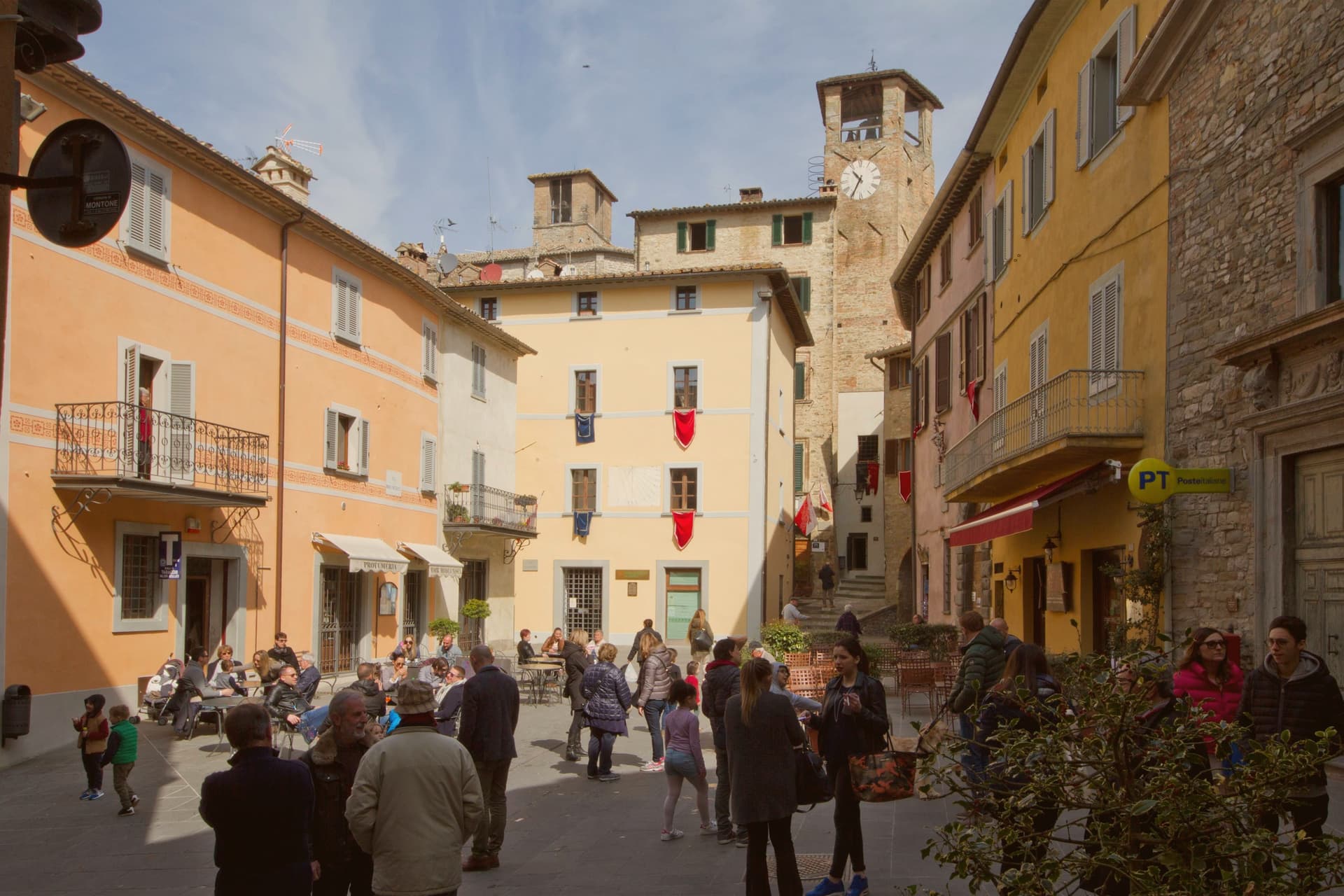
Montone sits at 482 meters on a ridge above the upper Tiber valley, thirty kilometers north of Perugia. The walled centro storico is small enough to circuit in fifteen minutes and steep enough that the route is the climb.
The town is the cradle of the Fortebracci, the condottieri family whose most famous member, Braccio da Montone, was made Count of Montone in 1414 by Antipope John XXIII. The Rocca di Braccio at the top of the hill and the Rocca d'Aries six kilometers out are both Fortebracci works.
The Gothic Chiesa di San Francesco, built around 1300 where the family had its houses, holds the Pinacoteca with a Bartolomeo Caporali altarpiece. The Donazione della Spina, a relic-thorn from Christ's crown given to the town by Carlo Fortebracci after the Venetians thanked him for naval service against the Turks, is processed twice a year, on Easter Monday and during the August week after Ferragosto.
Since 1997 the Umbria Film Festival has run here every July, founded with Terry Gilliam.
Tipico Osteria dei Sensi, Tipica Osteria dei Sensi, Locanda del Capitano & Tipico Osteria dei Sensi have been named by a guide.
What to see in Montone
- Chiesa di San Francesco. Gothic church of around 1300 with a fourteenth-century convent, picture gallery and cloister, on the hill where the Fortebracci had their houses.
- Rocca di Braccio. Fortress at the top of the borgo rebuilt under Oddo III Fortebracci in the late fourteenth century, now a panoramic ramparts walk.
- Rocca d'Aries. Castle six kilometers from the centro storico, the first Fortebracci stronghold according to tradition, restored and reopened to visit.
How to get to Montone
Perugia is roughly 47 minutes away by road.
Our tip
April through June and September into October are the steady months. The Umbria Film Festival runs in mid-July under Terry Gilliam's patronage, and the borgo doubles for that week with screenings in the piazze and the Rocca. The August Donazione della Spina pageant, the week after Ferragosto, fills the streets with medieval costumes and a Rocca di Braccio banquet.
Panicale
Why visit Panicale
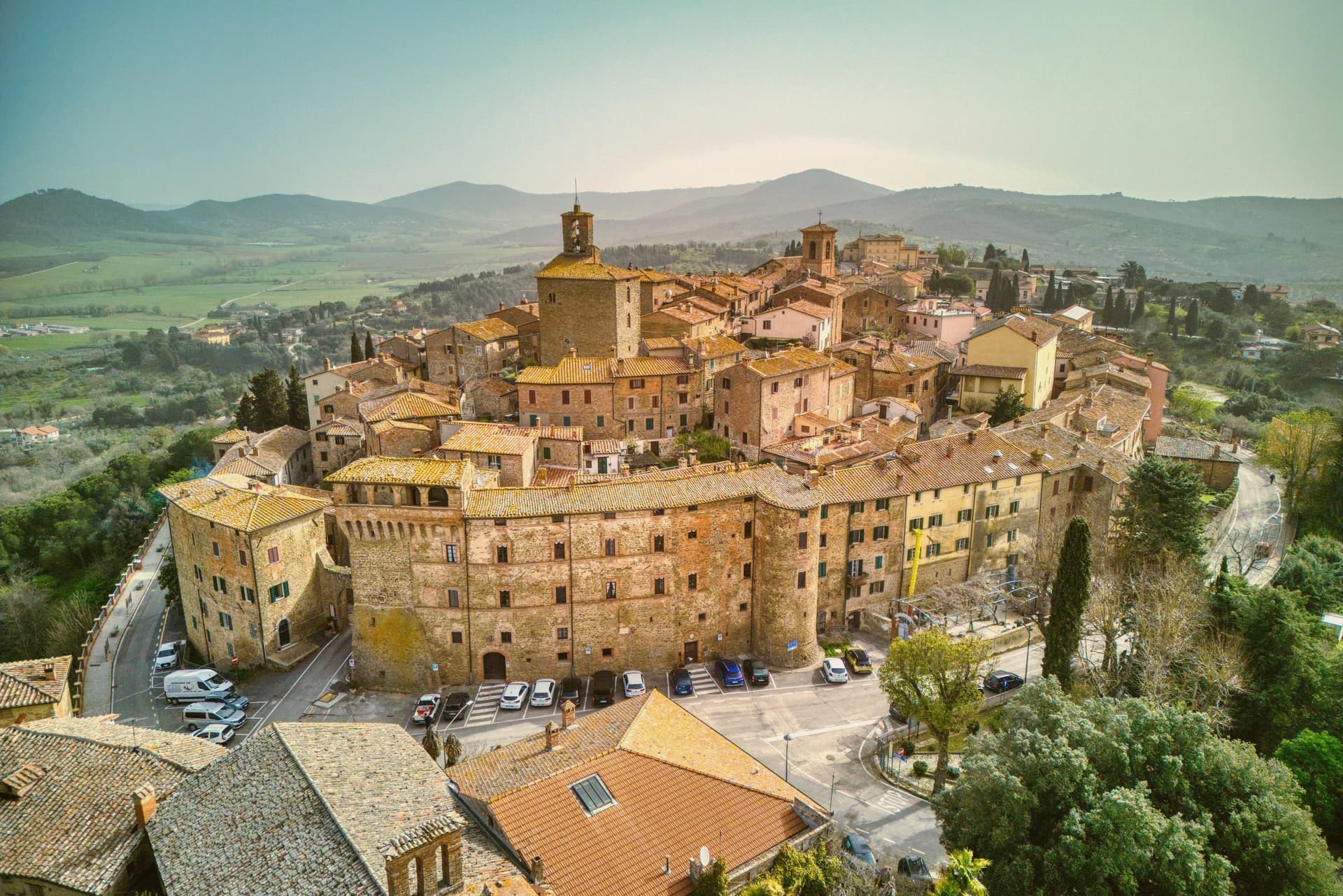
Panicale sits at 431 meters on the eastern slope of Monte Petrarvella, overlooking the southern shore of Lake Trasimeno from twenty-five kilometers southwest of Perugia. The medieval castle dates back in its earliest parts to the ninth century, and by the fourteenth Panicale was a small city-state with two gates facing Perugia and Florence and a moat around the walls.
Boldrino da Panicale, born in 1331, became one of the most feared mercenary captains of the trecento. The Chiesa di San Sebastiano, on a slope outside the walls, holds Pietro Perugino's Martyrdom of Saint Sebastian, frescoed across the entire back wall between spring and autumn of 1505, the saint's body crossed by the arrows of four archers in a deep landscape.
The Collegiata di San Michele Arcangelo on the main square claims an Annunciation attributed to Masolino da Panicale, the Renaissance painter the town shares as a birthplace claim with a Panicale in Tuscany. Three squares step down the slope on three different levels.
Lillotatini, Lillo Tatini have been named by a guide.
What to see in Panicale
- Chiesa di San Sebastiano. Fifteenth-century chapel on a slope outside the walls, with Perugino's Martyrdom of Saint Sebastian, frescoed in 1505 across the entire back wall.
- Collegiata di San Michele Arcangelo. Main parish church on Piazza San Michele, with an Annunciation attributed to Masolino da Panicale, master of Masaccio.
- Castello e mura medievali. Medieval circuit and gates dating to the ninth century, with two entrances toward Perugia and Florence and the line of the old moat.
How to get to Panicale
Perugia is roughly 48 minutes away by road.
Our tip
April through June and September into October are the windows. The lake catches morning light from the Panicale ramparts and the air at 431 meters keeps the heat down even in summer. July and August are warmer, and the Festa dell'Uva in late September runs the medieval procession through the three squares.
Montepulciano
Why visit Montepulciano
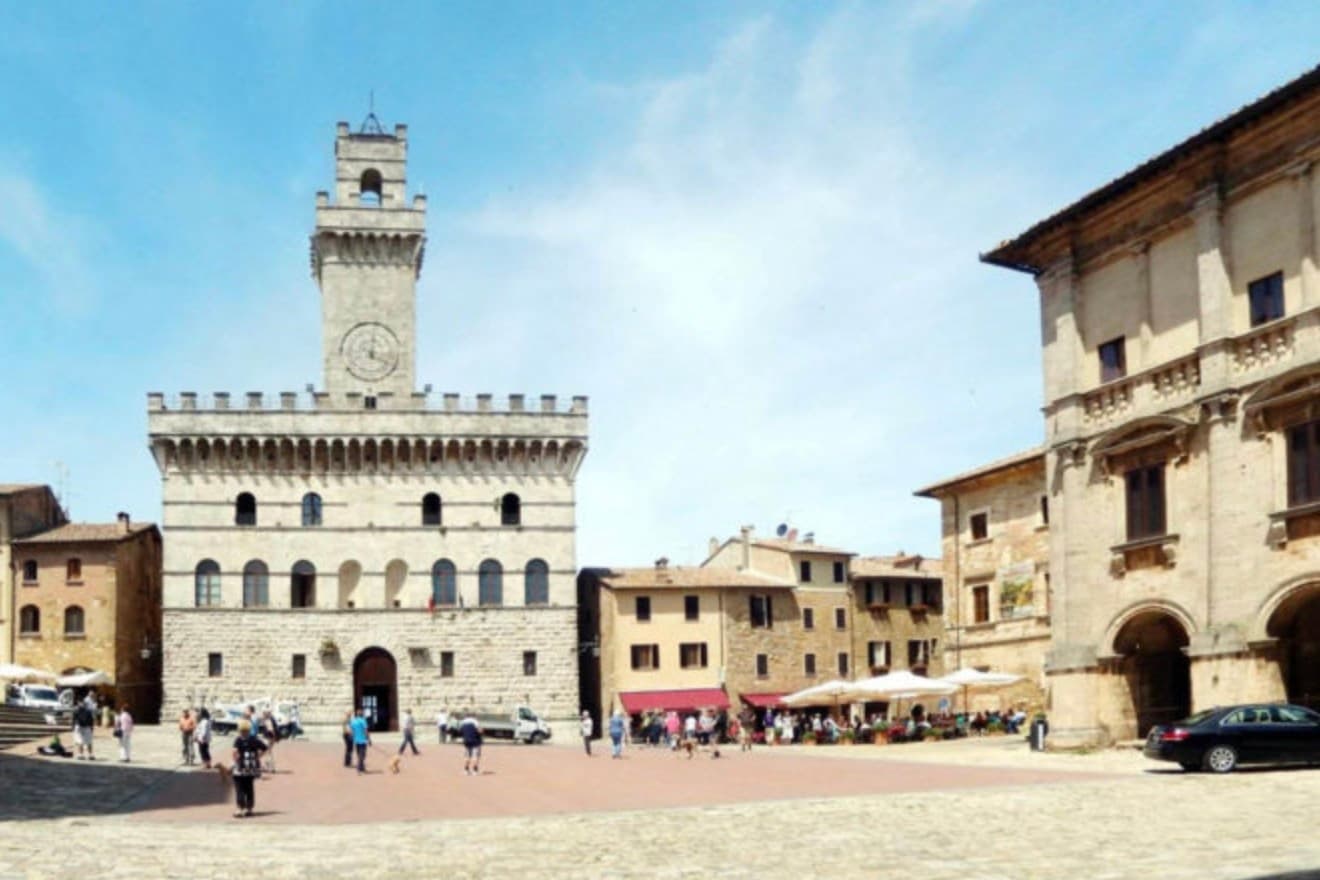
The ridge runs between the Val di Chiana and the Val d'Orcia, 70 kilometers southeast of Siena, and the town follows its spine uphill: streets climb from the gates toward the high point, where the main square sits ringed by the buildings that define the skyline from below. The origin predates the Renaissance fabric by centuries.
Etruscan tombs survive in the surrounding hills, though almost nothing of that period shows in the centro storico itself, which was rebuilt wholesale in the fifteenth and sixteenth centuries over whatever came before. The wine and the festival both use the climb as their setting rather than their subject: the cellars are cut into the rock beneath the palazzi, keeping a constant temperature for aging, and the barrel race each August sends two men from each of the eight contrade hauling an eighty-kilogram cask up the same gradient that every visitor covers on foot, only slower.
The steepness that shaped the defensive site nine centuries ago is still what a person feels first, in the legs, before the buildings register at all.
Ristorante Caffè Pasticceria Poliziano, Osmosi, Le Logge del Vignola and 3 more have been named by a guide.
What to see in Montepulciano
- Tempio di San Biagio. A 13-meter dome and travertine façade standing alone outside the walls, the ground falling away below it so the building reads as a single volume against the hillside.
- Piazza Grande. The high piazza at the top of the ridge, ringed by the Duomo, the Palazzo Comunale and the Palazzo Tarugi, all rebuilt in the fifteenth and sixteenth centuries.
- Palazzo Comunale. Town hall designed by Michelozzo in the fifteenth century, its tower offering a view over the Val di Chiana and Val d'Orcia.
How to get to Montepulciano
There is a railway station in the town, so you can arrive without a car and never need one while you are here. Perugia is roughly 57 minutes away by road.
✷ We have written about Montepulciano
“Now, the postcard itself, the towns, and here I have less to say than you would expect, because Pienza and Montepulciano have become, and I mean this precisely, the canteens of a theme park. They are where you go to park, walk a pretty street, use the toilet, refill the water, eat a plate of something, and buy a thing to take home. They are the food court between the rides.”
Read our piece on Montepulciano →Val d'Orcia | The Postcard Is Constructed
Our tip
April through June and September into October are the working months on the ridge: vine work in the surrounding hills, mild days, evening light that lingers over the Val d'Orcia. July and August push into the low thirties and the climb to Piazza Grande slows even the residents. The Bravìo delle Botti runs the last Sunday of August and fills the town. Calici di Stelle falls in July.
Assisi
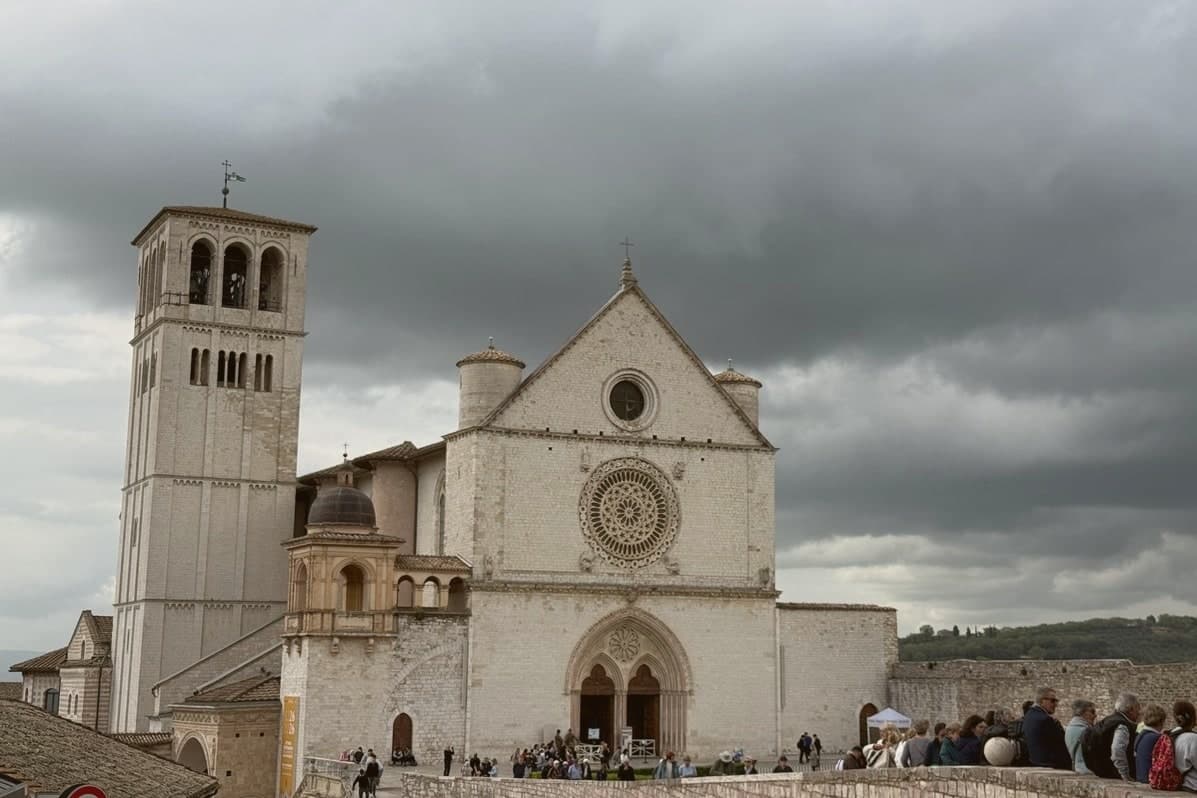
Why visit Assisi
Assisi sits on a terraced spur twenty kilometers east of Perugia, the town built into the western flank of Monte Subasio where it drops toward the plain below. The Umbri settled the site before the Romans came, and the municipium of Asisium grew up around what is now Piazza del Comune, the square that still forms the civic center of the medieval town.
The centro storico runs between two poles: the basilica holding Francis's tomb at one end and the church holding Clare's relics at the other, with the Roman square and its temple facade sitting between them as the oldest layer beneath the medieval one. Below the town, on the plain, stands the basilica built around the chapel where Francis founded his order and died.
Further up the mountain, past the town walls, the hermitage occupies a beech wood where Francis and his companions withdrew from all of it. The layout traces the life it commemorates: birth and burial at the center, founding and death on the plain below, retreat in the wood above.
The town has arranged itself, over centuries, around the geography of one man's biography.
Une, La Locanda del Cardinale, Benedikto and 1 more have been named by a guide.
What to see in Assisi
- Basilica di San Francesco. Two superimposed churches over the saint's tomb, frescoed by Cimabue, Giotto, Simone Martini and Pietro Lorenzetti.
- Basilica di Santa Chiara. Church at the eastern end of the centro storico, holding the relics of Saint Clare and the San Damiano Crucifix.
- Tempio di Minerva. Roman temple on Piazza del Comune, six Corinthian columns intact, one of the best-preserved temple façades in the country, converted to a church in 1539.
How to get to Assisi
There is a railway station in the town, so you can arrive without a car and never need one while you are here. Perugia is roughly 35 minutes away by road.
✷ We have written about Assisi
“The basilica is grand, and it is grand from a distance, which is the harder trick. You see it from the valley road as a long horizontal weight along the end of the ridge, held up on arches, wider than the town it belongs to. In front of it there is a huge sloping field, stone, which functions as a piazza sort-of.”
Read our piece on Assisi →Assisi | The Church He Would Have Chosen
Our tip
April through June and September into October are the months Assisi was built for. The hills around Monte Subasio turn green in spring and gold in autumn, and the pilgrim traffic spreads thinly enough that the centro storico keeps its silence in the early morning. October 3 and 4 are the Festa di San Francesco, when delegations from every Italian region process to the basilica. Festa di Sant'Anna falls in July.
Cortona
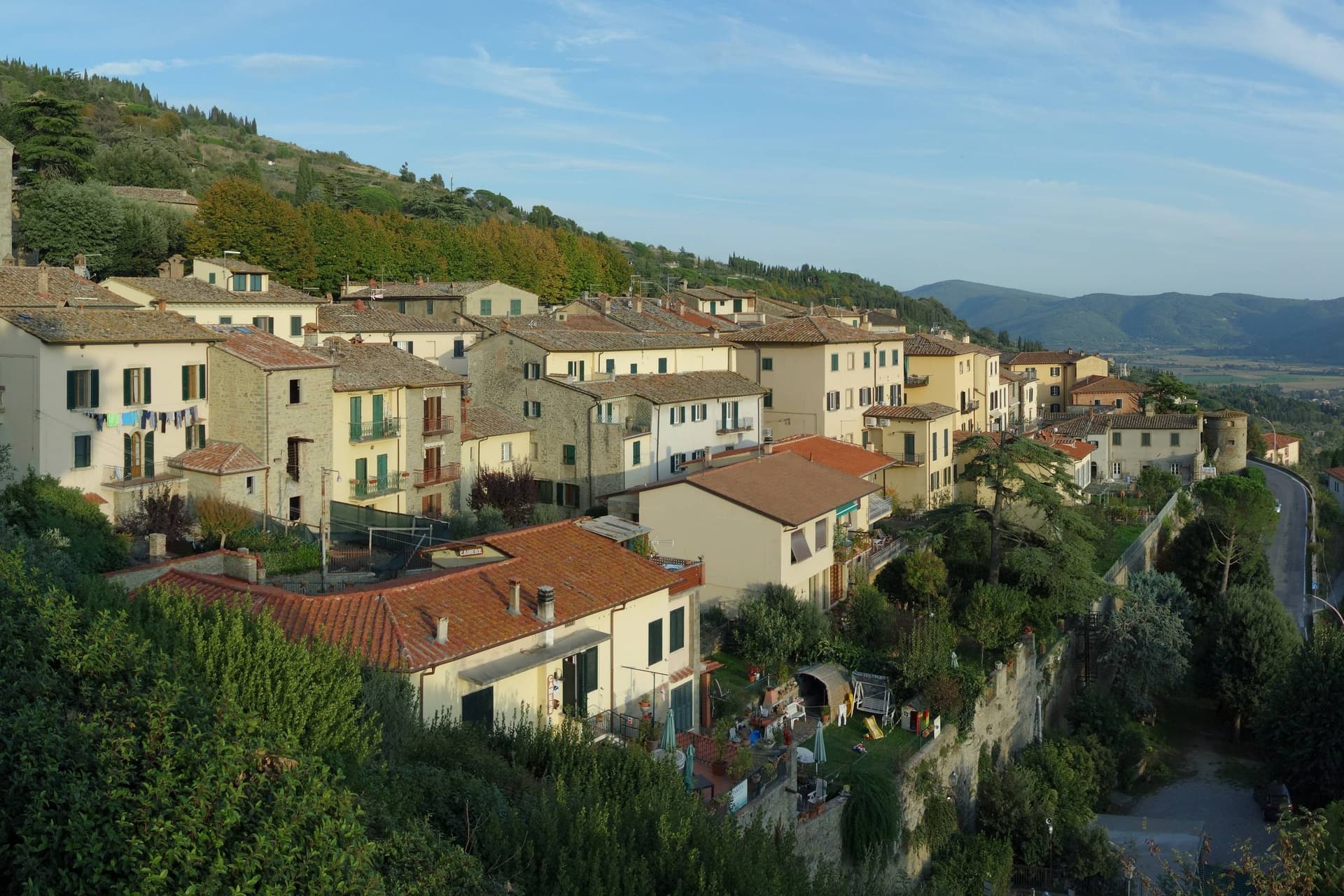
Why visit Cortona
Cortona stands on the southern flank of the Val di Chiana, looking across to Lake Trasimeno: a position that put it in sight of both the plain it governed and the water beyond it. The Etruscan name Curtun survives fixed in stone, and the city that carried it was built in tiers up the hillside, walls and fortress at the crown, church and convent lower down at the edges of the slope, houses and squares filling the ground between.
The bishop granted Francis of Assisi a place for retreat in 1211, and what resulted was built into a narrow valley below the town rather than within its walls, a retreat kept apart from the civic center even as it stayed within reach. Santa Margherita, the city's patron, is held on the ridge above the streets she once walked.
The painters Luca Signorelli and Pietro da Cortona were born inside the walls that still define the town's shape. Frances Mayes published her memoir in 1996, and the town has not been quiet since.
What emerges is a hill town whose Etruscan skeleton, medieval faith, and modern fame sit stacked on the same slope, each layer visible without erasing the one beneath it.
Il Falconiere, La Bucaccia, Osteria del Teatro and 4 more have been named by a guide.
What to see in Cortona
- Mura etrusche. The walls still ring the city entire, the foundation under every later layer of building, Roman and medieval alike.
- MAEC. Museum of the Etruscan Academy in Palazzo Casali, holding the bronze plaque and the lampadario di Cortona.
- Museo Diocesano. Collection in the former Chiesa del Gesù with Beato Angelico's Annunciation of 1430 and works by Luca Signorelli.
How to get to Cortona
There is a railway station in the town, so you can arrive without a car and never need one while you are here. Perugia is roughly 45 minutes away by road.
Our tip
April through June brings green hills, cool evenings and the longest hours in the Diocesano without a queue. September and October are the dry, gold months, light coming in low across Lake Trasimeno and the olive harvest running until November. July and August are the difficult months. Giostra dell'Archidado di Cortona falls in June.
More from Anywhere Italy
 The best towns worth staying overnight in the province of Perugia
- The best towns with a medieval festival that eat well within 90 minutes of Perugia
- The 9 best wine towns that eat well within 90 minutes of Perugia
 The best hidden hill towns with a serious restaurant within 90 minutes of Perugia
- The prettiest hidden villages with a serious restaurant within 90 minutes of Perugia
- The best towns you can reach by train that have a serious restaurant within 90 minutes of Perugia