
The best towns worth staying overnight in the province of Perugia
Umbria in the province of Perugia is built out of stone that changes colour with the weather, pale pink limestone in the hill towns, grey travertine around the Valnerina, warm brick on the plain. The food follows the altitude: lentils and pecorino and cured pork up towards the Sibillini, freshwater trout in the river villages, black truffle shaved over strangozzi in winter, torta al testo cooked on a hot disc all year. Autumn is the season the region actually smells of itself, wet oak woods, olive presses running, new oil green enough to sting. Evenings are the reward, when the day visitors leave and the piazza belongs to whoever is staying.
Most people give Umbria a single day, and most of that day goes to Perugia itself, the escalators up through the Rocca Paolina, the Corso Vannucci, the queue for the Galleria Nazionale. It is a fine city and it absorbs the coaches, along with a fast loop to a basilica and a lunch stop somewhere on the way back to Florence or Rome. The result is a province experienced entirely between late morning and mid afternoon.
The same hills, the same oil and lentils and truffle, carry on well past the day-trip radius, into towns with walls, a decent kitchen and somewhere proper to sleep. Staying overnight changes the arithmetic: an early walk on the ramparts, dinner that does not have to end by the last bus, a morning market that is not staged for anyone. These are the places in the province of Perugia where a guide has vouched for the bed, so the visit can last longer than an afternoon.
Of the 37 communes we have mapped in the province of Perugia, 6 qualify as towns worth staying overnight: each has a hotel a travel guide has vouched for, so you can stay rather than day-trip. The smallest, Scheggino, has 446 residents.
Two more lists worth reading alongside this one: The best hill towns with a serious restaurant in the province of Perugia and The best towns worth staying overnight that eat well within 90 minutes of Perugia.
Scheggino
Why visit Scheggino
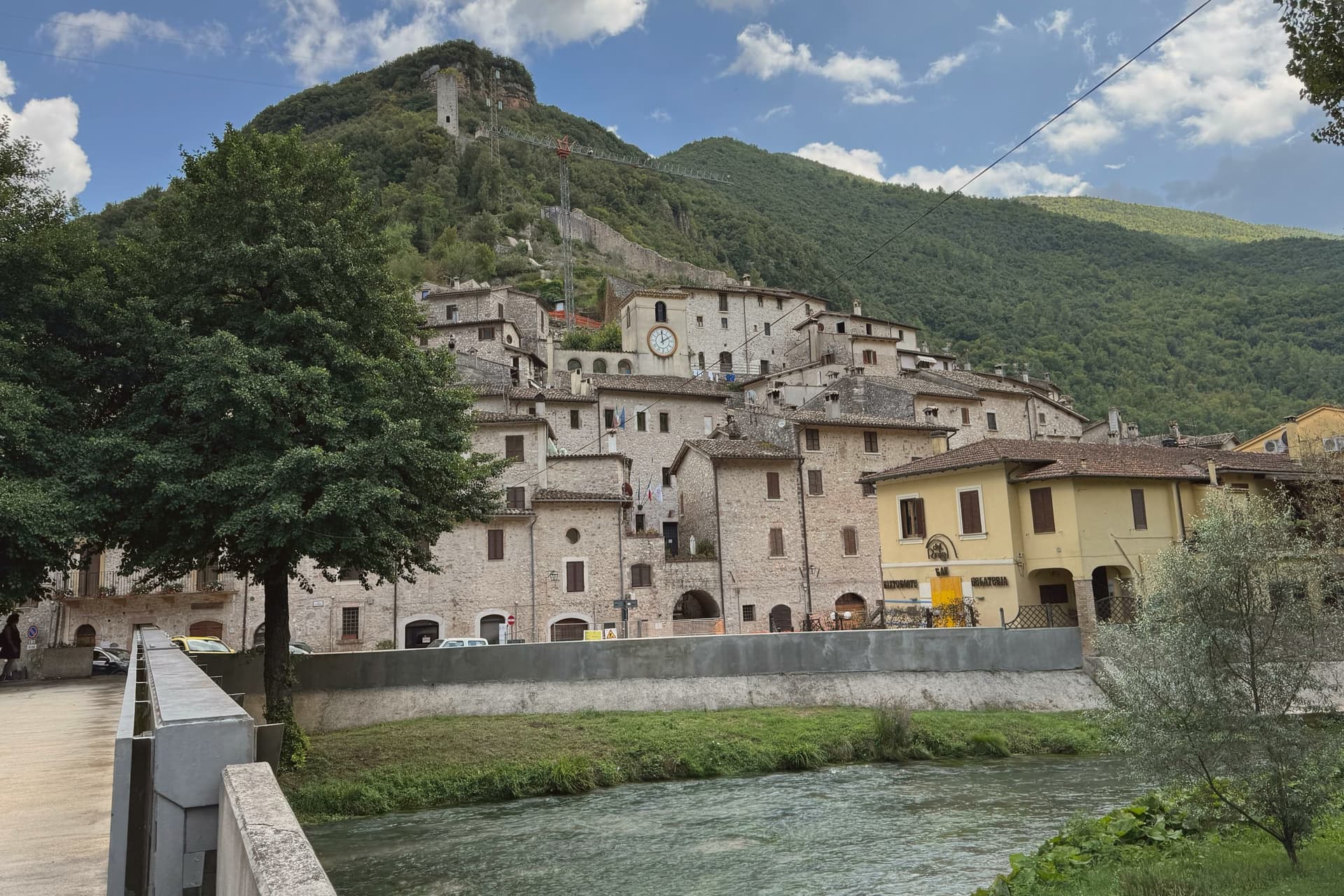
Scheggino sits at 280 meters in the heart of the Valnerina, the village wedged into a triangle of walls between the slope above and the Nera river below. The Duchy of Spoleto built it around the 12th century to defend one of the three bridges over the Nera; the triangular plan and the watchtower of white and pink stone, about 20 meters high, still mark the top of the castle.
The Nera runs alongside the lower edge of the village, divided into channels that once turned mills and now hold trout and the springs that feed the truffle washing rooms. Scheggino is the home of Urbani Tartufi, the first commercial company for the storage and processing of truffle, founded in 1928, which still has its plant on the river.
The Diamante Nero festival each summer prepares a giant frittata with more than 2,000 eggs and 80 kilos of black truffle. The Cammino di San Francesco passes through the village on the way south.
What to see in Scheggino
- Castello di Scheggino. Twelfth-century triangular castle of the Duchy of Spoleto, with a watchtower in white and pink stone about 20 meters high at the summit.
- Chiesa di San Nicola. Romanesque parish church at the heart of the centro storico, frescoes of the Umbrian school of the 15th century in the apse.
- Nera river canals. Channels of the Nera divided through the lower village, once for mills and now for trout farming and the truffle washing rooms of Urbani.
How to get to Scheggino
Terni is roughly 49 minutes away by road.
Our tip
April through June and September into October are the months for Scheggino. The Nera runs cold and full, the trout farms work at capacity, and the trails up to Vallo di Nera or down to Ferentillo are walkable in shade. July and August push the valley into the mid-thirties; the river canals through the village cool the lower streets and the trattorie pour Nera trout with local truffle.
Montone
Why visit Montone
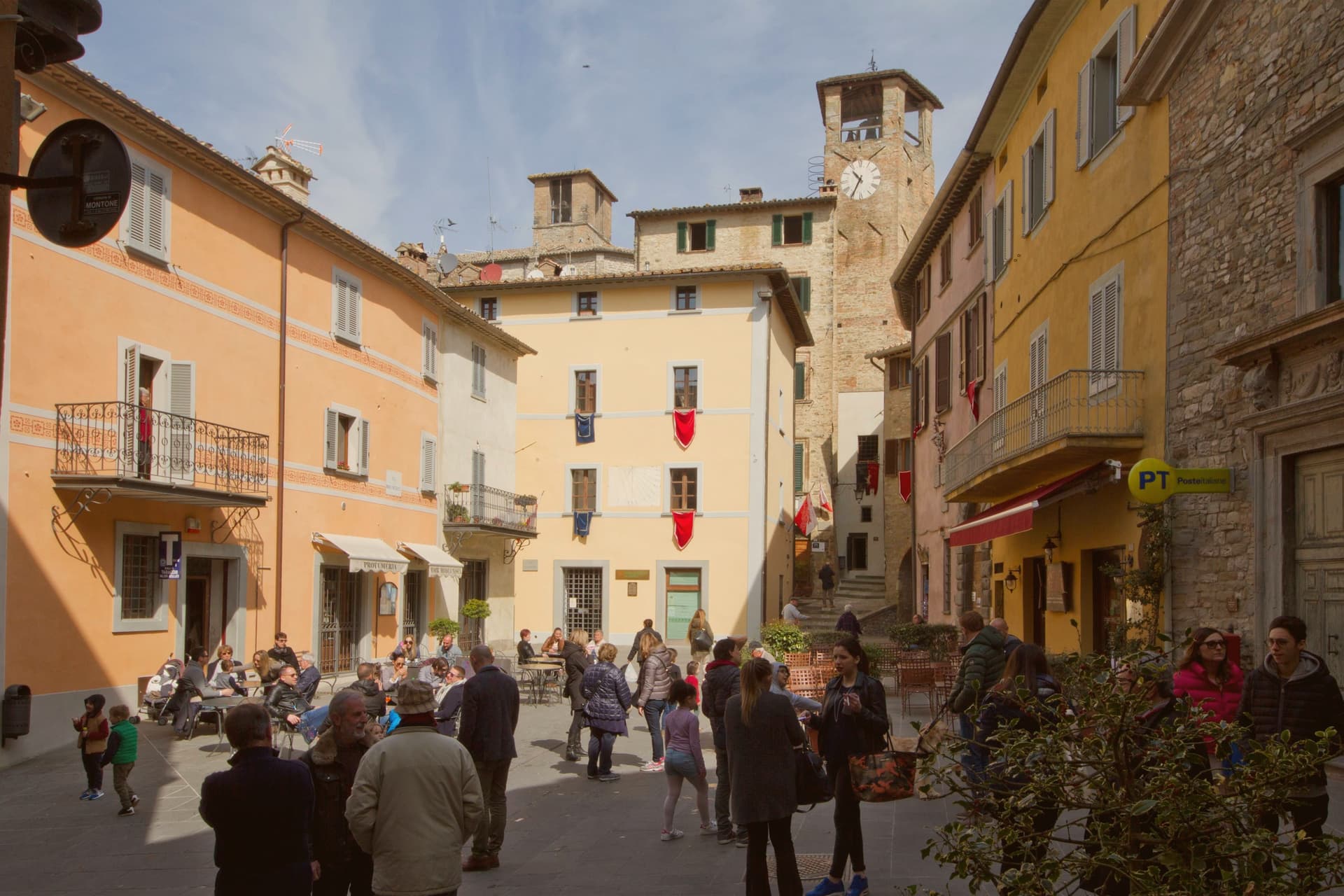
Montone sits at 482 meters on a ridge above the upper Tiber valley, thirty kilometers north of Perugia. The walled centro storico is small enough to circuit in fifteen minutes and steep enough that the route is the climb.
The town is the cradle of the Fortebracci, the condottieri family whose most famous member, Braccio da Montone, was made Count of Montone in 1414 by Antipope John XXIII. The Rocca di Braccio at the top of the hill and the Rocca d'Aries six kilometers out are both Fortebracci works.
The Gothic Chiesa di San Francesco, built around 1300 where the family had its houses, holds the Pinacoteca with a Bartolomeo Caporali altarpiece. The Donazione della Spina, a relic-thorn from Christ's crown given to the town by Carlo Fortebracci after the Venetians thanked him for naval service against the Turks, is processed twice a year, on Easter Monday and during the August week after Ferragosto.
Since 1997 the Umbria Film Festival has run here every July, founded with Terry Gilliam.
What to see in Montone
- Chiesa di San Francesco. Gothic church of around 1300 with a fourteenth-century convent, picture gallery and cloister, on the hill where the Fortebracci had their houses.
- Rocca di Braccio. Fortress at the top of the borgo rebuilt under Oddo III Fortebracci in the late fourteenth century, now a panoramic ramparts walk.
- Rocca d'Aries. Castle six kilometers from the centro storico, the first Fortebracci stronghold according to tradition, restored and reopened to visit.
How to get to Montone
Perugia is roughly 47 minutes away by road.
Our tip
April through June and September into October are the steady months. The Umbria Film Festival runs in mid-July under Terry Gilliam's patronage, and the borgo doubles for that week with screenings in the piazze and the Rocca. The August Donazione della Spina pageant, the week after Ferragosto, fills the streets with medieval costumes and a Rocca di Braccio banquet.
Norcia
Why visit Norcia
Norcia sits at 604 meters on a high plateau on the Umbrian side of the Monti Sibillini, ancient Nursia of the Sabines, fortified in the 3rd century BC by Rome. Saints Benedict and his twin sister Scholastica were born here in 480; the Benedictine Order and the Ora et Labora motto that shaped Western monasticism began on this piazza.
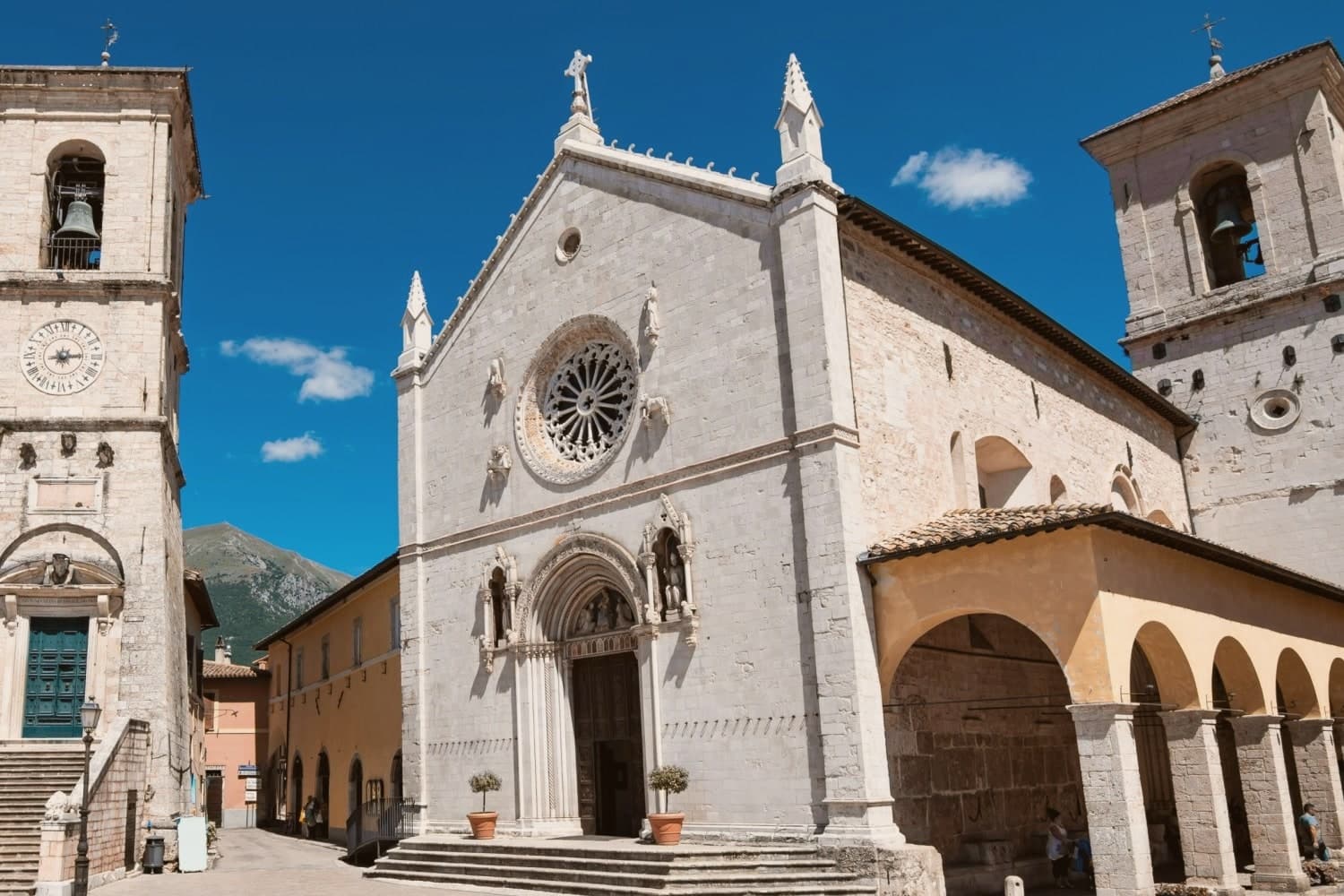
The Basilica di San Benedetto rises on the traditional birthplace, built between 1290 and 1338 over a pre-existing crypt. On 30 October 2016 a magnitude 6.5 earthquake destroyed the nave; only the façade was left standing.
Reconstruction completed on 30 October 2025, nine years to the day, with the original stones and earthquake-resistant technology. The town gave its name to norcineria, the Italian word for quality pork delicatessen, after centuries of Norcia butchers specializing in wild boar and pork.
Black truffle from the Valnerina, lentils from Castelluccio, and ricotta from the high pastures complete the table.
What to see in Norcia
- Basilica di San Benedetto. Built 1290-1338 over the traditional birthplace of Saints Benedict and Scholastica, rebuilt with original stones after 2016, reopened 30 October 2025.
- Castellina. Fortified papal stronghold designed by Jacopo Barozzi da Vignola in 1554, on Piazza San Benedetto, now the Museo Civico e Diocesano.
- Piazza San Benedetto. Civic and religious heart of the centro storico, with the Palazzo Comunale, the basilica, the Castellina and the statue of Benedict at the center.
How to get to Norcia
Terni is roughly 93 minutes away by road.
Our tip
April through June and September into October are the months for Norcia. The plateau holds its color, the lentil fields of Castelluccio bloom from mid-June into July, and the high pastures are open for hiking. July and August stay cooler than the Umbrian valleys at 604 meters, but the town fills with festival crowds for the Mostra Mercato del Tartufo Nero on the last weekend of February and again for sagras through the summer.
Assisi
Why visit Assisi
Assisi sits on a terraced spur twenty kilometers east of Perugia, the town built into the western flank of Monte Subasio where it drops toward the plain below. The Umbri settled the site before the Romans came, and the municipium of Asisium grew up around what is now Piazza del Comune, the square that still forms the civic center of the medieval town.
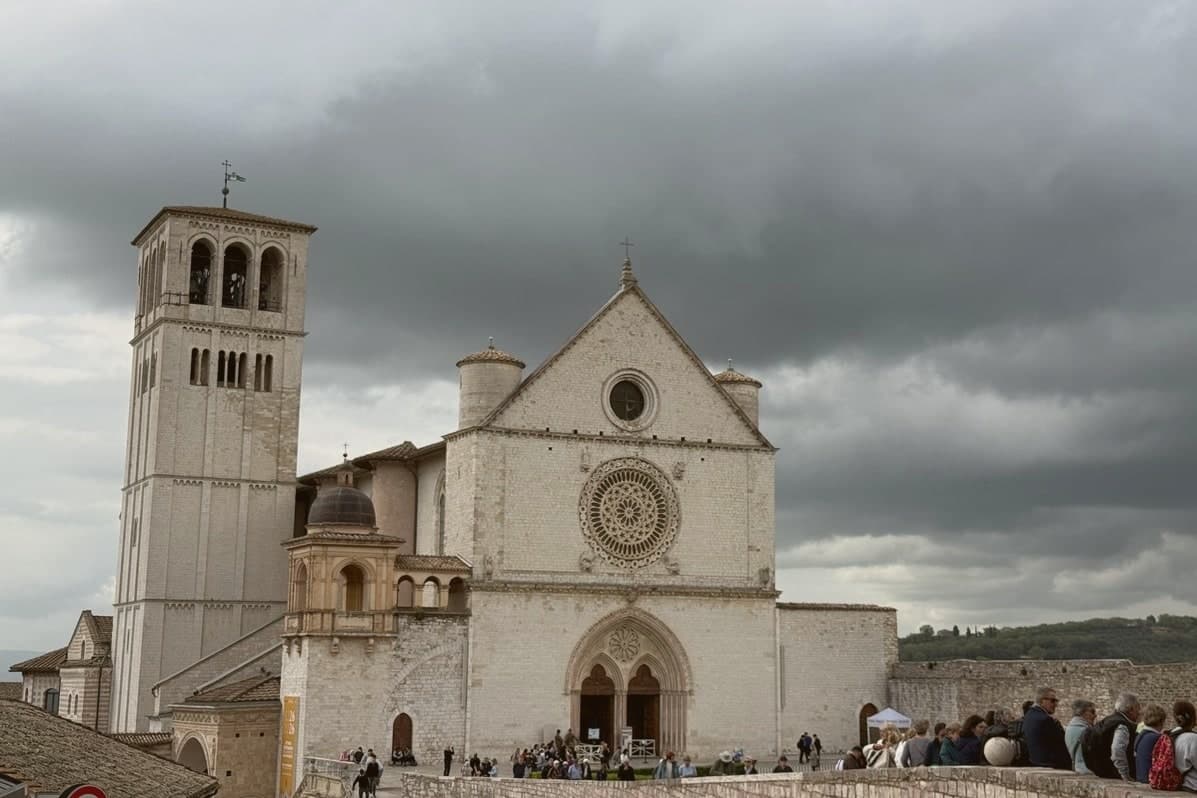
The centro storico runs between two poles: the basilica holding Francis's tomb at one end and the church holding Clare's relics at the other, with the Roman square and its temple facade sitting between them as the oldest layer beneath the medieval one. Below the town, on the plain, stands the basilica built around the chapel where Francis founded his order and died.
Further up the mountain, past the town walls, the hermitage occupies a beech wood where Francis and his companions withdrew from all of it. The layout traces the life it commemorates: birth and burial at the center, founding and death on the plain below, retreat in the wood above.
The town has arranged itself, over centuries, around the geography of one man's biography.
What to see in Assisi
- Basilica di San Francesco. Two superimposed churches over the saint's tomb, frescoed by Cimabue, Giotto, Simone Martini and Pietro Lorenzetti.
- Basilica di Santa Chiara. Church at the eastern end of the centro storico, holding the relics of Saint Clare and the San Damiano Crucifix.
- Tempio di Minerva. Roman temple on Piazza del Comune, six Corinthian columns intact, one of the best-preserved temple façades in the country, converted to a church in 1539.
How to get to Assisi
There is a railway station in the town, so you can arrive without a car and never need one while you are here. Perugia is roughly 35 minutes away by road.
✷ We have written about Assisi
“The basilica is grand, and it is grand from a distance, which is the harder trick. You see it from the valley road as a long horizontal weight along the end of the ridge, held up on arches, wider than the town it belongs to. In front of it there is a huge sloping field, stone, which functions as a piazza sort-of.”
Read our piece on Assisi →Assisi | The Church He Would Have Chosen
Our tip
April through June and September into October are the months Assisi was built for. The hills around Monte Subasio turn green in spring and gold in autumn, and the pilgrim traffic spreads thinly enough that the centro storico keeps its silence in the early morning. October 3 and 4 are the Festa di San Francesco, when delegations from every Italian region process to the basilica. Festa di Sant'Anna falls in July.
Panicale
Why visit Panicale
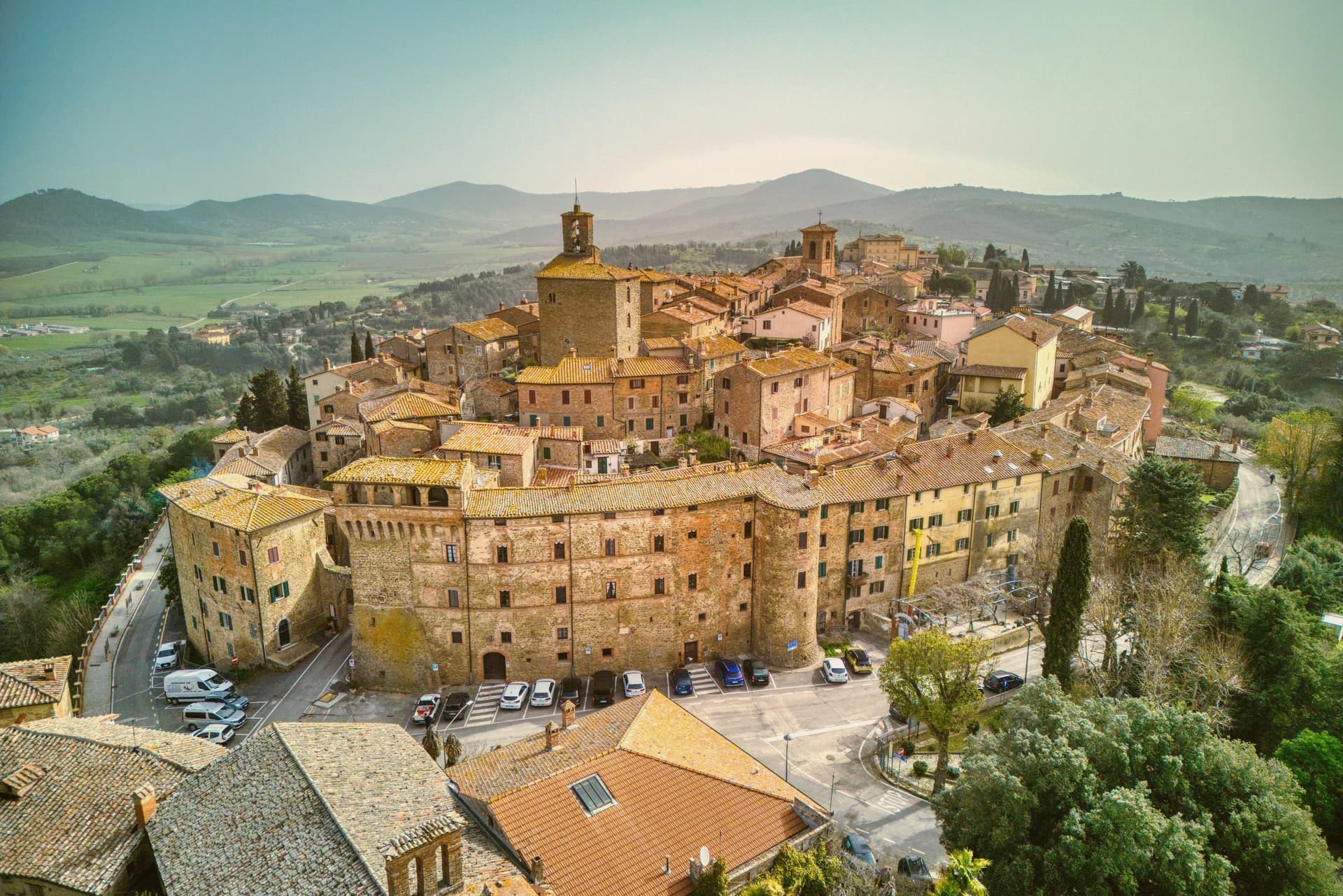
Panicale sits at 431 meters on the eastern slope of Monte Petrarvella, overlooking the southern shore of Lake Trasimeno from twenty-five kilometers southwest of Perugia. The medieval castle dates back in its earliest parts to the ninth century, and by the fourteenth Panicale was a small city-state with two gates facing Perugia and Florence and a moat around the walls.
Boldrino da Panicale, born in 1331, became one of the most feared mercenary captains of the trecento. The Chiesa di San Sebastiano, on a slope outside the walls, holds Pietro Perugino's Martyrdom of Saint Sebastian, frescoed across the entire back wall between spring and autumn of 1505, the saint's body crossed by the arrows of four archers in a deep landscape.
The Collegiata di San Michele Arcangelo on the main square claims an Annunciation attributed to Masolino da Panicale, the Renaissance painter the town shares as a birthplace claim with a Panicale in Tuscany. Three squares step down the slope on three different levels.
What to see in Panicale
- Chiesa di San Sebastiano. Fifteenth-century chapel on a slope outside the walls, with Perugino's Martyrdom of Saint Sebastian, frescoed in 1505 across the entire back wall.
- Collegiata di San Michele Arcangelo. Main parish church on Piazza San Michele, with an Annunciation attributed to Masolino da Panicale, master of Masaccio.
- Castello e mura medievali. Medieval circuit and gates dating to the ninth century, with two entrances toward Perugia and Florence and the line of the old moat.
How to get to Panicale
Perugia is roughly 48 minutes away by road.
Our tip
April through June and September into October are the windows. The lake catches morning light from the Panicale ramparts and the air at 431 meters keeps the heat down even in summer. July and August are warmer, and the Festa dell'Uva in late September runs the medieval procession through the three squares.
Todi
Why visit Todi
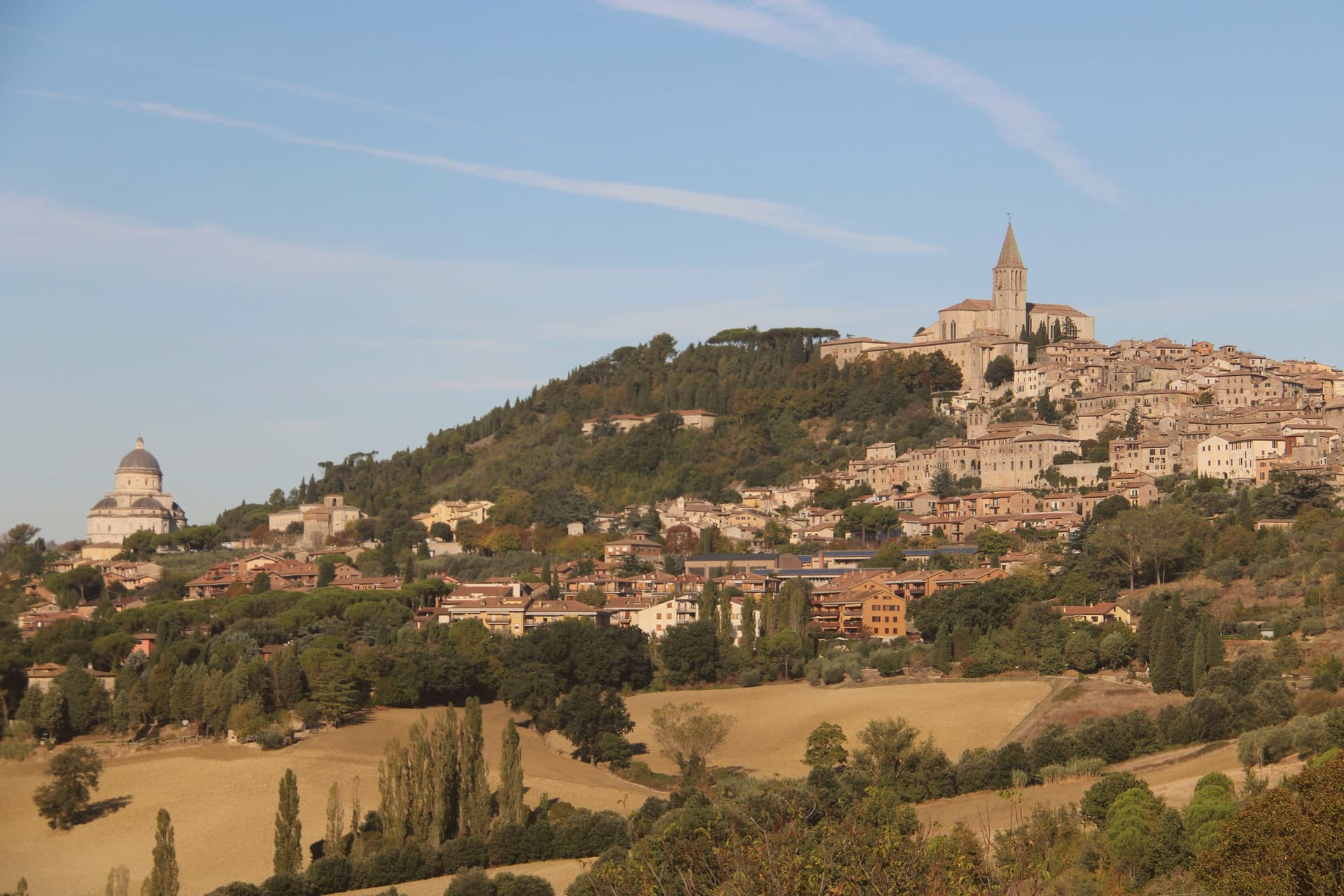
The hill the town occupies, Colle Nidoli, rises above the middle Tiber, and the settlement is built as three concentric ring walls rather than one: Etruscan and Roman courses at the base, a medieval circuit at the summit, the whole sequence readable from the hills around it. The square at the top sits directly over a Roman forum, and the cisterns cut beneath that forum still carry water and drainage for the town today, so the working infrastructure underfoot is as old as anything visible above ground.
The building on the square with the triple window keeps that window from the thirteenth century. The lower ground beyond the medieval walls holds the Roman niches, the surviving wall of a first-century BC public building, set at the foot of the town rather than within its defended core, a reminder that the settlement's Roman life extended past what the medieval walls later enclosed.
Outside the walls in the other direction stands the Renaissance temple, built over a century between 1508 and 1607, deliberately separated from the dense center it complements. Todi's layout is less a single town than a stack of settlements, Etruscan, Roman, medieval, Renaissance, each occupying its own ring or its own ground beyond the walls, none erasing what came before it.
What to see in Todi
- Piazza del Popolo. Square on the highest point of Colle Nidoli, built over Roman cisterns still in use, ringed by cathedral, Palazzo dei Priori, and Palazzo del Capitano.
- Cattedrale della Santissima Annunziata. Twelfth-century cathedral on the site of a Roman temple, north end of Piazza del Popolo, Gothic rose window and a fresco of the Last Judgment by Faenzone inside.
- Tempio di Santa Maria della Consolazione. Outside the walls rather than within the medieval fabric of the center, its dome fifty meters high, a solitary geometric mass against the surrounding hillside.
How to get to Todi
There is a railway station in the town, so you can arrive without a car and never need one while you are here. Terni is roughly 37 minutes away by road.
Our tip
April through June and September into October are the months locals prefer. The Tiber valley below stays green or gold depending on the half, and the upper terraces hold light into the evening. Todi Festival runs in late August with concerts and theater in the centro storico.
More from Anywhere Italy
- The best hill towns with a serious restaurant in the province of Perugia
 The best towns worth staying overnight that eat well within 90 minutes of Perugia
- The best hidden towns with a serious restaurant in the province of Perugia
- The 7 best towns with a serious restaurant that sit inside a nature park in the province of Perugia
 The 6 best hidden truffle towns in the province of Perugia
 The 6 best small towns that eat well in the province of Perugia