
The best hot spring towns in the province of Siena
90 towns visited, 910 to go. Follow along, free: Subscribe on Substack
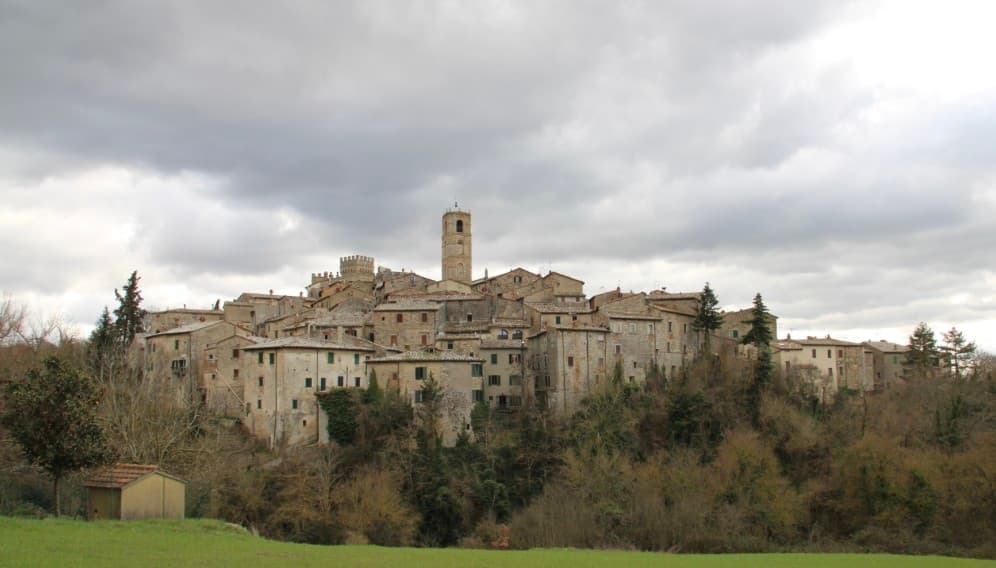
The water comes up hot from under southern Tuscany, carrying calcium and sulphur, and it has been used here since the Etruscans. In winter the steam sits over the pools in the early morning while the hills behind are bare clay and ploughed brown, and that is the best season for it: cold air, water at blood heat or above, oak smoke somewhere in the village. The bathing buildings are made of the local stone, travertine that the springs themselves deposited, and some of the basins are Roman walls with new plumbing behind them. Around them is the food of the Val d'Orcia and the Val di Chiana, pecorino aged in ash, pici rolled by hand, Chianina beef, and the wine of the Crete Senesi and the slopes above Montepulciano.
Most people who come to Tuscany for thermal water go to Saturnia, in the province of Grosseto, where the Cascate del Mulino spill down terraces of white travertine and the car park fills by the middle of the morning. It is remarkable and it is also on every list of things to do in Tuscany, which means coach groups, queues at the changing rooms, and photographs taken over other people's shoulders. Siena itself absorbs the rest, day trippers doing the Campo and the Duomo before driving south.
The same geology continues north and east of Saturnia, through the province of Siena, and it surfaces in villages that fewer people put on the itinerary. Some have grand nineteenth-century spa establishments, some have free pools below the walls, and some have both within walking distance of a piazza where the bar still serves builders at seven. The towns in this list all have natural thermal water and somewhere set up for bathing in it. They are also, mostly, places worth staying the night in for their own sake.
Of the 20 communes we have mapped in the province of Siena, 6 qualify as hot spring towns: each has natural thermal water and bathing establishments. The smallest, San Casciano dei Bagni, has 1,500 residents.
Elsewhere in the catalogue: The best hidden hot spring towns that eat well in Tuscany and The best hot spring towns with a serious restaurant in Tuscany.
Why visit San Casciano dei Bagni
San Casciano dei Bagni sits at 582 meters at the southern edge of the province of Siena, above 42 hot springs that average 42 degrees Celsius. The baths were used continuously from Etruscan through Roman times and again from the Renaissance, when visitors came from across Europe.
In 2022, an excavation that began in 2019 at the ancient sanctuary turned up 24 bronze votive statues protected by mud, with around 6,000 coins in gold, silver and bronze. The find was the largest of its kind in fifty years; most surviving Etruscan votive material is terracotta.
The 1,500 residents live on a basalt outcrop above the Roman thermal complex, in a centro storico of stone houses and three small churches. The borgo joined the Borghi più belli network in 2014 and remains one of the smallest communes in Toscana to carry both that label and Bandiera Arancione.
What to see in San Casciano dei Bagni
- Santuario Ritrovato. Etruscan-Roman thermal sanctuary excavated since 2019, where 24 bronze votives and around 6,000 coins were recovered in 2022.
- Bagno Grande. The principal natural pool of the 42 hot springs, used from the second century BC through the Renaissance and reopened to the public.
- Collegiata di San Leonardo. Romanesque parish church in the centro storico, restored in the seventeenth century, with a baptismal font carved from local travertine.
How to get to San Casciano dei Bagni
Perugia is about 1 h 8 min away by road.
Our tip
The thermal pools make the calendar different here. Winter is the season many visitors prefer, when the 42-degree water steams against cold air and snow occasionally dusts the basalt outcrop. April through June and September into October are the most balanced months: warm hill light, the dry-stone walls of the borgo at their best, the sanctuary excavations open to guided tours.
Why visit Rapolano Terme
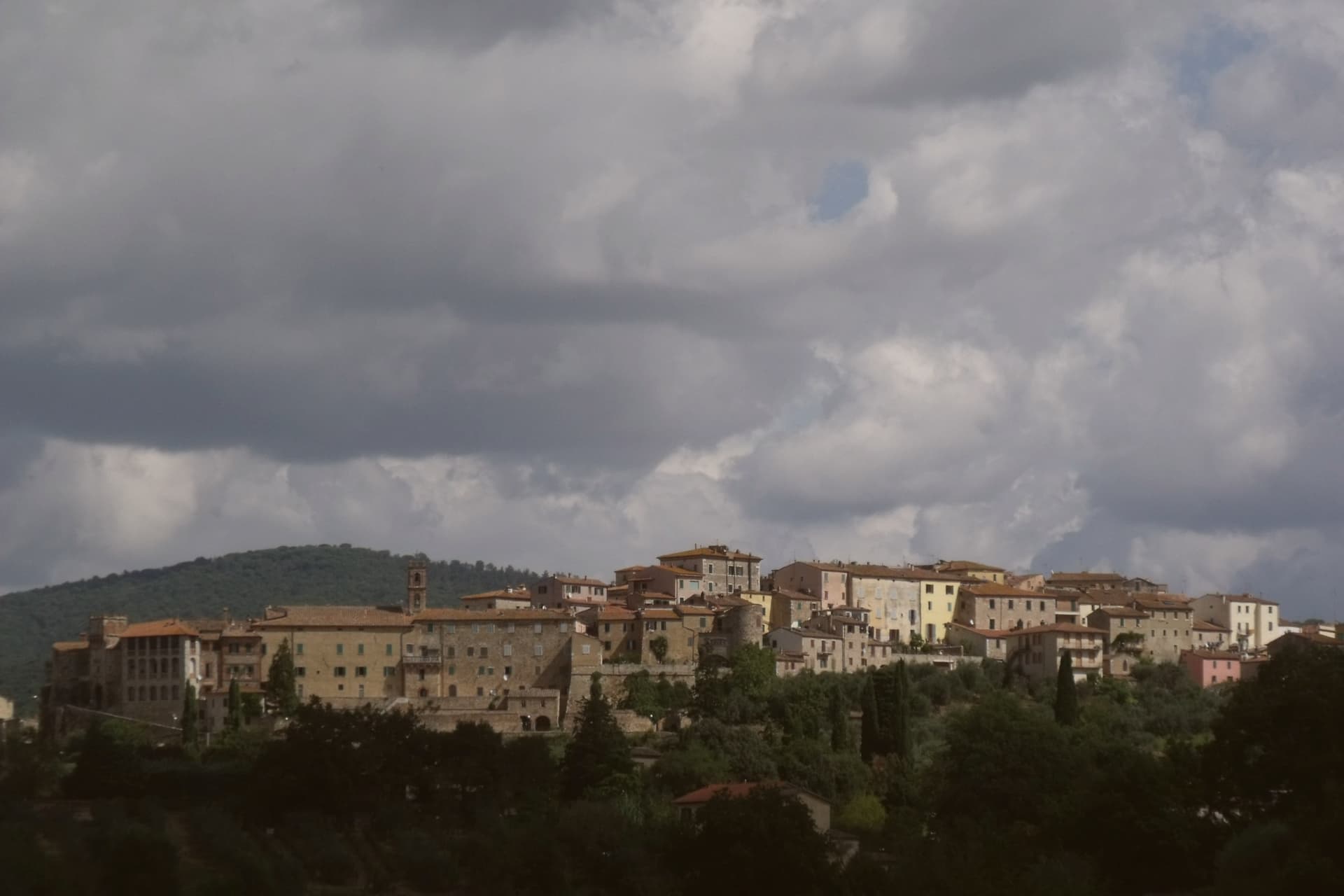
The comune sits at 334 meters on the eastern edge of the clay hills, twenty kilometers east of Siena. It was called simply Rapolano until 1949, when the spa industry pushed the name change, a shift that marks how thoroughly the waters came to define the place.
The thermal facilities and the quarry sit at some distance from each other within the comune: the springs rise near the centro and to its south, while the travertine beds lie in the Serre frazione three kilometers further out, a separate settlement built around the stone rather than the water. The medieval centro storico, meanwhile, holds no thermal or mineral history at all: a fortified perimeter, a Sienese-period castello on the highest point, and a parish church founded in the eleventh century, all predating the spa industry by centuries.
The clay-hill landscape spreads north and west of the comune, and draws most visitors past the spa itself. What emerges is a town built on two extractive industries, water and stone, wrapped around an older walled settlement that has little to do with either.
What to see in Rapolano Terme
- Terme Antica Querciolaia. Six outdoor pools at 38 degrees, the older of the two facilities and the one tied to a general's convalescence.
- Terme San Giovanni. Thermal complex south of the centro among the clay hills of the Crete Senesi, with outdoor pools facing vineyards and olive groves.
- Cave di travertino di Serre. Active quarries in the Serre di Rapolano frazione three kilometers south, the source of the stone behind the Pienza Duomo's façade.
How to get to Rapolano Terme
It has its own railway station. Perugia is about 1 h 3 min away by road. The full route from Florence.
Our tip
Thermal towns work year-round and Rapolano is the rare Sienese commune where winter is a season. The pools at Antica Querciolaia and San Giovanni stay open through the cold months and the steam off the 38-degree water against the December clay hills is the postcard the spa industry sells. April through June and September into October are the wider best months, with the Crete Senesi at full color and the surrounding wine and olive harvests pulling traffic through the centro.
Why visit Castiglione d'Orcia
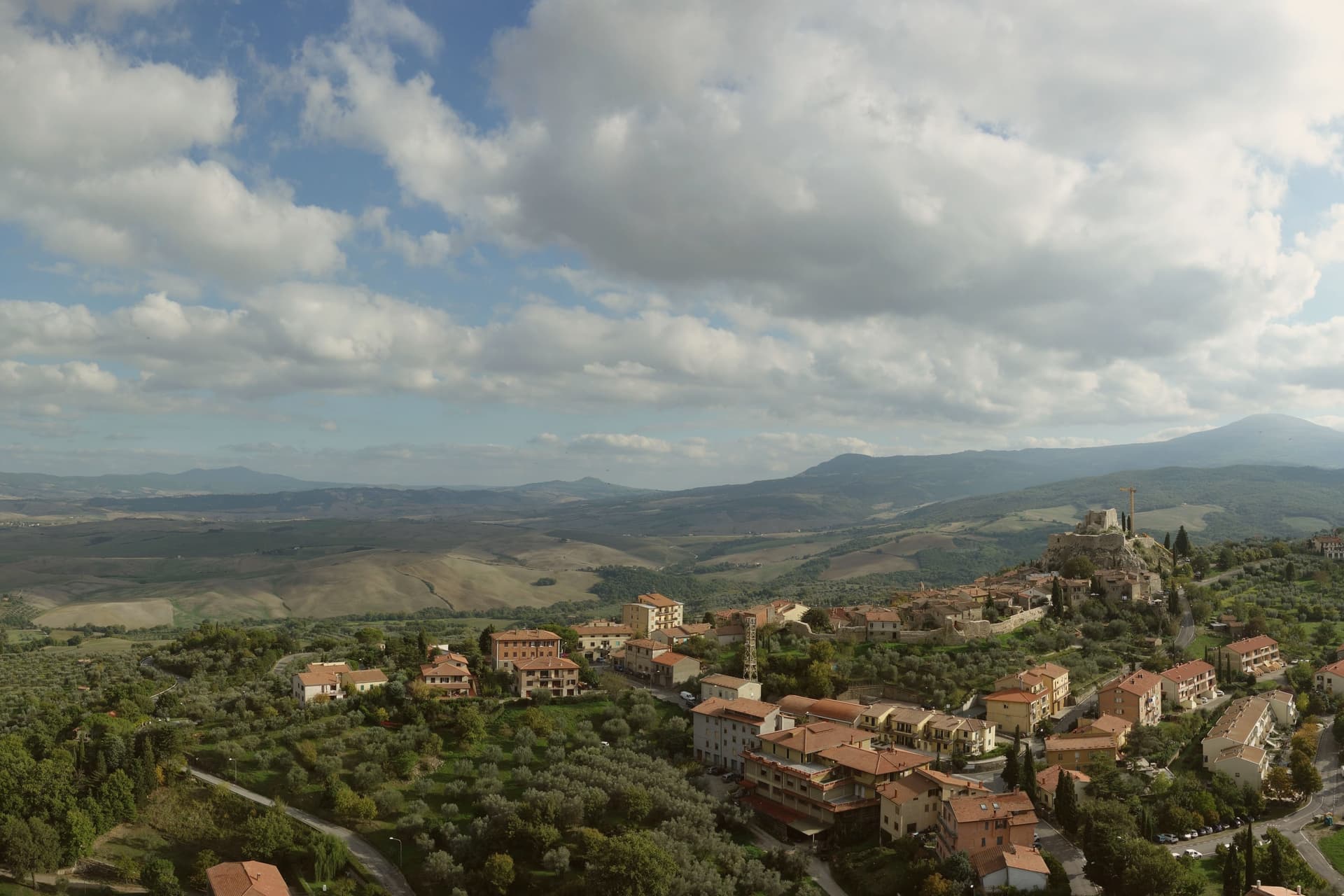
The village stands on a ridge where the land drops toward the Val d'Orcia, the agricultural landscape shaped by Sienese painters and Renaissance estate managers that stretches between Siena and the mountain to the south. First documented in 714, the settlement was then held by the Aldobrandeschi, who built the fortress above the village to hold the medieval road running between the mountain and the Via Francigena, the pilgrim route below.
Siena took the town in 1251 and passed control to the Salimbeni and later the Piccolomini, a shift that put a Sienese family in charge of the second fortress on the neighboring outcrop in the frazione of Rocca d'Orcia. The village center and its outlying frazione form two working parts of one settlement: the walled hill town with its civic square and parish church, and the fortified outcrop a short distance off that once policed the valley approach on its own.
The territory is one of three communes sharing the UNESCO inscription, a status that recognizes the whole valley rather than any single settlement within it. What the record shows, across all of it, is a place whose function was always defensive and administrative before it was scenic: two fortresses set to watch one road, a town divided between them, and a landscape that outgrew its original purpose to become the reason people look at it now.
What to see in Castiglione d'Orcia
- Rocca Aldobrandesca. Aldobrandeschi fortress above the village, documented from the eighth century, walls and keep open as an archaeological site.
- Rocca a Tentennano. Stronghold on a basalt outcrop in the frazione of Rocca d'Orcia, reached by a climb that still shows the defensive logic of the site, controlling the approach along the valley.
- Piazza Vecchietta. Small triangular civic square in the centro storico, the space that carries the painter's adopted name through the village center he left behind.
How to get to Castiglione d'Orcia
Perugia is about 1 h 45 min away by road.
Our tip
April through June and September into October are the months the Val d'Orcia photographers come for, the green hills and the gold stubble depending on the half. The borgo at 540 meters stays cool when the valley floor heats up. July and August push the lower fields into the mid thirties; afternoons thin out the centro storico but the ridge keeps a breeze.
Why visit San Quirico d'Orcia
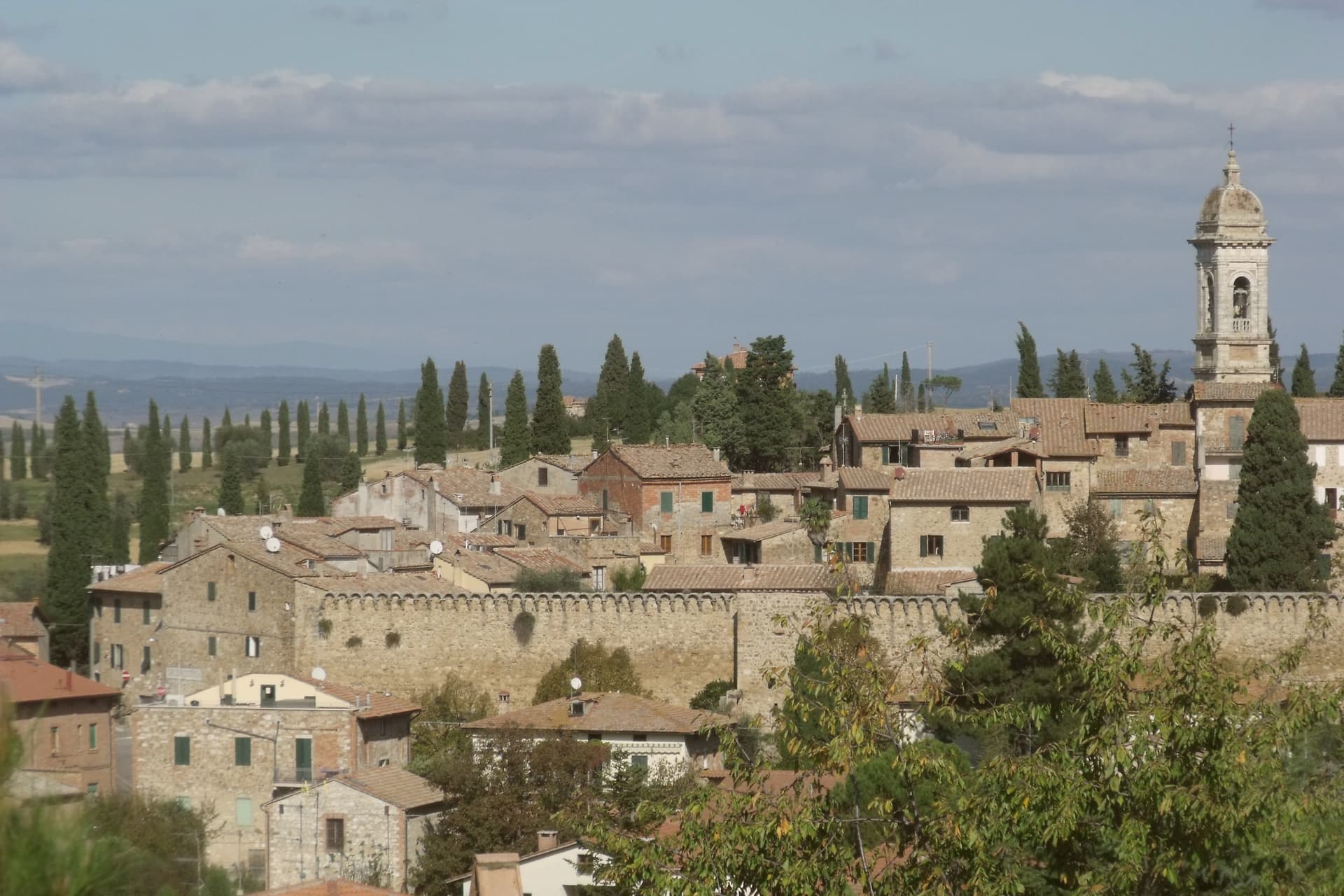
San Quirico d'Orcia sits at 409 meters on a low rise in the Val d'Orcia, the rolling clay-and-tufa landscape inscribed by UNESCO in 2004 as a cultural landscape shaped by fourteenth and fifteenth-century Sienese governance. The town was a stage on Sigeric the Serious's tenth-century Via Francigena from Canterbury to Rome and has remained a working stop on the route ever since.
The Collegiata dei Santi Quirico e Giulitta was built at the end of the twelfth century over an eighth-century baptistery; the lateral portal added in 1288 is attributed to Giovanni Pisano, then working on the Siena cathedral. The Horti Leonini, the geometric boxwood garden laid out by Diomede Leoni around 1580 inside the town walls, hosts the Forme nel Verde sculpture exhibition every summer since 1971.
Bagno Vignoni, the frazione five kilometers down the road, has a thermal pool at the center of its piazza, used since Etruscan times. Few comuni this small carry UNESCO, thermal and Francigena signals at once.
What to see in San Quirico d'Orcia
- Collegiata dei Santi Quirico e Giulitta. Romanesque parish church built late twelfth century over an eighth-century baptistery, with the 1288 lateral portal attributed to Giovanni Pisano.
- Horti Leonini. Italianate boxwood garden laid out by Diomede Leoni around 1580 inside the town walls, hosting the Forme nel Verde sculpture exhibition since 1971.
- Bagno Vignoni. Frazione five kilometers south, with a sixteenth-century thermal pool at the center of its piazza, fed by springs used since Etruscan times.
How to get to San Quirico d'Orcia
Perugia is about 1 h 36 min away by road.
✷ We have written about San Quirico d'Orcia
“When the film industry needed a picture of heaven, of the fields a dead hero walks home to, they came and shot it here, and that is the truest thing anyone has ever said about the Val d'Orcia. It is not a place. It is the afterlife as imagined by people who lived in cities. It is how the country looks to men who never spent an hour in it, dreamed up by Florentine bankers five hundred years ago and maintained, beautifully, ever since.”
Read our piece on San Quirico d'Orcia →Val d'Orcia | The Postcard Is Constructed
Our tip
April through June and September into October are the gold months in the Val d'Orcia: green wheat in spring, ochre stubble by autumn, low light that defines the cypress ridges. The Festa del Barbarossa runs the third Sunday of June with archery, jousts and crossbow contests between the town quarters. July and August are hot and busy; the centro storico fills with day-trippers from Pienza and Montalcino.
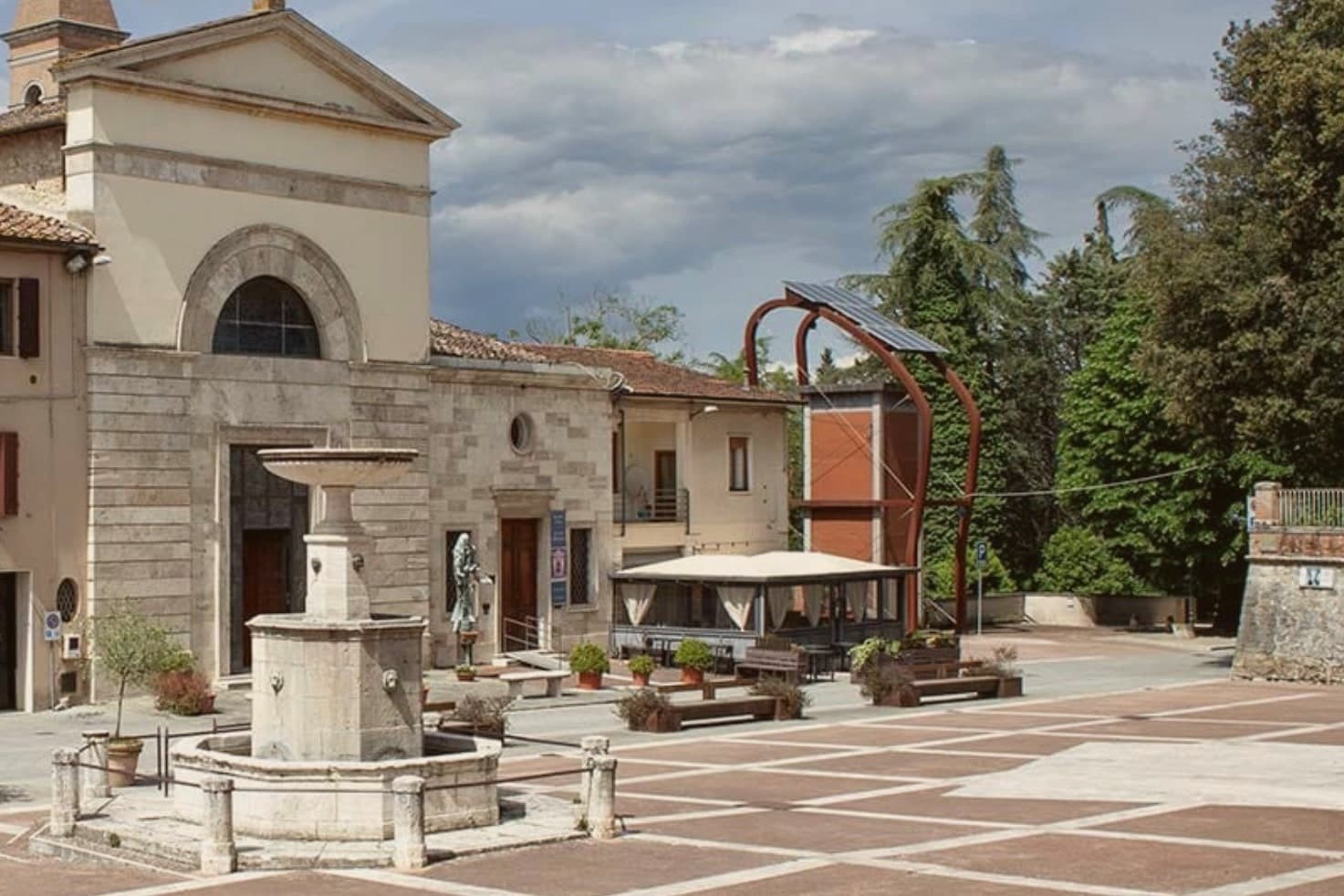
Why visit Castelnuovo Berardenga
The commune sits east of Siena, where the hills give way to the clay swells of the Crete Senesi. The name comes from the Terra Berardinga, the area controlled in the tenth century by a Frankish nobleman named Berardo, and the borgo grew up around the castle walls the Sienese Republic raised against Florence.
The centro storico, the villa and gardens at its heart, and the surrounding zone of vineyards form one continuous pattern rather than separate parts: fortress town above, wine country falling away below it toward the clay hills. Across the wider territory, 13 castles, 70 churches and 200 farms record the medieval pattern of the Sienese contado, a scatter of small fortified points and parish churches administering land rather than one dominant center.
The place reads as a border post that outlived its military purpose and settled into agriculture and the arts, its castle now a clock tower, its noble villa now a music foundation, its walls now overlooking rows of Sangiovese.
What to see in Castelnuovo Berardenga
- Villa Chigi Saracini. Eighteenth-century villa and Italian garden inside the centro storico, its park designed by the Sienese composer Guido Chigi Saracini, whose family foundation still runs the Accademia Musicale Chigiana in Siena.
- Torre dell'Orologio. Surviving tower of the fortress, now bearing the civic clock, the highest visible point of the centro storico.
- Chiesa dei Santi Giusto e Clemente. Eighteenth-century parish church with a neoclassical façade, built on the site of an earlier Romanesque pieve.
How to get to Castelnuovo Berardenga
Firenze is about 1 h 17 min away by road. The full route from Florence.
✷ We have written about Castelnuovo Berardenga
“The wine is the whole economy of these hills, every village with its own, the region’s name stamped on the most famous red in Italy. Tuscan food runs to cured and roasted meat, so the wine ran red to meet it, lighter than you expect, almost fruity, easy, made to sit beside a steak and not to be lectured about. Here is the only wine knowledge you need on this road: it is all good.”
Read our piece on Castelnuovo Berardenga →Road to Siena | The Long Way Is the Better Way
Our tip
April through June and September into October are the months Chianti Classico shows best, the green hills moving toward the gold of harvest. The Sagra del Vino runs the second weekend of September. July and August push past thirty and the centro storico empties between two and six; the cellars on the surrounding hills offer cool tastings and longer rentals.
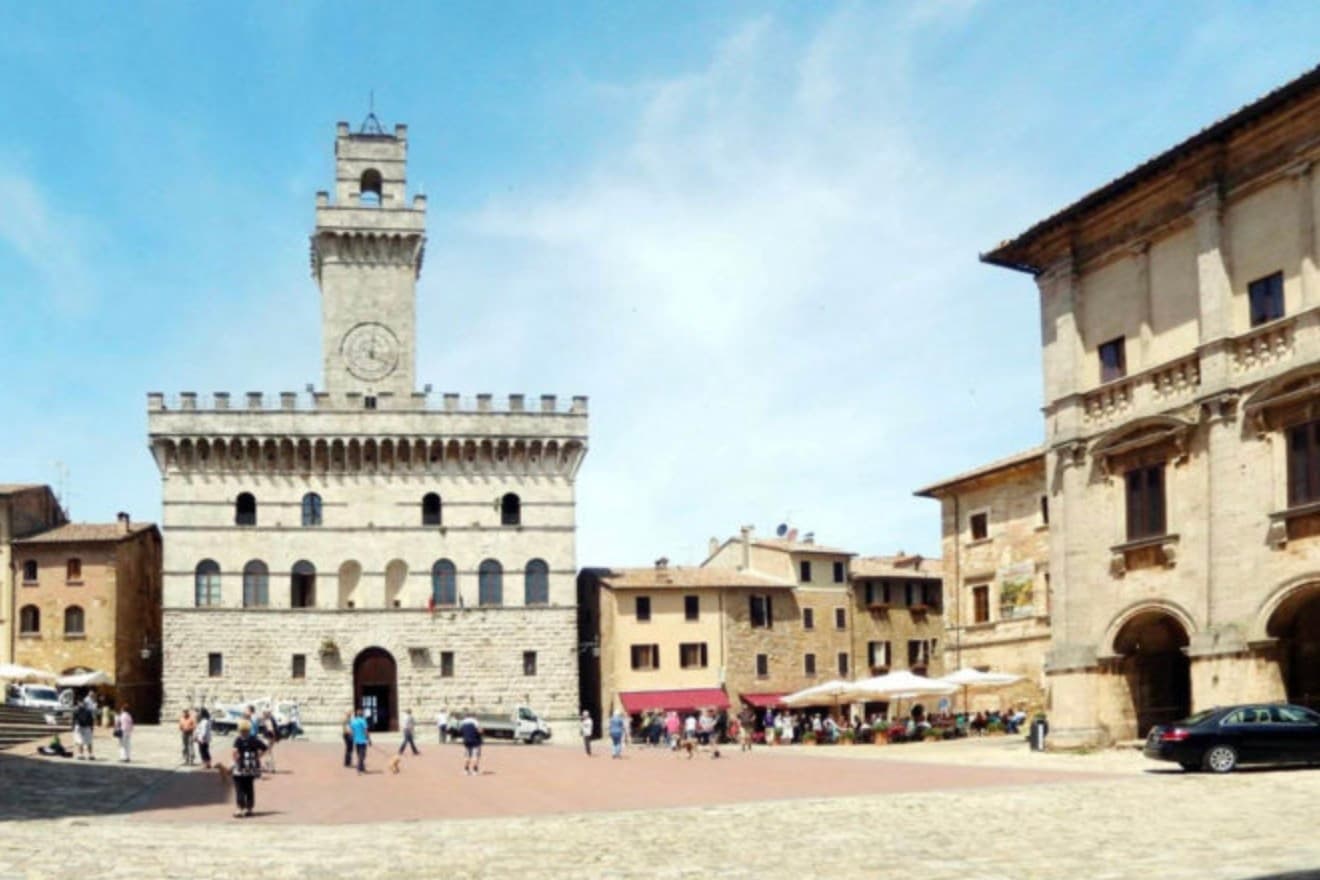
Why visit Montepulciano
The ridge runs between the Val di Chiana and the Val d'Orcia, 70 kilometers southeast of Siena, and the town follows its spine uphill: streets climb from the gates toward the high point, where the main square sits ringed by the buildings that define the skyline from below. The origin predates the Renaissance fabric by centuries.
Etruscan tombs survive in the surrounding hills, though almost nothing of that period shows in the centro storico itself, which was rebuilt wholesale in the fifteenth and sixteenth centuries over whatever came before. The wine and the festival both use the climb as their setting rather than their subject: the cellars are cut into the rock beneath the palazzi, keeping a constant temperature for aging, and the barrel race each August sends two men from each of the eight contrade hauling an eighty-kilogram cask up the same gradient that every visitor covers on foot, only slower.
The steepness that shaped the defensive site nine centuries ago is still what a person feels first, in the legs, before the buildings register at all.
What to see in Montepulciano
- Tempio di San Biagio. A 13-meter dome and travertine façade standing alone outside the walls, the ground falling away below it so the building reads as a single volume against the hillside.
- Piazza Grande. The high piazza at the top of the ridge, ringed by the Duomo, the Palazzo Comunale and the Palazzo Tarugi, all rebuilt in the fifteenth and sixteenth centuries.
- Palazzo Comunale. Town hall designed by Michelozzo in the fifteenth century, its tower offering a view over the Val di Chiana and Val d'Orcia.
How to get to Montepulciano
It has its own railway station. Perugia is about 57 min away by road. The full route from Florence.
Our tip
April through June and September into October are the working months on the ridge: vine work in the surrounding hills, mild days, evening light that lingers over the Val d'Orcia. July and August push into the low thirties and the climb to Piazza Grande slows even the residents. The Bravìo delle Botti runs the last Sunday of August and fills the town.
More from Anywhere Italy
- The best hidden hot spring towns that eat well in TuscanyTuscanyhot springseats wellhidden8 towns · smallest 1,500 residents
- The best hot spring towns with a serious restaurant in TuscanyTuscanyhot springsserious restaurant10 towns · smallest 1,500 residents
- The best hot-spring towns within 75 minutes of SienaNear Sienahot springswithin 75 min6 towns · smallest 2,572 residents · closest 24 min away
- The best hot-spring towns within 90 minutes of PerugiaNear Perugiahot springswithin 90 min7 towns · smallest 1,428 residents · closest 54 min away
- The best hidden wine towns with a serious restaurant in the province of SienaSiena provincewineserious restauranthidden8 towns · smallest 1,500 residents
- The best hot-spring towns within 90 minutes of FlorenceNear Florencehot springswithin 90 min7 towns · smallest 3,492 residents · closest 46 min away