
The best hot-spring towns within 90 minutes of Florence
Tuscan thermal water smells faintly of eggs and runs warm through winter, which is when it is best: steam lifting off travertine in the cold, vineyards bare on the slope above, lunch afterwards of pici, pecorino and a glass of something local. The bathing towns were built out of what the ground gave them, pale travertine quarried nearby, brick and stucco for the grand liberty-style pump rooms of the plains. Some springs run cool enough to drink and are bottled; others come up hot enough that the pools have to be stepped down in terraces before anyone can sit in them. Spring and late autumn are the sensible seasons, when the crowds thin and the water feels like the point rather than the novelty.
The famous one is Saturnia, down in the Maremma, where the Cascate del Mulino spill over limestone shelves in a series of natural basins. It is free, it is photogenic, and it is consequently full, with cars parked along the verge and queues for the better pools at weekends. It is also well over ninety minutes from Florence, most of it on roads that do not hurry.
The same geology carries on much closer to the city. The hot line of springs runs up through the Crete Senesi and the Val di Chiana, out west to the Valdera and the hills below Monte Pisano, and on to the coast, and the towns along it have been quietly bathing for centuries with a fraction of the attention. These are the ones inside easy reach of Florence, where the water is the reason the town exists at all.
Of the 42 communes we have mapped in a 90-minute drive of Florence, 7 qualify as hot-spring towns: each has thermal water a town has been built around. The smallest, Montaione, has 3,492 residents.
If you are still choosing, we have also written The best hot-spring towns within 75 minutes of Pisa and The best hot-spring towns within 75 minutes of Siena.
Montaione
Why visit Montaione
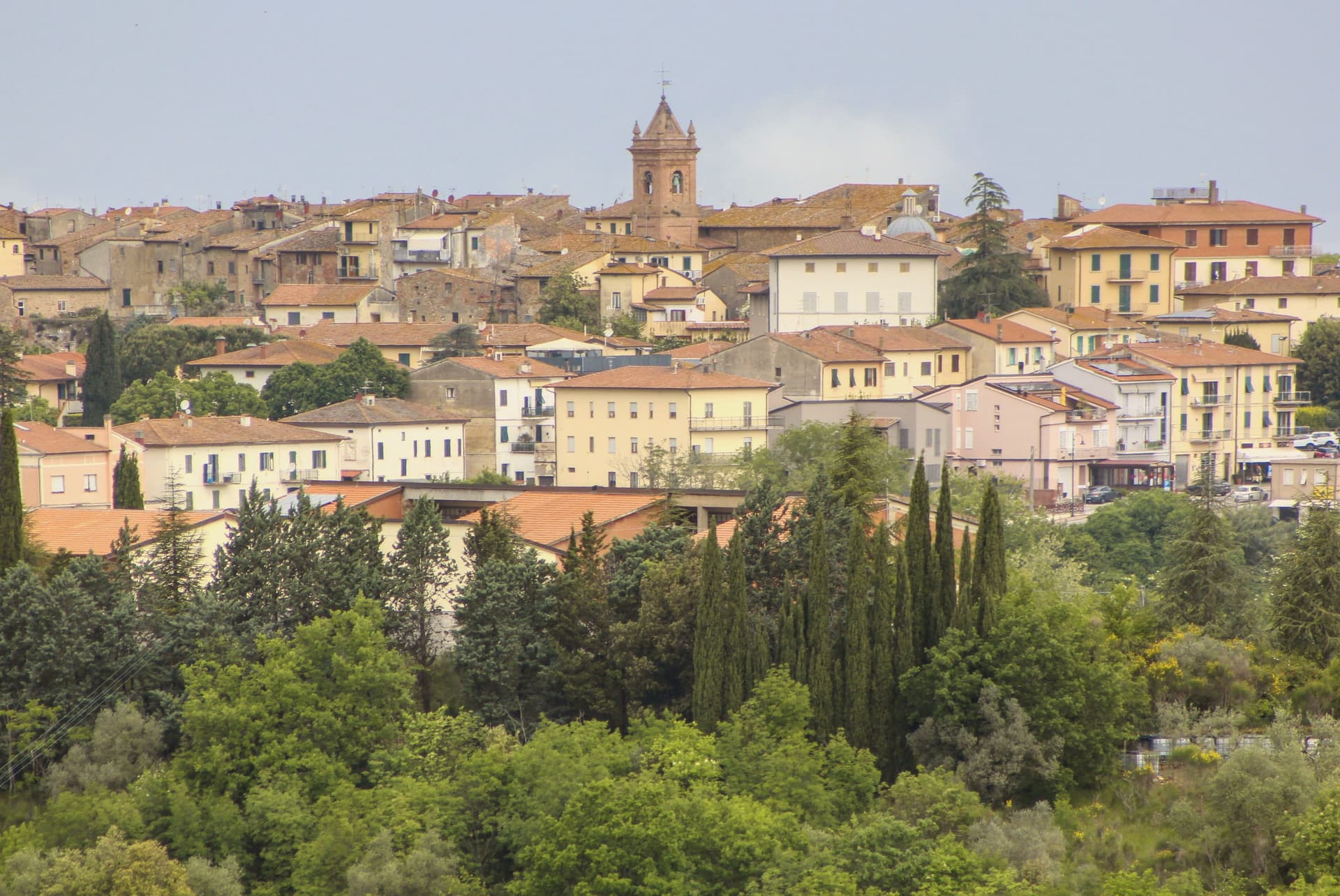
Montaione sits at 341 meters on a ridge above the Valdelsa, in the wooded hills west of Florence on the road toward Volterra. Etruscan and Roman finds at Poggio all'Aglione, Bellafonte and Iano confirm continuous occupation across the territory, material now held in the town's archaeological museum.
The medieval castello was the seat of an autonomous comune from 1256 and passed to Florence in 1369. From the early fourteenth century, glassmaking ran in the surrounding woods, and an eighteenth-century decree by the Grand Duke required master glassmakers to teach the craft to their fellow citizens.
The town joined Borghi più belli in 2007. The territory spreads well beyond the ridge itself.
Five kilometers west, a Franciscan convent founded in 1500 stands in the woods, its chapels laid out as a walkable replica of Jerusalem's holy sites. Ten kilometers south, Castelfalfi carries a separate, older Lombard origin, now a resort with its own vineyards and church.
Between them, the centro storico keeps the civic core: the tower, the palace, the parish church rebuilt on twelfth-century foundations. The comune, in effect, holds three distinct centuries of settlement at once: an ancient scatter of finds, a fourteenth-century craft economy, and a devotional complex from the 1500s, spread across ridge, castle and wood rather than gathered in one place.
What to see in Montaione
- Sacro Monte di San Vivaldo. Complex five kilometers west of the borgo. Seventeen chapels stand among oak woods, each holding a scene built as part of the topographical replica, still reached on foot along the paths between them.
- Castelfalfi. Lombard-origin castle and frazione ten kilometers south, restored as a private resort with vineyards and a Romanesque church of San Floriano.
- Centro storico. Medieval grid on the ridge, with the Palazzo Pretorio, the Torre del Cassero and the Chiesa di San Regolo restored after 1118 foundations.
How to get to Montaione
Firenze is roughly 67 minutes away by road.
Our tip
April through June and September into October are the months Montaione shows best, the Valdelsa light low on the wooded ridges and the San Vivaldo chapels in their full October ochre. The Mostra del Tartufo Bianco runs the last weekend of October and the first of November. July and August push past thirty in the valley but the centro storico at 341 meters stays manageable.
Rapolano Terme
Why visit Rapolano Terme
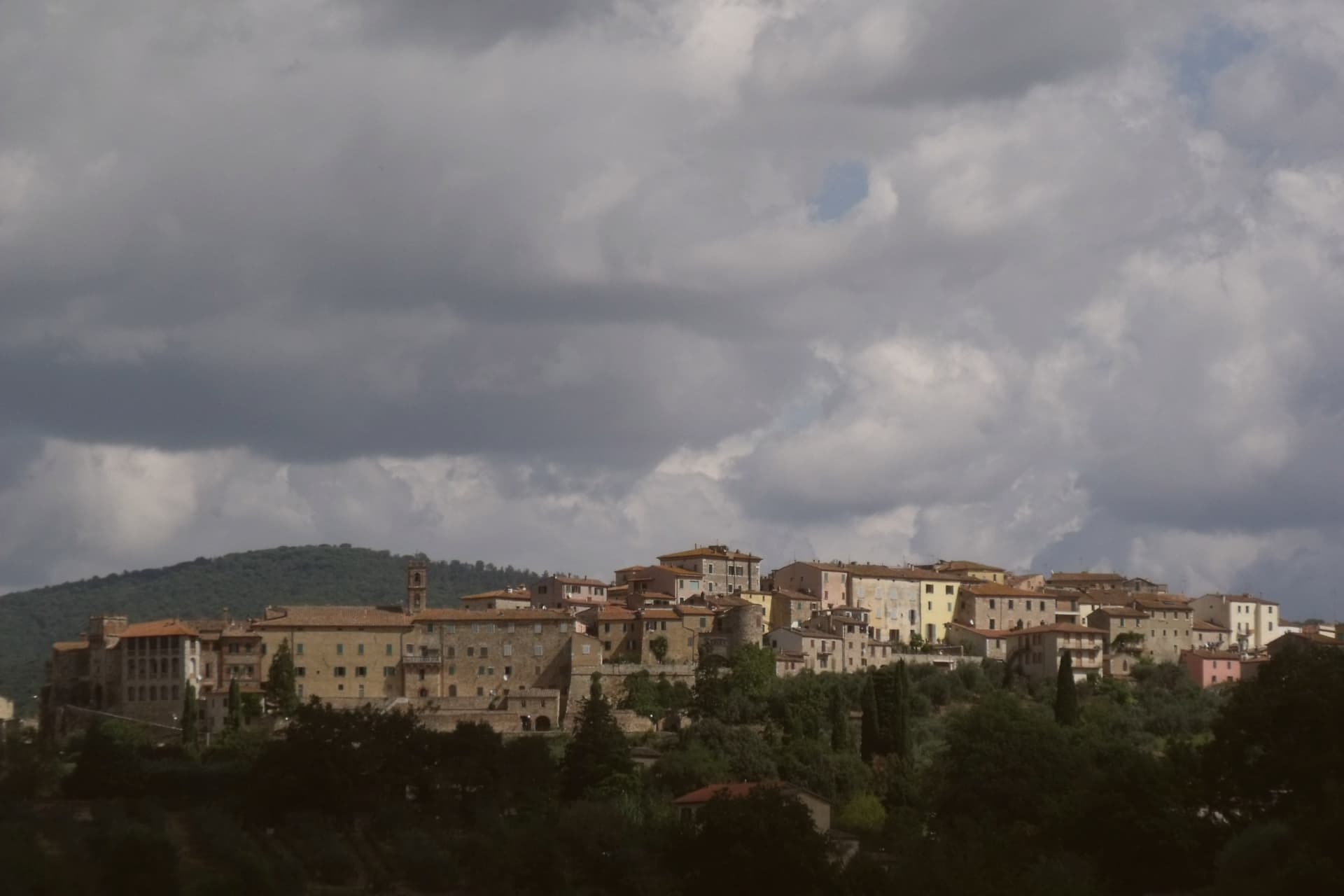
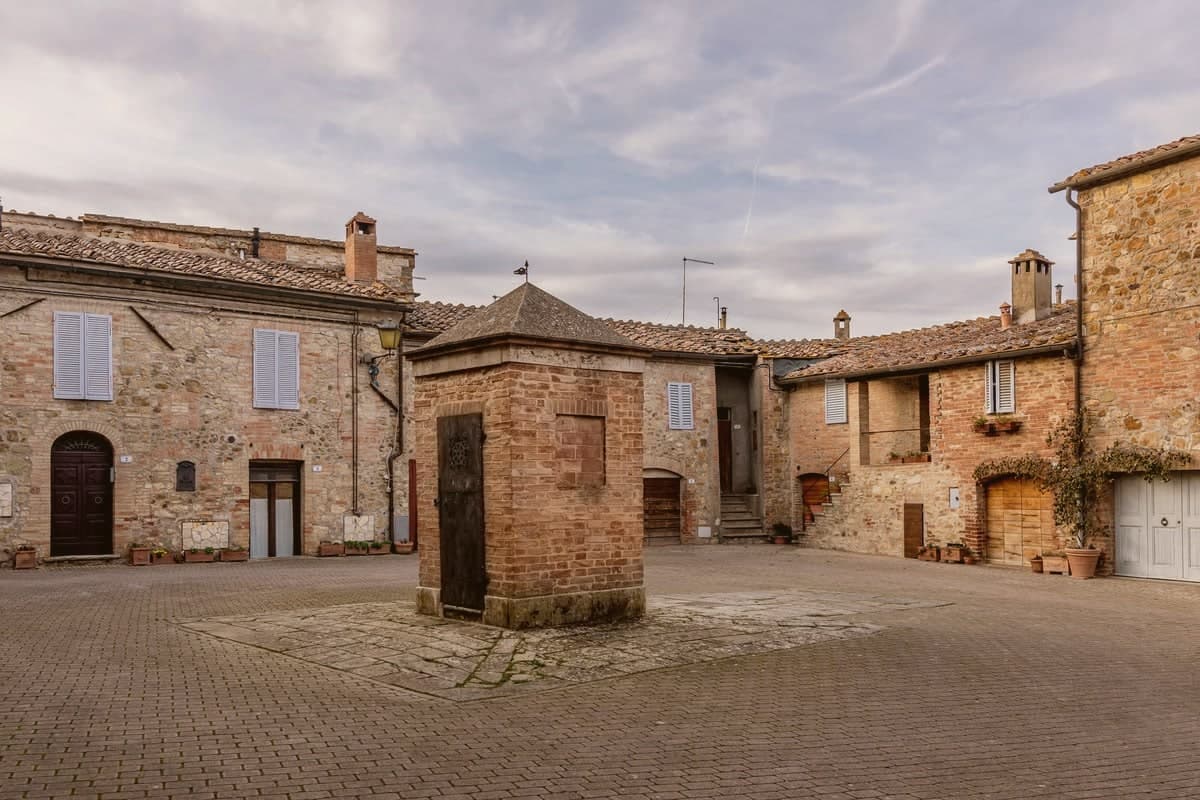
The comune sits at 334 meters on the eastern edge of the clay hills, twenty kilometers east of Siena. It was called simply Rapolano until 1949, when the spa industry pushed the name change, a shift that marks how thoroughly the waters came to define the place.
The thermal facilities and the quarry sit at some distance from each other within the comune: the springs rise near the centro and to its south, while the travertine beds lie in the Serre frazione three kilometers further out, a separate settlement built around the stone rather than the water. The medieval centro storico, meanwhile, holds no thermal or mineral history at all: a fortified perimeter, a Sienese-period castello on the highest point, and a parish church founded in the eleventh century, all predating the spa industry by centuries.
The clay-hill landscape spreads north and west of the comune, and draws most visitors past the spa itself. What emerges is a town built on two extractive industries, water and stone, wrapped around an older walled settlement that has little to do with either.
What to see in Rapolano Terme
- Terme Antica Querciolaia. Six outdoor pools at 38 degrees, the older of the two facilities and the one tied to a general's convalescence.
- Terme San Giovanni. Thermal complex south of the centro among the clay hills of the Crete Senesi, with outdoor pools facing vineyards and olive groves.
- Cave di travertino di Serre. Active quarries in the Serre di Rapolano frazione three kilometers south, the source of the stone behind the Pienza Duomo's façade.
How to get to Rapolano Terme
There is a railway station in the town, so you can arrive without a car and never need one while you are here. Perugia is roughly 63 minutes away by road.
Our tip
Thermal towns work year-round and Rapolano is the rare Sienese commune where winter is a season. The pools at Antica Querciolaia and San Giovanni stay open through the cold months and the steam off the 38-degree water against the December clay hills is the postcard the spa industry sells. April through June and September into October are the wider best months, with the Crete Senesi at full color and the surrounding wine and olive harvests pulling traffic through the centro.
Castelnuovo Berardenga
Why visit Castelnuovo Berardenga
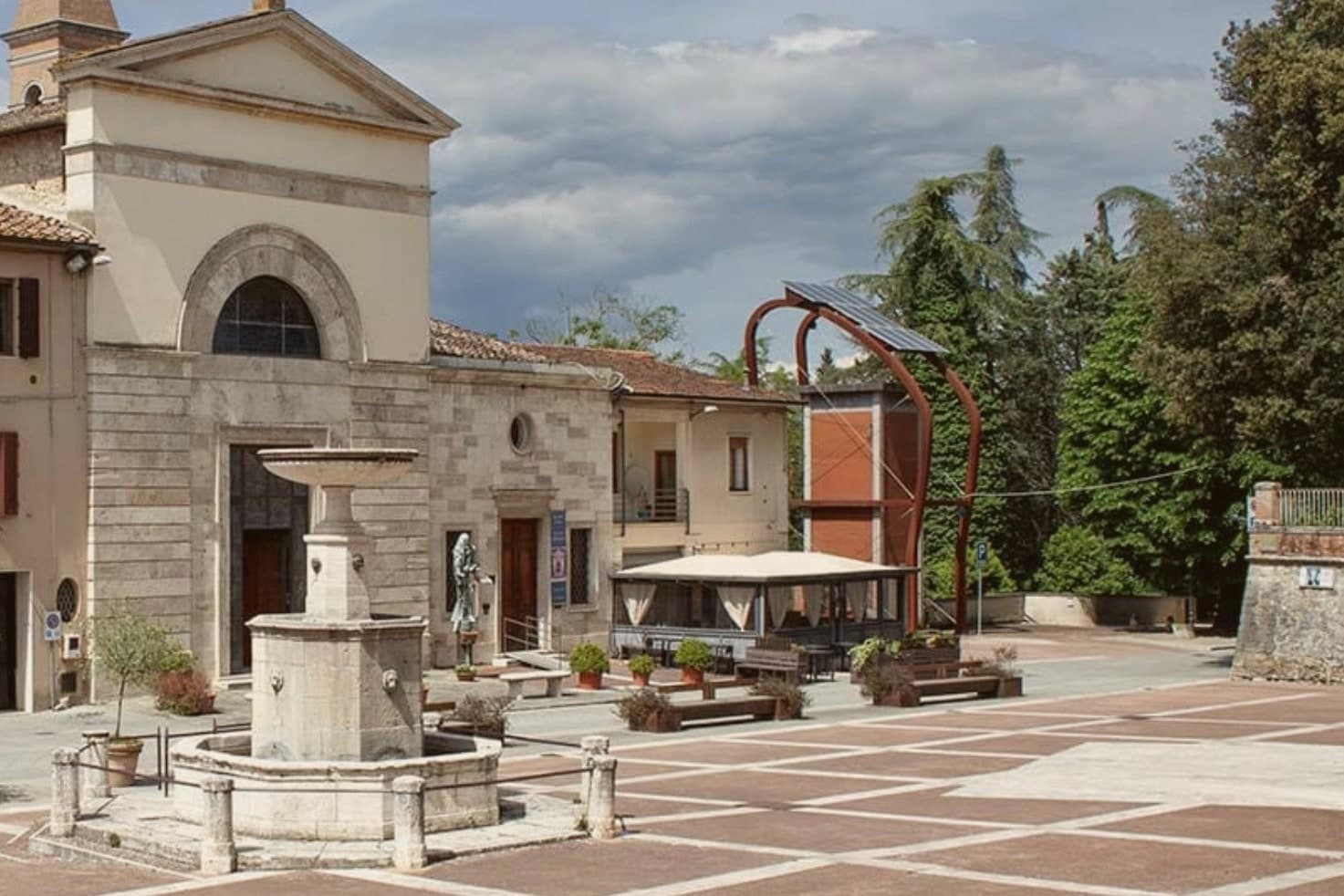
The commune sits east of Siena, where the hills give way to the clay swells of the Crete Senesi. The name comes from the Terra Berardinga, the area controlled in the tenth century by a Frankish nobleman named Berardo, and the borgo grew up around the castle walls the Sienese Republic raised against Florence.
The centro storico, the villa and gardens at its heart, and the surrounding zone of vineyards form one continuous pattern rather than separate parts: fortress town above, wine country falling away below it toward the clay hills. Across the wider territory, 13 castles, 70 churches and 200 farms record the medieval pattern of the Sienese contado, a scatter of small fortified points and parish churches administering land rather than one dominant center.
The place reads as a border post that outlived its military purpose and settled into agriculture and the arts, its castle now a clock tower, its noble villa now a music foundation, its walls now overlooking rows of Sangiovese.
What to see in Castelnuovo Berardenga
- Villa Chigi Saracini. Eighteenth-century villa and Italian garden inside the centro storico, its park designed by the Sienese composer Guido Chigi Saracini, whose family foundation still runs the Accademia Musicale Chigiana in Siena.
- Torre dell'Orologio. Surviving tower of the fortress, now bearing the civic clock, the highest visible point of the centro storico.
- Chiesa dei Santi Giusto e Clemente. Eighteenth-century parish church with a neoclassical façade, built on the site of an earlier Romanesque pieve.
How to get to Castelnuovo Berardenga
There is a railway station in the town, so you can arrive without a car and never need one while you are here. Firenze is roughly 77 minutes away by road.
Our tip
April through June and September into October are the months Chianti Classico shows best, the green hills moving toward the gold of harvest. The Sagra del Vino runs the second weekend of September. July and August push past thirty and the centro storico empties between two and six; the cellars on the surrounding hills offer cool tastings and longer rentals.
Montepulciano
Why visit Montepulciano
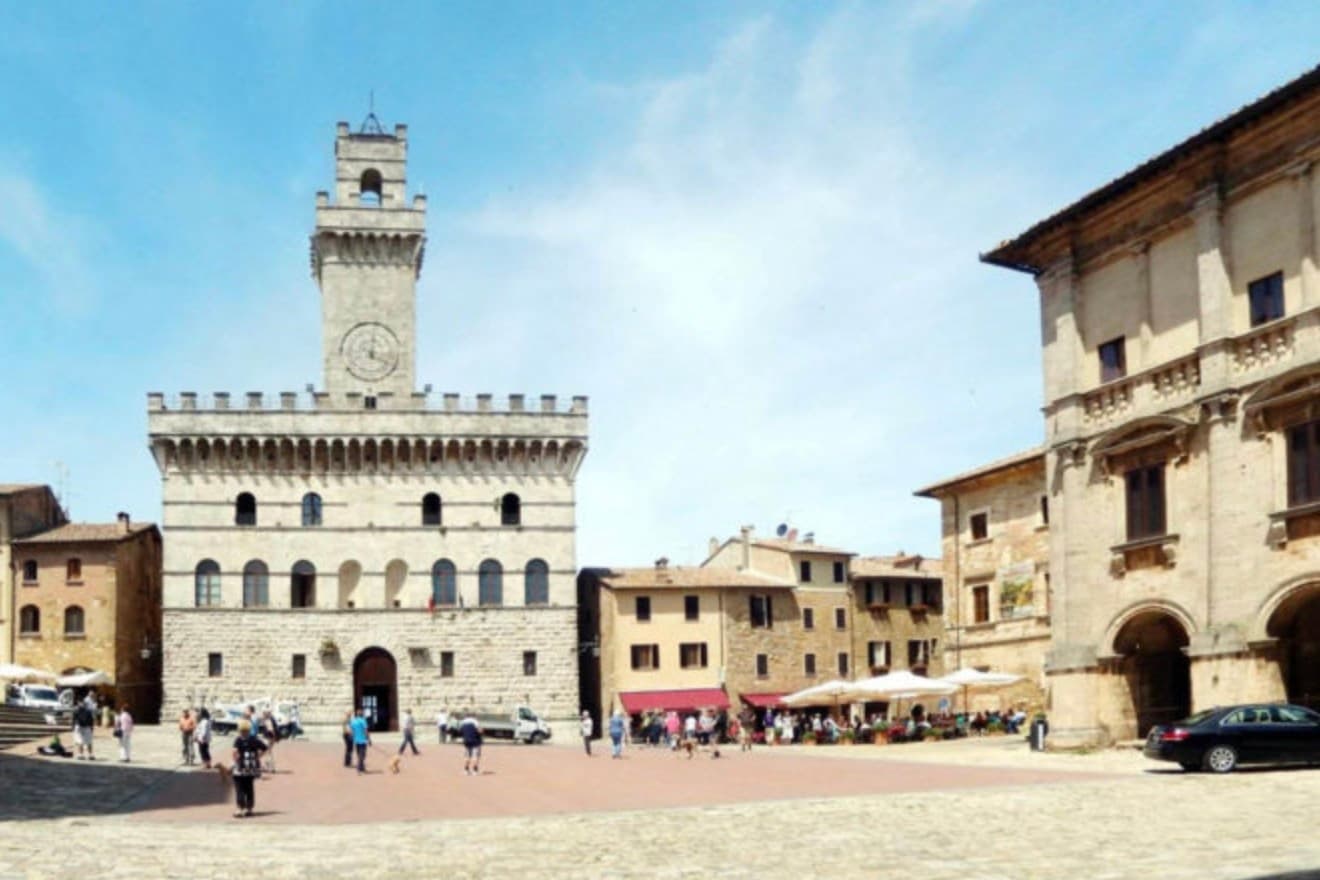
The ridge runs between the Val di Chiana and the Val d'Orcia, 70 kilometers southeast of Siena, and the town follows its spine uphill: streets climb from the gates toward the high point, where the main square sits ringed by the buildings that define the skyline from below. The origin predates the Renaissance fabric by centuries.
Etruscan tombs survive in the surrounding hills, though almost nothing of that period shows in the centro storico itself, which was rebuilt wholesale in the fifteenth and sixteenth centuries over whatever came before. The wine and the festival both use the climb as their setting rather than their subject: the cellars are cut into the rock beneath the palazzi, keeping a constant temperature for aging, and the barrel race each August sends two men from each of the eight contrade hauling an eighty-kilogram cask up the same gradient that every visitor covers on foot, only slower.
The steepness that shaped the defensive site nine centuries ago is still what a person feels first, in the legs, before the buildings register at all.
What to see in Montepulciano
- Tempio di San Biagio. A 13-meter dome and travertine façade standing alone outside the walls, the ground falling away below it so the building reads as a single volume against the hillside.
- Piazza Grande. The high piazza at the top of the ridge, ringed by the Duomo, the Palazzo Comunale and the Palazzo Tarugi, all rebuilt in the fifteenth and sixteenth centuries.
- Palazzo Comunale. Town hall designed by Michelozzo in the fifteenth century, its tower offering a view over the Val di Chiana and Val d'Orcia.
How to get to Montepulciano
There is a railway station in the town, so you can arrive without a car and never need one while you are here. Perugia is roughly 57 minutes away by road.
✷ We have written about Montepulciano
“Now, the postcard itself, the towns, and here I have less to say than you would expect, because Pienza and Montepulciano have become, and I mean this precisely, the canteens of a theme park. They are where you go to park, walk a pretty street, use the toilet, refill the water, eat a plate of something, and buy a thing to take home. They are the food court between the rides.”
Read our piece on Montepulciano →Val d'Orcia | The Postcard Is Constructed
Our tip
April through June and September into October are the working months on the ridge: vine work in the surrounding hills, mild days, evening light that lingers over the Val d'Orcia. July and August push into the low thirties and the climb to Piazza Grande slows even the residents. The Bravìo delle Botti runs the last Sunday of August and fills the town. Calici di Stelle falls in July.
Montecatini-Terme
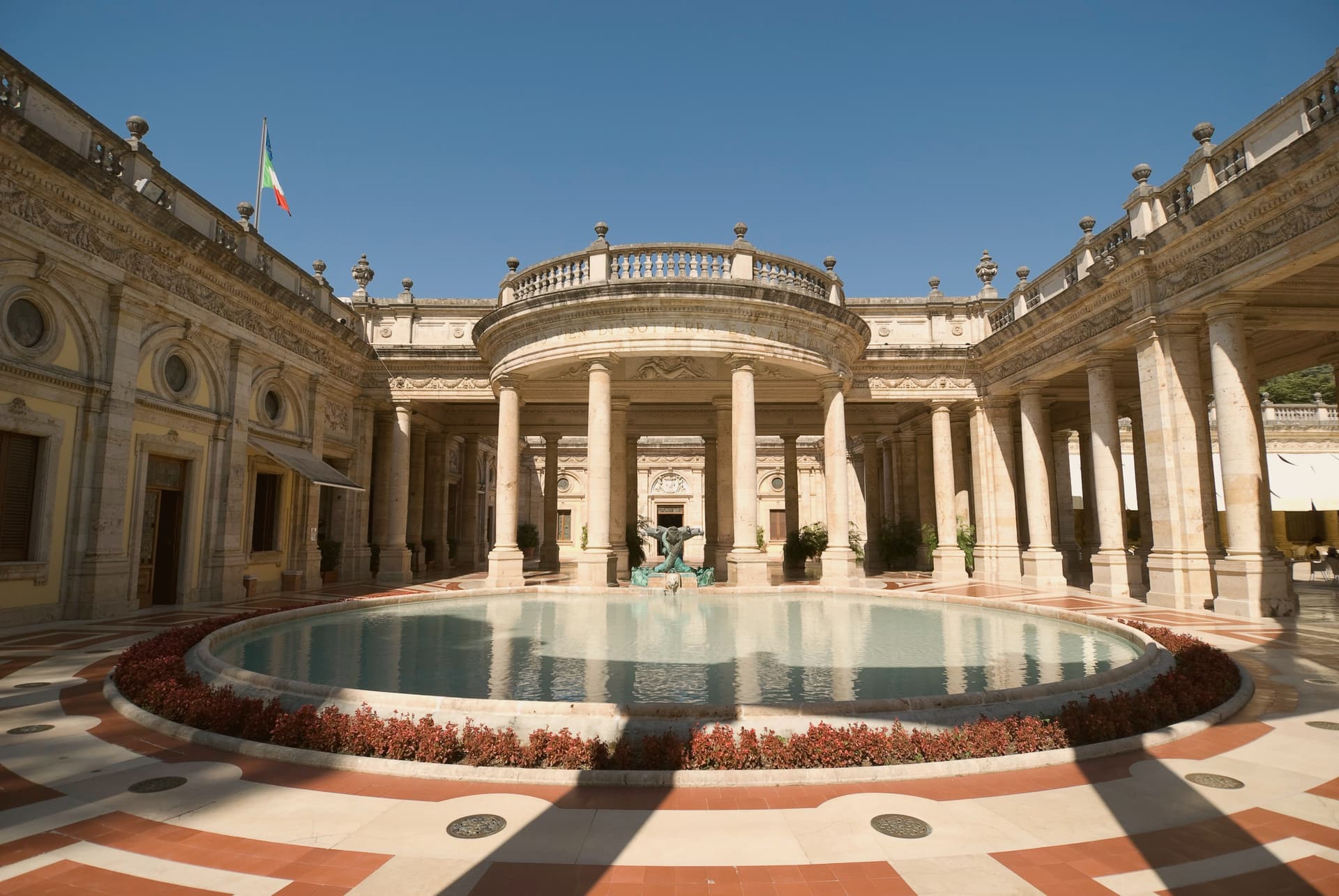
Why visit Montecatini-Terme
The spa town sits at 27 meters in the Valdinievole, forty kilometers west of Florence, at the foot of the hills that hold its older twin on the height above. That older settlement predates the town below it: the springs were exploited later, and the modern spa grew up on the flat ground beneath the hill village rather than around it.
The two remain connected by the red funicular, so a visitor moves between them in minutes rather than by road. Each of the four named waters treats a different complaint, drawn from the same eleven springs but separated by mineral content once they reach the surface.
The Thermal Park gathers the pavilions that were built to house this water cure, Liberty and neo-Renaissance architecture arranged as a single walled enclave rather than scattered through the town. In 2021 the UNESCO listing grouped the town with other spa towns built for the same purpose, Bath, Vichy, Baden-Baden and Karlovy Vary among them, recognition of a model of spa town that produced this particular layout: springs, park, pavilions, and a hill town kept deliberately apart from the cure below.
What to see in Montecatini-Terme
- Terme Tettuccio. The most famous of the thermal establishments, designed by Ugo Giovannozzi, with Liberty interiors built on the concept of the Roman baths.
- Parco Termale. Walled thermal park holding the major spa pavilions, laid out around the eleven springs that surface in the lower town.
- Funicolare di Montecatini. The two red cars carry passengers up the hill on rails laid in 1898, the ride lasting eight and a half minutes.
How to get to Montecatini-Terme
There is a railway station in the town, so you can arrive without a car and never need one while you are here. Prato is roughly 31 minutes away by road.
✷ We have written about Montecatini-Terme
“I grew up around water that smells. In Budapest, you do not think of this as a flaw. The thermal water comes up out of the ground carrying its minerals with it, iron and sulfur, and whatever else the limestone has been holding for ten thousand years, and it announces itself before you see it.”
Read our piece on Montecatini-Terme →Montecatini Terme | The Bath Without People
Our tip
The thermal park works as a year-round destination, but the seasons feel different. April through June and September through October are the comfortable months: pavilions open, hotels staffed, walking the park or the funicular pleasant. July and August are hot in the Valdinievole and busy with package tourism.
San Giuliano Terme
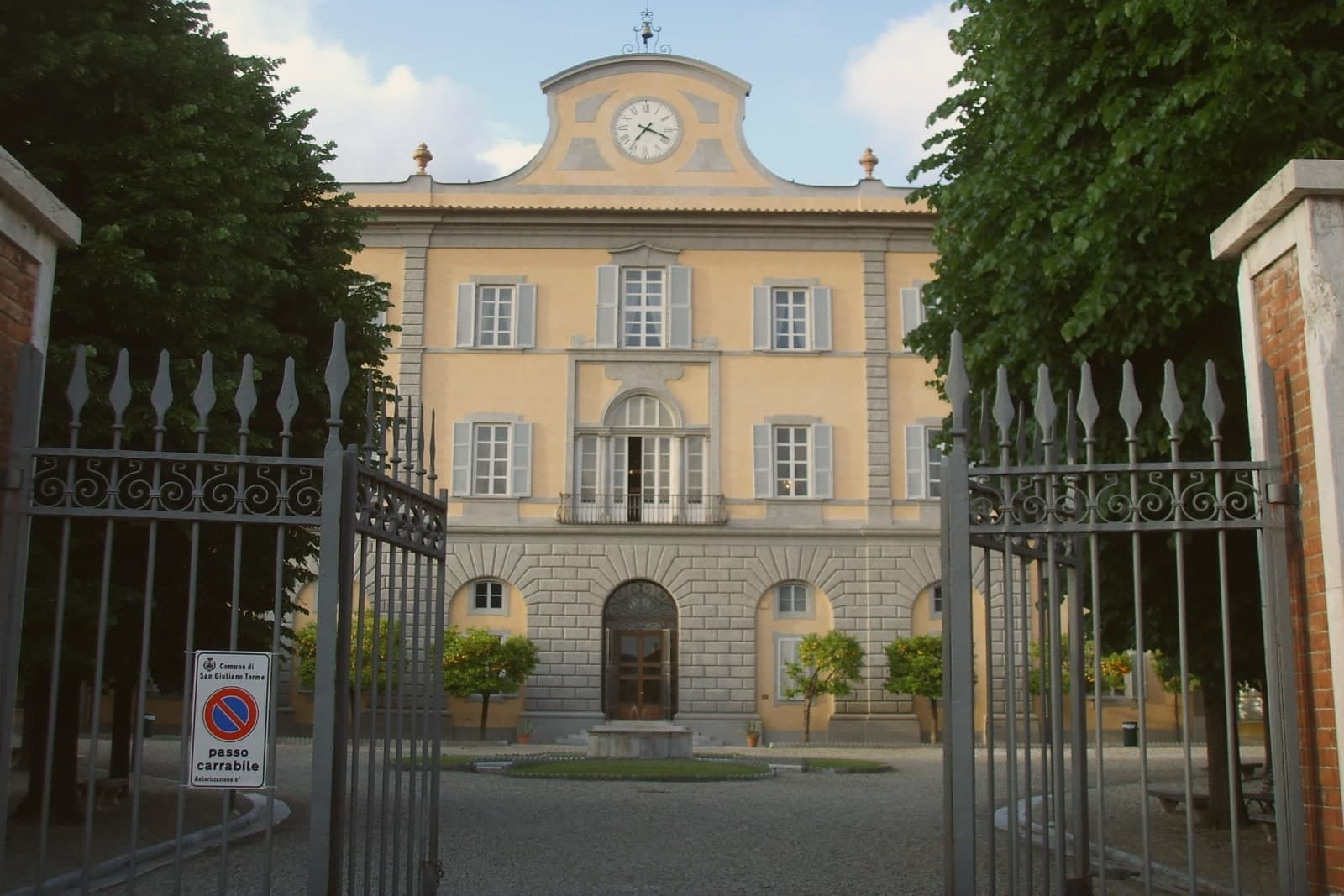
Why visit San Giuliano Terme
San Giuliano Terme sits at 10 meters at the southern foot of Monte Pisano, ten kilometers north of Pisa. The name Aquae Pisanae was the ancient one for the springs that rise here, and the town's own name records the later dedication to San Giuliano rather than to Pisa, though the waters remain tied to the city below by the aqueduct that still carries them there.
The frazioni climb the slope of Monte Pisano itself, olive groves stepping up the lower ground while the plain beneath opens into the pine forests and dunes of the Parco di Migliarino-San Rossore-Massaciuccoli, so the comune runs in one line from mountain ridge to coastal flat with the spa town fixed at the hinge between them. What holds the place together is water moving downhill: from the spring, through the baths where the waters were taken, along the arches to Pisa, and out across the plain toward the sea.
What to see in San Giuliano Terme
- Bagni di Pisa. The restored complex occupies the eighteenth-century Lorena baths, its rooms the ones where Byron, Shelley and Leopardi lodged while taking the waters.
- Acquedotto Mediceo. The line of arches runs from the springs of Asciano down to Pisa, parallel to the modern road, still legible as a single continuous structure across the plain.
- Monte Pisano. The granite ridge above the town, with olive groves on the lower slopes and trails leading to Rocca della Verruca.
How to get to San Giuliano Terme
There is a railway station in the town, so you can arrive without a car and never need one while you are here. Pisa is roughly 8 minutes away by road.
✷ We have written about San Giuliano Terme
“By the sea, cold hits differently. When that flat grey sky arrives, it means two things in our house: a big pot of bollito, and a thermal bath. The problem is finding one, the whole apparatus, multiple pools, the salt pool, sauna, steam room, mud, the entire game. For us, that means San Giuliano Terme, at the foot of Monte Pisano, and the Bagni di Pisa.”
Read our piece on San Giuliano Terme →Bagni di Pisa | The Tuesday Cure
Our tip
The thermal town runs year-round. Winter is the original spa season, with the warm pools welcome against the cold air off the Monte Pisano. April through June and September into October are the dry mild months for combining a spa stay with walks on Monte Pisano and the Parco di San Rossore. Sagra del Pesce falls in the season.
Livorno
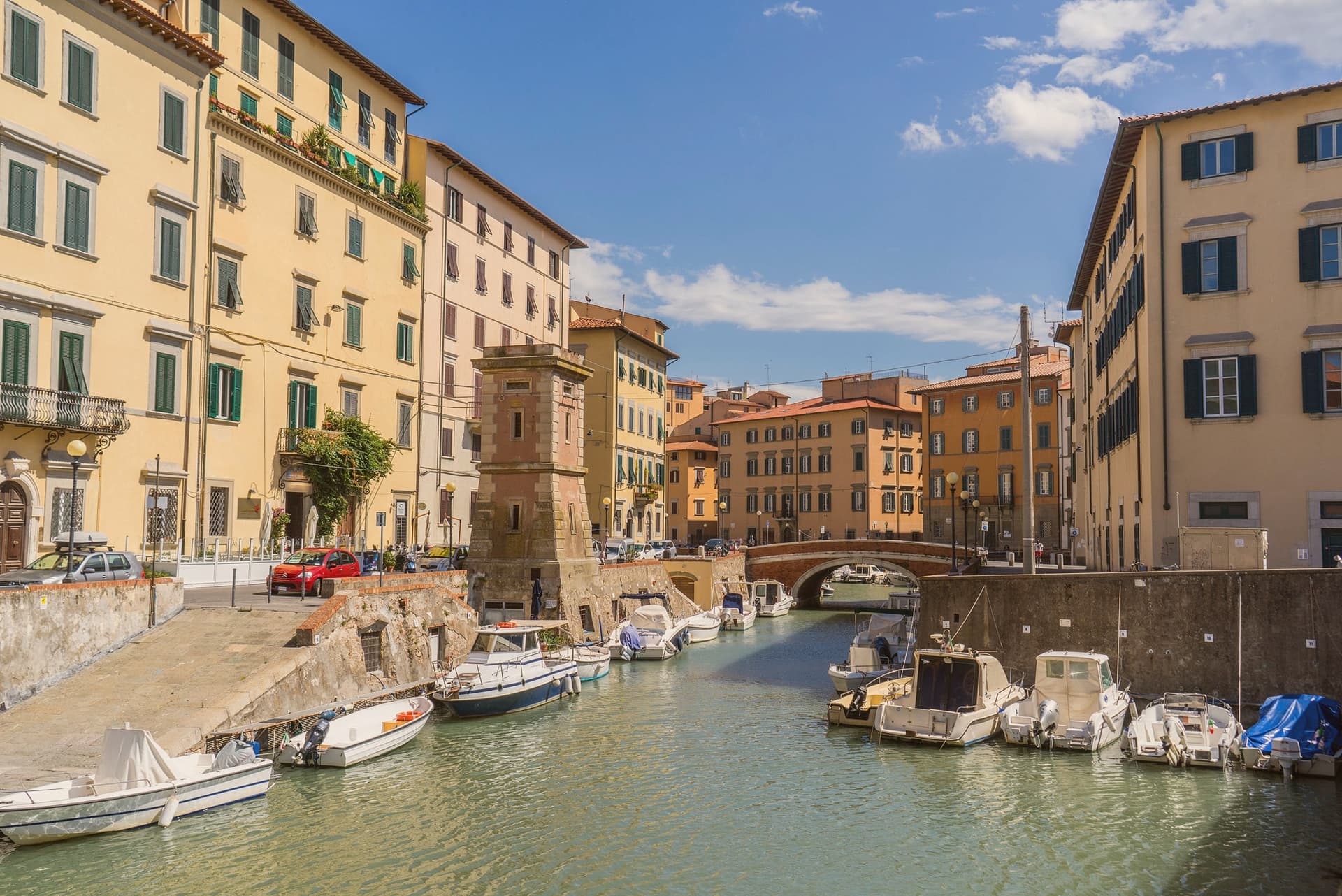
Why visit Livorno
Livorno is the Tuscan coast you don't expect: Medici-founded in 1577 as Nova Civitas, planned from scratch by Bernardo Buontalenti as a free port to rival Genoa and Venice, and unique among Tuscan cities for being entirely a Renaissance-era invention rather than a medieval inheritance. The original pentagonal city walls enclosed a Venetian-style quarter (Venezia Nuova) laced with navigable canals where merchant warehouses opened directly to the water — Jews, Greeks, Armenians, English, Dutch and North Africans were all invited to settle under the 1591–1593 'Livornine' laws granting freedom of worship and trade, making Livorno the most cosmopolitan port on the Mediterranean for two centuries.
What you see today: Fortezza Vecchia (1521) and Fortezza Nuova (1590) guarding the inner harbour; the four bronze Moors (1626) chained to the base of Ferdinando I's monument facing the port; the Terrazza Mascagni (a 1925 Art Deco chequerboard promenade with 4,100 black-and-white tiles facing the Tyrrhenian); the Cattedrale rebuilt after 1944 bombing; the Pentagono di Buontalenti street grid still visible from above. The Macchiaioli painters' movement was born here in the 1860s (Fattori, Lega, Signorini all lived and painted the local light).
Modigliani was born in Livorno in 1884. And the food: cacciucco — a 5-fish stew with toasted bread and red wine, the city's totemic dish — plus ponce alla livornese (rum-spiked coffee) at the Caffè Civili.
The Tuscan archipelago (Capraia, Gorgona, Elba) ferries out from the port within view of the promenade.
What to see in Livorno
- Terrazza Mascagni. A 1925 Art Deco seafront promenade with 4,100 black-and-white tiles facing the open Tyrrhenian — locals call it the world's most beautiful balcony, especially at sunset.
- Venezia Nuova quarter. The Medici-planned canal district from 1629. Walkable bridges, warehouse-doors-on-water, and the Effetto Venezia summer festival turn it into Tuscany's Venice.
- Quattro Mori (Monumento dei Quattro Mori). Pietro Tacca's four bronze Moors (1626) chained to the base of Grand Duke Ferdinando I's statue facing the port. Livorno's civic icon.
How to get to Livorno
There is a railway station in the town, so you can arrive without a car and never need one while you are here. Livorno is roughly 11 minutes away by road.
✷ We have written about Livorno
“I lived in Naples for weeks once, and those days remain among the best I have had, and the people there are among the finest I have met anywhere in this country, and I love the place without reservation. Naples is the same love story as Livorno.”
Read our piece on Livorno →Livorno | The City With No Time For You
Our tip
Livorno is a true year-round port city, but the sweet spot is April–June and September–October. May and June have the warm Tyrrhenian light, the Effetto Venezia festival (last week of July) brings the canal quarter alive at night, and September is still beach-warm without the crowds. July and August get hot and the port traffic peaks. Effetto Venezia falls in July.
More from Anywhere Italy
- The best hot-spring towns within 75 minutes of Pisa
- The best hot-spring towns within 75 minutes of Siena
- The best hidden hot spring towns you can reach by train in Toscana
 The best hot-spring towns within 90 minutes of Perugia
 The best hidden wine towns you can reach by train in the province of Siena
 The best towns you can reach by train in the province of Siena