
Coastal towns
Coastal towns in Tuscany
17 towns
Towns on the sea. A cliff town high above the water counts here rather than under mountains, because the sea is why you would go.
The towns
- Written about. No. 47.
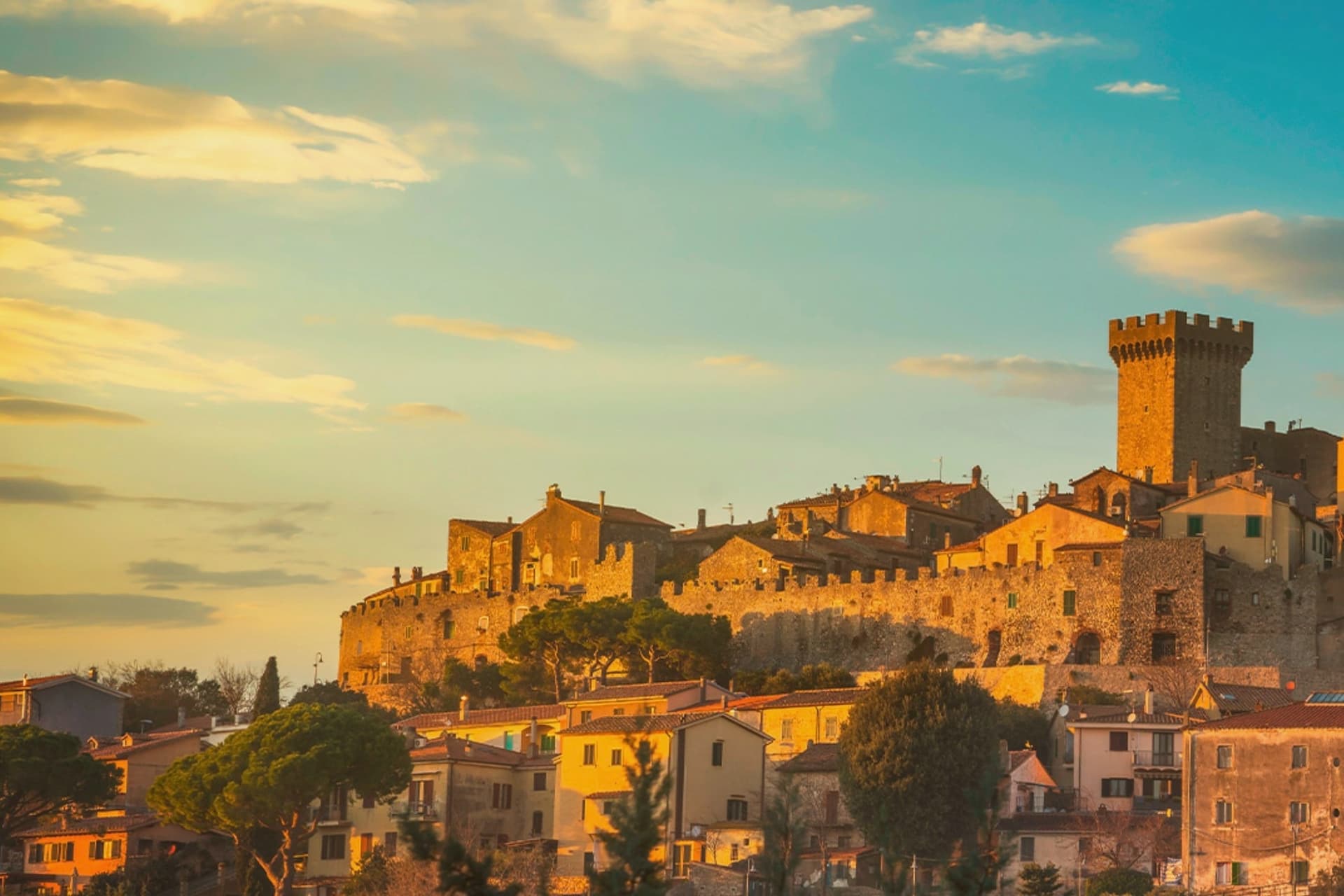
Capalbio
Province: Grosseto · 217 m
A walled hilltop borgo at 217 meters in the southern Maremma, donated to the Abbey of Tre Fontane by Charlemagne.
- Written about. No. 37.
Castagneto Carducci
Province: Livorno · 194 m
A hilltop borgo at 194 meters above the Costa degli Etruschi, renamed for the poet Carducci in 1907 and the home of Bolgheri and Sassicaia.
Capoliveri
Province: Livorno · 167 m
A medieval hill town at 167 meters on the eastern lobe of Elba, with 35 kilometers of coast below.
Montignoso
Province: Massa-Carrara · 132 m
A Riviera Apuana commune split between the Cinquale coastal frazione, the Castello Aghinolfi on the hill, and the Lago di Porta wetland on the Versilia plain.
Bibbona
Province: Livorno · 85 m
An Etruscan-origin hill village above the Costa degli Etruschi, with a Romanesque parish church and a Lorraine-built coastal fort eight kilometers down the road at Marina di Bibbona.
- Written about. No. 6.
Carrara
Province: Massa-Carrara · 80 m
The marble town at the foot of the Apuan Alps, with over 650 quarry sites in the valleys above and the stone that built the Pantheon and the Pietà.
- Written about. No. 2.
Camaiore
Province: Lucca · 34 m
The Versilia commune that runs from the mountains to the sea, a Roman Campus Maior on the Via Francigena with a beach at its western end.
- Written about. No. 39.
Piombino
Province: Livorno · 21 m
A promontory port facing Elba across the channel, founded by refugees from Etruscan Populonia and now the Tuscan archipelago's ferry capital.
- Written about. No. 3.
Pietrasanta
Province: Lucca · 14 m
The marble-processing town under the Apuan Alps, worked by Michelangelo, Henry Moore, Joan Miró and Fernando Botero.
- Written about. No. 49.
Grosseto
Province: Grosseto · 10 m
The Maremma capital on the Ombrone river, ringed by hexagonal Medici walls of 1564 that now serve as the city's public park.
- Written about. No. 51.
Monte Argentario
Province: Grosseto · 5 m
A 635-meter peninsula tied to the mainland by three sand spits, ringed by Spanish forts and marked by Caravaggio's death in 1610.
- Written about. No. 48.
Castiglione della Pescaia
Province: Grosseto · 4 m
A Maremma seaside town under an Aragonese castle, with the Vetulonia necropolis behind it and Italo Calvino buried on the hill.
- Written about. No. 13.
Pisa
Province: Pisa · 4 m
Maritime republic on the Arno, twelve kilometers from the Ligurian Sea, with the leaning bell tower at the center of a single UNESCO-listed walled compound.
- Written about. No. 16.
Livorno
Province: Livorno · 3 m
Tuscany's working port and Medici-planned 'New City', a 16th-century planned town built on reclaimed coast, with a Venice-like canal quarter, the Quattro Mori monument, and a 1.5-km seafront promenade that locals call the world's most beautiful balcony.
- Written about. No. 52.
Orbetello
Province: Grosseto · 3 m
A town on a narrow isthmus at the center of its own lagoon, fortified by Spain in 1557.
- Written about. No. 5.
Forte dei Marmi
Province: Lucca · 2 m
The Versilia luxury beach built around an eighteenth-century marble-loading fort, with 99 bagni concessions and a Wednesday market that draws Milan.
- Written about. No. 4.
Viareggio
Province: Lucca · 2 m
The Versilia capital, a Carnival city on the Tuscan coast that turned into a Belle Époque resort when the railway arrived.
From elsewhere in Italy
Five more towns
Pieve di Teco
Province: Imperia
A planned market town founded in 1233 in the middle Arroscia valley, with porticoed Corso Ponzoni and one of the smallest theaters in Italy.
San Marco d'Alunzio
Province: Messina
A hilltop borgo at 540 meters in pink Aluntina marble, founded by the Greeks and later Robert Guiscard's first Sicilian base.
Arcevia
Province: Ancona
A hilltop borgo at 535 meters above the Misa and Nevola valleys, defended in the Middle Ages by a ring of nine satellite castles.
Lavagna
Province: Genova
The Tigullio town that gave its name to slate, and its counts to a line of popes.
Subiaco
Province: Roma
The Aniene valley town where Benedict spent three years in a cliff cave, and where Italy's first printed book appeared in 1465.