
The prettiest villages with a food festival in Umbria
Umbria eats according to what the season hands it. Autumn brings black truffle shaved over strangozzi, chestnuts roasting in braziers set out on the street, and new oil so green it stains the bread. The villages are built from the stone underneath them, pale limestone and travertine that goes gold in late afternoon, and the walls still trace the shape a medieval siege left behind. Winter brings pork, lentils from the high plains, and the long slow lunches that come with cold weather inland.
Most visitors to the region give their days to Assisi and to Perugia, and both earn the attention: the basilica frescoes, the Etruscan arch, the hill roads that arrive at a view of the whole valley. In high season the coach parks fill early and the main streets move at the pace of the group in front. Orvieto takes the overflow, and the cathedral facade is worth the queue, though the queue is real.
The same hills, the same oil and the same cellars carry on past those towns, into villages where the sagra is still organised by the people who grow the thing being celebrated. These are smaller places, with fewer beds and fewer visitors, where a festival means trestle tables in a piazza rather than a ticketed event. Come for the ingredient and stay for the village around it.
Of the 48 communes we have mapped in Umbria, 10 qualify as prettiest villages with a food festival: each has passed the national assessment of Italy's most beautiful villages, and each holds a recurring food festival built around one local ingredient. The smallest, Paciano, has 957 residents.
If you are still choosing, we have also written The prettiest villages with a food festival within 90 minutes of Perugia and The best hidden towns with a food festival in the province of Perugia.
Why visit Paciano
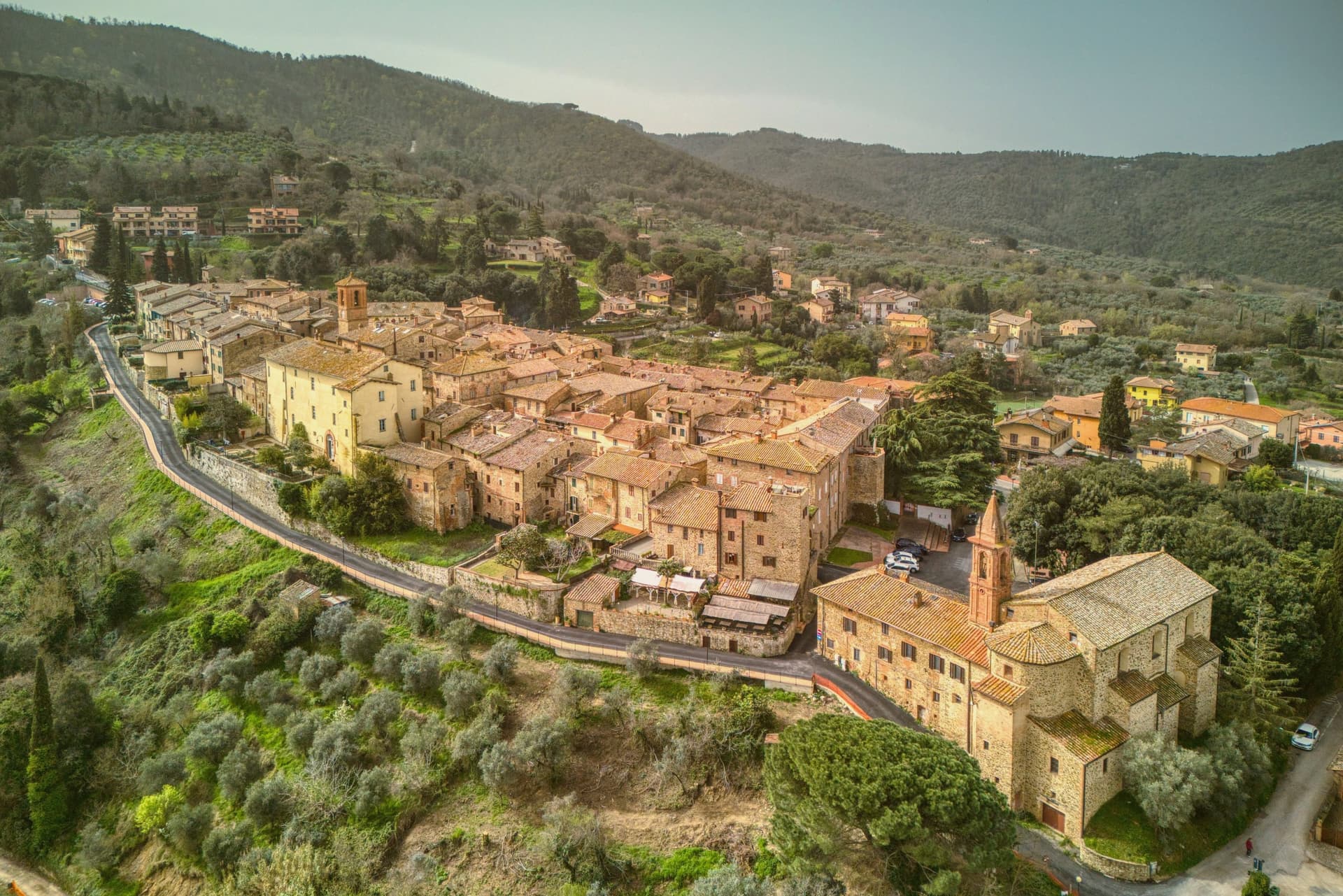
The town is first documented in 917, in an imperial charter of Berengar I, and appears again in 1260 as a castrum, a fortified site. Perugia rebuilt the walls and main tower between 1461 and 1473, using the site as a watch-post over the western approach to the lake below.
Inside the circuit, three parallel streets are linked by orthogonal alleys, a layout that carries the Renaissance palace with the Vignola staircase, the oldest noble residence in the town, and the 17th-century Palazzo Cennini, once the summer residence of a cardinal. The gates and towers sit at the edge of this grid, facing outward toward the water.
Olive oil from the slopes that drop toward the shore is the present-day specialty. What remains is a small fortified grid, built to watch a lake, that turned its military purpose into a domestic one once the watching was no longer needed.
What to see in Paciano
- Medieval walls. About 600 meters of circuit, with the three original gates named Fiorentina, Perugina and Rastrella still standing among the eight towers.
- Palazzo Baldeschi. Assembled from earlier tower houses, with a staircase attributed to Jacopo Barozzi da Vignola. Now used as an exhibition and cultural space.
- Rocca Buitoni. The oldest surviving palace in the town, built as a noble residence inside the walls, with a small private chapel.
How to get to Paciano
Perugia is roughly 44 minutes away by road.
Our tip
April through June and September into October are the months for Paciano. The slopes of Monte Petrarvella hold the wildflowers, Trasimeno is warm enough to swim from late May, and the olive groves run from green to silver-gold across the half-year. The Infiorata fills the three parallel streets each Corpus Domini in late May or June. Sagra dello Strozzaprete falls in August.
Why visit Sellano
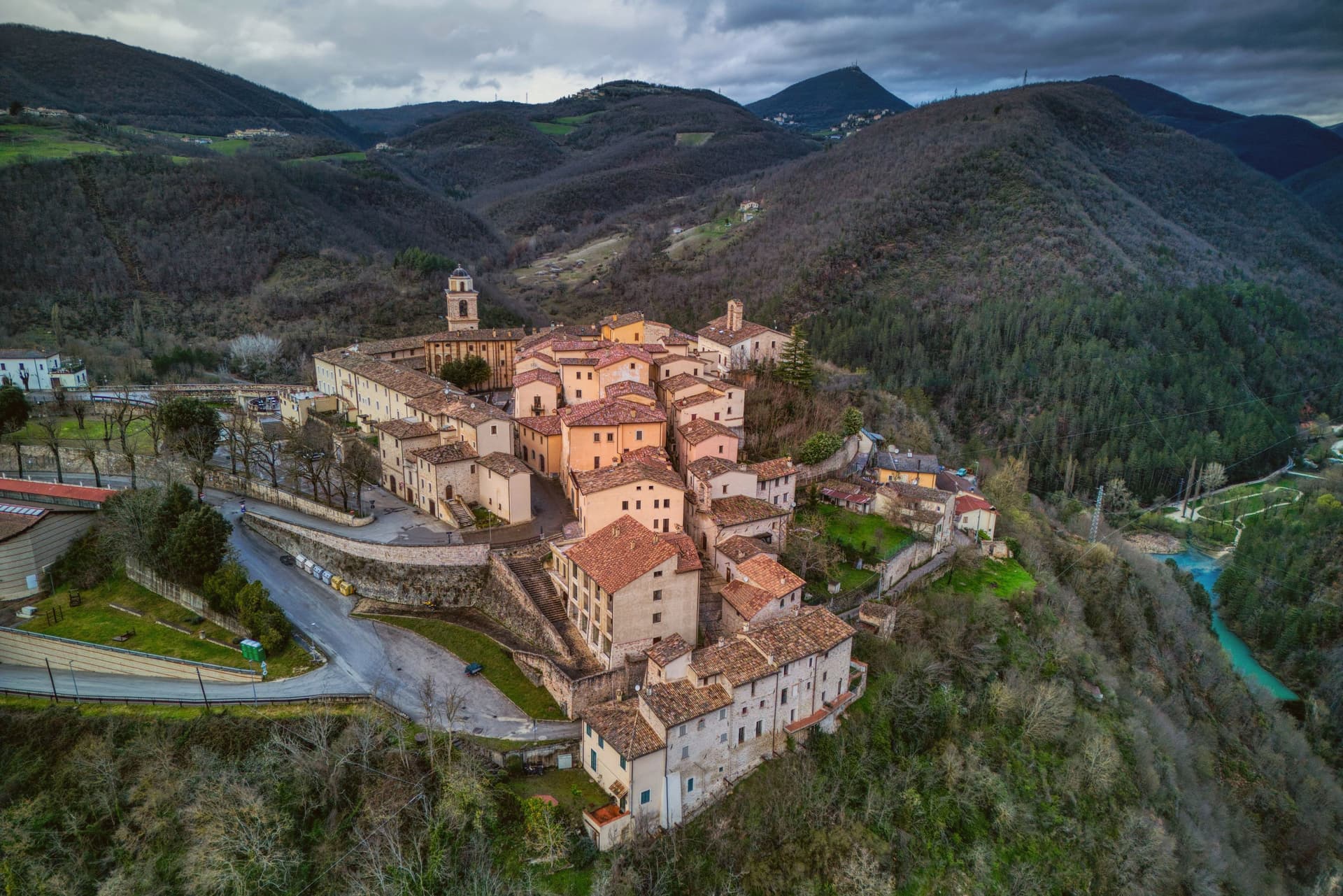
Sellano sits at 641 meters on the eastern edge of Umbria, looking over the Vigi stream toward the Marche border. The Vigi feeds the Nera; the valley is the upper Valnerina, one of the most isolated stretches of the Umbro-Marchigiano Apennines.
The 1979 and 1997 earthquakes hit the commune hard. The 1997 quake destroyed the sixteenth-century Palazzo dei Collicola at Montesanto and emptied most of the surrounding hamlets.
Reconstruction took two decades. In March 2024 a new structure opened: a 517-meter suspension footbridge across the Vigi gorge linking Sellano to the Castello di Montesanto, 175 meters above the valley floor, 1,023 steps, claimed as Europe's highest tibetan bridge alongside Portugal's Arouca 516.
Funded by NextAppennino, 1.6 million euros from PNRR earthquake-area development money. The bridge has become the visible decision of a small commune to bet its future on something other than waiting out emigration.
What to see in Sellano
- Ponte tibetano. 517-meter suspension footbridge opened March 2024, 175 meters above the Vigi gorge, 1,023 steps linking Sellano to Castello di Montesanto.
- Castello di Montesanto. Medieval fortress hamlet across the Vigi, depopulated after the 1997 earthquake, reachable on foot via the new bridge.
- Borgo medievale di Sellano. Compact walled centro storico looking east toward the Marche, partially rebuilt after the 1997 quake.
How to get to Sellano
Perugia is roughly 66 minutes away by road.
Our tip
May through October is the working season at 641 meters in the upper Valnerina. The new bridge runs full schedule, the trails along the Vigi gorge are open, and the temperature stays in the low twenties through summer afternoons. June and September are the best months for walking: long light, dry trail, late wildflowers. Sagra della Fojata e dell'Attorta falls in August.
Why visit Montecchio
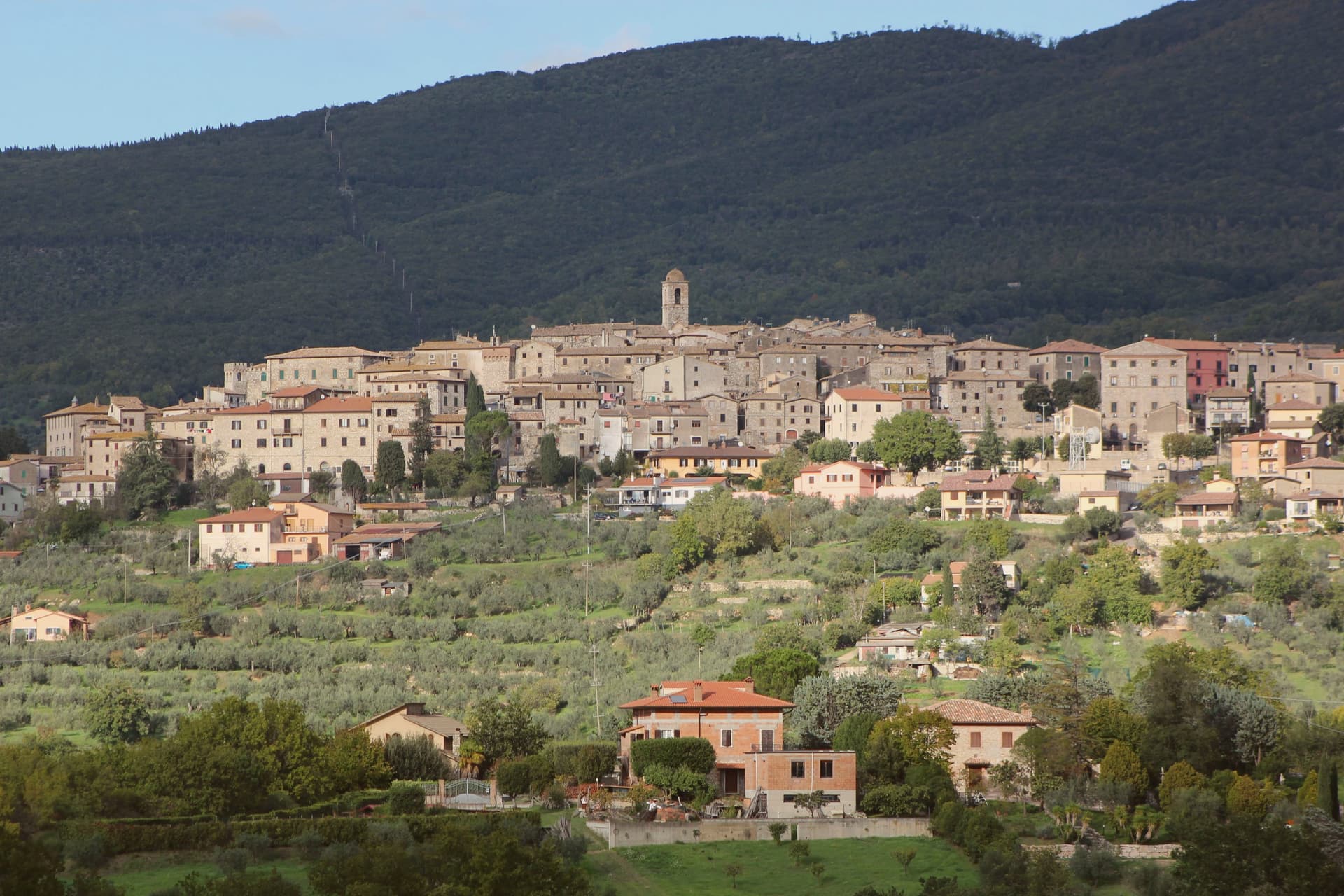
Montecchio sits at 377 meters on a ridge above the Tiber valley, fifty kilometers south of Perugia and thirty northwest of Terni. The territory was inhabited well before Rome: the Vallone di San Lorenzo, about five kilometers below the borgo, holds fifty chamber tombs carved into the soft calcarenite locally called matile, with strong ties to Etruscan Orvieto at its sixth-to-fifth-century BC peak.
The recovered artifacts, now in the Antiquarium of Tenaglie, document a wealthy pre-Roman community. The settlement of Montecchio is first documented in 1154; the castle was raised around 1165 by the Chiaravalle family and passed through the Alviano, Baschi, Colonna and Atti before becoming independent of Baschi in 1948.
Tenaglie, on the opposite ridge, is dominated by Palazzo Ancajani, built in the early 1700s on the foundations of an earlier fortification. The territory holds Borghi più belli, Città dell'Olio and Comuni Virtuosi standing together.
What to see in Montecchio
- Necropoli del Vallone di San Lorenzo. Pre-Roman necropolis 5 km below the borgo, 50 chamber tombs carved in matile rock with klinai-shaped benches, peak 6th-5th century BC.
- AMAT Antiquarium di Tenaglie. Archaeological museum in the Tenaglie frazione displaying the necropolis finds, with strong evidence of Etruscan Orvieto influence.
- Palazzo Ancajani (Tenaglie). Early 18th-century palace on a rocky ridge facing Montecchio, built by Filippo Ancajani over an earlier fortification.
How to get to Montecchio
Terni is roughly 57 minutes away by road.
Our tip
April through June and September into October are the months locals prefer. The necropolis trail through holm oak and juniper is at its best in spring, and the slopes above the Tiber stay golden into late autumn. July and August push temperatures past thirty-five degrees in the valley; the upper borgo holds the breeze and the tomb chambers stay cool year-round. Fiera della Castagna falls in the season.
Why visit Castiglione del Lago
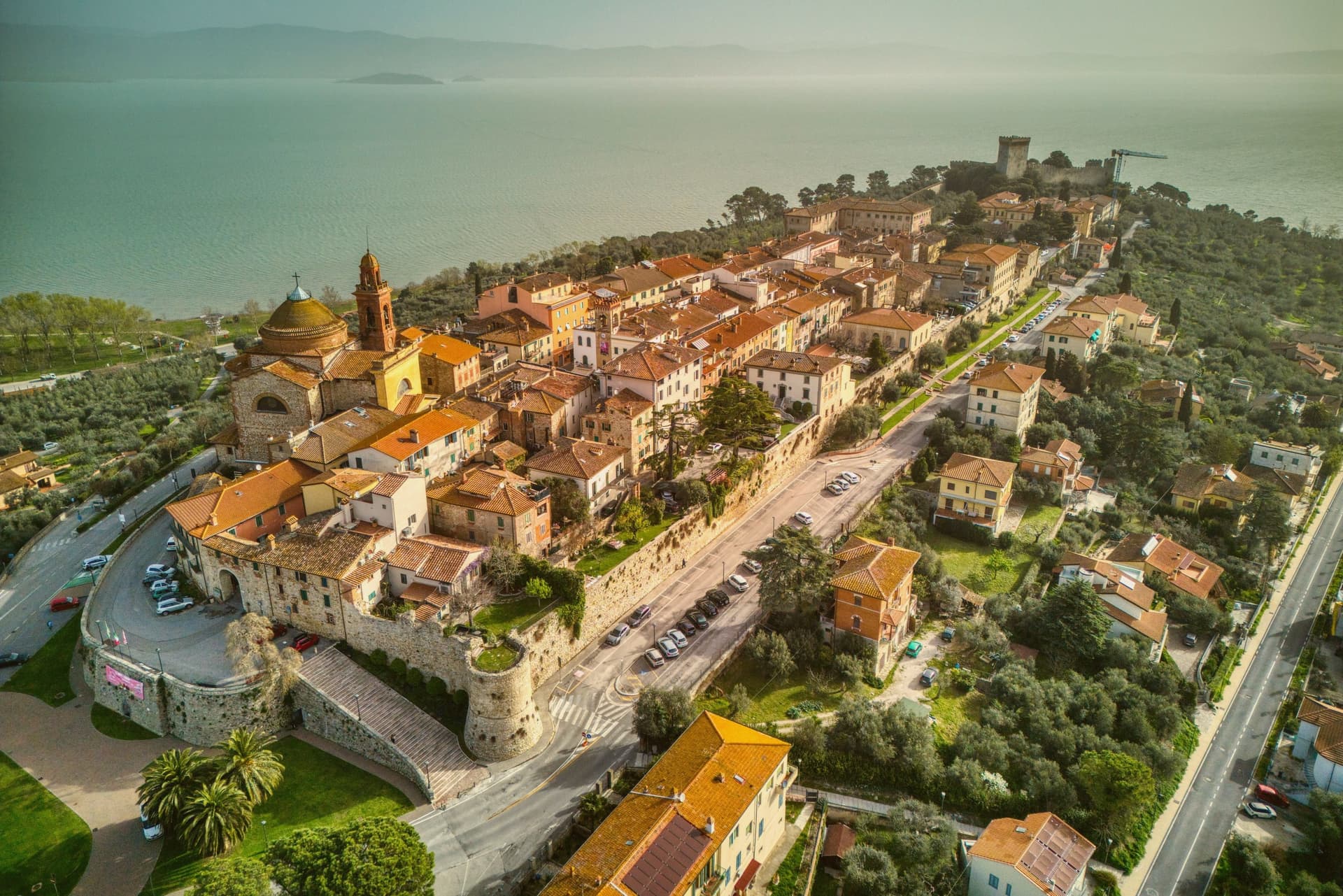
The town sits on a limestone promontory on the western shore of Lake Trasimeno, thirty kilometers from Perugia. That promontory was the fourth island of the lake in antiquity, before the strip of water separating it from the mainland silted in, which is why a place now solidly attached to shore still carries the memory of being an island in its layout and its name.
The fortress anchors the southern end of the centro storico, and a covered passage links it directly to the ducal palace: one museum complex, two buildings, four centuries apart, joined so that a visitor can pass from medieval military architecture into a Mannerist-frescoed residence without stepping outside. The town is the largest commune on the Trasimeno and the western base for the ferries out to the lake's islands, and it is the only one of the lake's shore towns to hold Borghi più belli status.
What this adds up to is a small center where fortification and courtly decoration sit back to back, and where the lake itself, its islands, its silted-in strait, its ferries, is never far from any single building.
What to see in Castiglione del Lago
- Palazzo della Corgna. Sixteenth-century ducal palace built for Ascanio della Corgna on a Baglioni structure, eight rooms frescoed by il Pomarancio between 1574 and 1590.
- Rocca del Leone. Pentagonal medieval fortress commissioned by Federico II di Svevia in 1247, linked to Palazzo della Corgna by a covered passageway.
- Chiesa di Santa Maria Maddalena. Parish church on the centro storico's main axis, bell tower rising to 329 meters above sea level over the lake.
How to get to Castiglione del Lago
There is a railway station in the town, so you can arrive without a car and never need one while you are here. Perugia is roughly 52 minutes away by road.
✷ We have written about Castiglione del Lago
“The lake is like a sanatorium compared to the sea. It’s relaxed. It’s calm. It’s silent. To find this level of almost disturbing quietness, you either go up into the mountains, or you really need to know your way around the sea to find that particular spot not overrun by vacationers and beach people. In Trasimeno, this is easy. Even the most popular towns like Castiglione or Passignano sit in quiet harmony with the stillness of the water.”
Read our piece on Castiglione del Lago →Lago Trasimeno | Never Compete with the Sea
Our tip
April through June and September into October are the months the Trasimeno shows best: the lake holds the light, the ferry to Isola Maggiore runs full schedule, and the lungolago at evening fills with locals and not yet with day-trippers. July and August push into the low thirties; the lake breeze helps, but weekends draw heavy traffic from Perugia and Florence. November through March is quiet. Stramaialata - Sagra del Mangiar Bene falls in August.
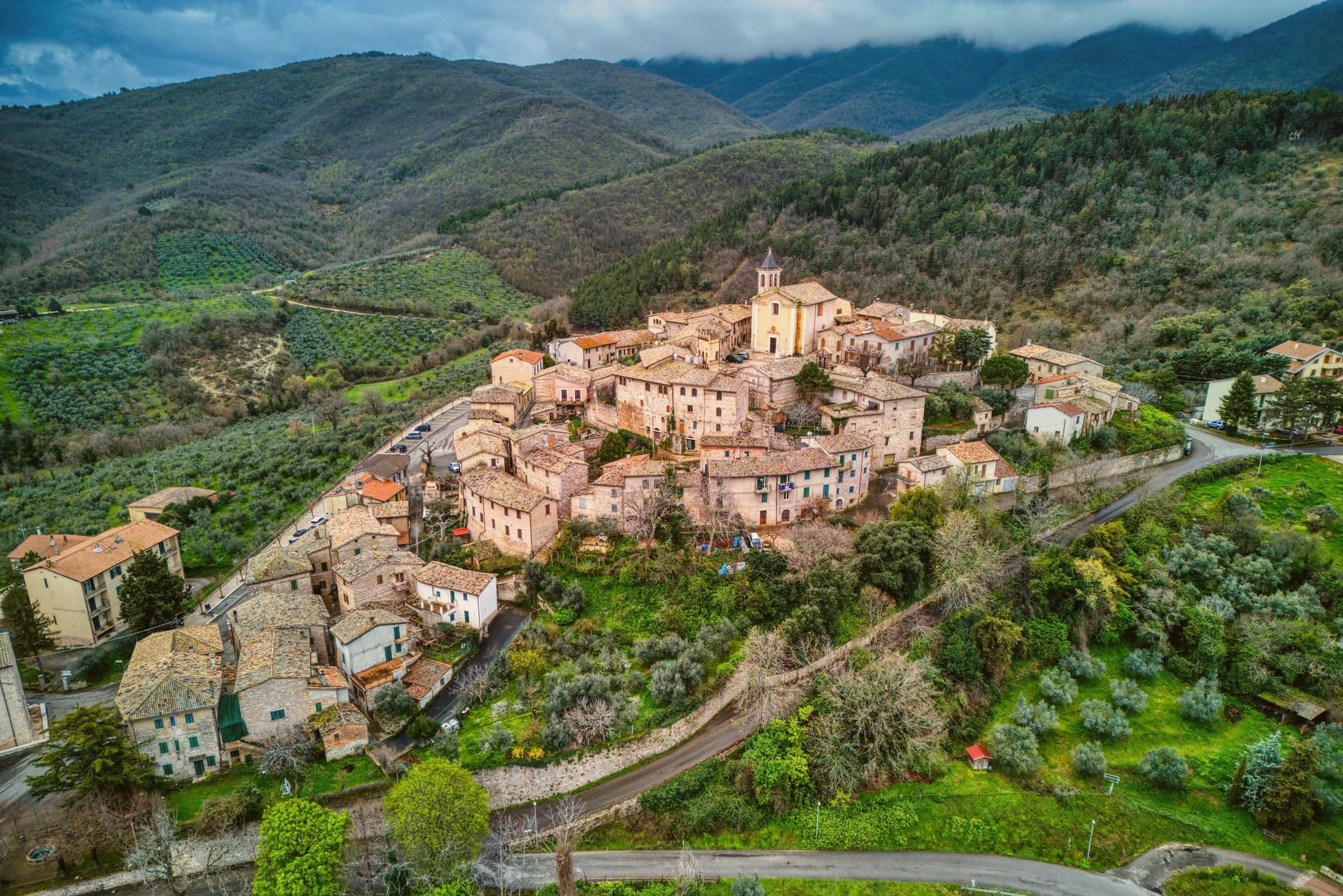
Why visit Giano dell'Umbria
Giano dell'Umbria sits at 547 meters on the eastern slope of a mountain range, inside the triangle between Foligno, Spoleto and Todi. The territory is dotted with small medieval castles, Montecchio and Morcicchia the most intact, and small Romanesque churches scattered between the olive groves.
The abbey stands just outside the walls of the capoluogo, while Montecchio, the castle, the frazione and the Antiquarium together, sits apart on its own ridge above Bastardo, closer to the Via Flaminia than to the main town. The commune is also the seat of the DOC Spoleto wine, with the Trebbiano Spoletino grape reborn here in the last decade, and the olive groves around Bastardo supply the Frantoi Aperti weekends every November.
Abbey, castle and grove read as three settlements on one slope: a religious center below the walls, a fortified outpost on the ridge, and an agricultural economy spread through the land between them.
What to see in Giano dell'Umbria
- Abbazia di San Felice. The crypt below the church is the part worth the stop, a Romanesque space set beneath the rebuilt monastery, holding the ground plan of the oratory that came before it.
- Castello di Montecchio. Fortified on the Monti Martani slope along the Via Flaminia, held by the lords of Giano from the 12th century; the walls and position over the road are still legible.
- Villa Rufione. A rural villa site between Montecchio and Bastardo, on the Via Flaminia Vetus. Nothing remains to visit on the ground; the finds are what survive, held in the Antiquarium of Montecchio.
How to get to Giano dell'Umbria
Terni is roughly 50 minutes away by road.
Our tip
April through June and September into October are the working months on the Martani slopes. The olive groves and the abbey grounds hold light well into the evening. November is the new-oil month: the Frantoi Aperti weekends open the mills, and the town fills for tastings of the just-pressed Martani oil. La Mangiaunta falls in October.
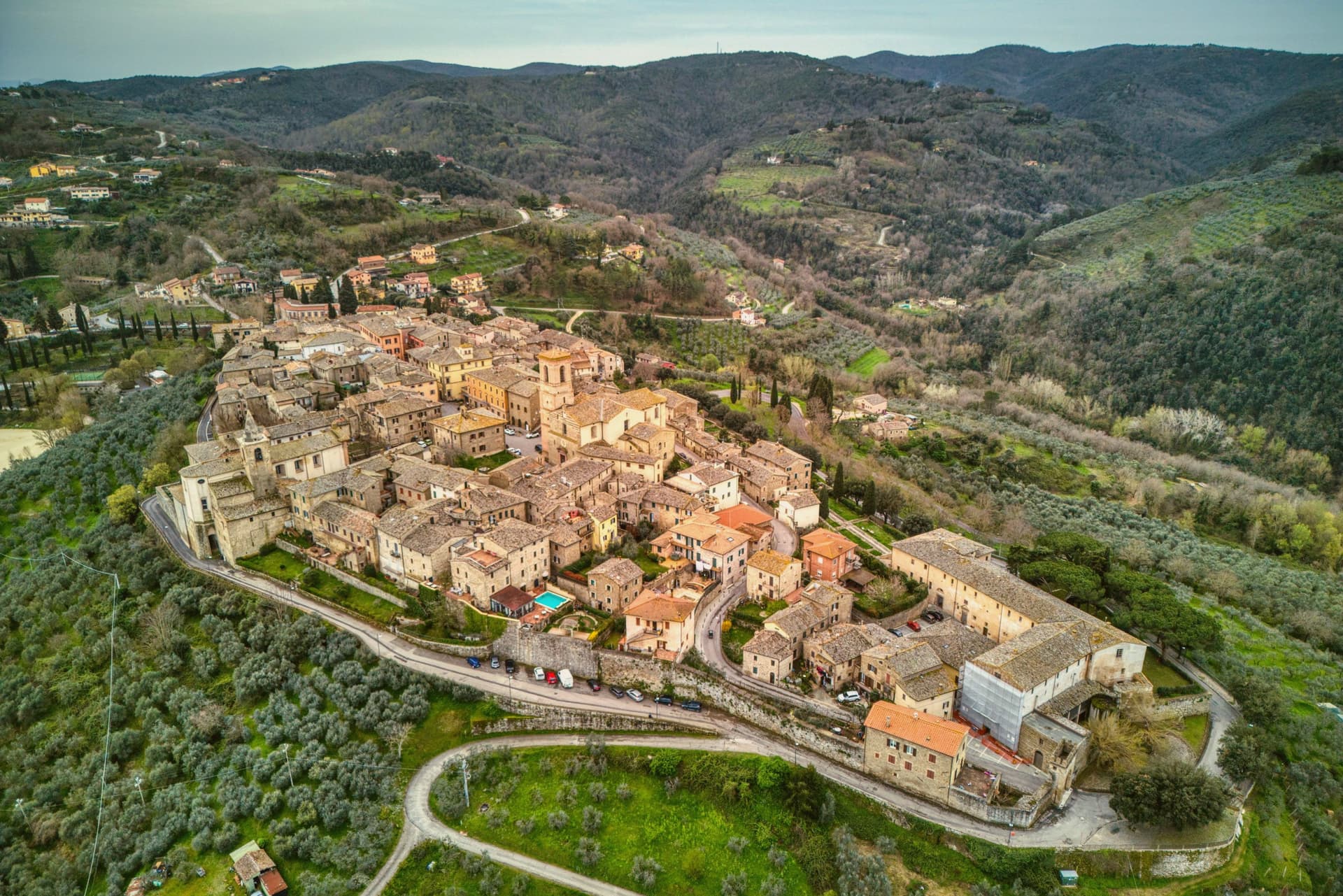
Why visit Bettona
Bettona sits at 353 meters on a hill north of the Colli Martani, looking across the cultivated plain toward Perugia. The Etruscans built here in the seventh century BC, and Bettona remains the only known Etruscan settlement east of the Tiber.
Stretches of polygonal walls from that period are still visible at the base of the medieval circuit, mixed with later Roman blocks. The town became a municipium under Augustus, declined during the barbarian invasions, was sacked by Totila in 548, and rebuilt as a self-governing commune by the late twelfth century.
Papal rule held from 1648 to unification. The Pinacoteca Civica, housed in the Palazzetto del Podestà on Piazza Cavour, keeps two paintings by Pietro Perugino (Sant'Antonio da Padova and Madonna della Misericordia), tabernacle panels attributed to El Greco, and Etruscan funerary stones and architectural terracottas from the territory.
The olive groves below town carry the Città dell'Olio designation.
What to see in Bettona
- Mura etrusche. Stretches of polygonal Etruscan walls visible at the base of the medieval circuit, from the seventh and sixth centuries BC.
- Pinacoteca Civica. Civic art gallery in the Palazzetto del Podestà holding two Perugino paintings, tablets attributed to El Greco and Etruscan finds.
- Chiesa di Santa Maria Maggiore. Main parish church on Piazza Cavour, with a reordered interior holding altarpieces and a Crocifissione fresco.
How to get to Bettona
Perugia is roughly 27 minutes away by road.
Our tip
April through June and September into October are the windows that work. The olive harvest runs from late October through November and gives the town its working rhythm, with the frantoi pressing into the evening. July and August are dry and hot; the centro storico is small enough that midday empties it. Sagra dell'Oca falls in July.
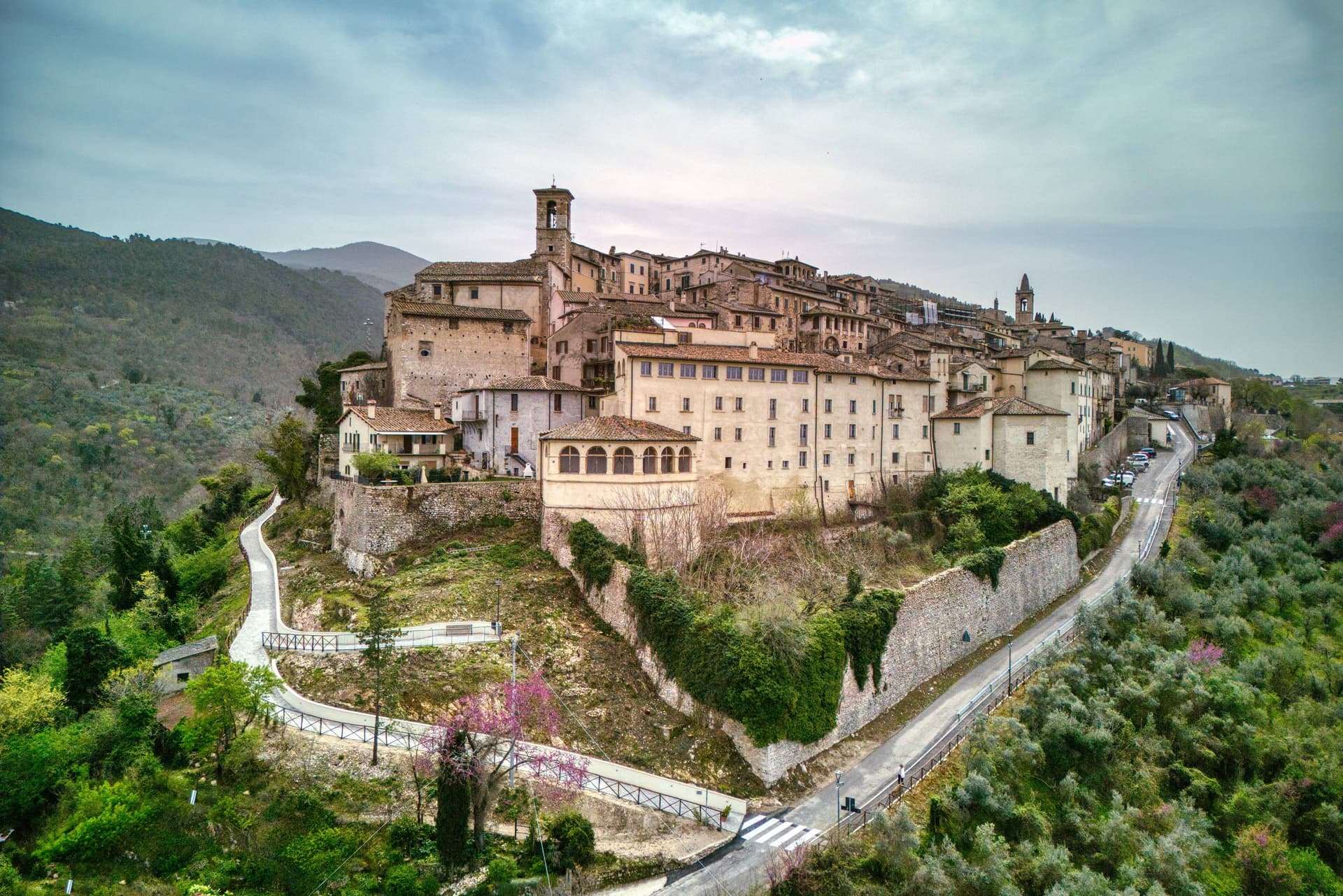
Why visit Stroncone
Stroncone sits at 451 meters on an olive-covered hill eight kilometers south of Terni, in the Conca Ternana on the western slope of the Apennine. The name traces to Duke Ugone of Spoleto, whose castrum Hugonis evolved through Castrugone and Strungone to the present form.
A group settled here around the tenth century and built a castle; Stroncone first appears in documents in 1012, when Giovanni di Pietro made a donation to the monastery of San Simeone. Pope Innocent III granted municipal self-rule in 1215.
The Convento di San Francesco, south of the walls, is one of the older Franciscan foundations in Umbria, founded by tradition by Francis himself in 1213, two years before papal recognition of the order. The medieval circuit walls remain almost complete, with the original gates framing a network of stepped lanes that climb to the small main square.
The Cammino di San Francesco passes through, picking up walkers between Rieti and Assisi.
What to see in Stroncone
- Convento di San Francesco. Franciscan convent south of the walls, founded by tradition by Saint Francis in 1213, two years before papal recognition of the order.
- Centro storico. Walled medieval core with original gates intact, climbing through stepped lanes to the small main square at the top of the hill.
- Chiesa di San Giovanni Decollato. Main parish church at the heart of the borgo, with frescoed interior and a Renaissance baptismal font.
How to get to Stroncone
There is a railway station in the town, so you can arrive without a car and never need one while you are here. Terni is roughly 18 minutes away by road.
Our tip
April through June and September into October are the months for Stroncone. Olive harvest carries the autumn rhythm into late November, and the frantoi work into the evening through October and November. July and August are warm in the Conca Ternana but the hill is high enough that nights cool quickly. Sagra De u Cecu Maritu falls in July.
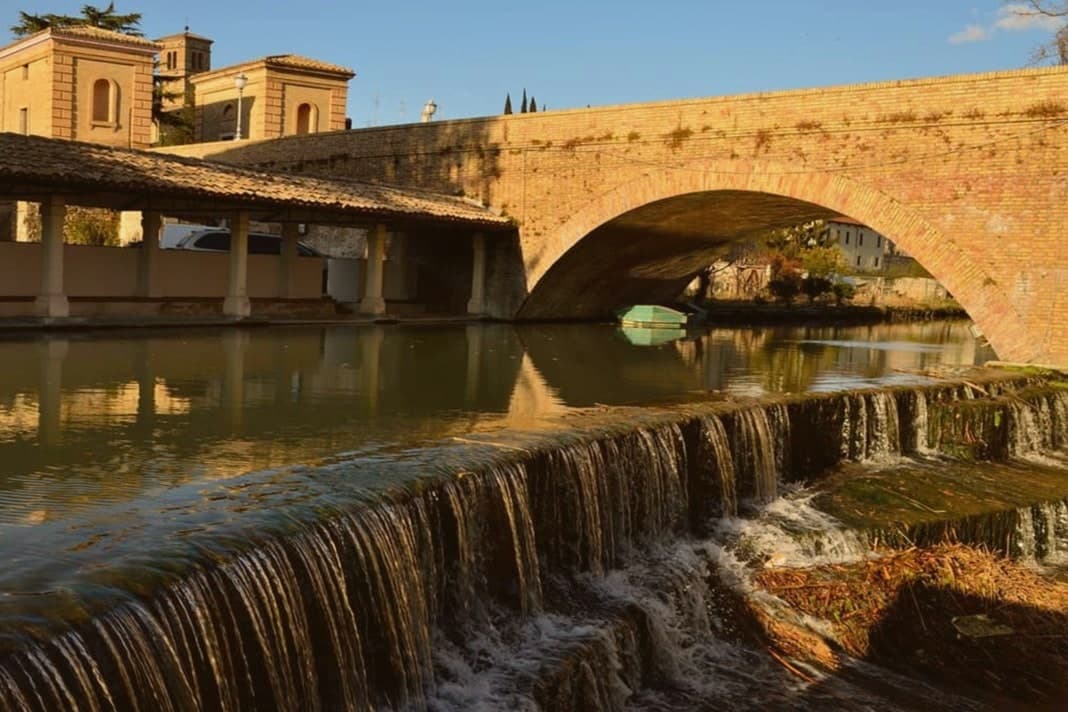
Why visit Bevagna
Bevagna sits on the floor of the Umbrian valley at 225 meters, where the Clitunno meets the Timia. Ancient Mevania, the name means she who stands in the middle, was a Roman mansio on the Via Flaminia, listed in the Antonine Itinerary.
A black-and-white mosaic of the 2nd century AD survives almost intact in the frigidarium of the Roman baths, twelve meters by seven, octopuses and dolphins in the center, tritons and sea-horses on the short sides. Piazza Silvestri at the heart of the centro storico holds two Romanesque churches that face each other at odd angles, San Michele Arcangelo and San Silvestro, built within years of each other in the late 12th century.
The Mercato delle Gaite each June turns the town into the year 1300 for ten days, four quarters competing on medieval trades and tavern menus, no anachronisms allowed. The Sagrantino slopes of Montefalco are nine kilometers up the road.
The re-enactment here is La Notte Medievale, usually held in September.
What to see in Bevagna
- Piazza Silvestri. Twelfth-century civic square ringed by the Palazzo dei Consoli, the churches of San Silvestro and San Michele, and the fountain of 1896.
- Chiesa di San Michele Arcangelo. Romanesque collegiate church built by Binello and Rodolfo at the end of the 12th century, on the main square.
- Chiesa di San Silvestro. Romanesque parish church across the piazza, signed and dated 1195 by Binello, the same builder as San Michele.
How to get to Bevagna
Perugia is roughly 39 minutes away by road.
Our tip
April through June and September into October are the months for Bevagna. The valley fills with green, the Sagrantino vines run on the slopes above town, and the rose festival fills the gardens around the walls in May. The Mercato delle Gaite runs the second half of June and is the single most concentrated weekend on the Umbrian medieval calendar. Sagra della Lumaca falls in August.
Why visit Montefalco
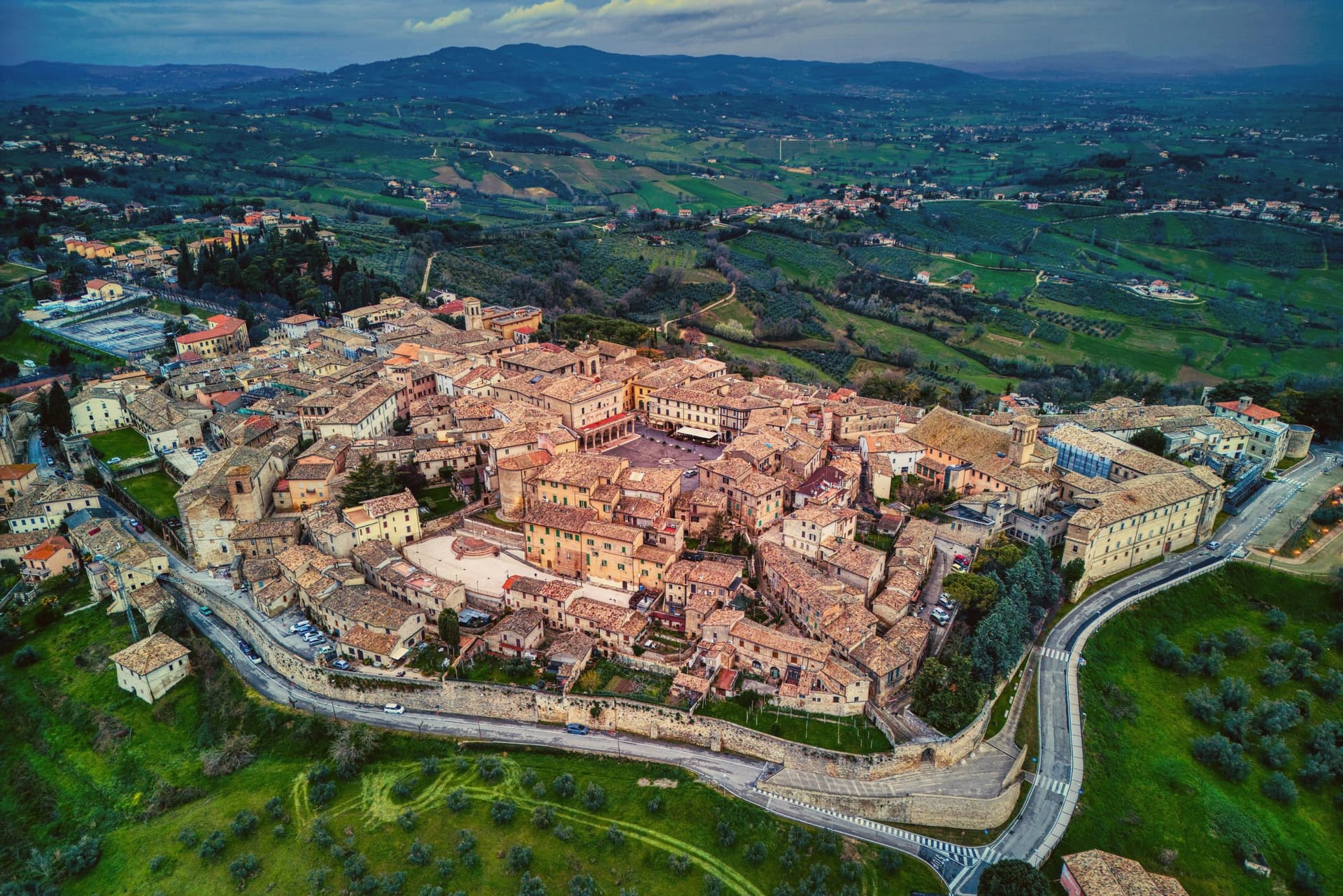
Montefalco sits on a hill above the Umbrian valley, its walls laid out in two concentric medieval circuits with five gates, the inner ring still complete and the outer ring added in the 14th century by the Trinci. At the top, the circular Piazza del Comune gathers four converging streets around the Palazzo Comunale, the high point from which the rest of the town falls away toward the walls and the vineyards beyond them.
The name Sagrantino belongs to the slopes right around those walls, where the grape has been traced back to the 1st century AD, and three of the largest producers, Caprai, Antonelli and Adanti, keep cellars within four kilometers of the centro storico. The harvest runs late September into October.
The fresco cycle Gozzoli painted in the apse of the former church of San Francesco is counted among his most complete surviving works, and the town's own name for itself, the railing of Umbria, describes the same eastern walls where the belvedere gathers seven hill towns into one view. Wine on the slopes, frescoes in the old church, a view of the valley from the walls: a hill town whose economy, art and setting all sit within walking distance of each other.
What to see in Montefalco
- Museo Civico di San Francesco. Former Franciscan church holding Benozzo Gozzoli's fresco cycle, plus works of the Umbrian school, in a building that has stood as the town's museum since deconsecration.
- Piazza del Comune. Circular medieval square at the top of the hill, ringed by the Palazzo Comunale, the Oratorio di Santa Maria di Piazza and four converging streets.
- Belvedere of Umbria. Panoramic walk on the eastern walls that takes in Perugia, Assisi, Spello, Foligno, Trevi, Spoleto and Todi from a single viewpoint.
How to get to Montefalco
Perugia is roughly 54 minutes away by road.
Our tip
April through June and September into October are the months for Montefalco. The vineyards run their full work cycle, the harvest of Sagrantino starts in the last week of September, and the railing belvedere holds the long Umbrian light. Settimana Enologica in mid-September brings producers from across the territory onto Piazza del Comune. Enologica Montefalco falls in September.
Why visit Torgiano
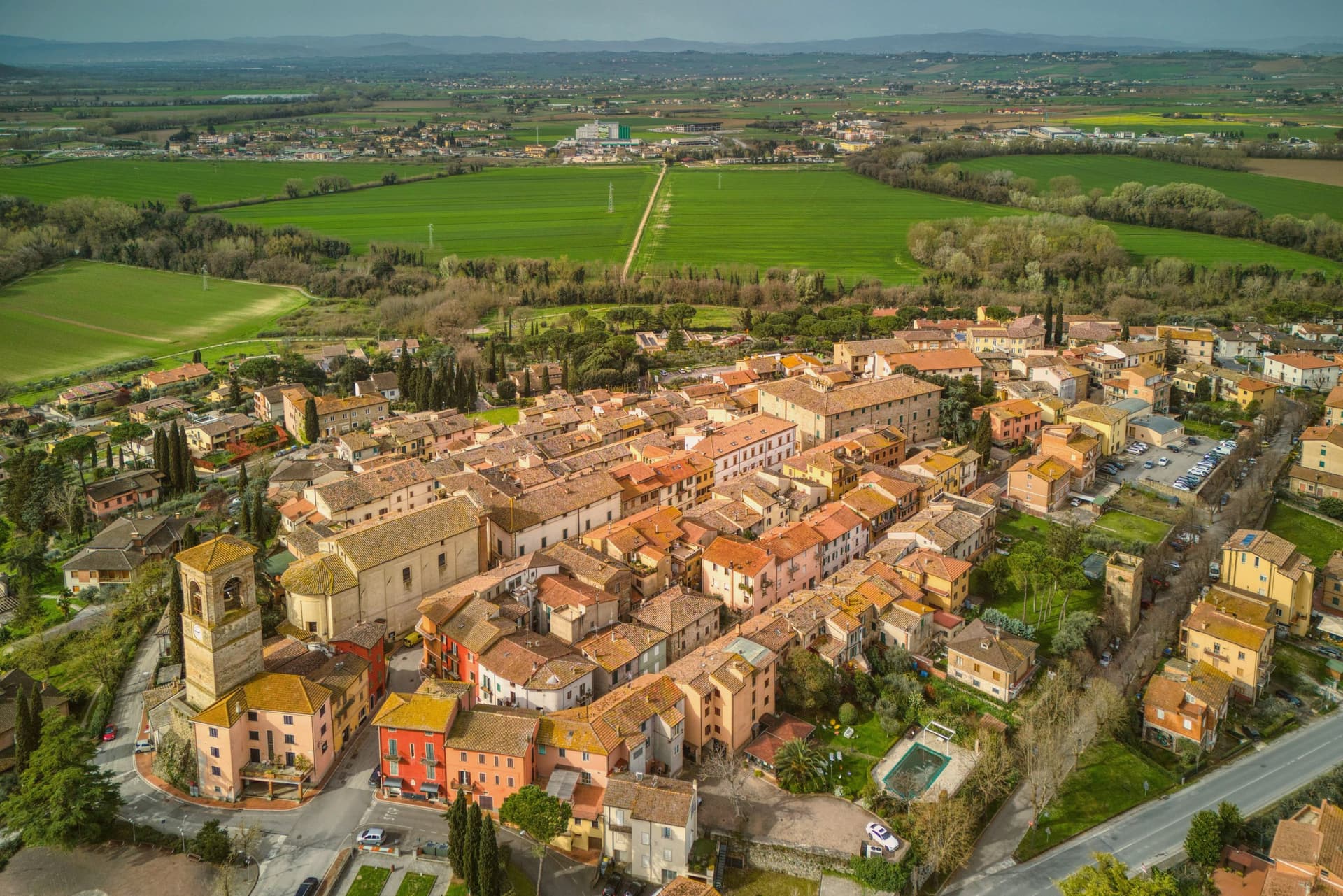
Torgiano sits at 219 meters at the point where the Chiascio joins the Tiber, ten kilometers south of Perugia. The Torre della Guardia, also called Torre Baglioni, was raised in 1274 to control the river customs traffic that moved up toward Rome from the Tiber valley.
Torgiano was the first Umbrian wine area to receive the DOC mark in 1968 and to be elevated to DOCG in 1990. Giorgio and Maria Grazia Lungarotti turned the wine economy of the town into a cultural project: the MUVIT, opened in 1974 inside the seventeenth-century Palazzo Graziani-Baglioni, holds three thousand pieces across twenty rooms documenting five thousand years of wine history.
The companion MOO, on the olive and oil, is inside a small medieval cluster within the castle walls. Both are managed by the Lungarotti Foundation.
The cantina itself, on the edge of the centro storico, has been the largest single Umbrian producer for half a century.
What to see in Torgiano
- MUVIT Museo del Vino. Wine museum opened 1974 in 17th-century Palazzo Graziani-Baglioni, with 3,000 pieces across 20 rooms covering 5,000 years of wine history.
- MOO Museo dell'Olivo e dell'Olio. Olive and oil museum in a medieval cluster within the castle walls, managed alongside MUVIT by the Lungarotti Foundation.
- Torre della Guardia (Torre Baglioni). Defensive tower raised 1274 to control the Tiber-Chiascio customs traffic, the only standing element of the original river fortifications.
How to get to Torgiano
Perugia is roughly 26 minutes away by road.
Our tip
April through June and September into October are the working months. The vineyards run their full cycle on the slopes around the confluence, and MUVIT and MOO keep regular hours. The Banco di Assaggio dei Vini d'Italia is the historical late-summer tasting that put Torgiano on the wider Italian wine map. Vinarelli - Agosto Torgianese falls in August.
More from Anywhere Italy
- The prettiest villages with a food festival within 90 minutes of Perugia
- The best hidden towns with a food festival in the province of Perugia
- The best olive oil towns with a food festival in the province of Perugia
 The 9 best small olive oil towns in Umbria
- The best hill towns with a food festival in the province of Perugia
- The prettiest small villages within 90 minutes of Perugia