
The prettiest villages with a food festival within 90 minutes of Perugia
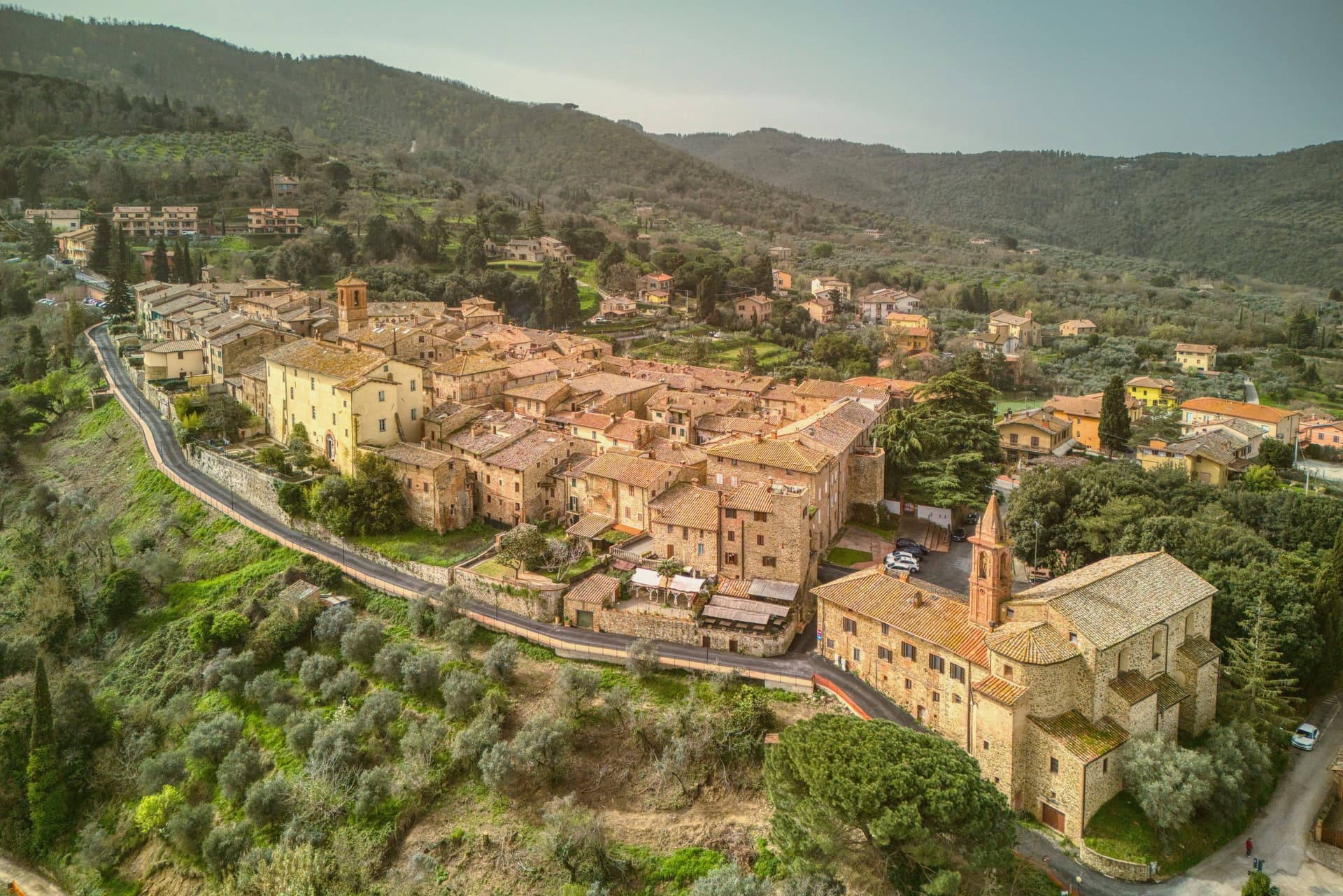
Umbria in autumn smells of woodsmoke and crushed olives. The hill villages here are built from pale travertine and warm sandstone, and their squares fill in October and November for sagre, the village festivals given over to one thing the surrounding land produces: black truffle dug in the oak woods above the Nera, the first pressing of the year's oil, saffron threads, lake fish from Trasimeno, red onion, Sagrantino grapes brought down from vineyards that turn the same colour as the wine. The cooking at these events is done by volunteers in a tent behind the church, on long tables, with paper cloths. Prices are low, portions are not, and the local wine comes in a jug.
Most people who come to this part of Italy for food go to Perugia itself, or to Assisi over the ridge, and both are worth the time. Perugia has Eurochocolate in autumn and a medieval centre that empties into a handful of streets, which means those streets are shoulder to shoulder from mid morning. Assisi runs on pilgrim coaches and fills its restaurants twice a day at fixed hours. Neither place gives you the thing the sagra gives you, which is a village cooking its own harvest for its own neighbours, with visitors welcome at the end of the bench.
The same hills, the same oil, the same truffle woods carry on well past the two famous names, out towards Trasimeno, down into the Valle Umbra and across the border into the Val di Chiana and the thermal country of southern Tuscany. Fewer people go, and the villages there have kept both their looks and their festival calendars. Each of the places in this list has passed the national assessment of Italy's most beautiful villages, and each holds a recurring festival built around a single local ingredient. Check the dates before you set out, because most run for one weekend only.
Of the 41 communes we have mapped within 90 minutes of Perugia, 11 qualify as prettiest villages with a food festival: each has passed the national assessment of Italy's most beautiful villages, and each holds a recurring food festival built around one local ingredient. This list is 10 of them. The smallest, Paciano, has 957 residents.
Elsewhere in the catalogue: The best hidden hill towns with a food festival within 90 minutes of Perugia and The prettiest small villages within 90 minutes of Perugia.
Paciano
Why visit Paciano
The town is first documented in 917, in an imperial charter of Berengar I, and appears again in 1260 as a castrum, a fortified site. Perugia rebuilt the walls and main tower between 1461 and 1473, using the site as a watch-post over the western approach to the lake below.
Inside the circuit, three parallel streets are linked by orthogonal alleys, a layout that carries the Renaissance palace with the Vignola staircase, the oldest noble residence in the town, and the 17th-century Palazzo Cennini, once the summer residence of a cardinal. The gates and towers sit at the edge of this grid, facing outward toward the water.
Olive oil from the slopes that drop toward the shore is the present-day specialty. What remains is a small fortified grid, built to watch a lake, that turned its military purpose into a domestic one once the watching was no longer needed.
What to see in Paciano
- Medieval walls. About 600 meters of circuit, with the three original gates named Fiorentina, Perugina and Rastrella still standing among the eight towers.
- Palazzo Baldeschi. Assembled from earlier tower houses, with a staircase attributed to Jacopo Barozzi da Vignola. Now used as an exhibition and cultural space.
- Rocca Buitoni. The oldest surviving palace in the town, built as a noble residence inside the walls, with a small private chapel.
How to get to Paciano
Perugia is roughly 44 minutes away by road.
Our tip
April through June and September into October are the months for Paciano. The slopes of Monte Petrarvella hold the wildflowers, Trasimeno is warm enough to swim from late May, and the olive groves run from green to silver-gold across the half-year. The Infiorata fills the three parallel streets each Corpus Domini in late May or June. Sagra dello Strozzaprete falls in August.
Sellano
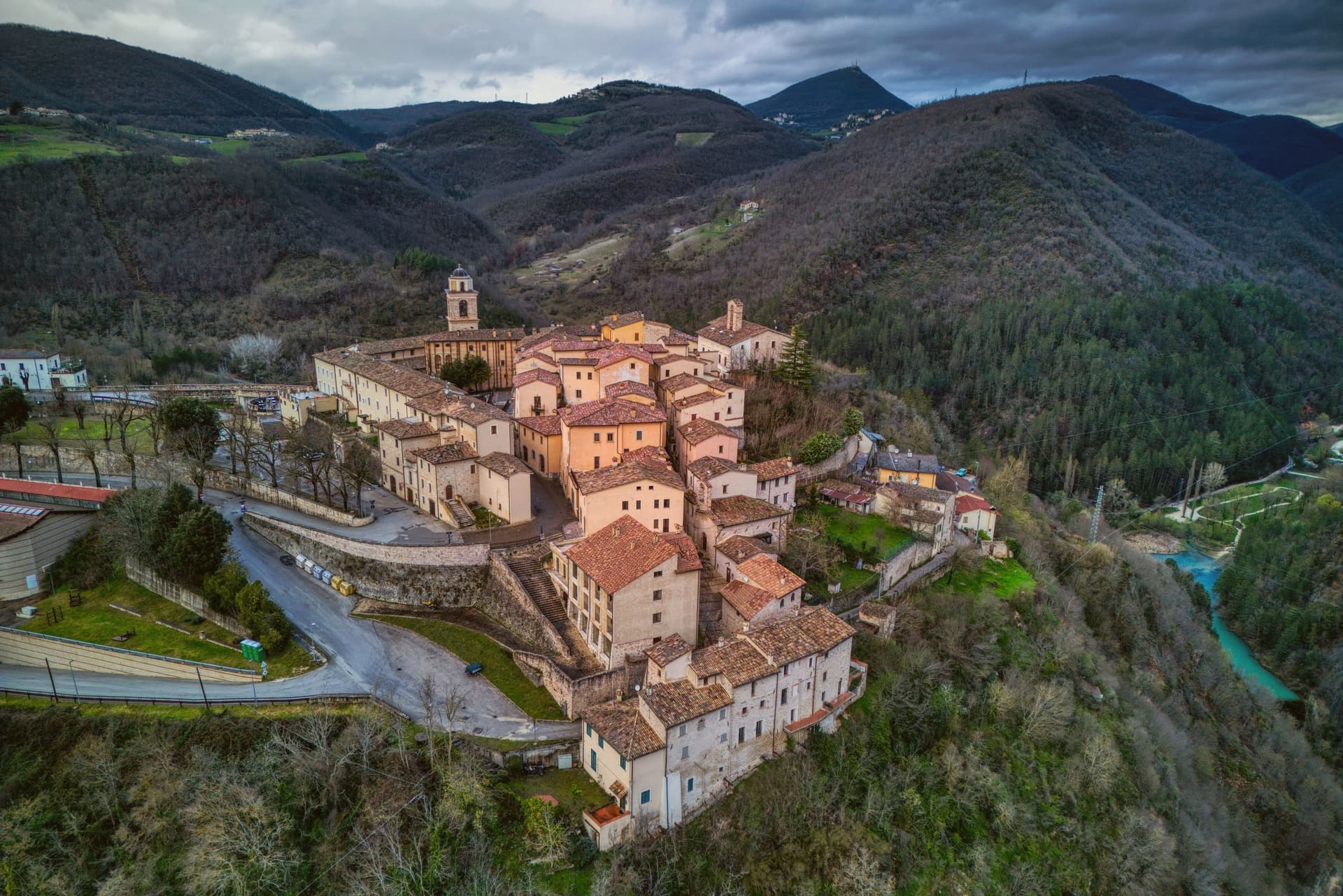
Why visit Sellano
Sellano sits at 641 meters on the eastern edge of Umbria, looking over the Vigi stream toward the Marche border. The Vigi feeds the Nera; the valley is the upper Valnerina, one of the most isolated stretches of the Umbro-Marchigiano Apennines.
The 1979 and 1997 earthquakes hit the commune hard. The 1997 quake destroyed the sixteenth-century Palazzo dei Collicola at Montesanto and emptied most of the surrounding hamlets.
Reconstruction took two decades. In March 2024 a new structure opened: a 517-meter suspension footbridge across the Vigi gorge linking Sellano to the Castello di Montesanto, 175 meters above the valley floor, 1,023 steps, claimed as Europe's highest tibetan bridge alongside Portugal's Arouca 516.
Funded by NextAppennino, 1.6 million euros from PNRR earthquake-area development money. The bridge has become the visible decision of a small commune to bet its future on something other than waiting out emigration.
What to see in Sellano
- Ponte tibetano. 517-meter suspension footbridge opened March 2024, 175 meters above the Vigi gorge, 1,023 steps linking Sellano to Castello di Montesanto.
- Castello di Montesanto. Medieval fortress hamlet across the Vigi, depopulated after the 1997 earthquake, reachable on foot via the new bridge.
- Borgo medievale di Sellano. Compact walled centro storico looking east toward the Marche, partially rebuilt after the 1997 quake.
How to get to Sellano
Perugia is roughly 66 minutes away by road.
Our tip
May through October is the working season at 641 meters in the upper Valnerina. The new bridge runs full schedule, the trails along the Vigi gorge are open, and the temperature stays in the low twenties through summer afternoons. June and September are the best months for walking: long light, dry trail, late wildflowers. Sagra della Fojata e dell'Attorta falls in August.
San Casciano dei Bagni
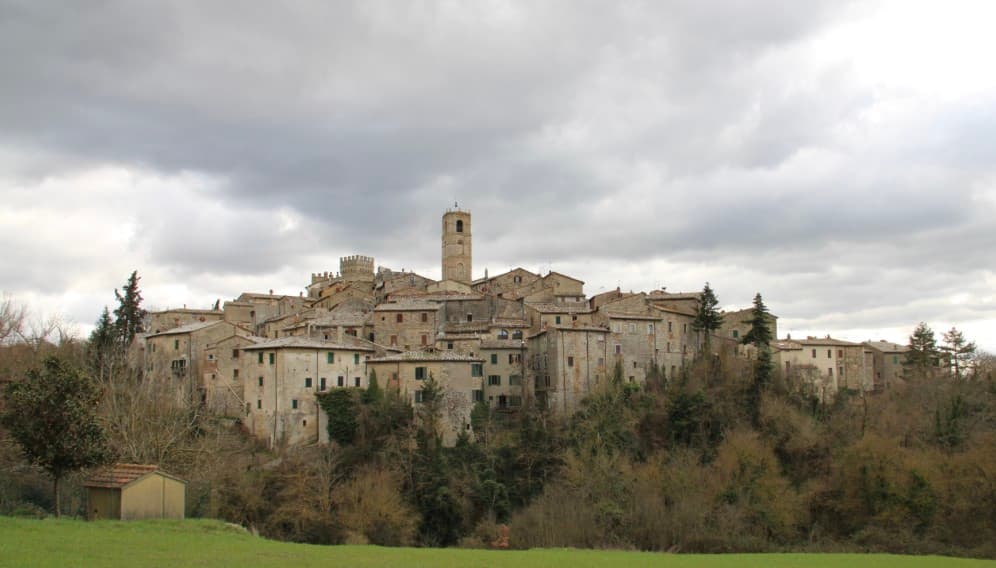
Why visit San Casciano dei Bagni
San Casciano dei Bagni sits at 582 meters at the southern edge of the province of Siena, above 42 hot springs that average 42 degrees Celsius. The baths were used continuously from Etruscan through Roman times and again from the Renaissance, when visitors came from across Europe.
In 2022, an excavation that began in 2019 at the ancient sanctuary turned up 24 bronze votive statues protected by mud, with around 6,000 coins in gold, silver and bronze. The find was the largest of its kind in fifty years; most surviving Etruscan votive material is terracotta.
The 1,500 residents live on a basalt outcrop above the Roman thermal complex, in a centro storico of stone houses and three small churches. The borgo joined the Borghi più belli network in 2014 and remains one of the smallest communes in Toscana to carry both that label and Bandiera Arancione.
The re-enactment here is Palio di San Cassiano di San Casciano dei Bagni, usually held in August.
What to see in San Casciano dei Bagni
- Santuario Ritrovato. Etruscan-Roman thermal sanctuary excavated since 2019, where 24 bronze votives and around 6,000 coins were recovered in 2022.
- Bagno Grande. The principal natural pool of the 42 hot springs, used from the second century BC through the Renaissance and reopened to the public.
- Collegiata di San Leonardo. Romanesque parish church in the centro storico, restored in the seventeenth century, with a baptismal font carved from local travertine.
How to get to San Casciano dei Bagni
Perugia is roughly 68 minutes away by road.
Our tip
The thermal pools make the calendar different here. Winter is the season many visitors prefer, when the 42-degree water steams against cold air and snow occasionally dusts the basalt outcrop. April through June and September into October are the most balanced months: warm hill light, the dry-stone walls of the borgo at their best, the sanctuary excavations open to guided tours. Sagra del Ciaffagnone di San Casciano dei Bagni falls in June.
Castiglione del Lago
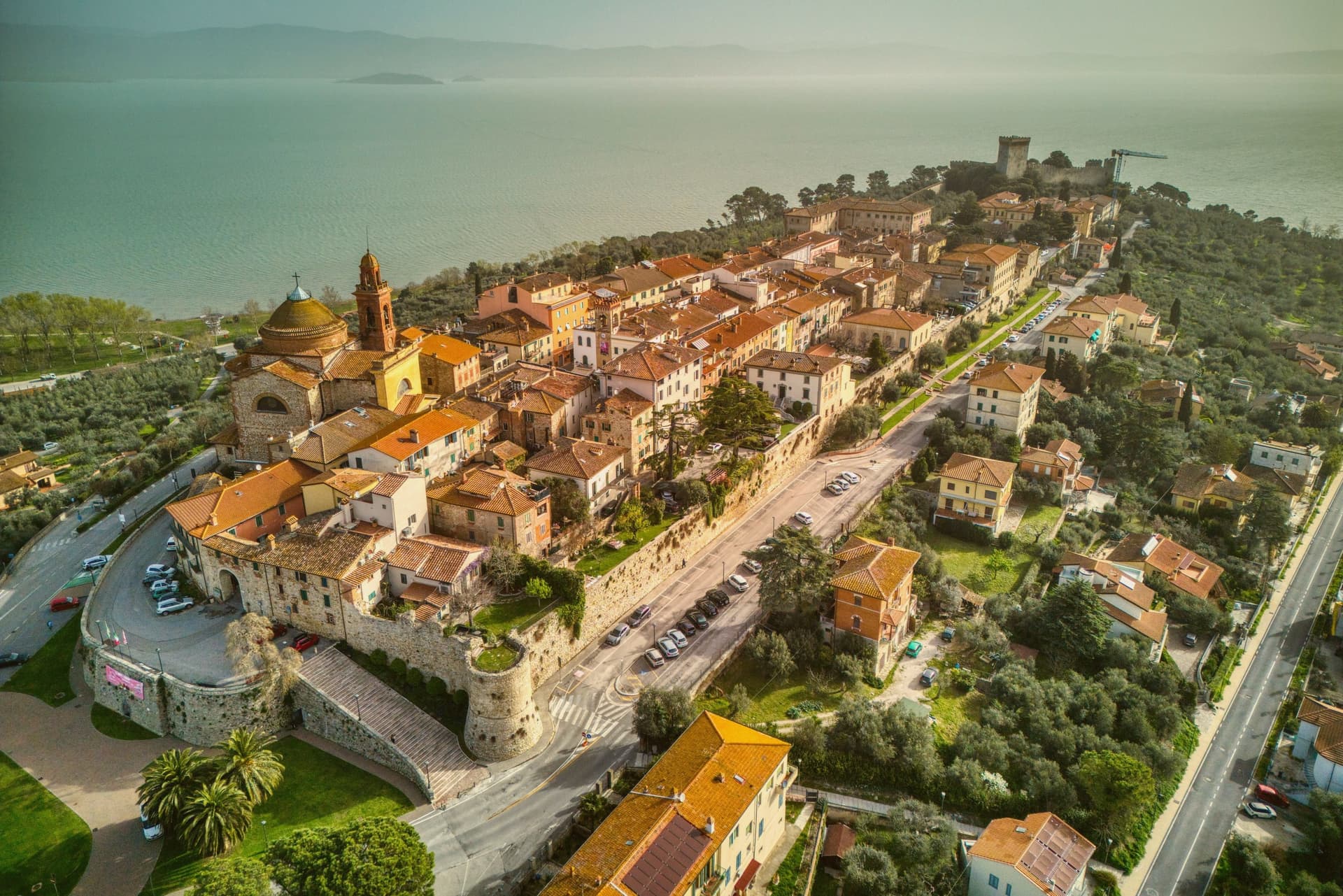
Why visit Castiglione del Lago
The town sits on a limestone promontory on the western shore of Lake Trasimeno, thirty kilometers from Perugia. That promontory was the fourth island of the lake in antiquity, before the strip of water separating it from the mainland silted in, which is why a place now solidly attached to shore still carries the memory of being an island in its layout and its name.
The fortress anchors the southern end of the centro storico, and a covered passage links it directly to the ducal palace: one museum complex, two buildings, four centuries apart, joined so that a visitor can pass from medieval military architecture into a Mannerist-frescoed residence without stepping outside. The town is the largest commune on the Trasimeno and the western base for the ferries out to the lake's islands, and it is the only one of the lake's shore towns to hold Borghi più belli status.
What this adds up to is a small center where fortification and courtly decoration sit back to back, and where the lake itself, its islands, its silted-in strait, its ferries, is never far from any single building.
What to see in Castiglione del Lago
- Palazzo della Corgna. Sixteenth-century ducal palace built for Ascanio della Corgna on a Baglioni structure, eight rooms frescoed by il Pomarancio between 1574 and 1590.
- Rocca del Leone. Pentagonal medieval fortress commissioned by Federico II di Svevia in 1247, linked to Palazzo della Corgna by a covered passageway.
- Chiesa di Santa Maria Maddalena. Parish church on the centro storico's main axis, bell tower rising to 329 meters above sea level over the lake.
How to get to Castiglione del Lago
There is a railway station in the town, so you can arrive without a car and never need one while you are here. Perugia is roughly 52 minutes away by road.
✷ We have written about Castiglione del Lago
“The lake is like a sanatorium compared to the sea. It’s relaxed. It’s calm. It’s silent. To find this level of almost disturbing quietness, you either go up into the mountains, or you really need to know your way around the sea to find that particular spot not overrun by vacationers and beach people. In Trasimeno, this is easy. Even the most popular towns like Castiglione or Passignano sit in quiet harmony with the stillness of the water.”
Read our piece on Castiglione del Lago →Lago Trasimeno | Never Compete with the Sea
Our tip
April through June and September into October are the months the Trasimeno shows best: the lake holds the light, the ferry to Isola Maggiore runs full schedule, and the lungolago at evening fills with locals and not yet with day-trippers. July and August push into the low thirties; the lake breeze helps, but weekends draw heavy traffic from Perugia and Florence. November through March is quiet. Stramaialata - Sagra del Mangiar Bene falls in August.
Cetona
Why visit Cetona
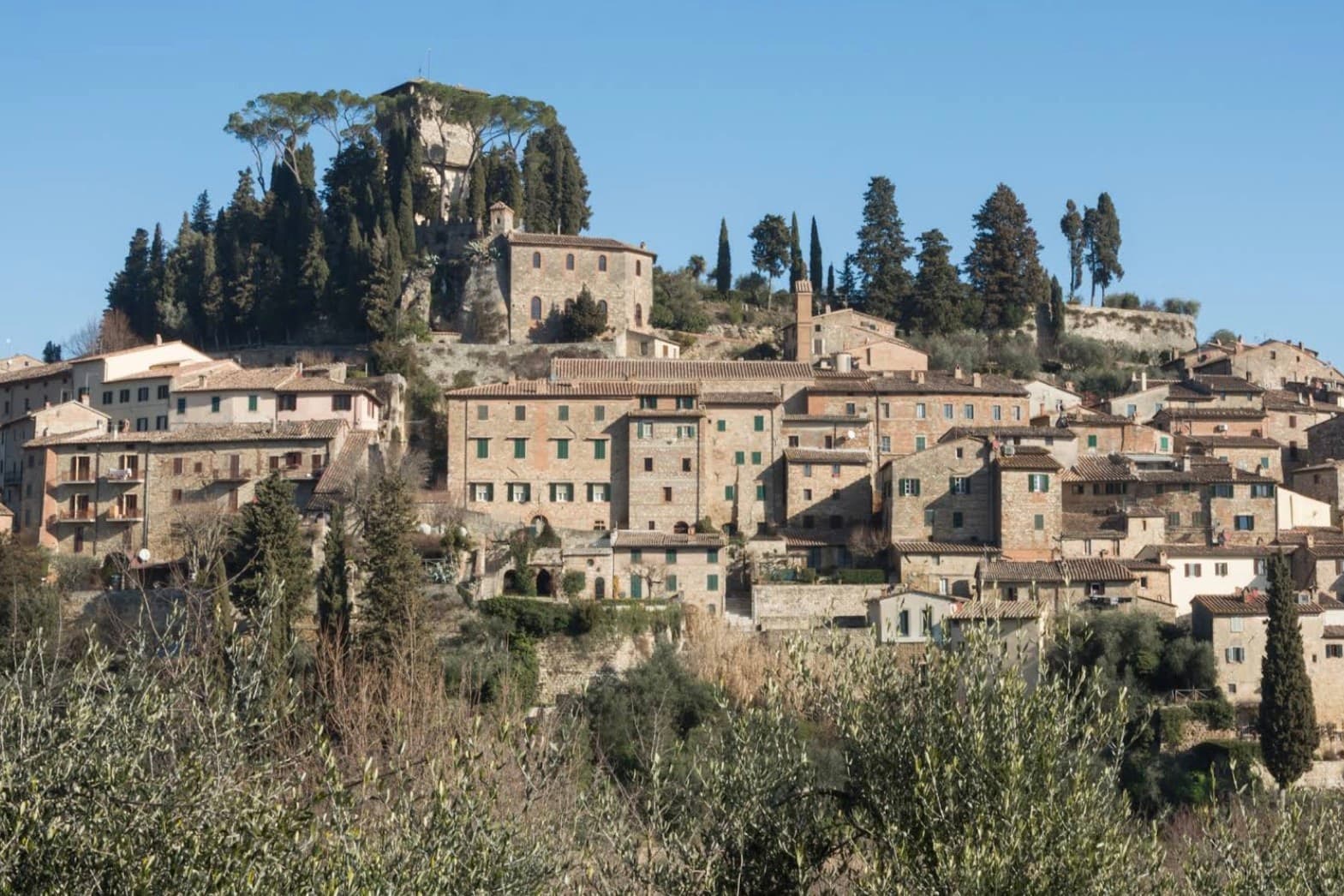
The town sits on the western flank of a ridge at the meeting point of Toscana, Umbria and Lazio, where the mountain divides the Val d'Orcia from the Val di Chiana. The medieval comune passed between Siena, Orvieto and Perugia before falling to Siena in the late fourteenth century, and it was Cosimo I who later sold it whole to a marchese.
The fortress at the top of the grid and the square laid out below it are two halves of the same Renaissance move: a private residence replacing a garrison at the summit, a flat civic stage opened up at the base. Above the town, in the woods, the hermitage and the caves belong to a much older layer, human use of the mountain reaching back to the Mesolithic, long before any comune or marchese laid claim to it.
What the town adds up to is a settlement built in tiers: a prehistoric mountain, a contested medieval center, and a Renaissance overlay that reorganized the base of the hill without touching what stood above it.
The re-enactment here is Corsa delle brocche a Cetona, usually held in July.
What to see in Cetona
- Piazza Garibaldi. Elliptical square at the foot of the medieval grid, flat and open where the streets above it climb steeply. The civic stage of the borgo, still the first thing that orients a visitor.
- Rocca di Cetona. Fortress at the top of the centro storico, its walls and keep still standing though the interior became a private residence rather than a garrison.
- Convento di San Francesco. Franciscan convent below the borgo, founded in 1212, with a single-nave church and a small cloister still in religious use.
How to get to Cetona
Perugia is roughly 78 minutes away by road.
Our tip
April through June and September into October are the months Cetona keeps its calmest pace, the wooded slopes of Monte Cetona green or rust depending on the half. July and August are hot in the centro storico but the mountain trails above 800 meters stay cool. The Mostra del Tartufo, dedicated to the local white truffles, runs the second weekend of November in Piazza Garibaldi. Sagra del Bico di Cetona falls in June.
Lucignano
Why visit Lucignano
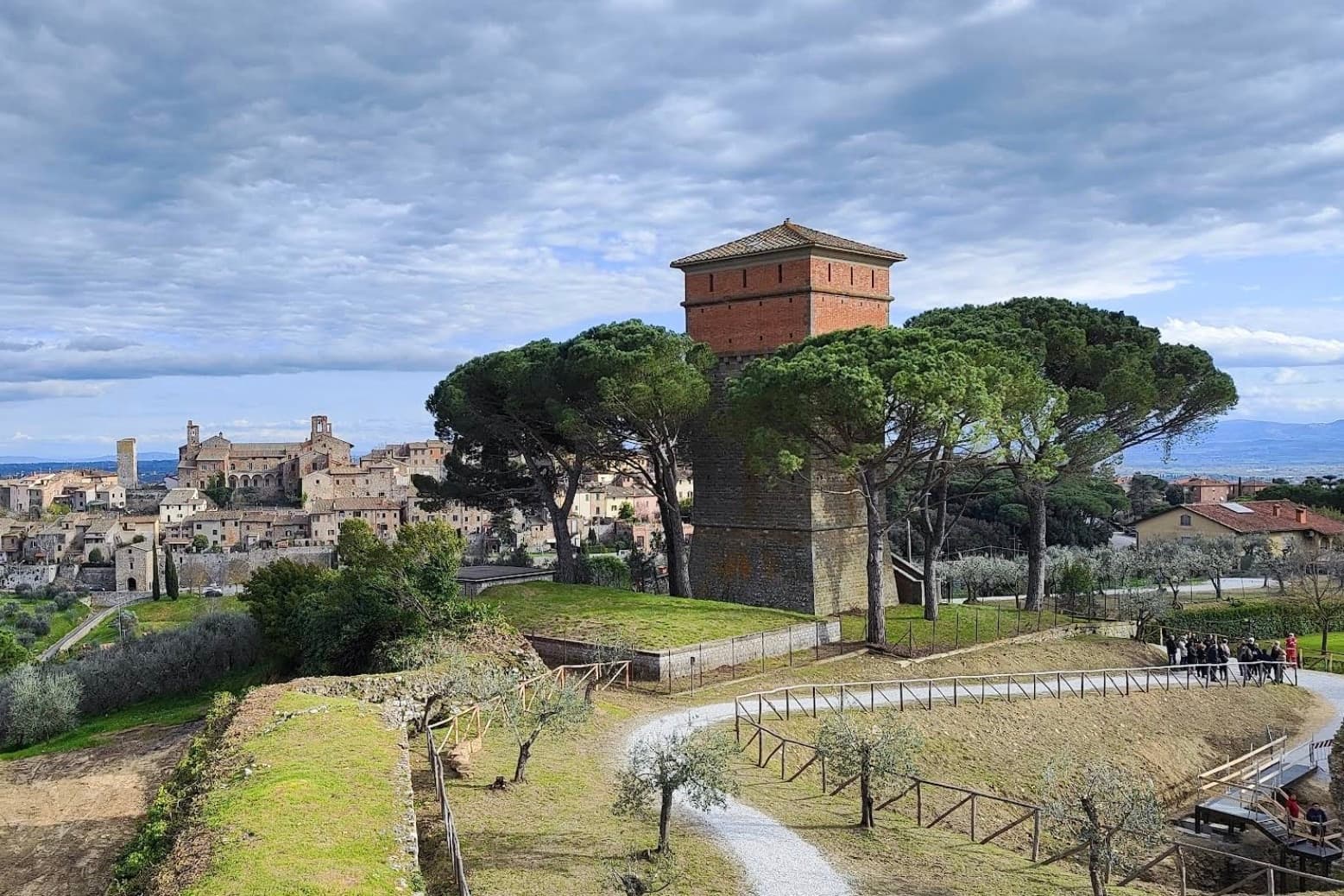
Lucignano sits at 400 meters on a hill in the Valdichiana, halfway between Siena and Arezzo, built on a tight elliptical plan of four concentric rings of streets. Its position made it one of the most contested settlements of medieval Toscana: Siena, Arezzo, Florence and Perugia all fought over it between 1200 and 1500.
The current walls and three gates date to a Sienese reconstruction of 1371. In the Museo Civico inside the Palazzo Comunale stands the Albero d'Oro, a 260-centimeter Gothic gold-and-coral reliquary in the shape of a tree, begun by Ugolino di Vieri in 1350 and finished by Gabriello d'Antonio in 1471.
Local tradition turned it into the Albero dell'Amore, a marriage charm. The Collegiata di San Michele Arcangelo dominates the highest ring of the borgo, and the elliptical plan is best read from the air, which is why drone footage of Lucignano keeps appearing in articles about medieval Tuscan urbanism.
The re-enactment here is Memorie dal passato a Lucignano, usually held in September.
What to see in Lucignano
- Albero d'Oro. 260-cm Gothic reliquary in the shape of a tree, gold, coral and enamel, begun by Ugolino di Vieri in 1350 and completed by Gabriello d'Antonio in 1471.
- Centro storico ellittico. Four concentric rings of streets inside elliptical walls, the most complete example of medieval Tuscan elliptical town planning.
- Collegiata di San Michele Arcangelo. Eighteenth-century church on the highest ring of the borgo, with a Vasari façade adjustment and a baroque organ inside the medieval shell.
How to get to Lucignano
There is a railway station in the town, so you can arrive without a car and never need one while you are here. Perugia is roughly 65 minutes away by road.
Our tip
April through June and September into October are the months Lucignano keeps its balance, the Valdichiana green or gold depending on the half and the centro storico cool inside its elliptical walls. The Maggiolata, a flower festival between the four quarters of the borgo, runs across the last two Sundays of May. July and August push the valley past thirty and the centro storico thins after lunch. Sagra della Filiera del Tartufo Marzuolo falls in March.
Bettona
Why visit Bettona
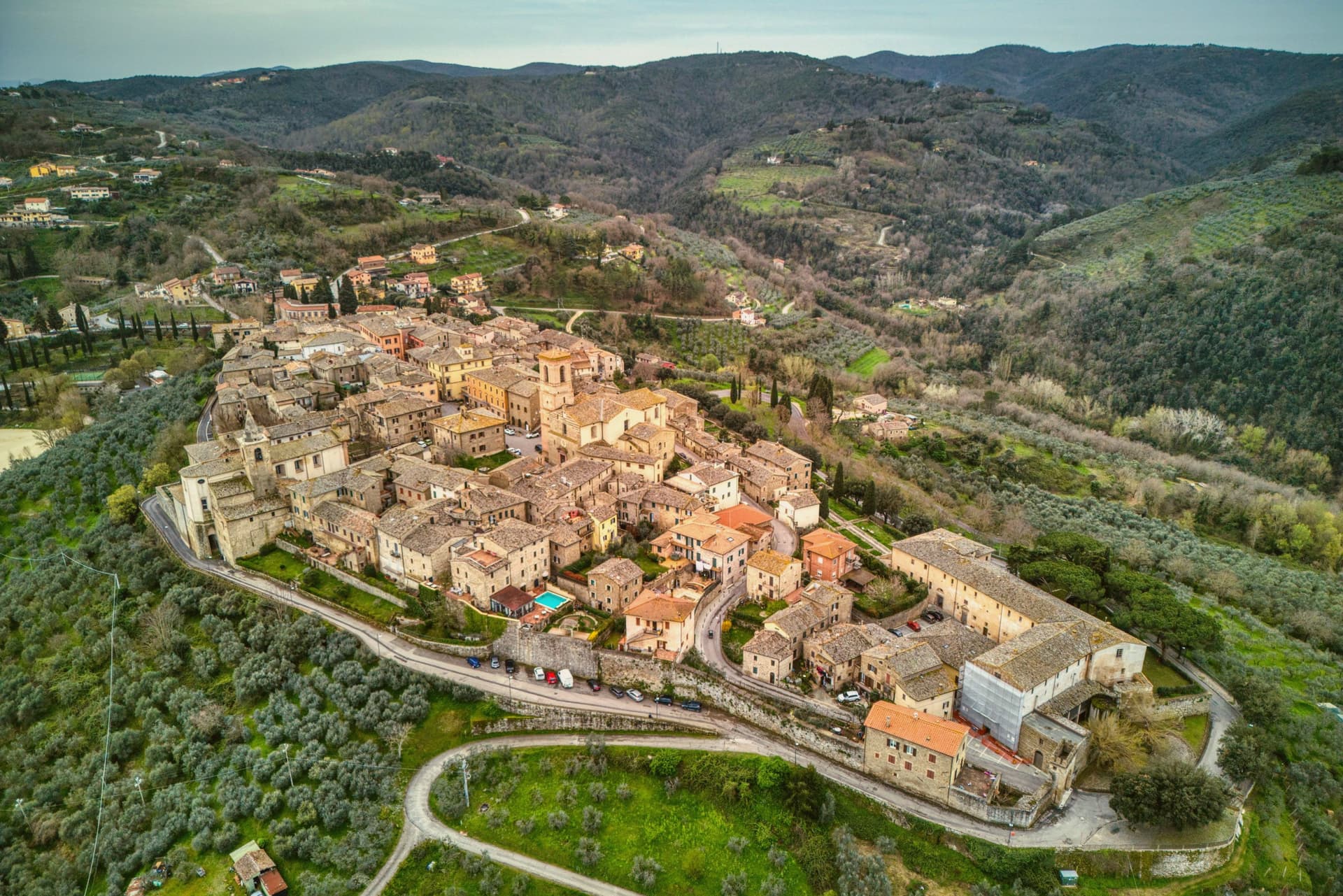
Bettona sits at 353 meters on a hill north of the Colli Martani, looking across the cultivated plain toward Perugia. The Etruscans built here in the seventh century BC, and Bettona remains the only known Etruscan settlement east of the Tiber.
Stretches of polygonal walls from that period are still visible at the base of the medieval circuit, mixed with later Roman blocks. The town became a municipium under Augustus, declined during the barbarian invasions, was sacked by Totila in 548, and rebuilt as a self-governing commune by the late twelfth century.
Papal rule held from 1648 to unification. The Pinacoteca Civica, housed in the Palazzetto del Podestà on Piazza Cavour, keeps two paintings by Pietro Perugino (Sant'Antonio da Padova and Madonna della Misericordia), tabernacle panels attributed to El Greco, and Etruscan funerary stones and architectural terracottas from the territory.
The olive groves below town carry the Città dell'Olio designation.
What to see in Bettona
- Mura etrusche. Stretches of polygonal Etruscan walls visible at the base of the medieval circuit, from the seventh and sixth centuries BC.
- Pinacoteca Civica. Civic art gallery in the Palazzetto del Podestà holding two Perugino paintings, tablets attributed to El Greco and Etruscan finds.
- Chiesa di Santa Maria Maggiore. Main parish church on Piazza Cavour, with a reordered interior holding altarpieces and a Crocifissione fresco.
How to get to Bettona
Perugia is roughly 27 minutes away by road.
Our tip
April through June and September into October are the windows that work. The olive harvest runs from late October through November and gives the town its working rhythm, with the frantoi pressing into the evening. July and August are dry and hot; the centro storico is small enough that midday empties it. Sagra dell'Oca falls in July.
Montefalco
Why visit Montefalco
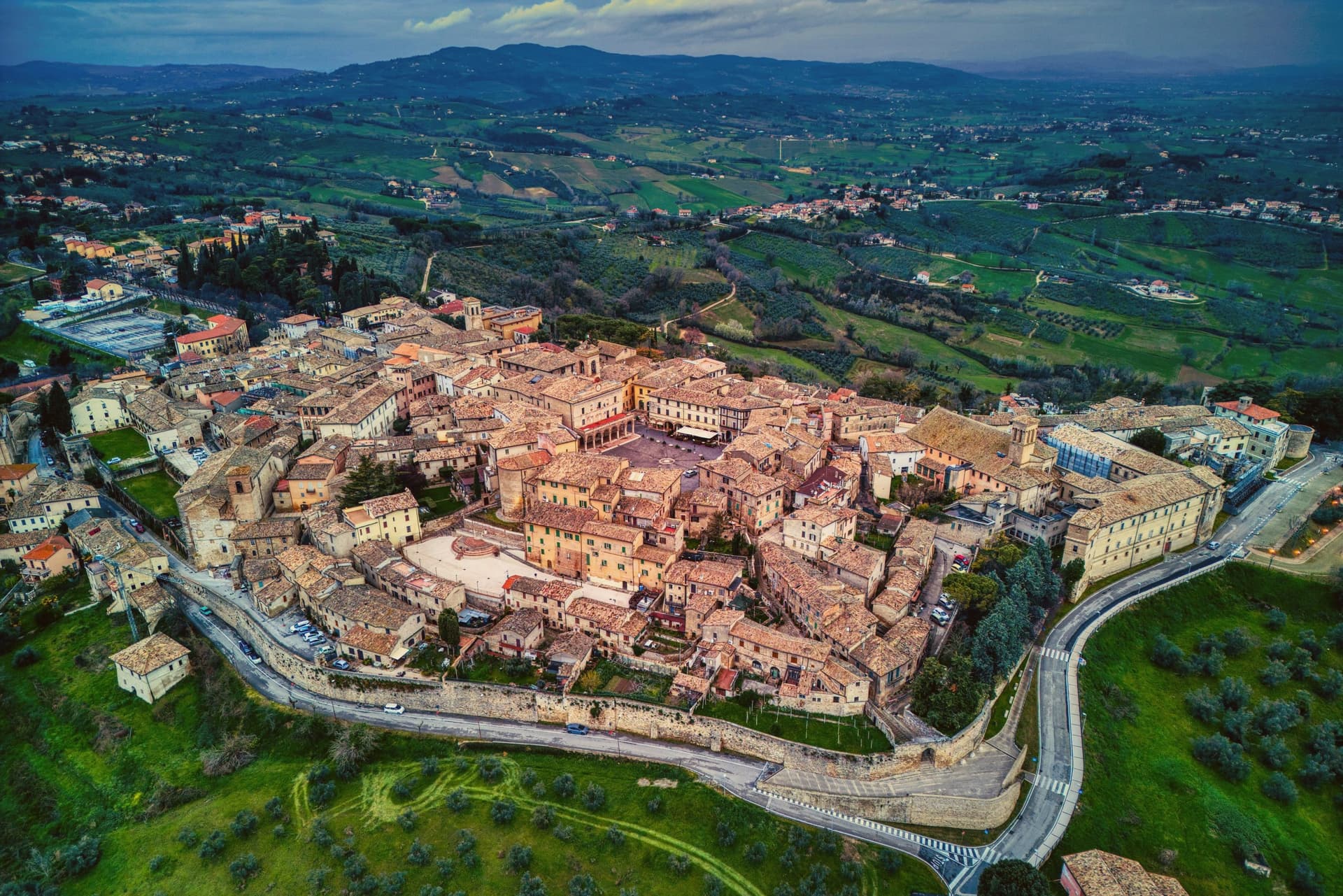
Montefalco sits on a hill above the Umbrian valley, its walls laid out in two concentric medieval circuits with five gates, the inner ring still complete and the outer ring added in the 14th century by the Trinci. At the top, the circular Piazza del Comune gathers four converging streets around the Palazzo Comunale, the high point from which the rest of the town falls away toward the walls and the vineyards beyond them.
The name Sagrantino belongs to the slopes right around those walls, where the grape has been traced back to the 1st century AD, and three of the largest producers, Caprai, Antonelli and Adanti, keep cellars within four kilometers of the centro storico. The harvest runs late September into October.
The fresco cycle Gozzoli painted in the apse of the former church of San Francesco is counted among his most complete surviving works, and the town's own name for itself, the railing of Umbria, describes the same eastern walls where the belvedere gathers seven hill towns into one view. Wine on the slopes, frescoes in the old church, a view of the valley from the walls: a hill town whose economy, art and setting all sit within walking distance of each other.
What to see in Montefalco
- Museo Civico di San Francesco. Former Franciscan church holding Benozzo Gozzoli's fresco cycle, plus works of the Umbrian school, in a building that has stood as the town's museum since deconsecration.
- Piazza del Comune. Circular medieval square at the top of the hill, ringed by the Palazzo Comunale, the Oratorio di Santa Maria di Piazza and four converging streets.
- Belvedere of Umbria. Panoramic walk on the eastern walls that takes in Perugia, Assisi, Spello, Foligno, Trevi, Spoleto and Todi from a single viewpoint.
How to get to Montefalco
Perugia is roughly 54 minutes away by road.
Our tip
April through June and September into October are the months for Montefalco. The vineyards run their full work cycle, the harvest of Sagrantino starts in the last week of September, and the railing belvedere holds the long Umbrian light. Settimana Enologica in mid-September brings producers from across the territory onto Piazza del Comune. Enologica Montefalco falls in September.
Anghiari
Why visit Anghiari
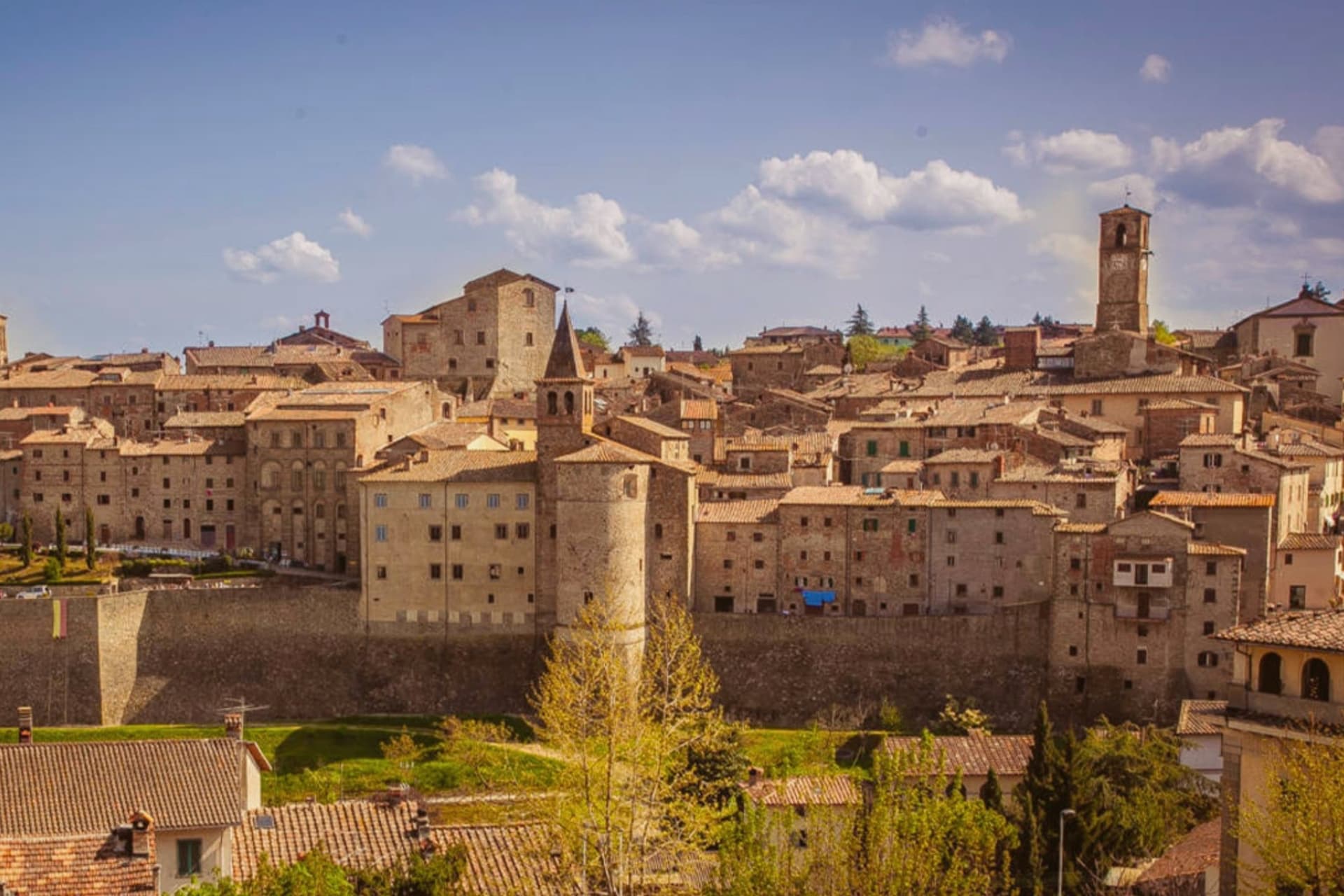
Anghiari sits at 430 meters on a spur above the upper Tiber valley, the Valtiberina, between Arezzo and the Umbrian border. The walled centro storico is intact, the streets running steeply from the Porta Sant'Angelo up to the Castello.
On 29 June 1440 the Florentine army defeated a Milanese force under Niccolò Piccinino in the plain below town, a battle that secured Florence's hold over central Italy and gave Leonardo da Vinci the commission for the Palazzo Vecchio fresco he started in 1505 and never finished. The painting, the Lost Leonardo, is presumed still to be hidden behind a Vasari wall in Florence.
Palazzo Taglieschi in the centro storico holds a polychrome wooden Madonna by Jacopo della Quercia and a working sixteenth-century table organ. The Mostra Mercato dell'Artigianato della Valtiberina has filled the streets with craft producers every spring since 1976, a working continuation of the textile and woodwork traditions that supported the town through the twentieth century.
The re-enactment here is Palio della Vittoria di Anghiari, usually held in June.
What to see in Anghiari
- Palazzo Taglieschi. Sixteenth-century palace in the centro storico, now the Museo Statale di Palazzo Taglieschi, with a wooden Madonna by Jacopo della Quercia and a working table organ.
- Castello di Anghiari. Medieval fortified core at the top of the town, walls and gates still intact, the visual anchor of the silhouette from the valley below.
- Campo della Battaglia. The plain at the foot of the walls where Florence defeated Milan on 29 June 1440, the battle that inspired Leonardo's lost Palazzo Vecchio fresco.
How to get to Anghiari
Perugia is roughly 82 minutes away by road.
Our tip
April through June and September into October are the working months in the Valtiberina: dry days, low cloud over the upper Tiber, the surrounding farmland green or gold by season. The Mostra Mercato dell'Artigianato runs the last week of April and the first week of May, filling the streets with artisans from across the valley. Late June marks the anniversary of the 1440 battle, with reenactments below the walls. Palio della Vittoria di Anghiari falls in June.
Torgiano
Why visit Torgiano
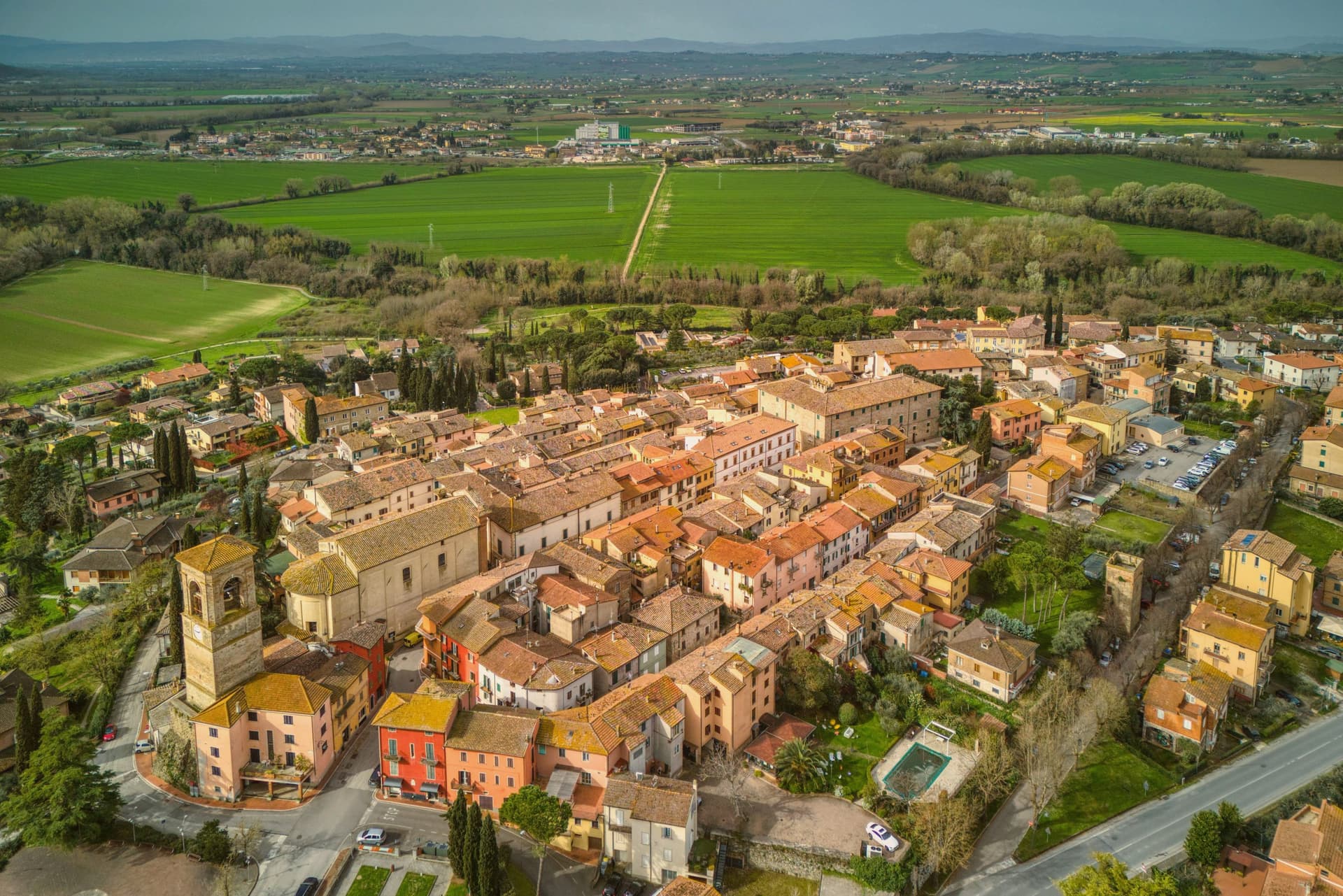
Torgiano sits at 219 meters at the point where the Chiascio joins the Tiber, ten kilometers south of Perugia. The Torre della Guardia, also called Torre Baglioni, was raised in 1274 to control the river customs traffic that moved up toward Rome from the Tiber valley.
Torgiano was the first Umbrian wine area to receive the DOC mark in 1968 and to be elevated to DOCG in 1990. Giorgio and Maria Grazia Lungarotti turned the wine economy of the town into a cultural project: the MUVIT, opened in 1974 inside the seventeenth-century Palazzo Graziani-Baglioni, holds three thousand pieces across twenty rooms documenting five thousand years of wine history.
The companion MOO, on the olive and oil, is inside a small medieval cluster within the castle walls. Both are managed by the Lungarotti Foundation.
The cantina itself, on the edge of the centro storico, has been the largest single Umbrian producer for half a century.
What to see in Torgiano
- MUVIT Museo del Vino. Wine museum opened 1974 in 17th-century Palazzo Graziani-Baglioni, with 3,000 pieces across 20 rooms covering 5,000 years of wine history.
- MOO Museo dell'Olivo e dell'Olio. Olive and oil museum in a medieval cluster within the castle walls, managed alongside MUVIT by the Lungarotti Foundation.
- Torre della Guardia (Torre Baglioni). Defensive tower raised 1274 to control the Tiber-Chiascio customs traffic, the only standing element of the original river fortifications.
How to get to Torgiano
Perugia is roughly 26 minutes away by road.
Our tip
April through June and September into October are the working months. The vineyards run their full cycle on the slopes around the confluence, and MUVIT and MOO keep regular hours. The Banco di Assaggio dei Vini d'Italia is the historical late-summer tasting that put Torgiano on the wider Italian wine map. Vinarelli - Agosto Torgianese falls in August.
More from Anywhere Italy
- The best hidden hill towns with a food festival within 90 minutes of Perugia
- The prettiest small villages within 90 minutes of Perugia
- The best hidden towns with a food festival in the province of Perugia
- The prettiest villages with a medieval festival within 90 minutes of Perugia
- The prettiest hidden villages with a serious restaurant within 90 minutes of Perugia
- The 9 best wine towns that eat well within 90 minutes of Perugia