
The prettiest villages with a food festival in Marche
The Marche interior is built in warm brick and pale travertine, on ridges that run east from the Sibillini towards the Adriatic, with vines and olives on the slopes below and beech woods above. Autumn is when these villages make sense: truffle season in the Cesano and Metauro valleys, must in the cellars, ciauscolo curing in cool rooms, chestnuts on the fire in the piazza. The food festivals here are sagre in the old sense, run by the parish or the pro loco, one ingredient at the centre and long trestle tables under the loggia. Spring brings the wild herb and fennel festivals, and summer the porchetta and the fried olive.
Most visitors to Marche go to Urbino for the Palazzo Ducale and the Raphael house, and it deserves the traffic, though the ramp up to the ducal courtyard can feel like a queue in high summer. The coast takes the rest: Senigallia for its beach and its famous restaurant bookings, Sirolo and the Conero cliffs in August, when the shuttle to the coves runs full. Both are worth the time. Both mean eating alongside a great many other people who read the same page you did.
The same hills and the same producers carry on inland and south, past the day-trip radius, into towns where the festival is still mainly for the people who live there. These are the smaller places on the ridge roads between Ancona and Ascoli, walled, mostly quiet on a weekday, and fully awake on the weekend their sagra falls. Fewer people go, which is the point, and the tables are longer for it.
Of the 63 communes we have mapped in Marche, 11 qualify as prettiest villages with a food festival: each has passed the national assessment of Italy's most beautiful villages, and each holds a recurring food festival built around one local ingredient. This list is 10 of them. The smallest, Montefiore dell'Aso, has 1,986 residents.
Two more lists worth reading alongside this one: The best hill towns with a food festival within 90 minutes of Ancona and The best towns with a food festival that eat well in Marche.
Montefiore dell'Aso
Why visit Montefiore dell'Aso
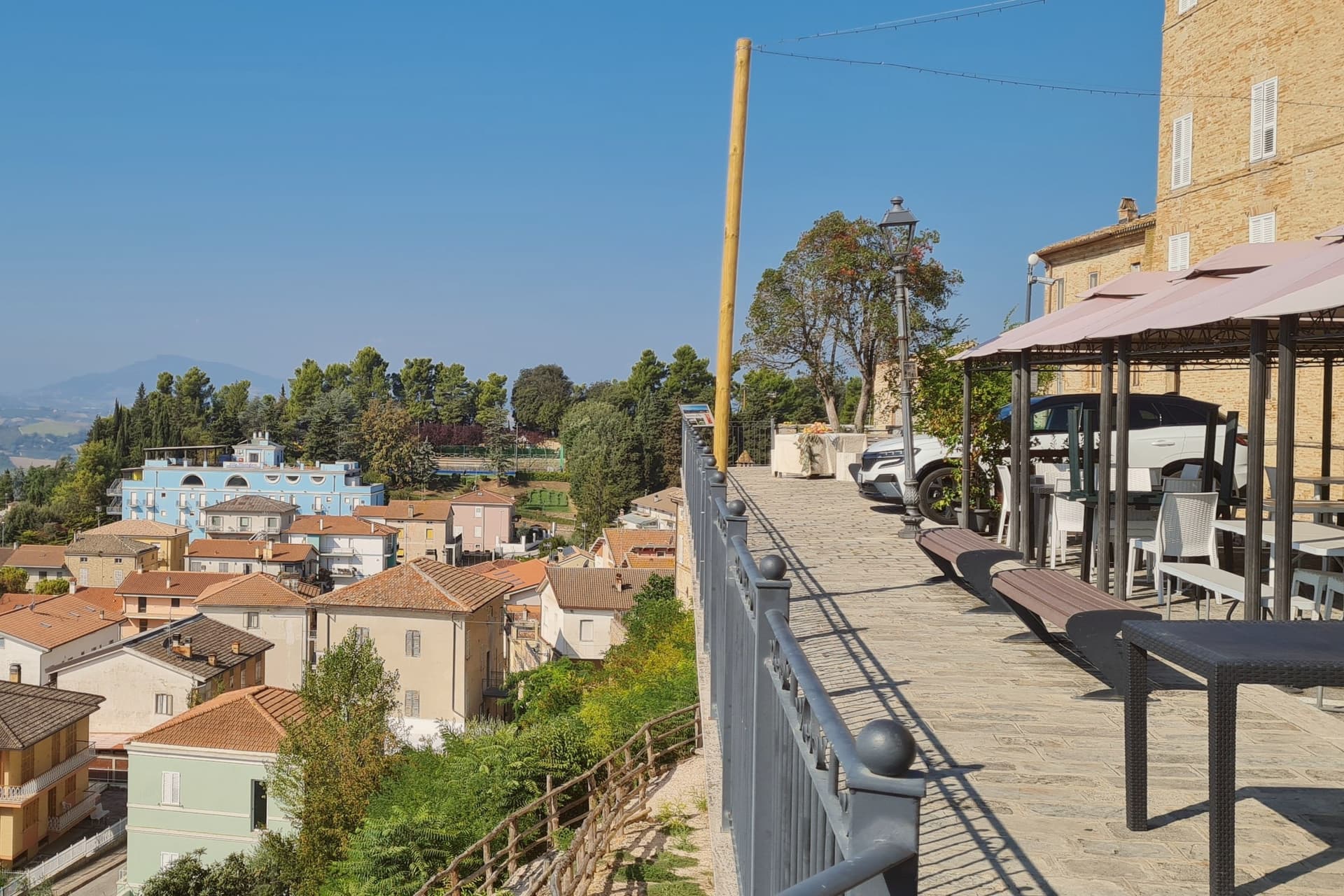
The ridge lies twenty-five kilometers from Ascoli Piceno and eleven from the Adriatic, the divide between the Aso and Menocchia valleys giving the town its double outlook, sea one way, the Sibillini the other. The territory was settled in the Neolithic and developed under the Piceni, with Roman necropolises dated to the first and second centuries BC.
Two earlier castles, Montefiore and Aspramonte, stood separately before merging in 1178 into a single walled town that grew into a free commune, the union of two settlements still legible in the shape of the centro storico on its ridge. The former Franciscan convent, built between 1247 and 1303, now gathers the town's separate histories under one roof: the recovered polyptych panels, the De Carolis paintings, the record of peasant life.
A hill town shaped by the fusion of two older ones, its museum performs the same act of reassembly on a smaller scale, holding together what was once scattered or separate.
What to see in Montefiore dell'Aso
- Polo Museale di San Francesco. Former Franciscan convent of 1247-1303, now a museum complex with the Crivelli room, the De Carolis museum and the Museum of Peasant Civilization.
- Polittico di Carlo Crivelli. The panels sit reassembled in the museum's dedicated room, the surviving remnant of a work broken apart and scattered on the antique market before recovery.
- Museo Adolfo De Carolis. Around five hundred works by the Montefiore-born symbolist artist, with sixty-nine oil sketches for the Salone dei Quattromila frescoes in Bologna's Palazzo del Podestà.
How to get to Montefiore dell'Aso
Ancona is roughly 64 minutes away by road.
Our tip
April through June and September into October are the best months for Montefiore dell'Aso. The Aso valley turns green by May, the ridge catches sea breezes from the Adriatic eleven kilometers east, and the Sibillini stand visible on clear afternoons. July and August touch the high twenties; the centro storico at 412 meters stays cooler than the river valleys below and the museum rooms hold steady through midday. Maialata in Piazza falls in August.
Petritoli
Why visit Petritoli
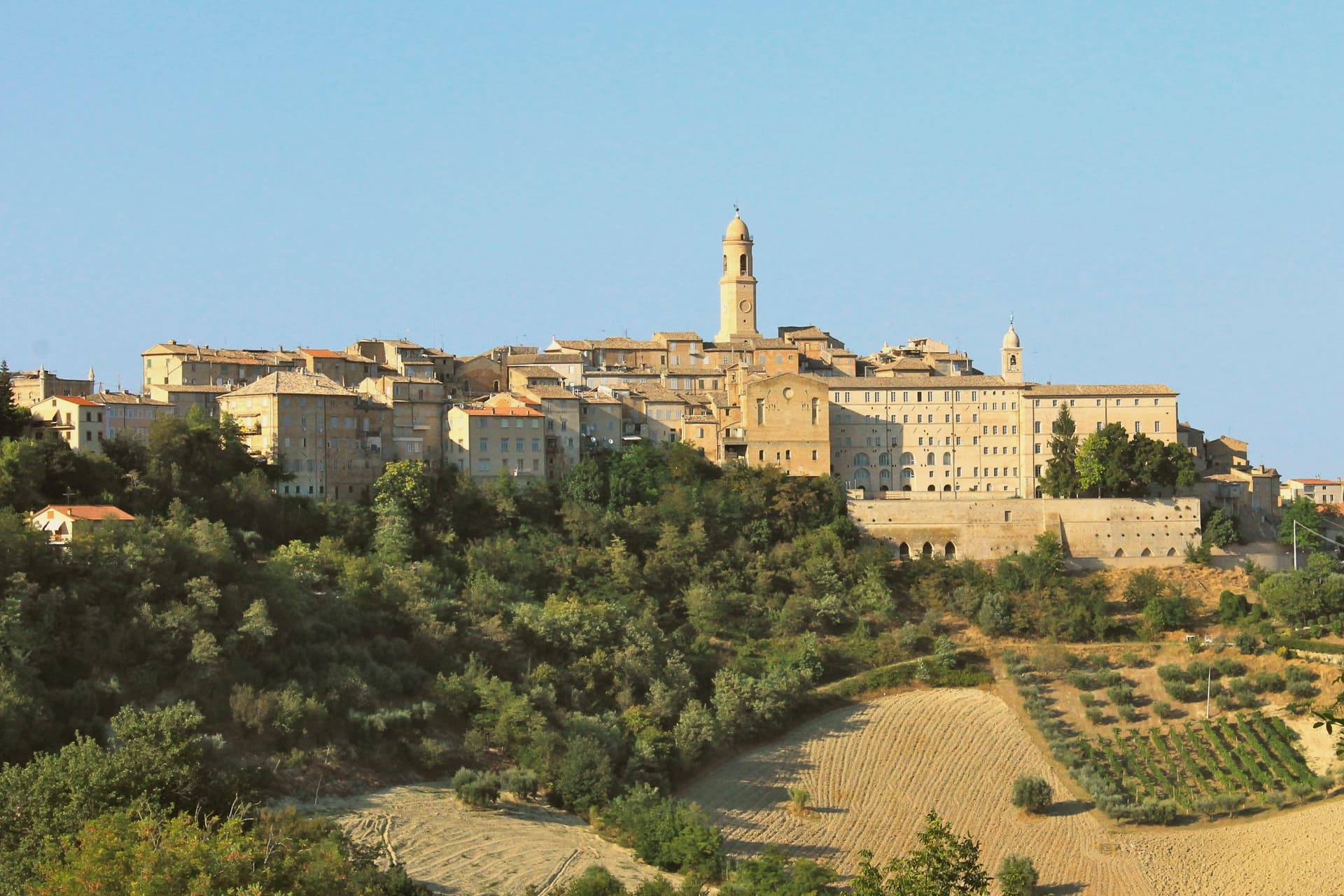
Petritoli sits in the southern Fermano, fifty kilometers north of Ascoli Piceno, on a turn-off from the Via Salaria that linked Ascoli to Fermo. The name and the site trace back to the three original nuclei, Petrosa, Petrania and Petrollavia, which merged into one hilltop settlement around the year 1000.
Their union is still legible in the stepped streets of the centro storico, where the three castle quarters knit together inside a single circuit of walls. The town looks outward as much as inward.
From the civic tower the ground falls away to the Aso valley, and on clear days the view reaches the Sibillini beyond it. Below the walls, the valley floor carries olive groves and mulberries, and oil, fruit and small-scale wine still form the working base of the local economy.
Some buildings were damaged in the 2016 earthquake and repaired in stages afterward, the town's ordinary continuity interrupted but not ended. What holds the place together, in the end, is that continuity: three separate castles resolved into one hill village, still worked from the valley it overlooks.
What to see in Petritoli
- Tre Archi. The arches frame the approach to the centro storico from below, the two flanking towers still rising clear of the newer construction around them.
- Teatro dell'Iride. Designed by Giuseppe Sabbatini, 270 seats across three tiers of boxes, still in seasonal use for concerts and prose.
- Torre Civica. Medieval civic tower above the centro storico, with views across the Aso valley to the Sibillini on clear days.
How to get to Petritoli
Ancona is roughly 67 minutes away by road.
Our tip
April through June and September into October are the months for Petritoli. The Aso valley turns green from April, the olive groves below the walls show pale silver from May, and the Sibillini line up clearest on autumn mornings. July and August touch the low thirties; the hilltop catches more breeze than the valley floor but the centro storico empties through the hottest afternoons. Sagra della Sporbatura falls in August.
Sarnano
Why visit Sarnano
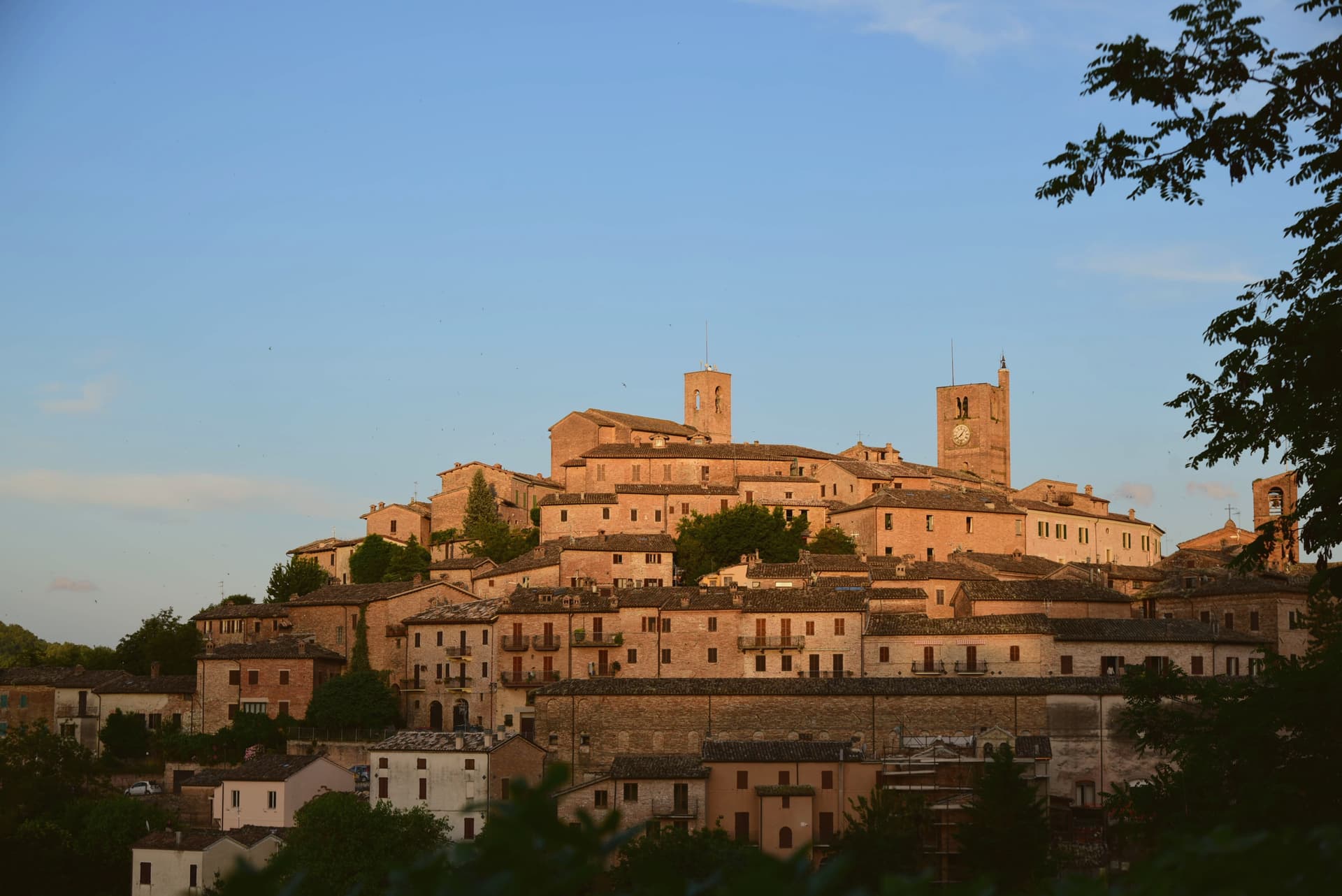
Sarnano sits on a hill within the Monti Sibillini National Park, seventy kilometers from Ancona. The old free commune built its civic center at the top of the settlement, where the square gathers the palazzi of the medieval government side by side with the church, a small stage for a town that once governed itself.
Below, the brick lanes drop away in concentric rings, the same baked brick used for houses that bridge the streets overhead and for small doors set into the walls to mark where the dead were once carried out. The spa lay downhill from the old town, drawing on springs pure enough to be used for respiratory, rheumatic and joint treatments from the 1930s until the earthquake of 24 August 2016 shut the historical building down; a new facility is being built to replace it.
Above the town, on Sassotetto, the ski slopes and the Sasso Spaccato mark the upper territory as the seasonal counterpart to the streets below. The town reads, then, as a set of layers stacked by elevation and by era: a governing hilltop, a residential brick warren beneath it, a therapeutic spa at the edge, and a working mountain above, each holding its own use across centuries rather than competing for the same one.
What to see in Sarnano
- Piazza Alta. The fourteenth-century Palazzo del Popolo, Palazzo dei Priori and Palazzo del Podestà stand together on the small civic stage of the old free commune, the church at their side.
- Centro storico di Sarnano. The lanes wind in concentric rings, crossed overhead by ponte houses, and small bricked-up doors of the dead are set into the walls at intervals along the brick.
- Chiesa di Santa Maria di Piazza Alta. Romanesque-gothic facade on the square's church, which once held the town's civic art collection, since moved to the Pinacoteca.
How to get to Sarnano
Ancona is roughly 84 minutes away by road.
Our tip
April through June and September into October are the best months for Sarnano. The Sibillini meadows turn green from May, the lavender fields above town bloom in early July, and the autumn light brings the brick centro storico to its warmest tone. July and August touch the high twenties at 539 meters but the elevated position and the forested slopes above keep the evenings cool. Festa del Ciauscolo e del salame spalmabile falls in September.
San Ginesio
Why visit San Ginesio
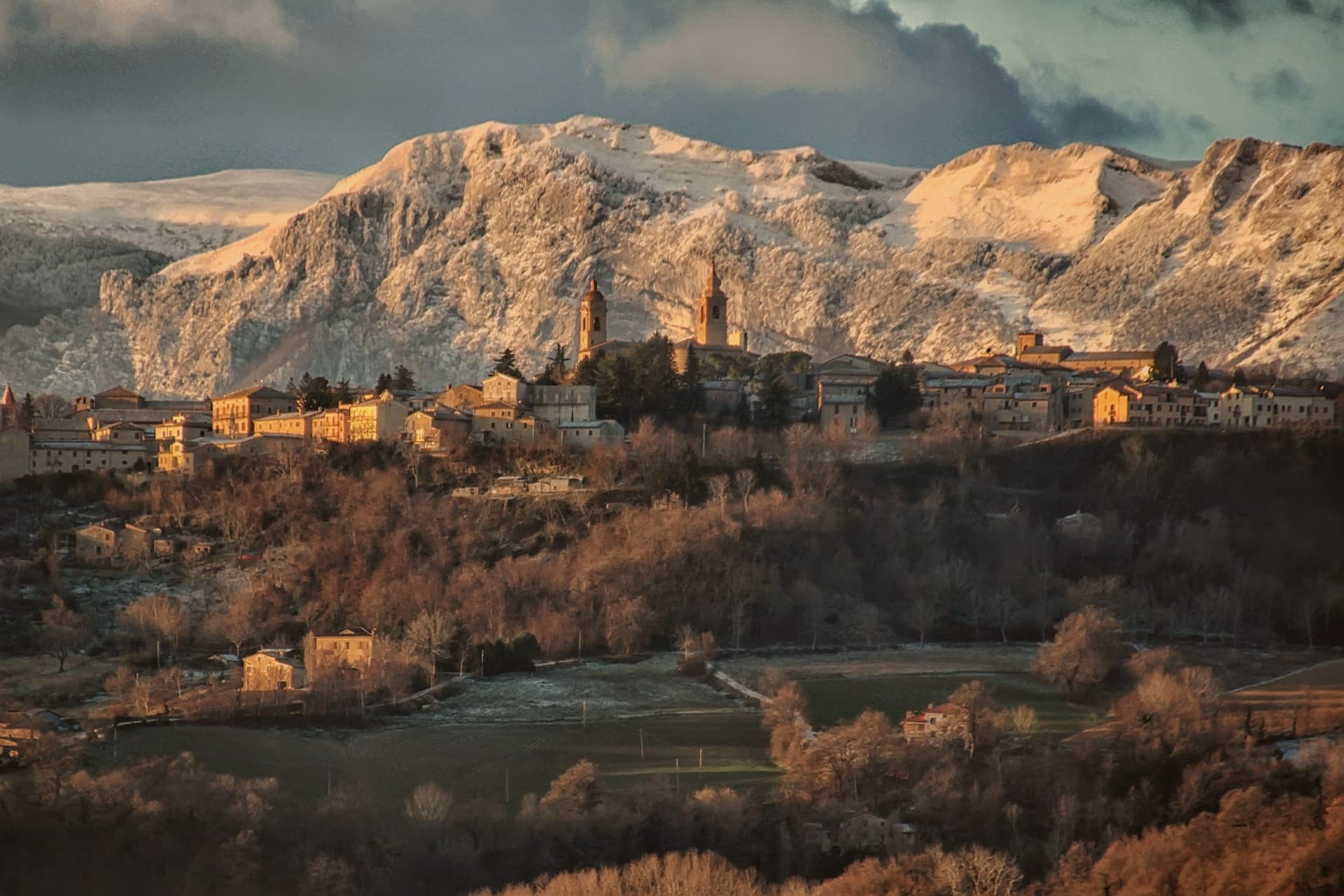
San Ginesio sits at 680 meters on a hill in the Macerata province, fifth highest commune in the province, on ground that Norman bourgeoisie first fortified in the tenth century to control the valley below. The town ran for a time as a free republic before joining the Papal States under Cardinal Albornoz's fourteenth-century constitutions, and it passed under the Da Varano of Camerino from 1355 to 1434.
A rivalry with the March of Fermo was settled at the Battle of Fornarina on 30 November 1377. The historic center gathers its civic and religious buildings around one square, the church, the hospital and the town hall standing within sight of each other, a layout that still reads as the working core of the old republic.
Outside the walls the ground rises toward the Sibillini massif, and the commune's territory reaches into the national park, so the same town that faces a piazza of medieval stone also has trails running from its western frazioni up into high pasture. The 2016 earthquake damaged many buildings and reconstruction is ongoing.
What the centuries of fortification, republic, and rivalry left behind is a hill town whose walls still look both ways: down over the valley it once controlled, and out toward the mountains that give it its name.
What to see in San Ginesio
- Collegiata della Santissima Annunziata. Fourteenth-century brick facade holds a Bernardino di Mariotto altarpiece inside. The building anchors one side of the square it faces.
- Ospedale dei Pellegrini. Sandstone columns with leaf capitals support the lower portico, an example of domus hospitales built along the pilgrim road. The brick loggia added above sits a century and a half later than the ground floor.
- Piazza Gentili. Central piazza of the centro storico, anchored by the Collegiata, the Palazzo del Comune and the Ospedale dei Pellegrini.
How to get to San Ginesio
Ancona is roughly 77 minutes away by road.
Our tip
May through October is the working window for San Ginesio. The Sibillini meadows turn green from May, the Balcony view reaches its clearest air through June and again in September, and the Battle of Fornarina commemoration runs each year on the last weekend of August. July and August touch the high twenties at 680 meters but the ridge breeze keeps the centro storico cool through the afternoons; the festa weekends fill Piazza Gentili. Fiera a San Liberato falls in August.
Ripatransone
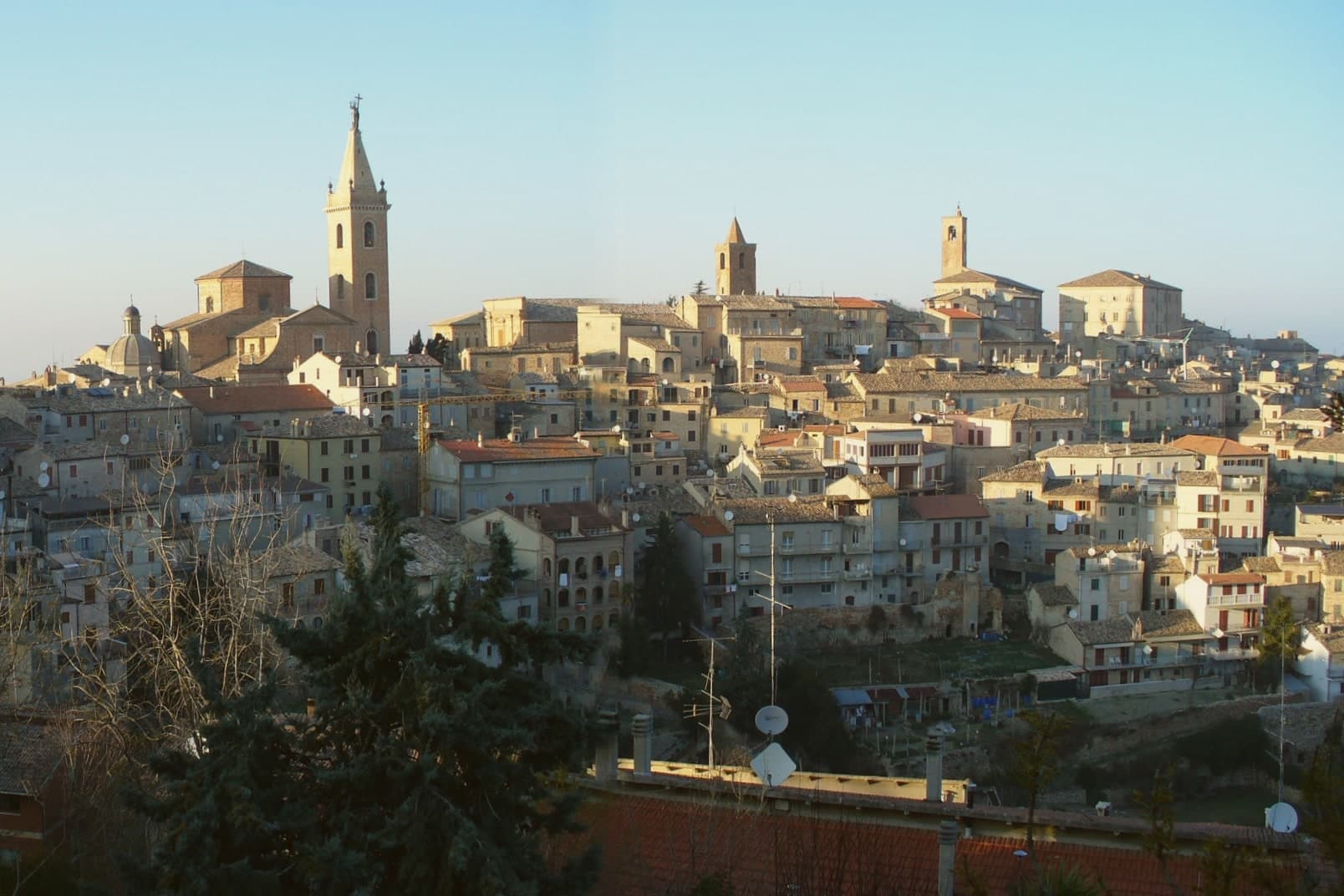
Why visit Ripatransone
Ripatransone sits at 494 meters on a ridge between the Tesino and Menocchia valleys, twenty kilometers from Ascoli Piceno and seven from the Adriatic, with views from the Sibillini and Gran Sasso to the coast that earned it the nickname Belvedere del Piceno. The hill has been inhabited since prehistory and was settled by the Umbri and then the Piceni; after centuries of Roman quiet a medieval town grew here from a circle of castles unified in 1096.
Pope Pius V raised it to City and diocesan see in 1571. The name combines ripa, cliff, with Transone, the first feudal lord.
The Vicolo più stretto d'Italia, the narrowest alley in Italy at 43 centimeters and 32 at its tightest point, runs between two stone houses near Via Margherita: shoulders go sideways. The Cavallo di Fuoco, a wooden horse covered in fireworks that gallops across the main piazza on the Sunday after Easter, has run since 1682.
What to see in Ripatransone
- Vicolo più stretto d'Italia. The narrowest alley in Italy, 43 centimeters wide and 32 at its tightest point, between two stone houses near Via Margherita.
- Piazza XX Settembre. The main square of the centro storico, with the Palazzo del Podestà, the Cathedral of San Gregorio Magno and the medieval Torre Civica.
- Cattedrale di San Gregorio Magno. Cathedral built between the seventeenth and eighteenth centuries on the site of an earlier church, raised to cathedral status by Pope Pius V in 1571.
How to get to Ripatransone
Pescara is roughly 70 minutes away by road.
Our tip
April through June and September into October are the working months for Ripatransone. The Tesino and Menocchia valleys turn green from April, the Cavallo di Fuoco runs on the Sunday after Easter, and the autumn light brings the clearest views from the ridge across to the Sibillini and the sea. July and August touch the low thirties; the ridge breeze keeps the centro storico cooler than the coastal plain seven kilometers below. Festival Frittella di Zia Maria falls in September.
Arcevia
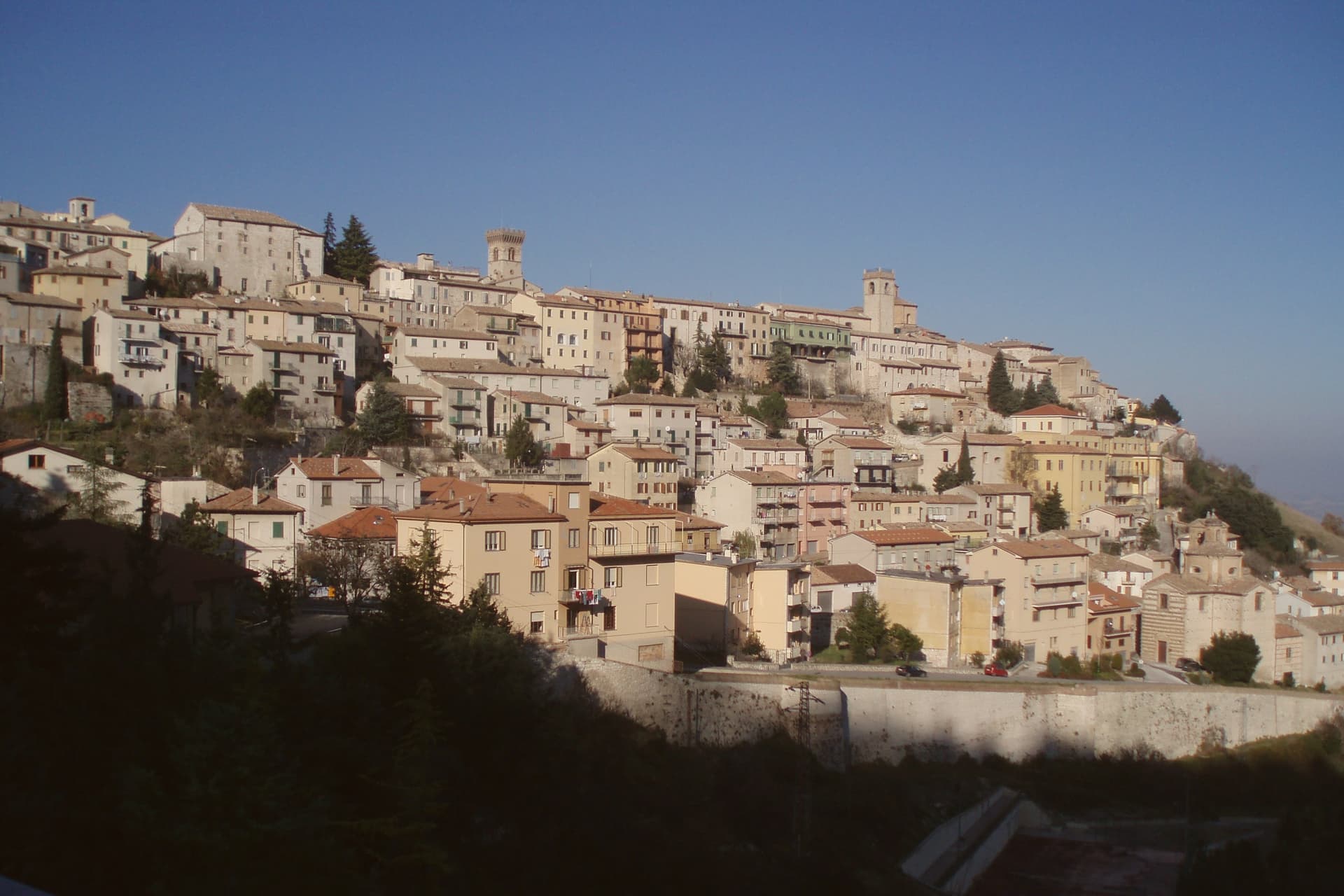
Why visit Arcevia
Arcevia sits at 535 meters between the Misa and Nevola valleys, forty-five kilometers from Ancona and inside the Parco Naturale Regionale della Gola della Rossa e di Frasassi. The town was the medieval seat of a free commune that built nine fortified satellite villages on the surrounding ridges between the thirteenth and fifteenth centuries to defend its territory against Serra San Quirico and other rivals: Avacelli, Castiglioni, Caudino, Loretello, Montale, Nidastore, Palazzo, Piticchio and San Pietro.
Loretello, the oldest, was founded in 1072 by the monks of Fonte Avellana. Each of the eight surviving castles retains its original layout, defensive walls and watchtower; together they form one of the most coherent medieval fortified networks in central Italy.
The Collegiata di San Medardo, in the capoluogo, holds a Luca Signorelli polyptych and a Giovanni della Robbia terracotta altarpiece. The Misa valley wines and the cooperative-pressed olive oil carry the local table.
What to see in Arcevia
- I Nove Castelli. Avacelli, Castiglioni, Caudino, Loretello, Montale, Nidastore, Palazzo, Piticchio and San Pietro: medieval fortified villages on the ridges around the capoluogo.
- Castello di Loretello. Oldest of the nine, founded 1072 by the monks of Fonte Avellana, expanded in the late fourteenth century, intact circuit of walls.
- Collegiata di San Medardo. Capoluogo's main church, holding a Luca Signorelli polyptych of 1507 and a Giovanni della Robbia terracotta altarpiece.
How to get to Arcevia
Ancona is roughly 69 minutes away by road.
Our tip
April through June and September into October are the best months for Arcevia. The Misa and Nevola valleys turn green from April, the vineyards on the surrounding ridges color from late August, and the woodland trails to the satellite castles stay open through autumn. July and August touch the high twenties at 535 meters; the ridge breeze keeps the centro storico cooler than the valley floor. Festa del Tartufo Nero Estivo falls in August.
Offida
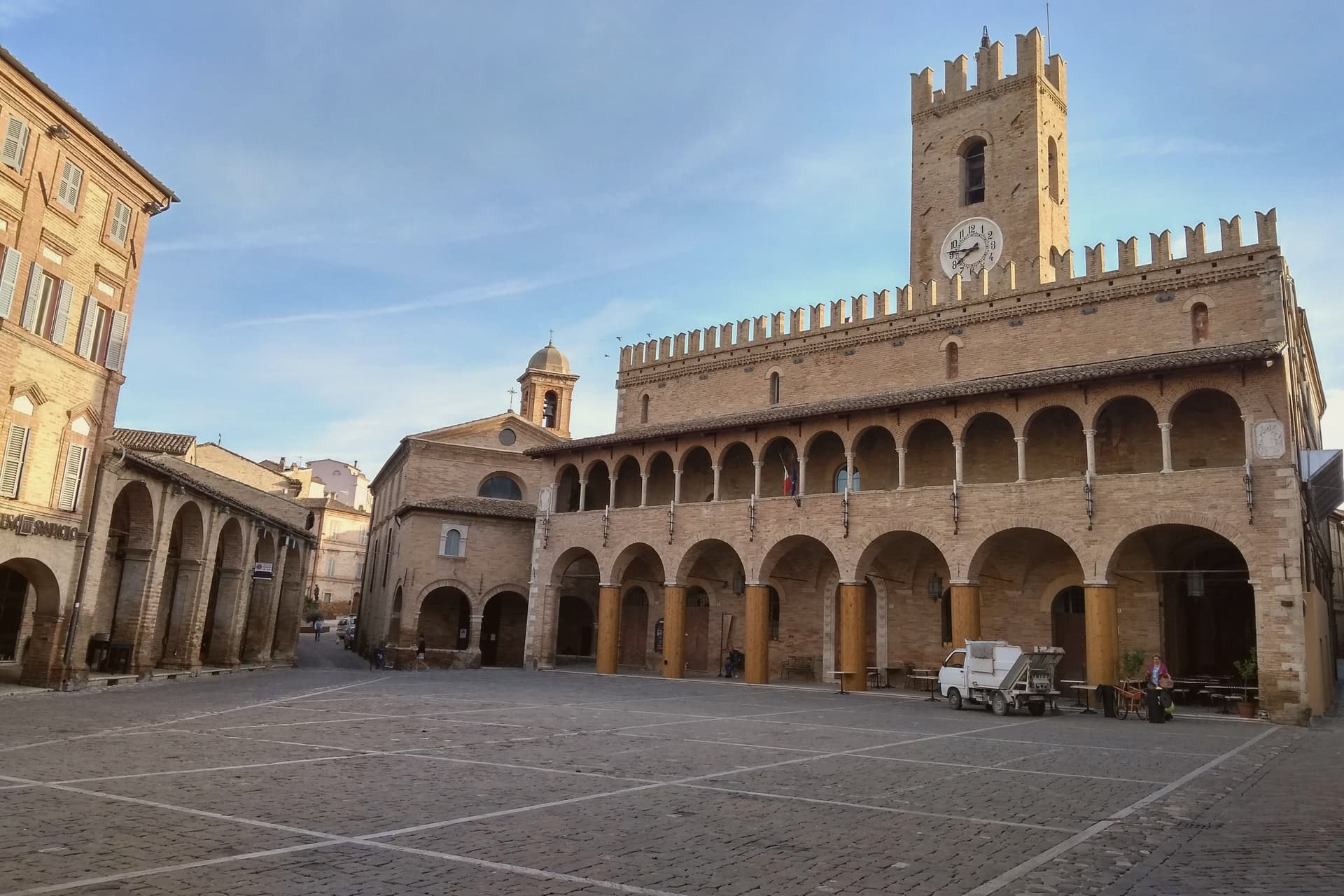
Why visit Offida
Offida sits at 293 meters on a cliff between the Tesino and Tronto valleys, twenty-three kilometers from Ascoli Piceno. The Chiesa di Santa Maria della Rocca rises on a rock spur at the western edge of the village, surrounded on three sides by cliffs that drop into two valleys: a Romanesque-Gothic temple in brick and travertine, raised by Master Albertino in 1330 on an older Benedictine foundation, with a double row of trilobed arches around the apse.
Inside, the apse and transept hold the fresco cycle of the Master of Offida, an anonymous monk painter who carried Giotto's lesson through the Rimini school, with the Marriage of Saint Catherine and Saint Christopher dated by inscription to 1367. Bobbin lace, merletto a tombolo, has been worked in town since the fifteenth century; the Museo del Merletto in Palazzo De Castellotti holds the collection.
The Carnevale Storico, with the Bove finto run and the Vlurd fire bundles, dates from before Lent in early February.
What to see in Offida
- Chiesa di Santa Maria della Rocca. Romanesque-Gothic brick-and-travertine church raised in 1330 by Master Albertino on a rock spur west of town, with the Master of Offida fresco cycle dated 1367 in the transept.
- Museo del Merletto a Tombolo. Inside Palazzo De Castellotti, with the lace collection, tools, historical documents and demonstrations of the bobbin-lace work practiced in town since the fifteenth century.
- Palazzo Comunale. Civic palace on the long Piazza del Popolo, with a portico, the Teatro Serpente Aureo and the access to the Museo del Merletto and the archaeological museum.
How to get to Offida
Pescara is roughly 74 minutes away by road.
Our tip
April through June and September into October are the best months for Offida. The hills around the town turn green by April and gold through the September harvest, the wine cellars run open tastings between vendemmia and St. Martin, and the Pecorino and Passerina vineyards stand out along the ridges. Sagra del Chichìripieno falls in August.
Pergola
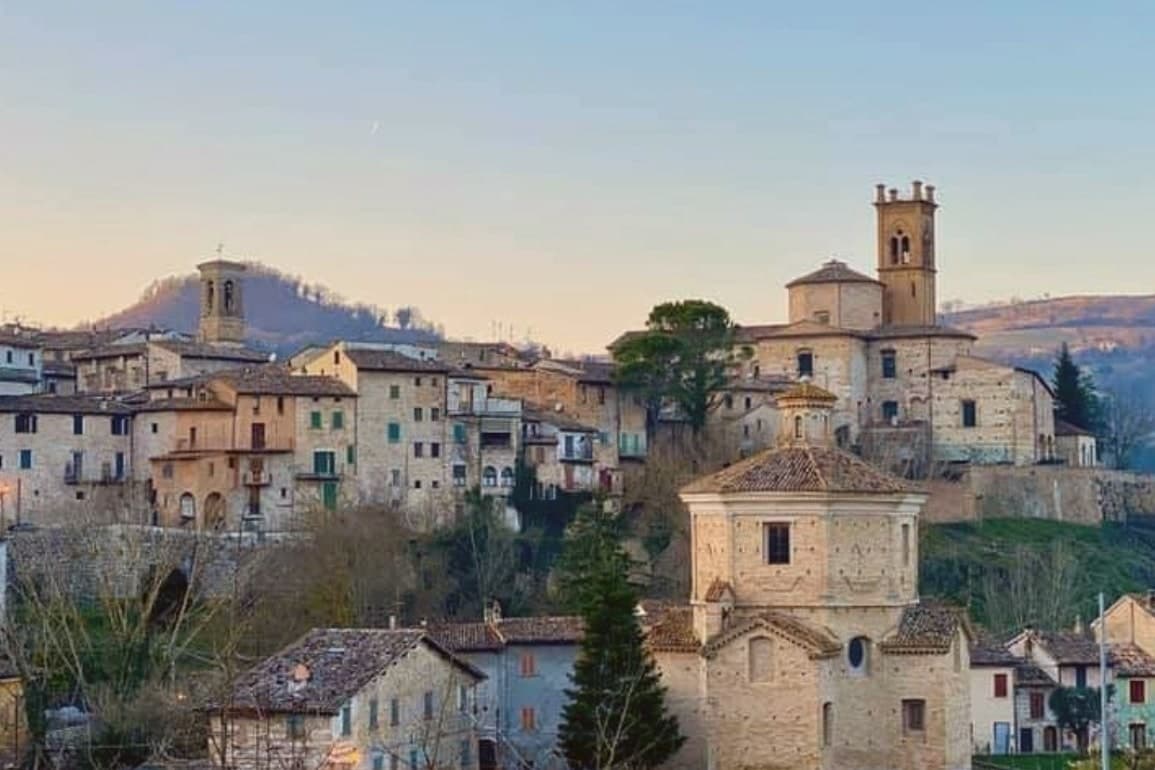
Why visit Pergola
Pergola sits at 265 meters on a terrace at the confluence of the Cesano and the Cinisco, fifty-five kilometers from Ancona in the inland Apennines. The town was founded in 1234 by the people of Gubbio with inhabitants of the surrounding castles, raised on older Roman ground along the Via Flaminia.
The defining find is the Bronzi Dorati da Cartoceto: hundreds of gilded bronze fragments unearthed in June and July 1946 at Santa Lucia di Calamello, in the frazione of Cartoceto, the only surviving group of Roman gilded bronze statues from antiquity. Reassembled into two standing women, two riders and two horses, the group dates to the late Republican period between 50 and 30 BC and is held in the Museo dei Bronzi Dorati, opened on 9 October 1999 in the fourteenth-century convent of San Giacomo.
Pergola is also a Città del Tartufo, with the Mostra Mercato del Tartufo Bianco Pregiato running across three weekends in October.
What to see in Pergola
- Museo dei Bronzi Dorati e della Città di Pergola. Opened 9 October 1999 in the fourteenth-century former convent of San Giacomo, holding the only surviving group of Roman gilded bronze statues, found at Cartoceto in 1946.
- Bronzi Dorati da Cartoceto di Pergola. Two standing women, two riders and two horses in gilded bronze from the late Republican period, 50 to 30 BC, the only surviving group of its kind in the world.
- Cattedrale di San Secondo. Pergola was a co-cathedral diocese until 1986; the cathedral on the central piazza holds works tied to the medieval and renaissance town.
How to get to Pergola
Ancona is roughly 75 minutes away by road.
Our tip
April through June and September into October are the best months for Pergola. The Cesano valley turns green in spring, the white truffle woods open from late September, and the inland Apennine air stays clearer than the coast on summer days. July and August touch the high twenties at 265 meters, with the centro storico quietest through midday. Sagra delle Tagliatella falls in August.
Treia
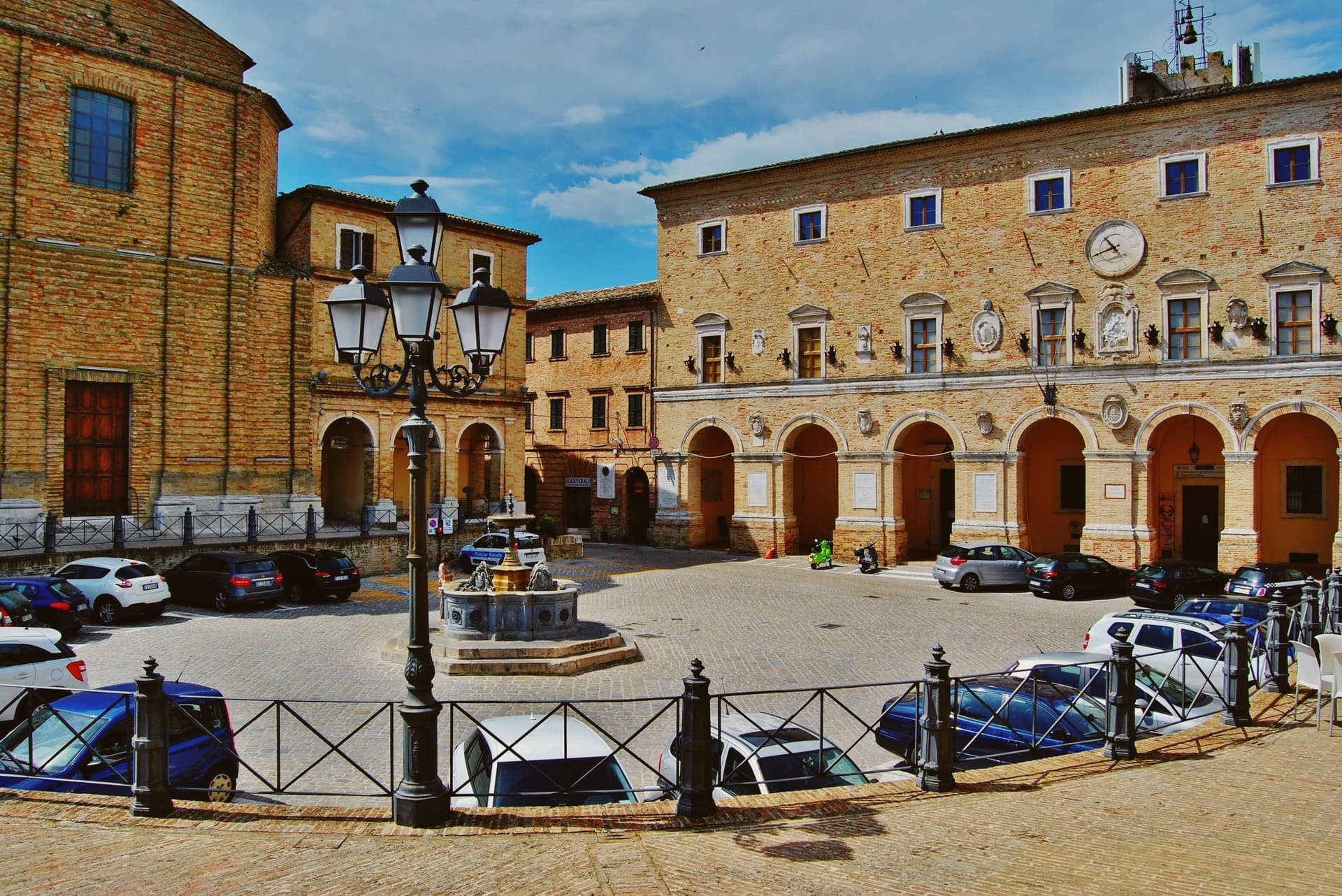
Why visit Treia
Treia stands at 342 meters in the hills between the Potenza and Chienti valleys, thirty-five kilometers from Ancona. The Roman town of Trea lay on the plateau below, a municipium founded shortly after 49 BC that flourished between Augustus and Antoninus Pius.
Around the year 1000 the population moved up to the more defensible hilltop of Montecchio, and the older site emptied. The new town stayed under the name Montecchio until 1790, when Pope Pius VI raised it to the rank of città and restored its Roman name.
The Piazza della Repubblica, on the highest point of the ridge, is closed at one end by the Cattedrale della Santissima Annunziata and at the other by Giuseppe Valadier's small Accademia Georgica, the eighteenth-century home of an agronomic academy founded in the fifteenth as the Accademia dei Sollevati. The Disfida del Bracciale, an Ottocento street-game in which four contrade compete, has filled the centro storico every first Sunday of August since 1978.
The re-enactment here is Disfida del Bracciale, usually held across July and August.
What to see in Treia
- Piazza della Repubblica. Belvedere piazza on the highest point of the ridge, closed by the Cattedrale della Santissima Annunziata at one end and the Accademia Georgica at the other.
- Accademia Georgica. Eighteenth-century Giuseppe Valadier building housing an academy founded in the 1400s, with 1,196 parchments of the municipal archive and over 15,000 volumes.
- Santuario del Santissimo Crocifisso. Cesare Bazzani sanctuary completed in the early twentieth century on the site of an older parish church, holding a sixteenth-century Umbrian fresco and a thirteenth-century crucifix.
How to get to Treia
Ancona is roughly 58 minutes away by road.
Our tip
April through June and September into October are the best months for Treia. The hills between the Potenza and Chienti turn green in spring, the wheat ripens through June, and the autumn light on the long ridge runs gold through October. July and August touch the low thirties; the high point of the centro storico catches a breeze most afternoons, and the Disfida del Bracciale on the first Sunday of August is the busiest weekend of the year. Disfida del Bracciale falls in July.
Fermo
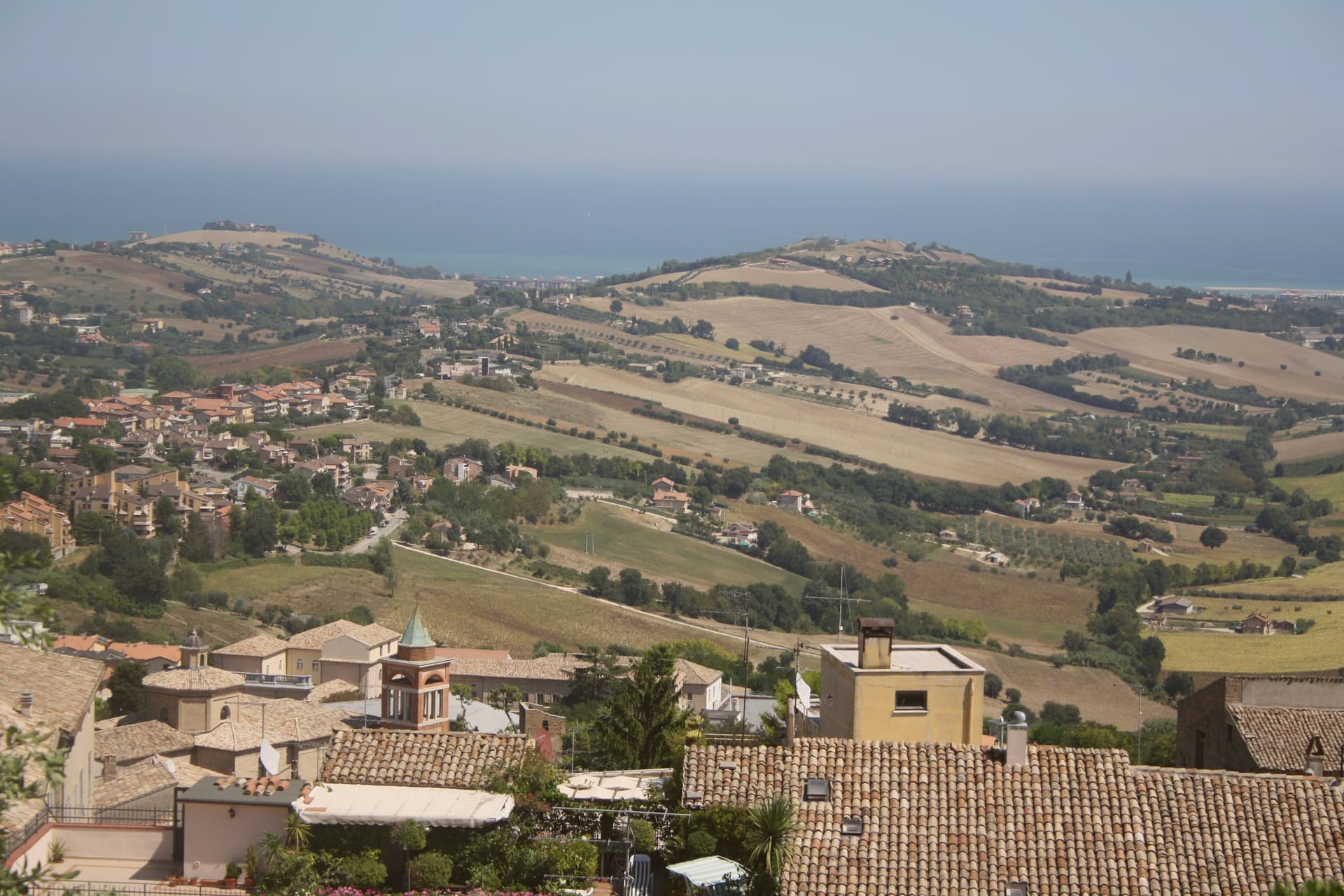
Why visit Fermo
Fermo sits eight kilometers inland from the Adriatic and from the seaside frazione of Lido di Fermo, which holds the commune's Bandiera Blu: a hill town with its own beach attached at a distance, the two connected by the same municipal boundary but separated in character and elevation. The Roman colony of Firmum Picenum was founded on the hilltop in 264 BC after the conquest of the Picentes, with six thousand Latin colonists settled there.
In the tenth century the town became the capital of the Marchia Firmana, the territorial label that eventually gave the region its name. The historic center still reads as a hilltop capital looking down toward a coast it administers rather than touches.
What began as a Latin colony on high ground, gained a name that outgrew it and spread to the whole region, and kept its port at arm's length: the distance between the hill and the shore is not incidental but the shape of how Fermo has always held its territory.
The re-enactment here is Cavalcata dell'Assunta, usually held in August.
What to see in Fermo
- Cisterne Romane. Thirty barrel-vaulted rooms in three parallel rows under the historic center, opus signinum waterproofing still in place, built to hold 15,000 cubic meters of water.
- Piazza del Popolo. The porticoes meet at the head of the square where the Palazzo dei Priori stands, the arrangement that has organized the civic center since the medieval period.
- Palazzo dei Priori. Built in 1296 by joining a thirteenth-century palace and a church, housing the Pinacoteca Civica, the Sala del Mappamondo and the Sixtus V bronze statue.
How to get to Fermo
Ancona is roughly 60 minutes away by road.
Our tip
April through June and September into October are the months for Fermo. The hilltop catches Adriatic light without coastal humidity, the Sabulo's wide views across the Aso and Tenna valleys run clear, and Lido di Fermo's beach eight kilometers below holds its Bandiera Blu status from May. July and August touch the low thirties in the valley but the centro storico stays cooler at 319 meters; the Cavalcata dell'Assunta on August 15 fills the streets with the historic medieval procession dating to 1182. Cavalcata dell'Assunta falls in August.
More from Anywhere Italy
 The best hill towns with a food festival within 90 minutes of Ancona
- The best towns with a food festival that eat well in Marche
 The 8 prettiest villages that eat well in Marche
- The best hill towns in the province of Ascoli Piceno
 The prettiest villages in the province of Macerata
 The 7 best hill towns in the province of Fermo