
The 8 prettiest villages that eat well in Marche
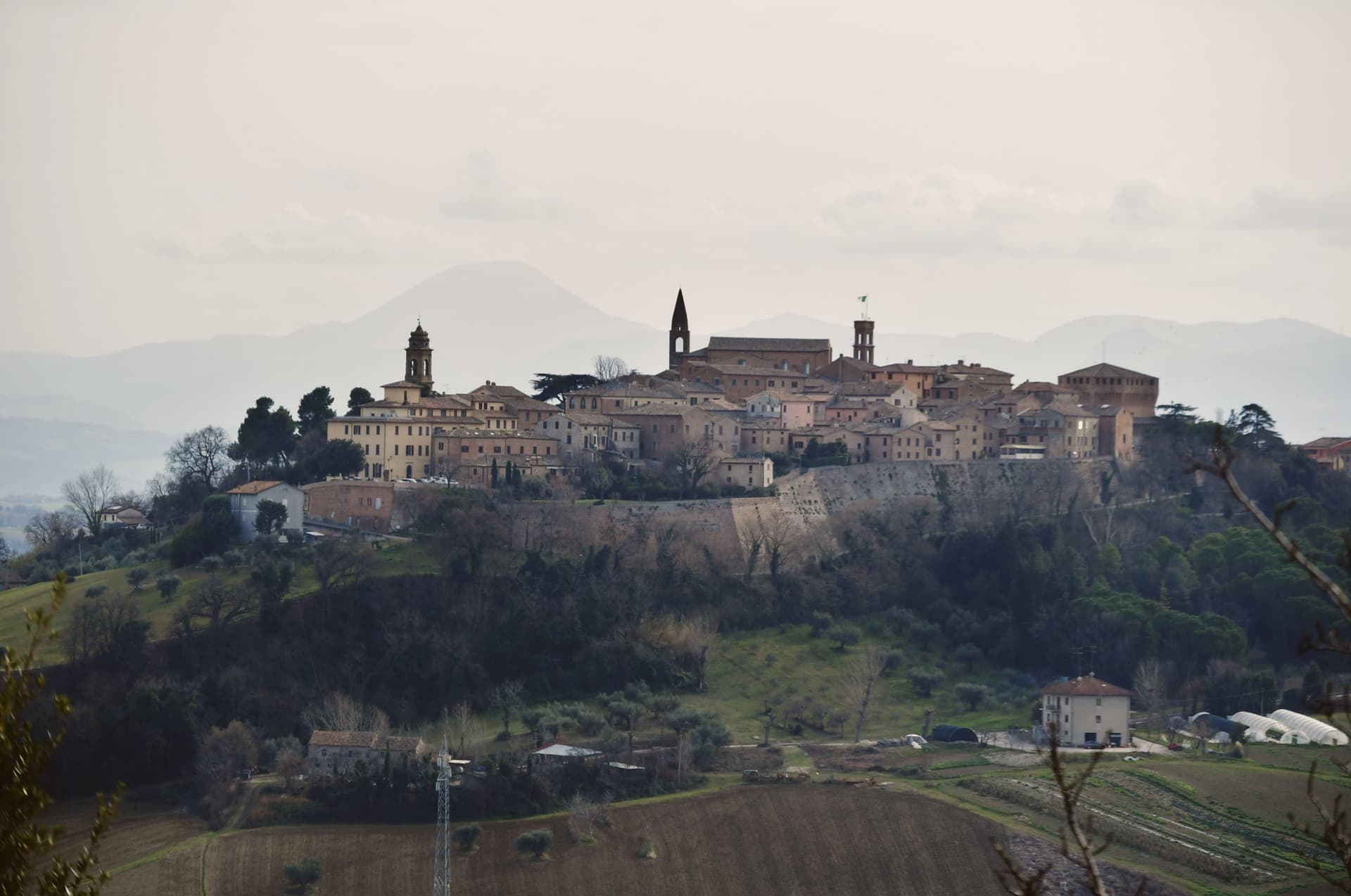
Marche builds its villages out of warm brick and pale travertine, set on ridges above vineyards, sunflower fields and the long combed lines of ploughed clay. The food follows the geography down from the mountains to the sea: vincisgrassi layered and baked until the top blisters, olive all'ascolana fried in the late afternoon, brodetto on the coast, ciauscolo soft enough to spread on bread. Verdicchio and pecorino fill the wine lists, and rosso piceno turns up in the glass at village tables where lunch runs past two. Spring and early autumn are the good months, when the hills stay green and the terraces open again.
Most visitors to the region give a day to Urbino, climbing to the Palazzo Ducale and the Raphael house, then move on. The ducal city deserves the attention, but its centre is small, its stairs are steep, and in high summer the coaches arrive together and the restaurants near the piazza turn over fast. It becomes the whole of Marche for a lot of people who never leave it.
The same hills, the same brick, the same kitchens continue south and east past Urbino, through the Fermano and the Piceno and down towards the Adriatic. These villages have all passed the national assessment of Italy's most beautiful villages, and in each one a dining guide has named a table worth sitting down at. Fewer people go, which mostly means it is easier to get a seat.
Of the 63 communes we have mapped in Marche, 8 qualify as prettiest villages that eat well: each has passed the national assessment of Italy's most beautiful villages, and a dining guide has named a table in each. The smallest, Mondavio, has 3,634 residents.
Elsewhere in the catalogue: The best towns with a food festival that eat well in Marche and The 10 best hill towns that eat well within 90 minutes of Ancona.
Mondavio
Why visit Mondavio
Mondavio sits at 280 meters on a hill between the Cesano and the Metauro rivers, twenty kilometers inland from Senigallia. The fortress at its center was built over an earlier medieval structure, and its patron used the commission to test a new kind of defensive geometry: an octagonal keep on a wide base of trapezoidal walls that incline outward in a helical line, with sightlines arranged so attackers could not aim straight at the walls.
The fortress was never attacked. Both the patron and the architect died in 1501, and the building remained slightly short of the original plan.
The town's walled core still gathers around that fortress, entered through two surviving gates and threaded with stone lanes that open onto the central piazza and the Palazzo Comunale. The Festa del Duca in August fills those same streets with costumed jousting and crossbow trials, a fair echo of the military purpose the walls were built for.
What the geometry was designed to prevent, an attack that never came, is now what the town preserves and re-enacts each summer.
Al Giardino da Giamburesti, Maria have been named by a guide.
What to see in Mondavio
- Rocca Roveresca. Commissioned by Giovanni della Rovere from Francesco di Giorgio Martini, built 1482-1492, octagonal keep on inclined trapezoidal walls designed to deflect cannon fire.
- Museo di Rievocazione Storica. Inside the Rocca, presents life in a Renaissance fortress with reconstructed armory, kitchen, prison and ballista chamber.
- Teatro Apollo. Eighteenth-century theatre at the heart of the borgo, all wood, with a horseshoe plan and four orders of boxes.
How to get to Mondavio
Ancona is roughly 61 minutes away by road.
Our tip
April through October is the working window for Mondavio. The hills between the Cesano and the Metauro turn green from April, the Rocca and the Teatro Apollo are open every day, and the surrounding olive and grain country opens for slow walks. The Festa del Duca in mid-August fills the streets with costumed jousting and crossbow trials.
Ripatransone
Why visit Ripatransone
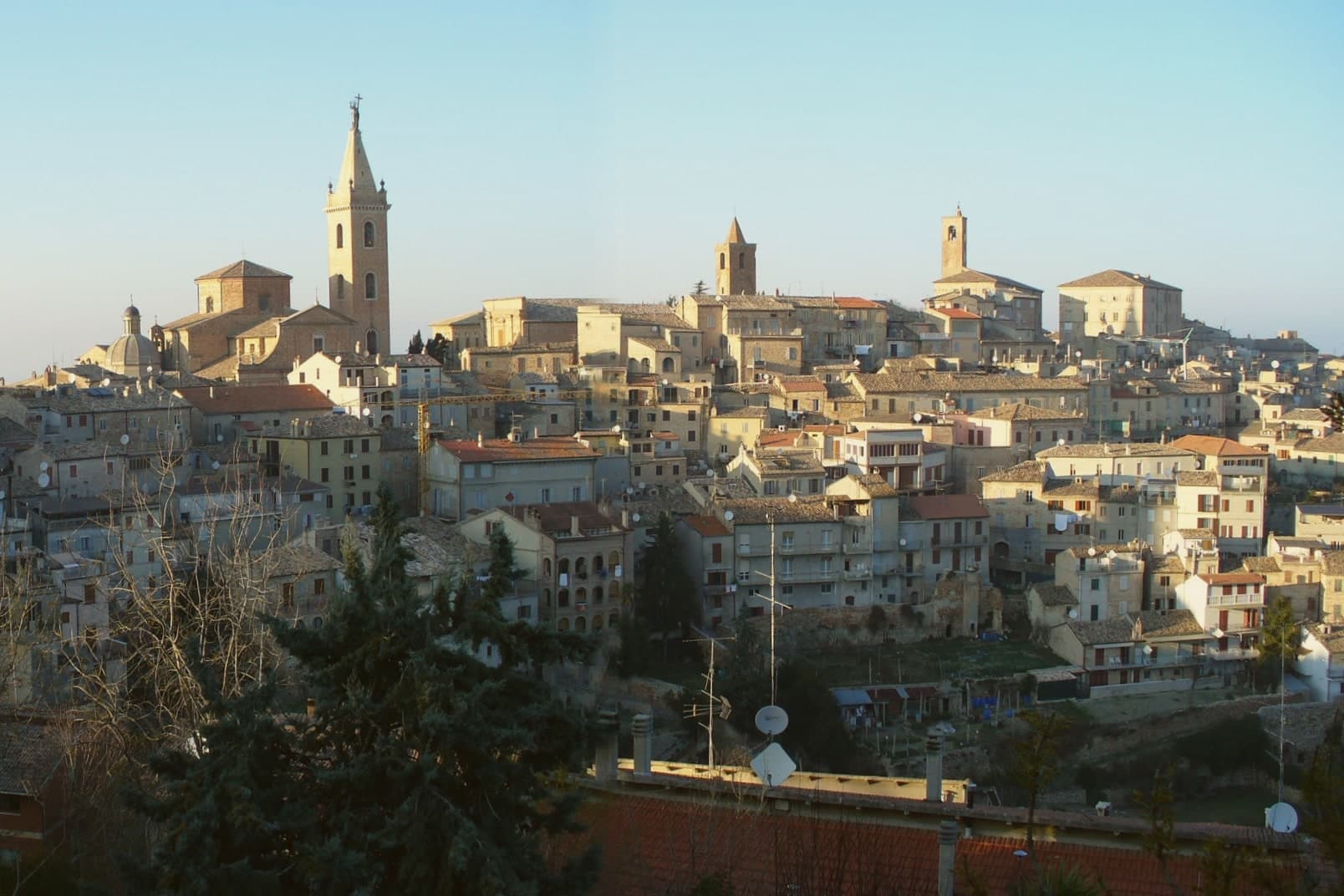
Ripatransone sits at 494 meters on a ridge between the Tesino and Menocchia valleys, twenty kilometers from Ascoli Piceno and seven from the Adriatic, with views from the Sibillini and Gran Sasso to the coast that earned it the nickname Belvedere del Piceno. The hill has been inhabited since prehistory and was settled by the Umbri and then the Piceni; after centuries of Roman quiet a medieval town grew here from a circle of castles unified in 1096.
Pope Pius V raised it to City and diocesan see in 1571. The name combines ripa, cliff, with Transone, the first feudal lord.
The Vicolo più stretto d'Italia, the narrowest alley in Italy at 43 centimeters and 32 at its tightest point, runs between two stone houses near Via Margherita: shoulders go sideways. The Cavallo di Fuoco, a wooden horse covered in fireworks that gallops across the main piazza on the Sunday after Easter, has run since 1682.
Iervasciò, Trattoria da Rita have been named by a guide.
What to see in Ripatransone
- Vicolo più stretto d'Italia. The narrowest alley in Italy, 43 centimeters wide and 32 at its tightest point, between two stone houses near Via Margherita.
- Piazza XX Settembre. The main square of the centro storico, with the Palazzo del Podestà, the Cathedral of San Gregorio Magno and the medieval Torre Civica.
- Cattedrale di San Gregorio Magno. Cathedral built between the seventeenth and eighteenth centuries on the site of an earlier church, raised to cathedral status by Pope Pius V in 1571.
How to get to Ripatransone
Pescara is roughly 70 minutes away by road.
Our tip
April through June and September into October are the working months for Ripatransone. The Tesino and Menocchia valleys turn green from April, the Cavallo di Fuoco runs on the Sunday after Easter, and the autumn light brings the clearest views from the ridge across to the Sibillini and the sea. July and August touch the low thirties; the ridge breeze keeps the centro storico cooler than the coastal plain seven kilometers below. Festival Frittella di Zia Maria falls in September.
Offida
Why visit Offida
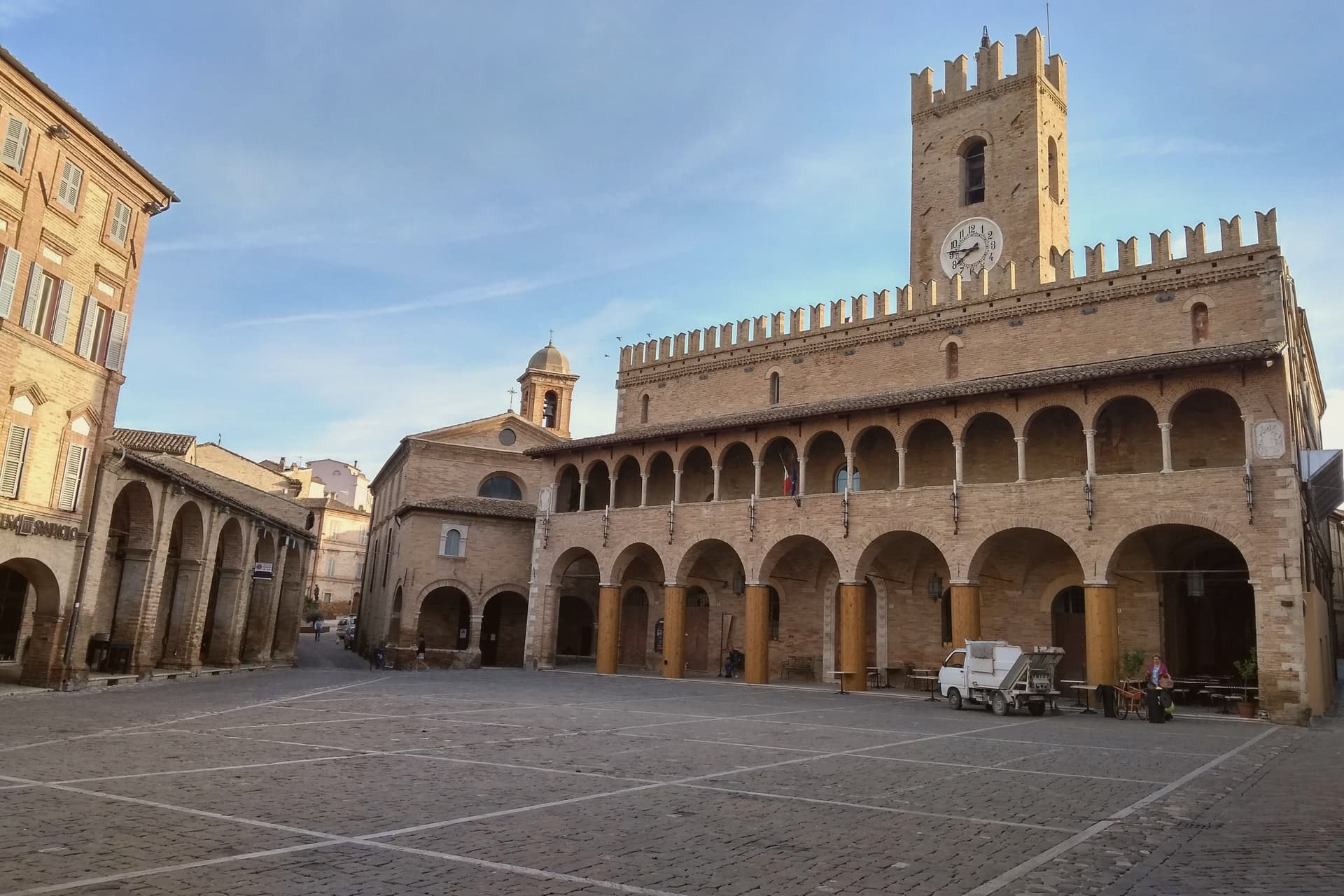
Offida sits at 293 meters on a cliff between the Tesino and Tronto valleys, twenty-three kilometers from Ascoli Piceno. The Chiesa di Santa Maria della Rocca rises on a rock spur at the western edge of the village, surrounded on three sides by cliffs that drop into two valleys: a Romanesque-Gothic temple in brick and travertine, raised by Master Albertino in 1330 on an older Benedictine foundation, with a double row of trilobed arches around the apse.
Inside, the apse and transept hold the fresco cycle of the Master of Offida, an anonymous monk painter who carried Giotto's lesson through the Rimini school, with the Marriage of Saint Catherine and Saint Christopher dated by inscription to 1367. Bobbin lace, merletto a tombolo, has been worked in town since the fifteenth century; the Museo del Merletto in Palazzo De Castellotti holds the collection.
The Carnevale Storico, with the Bove finto run and the Vlurd fire bundles, dates from before Lent in early February.
Osteria Ophis, Blob Caffè & Ristorante have been named by a guide.
What to see in Offida
- Chiesa di Santa Maria della Rocca. Romanesque-Gothic brick-and-travertine church raised in 1330 by Master Albertino on a rock spur west of town, with the Master of Offida fresco cycle dated 1367 in the transept.
- Museo del Merletto a Tombolo. Inside Palazzo De Castellotti, with the lace collection, tools, historical documents and demonstrations of the bobbin-lace work practiced in town since the fifteenth century.
- Palazzo Comunale. Civic palace on the long Piazza del Popolo, with a portico, the Teatro Serpente Aureo and the access to the Museo del Merletto and the archaeological museum.
How to get to Offida
Pescara is roughly 74 minutes away by road.
Our tip
April through June and September into October are the best months for Offida. The hills around the town turn green by April and gold through the September harvest, the wine cellars run open tastings between vendemmia and St. Martin, and the Pecorino and Passerina vineyards stand out along the ridges. Sagra del Chichìripieno falls in August.
Montecosaro
Why visit Montecosaro
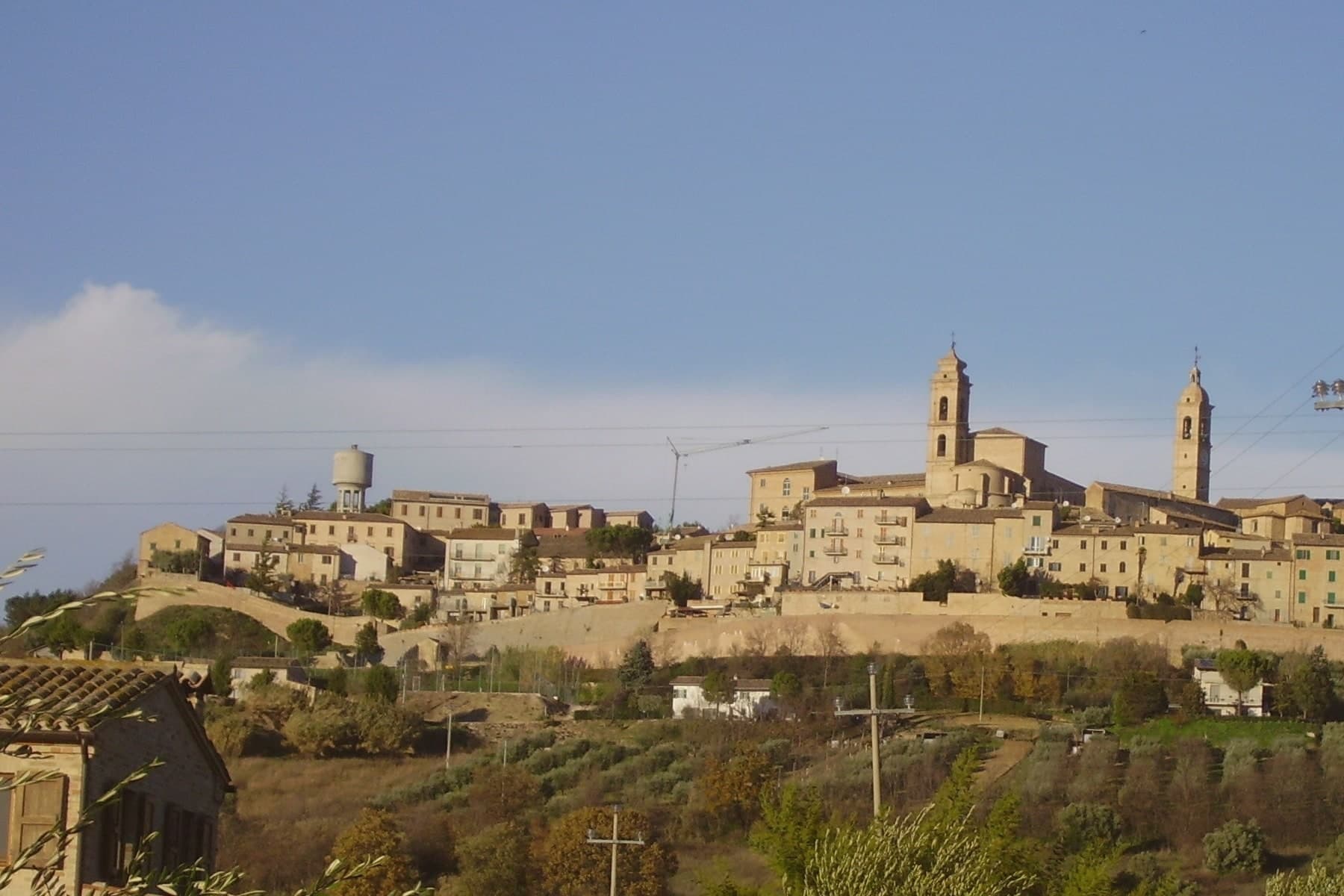
Montecosaro sits at 267 meters on a hill above the lower Chienti valley, fifteen kilometers from Macerata and inland from the Adriatic at Civitanova. The first record of a monastery in the river plain dates to 936, when the abbot Ildebrando received the church of Santa Maria from Farfa.
The current Basilica di Santa Maria a Piè di Chienti was raised in 1125 by the Lombard abbot Agenolfo, on the left bank a few kilometers from the river mouth: a three-nave Romanesque church with a raised presbytery and a ring of apsidioles, holding among the strongest Cluniac architecture in central Italy. The hilltop borgo above grew from a medieval castle after 1200, walled in the fourteenth century inside an oval that culminates at the Cassero, the former fortress now a public garden.
The Augustinian convent and the church of Sant'Agostino in the upper town date from the same century, rebuilt in the late eighteenth.
Due Cigni Ristorante have been named by a guide.
What to see in Montecosaro
- Basilica di Santa Maria a Piè di Chienti. Romanesque church rebuilt in 1125 by the Lombard abbot Agenolfo on a Farfa monastic foundation of 936, three naves with raised presbytery and apsidioles.
- Centro storico. Oval-walled medieval centro storico on the hill, with fourteenth-century walls and concentric streets climbing toward the Cassero.
- Cassero. Highest point of the walled borgo, where the medieval fortress once stood, now a public garden with views over the Chienti valley.
How to get to Montecosaro
There is a railway station in the town, so you can arrive without a car and never need one while you are here. Ancona is roughly 46 minutes away by road.
Our tip
April through June and September into October are the best months for Montecosaro. The Chienti valley turns green in spring and gold through the autumn harvest weeks, with mild afternoons on the hilltop and long views from the Cassero across to the Sibillini. July and August touch the low thirties; the hill catches more breeze than the river plain below, and the Basilica di Santa Maria stays cool through the day. Contesa dei Cento Ducati falls in August.
Treia
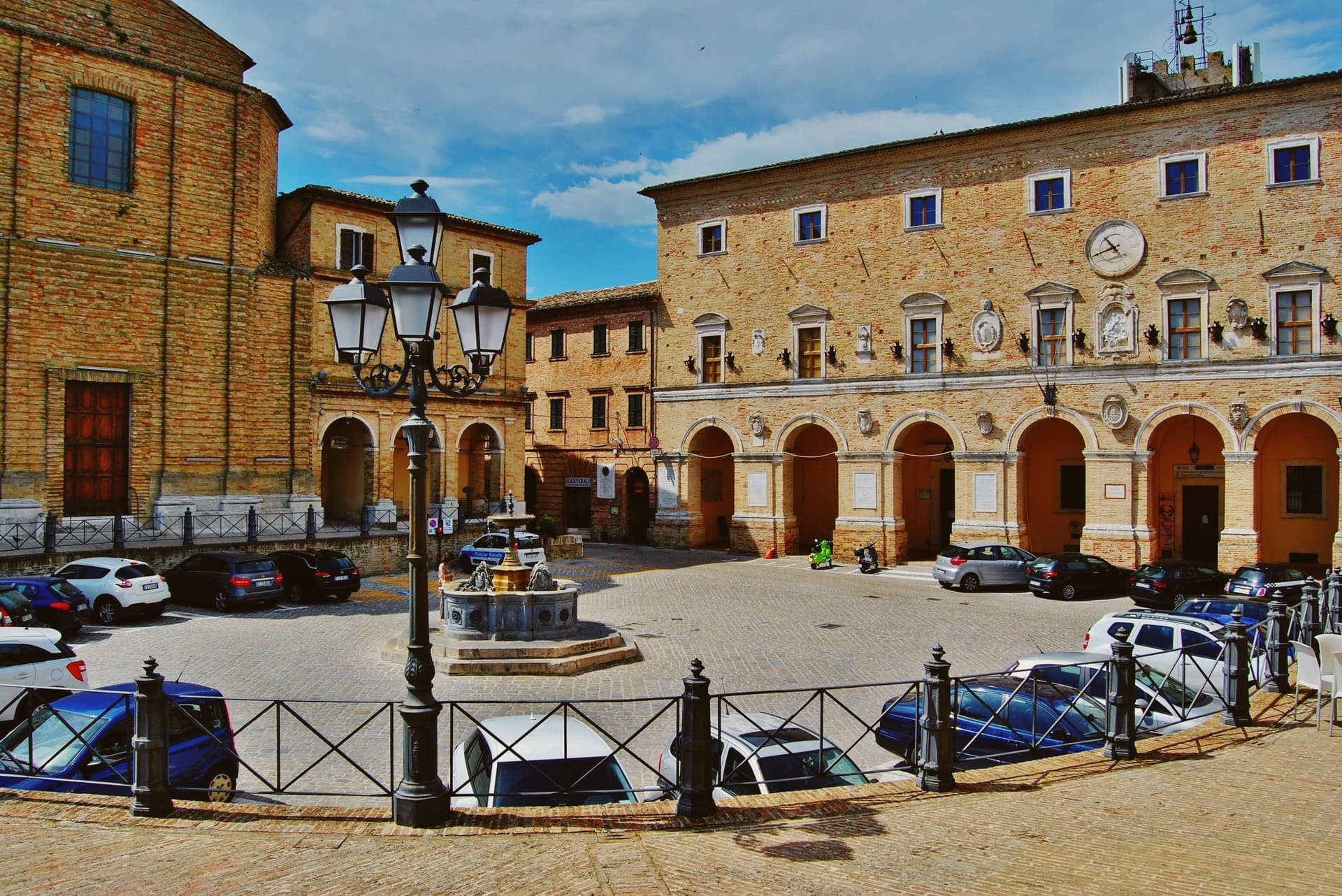
Why visit Treia
Treia stands at 342 meters in the hills between the Potenza and Chienti valleys, thirty-five kilometers from Ancona. The Roman town of Trea lay on the plateau below, a municipium founded shortly after 49 BC that flourished between Augustus and Antoninus Pius.
Around the year 1000 the population moved up to the more defensible hilltop of Montecchio, and the older site emptied. The new town stayed under the name Montecchio until 1790, when Pope Pius VI raised it to the rank of città and restored its Roman name.
The Piazza della Repubblica, on the highest point of the ridge, is closed at one end by the Cattedrale della Santissima Annunziata and at the other by Giuseppe Valadier's small Accademia Georgica, the eighteenth-century home of an agronomic academy founded in the fifteenth as the Accademia dei Sollevati. The Disfida del Bracciale, an Ottocento street-game in which four contrade compete, has filled the centro storico every first Sunday of August since 1978.
Il Casolare dei Segreti have been named by a guide.
What to see in Treia
- Piazza della Repubblica. Belvedere piazza on the highest point of the ridge, closed by the Cattedrale della Santissima Annunziata at one end and the Accademia Georgica at the other.
- Accademia Georgica. Eighteenth-century Giuseppe Valadier building housing an academy founded in the 1400s, with 1,196 parchments of the municipal archive and over 15,000 volumes.
- Santuario del Santissimo Crocifisso. Cesare Bazzani sanctuary completed in the early twentieth century on the site of an older parish church, holding a sixteenth-century Umbrian fresco and a thirteenth-century crucifix.
How to get to Treia
Ancona is roughly 58 minutes away by road.
Our tip
April through June and September into October are the best months for Treia. The hills between the Potenza and Chienti turn green in spring, the wheat ripens through June, and the autumn light on the long ridge runs gold through October. July and August touch the low thirties; the high point of the centro storico catches a breeze most afternoons, and the Disfida del Bracciale on the first Sunday of August is the busiest weekend of the year. Disfida del Bracciale falls in July.
Mondolfo
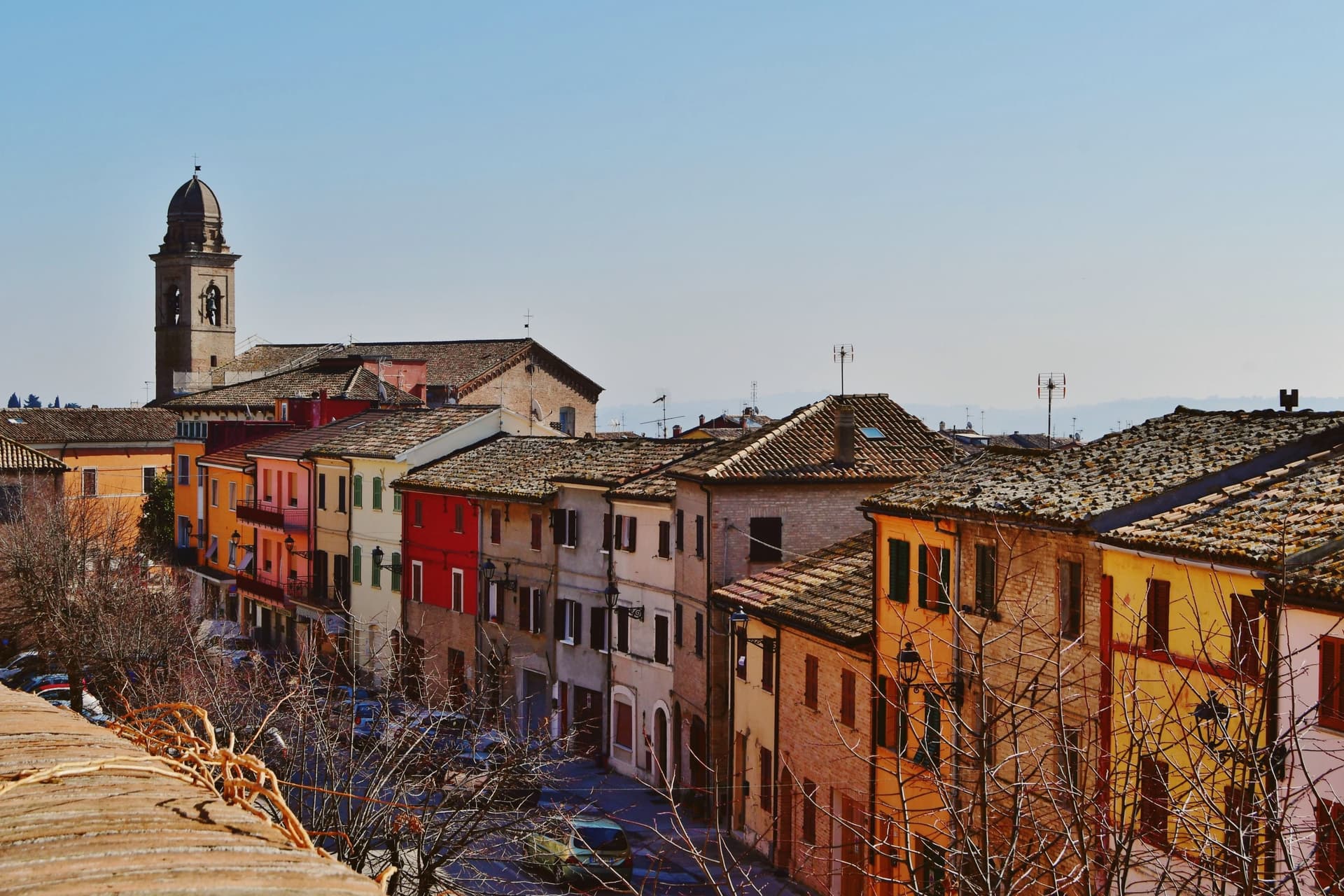
Why visit Mondolfo
Mondolfo sits at 144 meters on a ridge above the Adriatic between Pesaro and Senigallia, with the coastal frazione on the beach four kilometers below. A Byzantine castle stood here in the sixth and seventh centuries, and the present settlement formed around it in the early eleventh, when the Montoffo feudal family gave the town its name.
The Malatesta took the castle in the fourteenth century, then Sigismondo Pandolfo Malatesta lost it to Pope Pius II in 1463, at which point the walls and bastion that still anchor the southwest corner were rebuilt. The friary and church at the heart of the old town were rebuilt twice, first by Antonio di Pietro da Vercelli in 1466 and again under Domenico da Como in 1593.
Mondolfo joined the Borghi più belli d'Italia and holds recognitions for both its coast and its farmland. The town is a single history in two elevations: the ridge held the castle and later the fortified center, while the shore below, reached across the four kilometers of farmland now recognized for its management, grew into the seafront community that carries the coastal recognitions today.
What began as a Byzantine strongpoint and passed through Malatesta and papal hands still reads as a hill town looking down at its own beach.
Burro & Alici have been named by a guide.
What to see in Mondolfo
- Mura Roveresche. Roughly 600 meters of fifteenth-century walls and the south-west bastion, redesigned by the Della Rovere for early artillery defense after 1463.
- Complesso Monumentale di Sant'Agostino. Augustinian friary and church from the late thirteenth century, rebuilt in 1466 and again in 1593, now home to the civic museum and the Sant'Agostino complex.
- Centro storico. Walled hill borgo with narrow streets, the Palazzo del Comune and the Chiesa di Santa Giustina at the heart of the perimeter.
How to get to Mondolfo
There is a railway station in the town, so you can arrive without a car and never need one while you are here. Ancona is roughly 44 minutes away by road.
Our tip
May through September is the main window for Mondolfo. The Marotta seafront opens from late spring, the Bandiera Blu lido water clears from June, and the hill borgo above stays a few degrees cooler than the beach. July and August fill the lungomare with the worst of the coast traffic; the walled borgo above keeps quieter. Festa del Mare falls in August.
Grottammare
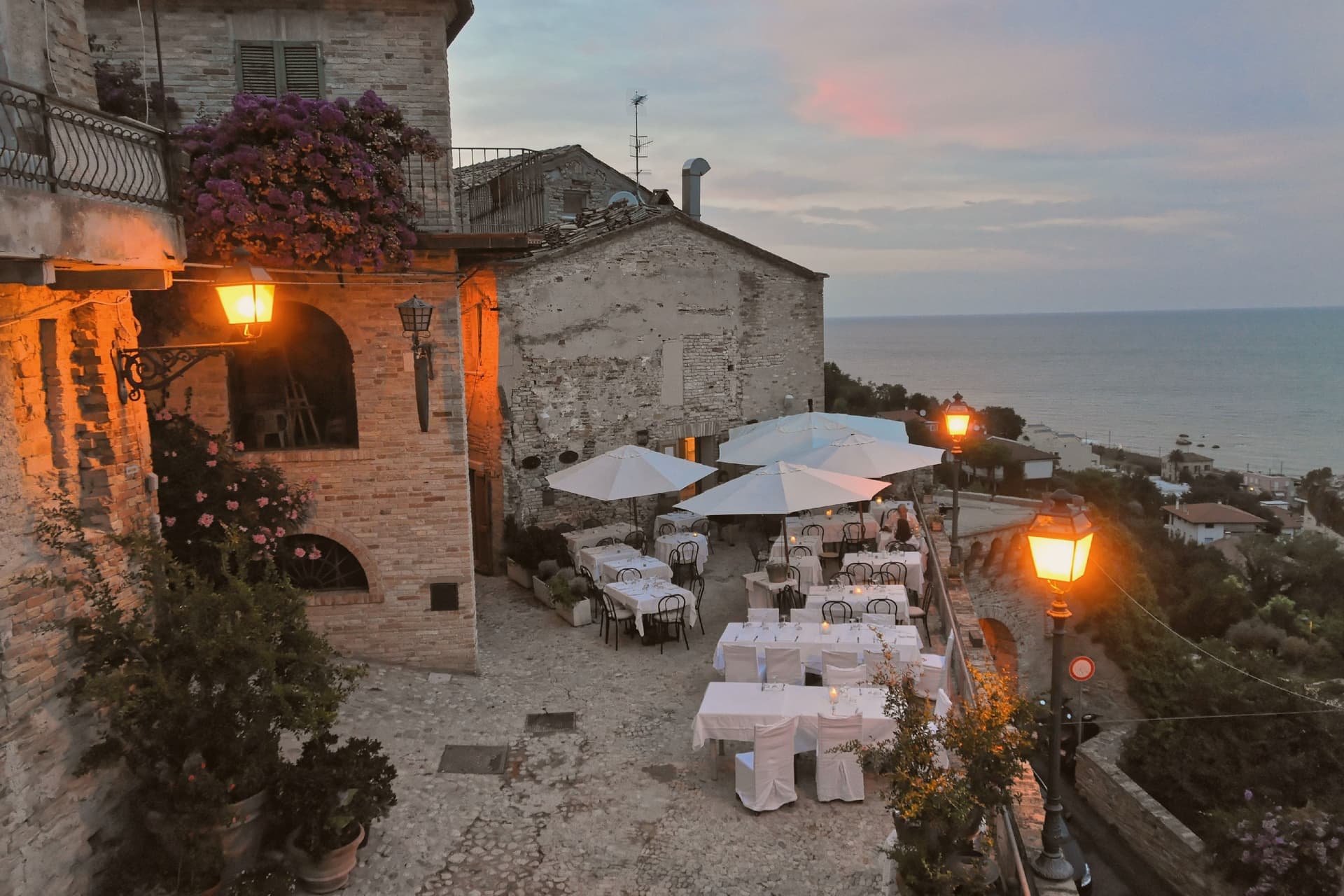
Why visit Grottammare
Grottammare sits on the Ascoli Piceno coast at the mouth of the Tesino. The town splits into two nuclei that never merged: a lungomare on the Adriatic, laid out with palms and Liberty villas in the late nineteenth century, and an older settlement on the hill above, reached by climbing away from the water rather than along it.
Felice Peretti was born in that upper settlement on 13 December 1521, in a house on what became the borgo's central square. He left, rose through the church, and returned as Pope Sixtus V only in monument: two churches he commissioned for his birthplace after 1585, one built beside the house itself and one now holding the collection of objects he sent back from Rome.
The upper town still carries its eleventh-century walls and the traces of an earlier fortress on the Incasato spur, and it has been named among the Borghi più belli d'Italia. The coast below has its own separate recognitions, for water quality and for the management of the hills behind it.
The two halves read as a single biography split in space: the hill holds the birth and the memory, the shore holds the later invention of the town as a seaside resort, and neither nucleus explains itself without the other.
Attico sul Mare, Il Topicco, La Cantina di Sant'Agustino 1650 and 1 more have been named by a guide.
What to see in Grottammare
- Paese Alto (Borgo Antico). Brick lanes climb the Incasato hill inside the eleventh-century walls, past the remains of a fortified spur that looks down over the seafront below.
- Chiesa di Santa Lucia. On the central square of the upper town, next to the house of Peretti's birth, a plain sixteenth-century commission from a native son grown powerful.
- Museo Sistino. Inside the Chiesa di San Giovanni Battista, the liturgical objects on display came back to the town only after the local boy had become pope.
How to get to Grottammare
There is a railway station in the town, so you can arrive without a car and never need one while you are here. Pescara is roughly 60 minutes away by road.
Our tip
May through September is the main window for Grottammare. The Bandiera Blu seafront is open from late spring, the palms on Lungomare De Gasperi catch full light from June, and the Paese Alto stays a few degrees cooler than the beach. July and August touch the low thirties on the coast; the upper town shaded lanes are the cool retreat. La Fiera di San Martino falls in November.
Fermo
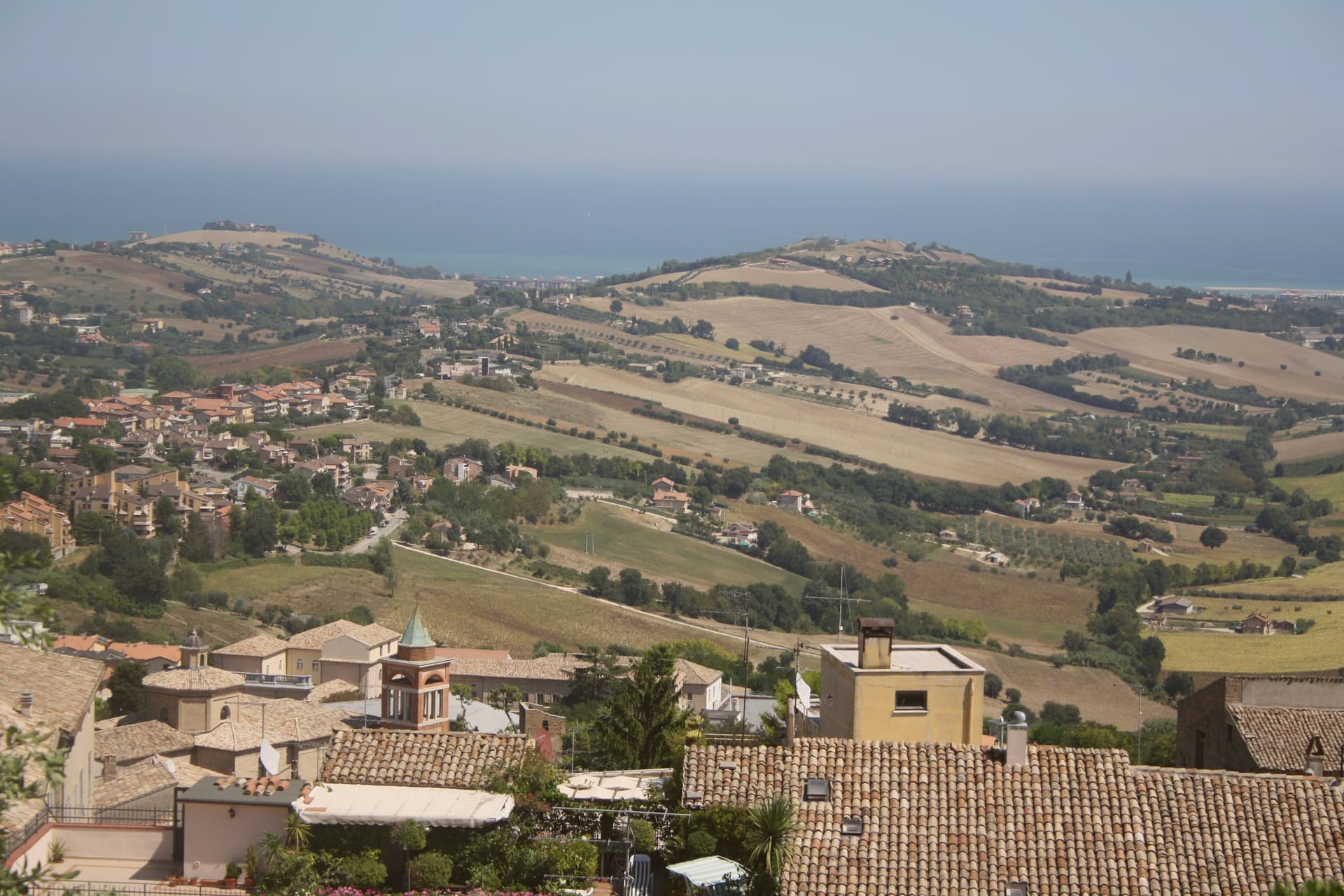
Why visit Fermo
Fermo sits eight kilometers inland from the Adriatic and from the seaside frazione of Lido di Fermo, which holds the commune's Bandiera Blu: a hill town with its own beach attached at a distance, the two connected by the same municipal boundary but separated in character and elevation. The Roman colony of Firmum Picenum was founded on the hilltop in 264 BC after the conquest of the Picentes, with six thousand Latin colonists settled there.
In the tenth century the town became the capital of the Marchia Firmana, the territorial label that eventually gave the region its name. The historic center still reads as a hilltop capital looking down toward a coast it administers rather than touches.
What began as a Latin colony on high ground, gained a name that outgrew it and spread to the whole region, and kept its port at arm's length: the distance between the hill and the shore is not incidental but the shape of how Fermo has always held its territory.
Emilio, L'Enoteca Bar a Vino have been named by a guide.
What to see in Fermo
- Cisterne Romane. Thirty barrel-vaulted rooms in three parallel rows under the historic center, opus signinum waterproofing still in place, built to hold 15,000 cubic meters of water.
- Piazza del Popolo. The porticoes meet at the head of the square where the Palazzo dei Priori stands, the arrangement that has organized the civic center since the medieval period.
- Palazzo dei Priori. Built in 1296 by joining a thirteenth-century palace and a church, housing the Pinacoteca Civica, the Sala del Mappamondo and the Sixtus V bronze statue.
How to get to Fermo
Ancona is roughly 60 minutes away by road.
Our tip
April through June and September into October are the months for Fermo. The hilltop catches Adriatic light without coastal humidity, the Sabulo's wide views across the Aso and Tenna valleys run clear, and Lido di Fermo's beach eight kilometers below holds its Bandiera Blu status from May. July and August touch the low thirties in the valley but the centro storico stays cooler at 319 meters; the Cavalcata dell'Assunta on August 15 fills the streets with the historic medieval procession dating to 1182. Cavalcata dell'Assunta falls in August.
More from Anywhere Italy
 The best towns with a food festival that eat well in Marche
 The 10 best hill towns that eat well within 90 minutes of Ancona
 The prettiest villages with a food festival in Marche
- The 6 best small hill towns that eat well in Marche
 The best small towns that eat well in Marche
 The prettiest villages in the province of Macerata