
The 8 best hill towns on a walking route within 90 minutes of Terni
The country around Terni is built for walking. Ridges of pale limestone run down to the Nera and the Valnerina, holm oak and beech give way to olive terraces, and every hill of any consequence carries a settlement of grey stone houses packed tight behind a wall. The waymarked routes here, the Via di Francesco and the old pilgrim tracks that feed into it, link these places at roughly the distance a walker covers in a day. Spring and early autumn are the seasons for it, when the Nera runs cold and clear and the trattorie put out river trout, black truffle, lentils from the high plains and the flat local celery that turns up on menus in late autumn.
Most people who come to Umbria to walk are walking to Assisi. The basilica, the frescoes and the saint's own biography pull coach parties and pilgrim groups onto the same stretches of path all through the warm months, and the beds in the last stages before the town are booked out well ahead. It is a fine route and the reason many walkers come to the region at all. It is also, for long sections in summer, a queue with a view.
The same routes carry on south and west, through country that sees a fraction of that traffic. The valley of the Nera, the ridges above Spoleto, the high ground towards Norcia and the volcanic hills over towards Lake Bolsena all hold hill towns that function as stages: a place to sleep, eat well and set off again in the morning. These are the towns on those stages, within ninety minutes of Terni, each one an inland hill settlement on a long historic walking route.
Of the 36 communes we have mapped within 90 minutes of Terni, 8 qualify as hill towns on a walking route: each is an inland hill settlement, and each is a stage on one of the long historic walking routes. The smallest, Scheggino, has 446 residents.
Elsewhere in the catalogue: The best towns you can reach by train that eat well within 90 minutes of Terni and The best hill towns with a food festival within 90 minutes of Terni.
Scheggino
Why visit Scheggino
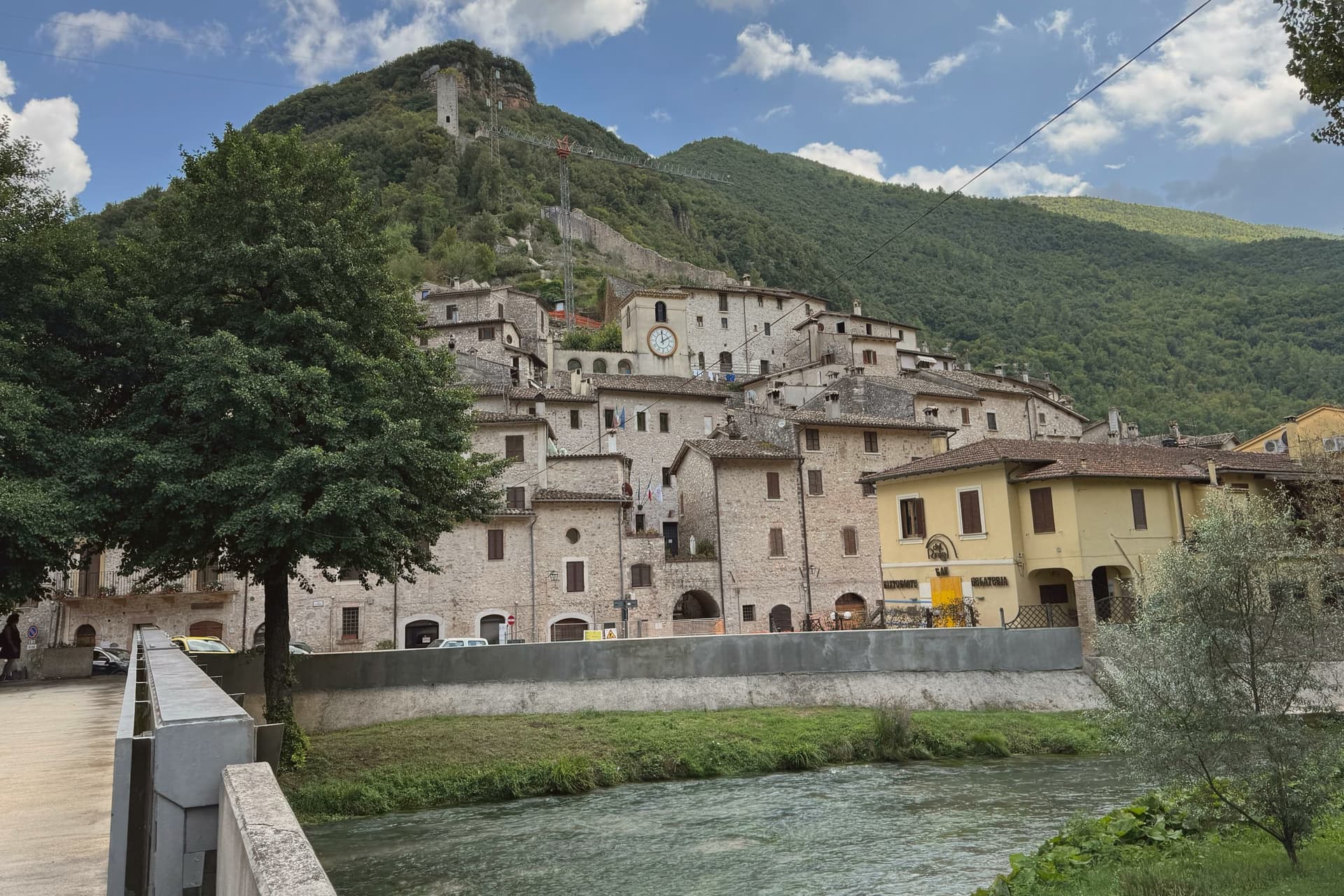
Scheggino sits at 280 meters in the heart of the Valnerina, the village wedged into a triangle of walls between the slope above and the Nera river below. The Duchy of Spoleto built it around the 12th century to defend one of the three bridges over the Nera; the triangular plan and the watchtower of white and pink stone, about 20 meters high, still mark the top of the castle.
The Nera runs alongside the lower edge of the village, divided into channels that once turned mills and now hold trout and the springs that feed the truffle washing rooms. Scheggino is the home of Urbani Tartufi, the first commercial company for the storage and processing of truffle, founded in 1928, which still has its plant on the river.
The Diamante Nero festival each summer prepares a giant frittata with more than 2,000 eggs and 80 kilos of black truffle. The Cammino di San Francesco passes through the village on the way south.
What to see in Scheggino
- Castello di Scheggino. Twelfth-century triangular castle of the Duchy of Spoleto, with a watchtower in white and pink stone about 20 meters high at the summit.
- Chiesa di San Nicola. Romanesque parish church at the heart of the centro storico, frescoes of the Umbrian school of the 15th century in the apse.
- Nera river canals. Channels of the Nera divided through the lower village, once for mills and now for trout farming and the truffle washing rooms of Urbani.
How to get to Scheggino
Terni is roughly 49 minutes away by road.
Our tip
April through June and September into October are the months for Scheggino. The Nera runs cold and full, the trout farms work at capacity, and the trails up to Vallo di Nera or down to Ferentillo are walkable in shade. July and August push the valley into the mid-thirties; the river canals through the village cool the lower streets and the trattorie pour Nera trout with local truffle.
Monteleone di Spoleto
Why visit Monteleone di Spoleto
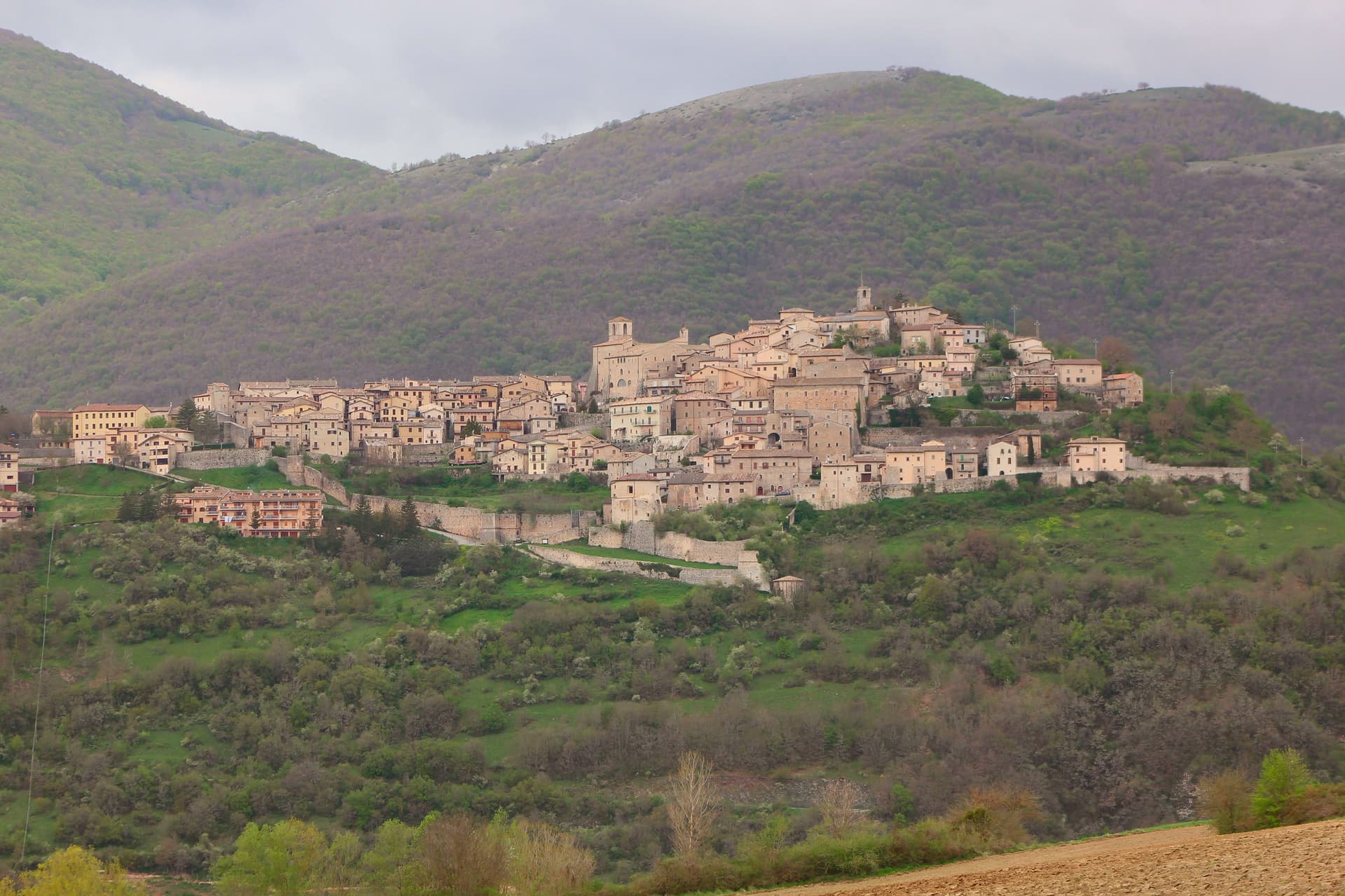
Monteleone sits at 978m on a hilltop in the upper Nera valley, the upper extension of the Valnerina, at the point where Umbria, Lazio and Marche converge. A castle anchors the summit and gives the borgo its defining silhouette, much-rebuilt over the centuries and again after the 2016 earthquake.
Below it sit the Chiesa and Convento di San Francesco, and the whole village is compact enough that the fortress organizes the view from almost anywhere within it. The find that put the town on archaeological maps happened by accident: a local farmer ploughing a field at the Colle del Capitano turned up an Etruscan bronze parade chariot in 1902, a complete biga from the 6th century BC.
His family sold it to French dealers for the equivalent of 950 lire, and it reached the Metropolitan Museum of Art in New York in 1903, where it is now displayed in Gallery 170 as the most complete pre-Roman parade chariot known to survive, its bronze panels depicting Achilles' birth, his combat with Memnon, and his apotheosis. Monteleone has pursued repatriation since 1990 through multiple legal proceedings, none successful, and the Met's title is now considered settled.
The village opened a museum in 2002 holding a full-scale replica alongside the original context of the find, and the town is also a marked stop on a 350-km pilgrim walk running from Norcia, Benedict's birthplace, through Monteleone to Subiaco and Montecassino, with pilgrim accommodation available locally. The 2016 Norcia and Cascia earthquake damaged several buildings in town; the castle and the Franciscan church have been restored, though reconstruction continues elsewhere.
Beyond the village, the Sibillini Mountains National Park lies to the east, the Cascia-Norcia route linking Benedict's and Rita's home towns runs to the north, and Lago di Piediluco is 30 km south. The food follows the Valnerina pattern: strangozzi with truffle, lentils from Castelluccio di Norcia, prosciutto and other Norcineria meats, pecorino, and Sagrantino di Montefalco from 60 km west.
Depopulation has been steep, from 1,800 residents in 1951 to 555 today, which leaves a village built for a much larger population now organized around a fortress, a church and a museum that all outsize the number of people currently living among them.
What to see in Monteleone di Spoleto
- Museo della Civiltà del Carro (replica chariot). Full-scale replica of the Monteleone Chariot, with the context of the 1902 find laid out around it. The panels on the original show Achilles' birth, his combat with Memnon, and his apotheosis. The museum also documents the village's repatriation campaign, active since 1990 and unsuccessful in every legal proceeding brought so far.
- Rocca dei Brancaleoni. The castle anchors the high point of the borgo, its rebuilt walls now standing again after 2016 earthquake repairs. From the top, the view runs across the whole upper Nera valley.
- Chiesa di San Francesco (Renaissance ceiling). 13th-century Franciscan church with later restorations and a carved wooden ceiling added in the 16th century. Also repaired after 2016 earthquake damage.
How to get to Monteleone di Spoleto
Terni is roughly 59 minutes away by road.
Our tip
Monteleone di Spoleto is mountain-seasonal — May through September is the high season. June-July brings the Cammino di San Benedetto pilgrim flow. Castelluccio di Norcia lentil bloom (late June-early July, 20 km east, the famous fiorita) is a major regional draw.
Arrone
Why visit Arrone
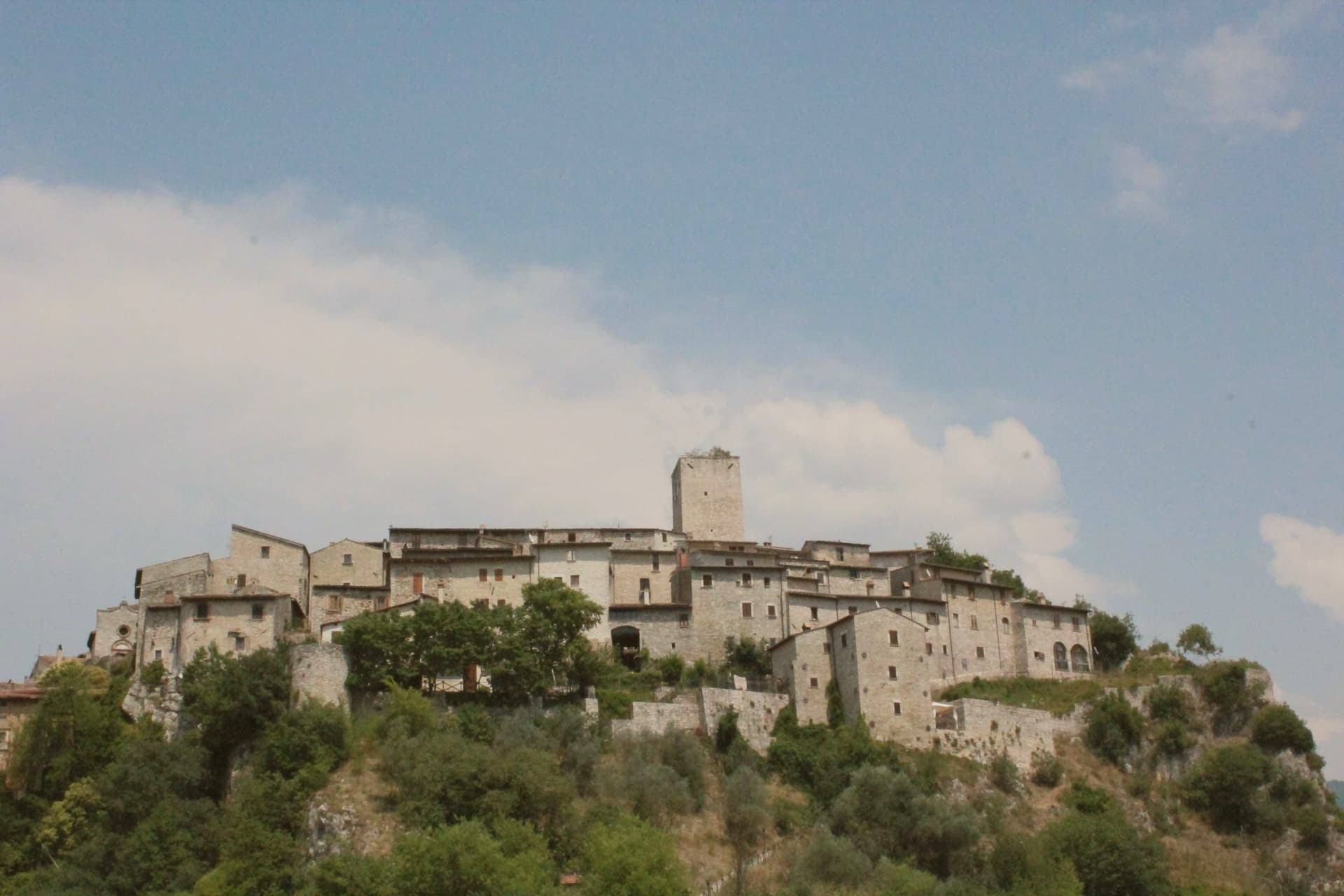
Arrone sits at 243 meters on the left bank of the Nera in the lower Valnerina, the upper part of the village a 9th- or 10th-century noble castle with its walls and alleys still in their medieval layout. The town grew up around the fortified hill and spread along the river as the danger faded.
The Cascata delle Marmore, the largest man-made waterfall in the world at 165 meters across three tiers, is five kilometers downstream; the Romans cut the original channel in 271 BC to drain the marshes around Rieti, and successive interventions through the 16th century gave the falls their present form. The Cammino di San Francesco passes through, and the village is the base for kayaking and rafting on the lower Nera.
The Chiesa di San Giovanni Battista in the upper castle holds 15th-century frescoes of the Umbrian school, and the collegiate Chiesa di Santa Maria in the lower village was rebuilt in the 16th century on Romanesque foundations.
What to see in Arrone
- Castello di Arrone. Upper part of the village, the 9th-10th century castle, walls and steep medieval alleys preserved to the original layout.
- Chiesa di San Giovanni Battista. Fourteenth-century church inside the upper castle, with 15th-century frescoes of the Umbrian school, including a Madonna and saints.
- Chiesa Collegiata di Santa Maria. Sixteenth-century collegiate church in the lower village, rebuilt on Romanesque foundations, with frescoes by Vincenzo Tamagni.
How to get to Arrone
Terni is roughly 34 minutes away by road.
Our tip
April through June and September into October are the months for Arrone. The Nera runs full from snowmelt and spring rain, the rafting season opens, and the Cascata delle Marmore releases on a fixed schedule that suits the morning light. July and August touch the mid-thirties in the lower Valnerina; the falls cool the air around the basin, and the Cammino di San Francesco walkers pass through early.
Stroncone
Why visit Stroncone
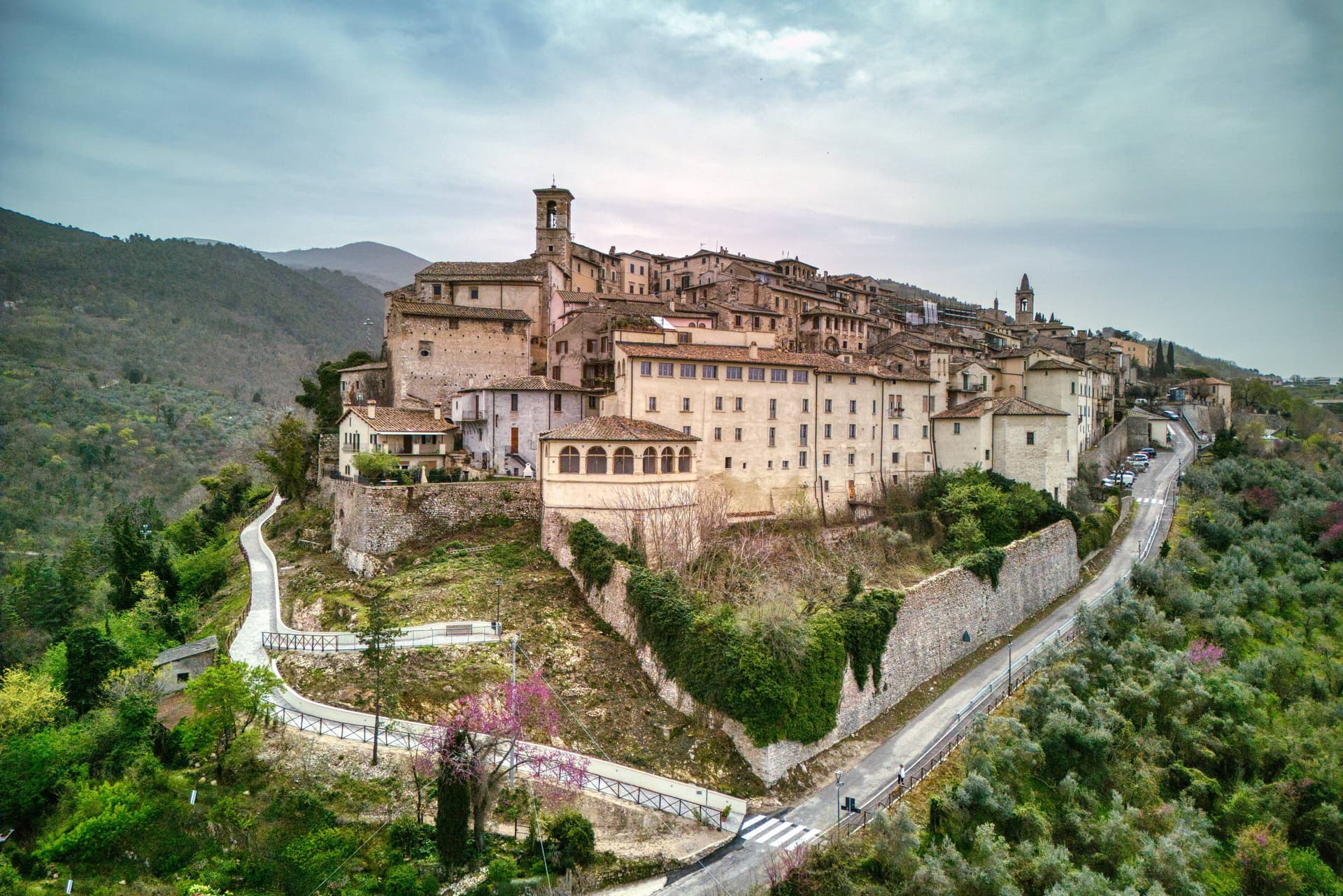
Stroncone sits at 451 meters on an olive-covered hill eight kilometers south of Terni, in the Conca Ternana on the western slope of the Apennine. The name traces to Duke Ugone of Spoleto, whose castrum Hugonis evolved through Castrugone and Strungone to the present form.
A group settled here around the tenth century and built a castle; Stroncone first appears in documents in 1012, when Giovanni di Pietro made a donation to the monastery of San Simeone. Pope Innocent III granted municipal self-rule in 1215.
The Convento di San Francesco, south of the walls, is one of the older Franciscan foundations in Umbria, founded by tradition by Francis himself in 1213, two years before papal recognition of the order. The medieval circuit walls remain almost complete, with the original gates framing a network of stepped lanes that climb to the small main square.
The Cammino di San Francesco passes through, picking up walkers between Rieti and Assisi.
What to see in Stroncone
- Convento di San Francesco. Franciscan convent south of the walls, founded by tradition by Saint Francis in 1213, two years before papal recognition of the order.
- Centro storico. Walled medieval core with original gates intact, climbing through stepped lanes to the small main square at the top of the hill.
- Chiesa di San Giovanni Decollato. Main parish church at the heart of the borgo, with frescoed interior and a Renaissance baptismal font.
How to get to Stroncone
There is a railway station in the town, so you can arrive without a car and never need one while you are here. Terni is roughly 18 minutes away by road.
Our tip
April through June and September into October are the months for Stroncone. Olive harvest carries the autumn rhythm into late November, and the frantoi work into the evening through October and November. July and August are warm in the Conca Ternana but the hill is high enough that nights cool quickly. Sagra De u Cecu Maritu falls in July.
Montefiascone
Why visit Montefiascone
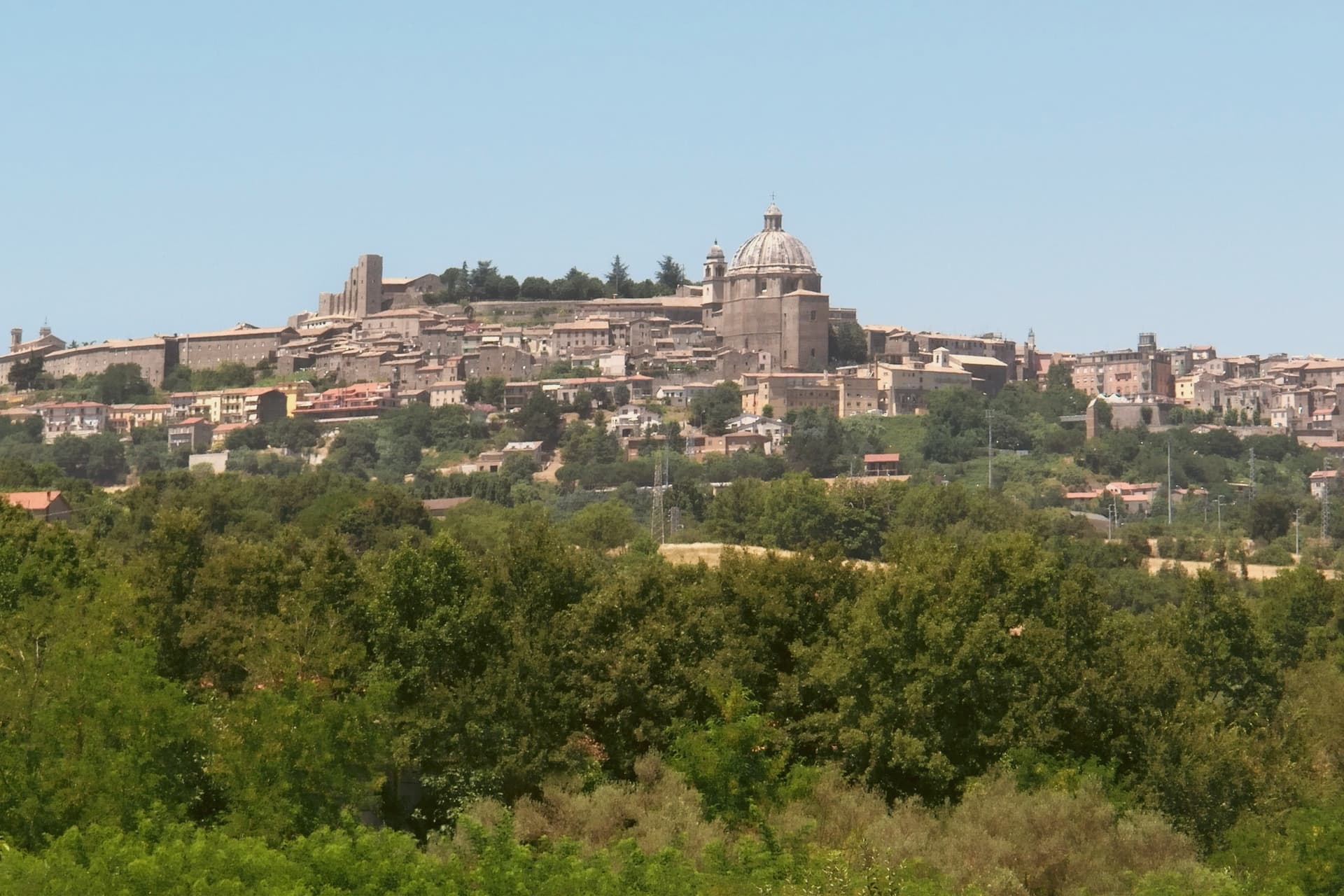
The town sits on the southeastern rim of a volcanic crater, about a hundred kilometers north of Rome, with the fortress at its highest point and the rest of the settlement built down the slope from there. The basilica stands just outside the walls at the lower end of that slope, separate enough from the fortress and the cathedral that the three read as three distinct centers of the town rather than one monument with satellites.
The wine takes its name from the same twelfth-century legend that put a German bishop's prelate on the road marking inn doors, and that bishop is the one buried in the basilica below, which ties the town's best-known export to a specific grave rather than to a floating story. The pilgrim route passes through on its way between Bolsena and Viterbo, so the hill that holds a papal summer residence and a wine legend was also, and still is, a stop on a much longer walk to Rome.
What the place adds up to is a small hill town where a fortress, a two-story church, and a road to somewhere else all sit within a short walk of one another, each one a different kind of stop on the same hill.
What to see in Montefiascone
- Rocca dei Papi. The fortress walls enclose the summit; the tower stair is narrow and gives out onto the panorama at once, the water filling the whole crater rim below.
- Basilica di San Flaviano. Two churches stacked on each other, the lower nave older and darker, the upper one built two centuries later and open to more light. The frescoes are original to the walls, not restored copies, and the German bishop Johannes Defuk is buried here.
- Cattedrale di Santa Margherita. The octagonal dome is 27 meters across, third largest in Italy by base diameter, finished in the late sixteenth century. It dominates the town's roofline the way the fortress dominates its summit.
How to get to Montefiascone
There is a railway station in the town, so you can arrive without a car and never need one while you are here. Terni is roughly 75 minutes away by road.
Our tip
April through June and September through October are the strong months. The hilltop position keeps Montefiascone cooler than Viterbo down the road, and the air over the lake is clearest in spring and autumn. July and August reach the low thirties; afternoons in the centro storico thin out between two and five. Fiera Del Vino falls in August.
Orvieto
Why visit Orvieto
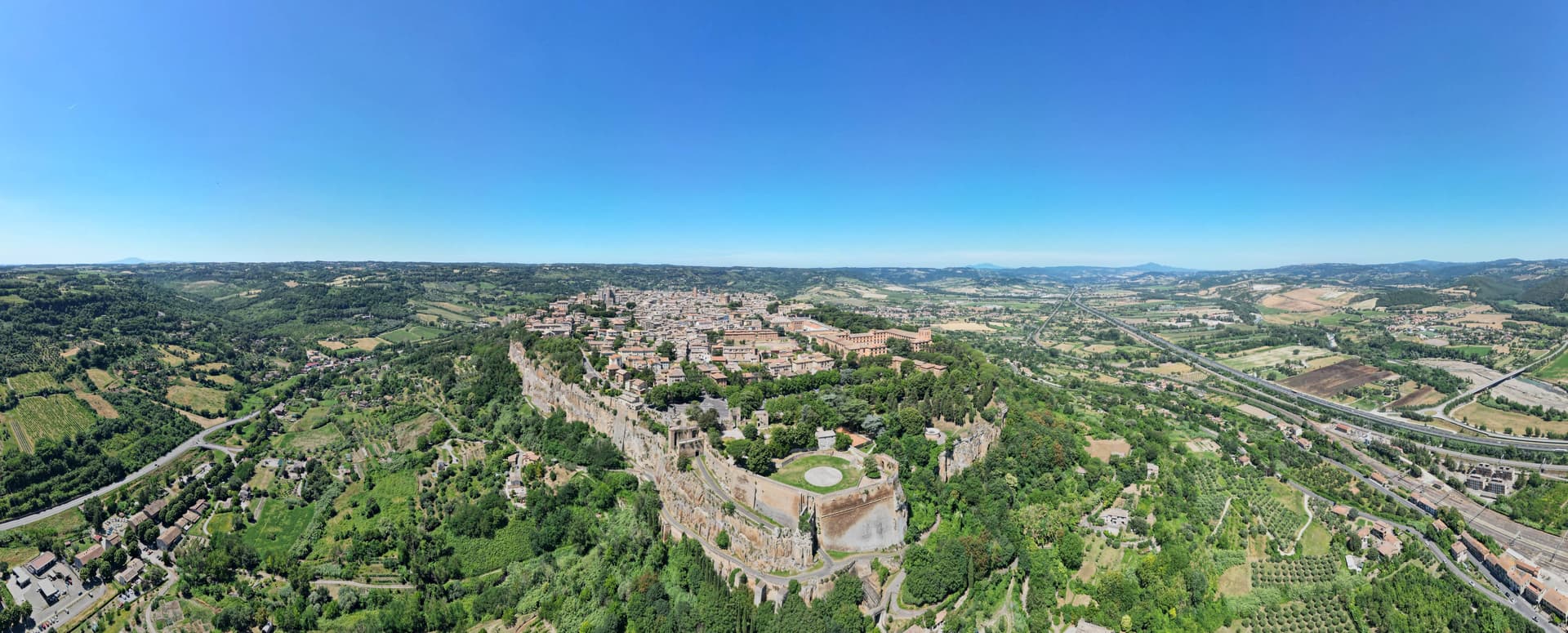
Orvieto sits on a flat-topped butte of volcanic tuff at 325 meters, the cliffs 195 meters above the surrounding plain. The town began as Velzna, a flourishing Etruscan metropolis, and the Romans destroyed it in 264 BC.
The medieval town that replaced it on the same plateau became a papal refuge in the 13th century, when popes left Rome for the safety of the height. The town's layers sit one below the other rather than side by side: the cliff face is honeycombed with Etruscan and medieval cavities, cisterns and pigeon roosts cut into the same tuff that the necropolis at its foot was carved into during the 6th century BC, while the cathedral and its chapel occupy the surface above, and the well descends back down through the rock to reach water.
What looks from a distance like a single stone crown is in fact three towns stacked in the same column of tuff: the dead below, the popes and their cathedral on top, and a passage cut straight through the middle to keep the town supplied.
What to see in Orvieto
- Duomo di Orvieto. The polychrome marble façade rises in tiers of mosaic and sculpture, the decorative Gothic worked into bands of color rather than left plain stone.
- Cappella di San Brizio. The Last Judgment fills the chapel wall to wall, figures twisting and falling across the vault and lunettes inside the cathedral.
- Pozzo di San Patrizio. Sunk for Pope Clement VII, the shaft drops 53 meters, lit by windows cut into the walls of the two ramps so the descent is never dark. Antonio da Sangallo the Younger designed it to move water and mules at once, without either crossing the other's path.
How to get to Orvieto
There is a railway station in the town, so you can arrive without a car and never need one while you are here. Terni is roughly 56 minutes away by road.
Our tip
April through June and September into October are the months for Orvieto. The plateau holds the long light, the Paglia valley below is green or gold, and the white wine of the surrounding vineyards is poured at every osteria. Umbria Jazz Winter runs around New Year and fills the Teatro Mancinelli; the Corpus Domini procession on the second Sunday after Pentecost is the most concentrated religious event of the year. Sagra del Bosco falls in September.
Spoleto
Why visit Spoleto
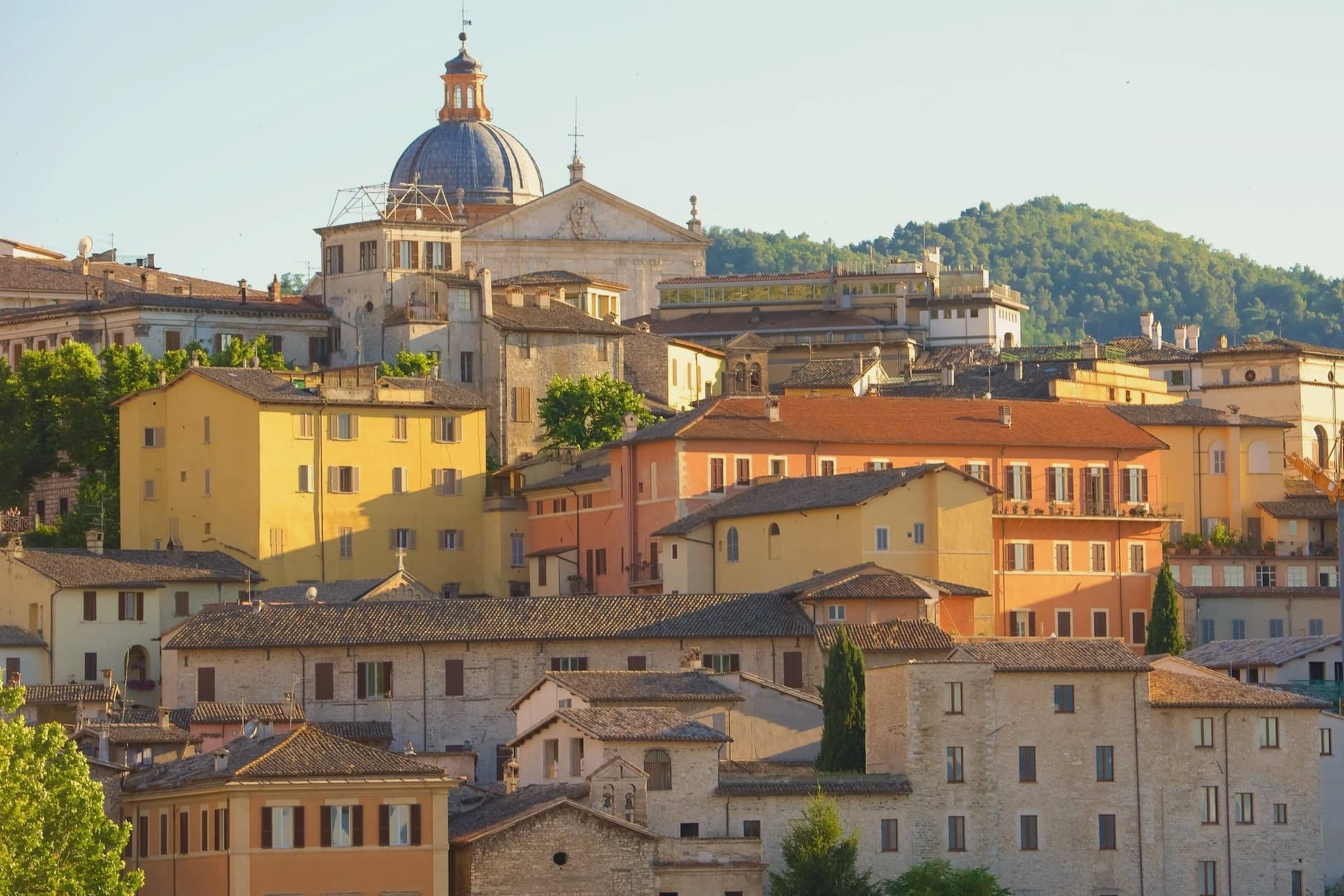
Spoleto sits at 396 meters at the southern edge of the Valle Umbra, the Apennines rising behind it toward Monteluco. The town was Roman Spoletium from 241 BC, then capital of one of the two great Lombard duchies of Italy from 576, controlling Umbria, Sabina, Picenum and the Pescara valley for more than five centuries.
The Rocca Albornoziana on the Colle Sant'Elia was built between 1363 and 1367 by Matteo Gattapone for Cardinal Albornoz, both a papal fortress and a residence, now the Museo Nazionale del Ducato. From the Rocca the Ponte delle Torri, 230 meters long and 80 meters high, crosses the Tessino gorge to Monteluco, an aqueduct of the 13th century built over Roman foundations.
The Duomo holds a Byzantine mosaic of 1207 across its façade and Filippo Lippi's last fresco cycle in the apse. Gian Carlo Menotti founded the Festival dei Due Mondi in 1958; the Roman theater, the Rocca courtyard and Piazza del Duomo still carry the program each year from late June into mid-July.
What to see in Spoleto
- Rocca Albornoziana. Papal fortress built 1363-1367 by Matteo Gattapone for Cardinal Albornoz, now the Museo Nazionale del Ducato di Spoleto.
- Ponte delle Torri. Aqueduct bridge 230 meters long and 80 meters high, crossing the Tessino gorge to Monteluco, 13th-14th century on Roman foundations.
- Duomo di Santa Maria Assunta. Twelfth-century Romanesque cathedral with Byzantine mosaic of 1207 on the façade, Renaissance portico, and Filippo Lippi frescoes in the apse.
How to get to Spoleto
There is a railway station in the town, so you can arrive without a car and never need one while you are here. Terni is roughly 41 minutes away by road.
Our tip
April through June and September into October are the months for Spoleto. The town opens its gardens, the Rocca courtyard fills with sun, and the long walks along the Giro dei Condotti above the Ponte delle Torri become bearable again. The Festival dei Due Mondi runs from late June into mid-July, when Spoleto doubles in population and the Roman theater carries opera into the small hours. Sagra dell'Anguilla e del Gambero di Fiume falls in August.
Rieti
Why visit Rieti
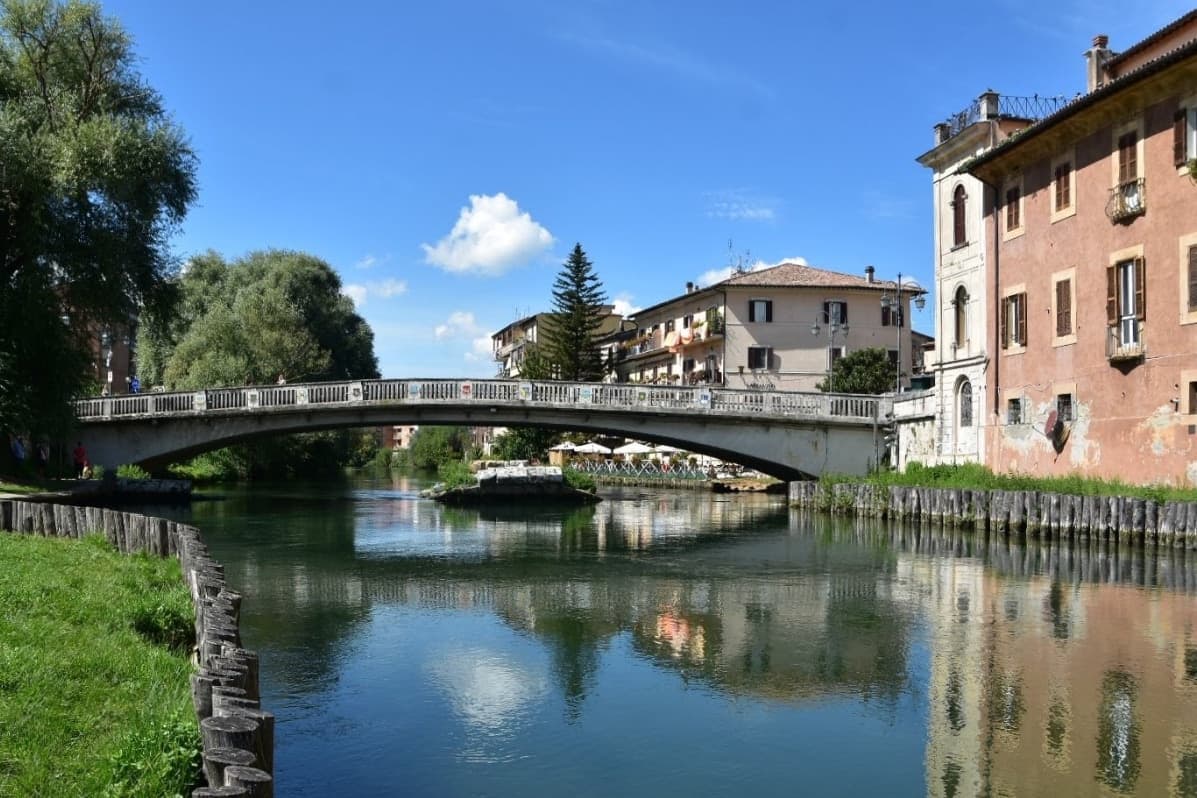
Rieti stands on a low rise at the edge of the Piana Reatina, the plain the Romans made when they drained the Lacus Velinus and sent its water over the cliff at Marmore. Medieval walls still close one side of the centro storico, and Via Roma runs down to the Velino and the stumps of the Roman bridge that carried the Via Salaria into town.
A marker in Piazza San Rufo stands for what Rieti has claimed for centuries: the umbilicus Italiae, the center of Italy. Popes stayed here often enough to build a palace beside the cathedral, and in 1234 Gregory IX canonized Saint Dominic inside it.
Saint Francis spent long stretches in the valley, which is why it is called the Valle Santa; the sanctuaries of Fonte Colombo and La Foresta are both in the comune. Above the plain, Monte Terminillo rises to 2,217 meters and is known as Rome's mountain.
In 2021 the town offered remote workers half their rent, up to 200 euros a month, to come and live here.
What to see in Rieti
- Cattedrale di Santa Maria Assunta. Romanesque outside and Baroque inside, built between 1109 and 1225 with a bell tower of 1252. Pope Gregory IX canonized Saint Dominic here in 1234.
- Palazzo Papale. The bishops' palace raised in 1283 for the papal court beside the cathedral, with a vaulted loggia at street level; it now holds part of the diocesan museum.
- Piazza San Rufo. A small square in the old town with a marker for the traditional center of Italy, the umbilicus Italiae.
How to get to Rieti
There is a railway station in the town, so you can arrive without a car and never need one while you are here. Terni is roughly 39 minutes away by road.
Our tip
April to October suits Rieti. Spring turns the plain green and fills the Velino; June is the Giugno Antoniano, which ends in the Processione dei Ceri, and late July brings the Palio della Tinozza, races in wooden tubs on the river. Summer is warm in town at 405 meters and cool on Terminillo, where the high trails open. Ottava de Santo Egidio falls in August.
More from Anywhere Italy
 The best towns you can reach by train that eat well within 90 minutes of Terni
 The best hill towns with a food festival within 90 minutes of Terni
- The best hill towns with a serious restaurant within 90 minutes of Terni
- The 9 best towns on a walking route that you can reach by train in Umbria
 The best hill towns on a walking route in Lazio
 The 9 best hidden hill towns that eat well within 90 minutes of Terni