
The 10 best towns you can reach by train that hold a food festival within 90 minutes of Perugia
The land between Perugia and the Valdichiana is farming country that has never stopped cooking what it grows. Umbrian towns build a whole weekend around one thing, the black truffle dug from the oak woods above Gubbio, the chickpeas and lentils of the upland plains, carp and eel from Lake Trasimeno grilled on reeds, new oil pressed in November and eaten on toasted bread with nothing else on it. The towns themselves are built of pale local travertine and warm brick, stacked on hills that catch the last light over the plain. Autumn is the season these places are at their busiest and best, though spring brings the artichoke and wild asparagus festivals and the summer nights bring the pasta ones.
The default plan is Perugia itself, then a run down to Orvieto, and the two of them absorb most of the visitors who come to central Italy without a car. Perugia has the escalators through the Rocca Paolina, the chocolate festival that fills the corso every October, and a station link that makes it easy. It is a good city and the crowding is earned, but on a festival weekend the historic centre is largely people who arrived that morning and will leave that evening, and the food on offer has been scaled up to meet them.
The same rail lines carry on past the city in every direction, through the Trasimeno basin, along the Valdichiana towards Chiusi, and down the Foligno valley towards Spoleto. The towns strung along them hold their own sagre, run by the local pro loco rather than by anyone selling tickets, and fewer people go. Each of the places here can be reached without a car, and each has a recurring festival built around one ingredient it actually produces.
Of the 41 communes we have mapped within 90 minutes of Perugia, 10 qualify as towns you can reach by train with a food festival: we have confirmed each is reachable without a car, and each holds a recurring food festival built around one local ingredient. The smallest, Fossato di Vico, has 2,639 residents.
Two more lists worth reading alongside this one: The best towns with a medieval festival that you can reach by train within 90 minutes of Perugia and The best towns with a food festival that you can reach by train in the province of Perugia.
Fossato di Vico
Why visit Fossato di Vico
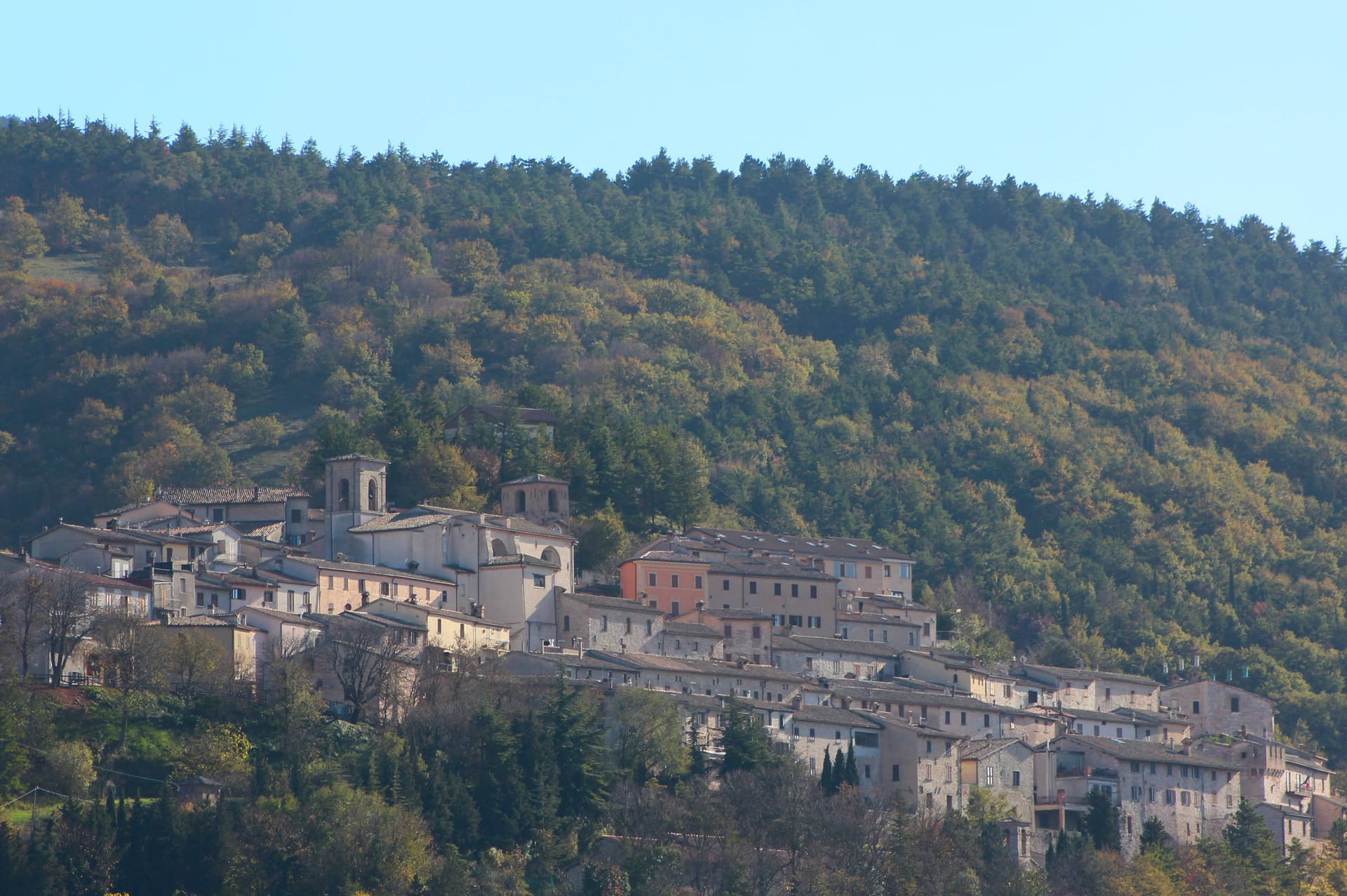
Fossato di Vico stands at 581 meters on the slopes of Mount Mutali, on the line of the Via Flaminia between Foligno and Gubbio. The Romans built a changing station here called Hellvillum after laying the road in 220 BC.
The borgo proper was founded in 980 by Lupo, called Vico, son of Monaldo, count of Nocera. In the twelfth century it passed to the Marsciano counts, who eventually sold it to Gubbio; in the thirteenth Perugia took it militarily and the commune declared independence.
What survives from that period is the network of covered passages called Le Rughe, stone vaults that turned the street into a defensible interior, a rare example of thirteenth-century castle architecture used as everyday infrastructure. The church of San Pietro, the oldest in town, predates the castle and was founded as a Camaldolese monastery.
The Chiesa di San Benedetto outside the walls keeps Eugubine-school frescoes including what is taken to be one of the earliest known portraits of a pope.
What to see in Fossato di Vico
- Le Rughe. Thirteenth-century covered alleyways under round stone vaults, rare surviving example of defensive castle-street architecture.
- Chiesa di San Pietro. Oldest church in town, founded as a Camaldolese monastery, Romanesque structure predating the medieval castle.
- Chiesa di San Benedetto. Thirteenth-century Benedictine abbey outside the walls, fragments of fourteenth and fifteenth-century Eugubine-school frescoes including an early papal portrait.
How to get to Fossato di Vico
There is a railway station in the town, so you can arrive without a car and never need one while you are here. Perugia is roughly 47 minutes away by road.
Our tip
April through June brings the slopes of Mount Mutali green and the upper Flaminia corridor walkable in long evenings. September and October are clear, with first frost on the higher pastures by month's end. July and August push the lower valley into the mid-thirties; at 581 meters the borgo stays cooler, and the vaulted Rughe hold a constant temperature that feels engineered. Sagra del Cinghiale falls in August.
Lucignano
Why visit Lucignano
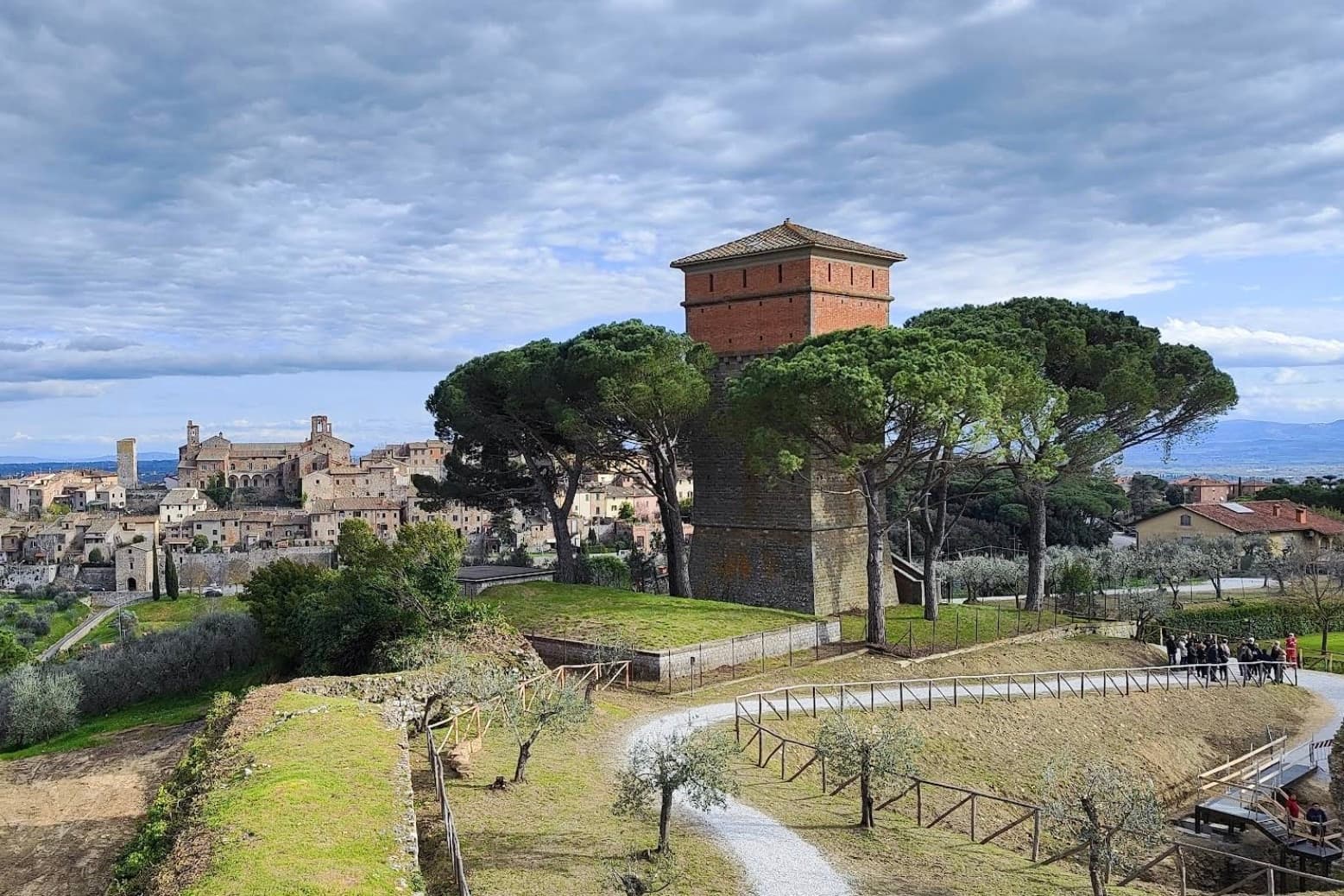
Lucignano sits at 400 meters on a hill in the Valdichiana, halfway between Siena and Arezzo, built on a tight elliptical plan of four concentric rings of streets. Its position made it one of the most contested settlements of medieval Toscana: Siena, Arezzo, Florence and Perugia all fought over it between 1200 and 1500.
The current walls and three gates date to a Sienese reconstruction of 1371. In the Museo Civico inside the Palazzo Comunale stands the Albero d'Oro, a 260-centimeter Gothic gold-and-coral reliquary in the shape of a tree, begun by Ugolino di Vieri in 1350 and finished by Gabriello d'Antonio in 1471.
Local tradition turned it into the Albero dell'Amore, a marriage charm. The Collegiata di San Michele Arcangelo dominates the highest ring of the borgo, and the elliptical plan is best read from the air, which is why drone footage of Lucignano keeps appearing in articles about medieval Tuscan urbanism.
The re-enactment here is Memorie dal passato a Lucignano, usually held in September.
What to see in Lucignano
- Albero d'Oro. 260-cm Gothic reliquary in the shape of a tree, gold, coral and enamel, begun by Ugolino di Vieri in 1350 and completed by Gabriello d'Antonio in 1471.
- Centro storico ellittico. Four concentric rings of streets inside elliptical walls, the most complete example of medieval Tuscan elliptical town planning.
- Collegiata di San Michele Arcangelo. Eighteenth-century church on the highest ring of the borgo, with a Vasari façade adjustment and a baroque organ inside the medieval shell.
How to get to Lucignano
There is a railway station in the town, so you can arrive without a car and never need one while you are here. Perugia is roughly 65 minutes away by road.
Our tip
April through June and September into October are the months Lucignano keeps its balance, the Valdichiana green or gold depending on the half and the centro storico cool inside its elliptical walls. The Maggiolata, a flower festival between the four quarters of the borgo, runs across the last two Sundays of May. July and August push the valley past thirty and the centro storico thins after lunch. Sagra della Filiera del Tartufo Marzuolo falls in March.
Chiusi
Why visit Chiusi
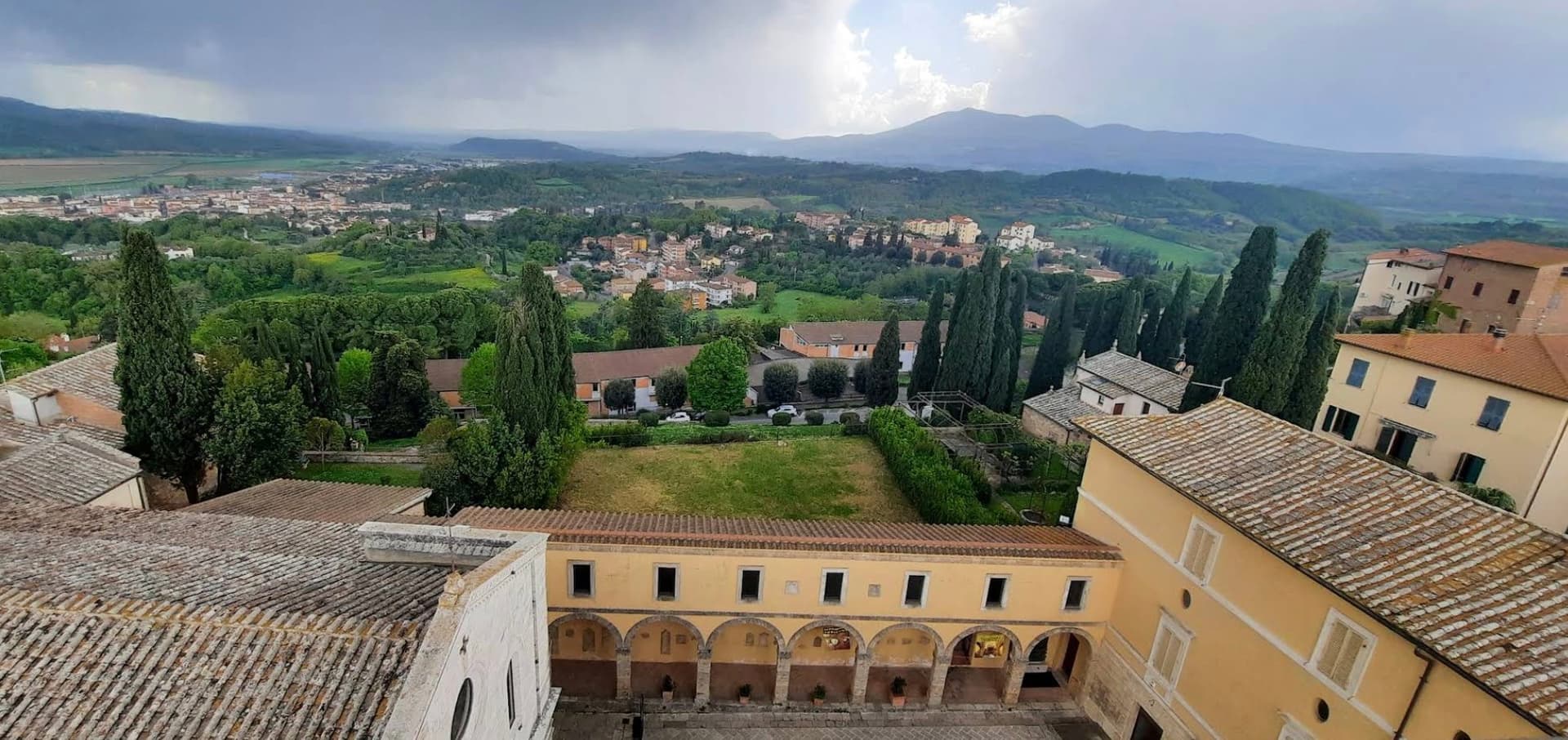
The hilltop stands above the Val di Chiana, the valley floor visible from the town at a height that made it defensible and gave it command of the surrounding farmland. The cathedral, the museums and the tunnel network are close enough to walk between within the old center, while the painted necropolis and the lake lie outside it, a few kilometers apart in different directions, one inland toward the tombs and the other north toward open water.
The tunnels themselves connect the upper town to what lies beneath it: built as drainage, later folded into legend by Pliny the Elder, who took them for part of a king's tomb. The cathedral's own columns, lifted from earlier Roman buildings, make the same point in stone that the tombs make in paint and the museum makes in bucchero and alabaster: this is a town built repeatedly on top of itself, each layer reusing what the last one left behind.
The re-enactment here is Tria Turris Medioevo e Palio delle Torri di Chiusi, usually held in June.
What to see in Chiusi
- Museo Nazionale Etrusco. Holds canopic urns, alabaster sarcophagi, bucchero pottery and grave goods pulled from the necropolises around the town.
- Duomo di San Secondiano. Cathedral built around 560 AD over an earlier basilica, renovated in the thirteenth century, nave and two aisles on antique marble columns from Roman buildings.
- Labirinto di Porsenna. Visited from the Museo della Cattedrale, the tunnels run beneath the streets at a scale that still reads as engineering rather than legend, whatever Pliny made of them.
How to get to Chiusi
There is a railway station in the town, so you can arrive without a car and never need one while you are here. Perugia is roughly 58 minutes away by road.
Our tip
April through June and September into October are the working months on the Val di Chiana edge: mild days, evening light over the lake, the wine and olive cycles below town. The Frittellata of San Giuseppe in mid-March and the Festa di San Mustiola in early June fill the centro storico with traditional kitchens. July and August push past thirty degrees and the basin below town holds the heat; the museums and the Labirinto stay cool. Tria Turris Medioevo e Palio delle Torri di Chiusi falls in June.
Montepulciano
Why visit Montepulciano
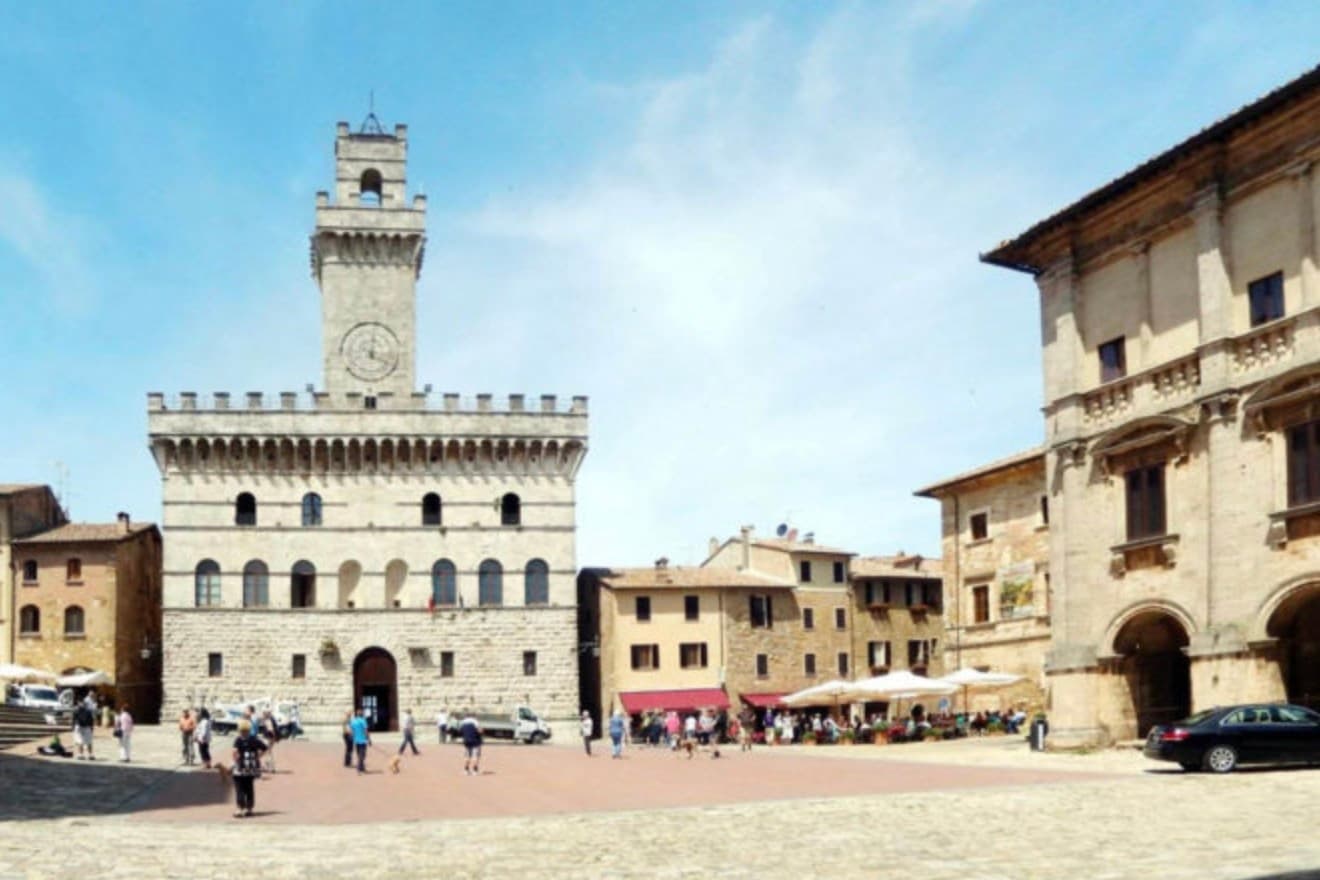
The ridge runs between the Val di Chiana and the Val d'Orcia, 70 kilometers southeast of Siena, and the town follows its spine uphill: streets climb from the gates toward the high point, where the main square sits ringed by the buildings that define the skyline from below. The origin predates the Renaissance fabric by centuries.
Etruscan tombs survive in the surrounding hills, though almost nothing of that period shows in the centro storico itself, which was rebuilt wholesale in the fifteenth and sixteenth centuries over whatever came before. The wine and the festival both use the climb as their setting rather than their subject: the cellars are cut into the rock beneath the palazzi, keeping a constant temperature for aging, and the barrel race each August sends two men from each of the eight contrade hauling an eighty-kilogram cask up the same gradient that every visitor covers on foot, only slower.
The steepness that shaped the defensive site nine centuries ago is still what a person feels first, in the legs, before the buildings register at all.
The re-enactment here is Bravio delle Botti, usually held in August.
What to see in Montepulciano
- Tempio di San Biagio. A 13-meter dome and travertine façade standing alone outside the walls, the ground falling away below it so the building reads as a single volume against the hillside.
- Piazza Grande. The high piazza at the top of the ridge, ringed by the Duomo, the Palazzo Comunale and the Palazzo Tarugi, all rebuilt in the fifteenth and sixteenth centuries.
- Palazzo Comunale. Town hall designed by Michelozzo in the fifteenth century, its tower offering a view over the Val di Chiana and Val d'Orcia.
How to get to Montepulciano
There is a railway station in the town, so you can arrive without a car and never need one while you are here. Perugia is roughly 57 minutes away by road.
✷ We have written about Montepulciano
“Now, the postcard itself, the towns, and here I have less to say than you would expect, because Pienza and Montepulciano have become, and I mean this precisely, the canteens of a theme park. They are where you go to park, walk a pretty street, use the toilet, refill the water, eat a plate of something, and buy a thing to take home. They are the food court between the rides.”
Read our piece on Montepulciano →Val d'Orcia | The Postcard Is Constructed
Our tip
April through June and September into October are the working months on the ridge: vine work in the surrounding hills, mild days, evening light that lingers over the Val d'Orcia. July and August push into the low thirties and the climb to Piazza Grande slows even the residents. The Bravìo delle Botti runs the last Sunday of August and fills the town. Calici di Stelle falls in July.
Magione
Why visit Magione
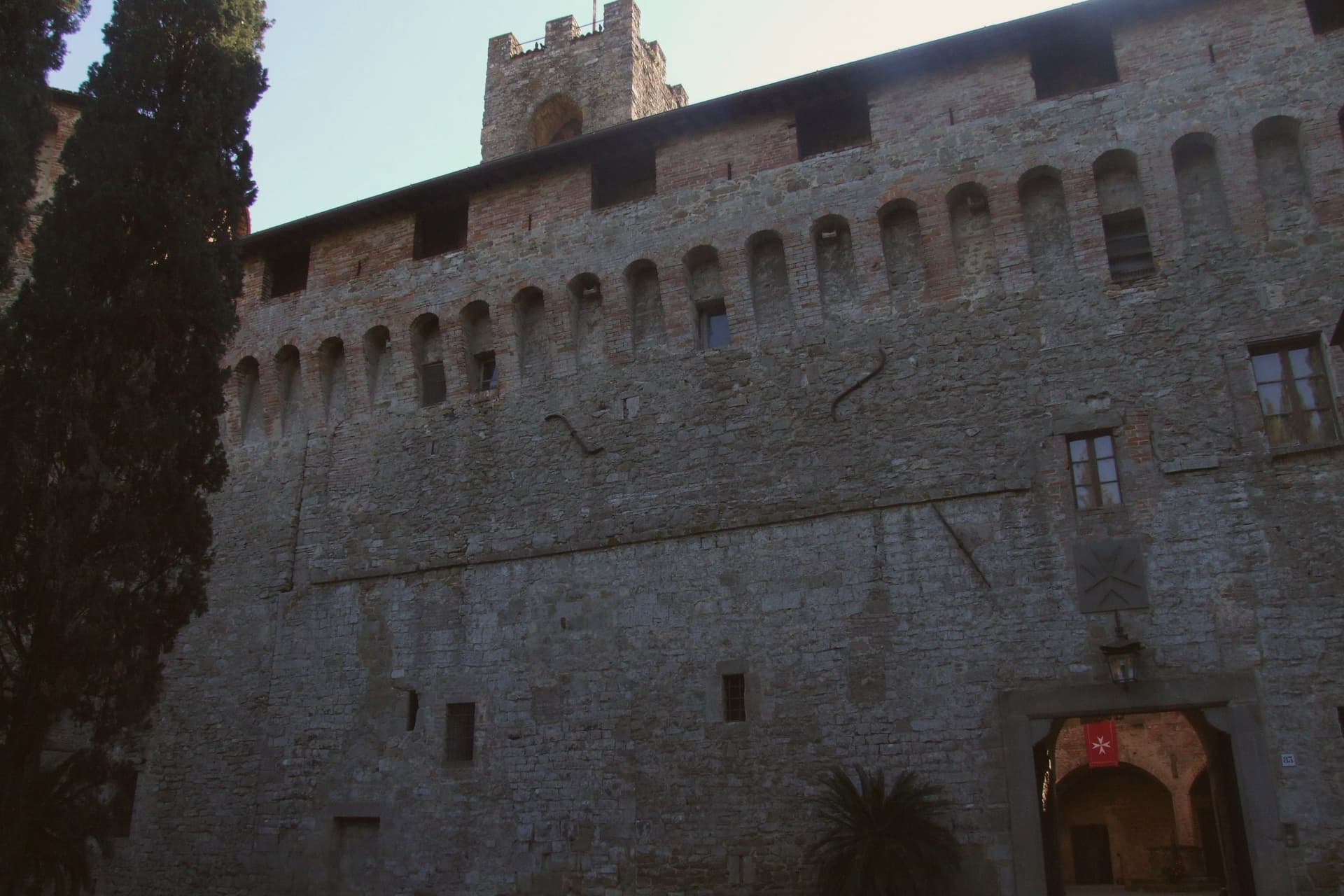
Magione sits at 299 meters on a hill east of Lake Trasimeno, fifteen kilometers from Perugia. The name comes from the Knights Hospitaller, who built a hospital here in the mid-twelfth century dedicated to Saint John the Baptist and called their convent Maison in their own language.
The original nucleus stood on the Perugia-Tuscany route and grew into the fortified base that still anchors the town today. The lower town is organized around two medieval poles: the castle complex near the old route, and the quadrangular tower rising thirty meters over the settlement, built in the same period by the same Order.
The vineyards on the surrounding hills lie between 250 and 350 meters above sea level, and the town's territory extends down to the lake's eastern shore. In October 1502, the castle hosted a plot against Cesare Borgia: his own captains and allies conspired against him inside its walls.
Niccolò Machiavelli, on diplomatic mission for Florence, learned the details and passed them to Borgia, who dismantled the conspirators within months. A hospital, a tower, and a plot against a Borgia: the town's history reads as a sequence of episodes gathered around the same fortified point on the road between Perugia and Tuscany.
What to see in Magione
- Castello dei Cavalieri di Malta. The fortified complex built by the Knights Hospitaller stands as the town's anchor, its walls the setting where the Conspiracy of Magione was plotted against Cesare Borgia.
- Torre dei Lambardi. Thirty-meter quadrangular tower built between the twelfth and thirteenth centuries by the Gerosolimitani Knights, three floors and a summit terrace.
- Chiesa di San Giovanni Battista. Parish church inside the castle complex, dedicated to the saint of the original Hospitaller foundation.
How to get to Magione
There is a railway station in the town, so you can arrive without a car and never need one while you are here. Perugia is roughly 23 minutes away by road.
✷ We have written about Magione
“The lake is like a sanatorium compared to the sea. It’s relaxed. It’s calm. It’s silent. To find this level of almost disturbing quietness, you either go up into the mountains, or you really need to know your way around the sea to find that particular spot not overrun by vacationers and beach people. In Trasimeno, this is easy. Even the most popular towns like Castiglione or Passignano sit in quiet harmony with the stillness of the water.”
Read our piece on Magione →Lago Trasimeno | Never Compete with the Sea
Our tip
April through June and September into October are the working months on the eastern Trasimeno: clear lake light, olive groves on the hills above, evenings cool enough to walk between the Castello and the Torre. July and August reach the low thirties in the basin; the lake helps but weekends fill with Perugia and Florence day-trippers and the lakefront frazione of San Feliciano runs heavy. The olive harvest in late October and November turns the territory busy with frantoi at full capacity. Festa del Giacchio - Sagra del Pesce del Lago Trasimeno falls in July.
Castiglione del Lago
Why visit Castiglione del Lago
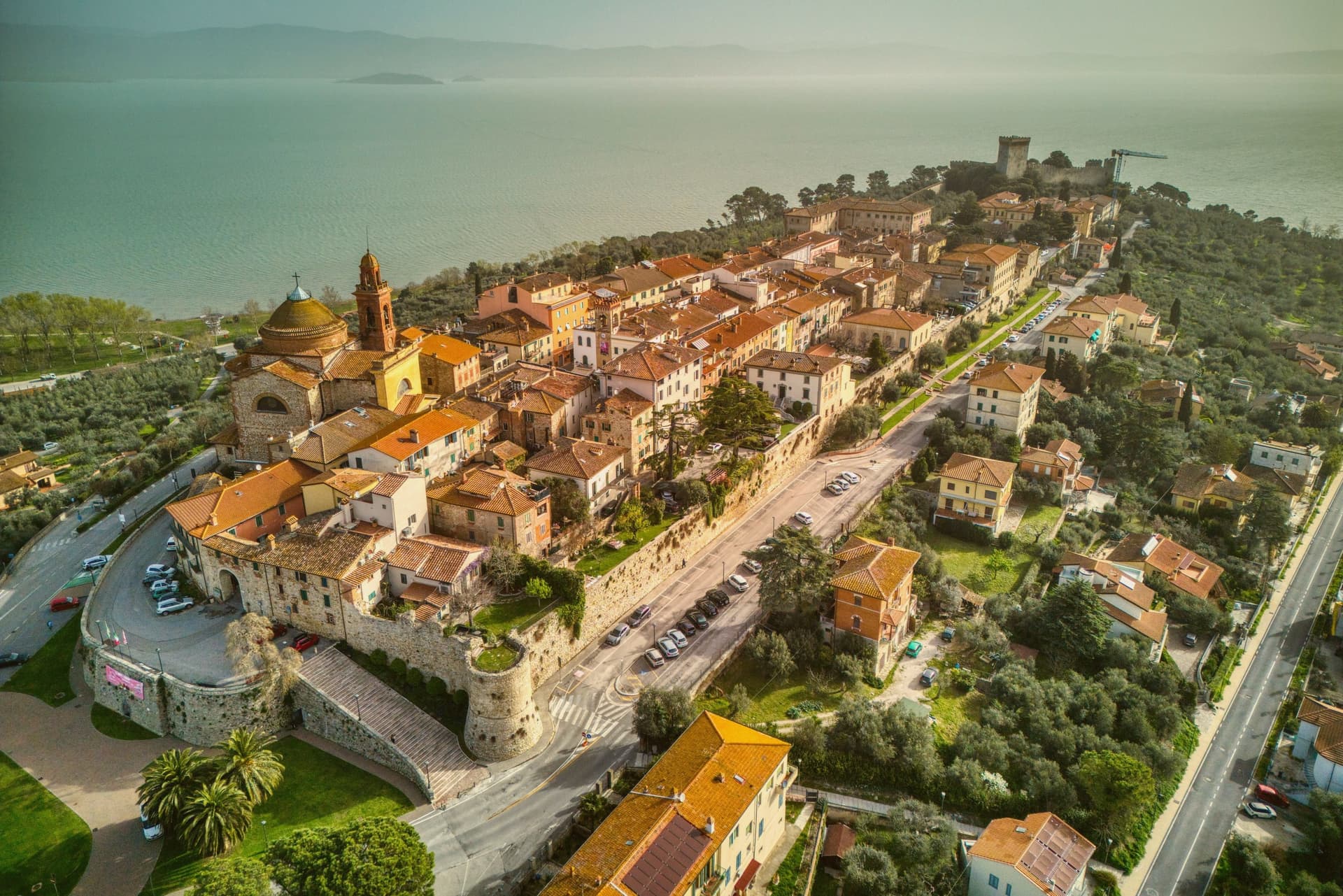
The town sits on a limestone promontory on the western shore of Lake Trasimeno, thirty kilometers from Perugia. That promontory was the fourth island of the lake in antiquity, before the strip of water separating it from the mainland silted in, which is why a place now solidly attached to shore still carries the memory of being an island in its layout and its name.
The fortress anchors the southern end of the centro storico, and a covered passage links it directly to the ducal palace: one museum complex, two buildings, four centuries apart, joined so that a visitor can pass from medieval military architecture into a Mannerist-frescoed residence without stepping outside. The town is the largest commune on the Trasimeno and the western base for the ferries out to the lake's islands, and it is the only one of the lake's shore towns to hold Borghi più belli status.
What this adds up to is a small center where fortification and courtly decoration sit back to back, and where the lake itself, its islands, its silted-in strait, its ferries, is never far from any single building.
What to see in Castiglione del Lago
- Palazzo della Corgna. Sixteenth-century ducal palace built for Ascanio della Corgna on a Baglioni structure, eight rooms frescoed by il Pomarancio between 1574 and 1590.
- Rocca del Leone. Pentagonal medieval fortress commissioned by Federico II di Svevia in 1247, linked to Palazzo della Corgna by a covered passageway.
- Chiesa di Santa Maria Maddalena. Parish church on the centro storico's main axis, bell tower rising to 329 meters above sea level over the lake.
How to get to Castiglione del Lago
There is a railway station in the town, so you can arrive without a car and never need one while you are here. Perugia is roughly 52 minutes away by road.
Our tip
April through June and September into October are the months the Trasimeno shows best: the lake holds the light, the ferry to Isola Maggiore runs full schedule, and the lungolago at evening fills with locals and not yet with day-trippers. July and August push into the low thirties; the lake breeze helps, but weekends draw heavy traffic from Perugia and Florence. November through March is quiet. Stramaialata - Sagra del Mangiar Bene falls in August.
Assisi
Why visit Assisi
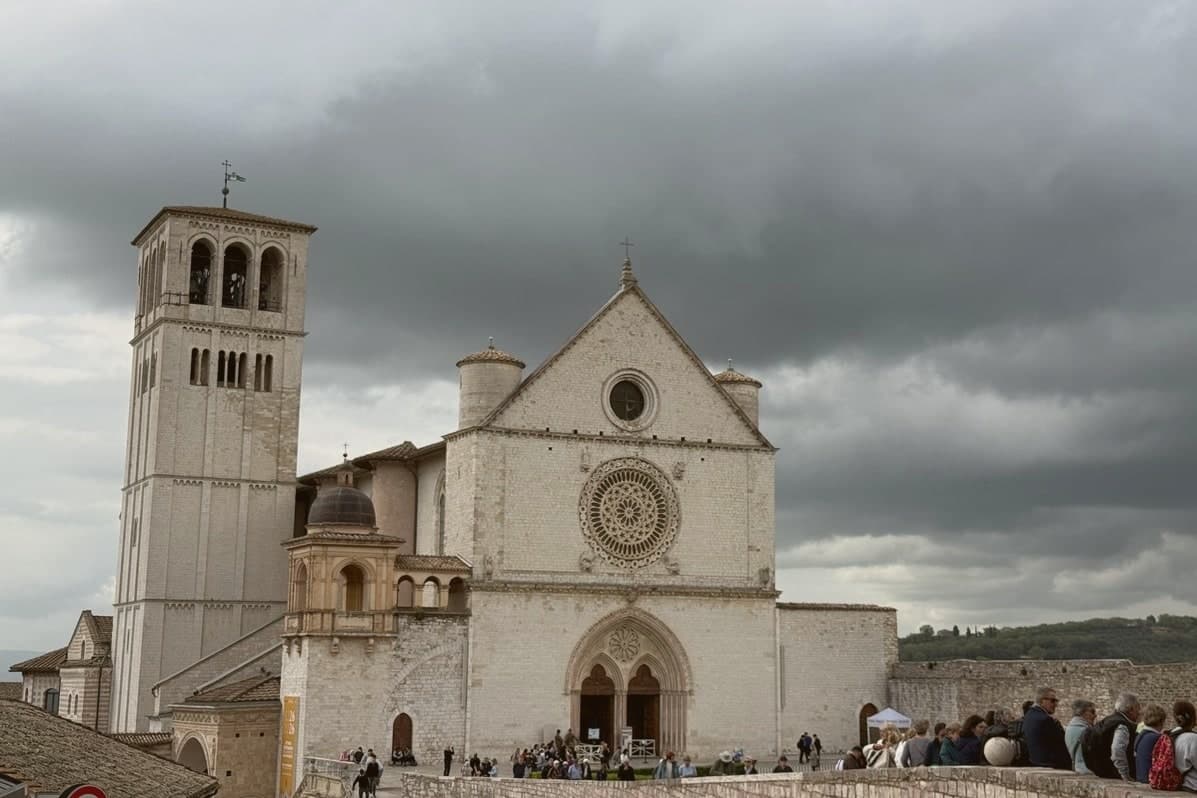
Assisi sits on a terraced spur twenty kilometers east of Perugia, the town built into the western flank of Monte Subasio where it drops toward the plain below. The Umbri settled the site before the Romans came, and the municipium of Asisium grew up around what is now Piazza del Comune, the square that still forms the civic center of the medieval town.
The centro storico runs between two poles: the basilica holding Francis's tomb at one end and the church holding Clare's relics at the other, with the Roman square and its temple facade sitting between them as the oldest layer beneath the medieval one. Below the town, on the plain, stands the basilica built around the chapel where Francis founded his order and died.
Further up the mountain, past the town walls, the hermitage occupies a beech wood where Francis and his companions withdrew from all of it. The layout traces the life it commemorates: birth and burial at the center, founding and death on the plain below, retreat in the wood above.
The town has arranged itself, over centuries, around the geography of one man's biography.
What to see in Assisi
- Basilica di San Francesco. Two superimposed churches over the saint's tomb, frescoed by Cimabue, Giotto, Simone Martini and Pietro Lorenzetti.
- Basilica di Santa Chiara. Church at the eastern end of the centro storico, holding the relics of Saint Clare and the San Damiano Crucifix.
- Tempio di Minerva. Roman temple on Piazza del Comune, six Corinthian columns intact, one of the best-preserved temple façades in the country, converted to a church in 1539.
How to get to Assisi
There is a railway station in the town, so you can arrive without a car and never need one while you are here. Perugia is roughly 35 minutes away by road.
✷ We have written about Assisi
“The basilica is grand, and it is grand from a distance, which is the harder trick. You see it from the valley road as a long horizontal weight along the end of the ridge, held up on arches, wider than the town it belongs to. In front of it there is a huge sloping field, stone, which functions as a piazza sort-of.”
Read our piece on Assisi →Assisi | The Church He Would Have Chosen
Our tip
April through June and September into October are the months Assisi was built for. The hills around Monte Subasio turn green in spring and gold in autumn, and the pilgrim traffic spreads thinly enough that the centro storico keeps its silence in the early morning. October 3 and 4 are the Festa di San Francesco, when delegations from every Italian region process to the basilica. Festa di Sant'Anna falls in July.
Castiglion Fiorentino
Why visit Castiglion Fiorentino
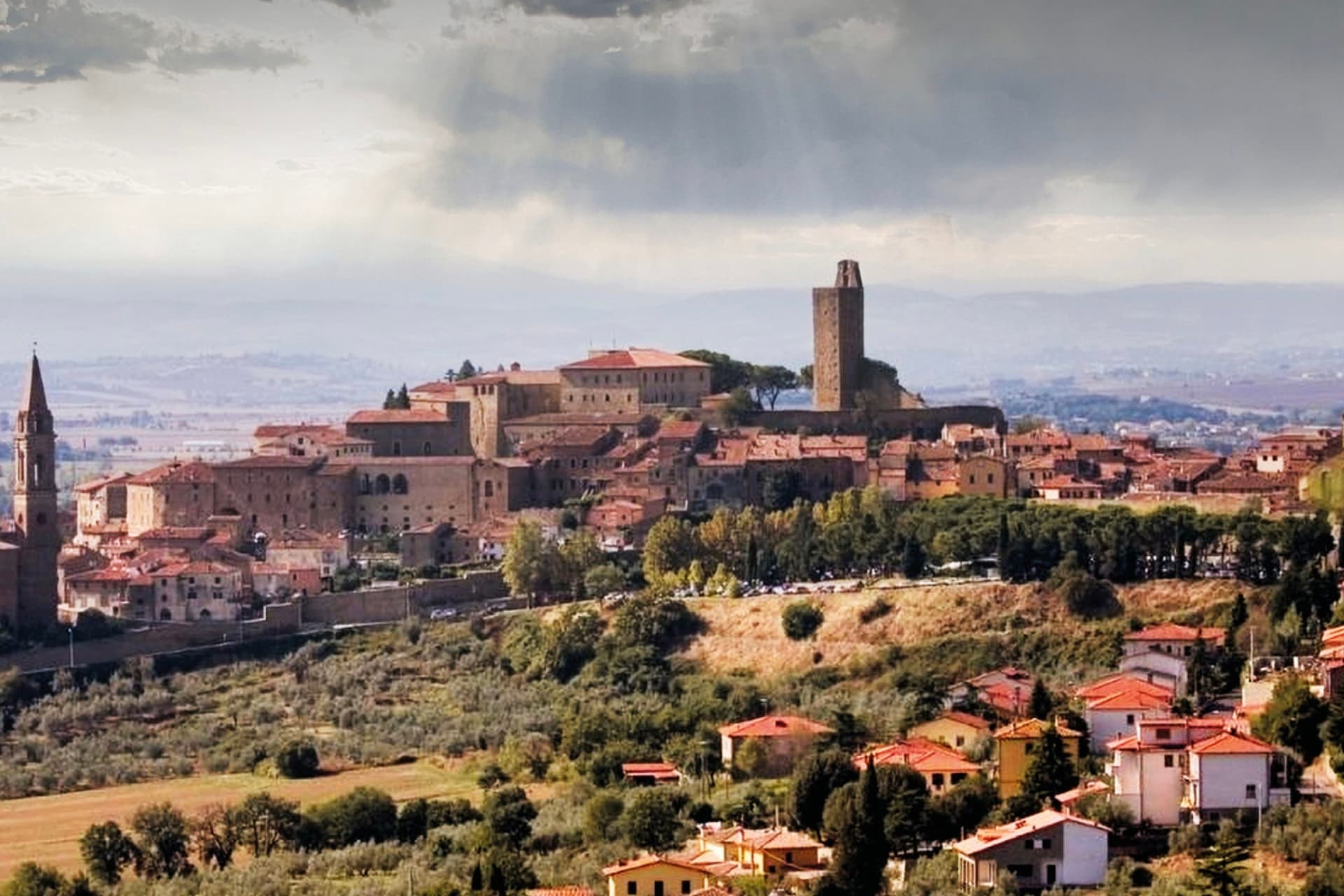
The hill stands between Arezzo and Cortona, above the fertile plain that gives the area its name. The centro storico is layered directly on what came before it: the medieval streets and the fortress at the summit sit on foundations from the fourth century BC, so walking from the lower gates to the top of the town is also a climb through the town's own construction history, one period built on the next rather than beside it.
The upper terrace holds the oldest religious building along with the fortress, while the main piazza lower down gathers the later additions, the parish church, the arcade, and the gallery, into a single civic space. The town carried allegiance first to Perugia, then to Florence from 1384, and was renamed at that moment, a change of name that marks the point where the additions to the skyline, the arcade among them, became possible.
What results is a town where the sightlines do the explaining: the arcade frames the plain because the plain was always the reason to build here, and the fortress crowns the hill because it was already fortified ground long before anyone called it that.
The re-enactment here is Palio dei Rioni di Castiglion Fiorentino (Arezzo), usually held in June.
What to see in Castiglion Fiorentino
- Cassero. Fortified core at the top of the town. The tower is reached by climbing through the streets of the centro storico, with the drop toward the plain opening out only at the top.
- Logge del Vasari. The three arches sit at the edge of Piazza del Municipio, so the arcade functions as a frame for the view rather than a monument to walk around. Below it, the Pinacoteca occupies the neighboring building.
- Pinacoteca Comunale. Civic gallery next to the Logge with works by Bartolomeo della Gatta, Margaritone d'Arezzo, Taddeo Gaddi and a notable bust reliquary in gilded silver.
How to get to Castiglion Fiorentino
There is a railway station in the town, so you can arrive without a car and never need one while you are here. Perugia is roughly 54 minutes away by road.
Our tip
April through June and September into October are the working months in the Val di Chiana: dry days, mild evenings, harvest of olives and Sangiovese into October. July and August push past thirty degrees and the plain below holds the heat; the town at 342 meters runs a few degrees cooler. The Palio dei Rioni in mid-June fills the streets with banners between the four historic quarters and a horse race in the Cassero square. Palio dei Rioni di Castiglion Fiorentino (Arezzo) falls in June.
Cortona
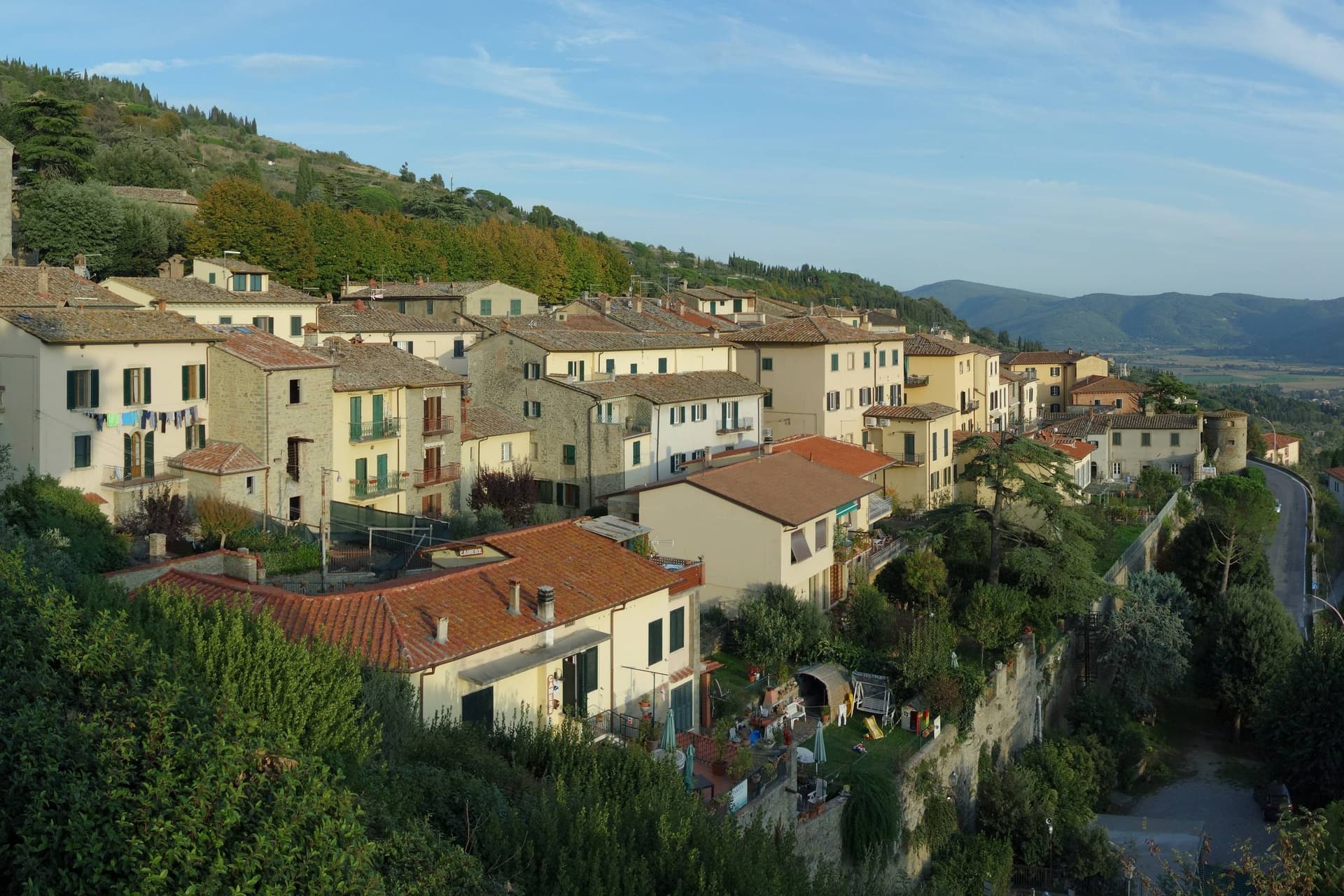
Why visit Cortona
Cortona stands on the southern flank of the Val di Chiana, looking across to Lake Trasimeno: a position that put it in sight of both the plain it governed and the water beyond it. The Etruscan name Curtun survives fixed in stone, and the city that carried it was built in tiers up the hillside, walls and fortress at the crown, church and convent lower down at the edges of the slope, houses and squares filling the ground between.
The bishop granted Francis of Assisi a place for retreat in 1211, and what resulted was built into a narrow valley below the town rather than within its walls, a retreat kept apart from the civic center even as it stayed within reach. Santa Margherita, the city's patron, is held on the ridge above the streets she once walked.
The painters Luca Signorelli and Pietro da Cortona were born inside the walls that still define the town's shape. Frances Mayes published her memoir in 1996, and the town has not been quiet since.
What emerges is a hill town whose Etruscan skeleton, medieval faith, and modern fame sit stacked on the same slope, each layer visible without erasing the one beneath it.
The re-enactment here is Giostra dell'Archidado di Cortona, usually held in June.
What to see in Cortona
- Mura etrusche. The walls still ring the city entire, the foundation under every later layer of building, Roman and medieval alike.
- MAEC. Museum of the Etruscan Academy in Palazzo Casali, holding the bronze plaque and the lampadario di Cortona.
- Museo Diocesano. Collection in the former Chiesa del Gesù with Beato Angelico's Annunciation of 1430 and works by Luca Signorelli.
How to get to Cortona
There is a railway station in the town, so you can arrive without a car and never need one while you are here. Perugia is roughly 45 minutes away by road.
Our tip
April through June brings green hills, cool evenings and the longest hours in the Diocesano without a queue. September and October are the dry, gold months, light coming in low across Lake Trasimeno and the olive harvest running until November. July and August are the difficult months. Giostra dell'Archidado di Cortona falls in June.
Foligno
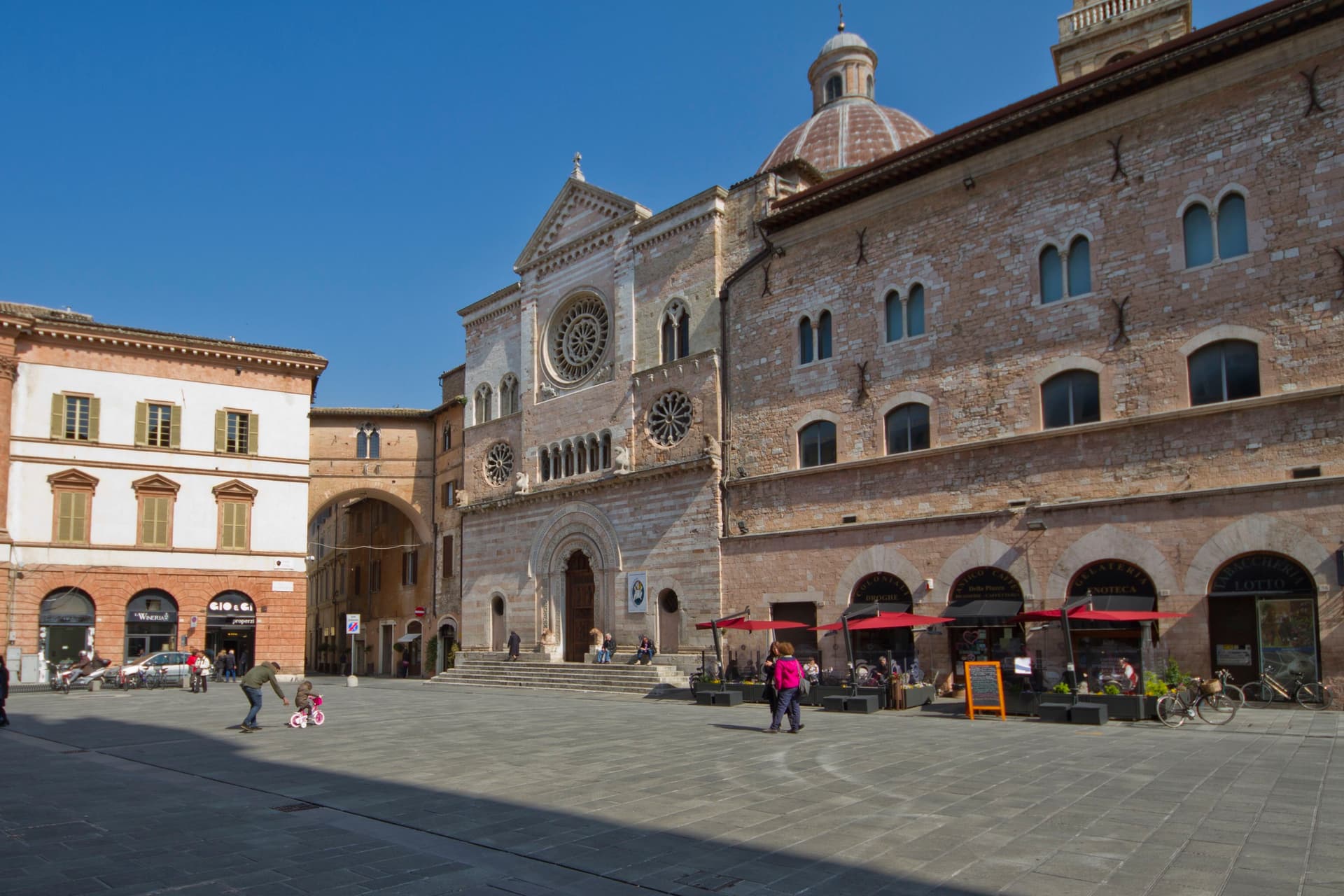
Why visit Foligno
Foligno sits on the left bank of the Topino where the river leaves the Apennines and meets the plain of the Clitunno, the point at which the mountains give way to the Umbrian Valley. The town was called Fulginium in antiquity, and Cicero mentions the prefecture in two surviving fragments.
The Trinci ruled the town from 1305 to 1439, and the palace that carries their name still stands at its center, with the cathedral facing the same square where the town's tournament has run twice a year since its revival. The city's oldest church predates the Trinci period by centuries, its site going back to an 8th-century chapel, while the abbey in the hills above town was founded still earlier, in 1084, its cloister finished in 1229.
Between the ancient prefecture, the medieval abbey, the Trinci court, and the print workshop that put Dante into type, Foligno reads as a valley crossing point where successive centuries each left a building rather than displacing what came before.
The re-enactment here is Giostra della Quintana, usually held in September.
What to see in Foligno
- Palazzo Trinci. Seat of the Trinci signoria 1305-1439, frescoed by Gentile da Fabriano and Jacopo Bellini, now holding the Pinacoteca and archaeological museum.
- Cattedrale di San Feliciano. Romanesque cathedral on Piazza della Repubblica, built over the tomb of the bishop-martyr buried here in 251 AD.
- Basilica di Santa Maria Infraportas. Oldest church in the city on the site of an 8th-century chapel, frescoes by Nelli, Ugolino di Gisberto, Alunno and Mezzastris.
How to get to Foligno
There is a railway station in the town, so you can arrive without a car and never need one while you are here. Perugia is roughly 42 minutes away by road.
Our tip
April through June and September into October are the months locals prefer. The Quintana runs twice a year, the June and September editions filling the rioni for a week each. April through October is also the season for the Topino river paths and the climb up to Sassovivo. Festevolezze falls in July.
More from Anywhere Italy
- The best towns with a medieval festival that you can reach by train within 90 minutes of Perugia
- The best towns with a food festival that you can reach by train in the province of Perugia
 The best hidden olive oil towns you can reach by train within 90 minutes of Perugia
- The best towns you can reach by train that have a serious restaurant within 90 minutes of Perugia
 The best hidden hill towns with a food festival within 90 minutes of Perugia
- The best hill towns with a food festival in the province of Perugia