
The best hidden hill towns with a food festival within 90 minutes of Perugia
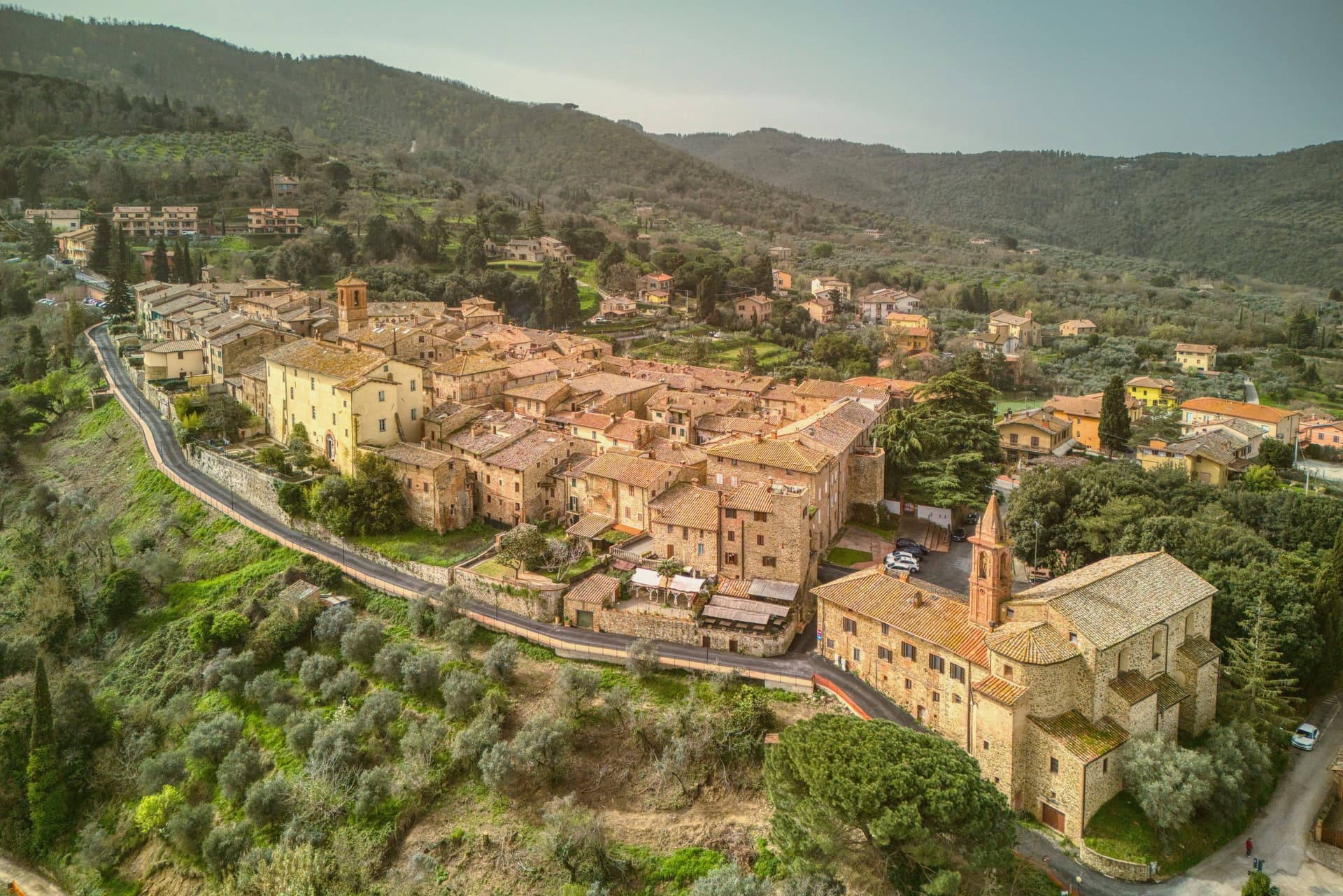
The country between Perugia and the Tuscan border is stone and slope: travertine and tufa houses, oak woods on the ridges, olive terraces below, and towns that sit where the land stops climbing. Autumn is the season the food here declares itself, when the truffle diggers come down from the woods and the new oil arrives cloudy and green in the frantoi. Each of these places has one thing it grows or forages better than its neighbours, and once a year the whole town cooks it in the piazza. Spring and early summer bring their own, broad beans, cherries, wild asparagus, served on trestle tables under the walls.
Most people arriving in Umbria go to Assisi, and for good reason, though the basilica car parks fill by mid-morning and the road up is a queue of coaches from Easter to October. Perugia itself absorbs the rest, its escalators and its chocolate festival and its student bars. Both are worth the time. Both mean that the visitor sees Umbria as two crowded hilltops with a plain between them.
The hills carry on well past the famous stops, in every direction from Perugia, and the food does too. Sagrantino vineyards on one side, Chianina cattle country and Etruscan tombs on the other, a lake in the middle with its own fish. Fewer people go to the towns in this list, which is largely why their festivals are still cooked by the people who live there.
Of the 41 communes we have mapped within 90 minutes of Perugia, 17 qualify as hill towns with a food festival: each is an inland hill settlement, and each holds a recurring food festival built around one local ingredient. This list is the hidden ones, 10 in all, ordered smallest first. The smallest, Paciano, has 957 residents.
Elsewhere in the catalogue: The best hidden towns with a food festival in the province of Perugia and The prettiest villages with a food festival within 90 minutes of Perugia.
Paciano
Why visit Paciano
The town is first documented in 917, in an imperial charter of Berengar I, and appears again in 1260 as a castrum, a fortified site. Perugia rebuilt the walls and main tower between 1461 and 1473, using the site as a watch-post over the western approach to the lake below.
Inside the circuit, three parallel streets are linked by orthogonal alleys, a layout that carries the Renaissance palace with the Vignola staircase, the oldest noble residence in the town, and the 17th-century Palazzo Cennini, once the summer residence of a cardinal. The gates and towers sit at the edge of this grid, facing outward toward the water.
Olive oil from the slopes that drop toward the shore is the present-day specialty. What remains is a small fortified grid, built to watch a lake, that turned its military purpose into a domestic one once the watching was no longer needed.
What to see in Paciano
- Medieval walls. About 600 meters of circuit, with the three original gates named Fiorentina, Perugina and Rastrella still standing among the eight towers.
- Palazzo Baldeschi. Assembled from earlier tower houses, with a staircase attributed to Jacopo Barozzi da Vignola. Now used as an exhibition and cultural space.
- Rocca Buitoni. The oldest surviving palace in the town, built as a noble residence inside the walls, with a small private chapel.
How to get to Paciano
Perugia is roughly 44 minutes away by road.
Our tip
April through June and September into October are the months for Paciano. The slopes of Monte Petrarvella hold the wildflowers, Trasimeno is warm enough to swim from late May, and the olive groves run from green to silver-gold across the half-year. The Infiorata fills the three parallel streets each Corpus Domini in late May or June. Sagra dello Strozzaprete falls in August.
Cetona
Why visit Cetona
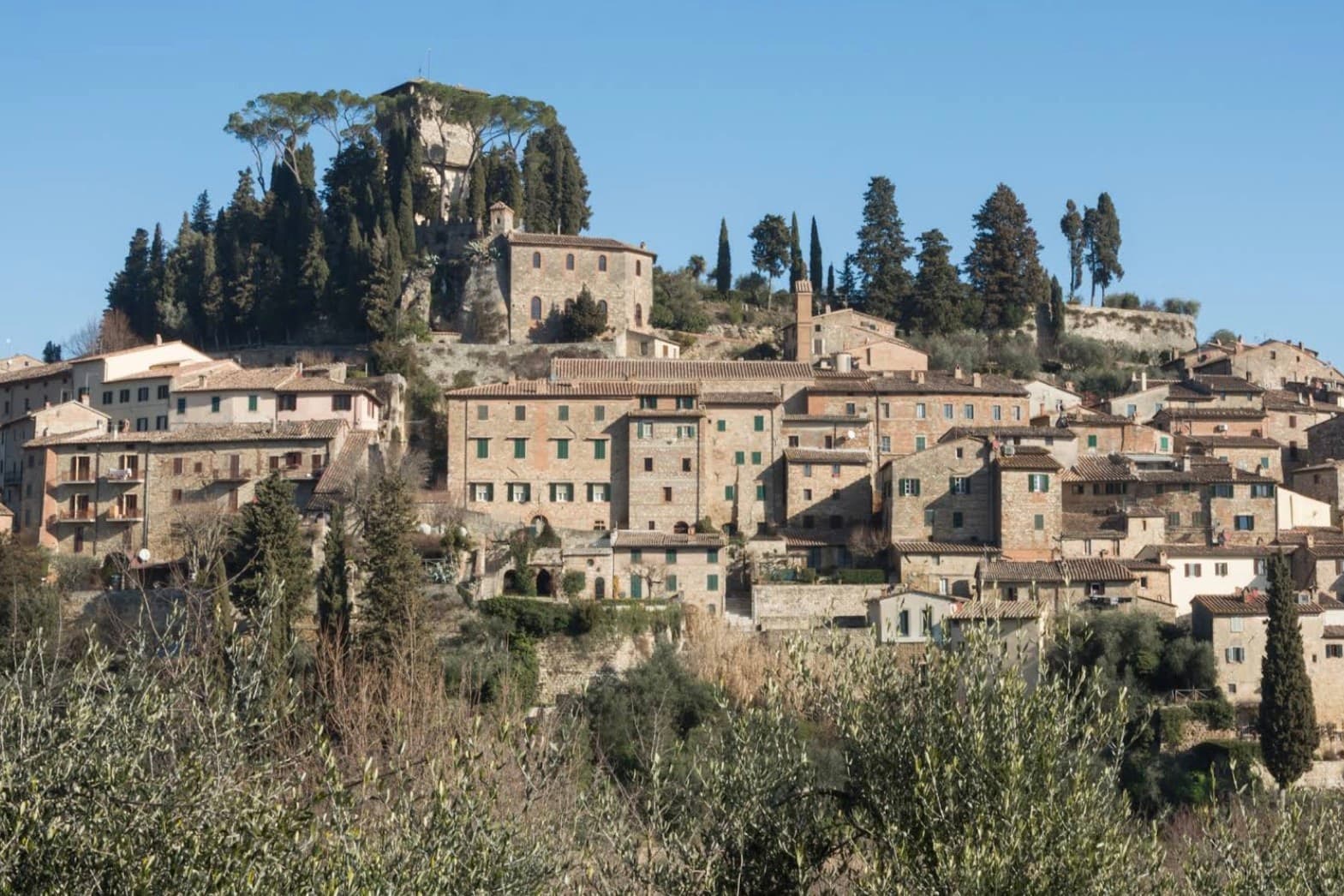
The town sits on the western flank of a ridge at the meeting point of Toscana, Umbria and Lazio, where the mountain divides the Val d'Orcia from the Val di Chiana. The medieval comune passed between Siena, Orvieto and Perugia before falling to Siena in the late fourteenth century, and it was Cosimo I who later sold it whole to a marchese.
The fortress at the top of the grid and the square laid out below it are two halves of the same Renaissance move: a private residence replacing a garrison at the summit, a flat civic stage opened up at the base. Above the town, in the woods, the hermitage and the caves belong to a much older layer, human use of the mountain reaching back to the Mesolithic, long before any comune or marchese laid claim to it.
What the town adds up to is a settlement built in tiers: a prehistoric mountain, a contested medieval center, and a Renaissance overlay that reorganized the base of the hill without touching what stood above it.
The re-enactment here is Corsa delle brocche a Cetona, usually held in July.
What to see in Cetona
- Piazza Garibaldi. Elliptical square at the foot of the medieval grid, flat and open where the streets above it climb steeply. The civic stage of the borgo, still the first thing that orients a visitor.
- Rocca di Cetona. Fortress at the top of the centro storico, its walls and keep still standing though the interior became a private residence rather than a garrison.
- Convento di San Francesco. Franciscan convent below the borgo, founded in 1212, with a single-nave church and a small cloister still in religious use.
How to get to Cetona
Perugia is roughly 78 minutes away by road.
Our tip
April through June and September into October are the months Cetona keeps its calmest pace, the wooded slopes of Monte Cetona green or rust depending on the half. July and August are hot in the centro storico but the mountain trails above 800 meters stay cool. The Mostra del Tartufo, dedicated to the local white truffles, runs the second weekend of November in Piazza Garibaldi. Sagra del Bico di Cetona falls in June.
Fossato di Vico
Why visit Fossato di Vico
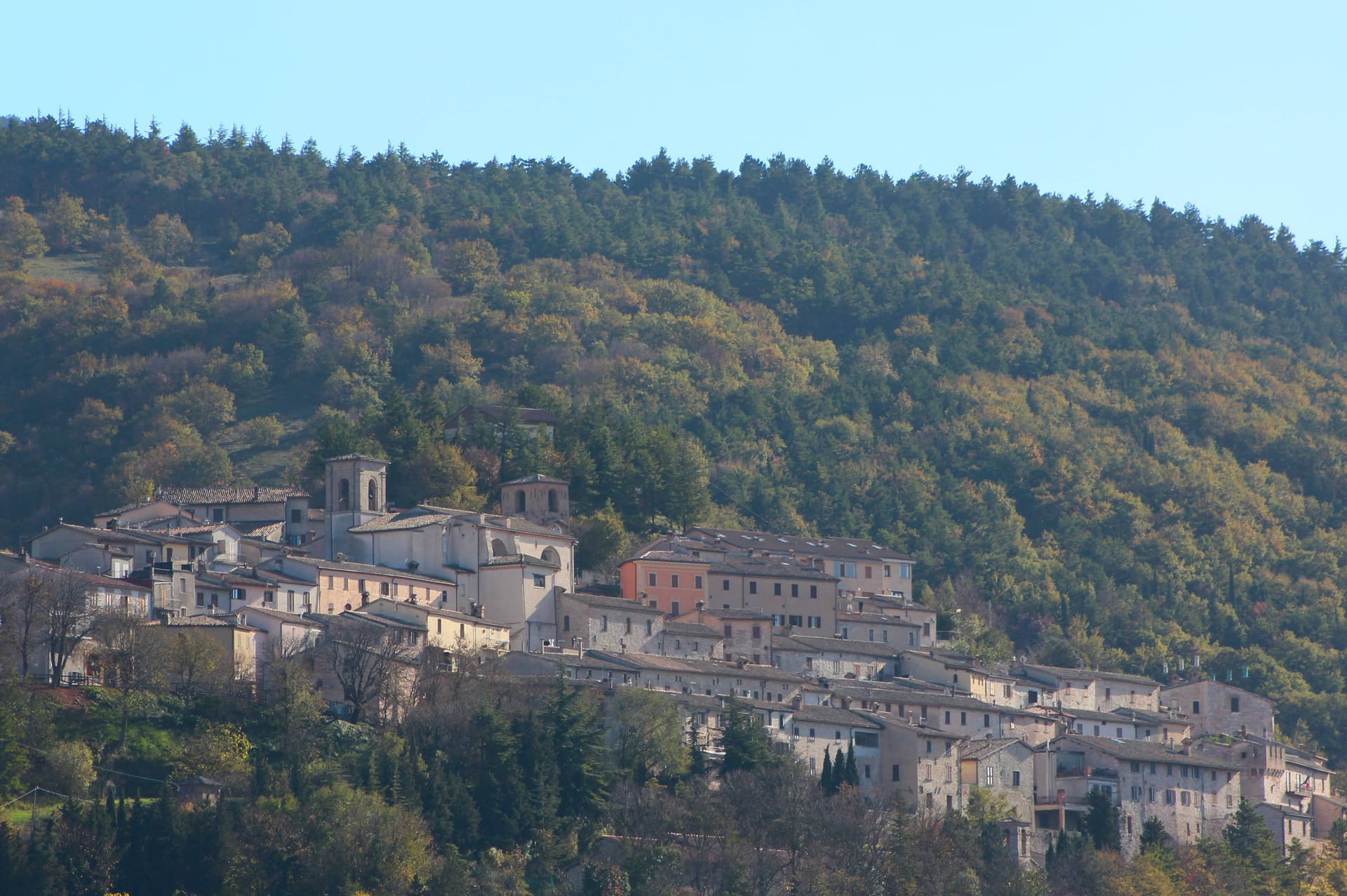
Fossato di Vico stands at 581 meters on the slopes of Mount Mutali, on the line of the Via Flaminia between Foligno and Gubbio. The Romans built a changing station here called Hellvillum after laying the road in 220 BC.
The borgo proper was founded in 980 by Lupo, called Vico, son of Monaldo, count of Nocera. In the twelfth century it passed to the Marsciano counts, who eventually sold it to Gubbio; in the thirteenth Perugia took it militarily and the commune declared independence.
What survives from that period is the network of covered passages called Le Rughe, stone vaults that turned the street into a defensible interior, a rare example of thirteenth-century castle architecture used as everyday infrastructure. The church of San Pietro, the oldest in town, predates the castle and was founded as a Camaldolese monastery.
The Chiesa di San Benedetto outside the walls keeps Eugubine-school frescoes including what is taken to be one of the earliest known portraits of a pope.
What to see in Fossato di Vico
- Le Rughe. Thirteenth-century covered alleyways under round stone vaults, rare surviving example of defensive castle-street architecture.
- Chiesa di San Pietro. Oldest church in town, founded as a Camaldolese monastery, Romanesque structure predating the medieval castle.
- Chiesa di San Benedetto. Thirteenth-century Benedictine abbey outside the walls, fragments of fourteenth and fifteenth-century Eugubine-school frescoes including an early papal portrait.
How to get to Fossato di Vico
There is a railway station in the town, so you can arrive without a car and never need one while you are here. Perugia is roughly 47 minutes away by road.
Our tip
April through June brings the slopes of Mount Mutali green and the upper Flaminia corridor walkable in long evenings. September and October are clear, with first frost on the higher pastures by month's end. July and August push the lower valley into the mid-thirties; at 581 meters the borgo stays cooler, and the vaulted Rughe hold a constant temperature that feels engineered. Sagra del Cinghiale falls in August.
Montepulciano
Why visit Montepulciano
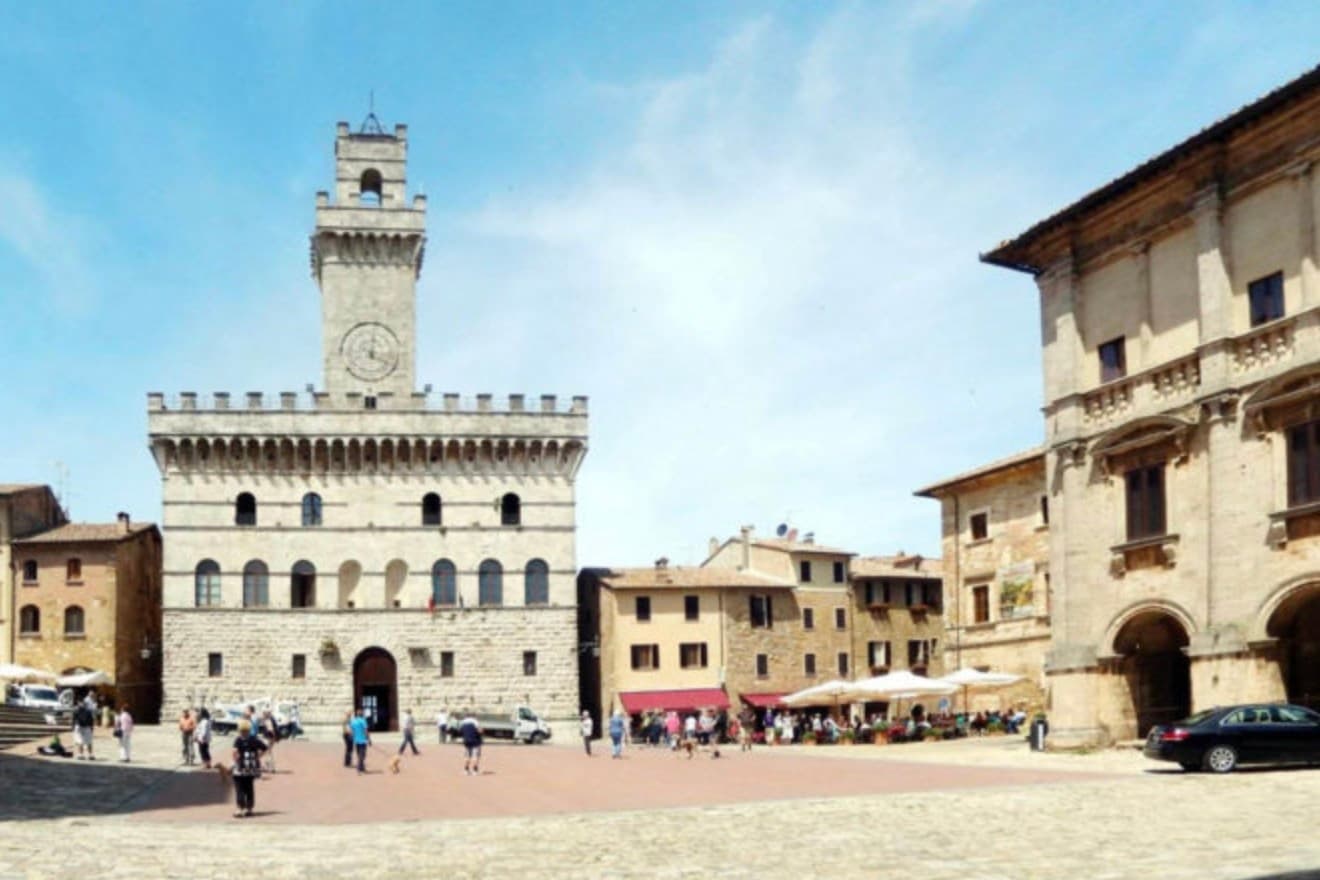
The ridge runs between the Val di Chiana and the Val d'Orcia, 70 kilometers southeast of Siena, and the town follows its spine uphill: streets climb from the gates toward the high point, where the main square sits ringed by the buildings that define the skyline from below. The origin predates the Renaissance fabric by centuries.
Etruscan tombs survive in the surrounding hills, though almost nothing of that period shows in the centro storico itself, which was rebuilt wholesale in the fifteenth and sixteenth centuries over whatever came before. The wine and the festival both use the climb as their setting rather than their subject: the cellars are cut into the rock beneath the palazzi, keeping a constant temperature for aging, and the barrel race each August sends two men from each of the eight contrade hauling an eighty-kilogram cask up the same gradient that every visitor covers on foot, only slower.
The steepness that shaped the defensive site nine centuries ago is still what a person feels first, in the legs, before the buildings register at all.
The re-enactment here is Bravio delle Botti, usually held in August.
What to see in Montepulciano
- Tempio di San Biagio. A 13-meter dome and travertine façade standing alone outside the walls, the ground falling away below it so the building reads as a single volume against the hillside.
- Piazza Grande. The high piazza at the top of the ridge, ringed by the Duomo, the Palazzo Comunale and the Palazzo Tarugi, all rebuilt in the fifteenth and sixteenth centuries.
- Palazzo Comunale. Town hall designed by Michelozzo in the fifteenth century, its tower offering a view over the Val di Chiana and Val d'Orcia.
How to get to Montepulciano
There is a railway station in the town, so you can arrive without a car and never need one while you are here. Perugia is roughly 57 minutes away by road.
✷ We have written about Montepulciano
“Now, the postcard itself, the towns, and here I have less to say than you would expect, because Pienza and Montepulciano have become, and I mean this precisely, the canteens of a theme park. They are where you go to park, walk a pretty street, use the toilet, refill the water, eat a plate of something, and buy a thing to take home. They are the food court between the rides.”
Read our piece on Montepulciano →Val d'Orcia | The Postcard Is Constructed
Our tip
April through June and September into October are the working months on the ridge: vine work in the surrounding hills, mild days, evening light that lingers over the Val d'Orcia. July and August push into the low thirties and the climb to Piazza Grande slows even the residents. The Bravìo delle Botti runs the last Sunday of August and fills the town. Calici di Stelle falls in July.
Magione
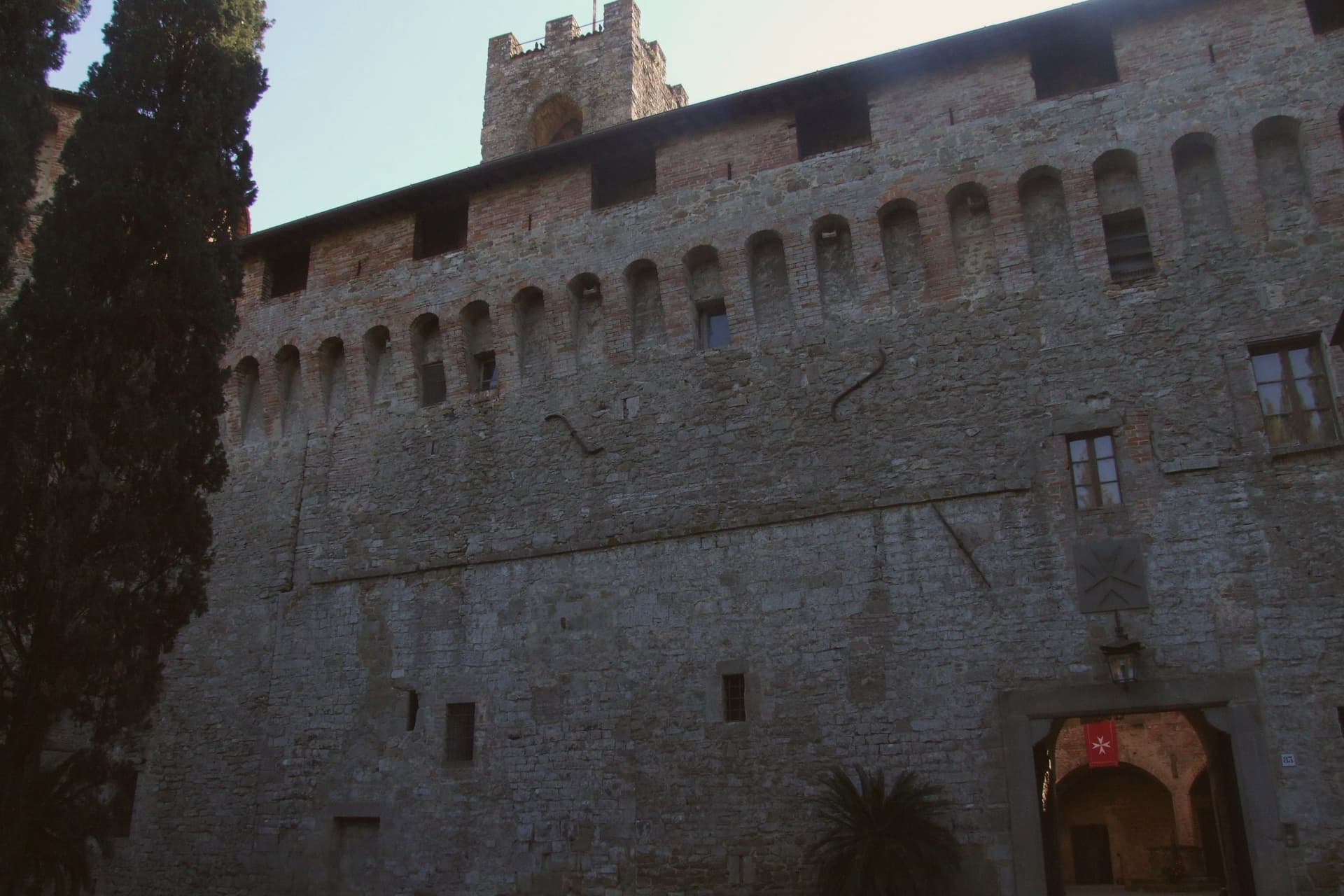
Why visit Magione
Magione sits at 299 meters on a hill east of Lake Trasimeno, fifteen kilometers from Perugia. The name comes from the Knights Hospitaller, who built a hospital here in the mid-twelfth century dedicated to Saint John the Baptist and called their convent Maison in their own language.
The original nucleus stood on the Perugia-Tuscany route and grew into the fortified base that still anchors the town today. The lower town is organized around two medieval poles: the castle complex near the old route, and the quadrangular tower rising thirty meters over the settlement, built in the same period by the same Order.
The vineyards on the surrounding hills lie between 250 and 350 meters above sea level, and the town's territory extends down to the lake's eastern shore. In October 1502, the castle hosted a plot against Cesare Borgia: his own captains and allies conspired against him inside its walls.
Niccolò Machiavelli, on diplomatic mission for Florence, learned the details and passed them to Borgia, who dismantled the conspirators within months. A hospital, a tower, and a plot against a Borgia: the town's history reads as a sequence of episodes gathered around the same fortified point on the road between Perugia and Tuscany.
What to see in Magione
- Castello dei Cavalieri di Malta. The fortified complex built by the Knights Hospitaller stands as the town's anchor, its walls the setting where the Conspiracy of Magione was plotted against Cesare Borgia.
- Torre dei Lambardi. Thirty-meter quadrangular tower built between the twelfth and thirteenth centuries by the Gerosolimitani Knights, three floors and a summit terrace.
- Chiesa di San Giovanni Battista. Parish church inside the castle complex, dedicated to the saint of the original Hospitaller foundation.
How to get to Magione
There is a railway station in the town, so you can arrive without a car and never need one while you are here. Perugia is roughly 23 minutes away by road.
✷ We have written about Magione
“The lake is like a sanatorium compared to the sea. It’s relaxed. It’s calm. It’s silent. To find this level of almost disturbing quietness, you either go up into the mountains, or you really need to know your way around the sea to find that particular spot not overrun by vacationers and beach people. In Trasimeno, this is easy. Even the most popular towns like Castiglione or Passignano sit in quiet harmony with the stillness of the water.”
Read our piece on Magione →Lago Trasimeno | Never Compete with the Sea
Our tip
April through June and September into October are the working months on the eastern Trasimeno: clear lake light, olive groves on the hills above, evenings cool enough to walk between the Castello and the Torre. July and August reach the low thirties in the basin; the lake helps but weekends fill with Perugia and Florence day-trippers and the lakefront frazione of San Feliciano runs heavy. The olive harvest in late October and November turns the territory busy with frantoi at full capacity. Festa del Giacchio - Sagra del Pesce del Lago Trasimeno falls in July.
Lucignano
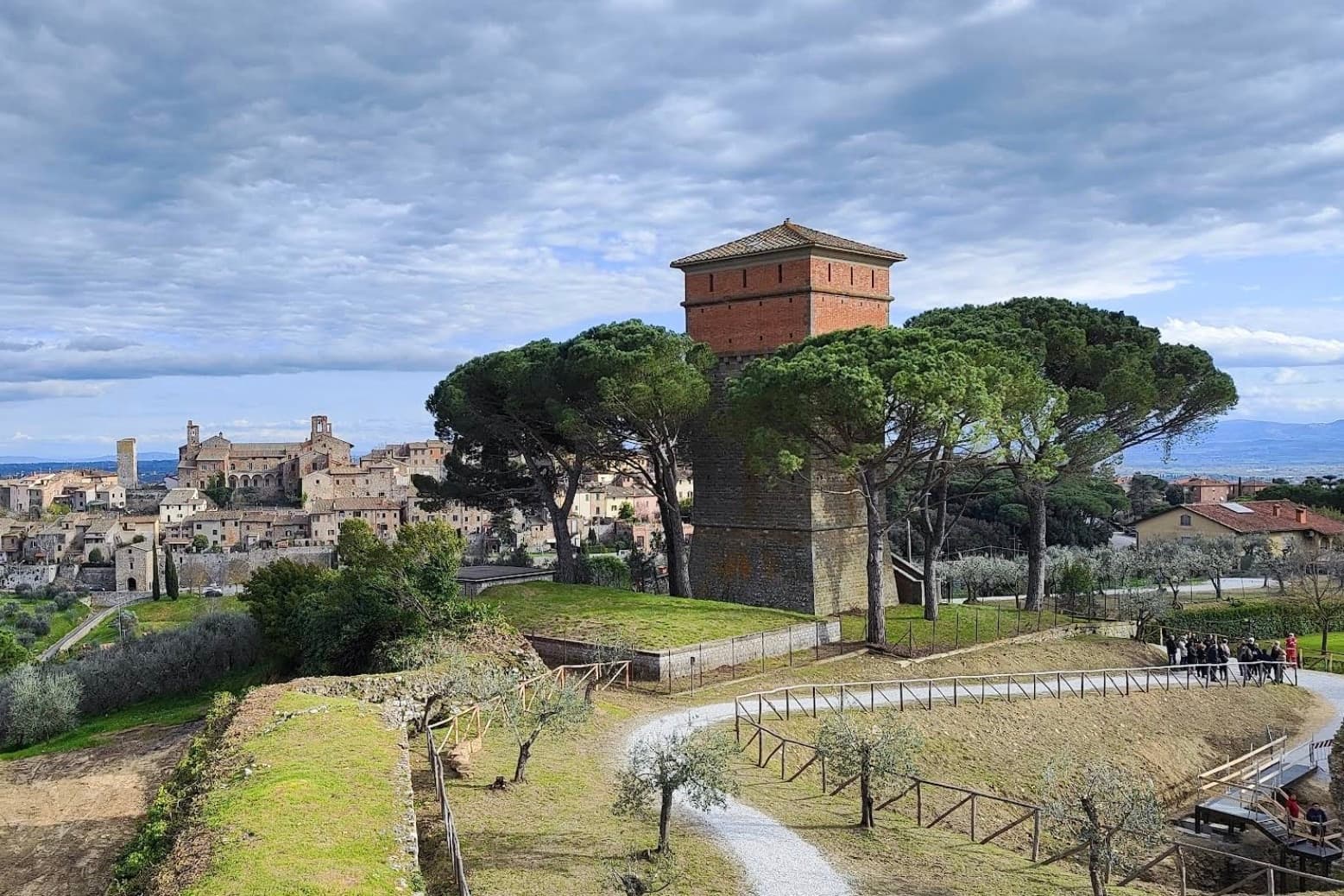
Why visit Lucignano
Lucignano sits at 400 meters on a hill in the Valdichiana, halfway between Siena and Arezzo, built on a tight elliptical plan of four concentric rings of streets. Its position made it one of the most contested settlements of medieval Toscana: Siena, Arezzo, Florence and Perugia all fought over it between 1200 and 1500.
The current walls and three gates date to a Sienese reconstruction of 1371. In the Museo Civico inside the Palazzo Comunale stands the Albero d'Oro, a 260-centimeter Gothic gold-and-coral reliquary in the shape of a tree, begun by Ugolino di Vieri in 1350 and finished by Gabriello d'Antonio in 1471.
Local tradition turned it into the Albero dell'Amore, a marriage charm. The Collegiata di San Michele Arcangelo dominates the highest ring of the borgo, and the elliptical plan is best read from the air, which is why drone footage of Lucignano keeps appearing in articles about medieval Tuscan urbanism.
The re-enactment here is Memorie dal passato a Lucignano, usually held in September.
What to see in Lucignano
- Albero d'Oro. 260-cm Gothic reliquary in the shape of a tree, gold, coral and enamel, begun by Ugolino di Vieri in 1350 and completed by Gabriello d'Antonio in 1471.
- Centro storico ellittico. Four concentric rings of streets inside elliptical walls, the most complete example of medieval Tuscan elliptical town planning.
- Collegiata di San Michele Arcangelo. Eighteenth-century church on the highest ring of the borgo, with a Vasari façade adjustment and a baroque organ inside the medieval shell.
How to get to Lucignano
There is a railway station in the town, so you can arrive without a car and never need one while you are here. Perugia is roughly 65 minutes away by road.
Our tip
April through June and September into October are the months Lucignano keeps its balance, the Valdichiana green or gold depending on the half and the centro storico cool inside its elliptical walls. The Maggiolata, a flower festival between the four quarters of the borgo, runs across the last two Sundays of May. July and August push the valley past thirty and the centro storico thins after lunch. Sagra della Filiera del Tartufo Marzuolo falls in March.
Bettona
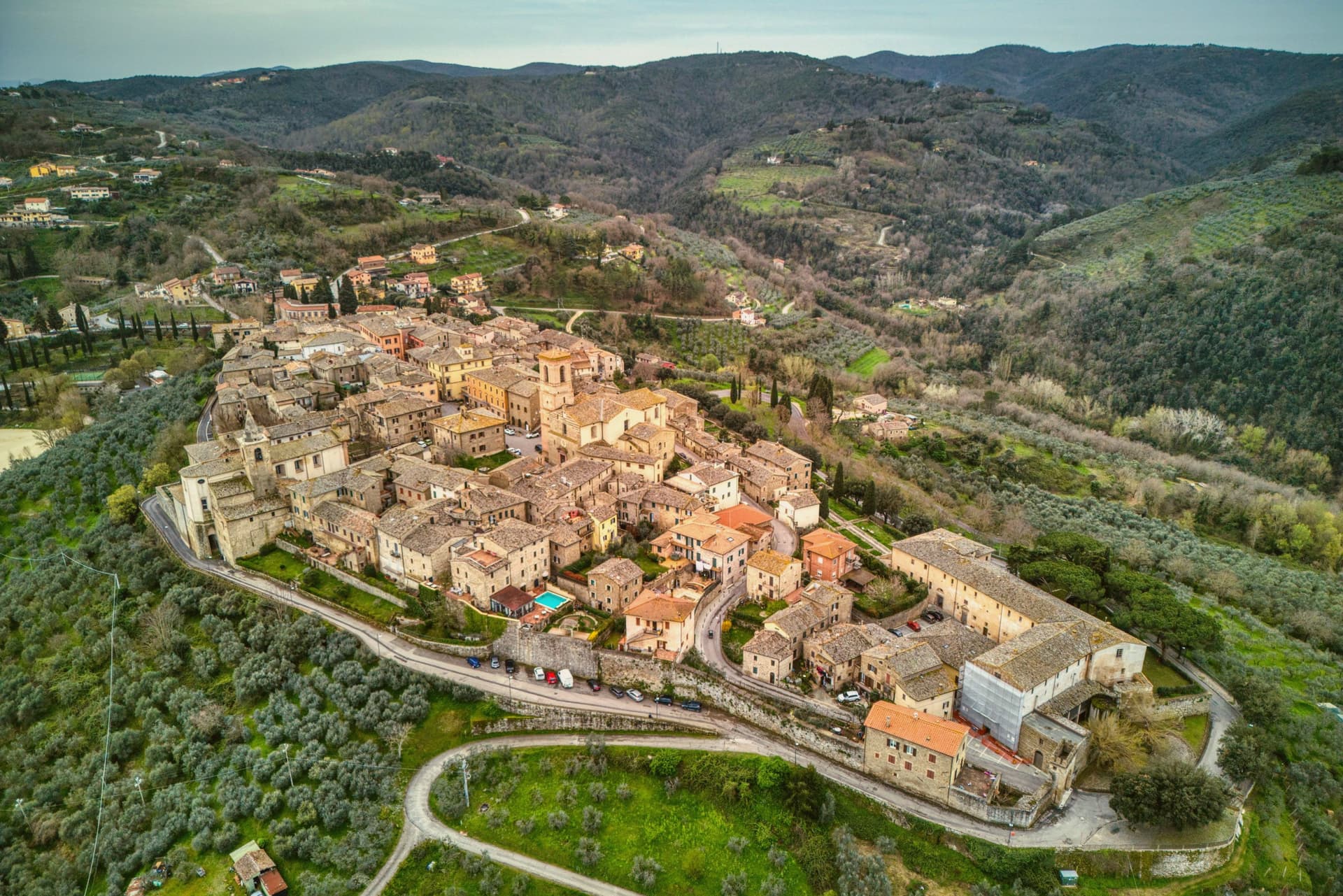
Why visit Bettona
Bettona sits at 353 meters on a hill north of the Colli Martani, looking across the cultivated plain toward Perugia. The Etruscans built here in the seventh century BC, and Bettona remains the only known Etruscan settlement east of the Tiber.
Stretches of polygonal walls from that period are still visible at the base of the medieval circuit, mixed with later Roman blocks. The town became a municipium under Augustus, declined during the barbarian invasions, was sacked by Totila in 548, and rebuilt as a self-governing commune by the late twelfth century.
Papal rule held from 1648 to unification. The Pinacoteca Civica, housed in the Palazzetto del Podestà on Piazza Cavour, keeps two paintings by Pietro Perugino (Sant'Antonio da Padova and Madonna della Misericordia), tabernacle panels attributed to El Greco, and Etruscan funerary stones and architectural terracottas from the territory.
The olive groves below town carry the Città dell'Olio designation.
What to see in Bettona
- Mura etrusche. Stretches of polygonal Etruscan walls visible at the base of the medieval circuit, from the seventh and sixth centuries BC.
- Pinacoteca Civica. Civic art gallery in the Palazzetto del Podestà holding two Perugino paintings, tablets attributed to El Greco and Etruscan finds.
- Chiesa di Santa Maria Maggiore. Main parish church on Piazza Cavour, with a reordered interior holding altarpieces and a Crocifissione fresco.
How to get to Bettona
Perugia is roughly 27 minutes away by road.
Our tip
April through June and September into October are the windows that work. The olive harvest runs from late October through November and gives the town its working rhythm, with the frantoi pressing into the evening. July and August are dry and hot; the centro storico is small enough that midday empties it. Sagra dell'Oca falls in July.
Bevagna
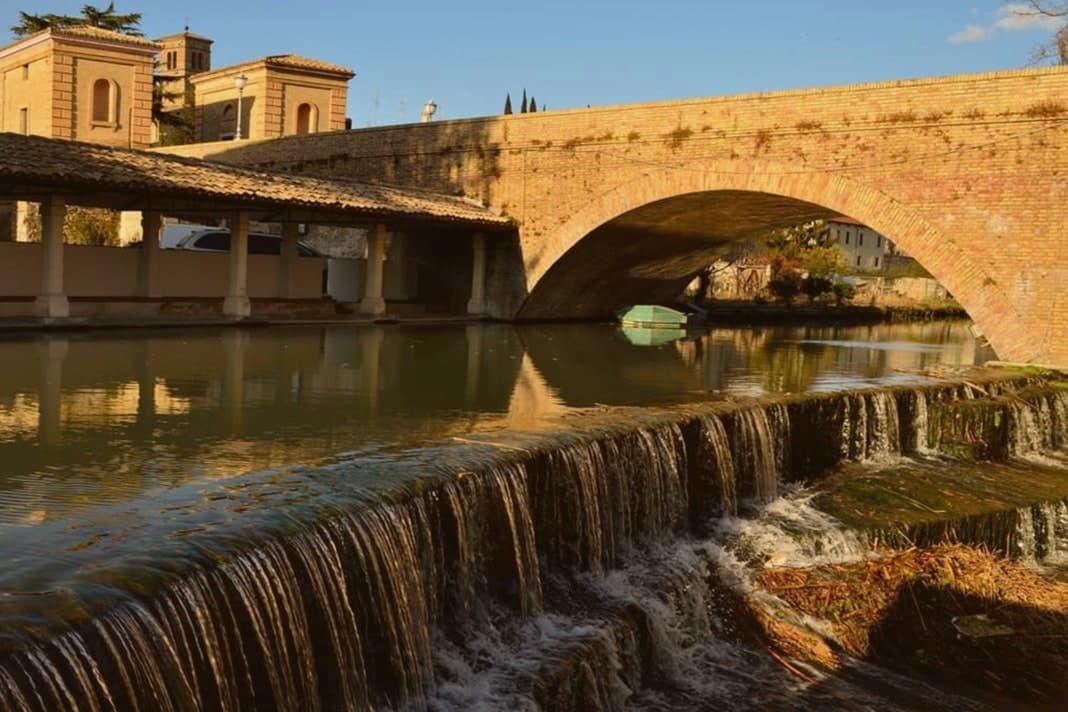
Why visit Bevagna
Bevagna sits on the floor of the Umbrian valley at 225 meters, where the Clitunno meets the Timia. Ancient Mevania, the name means she who stands in the middle, was a Roman mansio on the Via Flaminia, listed in the Antonine Itinerary.
A black-and-white mosaic of the 2nd century AD survives almost intact in the frigidarium of the Roman baths, twelve meters by seven, octopuses and dolphins in the center, tritons and sea-horses on the short sides. Piazza Silvestri at the heart of the centro storico holds two Romanesque churches that face each other at odd angles, San Michele Arcangelo and San Silvestro, built within years of each other in the late 12th century.
The Mercato delle Gaite each June turns the town into the year 1300 for ten days, four quarters competing on medieval trades and tavern menus, no anachronisms allowed. The Sagrantino slopes of Montefalco are nine kilometers up the road.
The re-enactment here is La Notte Medievale, usually held in September.
What to see in Bevagna
- Piazza Silvestri. Twelfth-century civic square ringed by the Palazzo dei Consoli, the churches of San Silvestro and San Michele, and the fountain of 1896.
- Chiesa di San Michele Arcangelo. Romanesque collegiate church built by Binello and Rodolfo at the end of the 12th century, on the main square.
- Chiesa di San Silvestro. Romanesque parish church across the piazza, signed and dated 1195 by Binello, the same builder as San Michele.
How to get to Bevagna
Perugia is roughly 39 minutes away by road.
Our tip
April through June and September into October are the months for Bevagna. The valley fills with green, the Sagrantino vines run on the slopes above town, and the rose festival fills the gardens around the walls in May. The Mercato delle Gaite runs the second half of June and is the single most concentrated weekend on the Umbrian medieval calendar. Sagra della Lumaca falls in August.
Montefalco
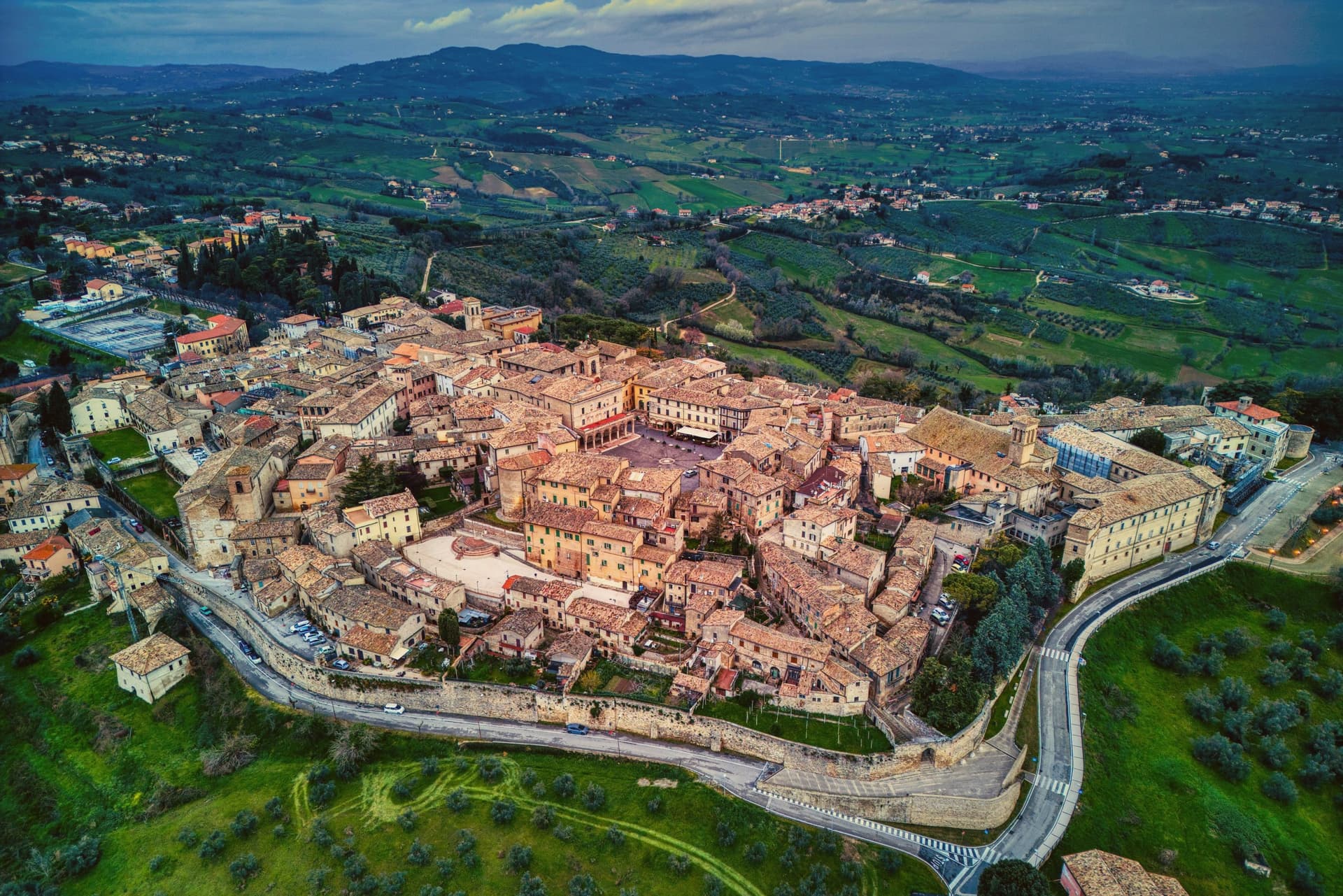
Why visit Montefalco
Montefalco sits on a hill above the Umbrian valley, its walls laid out in two concentric medieval circuits with five gates, the inner ring still complete and the outer ring added in the 14th century by the Trinci. At the top, the circular Piazza del Comune gathers four converging streets around the Palazzo Comunale, the high point from which the rest of the town falls away toward the walls and the vineyards beyond them.
The name Sagrantino belongs to the slopes right around those walls, where the grape has been traced back to the 1st century AD, and three of the largest producers, Caprai, Antonelli and Adanti, keep cellars within four kilometers of the centro storico. The harvest runs late September into October.
The fresco cycle Gozzoli painted in the apse of the former church of San Francesco is counted among his most complete surviving works, and the town's own name for itself, the railing of Umbria, describes the same eastern walls where the belvedere gathers seven hill towns into one view. Wine on the slopes, frescoes in the old church, a view of the valley from the walls: a hill town whose economy, art and setting all sit within walking distance of each other.
What to see in Montefalco
- Museo Civico di San Francesco. Former Franciscan church holding Benozzo Gozzoli's fresco cycle, plus works of the Umbrian school, in a building that has stood as the town's museum since deconsecration.
- Piazza del Comune. Circular medieval square at the top of the hill, ringed by the Palazzo Comunale, the Oratorio di Santa Maria di Piazza and four converging streets.
- Belvedere of Umbria. Panoramic walk on the eastern walls that takes in Perugia, Assisi, Spello, Foligno, Trevi, Spoleto and Todi from a single viewpoint.
How to get to Montefalco
Perugia is roughly 54 minutes away by road.
Our tip
April through June and September into October are the months for Montefalco. The vineyards run their full work cycle, the harvest of Sagrantino starts in the last week of September, and the railing belvedere holds the long Umbrian light. Settimana Enologica in mid-September brings producers from across the territory onto Piazza del Comune. Enologica Montefalco falls in September.
Anghiari
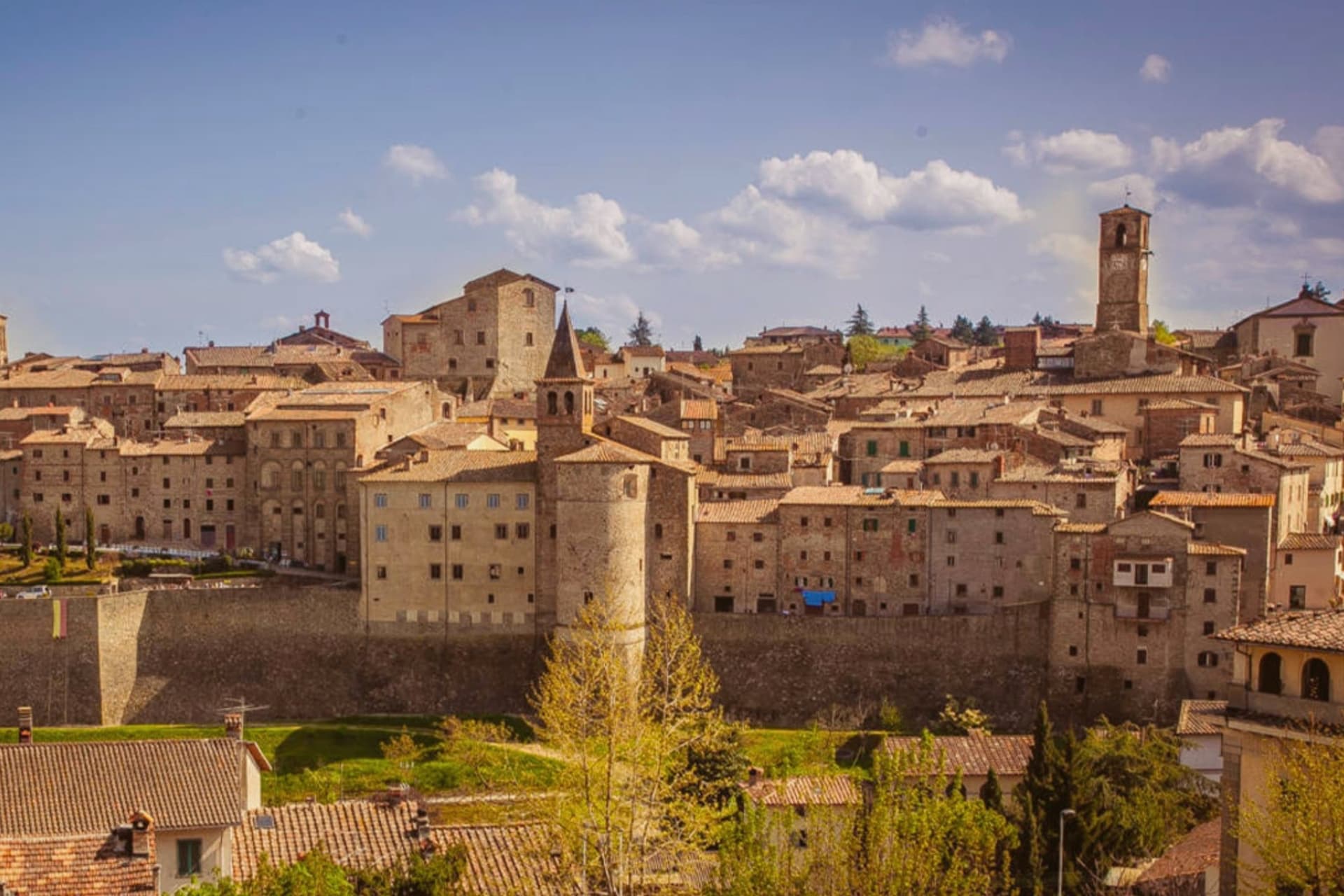
Why visit Anghiari
Anghiari sits at 430 meters on a spur above the upper Tiber valley, the Valtiberina, between Arezzo and the Umbrian border. The walled centro storico is intact, the streets running steeply from the Porta Sant'Angelo up to the Castello.
On 29 June 1440 the Florentine army defeated a Milanese force under Niccolò Piccinino in the plain below town, a battle that secured Florence's hold over central Italy and gave Leonardo da Vinci the commission for the Palazzo Vecchio fresco he started in 1505 and never finished. The painting, the Lost Leonardo, is presumed still to be hidden behind a Vasari wall in Florence.
Palazzo Taglieschi in the centro storico holds a polychrome wooden Madonna by Jacopo della Quercia and a working sixteenth-century table organ. The Mostra Mercato dell'Artigianato della Valtiberina has filled the streets with craft producers every spring since 1976, a working continuation of the textile and woodwork traditions that supported the town through the twentieth century.
The re-enactment here is Palio della Vittoria di Anghiari, usually held in June.
What to see in Anghiari
- Palazzo Taglieschi. Sixteenth-century palace in the centro storico, now the Museo Statale di Palazzo Taglieschi, with a wooden Madonna by Jacopo della Quercia and a working table organ.
- Castello di Anghiari. Medieval fortified core at the top of the town, walls and gates still intact, the visual anchor of the silhouette from the valley below.
- Campo della Battaglia. The plain at the foot of the walls where Florence defeated Milan on 29 June 1440, the battle that inspired Leonardo's lost Palazzo Vecchio fresco.
How to get to Anghiari
Perugia is roughly 82 minutes away by road.
Our tip
April through June and September into October are the working months in the Valtiberina: dry days, low cloud over the upper Tiber, the surrounding farmland green or gold by season. The Mostra Mercato dell'Artigianato runs the last week of April and the first week of May, filling the streets with artisans from across the valley. Late June marks the anniversary of the 1440 battle, with reenactments below the walls. Palio della Vittoria di Anghiari falls in June.
More from Anywhere Italy
- The best hidden towns with a food festival in the province of Perugia
- The prettiest villages with a food festival within 90 minutes of Perugia
- The best hidden hill towns with a medieval festival within 90 minutes of Perugia
- The best hill towns with a food festival in the province of Perugia
 The best hidden hill towns with a serious restaurant within 90 minutes of Perugia
- The 10 best towns you can reach by train that hold a food festival within 90 minutes of Perugia