
The best hidden hill towns with a medieval festival within 90 minutes of Perugia
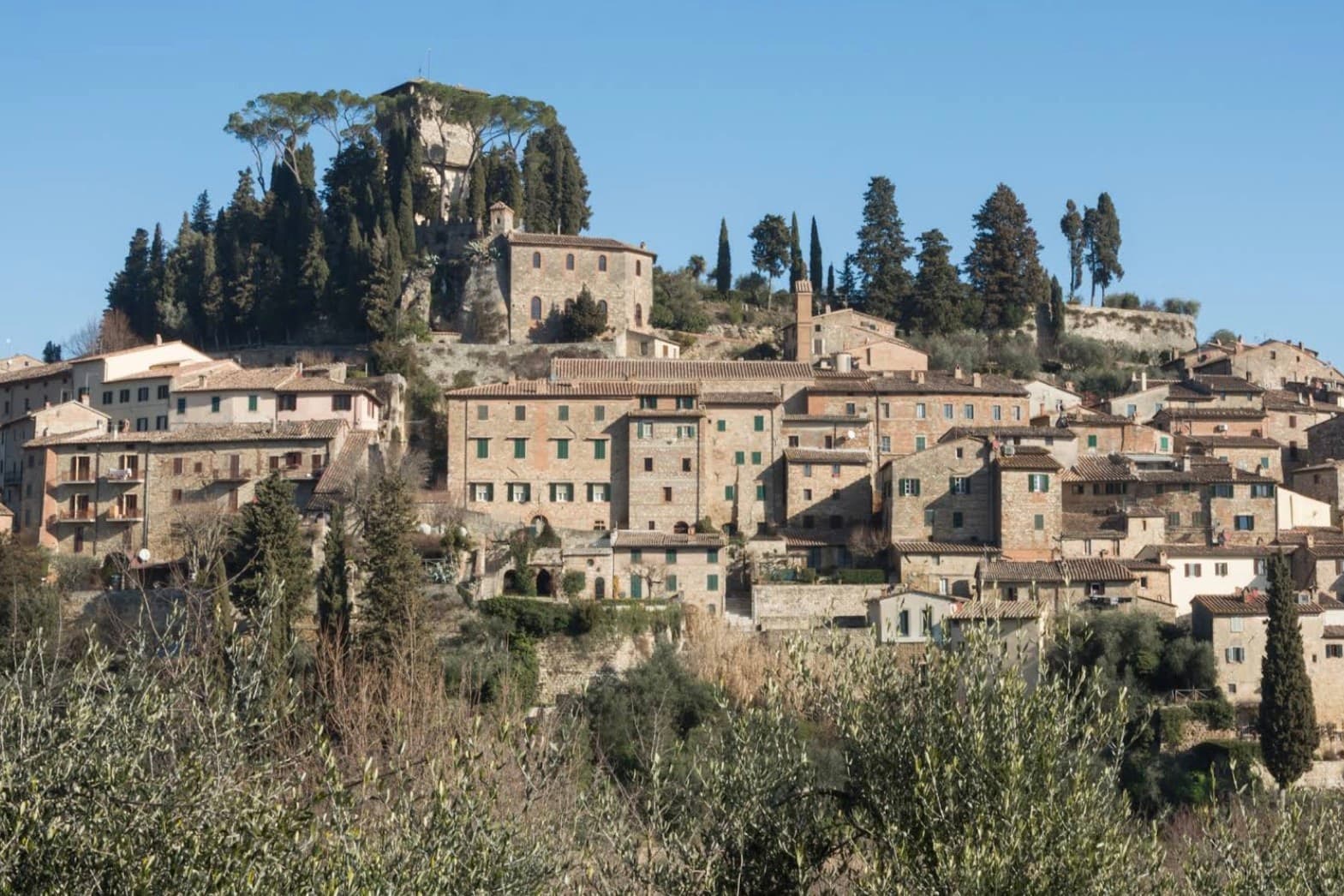
The hills between Perugia and the Tuscan border are built in bands: oak and holm oak on the slopes, olives on the terraces below, then vines and tobacco flats along the Chiana and Tiber valleys. The towns sit at the top, walled in travertine and brick, with a piazza that doubles as a stage the moment the weather turns warm. Late spring through September is festival season, when quarters compete at the crossbow, the drums start in the early evening, and dinner is served on long trestle tables in the street: torchio pasta, pork cooked over vine cuttings, unfiltered olive oil from the last pressing. Autumn is quieter and better for eating, when the new oil arrives and the truffle stalls open in the market squares.
Most visitors to this part of Italy set the compass on Assisi, and in high summer the basilica queue reaches down the hill and the coach parks fill by mid-morning. Siena's Palio, the other great draw, is a matter of hours in a piazza packed shoulder to shoulder, watched by many more people than the town can comfortably hold. Both are worth going to, and both have absorbed so much attention that the surrounding countryside reads, to a lot of itineraries, as the bit you drive through on the way.
The same hills carry on past both of them, and so does the festival calendar. The towns here are smaller, fewer people go, and the re-enactments they stage are not tourist spectacles bolted on but events with centuries of local argument behind them: a crossbow rivalry played out between neighbouring comuni, a market restaged in a medieval quarter, a joust run on a street of hard-packed earth. All are inland hill settlements within a comfortable drive of Perugia, close enough to use as a base and far enough apart to make a week of it.
Of the 41 communes we have mapped within 90 minutes of Perugia, 14 qualify as hill towns with a medieval festival: each is an inland hill settlement, and each stages a recurring historical re-enactment. This list is the hidden ones, 10 in all, ordered smallest first. The smallest, Cetona, has 2,488 residents.
Two more lists worth reading alongside this one: The prettiest villages with a medieval festival within 90 minutes of Perugia and The best hidden hill towns with a serious restaurant within 90 minutes of Perugia.
Why visit Cetona
The town sits on the western flank of a ridge at the meeting point of Toscana, Umbria and Lazio, where the mountain divides the Val d'Orcia from the Val di Chiana. The medieval comune passed between Siena, Orvieto and Perugia before falling to Siena in the late fourteenth century, and it was Cosimo I who later sold it whole to a marchese.
The fortress at the top of the grid and the square laid out below it are two halves of the same Renaissance move: a private residence replacing a garrison at the summit, a flat civic stage opened up at the base. Above the town, in the woods, the hermitage and the caves belong to a much older layer, human use of the mountain reaching back to the Mesolithic, long before any comune or marchese laid claim to it.
What the town adds up to is a settlement built in tiers: a prehistoric mountain, a contested medieval center, and a Renaissance overlay that reorganized the base of the hill without touching what stood above it.
The re-enactment here is Corsa delle brocche a Cetona, usually held in July.
What to see in Cetona
- Piazza Garibaldi. Elliptical square at the foot of the medieval grid, flat and open where the streets above it climb steeply. The civic stage of the borgo, still the first thing that orients a visitor.
- Rocca di Cetona. Fortress at the top of the centro storico, its walls and keep still standing though the interior became a private residence rather than a garrison.
- Convento di San Francesco. Franciscan convent below the borgo, founded in 1212, with a single-nave church and a small cloister still in religious use.
How to get to Cetona
Perugia is roughly 78 minutes away by road.
Our tip
April through June and September into October are the months Cetona keeps its calmest pace, the wooded slopes of Monte Cetona green or rust depending on the half. July and August are hot in the centro storico but the mountain trails above 800 meters stay cool. The Mostra del Tartufo, dedicated to the local white truffles, runs the second weekend of November in Piazza Garibaldi. Sagra del Bico di Cetona falls in June.
Why visit Lucignano
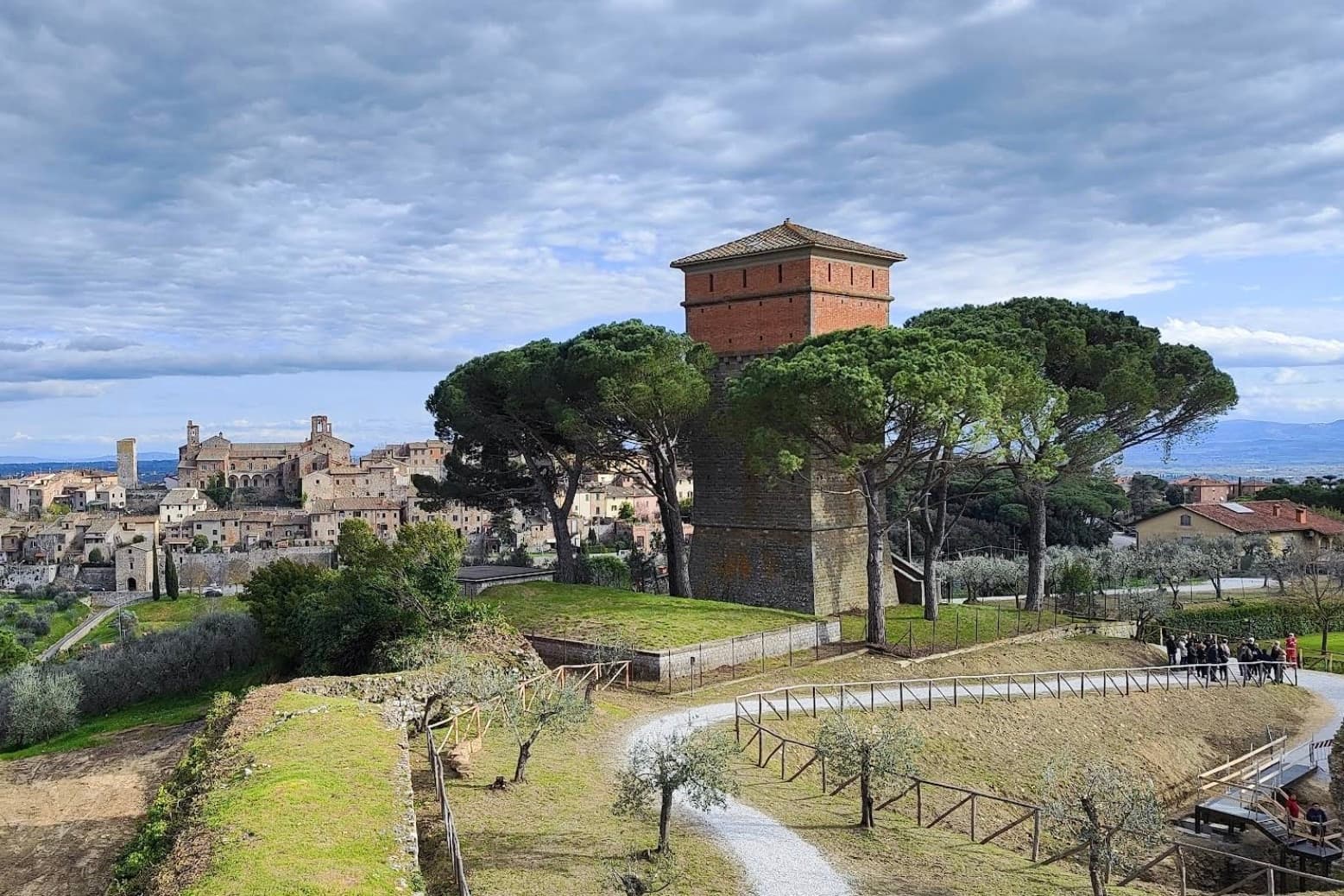
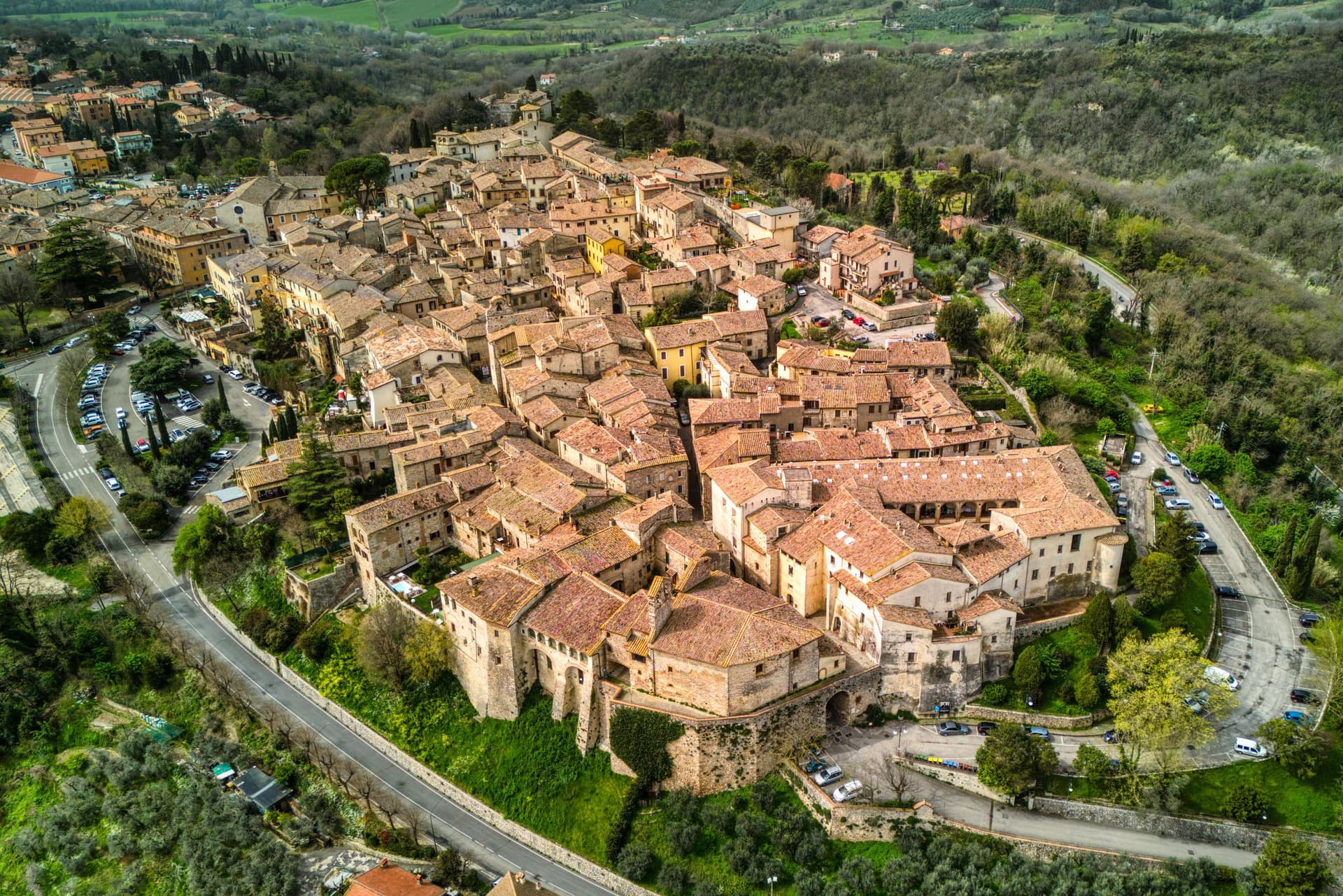
Lucignano sits at 400 meters on a hill in the Valdichiana, halfway between Siena and Arezzo, built on a tight elliptical plan of four concentric rings of streets. Its position made it one of the most contested settlements of medieval Toscana: Siena, Arezzo, Florence and Perugia all fought over it between 1200 and 1500.
The current walls and three gates date to a Sienese reconstruction of 1371. In the Museo Civico inside the Palazzo Comunale stands the Albero d'Oro, a 260-centimeter Gothic gold-and-coral reliquary in the shape of a tree, begun by Ugolino di Vieri in 1350 and finished by Gabriello d'Antonio in 1471.
Local tradition turned it into the Albero dell'Amore, a marriage charm. The Collegiata di San Michele Arcangelo dominates the highest ring of the borgo, and the elliptical plan is best read from the air, which is why drone footage of Lucignano keeps appearing in articles about medieval Tuscan urbanism.
The re-enactment here is Memorie dal passato a Lucignano, usually held in September.
What to see in Lucignano
- Albero d'Oro. 260-cm Gothic reliquary in the shape of a tree, gold, coral and enamel, begun by Ugolino di Vieri in 1350 and completed by Gabriello d'Antonio in 1471.
- Centro storico ellittico. Four concentric rings of streets inside elliptical walls, the most complete example of medieval Tuscan elliptical town planning.
- Collegiata di San Michele Arcangelo. Eighteenth-century church on the highest ring of the borgo, with a Vasari façade adjustment and a baroque organ inside the medieval shell.
How to get to Lucignano
There is a railway station in the town, so you can arrive without a car and never need one while you are here. Perugia is roughly 65 minutes away by road.
Our tip
April through June and September into October are the months Lucignano keeps its balance, the Valdichiana green or gold depending on the half and the centro storico cool inside its elliptical walls. The Maggiolata, a flower festival between the four quarters of the borgo, runs across the last two Sundays of May. July and August push the valley past thirty and the centro storico thins after lunch. Sagra della Filiera del Tartufo Marzuolo falls in March.
Why visit Bevagna
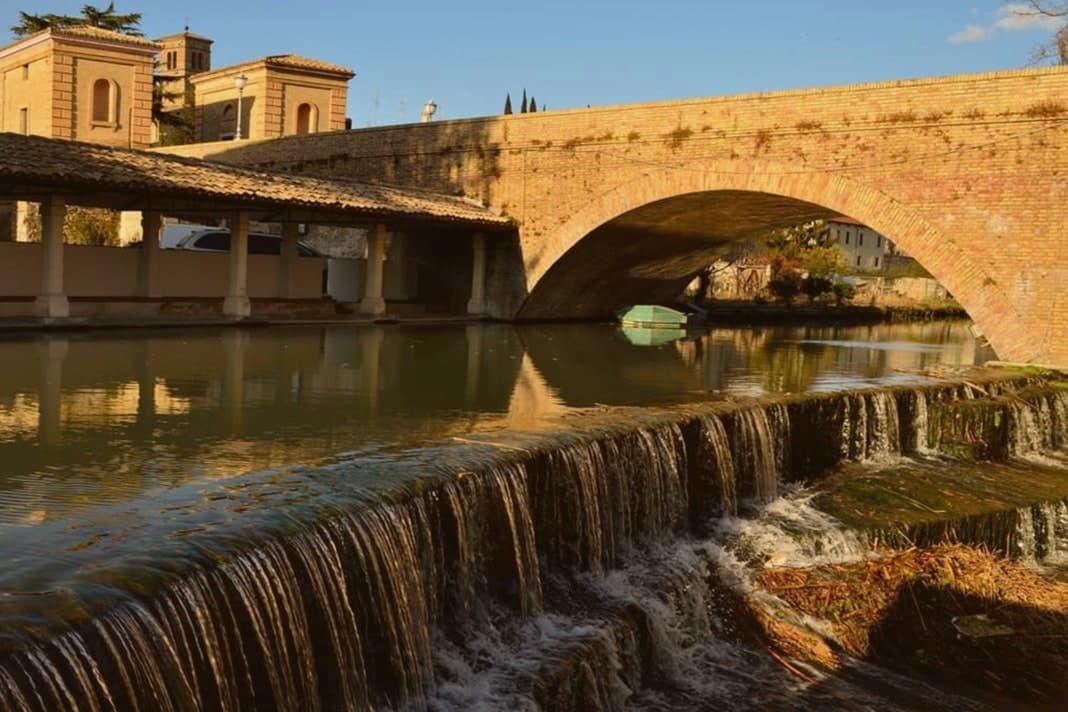
Bevagna sits on the floor of the Umbrian valley at 225 meters, where the Clitunno meets the Timia. Ancient Mevania, the name means she who stands in the middle, was a Roman mansio on the Via Flaminia, listed in the Antonine Itinerary.
A black-and-white mosaic of the 2nd century AD survives almost intact in the frigidarium of the Roman baths, twelve meters by seven, octopuses and dolphins in the center, tritons and sea-horses on the short sides. Piazza Silvestri at the heart of the centro storico holds two Romanesque churches that face each other at odd angles, San Michele Arcangelo and San Silvestro, built within years of each other in the late 12th century.
The Mercato delle Gaite each June turns the town into the year 1300 for ten days, four quarters competing on medieval trades and tavern menus, no anachronisms allowed. The Sagrantino slopes of Montefalco are nine kilometers up the road.
The re-enactment here is La Notte Medievale, usually held in September.
What to see in Bevagna
- Piazza Silvestri. Twelfth-century civic square ringed by the Palazzo dei Consoli, the churches of San Silvestro and San Michele, and the fountain of 1896.
- Chiesa di San Michele Arcangelo. Romanesque collegiate church built by Binello and Rodolfo at the end of the 12th century, on the main square.
- Chiesa di San Silvestro. Romanesque parish church across the piazza, signed and dated 1195 by Binello, the same builder as San Michele.
How to get to Bevagna
Perugia is roughly 39 minutes away by road.
Our tip
April through June and September into October are the months for Bevagna. The valley fills with green, the Sagrantino vines run on the slopes above town, and the rose festival fills the gardens around the walls in May. The Mercato delle Gaite runs the second half of June and is the single most concentrated weekend on the Umbrian medieval calendar. Sagra della Lumaca falls in August.
Why visit Montepulciano
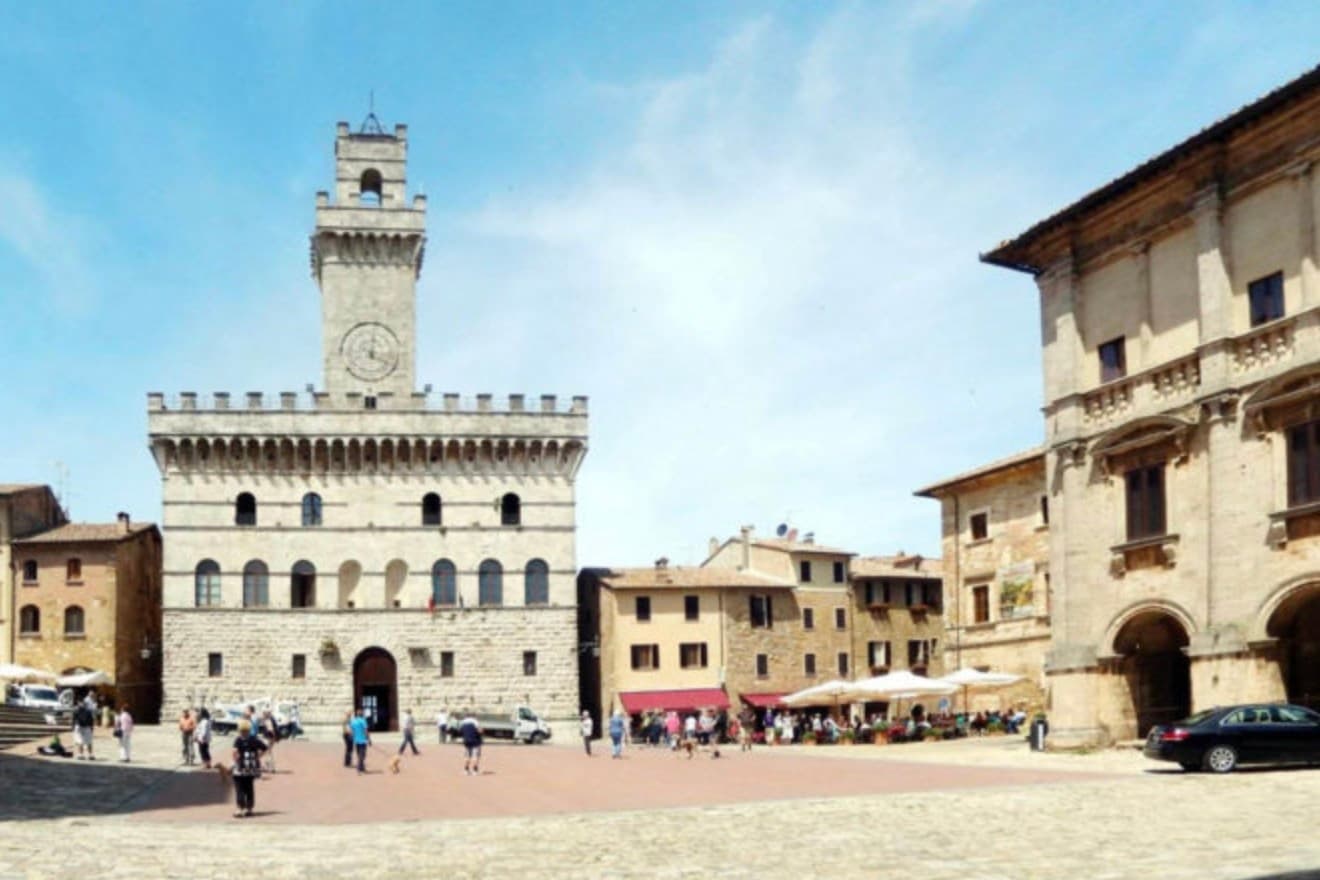
The ridge runs between the Val di Chiana and the Val d'Orcia, 70 kilometers southeast of Siena, and the town follows its spine uphill: streets climb from the gates toward the high point, where the main square sits ringed by the buildings that define the skyline from below. The origin predates the Renaissance fabric by centuries.
Etruscan tombs survive in the surrounding hills, though almost nothing of that period shows in the centro storico itself, which was rebuilt wholesale in the fifteenth and sixteenth centuries over whatever came before. The wine and the festival both use the climb as their setting rather than their subject: the cellars are cut into the rock beneath the palazzi, keeping a constant temperature for aging, and the barrel race each August sends two men from each of the eight contrade hauling an eighty-kilogram cask up the same gradient that every visitor covers on foot, only slower.
The steepness that shaped the defensive site nine centuries ago is still what a person feels first, in the legs, before the buildings register at all.
The re-enactment here is Bravio delle Botti, usually held in August.
What to see in Montepulciano
- Tempio di San Biagio. A 13-meter dome and travertine façade standing alone outside the walls, the ground falling away below it so the building reads as a single volume against the hillside.
- Piazza Grande. The high piazza at the top of the ridge, ringed by the Duomo, the Palazzo Comunale and the Palazzo Tarugi, all rebuilt in the fifteenth and sixteenth centuries.
- Palazzo Comunale. Town hall designed by Michelozzo in the fifteenth century, its tower offering a view over the Val di Chiana and Val d'Orcia.
How to get to Montepulciano
There is a railway station in the town, so you can arrive without a car and never need one while you are here. Perugia is roughly 57 minutes away by road.
✷ We have written about Montepulciano
“Now, the postcard itself, the towns, and here I have less to say than you would expect, because Pienza and Montepulciano have become, and I mean this precisely, the canteens of a theme park. They are where you go to park, walk a pretty street, use the toilet, refill the water, eat a plate of something, and buy a thing to take home. They are the food court between the rides.”
Read our piece on Montepulciano →Val d'Orcia | The Postcard Is Constructed
Our tip
April through June and September into October are the working months on the ridge: vine work in the surrounding hills, mild days, evening light that lingers over the Val d'Orcia. July and August push into the low thirties and the climb to Piazza Grande slows even the residents. The Bravìo delle Botti runs the last Sunday of August and fills the town. Calici di Stelle falls in July.
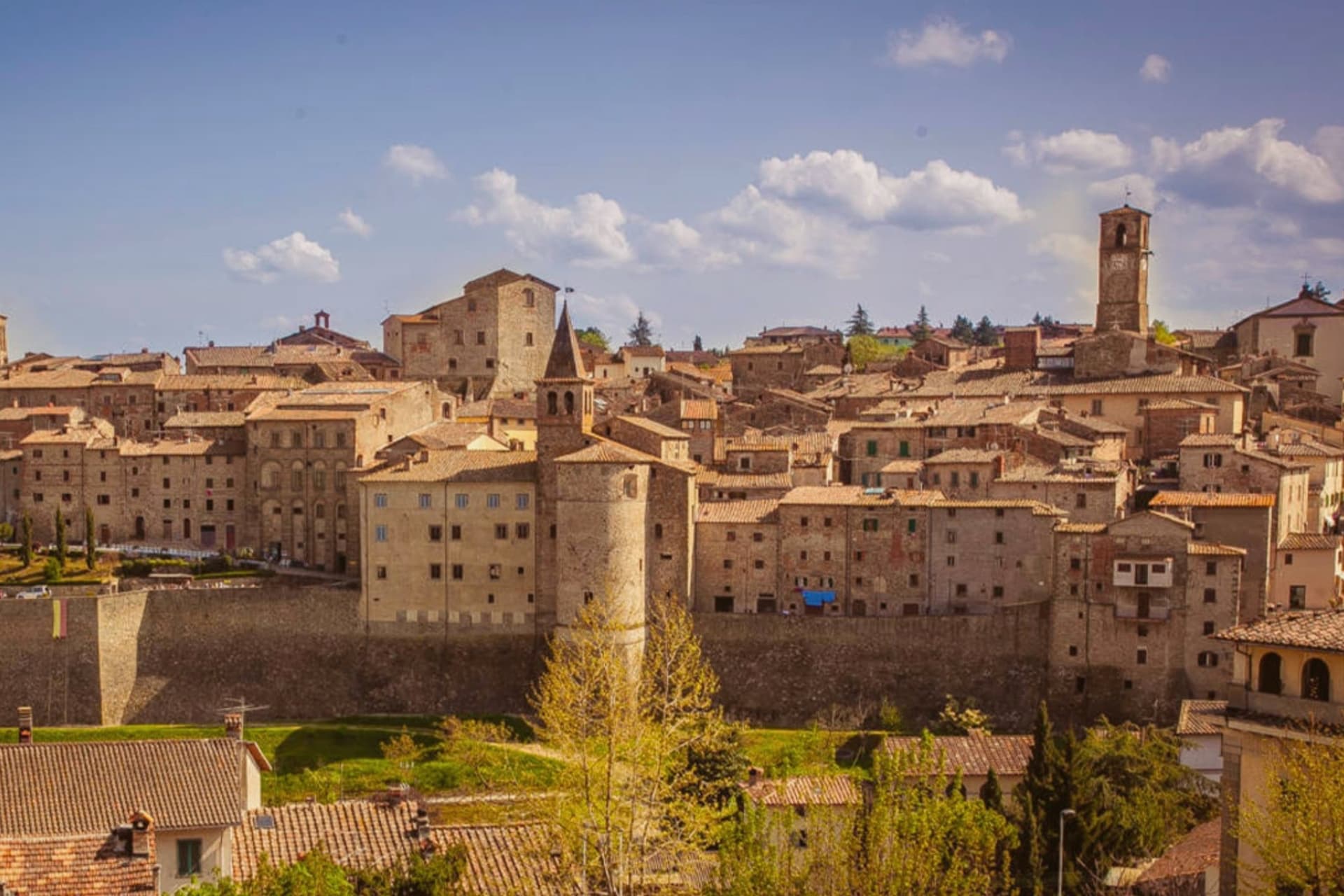
Why visit Anghiari
Anghiari sits at 430 meters on a spur above the upper Tiber valley, the Valtiberina, between Arezzo and the Umbrian border. The walled centro storico is intact, the streets running steeply from the Porta Sant'Angelo up to the Castello.
On 29 June 1440 the Florentine army defeated a Milanese force under Niccolò Piccinino in the plain below town, a battle that secured Florence's hold over central Italy and gave Leonardo da Vinci the commission for the Palazzo Vecchio fresco he started in 1505 and never finished. The painting, the Lost Leonardo, is presumed still to be hidden behind a Vasari wall in Florence.
Palazzo Taglieschi in the centro storico holds a polychrome wooden Madonna by Jacopo della Quercia and a working sixteenth-century table organ. The Mostra Mercato dell'Artigianato della Valtiberina has filled the streets with craft producers every spring since 1976, a working continuation of the textile and woodwork traditions that supported the town through the twentieth century.
The re-enactment here is Palio della Vittoria di Anghiari, usually held in June.
What to see in Anghiari
- Palazzo Taglieschi. Sixteenth-century palace in the centro storico, now the Museo Statale di Palazzo Taglieschi, with a wooden Madonna by Jacopo della Quercia and a working table organ.
- Castello di Anghiari. Medieval fortified core at the top of the town, walls and gates still intact, the visual anchor of the silhouette from the valley below.
- Campo della Battaglia. The plain at the foot of the walls where Florence defeated Milan on 29 June 1440, the battle that inspired Leonardo's lost Palazzo Vecchio fresco.
How to get to Anghiari
Perugia is roughly 82 minutes away by road.
Our tip
April through June and September into October are the working months in the Valtiberina: dry days, low cloud over the upper Tiber, the surrounding farmland green or gold by season. The Mostra Mercato dell'Artigianato runs the last week of April and the first week of May, filling the streets with artisans from across the valley. Late June marks the anniversary of the 1440 battle, with reenactments below the walls. Palio della Vittoria di Anghiari falls in June.
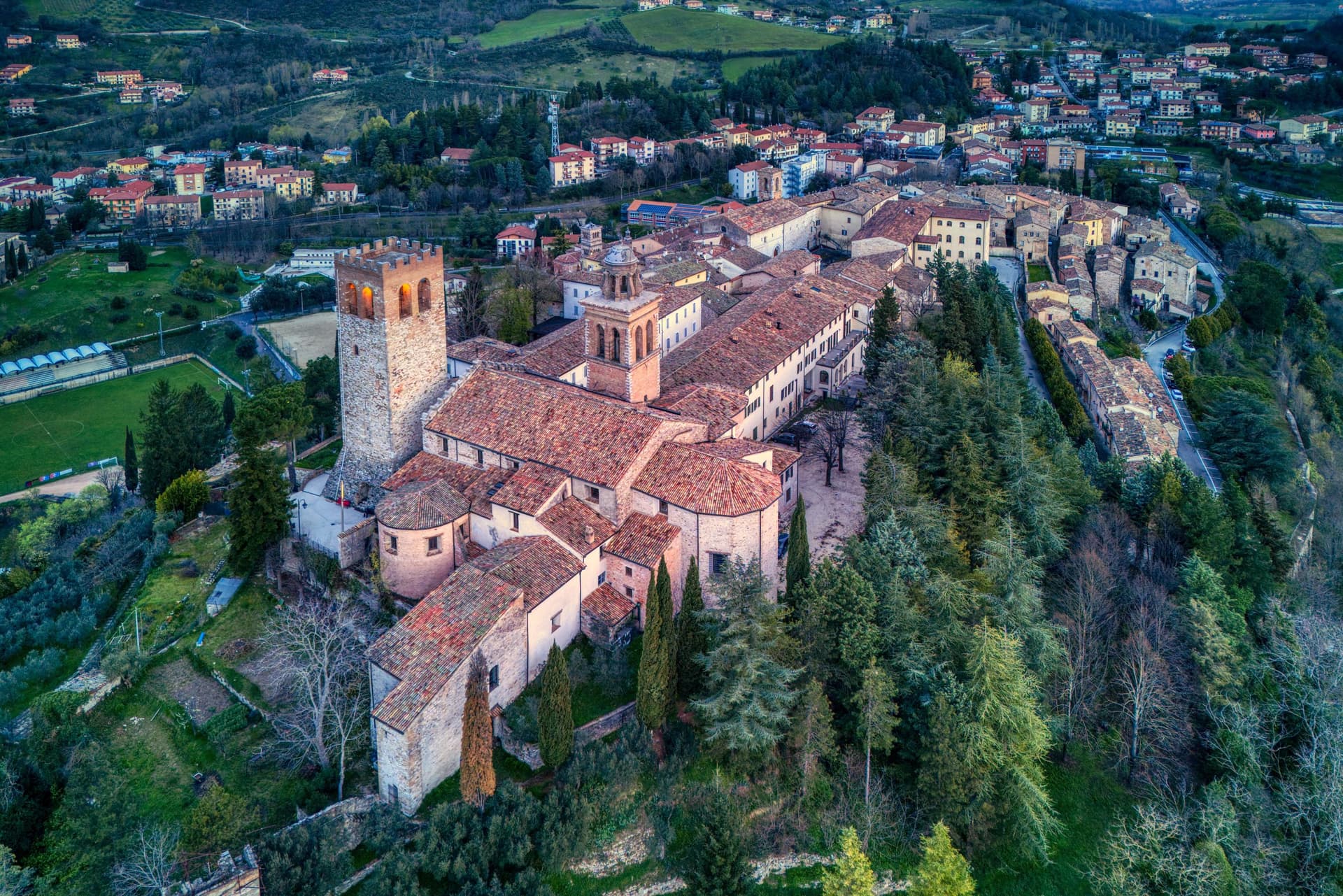
Why visit Nocera Umbra
Nocera Umbra sits fifteen kilometers north of Foligno. The Romans called it Nuceria; the town has held its own bishopric since the early Middle Ages and was contested between Perugia, Spoleto and the Trinci of Foligno through the medieval period, a tug of war between larger powers that left it walled and defensible on its slope rather than absorbed by any one of them.
The centro storico climbs to a summit where the tower, the cathedral and the former Rocca stand together, the civic and the religious and the military crowded onto the same high ground. Below, five kilometers down from that core, the springs form a separate pole of the town's life, functional rather than defensive, drawing visitors for water rather than for stone.
The Bandiera Arancione recognition was reconfirmed after reconstruction, a marker that the rebuilding did not just replace what fell but held the town to the standard it met before the quake.
The re-enactment here is Palio dei Quartieri, usually held in August.
What to see in Nocera Umbra
- Campanaccio (Torre Civica). Eleventh-century square tower at the highest point of the borgo. Only part of one side remained standing after 1997; the rest is reconstruction, stone matched to stone.
- Pinacoteca e Museo Civico. Civic gallery in the deconsecrated Chiesa di San Francesco with works by Niccolò Alunno, Matteo da Gualdo, and the school of Cimabue.
- Cattedrale di Santa Maria Assunta. Cathedral at the summit of the centro storico, partially damaged and restored, set beside the tower and the former Rocca.
How to get to Nocera Umbra
There is a railway station in the town, so you can arrive without a car and never need one while you are here. Perugia is roughly 57 minutes away by road.
Our tip
April through June and September into October are the months locals prefer. The slopes around the centro storico hold light well into the evening and the Bagni di Nocera springs are at their easiest to walk. July and August push temperatures into the low thirties, manageable at this elevation; the Pinacoteca and the cathedral stay cool through the afternoon. Palio dei Quartieri falls in August.
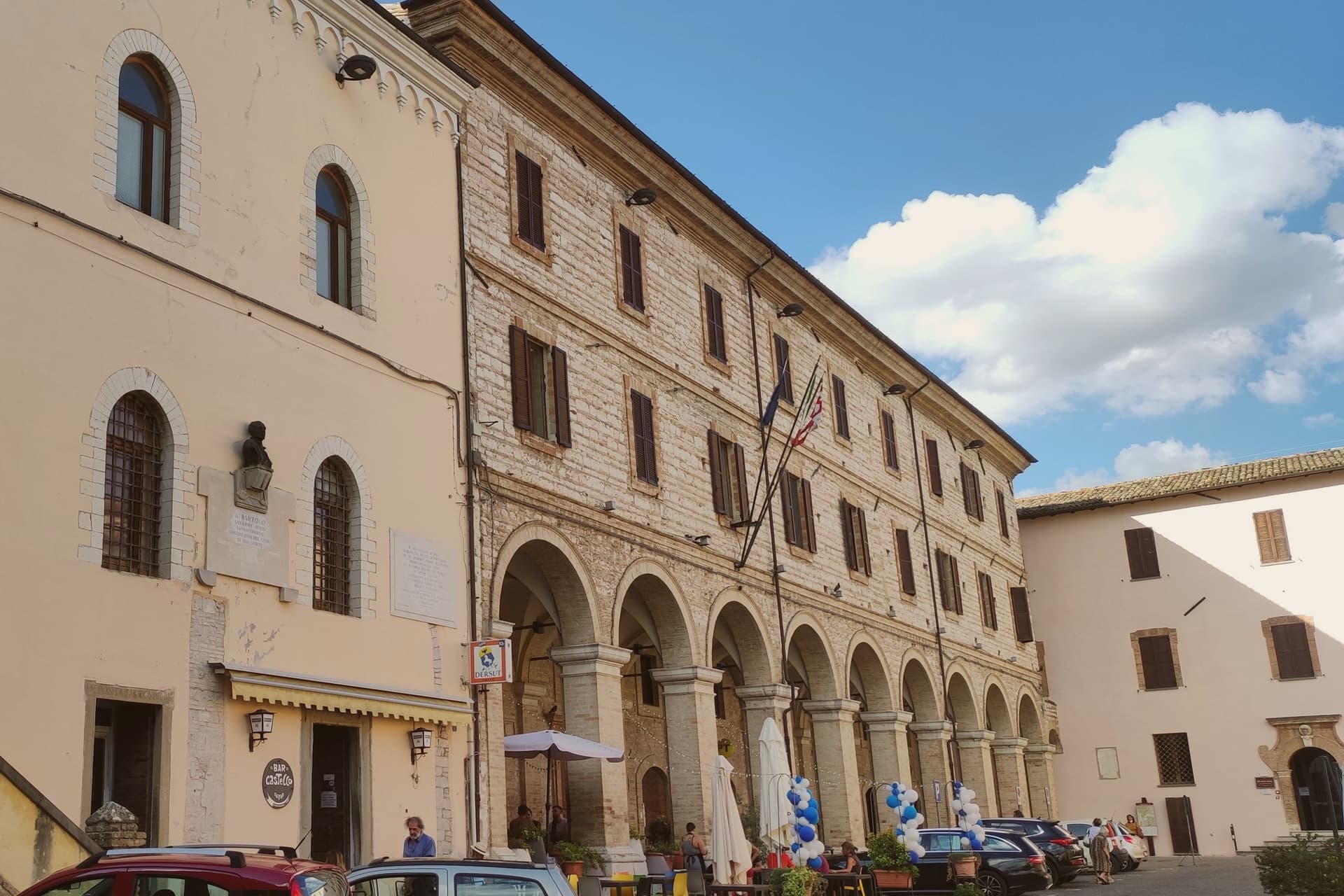
Why visit Sassoferrato
Sassoferrato sits on the eastern slope of the Apennines on two levels: the Borgo at around 310 meters and the Castello at 400 meters, dominated by the Rocca built in 1365 by order of Cardinal Albornoz. A kilometer south of the modern town lies Sentinum, the Roman city next to which the consuls Publius Decius Mus and Fabius Maximus Rullianus defeated a coalition of Samnites, Etruscans, Umbrians and Senone Gauls in 295 BC, in the decisive battle of the Third Samnite War that allowed Rome to unify central Italy.
The archaeological park preserves the cardo and decumanus, the urban baths, a second extramural bath complex and the ruins of a metalworking shop. The Civic Archaeological Museum inside the Palazzo dei Priori, built 1355, holds the finds from Sentinum, including a Byzantine Saint Demetrius mosaic icon on wooden support.
Giovanni Battista Salvi, called Il Sassoferrato, was born here in 1609; Palazzo Oliva holds a collection of his Raphaelesque devotional paintings. The town gives its name to the Battle of the Nations historical reenactment, held each August.
The re-enactment here is Palio della Miniera di Zolfo, usually held in August.
What to see in Sassoferrato
- Rocca Albornoz. Fourteenth-century fortress built 1365 by order of Cardinal Albornoz, dominating the upper Castello district at 400 meters.
- Parco Archeologico di Sentinum. Roman city a kilometer south of town, with the cardo and decumanus, the urban baths and the extramural bath complex still visible.
- Museo Civico Archeologico. Inside the 1355 Palazzo dei Priori, holding the finds from Sentinum and the Byzantine Saint Demetrius mosaic icon on wooden support.
How to get to Sassoferrato
Perugia is roughly 74 minutes away by road.
Our tip
April through June and September into October are the best months for Sassoferrato. The Sentino valley turns green from April, the archaeological park at Sentinum opens its full guided program through the warmer months, and the Palio di Sant'Ugo and Battaglia delle Nazioni reenactment fill the streets each August. July and August touch the high twenties at 386 meters but the two-level position keeps the Castello cooler than the Borgo and the lower river. Palio della Miniera di Zolfo falls in August.
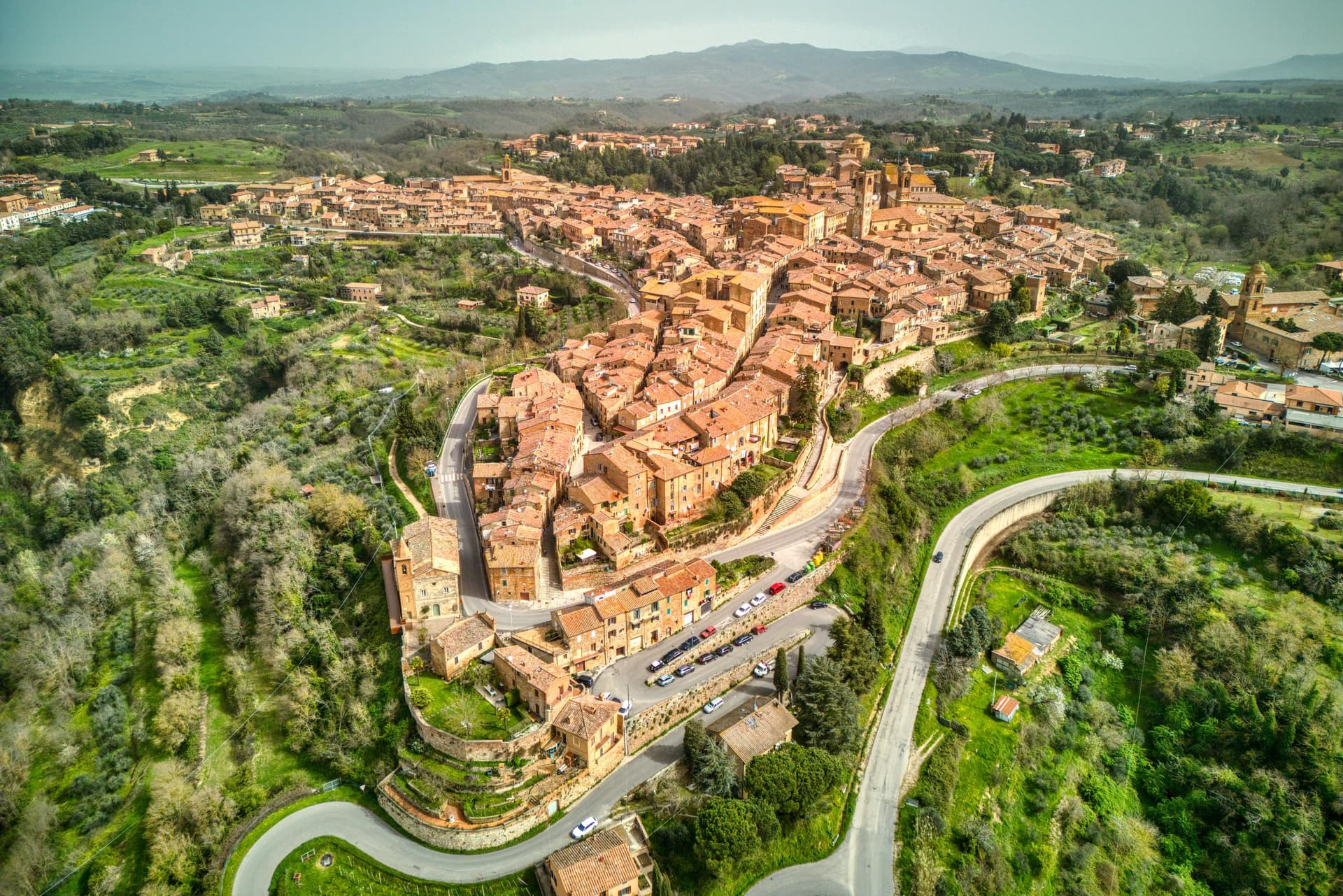
Why visit Città della Pieve
Città della Pieve sits on a hill at 508 meters between Umbria and Tuscany, about 260 meters above the Valdichiana and within sight of Lake Trasimeno. The town is built almost entirely of the local red brick that has been fired here since the Middle Ages, which gives the centro storico a uniform terracotta color.
Pietro Vannucci, known as Perugino, was born here around 1448 and returned in 1504 to fresco the Adoration of the Magi inside the Oratorio di Santa Maria dei Bianchi, one of the largest works he ever painted. The Cathedral of San Gervasio holds two more Perugino panels from 1510 and 1514.
Pope Clement VIII elevated the town from Castel della Pieve in 1600, restoring its episcopal seat. Vicolo Baciadonne, eighty centimeters wide, threads between two brick walls and is regularly cited as the narrowest alley in Italy.
The re-enactment here is Palio dei Terzieri, usually held in August.
What to see in Città della Pieve
- Cattedrale dei Santi Gervasio e Protasio. Cathedral on the main piazza with two Perugino panels, the Madonna and Child with Saints of 1514 and the Baptism of Christ of 1510.
- Oratorio di Santa Maria dei Bianchi. Confraternity oratory holding Perugino's Adoration of the Magi, frescoed in 1504 and considered one of his largest single works.
- Torre del Pubblico. Twelfth-century civic tower in Lombard Romanesque style, thirty-nine meters tall, set next to the cathedral on Piazza Plebiscito.
How to get to Città della Pieve
There is a railway station in the town, so you can arrive without a car and never need one while you are here. Perugia is roughly 47 minutes away by road.
Our tip
April through June and September into October are the months locals prefer. The Valdichiana below stays green or gold depending on the half, and the brick of the centro storico holds the late light well. The Infiorata in June covers the main streets in petal carpets for Corpus Domini, drawing the year's largest crowd. Palio dei Terzieri falls in August.
Why visit Chiusi
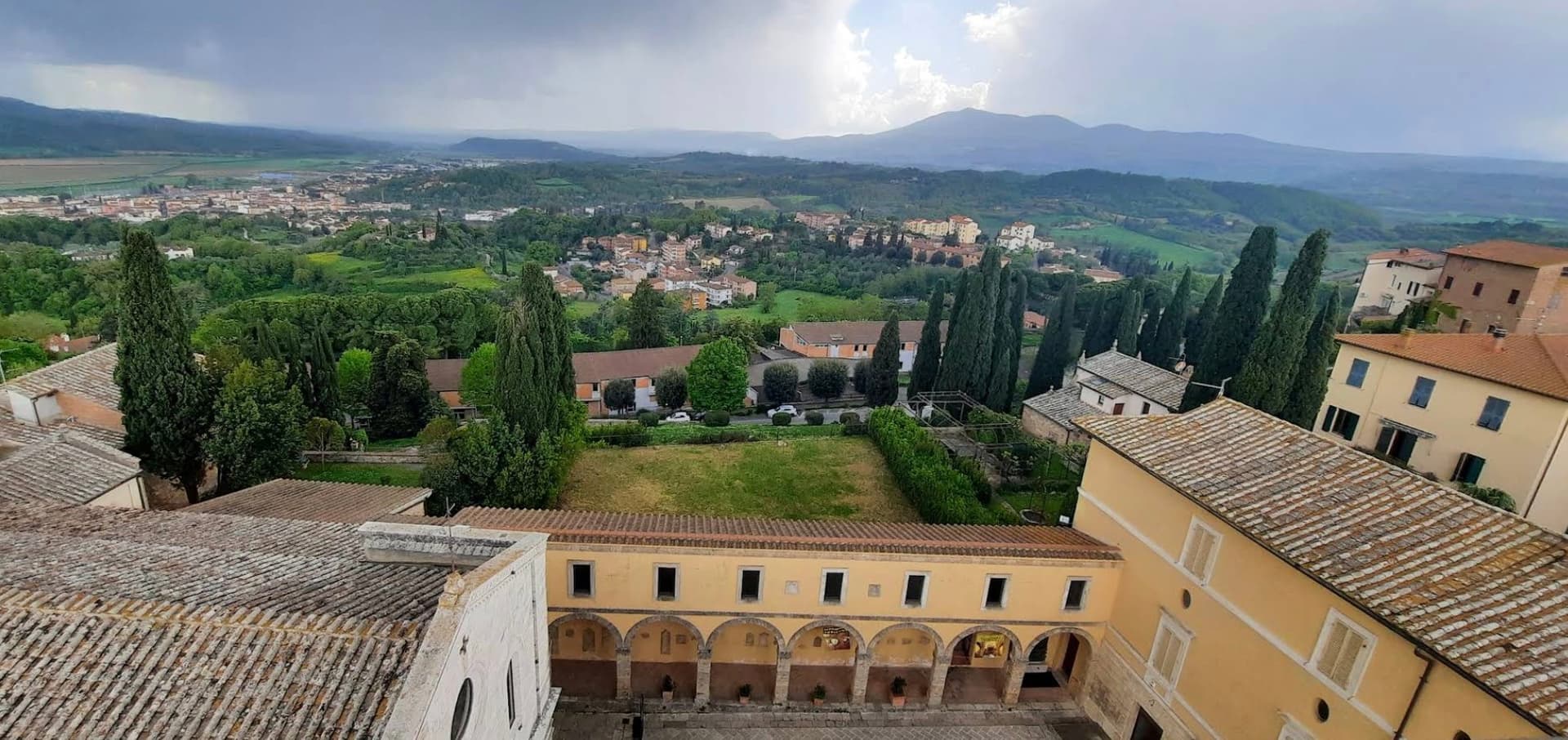
The hilltop stands above the Val di Chiana, the valley floor visible from the town at a height that made it defensible and gave it command of the surrounding farmland. The cathedral, the museums and the tunnel network are close enough to walk between within the old center, while the painted necropolis and the lake lie outside it, a few kilometers apart in different directions, one inland toward the tombs and the other north toward open water.
The tunnels themselves connect the upper town to what lies beneath it: built as drainage, later folded into legend by Pliny the Elder, who took them for part of a king's tomb. The cathedral's own columns, lifted from earlier Roman buildings, make the same point in stone that the tombs make in paint and the museum makes in bucchero and alabaster: this is a town built repeatedly on top of itself, each layer reusing what the last one left behind.
The re-enactment here is Tria Turris Medioevo e Palio delle Torri di Chiusi, usually held in June.
What to see in Chiusi
- Museo Nazionale Etrusco. Holds canopic urns, alabaster sarcophagi, bucchero pottery and grave goods pulled from the necropolises around the town.
- Duomo di San Secondiano. Cathedral built around 560 AD over an earlier basilica, renovated in the thirteenth century, nave and two aisles on antique marble columns from Roman buildings.
- Labirinto di Porsenna. Visited from the Museo della Cattedrale, the tunnels run beneath the streets at a scale that still reads as engineering rather than legend, whatever Pliny made of them.
How to get to Chiusi
There is a railway station in the town, so you can arrive without a car and never need one while you are here. Perugia is roughly 58 minutes away by road.
Our tip
April through June and September into October are the working months on the Val di Chiana edge: mild days, evening light over the lake, the wine and olive cycles below town. The Frittellata of San Giuseppe in mid-March and the Festa di San Mustiola in early June fill the centro storico with traditional kitchens. July and August push past thirty degrees and the basin below town holds the heat; the museums and the Labirinto stay cool. Tria Turris Medioevo e Palio delle Torri di Chiusi falls in June.
Why visit Deruta
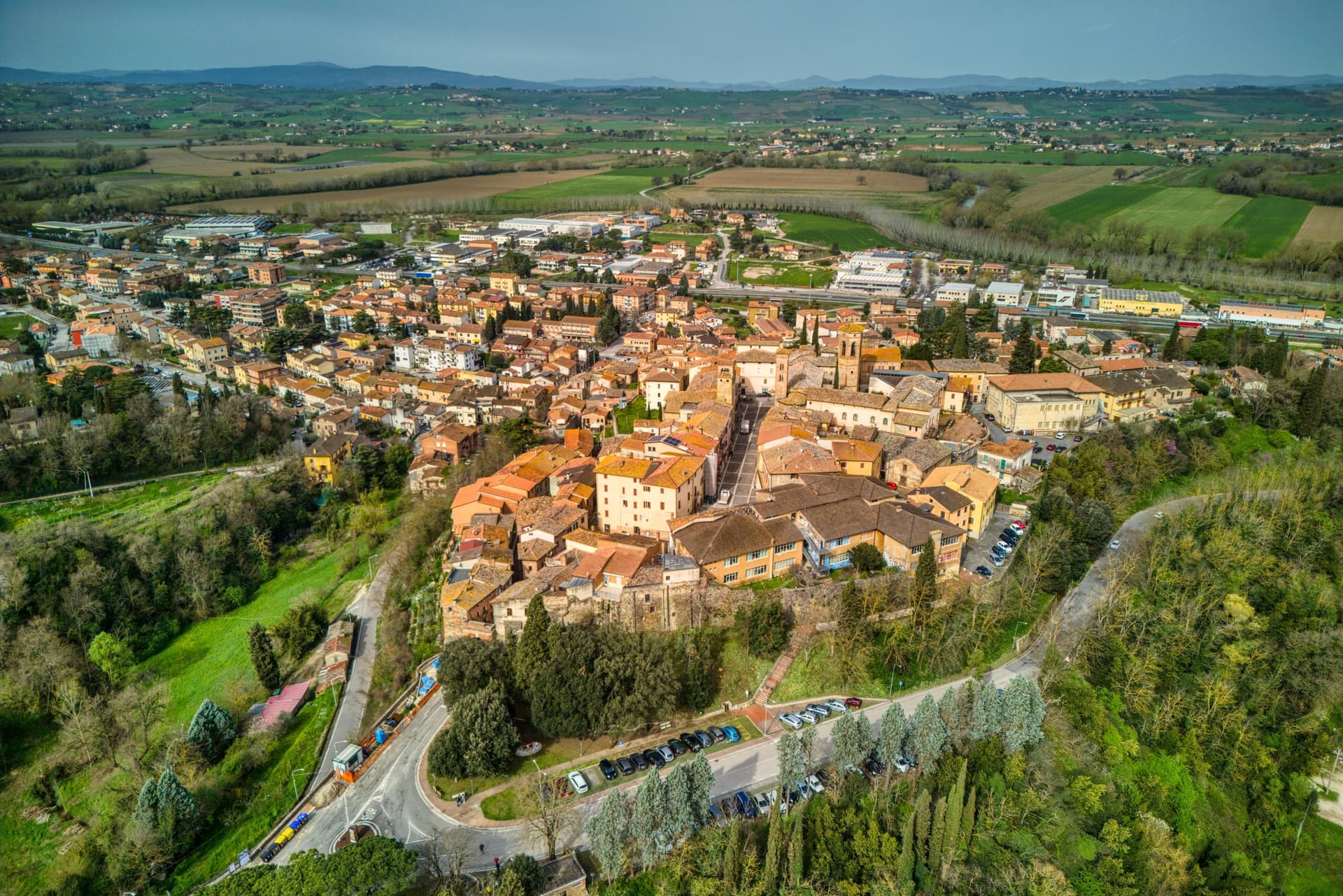
Deruta sits fifteen kilometers south of Perugia, its hill rising above the Tiber on the river's left bank. The walled medieval core, organized around Piazza dei Consoli, occupies the high ground, while the lower town spreads along the old road linking Perugia to Rome.
That road is where the workshops cluster, most of them family businesses running three or four generations deep, and it is also the route that carries traffic five kilometers south to the pilgrimage church, its walls built up over four centuries from votive tiles left by travelers on the same stretch of road. The first documented kilns appear in the archaeological record in the late thirteenth century, and by the early sixteenth the town's workshops had developed the lustro finish that gave Deruta wares their metallic shine, along with the Bella Donna plates that paired painted portraits with flattering banderoles naming the women depicted.
That convent complex, once a working monastery, now holds both the ceramics museum and, next door, the civic gallery with its Perugino and Alunno panels, so the town's religious architecture, its art collection, and its ceramics history sit under the same roof by accident of reuse rather than design. The upper town's churches and museums hold the record of what Deruta made and believed; the lower town's workshops are still making it.
The re-enactment here is Palio della Brocca, usually held across August and September.
What to see in Deruta
- Museo Regionale della Ceramica. Holds over 6,000 pieces from medieval to modern, arranged through the convent's old cloister and cells.
- Chiesa di San Francesco. Consecrated 1388 after earthquake reconstruction, Sienese 14th-century frescoes inside, Domenico Alfani Raphael-school panel above an altar.
- Pinacoteca Comunale. Civic gallery with Perugino's Eterno and Saints Romano e Rocco, plus two altarpieces by Niccolò Alunno from the surrounding churches.
How to get to Deruta
There is a railway station in the town, so you can arrive without a car and never need one while you are here. Perugia is roughly 19 minutes away by road.
Our tip
April through June and September into October are the months locals prefer. The Tiber valley stays mild and the workshops keep regular hours, with kilns running on weekdays and tastings open on weekends. The Festa della Ceramica in late August opens the cellars and the older workshops to the public. Palio della Brocca falls in August.
More from Anywhere Italy
 The prettiest villages with a medieval festival within 90 minutes of Perugia
 The best hidden hill towns with a serious restaurant within 90 minutes of Perugia
- The best towns with a medieval festival that you can reach by train within 90 minutes of Perugia
- The best olive oil towns with a medieval festival within 90 minutes of Perugia
- The best towns with a medieval festival that eat well within 90 minutes of Perugia
 The best medieval festivals in Umbria