
Without a car
Apulia by train
41 towns
Towns in this region where we confirmed an active station. Check the timetable before you go: a station on the map is not the same as a useful service.
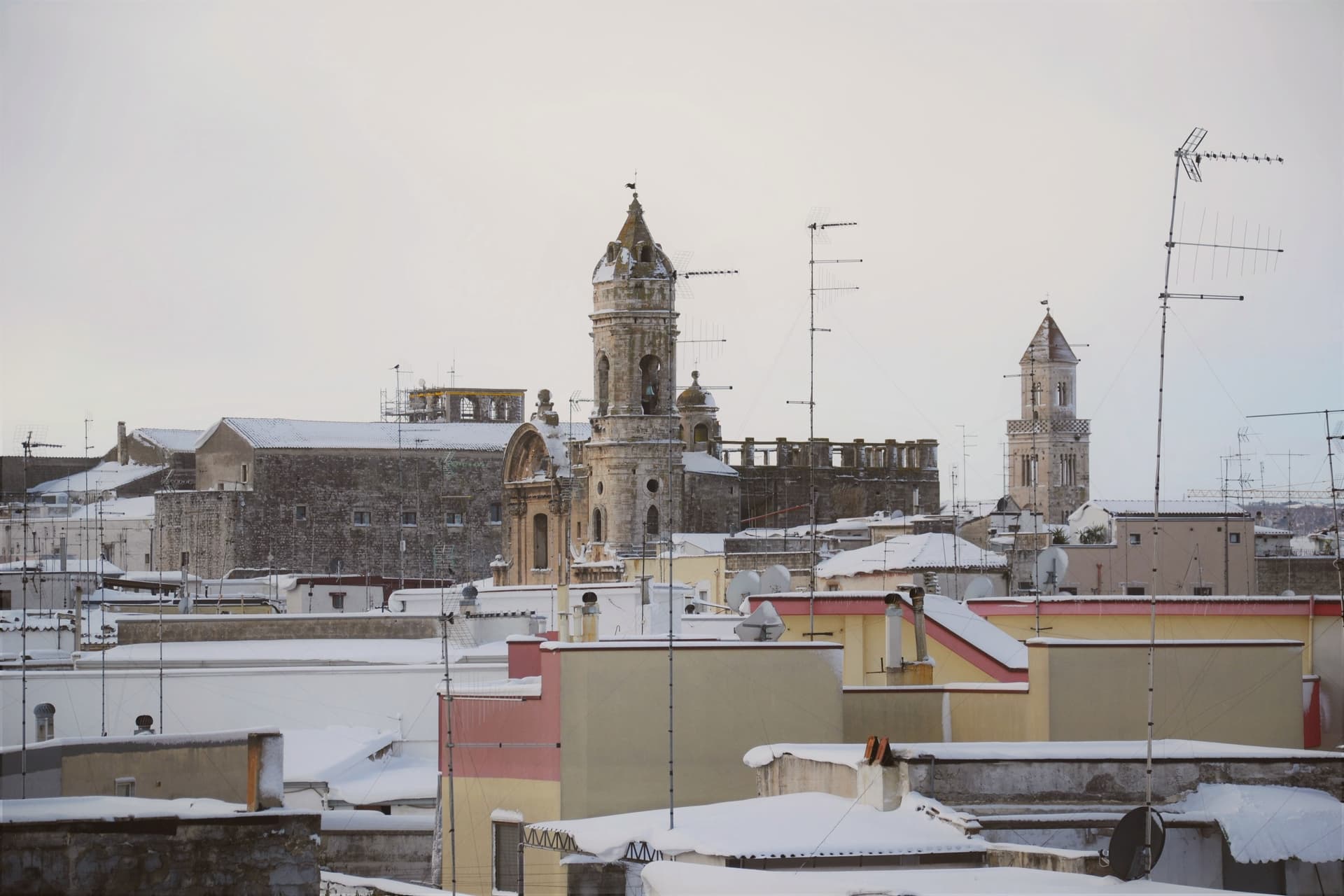
Acquaviva delle Fonti
Province: Bari · 300 m
A Murge town at 300 meters between Bari and the Itria valley, named for its springs and a DOP red onion.
Alberobello
Province: Bari · 402 m
The Itria valley town built entirely of trulli, 1,500 corbelled limestone cones in two quarters, UNESCO since 1996.
Andria
Province: Barletta-Andria-Trani · 151 m
Frederick II's favourite Apulian city, the birthplace of burrata, ruling the Murge plateau eighteen kilometers north of its most famous castle.
Bisceglie
Province: Barletta-Andria-Trani · 16 m
An Adriatic port town between Trani and Molfetta, named for Roman watchtowers, with five dolmens around it and a Norman cathedral begun in 1073.
Bovino
Province: Foggia · 646 m
A Daunian Mountains hill town at 646 meters above the Cervaro valley, Roman Vibinum, with a Norman-Swabian castle later turned into a Guevara ducal palace.
Campi Salentina
Province: Lecce · 47 m
A Salento plain town fifteen kilometers north of Lecce, rebuilt after the Saracen raids of 926 and later raised to a marquisate.
Carovigno
Province: Brindisi · 161 m
An upper Salento hill town between Brindisi and Ostuni, with a marine reserve on its coast.
Casamassima
Province: Bari · 230 m
The blue town of the Murge, twenty kilometers south of Bari, its centro storico painted with copper-blue lime after the 1658 plague spared its residents.
Castellana Grotte
Province: Bari · 290 m
A Murge town built on top of the cave system it is named for, three kilometers of galleries running 60 meters under the limestone plateau.
Castellaneta
Province: Taranto · 235 m
A cliff-edge Murge town at 235 meters above the Gravina Grande canyon, birthplace of Rudolph Valentino in 1895, with a Bandiera Blu Ionian marina.
Cisternino
Province: Brindisi · 394 m
An Itria valley borgo on the southern Murgia at 394 meters, whitewashed and looking down over drystone walls and trulli.
Conversano
Province: Bari · 219 m
A pre-Murge hill town at 219 meters, three centuries seat of the Acquaviva counts, with the abbey-monastery once called the Wonder of Puglia.
Copertino
Province: Lecce · 34 m
A Salento town fifteen kilometers west of Lecce, with one of Puglia's largest Renaissance fortresses and the birthplace of Saint Joseph of Copertino.
Corigliano d'Otranto
Province: Lecce · 95 m
A Griko-speaking town twenty-five kilometers south of Lecce, built around a 1500s Lecce-stone castle of circular towers around a quadrangular plan.
Fasano
Province: Brindisi · 118 m
A Brindisi-province town running from the Adriatic up to the Itria escarpment, holding a Roman coastal city, a wooded highpoint, and Europe's second-largest safari park.
Galatina
Province: Lecce · 78 m
The Salento town at 78 meters where the cult of San Paolo bred tarantism and gave the pizzica its origin myth.
Galatone
Province: Lecce · 57 m
A Salento town at 57 meters thirteen kilometers from Gallipoli, built around a Baroque sanctuary raised over a fourteenth-century Byzantine icon.
Gallipoli
Province: Lecce · 12 m
The Ionian beach city on a limestone island, Greek Kallipolis meaning beautiful city, tied to the mainland by a seventeenth-century bridge.
Giovinazzo
Province: Bari · 7 m
An Adriatic fishing port twenty kilometers northwest of Bari, with a Norman cathedral and a Bronze Age dolmen in the agro inland.
Giurdignano
Province: Lecce · 78 m
A two-thousand-resident Salento borgo at 78 meters known as the megalithic garden of Italy, with nineteen menhirs and a cluster of dolmens.
Gravina in Puglia
Province: Bari · 350 m
Puglia's deepest gravina: a Bari-province town of 42,700 built on the lip of a 100m-deep limestone canyon, its cliffs threaded with rupestrian cave churches.
Lecce
Province: Lecce · 49 m
The Baroque capital of the Salento, ninety-four thousand people on the Lecce-stone plain, carving its façades in honey limestone since 1500.
Locorotondo
Province: Bari · 410 m
The round white town on the Itria valley ridge at 410 meters, with cummerse roofs the rest of Puglia does not have.
Manduria
Province: Taranto · 79 m
The Messapian capital thirty-five kilometers east of Taranto, ringed by three concentric stone walls and the home of Primitivo.
Martina Franca
Province: Taranto · 431 m
Puglia's second Baroque city after Lecce, on the Itria ridge at 431 meters, with an opera festival in its ducal courtyard since 1975.
Minervino Murge
Province: Barletta-Andria-Trani · 445 m
A ridge town at 445 meters where the Murgia plateau breaks off into open view, inside the national park that carries its name.
Monopoli
Province: Bari · 9 m
An Adriatic walled town forty kilometers south of Bari, the Charles V castle on the headland, 156 square kilometers of coastline behind it.
Nardò
Province: Lecce · 45 m
The second city of Salento after Lecce, a Baroque inland capital twenty-five kilometers from Lecce with a Ionian coastline behind it.
Oria
Province: Brindisi · 166 m
A Messapian acropolis between Taranto and Brindisi crowned by Frederick II's triangular castle, home to one of medieval Europe's oldest Jewish communities.
Ostuni
Province: Brindisi · 218 m
The Città Bianca on three hills at 218 meters, eight kilometers inland, whitewashed against the Murge above an Adriatic plain of olive trees.
Otranto
Province: Lecce · 20 m
Italy's easternmost city, eighty kilometers from Albania, with a Norman mosaic floor and the bones of 813 martyrs in the cathedral.
Polignano a Mare
Province: Bari · 24 m
The Adriatic cliff town thirty kilometers south of Bari, built on a twenty-metre limestone bluff, birthplace of Domenico Modugno.
Putignano
Province: Bari · 372 m
Putignano has run its carnival continuously since 1394, the longest unbroken run in Europe, staged in a Murgia town with a karst cave threaded beneath its own centro storico.
Rodi Garganico
Province: Foggia · 42 m
A Gargano promontory town above the Adriatic, citrus capital of the peninsula, with DOP oranges and lemons grown on the terraces below it.
Sammichele di Bari
Province: Bari · 280 m
A Murge town at 280 meters founded in 1609, anchored by the Caracciolo castle and famous for the zampina pork sausage.
San Severo
Province: Foggia · 86 m
The Daunia wine capital on the Tavoliere, home to Puglia's first DOC of 1968 and a Carnevale of fanoia explosions known across the south.
Specchia
Province: Lecce · 130 m
A medieval Salento borgo on the Serra Magnone at 130 meters, named for the Messapian stone lookouts that once watched the coast.
Trani
Province: Barletta-Andria-Trani · 7 m
The Adriatic port whose pink-white Romanesque cathedral stands on the water, built for a Greek pilgrim who died here in 1094.
Trinitapoli
Province: Barletta-Andria-Trani · 5 m
A Tavoliere town between the Saline di Margherita and the Ofanto, sitting on a Bronze Age sanctuary that still surprises archaeologists.
Ugento
Province: Lecce · 108 m
A Messapian-Roman town five kilometers from the Ionian, where a Baroque castle sits on the walls of the ancient city of Ozan.
Vico del Gargano
Province: Foggia · 445 m
A Gargano hill town at 445 meters where a Norman castle, a kiss alley, and DOP citrus terraces step down toward the Adriatic.
The slow-trip planner
Plan a slow trip across the towns travelers skip.
Answer five questions. We will shape a geographically coherent slow trip from the 1,000 Italian towns most travelers skip. Yours to save and share.
From elsewhere in Italy
Five more towns to discover
Visso
Province: Macerata
The northern Sibillini gate at 607 meters where the Nera meets the Ussita, holding one of two surviving manuscripts of Leopardi's L'Infinito.
Goriano Sicoli
Province: L'Aquila
At 720 meters in the Subequana valley, a medieval village drawn by M.C. Escher in 1929 keeps a May ritual folklorists trace to Demeter.
Ugento
Province: Lecce
A Messapian-Roman town five kilometers from the Ionian, where a Baroque castle sits on the walls of the ancient city of Ozan.
Fontanellato
Province: Parma
A Parma-plain town built around the Rocca Sanvitale, the moated fortress at its center.
Pescina
Province: L'Aquila
A Marsica town at 735 meters, on the rim of the drained Fucino basin, that lost five thousand of six thousand people in a single morning in 1915.