
Apulia · Barletta-Andria-Trani
Andria
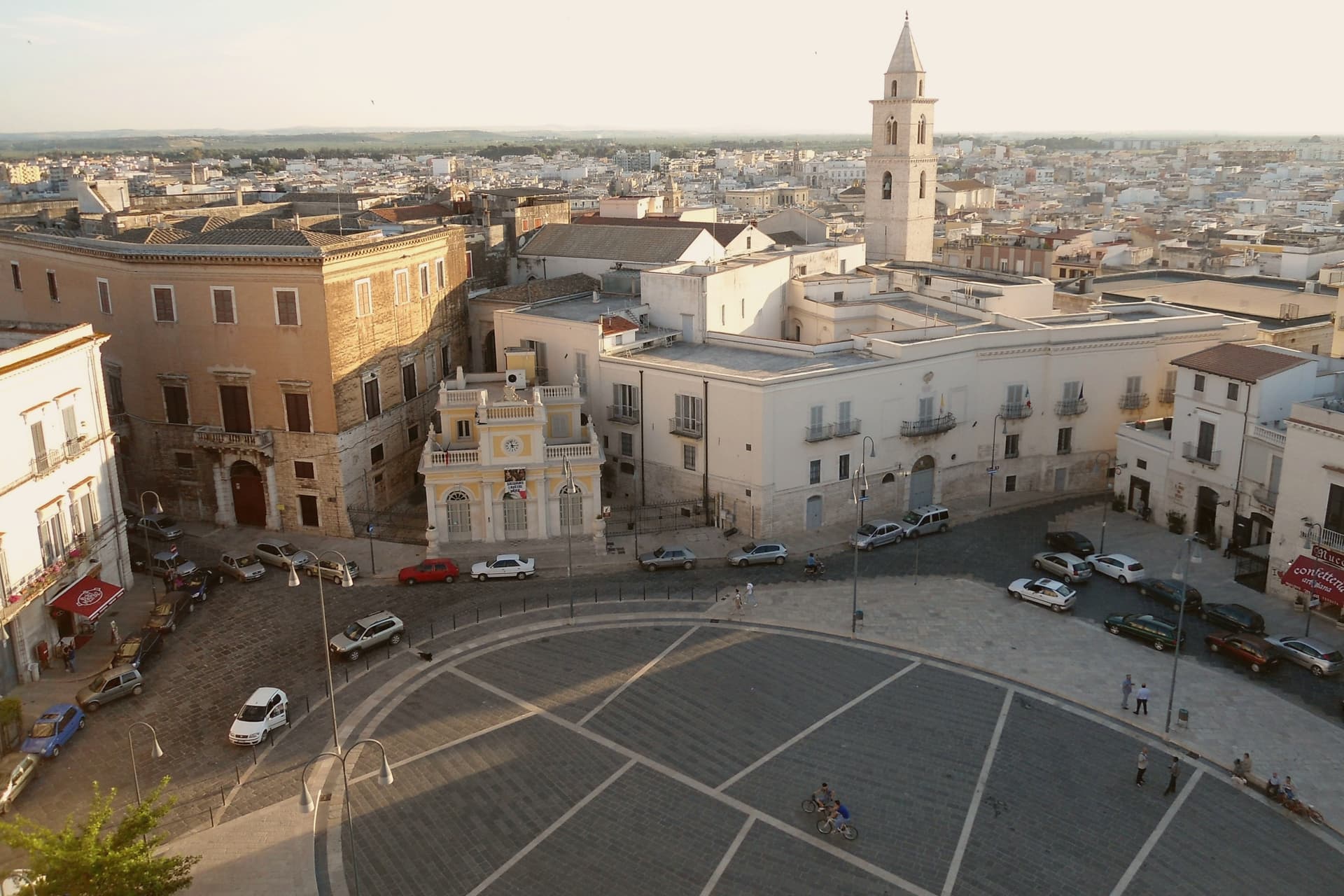
Frederick II's favourite Apulian city, the birthplace of burrata, ruling the Murge plateau eighteen kilometers north of its most famous castle.
- Best time
- Apr–Oct
- By car
- 1 h 6 min from Bari
- By train
- Station in the comune
- Population
- 97,146
Known for
CASTEL DEL MONTE
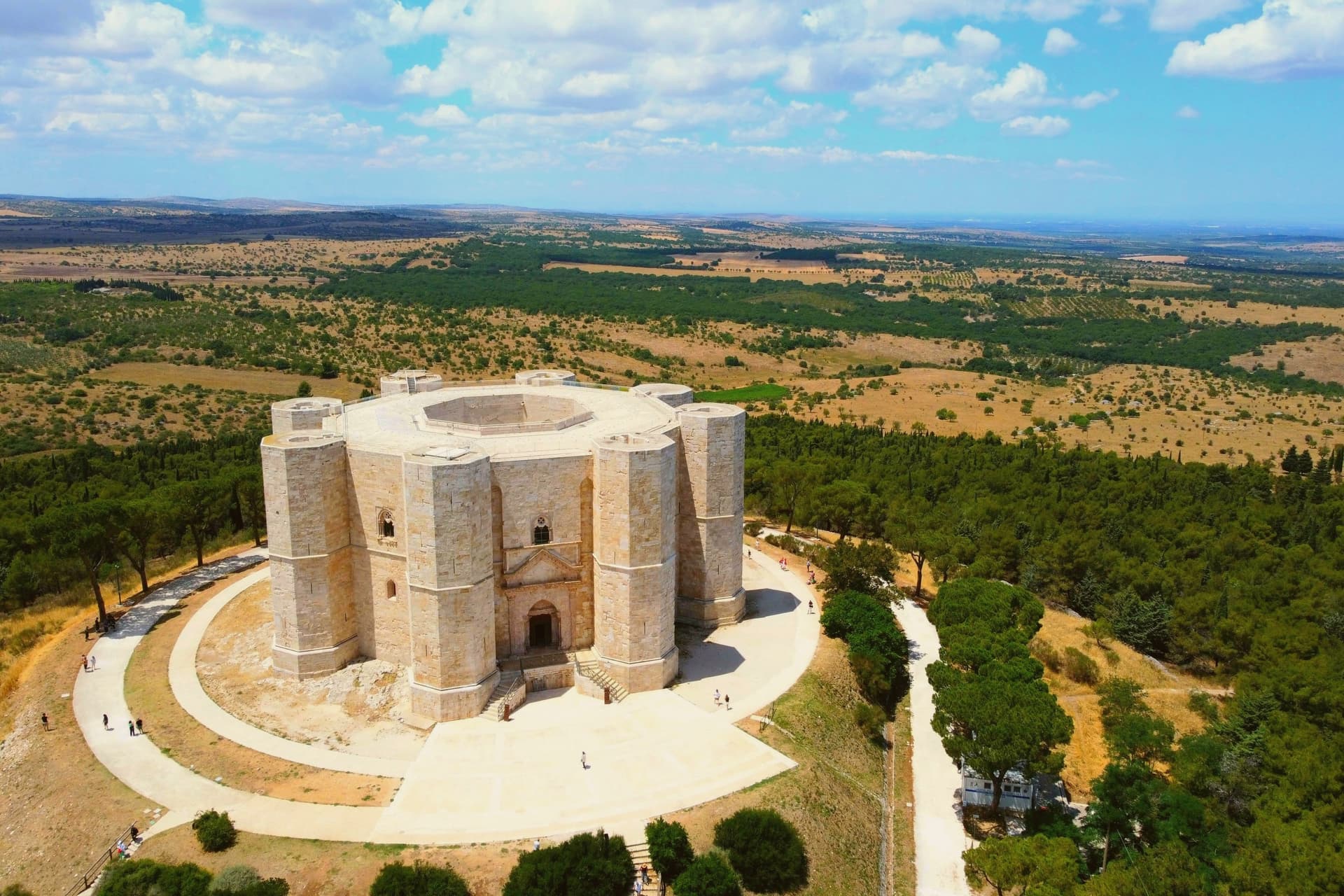
Frederick II's octagonal Murge castle of the 1240s, UNESCO 1996, the image on the back of the Italian one-cent euro coin.
BURRATA
Invented in Andria in the early twentieth century by the Bianchino family; the soft mozzarella shell filled with cream and stracciatella now travels worldwide.
OLIVE OIL
Coratina cultivar from the surrounding Murge, one of Italy's most-planted varieties, the backbone of Terra di Bari DOP.
LENTICCHIA DI ALTAMURA
The commune also lies inside the Lenticchia di Altamura IGP production zone.
When to visit
Best · Apr–Oct
- J13°
- F15°
- M16°
- A19°
- M25°
- J30°
- J33°
- A33°
- S28°
- O24°
- N18°
- D14°
- Best
- Hot or crowded
- Quiet
- Mostly closed
Daytime averages, 2020–2024. Weather data by Open-Meteo.com.
Why come
Andria sits on the Murge plateau, ten kilometers from the Adriatic, the third-largest city in Puglia after Bari and Taranto. It was made a fortified civitas in 1046 under Peter the Norman, with twelve towers, three gates and a citadel; Frederick II raised it again in the thirteenth century and built his most famous castle on a hilltop eighteen kilometers south of the city walls. The city and Castel del Monte read as two expressions of the same Frederician ambition, one a working civitas of towers and gates, the other a solitary geometric exercise on an open plateau with no town around it at all.
The other claim Andria makes is burrata, invented around the early twentieth century by the Bianchino family as a way to use leftover mozzarella scraps. A fortified city, an unfinished castle, and a cheese born from kitchen thrift: the Murge produced a walled seat of power and, separately, an object meant to be looked at rather than defended, and a food born of nothing more than not wanting to waste the scraps.
The Sunday letter
Andria is on our list. Its letter is still to come.
We are writing about all 1,000 of these towns, one at a time, in a free letter every Sunday: the photo, the food, the festa. That is our mission. Sign up and you will be there when Andria comes up. By Peter & Sophia, from Pietrasanta.
Read on
Andria in our articles
 The best olive oil towns that eat well within 90 minutes of Bari6 towns, Andria among them.
 The 7 best towns inside a national park that eat well in Puglia7 towns, Andria among them.
 The best hill towns inside a national park in Puglia7 towns, Andria among them.
 The best towns known for what they grow within 75 minutes of Bari7 towns, Andria among them.
How to get there
From Bari / Brindisi (BRI), about 59 minutes by car.
Naples / Salerno (NAP) is about 3 hours away.
By car from the centre of Bari 1 hour, Lecce 3 hours or Salerno 3 hours.
There is a railway station in the comune, so you can arrive without a car.
Coming from Bari?
Coming by train into Bari Centrale? Andria is about 1h 8m away by road.
What to see
Castel del Monte
An octagonal prism with eight octagonal towers, standing alone on a Murge hilltop and visible for fifty kilometers in any direction. Never finished, never used for war.
Cattedrale di Santa Maria Assunta
Romanesque cathedral founded in the twelfth century, rebuilt over the centuries, holds the crypt and the relics of San Riccardo, the city's patron.
Chiesa di Sant'Agostino
Gothic-Romanesque church built by the Teutonic Knights in the late thirteenth century, with a sculpted portal that is one of the finest in Puglia.
Porta Sant'Andrea
Surviving medieval gate of the Frederician walls, also called Porta della Castellana, still framing the eastern entrance to the centro storico.
Parco Nazionale dell'Alta Murgia
National park on the Murge plateau around the castle, dolines and pseudosteppe, with the largest population of lesser kestrels in Europe.
The slow-trip planner
Building a trip? Find where Andria fits in a slow Italy circuit.
Answer five questions. We will shape a geographically coherent slow trip from the 1,000 Italian towns most travelers skip. Yours to save and share.
We recommend
Where to eat
Not our picks, but places the guides put their name to: a Michelin star, a Gambero Rosso fork, a Slow Food snail, a Michelin Key for the hotels. Worth a table, a counter, or a night when you pass through.
Antichi SaporiTrattoria
Antichi Sapori has a Michelin Bib Gourmand, three Gambero Rosso prawns and a Slow Food snail, among other nods.
Confetteria Mucci Giovanni con annesso Museo del ConfettoPasticceria
Confetteria Mucci Giovanni con annesso Museo del Confetto has a place on Italy's historic-locali register to its name.
Il TuraccioloRistorante
Il Turacciolo carries a Michelin Bib Gourmand.
Living here
- Population 97,146
- A local hubi
- Pharmacy in town
- High school within a 30-minute drive
- Train station in the comune
- Nearest airport Bari / Brindisi, 59 min drive
- Regional capital Bari, 1 h 3 min drive
Common questions
- What is Andria known for?
- Frederick II's favourite Apulian city, the birthplace of burrata, ruling the Murge plateau eighteen kilometers north of its most famous castle.
- Where is Andria?
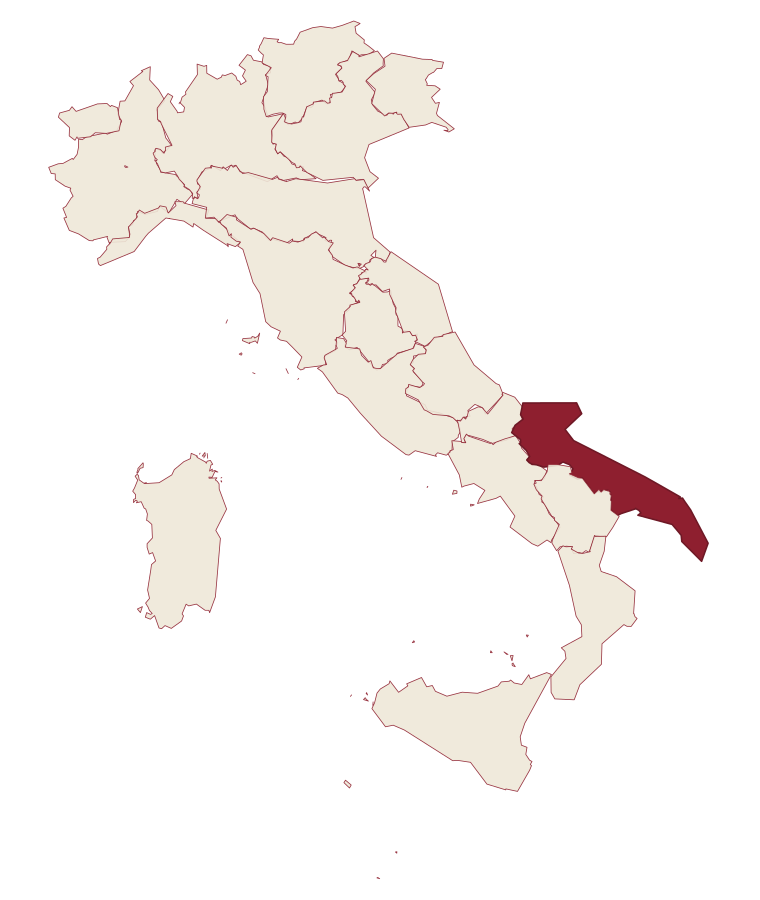
- Andria is a comune in the province of Barletta-Andria-Trani, in Apulia, at 151 meters above sea level.
- What is the nearest airport to Andria?
- Bari / Brindisi (BRI), about 59 minutes by car.
- Can you get to Andria without a car?
- Yes. There is a railway station in the comune, so you can arrive by train.
- How long is the drive from Bari to Andria?
- About 1 hour by car.
- When is the best time to visit Andria?
- Best in Apr–Oct. July is the warmest month, averaging 33 degrees, and March the wettest, with about 12 rain days.
- Which other towns are like Andria?
- Lecce, San Severo and Manduria.
- How many people live in Andria?
- 97,146 at the 2023 count.
Tags & datadesignations · numbers · sources
The numbers
- Elevation: 151 m
- Population: 97,146
- Surface area: 402.89 km²
These figures were compiled from public directories: ISTAT, OpenStreetMap and Wikidata, and from the official listings of the guides named on this page. Town details change; verify with official sources before you travel.
Featured on
Andria appears on this themed pick from our Collections:
Similar
Towns like Andria
Lecce
Province: Lecce
both inland, away from the coast · both over 10,000 people
San Severo
Province: Foggia
both inland, away from the coast · both over 10,000 people
Manduria
Province: Taranto
both inland, away from the coast · both over 10,000 people
Nardò
Province: Lecce
both inland, away from the coast · both over 10,000 people
Caserta
Province: Caserta
both inland, away from the coast · both over 10,000 people
Benevento
Province: Benevento
both inland, away from the coast · both over 10,000 people
🏛️ UNESCO
More UNESCO towns
Matera
Province: Matera
Cave dwellings carved into limestone since the Paleolithic, called the shame of Italy in the 1950s and made European Capital of Culture in 2019.
Amalfi
Province: Salerno
The first Italian maritime republic and the coast it named, six meters above the sea between cliffs that close around the duomo's steps.
Ascea
Province: Salerno
Two villages, a hilltown at 230 meters and a Cilento marina, with Parmenides and Zeno's Eleatic school in the ruins of Greek Velia below.
Atrani
Province: Salerno
The smallest commune in Italy by area, twelve hectares of stacked houses where the Amalfi Coast pinches shut around a single piazza.
Benevento
Province: Benevento
Sannio capital at the Calore-Sabato confluence, with a 114 AD Trajan arch and a Lombard rotunda on the UNESCO list.