
The best coastal towns within 90 minutes of Florence
Tuscany's coast runs flat and sandy from the Apuan foothills down towards the mouth of the Arno, and Florence sits near enough that the water is a morning's drive or a train ride away. The light changes as the hills drop: umbrella pines, drainage canals, rows of painted bathing huts, and behind it all the white scars of the marble quarries above Carrara. Summer is the obvious season, when the stabilimenti open and the beach bars serve schiacciata and cold vermentino, but autumn is when the fish is best. Cacciucco in Livorno, spaghetti with clams, mussels, chickpea farinata eaten standing up. The building stock is stucco and marble rather than the stone of the Chianti hills, which is part of why the coast reads as a different country.
Most people who leave Florence for water head south to the Maremma or west out to Elba, and in August the ferries from Piombino run full and the coastal road stiffens with traffic. Elba earns its reputation: clear water, good coves, real hills. It also takes most of a day each way to reach properly, which makes it a poor fit for anyone with a hotel booked in Florence. The result is a coast crowded in one place and comparatively quiet in others.
The same sea, the same pine woods and the same kitchens continue north of the Arno, along the Versilia and down into the port. These are towns with year-round lives, marble workshops, markets, working harbours, and they sit inside a train timetable that makes an afternoon at the beach reasonable from the city. Fewer visitors treat them as destinations in their own right, which is the argument for going.
Of the 42 communes we have mapped in a 90-minute drive of Florence, 6 qualify as coastal towns: each is on the sea. The smallest, Forte dei Marmi, has 6,861 residents.
Two more lists worth reading alongside this one: The best coastal towns that eat well within 90 minutes of Pisa and The best coastal towns worth staying overnight in Toscana.
Forte dei Marmi
Why visit Forte dei Marmi
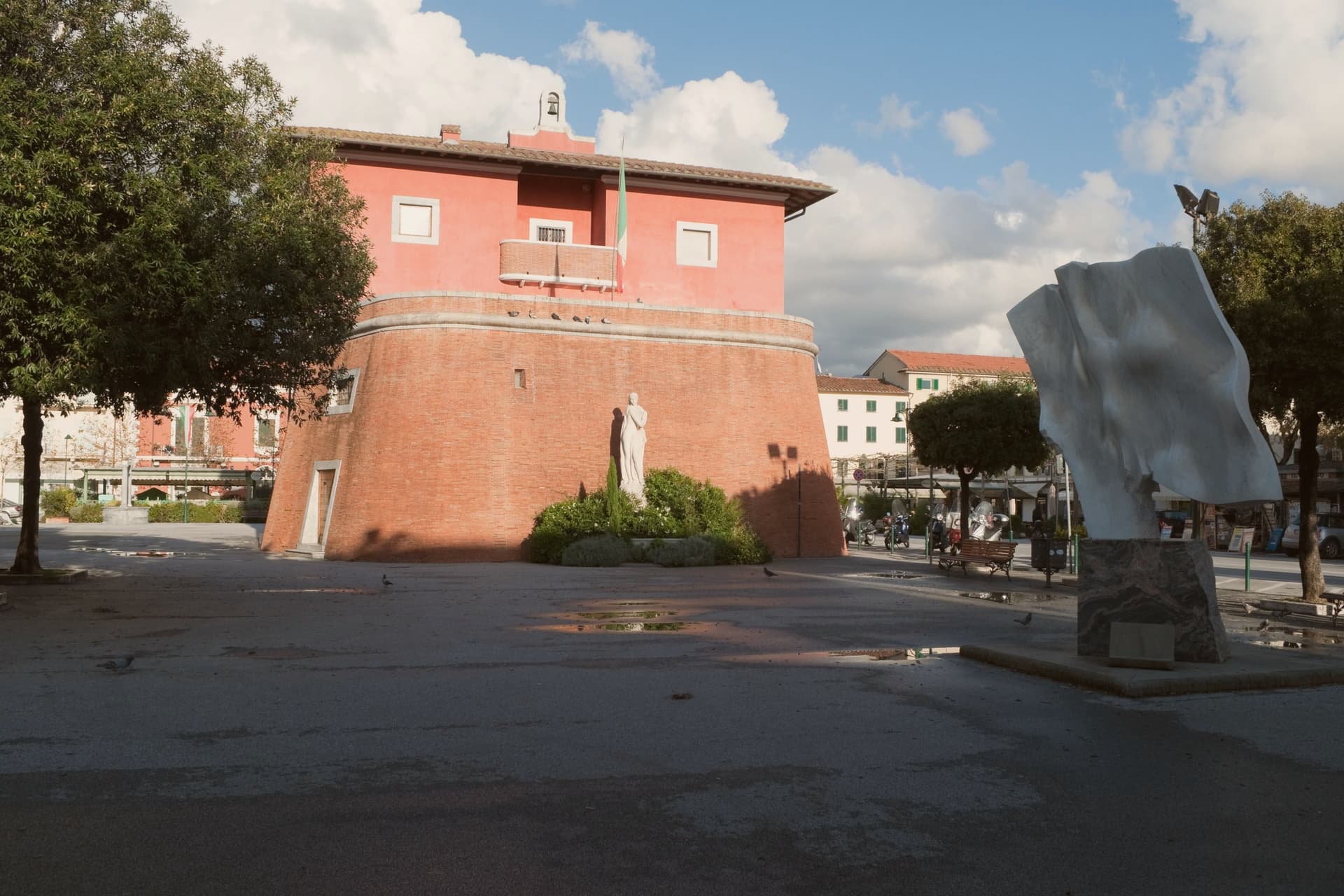
Forte dei Marmi sits at sea level on the Versilia coast, 8.9 square kilometers of flat ground between the Apuan Alps and the Ligurian Sea. The town takes its name from a small fort built in 1788 under Grand Duke Leopold to defend the coast and used through the nineteenth century to stockpile marble shipped down from the Carrara and Seravezza quarries before loading onto ships at the wooden pier.
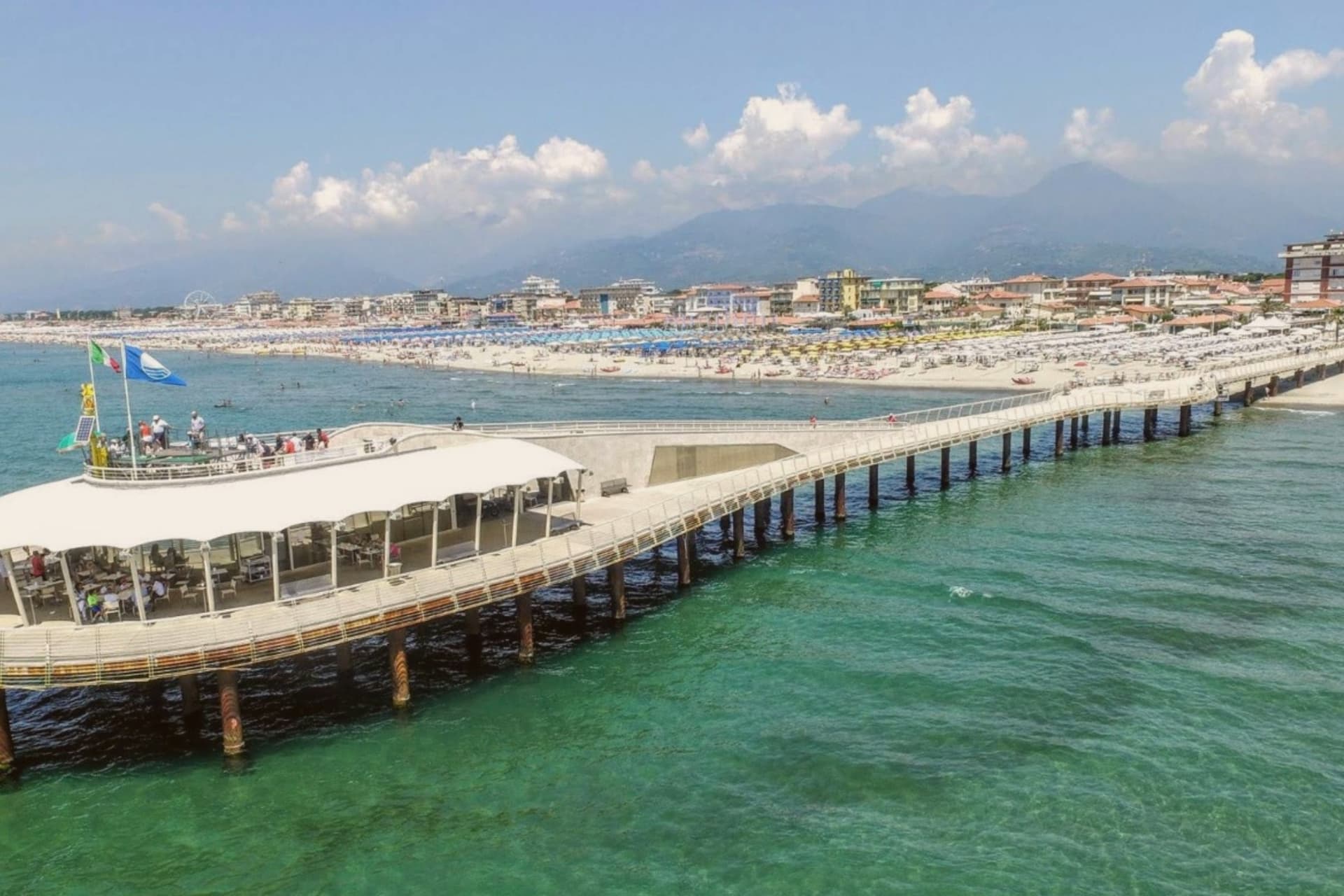
The Pontile, built between 1867 and 1877, carried tracks and a steam crane for the marble trade and is now the central promenade landmark. The town became a Belle Époque resort in the early twentieth century, then a luxury destination from the 1960s.
Russian buyers arrived in the 1990s, the press named the seafront Piccola Russia, and by 2023 around 99 bagni concessions operate along the beach, the most prestigious cabins renting at over 20,000 euros per season.
The beach here holds the national bathing award, which a comune has to win back every year on water quality, beach management and safety.
What to see in Forte dei Marmi
- Fortino di Leopoldo. The 1788 marble-loading fortress that gave the town its name, on the central piazza, now housing the Museo della Satira e della Caricatura.
- Pontile. Wooden marble-loading pier built between 1867 and 1877, with tracks and a steam crane, now the central seafront promenade.
- Spiaggia di Forte dei Marmi. Wide Versilia Bandiera Blu beach with around 99 bagni concessions running back to the Belle Époque, fine golden sand and the Apuan Alps as backdrop.
How to get to Forte dei Marmi
Pisa is roughly 38 minutes away by road.
Our tip
May through September is the resort season. June and September give the cleanest weather and the calmest beach. July and August fill the bagni to capacity, the seafront restaurants book a month ahead, the Wednesday market gets dense, and the parking on Viale Morin disappears by ten.
Pietrasanta
Why visit Pietrasanta
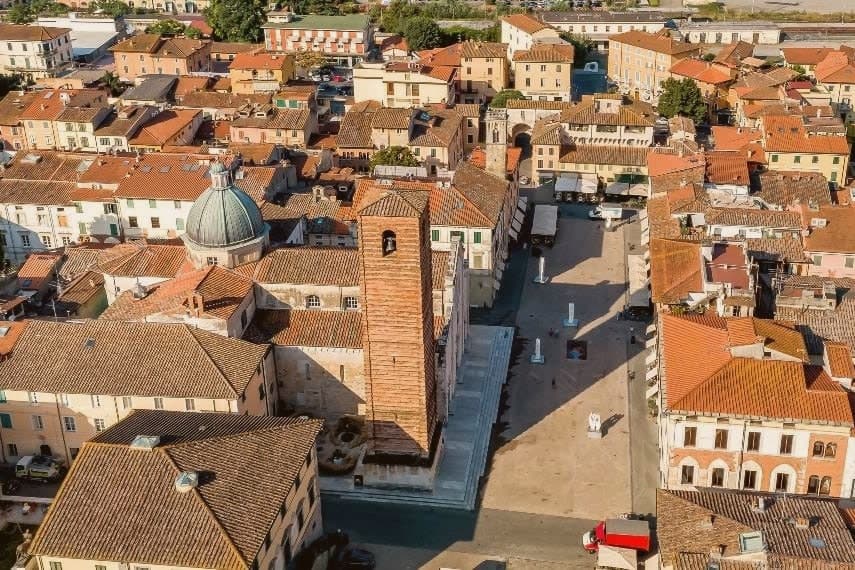
Pietrasanta sits at 14 meters at the foot of the Apuan Alps, two kilometers from the Tyrrhenian, close enough to the quarries behind it and the coast in front of it that stone and sea both shape the town. It was founded in 1255 by Luca Guiscardo da Pietrasanta on the older fortress that already stood on the hill, and it grew through the fifteenth century into the processing center for marble cut from the mountains at its back.
The centro storico, where the studi and foundries still work, sits inland; the beachfront with its pinewood park lies on the coast, a separate register of the same town, one built for stone and one for summer. Michelangelo arrived in the early 1500s to work the local stone, and Henry Moore, Joan Miró and Damien Hirst followed in the twentieth century, drawn by the same studios and foundries that cut marble for the Duomo's façade centuries earlier.
The Mariani foundry on the outskirts now casts work for sculptors who order remotely from New York and Beijing. What began as a quarry town for one church has become a place where the working of stone, not the display of it, is the thing on view.
The beach here holds the national bathing award, which a comune has to win back every year on water quality, beach management and safety.
What to see in Pietrasanta
- Duomo di San Martino. White-marble façade on the collegiate church, first documented in 1223 and enlarged in 1330 and 1387. It faces the square that still functions as the town's civic center.
- Piazza Duomo. Main square with the Marzocco column celebrating Florence's 1513 reacquisition and a statue of Grand Duke Leopold by Vincenzo Santini.
- Museo dei Bozzetti. Civic museum holding 700 plaster models and clay sketches from sculptors who have worked in the local studios since the 1960s, a record of process rather than finished work.
How to get to Pietrasanta
There is a railway station in the town, so you can arrive without a car and never need one while you are here. Pisa is roughly 41 minutes away by road.
Our tip
May through September brings the Versilia season: Marina di Pietrasanta fills, the Versiliana festival programs concerts and theatre in the pinewood from late June, and the centro storico restaurants spread tables across Piazza Duomo. June and September are the calmer brackets. July and August push the beach to capacity and the inland piazza into evening-only rhythm. Pietrasanta Medievale a Pietrasanta falls in October.
Camaiore
Why visit Camaiore
Camaiore stretches from the Apuan Alps to the Versilia coastline, the only Versilia commune with substantial territory in both. The town center sits at 34 meters on the alluvial plain, named Campus Maior by the Romans for a military encampment on the road from Lucca to Luni.
That name and that road explain the town's shape: a fixed inland center built around the Collegiata and the medieval grid, connected by the Via Francigena to a coast six kilometers away that the Romans never had reason to build toward. The inland town and the beach at Lido di Camaiore function as two settlements under one name, joined by the road rather than by contiguous streets, with the Apuan Alps visible from the shore as the backdrop to both.
A commune this shape, mountain territory, a Roman road town, and a beach at the end of it, holds together not because its parts resemble each other but because each has stayed distinct while remaining reachable from the others.
The beach here holds the national bathing award, which a comune has to win back every year on water quality, beach management and safety.
What to see in Camaiore
- Collegiata di Santa Maria Assunta. Thirteenth-century parish church with a fourteenth-century bell tower, the central religious building of the inland town.
- Badia di San Pietro. The church stands alone now, a single Romanesque nave where a monastery once stood, its stone unadorned in the way that marks the Lombard-era Benedictine houses of the region.
- Lido di Camaiore. Fine sand six kilometers from the town center, with the Apuan Alps rising directly behind it, mountain and shoreline visible in the same view.
How to get to Camaiore
There is a railway station in the town, so you can arrive without a car and never need one while you are here. Pisa is roughly 44 minutes away by road.
Our tip
May through September runs the Versilia season at the Lido and gives the inland town its share of light evenings. June and September are the quieter brackets: warm enough for the sea, cool enough to walk the Francigena stages without losing the morning. July and August fill the Lido with families from Lucca and Milan, parking gets tight, and the inland piazze stay calmer than the seafront.
Viareggio
Why visit Viareggio
Viareggio sits at sea level on the Versilia coastal plain, the largest commune on the Tuscan riviera. The first parade ran in 1873, organized by middle-class residents as a float procession down the seafront; the masked protest against tax policy that followed gave the event its character.
The mascot's colour scheme, red and white, was taken from the beach umbrellas that line the shore, a detail that ties the Carnival's invented figure back to the town's own beach culture rather than to any outside tradition. The rail link to Lucca and Florence arrived in 1890, and the city turned into a Belle Époque resort in response: the seafront was rebuilt in the ornamented style of that era over the following decades.
The Magazzini Duilio 48 along Viale Margherita, together with the promenade's other survivors, mark out where that resort-era rebuilding is still legible today. The city's two identities sit side by side on the same stretch of shore: one built by a rail-borne resort economy, the other by a homegrown winter festival that turned into the town's defining export.
The beach here holds the national bathing award, which a comune has to win back every year on water quality, beach management and safety.
What to see in Viareggio
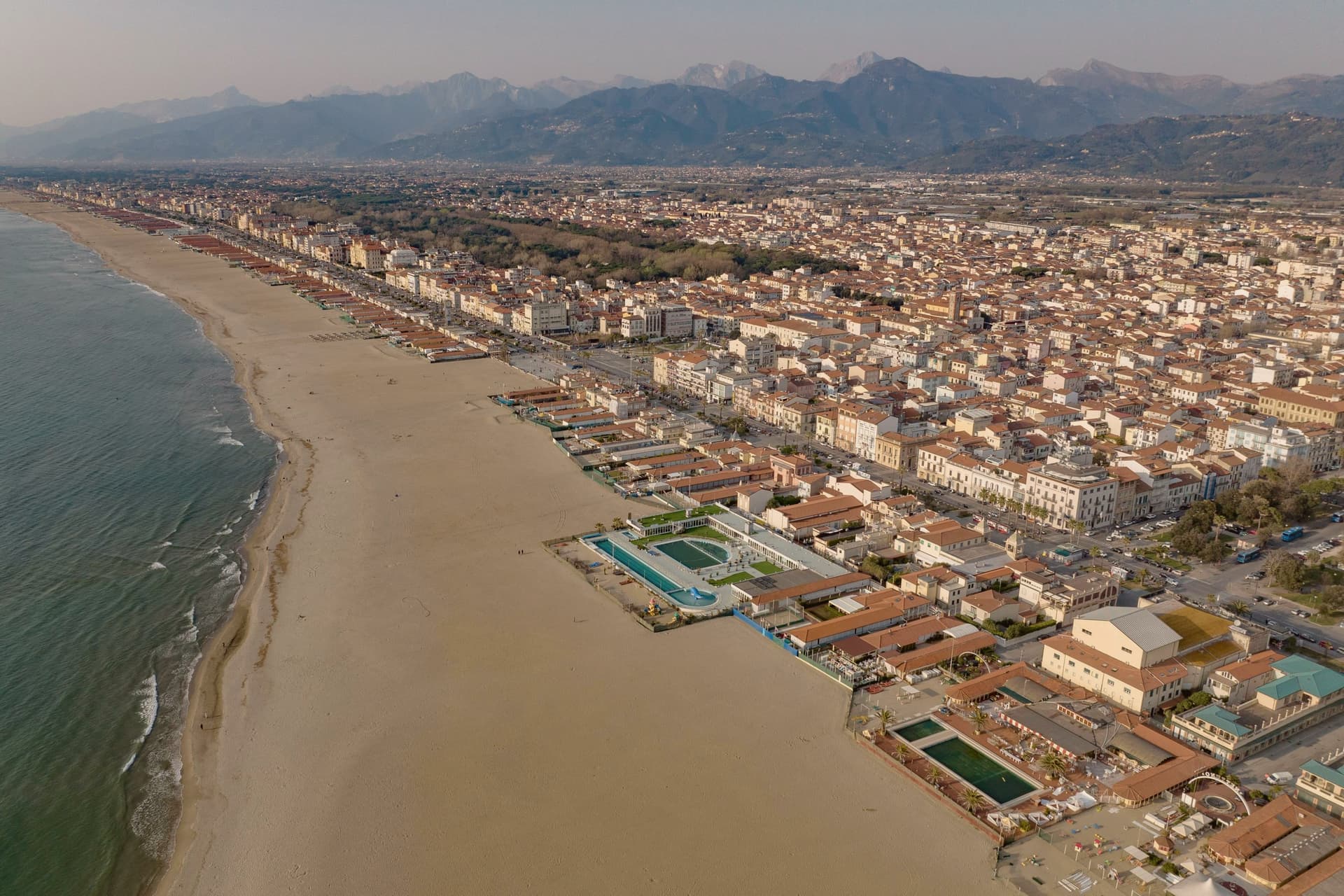
- Passeggiata Liberty. Three-kilometer Belle Époque seafront promenade lined with Stile Liberty villas, cafés and bath houses built between 1890 and 1925.
- Cittadella del Carnevale. Sixteen vast hangars where the papier-mâché floats are built year-round, with the Museo del Carnevale and the float-construction workshops open to visitors.
- Spiaggia di Viareggio. Ten-kilometer Bandiera Blu beach lined with the original bagni concessions of the Belle Époque, fine sand and shallow seabed.
How to get to Viareggio
There is a railway station in the town, so you can arrive without a car and never need one while you are here. Pisa is roughly 29 minutes away by road.
✷ We have written about Viareggio
“The bike lane starts at the bottom of Lido di Camaiore and runs south along the coast for about eight kilometers before it hits the pier at Viareggio, and the thing it teaches you, if you ride it often enough, is that Viareggio is a city you should almost always see from the saddle of a bicycle and never, if you can help it, from the pavement. The pavement has the crowd on it. The bike lane has the city.”
Read our piece on Viareggio →Viareggio | The cat at the end of the road
Our tip
May through September runs the season. June and September are calmer than the July-August peak when the beach concessions sell out and the parking on Lungomare fills by ten. February brings Carnival weekends and the largest crowds of the year for the parades along Viale Manin and Viale Margherita; the floats run through a full Sunday route.
Pisa
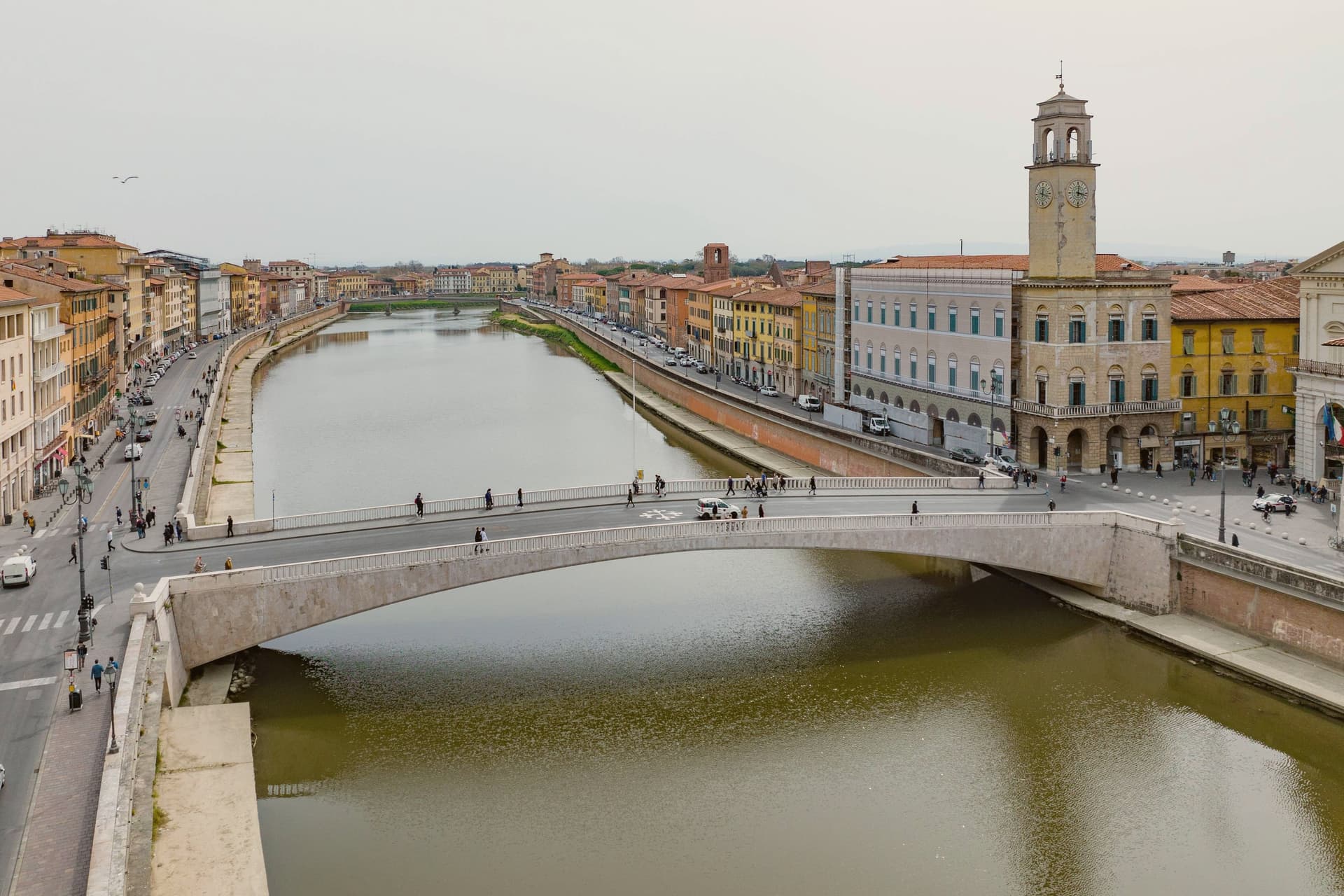
Why visit Pisa
The Arno reaches the Ligurian Sea twelve kilometers past the city, and the river is what built it: an Arsenal on its banks built galleys for the Crusades, and Mediterranean trade paid for the walled compound northwest of the centro. That compound, inscribed by UNESCO as one of the first Italian sites in 1987, gathers four buildings of the same Pisan Romanesque school in one field, the cathedral, the baptistery, the cemetery cloister and the bell tower, close enough to read as a single composition rather than a set of monuments visited separately.
The city has a second center away from that field. Piazza dei Cavalieri became the Medici political seat after the republic fell, and the university founded in 1343 keeps both squares populated with people who live and work there rather than pass through.
The Lungarni tie the two halves together physically, two quays following the river on both banks, lined with palazzi spanning the twelfth to the nineteenth century. What this adds up to is a town built in two unequal pieces: a religious and civic compound frozen at its medieval peak, and a working river city around it that never stopped adding centuries to its banks.
The beach here holds the national bathing award, which a comune has to win back every year on water quality, beach management and safety.
What to see in Pisa
- Torre Pendente. Finished 1372, two centuries after it began, the lean is visible from ground level without needing to climb it, south of vertical against the other three white buildings of the square.
- Duomo di Pisa. Pisan Romanesque cathedral begun 1064 by Buscheto, financed from the Mediterranean trade, with bronze doors by Bonanno Pisano and a pulpit by Giovanni Pisano.
- Battistero di San Giovanni. Largest baptistery in Italy at 54.86 meters tall, begun 1152, Romanesque base and Gothic upper level, with a pulpit by Nicola Pisano.
How to get to Pisa
There is a railway station in the town, so you can arrive without a car and never need one while you are here. Pisa is roughly 16 minutes away by road.
✷ We have written about Pisa
“It was a Tuesday in January, ten degrees, the kind of soft grey Tuscan winter rain that does not quite commit to being rain, and what we wanted, in a way that surprised both of us, was a bowl of Japanese noodle soup. The nearest place to get one was Pisa.”
Read our piece on Pisa →Pisa | Beyond the Tower
Our tip
May, June, September and October are the months when the Lungarni are at their best, the temperature stays in the twenties, and the lines at Piazza dei Miracoli compress by mid-afternoon. The Luminara di San Ranieri, on 16 June, lights the riverbank with eighty thousand candles and is the night the city sees most. July and August are hot and humid, with the day-tripper waves from cruise ships at Livorno filling the compound from morning. Gioco del Ponte falls in June.
Livorno
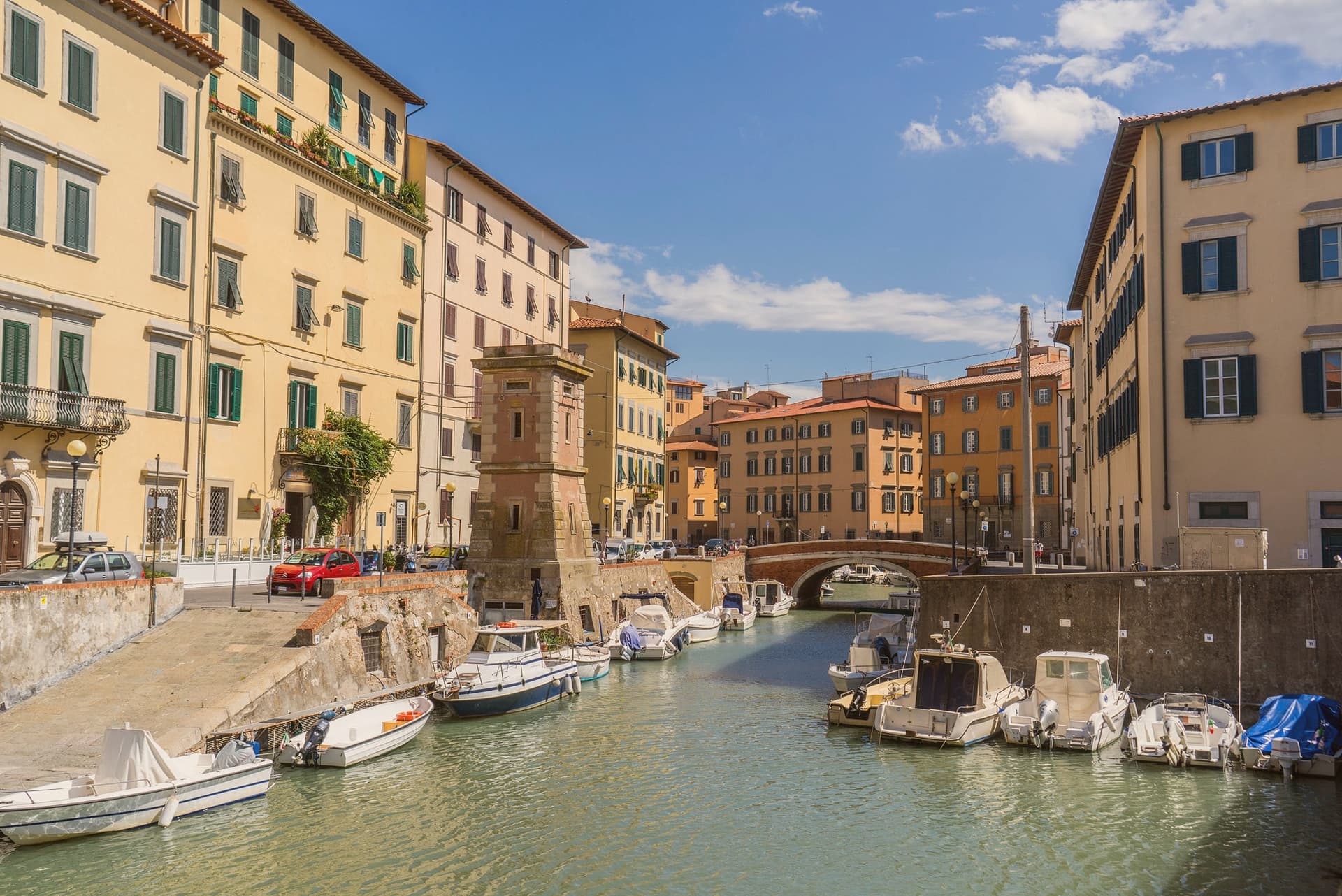
Why visit Livorno
Livorno is the Tuscan coast you don't expect: Medici-founded in 1577 as Nova Civitas, planned from scratch by Bernardo Buontalenti as a free port to rival Genoa and Venice, and unique among Tuscan cities for being entirely a Renaissance-era invention rather than a medieval inheritance. The original pentagonal city walls enclosed a Venetian-style quarter (Venezia Nuova) laced with navigable canals where merchant warehouses opened directly to the water — Jews, Greeks, Armenians, English, Dutch and North Africans were all invited to settle under the 1591–1593 'Livornine' laws granting freedom of worship and trade, making Livorno the most cosmopolitan port on the Mediterranean for two centuries.
What you see today: Fortezza Vecchia (1521) and Fortezza Nuova (1590) guarding the inner harbour; the four bronze Moors (1626) chained to the base of Ferdinando I's monument facing the port; the Terrazza Mascagni (a 1925 Art Deco chequerboard promenade with 4,100 black-and-white tiles facing the Tyrrhenian); the Cattedrale rebuilt after 1944 bombing; the Pentagono di Buontalenti street grid still visible from above. The Macchiaioli painters' movement was born here in the 1860s (Fattori, Lega, Signorini all lived and painted the local light).
Modigliani was born in Livorno in 1884. And the food: cacciucco — a 5-fish stew with toasted bread and red wine, the city's totemic dish — plus ponce alla livornese (rum-spiked coffee) at the Caffè Civili.
The Tuscan archipelago (Capraia, Gorgona, Elba) ferries out from the port within view of the promenade.
The beach here holds the national bathing award, which a comune has to win back every year on water quality, beach management and safety.
What to see in Livorno
- Terrazza Mascagni. A 1925 Art Deco seafront promenade with 4,100 black-and-white tiles facing the open Tyrrhenian — locals call it the world's most beautiful balcony, especially at sunset.
- Venezia Nuova quarter. The Medici-planned canal district from 1629. Walkable bridges, warehouse-doors-on-water, and the Effetto Venezia summer festival turn it into Tuscany's Venice.
- Quattro Mori (Monumento dei Quattro Mori). Pietro Tacca's four bronze Moors (1626) chained to the base of Grand Duke Ferdinando I's statue facing the port. Livorno's civic icon.
How to get to Livorno
There is a railway station in the town, so you can arrive without a car and never need one while you are here. Livorno is roughly 11 minutes away by road.
✷ We have written about Livorno
“I lived in Naples for weeks once, and those days remain among the best I have had, and the people there are among the finest I have met anywhere in this country, and I love the place without reservation. Naples is the same love story as Livorno.”
Read our piece on Livorno →Livorno | The City With No Time For You
Our tip
Livorno is a true year-round port city, but the sweet spot is April–June and September–October. May and June have the warm Tyrrhenian light, the Effetto Venezia festival (last week of July) brings the canal quarter alive at night, and September is still beach-warm without the crowds. July and August get hot and the port traffic peaks. Effetto Venezia falls in July.
More from Anywhere Italy
 The best coastal towns that eat well within 90 minutes of Pisa
 The best coastal towns worth staying overnight in Toscana
- The best beach towns within 90 minutes of Pisa
 The 6 best towns with a serious restaurant in the province of Lucca
- The 6 best coastal towns inside a nature park in Toscana
 The best coastal towns within two hours of Parma