
The 6 best towns with a serious restaurant in the province of Lucca
The province of Lucca puts three landscapes within an hour of each other, and all of them feed the kitchens. Behind the coast the Apuan Alps quarry white marble, and the towns at their feet are built from it: pavements, church fronts, war memorials, bar counters. Down on the flat the pinewoods run into the sand, and the fish comes off the boats at dawn, red mullet, cuttlefish, the small anchovies fried whole. Inland the hills climb into olive terraces and the vineyards around Montecarlo, and the cooking turns to farro soup, wild boar, tordelli in meat sauce, chestnut flour in autumn. Spring and late September are the good months, when the sea is still warm and the mountain roads are clear.
Most people eating their way through Tuscany do it in Florence, and the city has the guide entries to justify the trip. It also has the queues, the fixed sittings, the tables booked months out and the trattorie near Santa Croce that have quietly stopped cooking for anyone who lives there. Prices follow the crowds. By August the historic centre is a slow shuffle between the Duomo and the Uffizi, and dinner is something you fight for rather than sit down to.
The good cooking does not stop at the provincial border. The same Tuscan supply lines, the marble hills, the Versilia fish markets, the olive presses and the wine towns, run west and north into the province of Lucca, and the kitchens there work for a local clientele as much as a visiting one. Some sit inside walled towns, some on a seafront promenade, some up a hill road among vines. Each of the towns here holds a restaurant listed by the most demanding of the dining guides, and fewer people make the drive.
Of the 11 communes we have mapped in the province of Lucca, 6 qualify as towns with a serious restaurant: each holds a restaurant listed by the most demanding of the dining guides. The smallest, Montecarlo, has 4,389 residents.
Two more lists worth reading alongside this one: The 8 best towns you can reach by train in the province of Lucca and The best towns you can reach by train that have a serious restaurant within 90 minutes of Pisa.
Montecarlo
Why visit Montecarlo
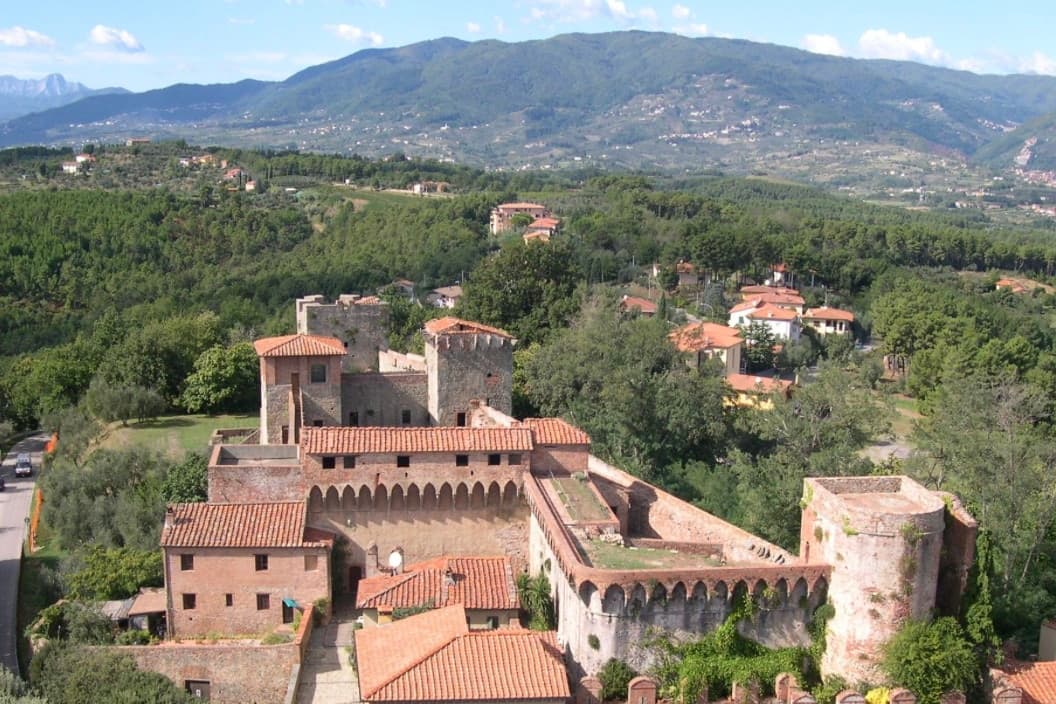
Montecarlo sits at 163 meters on an isolated hill above the Lucca plain, looking south toward the Valdinievole. Holy Roman Emperor Charles IV founded it in 1333 after liberating Lucca from Pisan rule, on a site previously called Vivinaia for the wine roads that crossed the hill.
The name Monte di Carlo, Charles's mountain, has held since. The walled centro storico is still ringed by its fourteenth-century defensive walls, with the Fortezza del Cerruglio rising above the highest point.
Wine production has been documented here since Roman times; the first tavern keepers selling Trebbiano in barrels appear in records in 1371. The Montecarlo DOC was established in 1969, the white blends Trebbiano with French varieties including Sémillon and Pinot Gris, and roughly twenty wineries operate within the commune, a notable density for a population under 4,500.
Antico Ristorante Forassiepi, Locanda Agricola Posapiano, Forassiepi have been named by a guide.
What to see in Montecarlo
- Fortezza del Cerruglio. Fourteenth-century fortress on the highest point of the hill, expanded by Castruccio Castracani and the Florentines in the fifteenth century.
- Centro storico. Walled medieval village founded by Charles IV in 1333, still inside its original defensive perimeter along Via Roma.
- Teatro dei Rassicurati. Small eighteenth-century theatre with 95 seats and a horseshoe plan, inaugurated in 1795 and still used for the autumn season.
How to get to Montecarlo
There is a railway station in the town, so you can arrive without a car and never need one while you are here. Prato is roughly 38 minutes away by road.
Our tip
April through June and September through October bracket the year here. April brings the vines into leaf, May the first whites of the new vintage onto cellar tables, and September the harvest. The Festa del Vino runs in early September on the streets inside the walls. Festa del Vino Montecarlo di Toscana falls in August.
Forte dei Marmi
Why visit Forte dei Marmi
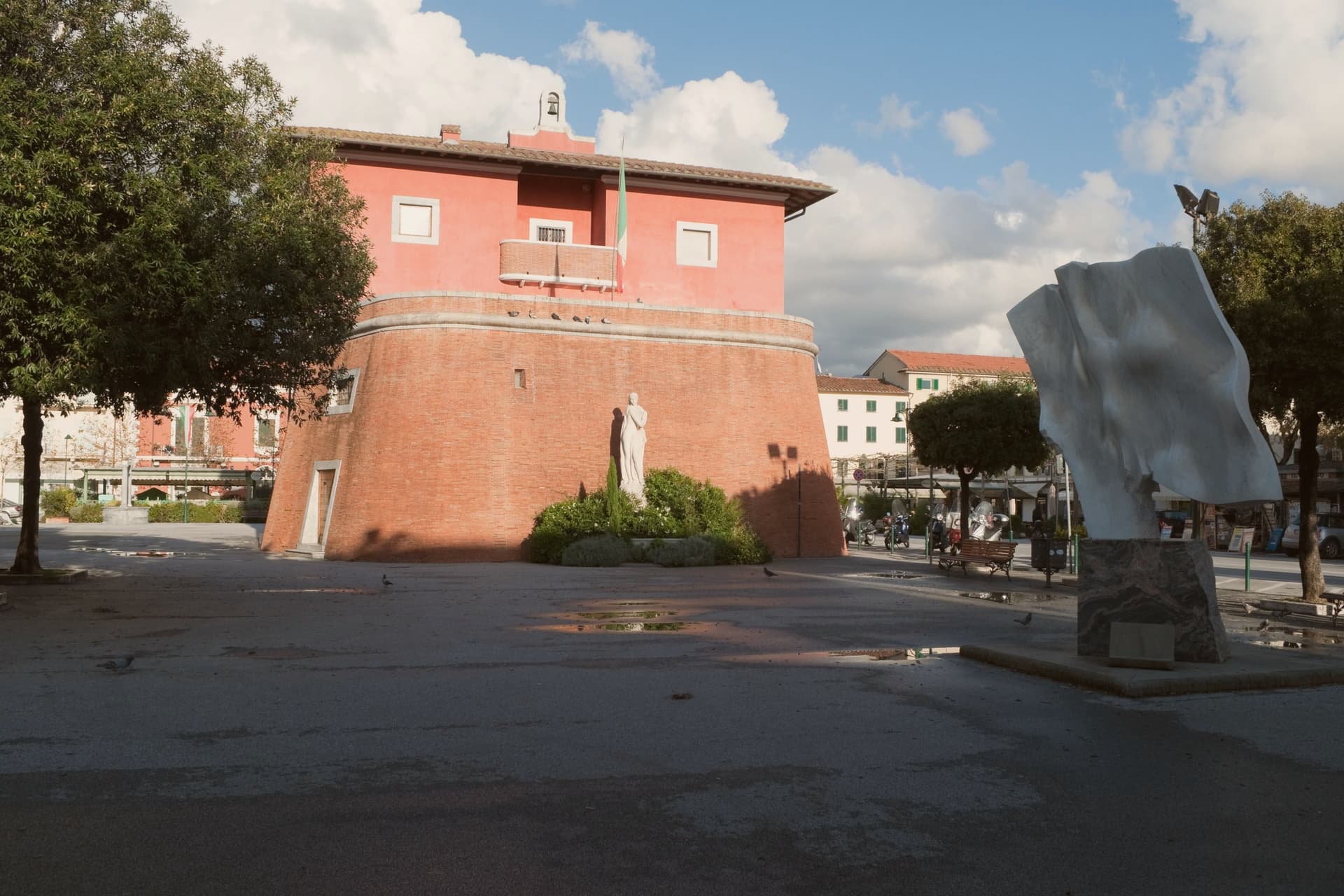
Forte dei Marmi sits at sea level on the Versilia coast, 8.9 square kilometers of flat ground between the Apuan Alps and the Ligurian Sea. The town takes its name from a small fort built in 1788 under Grand Duke Leopold to defend the coast and used through the nineteenth century to stockpile marble shipped down from the Carrara and Seravezza quarries before loading onto ships at the wooden pier.
The Pontile, built between 1867 and 1877, carried tracks and a steam crane for the marble trade and is now the central promenade landmark. The town became a Belle Époque resort in the early twentieth century, then a luxury destination from the 1960s.
Russian buyers arrived in the 1990s, the press named the seafront Piccola Russia, and by 2023 around 99 bagni concessions operate along the beach, the most prestigious cabins renting at over 20,000 euros per season.
La Magnolia, Sciabola, Bistrot and 4 more have been named by a guide.
What to see in Forte dei Marmi
- Fortino di Leopoldo. The 1788 marble-loading fortress that gave the town its name, on the central piazza, now housing the Museo della Satira e della Caricatura.
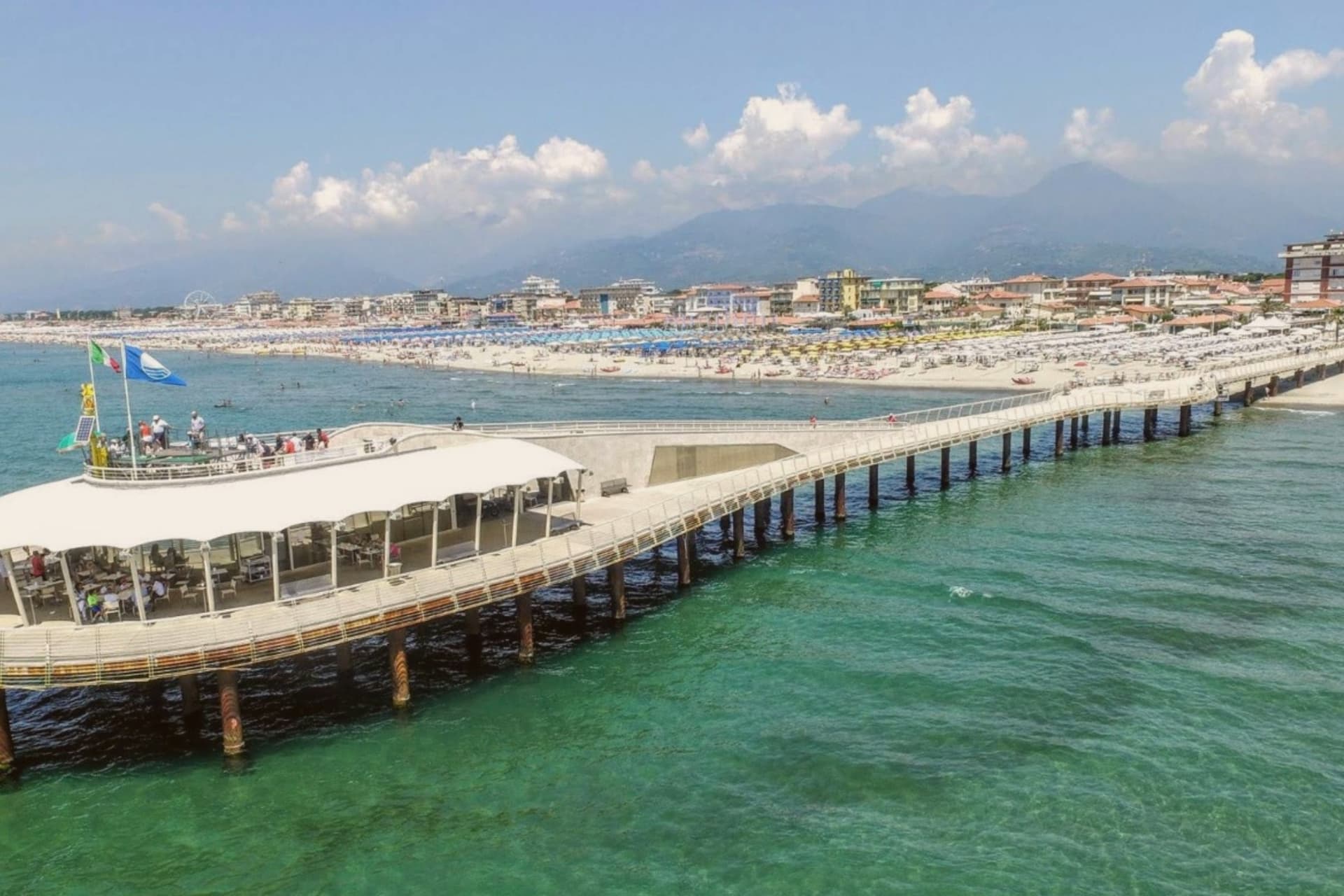
- Pontile. Wooden marble-loading pier built between 1867 and 1877, with tracks and a steam crane, now the central seafront promenade.
- Spiaggia di Forte dei Marmi. Wide Versilia Bandiera Blu beach with around 99 bagni concessions running back to the Belle Époque, fine golden sand and the Apuan Alps as backdrop.
How to get to Forte dei Marmi
Pisa is roughly 38 minutes away by road.
Our tip
May through September is the resort season. June and September give the cleanest weather and the calmest beach. July and August fill the bagni to capacity, the seafront restaurants book a month ahead, the Wednesday market gets dense, and the parking on Viale Morin disappears by ten.
Pietrasanta
Why visit Pietrasanta
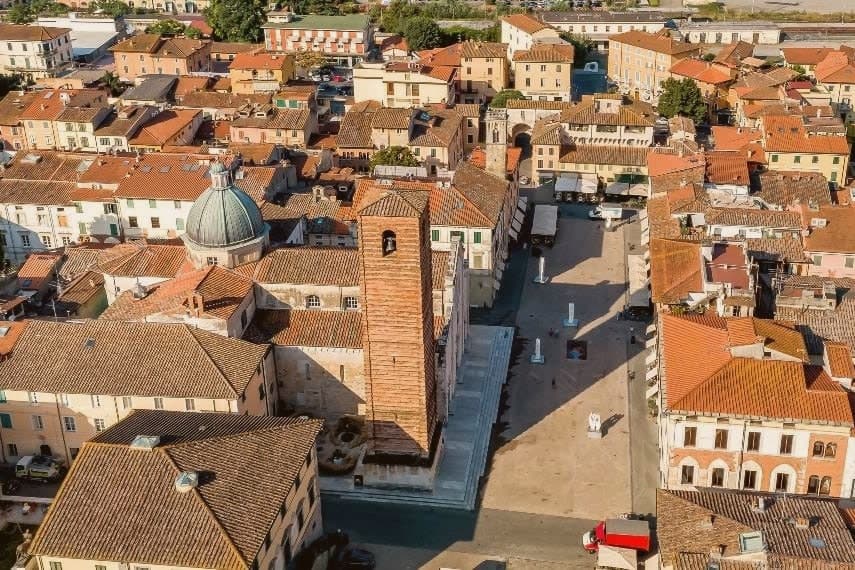
Pietrasanta sits at 14 meters at the foot of the Apuan Alps, two kilometers from the Tyrrhenian, close enough to the quarries behind it and the coast in front of it that stone and sea both shape the town. It was founded in 1255 by Luca Guiscardo da Pietrasanta on the older fortress that already stood on the hill, and it grew through the fifteenth century into the processing center for marble cut from the mountains at its back.
The centro storico, where the studi and foundries still work, sits inland; the beachfront with its pinewood park lies on the coast, a separate register of the same town, one built for stone and one for summer. Michelangelo arrived in the early 1500s to work the local stone, and Henry Moore, Joan Miró and Damien Hirst followed in the twentieth century, drawn by the same studios and foundries that cut marble for the Duomo's façade centuries earlier.
The Mariani foundry on the outskirts now casts work for sculptors who order remotely from New York and Beijing. What began as a quarry town for one church has become a place where the working of stone, not the display of it, is the thing on view.
Alex, La Martinatica, Filippo and 6 more have been named by a guide.
What to see in Pietrasanta
- Duomo di San Martino. White-marble façade on the collegiate church, first documented in 1223 and enlarged in 1330 and 1387. It faces the square that still functions as the town's civic center.
- Piazza Duomo. Main square with the Marzocco column celebrating Florence's 1513 reacquisition and a statue of Grand Duke Leopold by Vincenzo Santini.
- Museo dei Bozzetti. Civic museum holding 700 plaster models and clay sketches from sculptors who have worked in the local studios since the 1960s, a record of process rather than finished work.
How to get to Pietrasanta
There is a railway station in the town, so you can arrive without a car and never need one while you are here. Pisa is roughly 41 minutes away by road.
Our tip
May through September brings the Versilia season: Marina di Pietrasanta fills, the Versiliana festival programs concerts and theatre in the pinewood from late June, and the centro storico restaurants spread tables across Piazza Duomo. June and September are the calmer brackets. July and August push the beach to capacity and the inland piazza into evening-only rhythm. Pietrasanta Medievale a Pietrasanta falls in October.
Camaiore
Why visit Camaiore
Camaiore stretches from the Apuan Alps to the Versilia coastline, the only Versilia commune with substantial territory in both. The town center sits at 34 meters on the alluvial plain, named Campus Maior by the Romans for a military encampment on the road from Lucca to Luni.
That name and that road explain the town's shape: a fixed inland center built around the Collegiata and the medieval grid, connected by the Via Francigena to a coast six kilometers away that the Romans never had reason to build toward. The inland town and the beach at Lido di Camaiore function as two settlements under one name, joined by the road rather than by contiguous streets, with the Apuan Alps visible from the shore as the backdrop to both.
A commune this shape, mountain territory, a Roman road town, and a beach at the end of it, holds together not because its parts resemble each other but because each has stayed distinct while remaining reachable from the others.
Il Merlo, Quinto Quarto, La Dogana and 1 more have been named by a guide.
What to see in Camaiore
- Collegiata di Santa Maria Assunta. Thirteenth-century parish church with a fourteenth-century bell tower, the central religious building of the inland town.
- Badia di San Pietro. The church stands alone now, a single Romanesque nave where a monastery once stood, its stone unadorned in the way that marks the Lombard-era Benedictine houses of the region.
- Lido di Camaiore. Fine sand six kilometers from the town center, with the Apuan Alps rising directly behind it, mountain and shoreline visible in the same view.
How to get to Camaiore
There is a railway station in the town, so you can arrive without a car and never need one while you are here. Pisa is roughly 44 minutes away by road.
✷ We have written about Camaiore
“I watched eight old men stand up at once, and something in me quietly rearranged itself. They had been sitting at Caffè Celero on Piazza San Bernardino for most of an hour, maybe longer, doing what men over sixty do on an Italian piazza, which is nothing, but nothing done carefully and particularly.”
Read our piece on Camaiore →I Could Get Old Here
Our tip
May through September runs the Versilia season at the Lido and gives the inland town its share of light evenings. June and September are the quieter brackets: warm enough for the sea, cool enough to walk the Francigena stages without losing the morning. July and August fill the Lido with families from Lucca and Milan, parking gets tight, and the inland piazze stay calmer than the seafront.
Viareggio
Why visit Viareggio
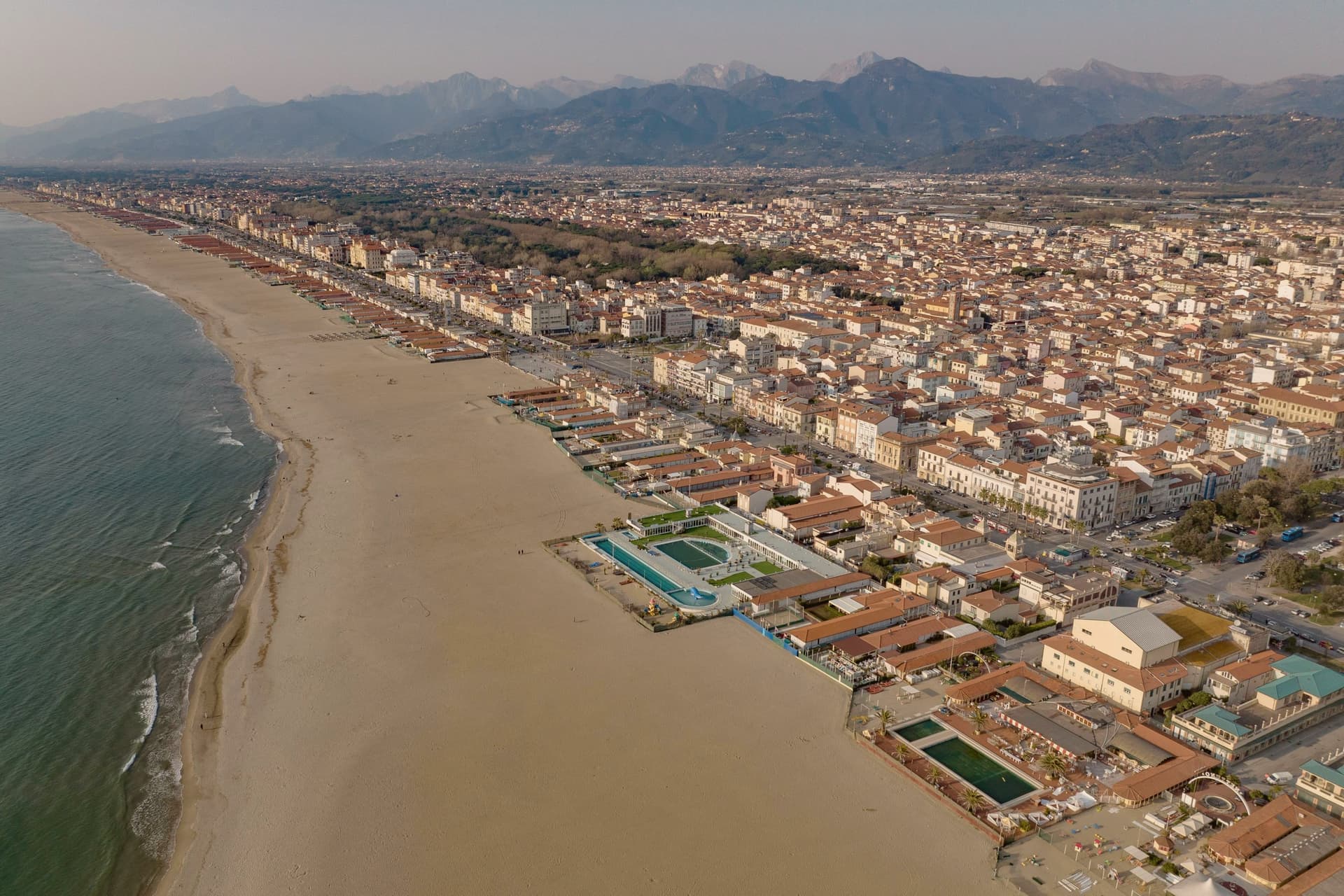
Viareggio sits at sea level on the Versilia coastal plain, the largest commune on the Tuscan riviera. The first parade ran in 1873, organized by middle-class residents as a float procession down the seafront; the masked protest against tax policy that followed gave the event its character.
The mascot's colour scheme, red and white, was taken from the beach umbrellas that line the shore, a detail that ties the Carnival's invented figure back to the town's own beach culture rather than to any outside tradition. The rail link to Lucca and Florence arrived in 1890, and the city turned into a Belle Époque resort in response: the seafront was rebuilt in the ornamented style of that era over the following decades.
The Magazzini Duilio 48 along Viale Margherita, together with the promenade's other survivors, mark out where that resort-era rebuilding is still legible today. The city's two identities sit side by side on the same stretch of shore: one built by a rail-borne resort economy, the other by a homegrown winter festival that turned into the town's defining export.
Il Piccolo Principe, Lunasia, Romano and 9 more have been named by a guide.
What to see in Viareggio
- Passeggiata Liberty. Three-kilometer Belle Époque seafront promenade lined with Stile Liberty villas, cafés and bath houses built between 1890 and 1925.
- Cittadella del Carnevale. Sixteen vast hangars where the papier-mâché floats are built year-round, with the Museo del Carnevale and the float-construction workshops open to visitors.
- Spiaggia di Viareggio. Ten-kilometer Bandiera Blu beach lined with the original bagni concessions of the Belle Époque, fine sand and shallow seabed.
How to get to Viareggio
There is a railway station in the town, so you can arrive without a car and never need one while you are here. Pisa is roughly 29 minutes away by road.
✷ We have written about Viareggio
“The bike lane starts at the bottom of Lido di Camaiore and runs south along the coast for about eight kilometers before it hits the pier at Viareggio, and the thing it teaches you, if you ride it often enough, is that Viareggio is a city you should almost always see from the saddle of a bicycle and never, if you can help it, from the pavement. The pavement has the crowd on it. The bike lane has the city.”
Read our piece on Viareggio →Viareggio | The cat at the end of the road
Our tip
May through September runs the season. June and September are calmer than the July-August peak when the beach concessions sell out and the parking on Lungomare fills by ten. February brings Carnival weekends and the largest crowds of the year for the parades along Viale Manin and Viale Margherita; the floats run through a full Sunday route.
Lucca
Why visit Lucca
Lucca sits at 19 meters on the Serchio plain, a Roman colony from 180 BC laid out in a grid still visible in the centro storico. The current walls run four kilometers around the city, twelve meters high and thirty meters wide, built between 1513 and 1645 and never breached.
They are now a tree-lined elevated promenade circling the old city, and one of the only complete Renaissance city walls left in Italy. The Piazza dell'Anfiteatro preserves the elliptical footprint of a second-century Roman amphitheater that once held ten thousand spectators; the ring of houses follows the arena's exact shape.
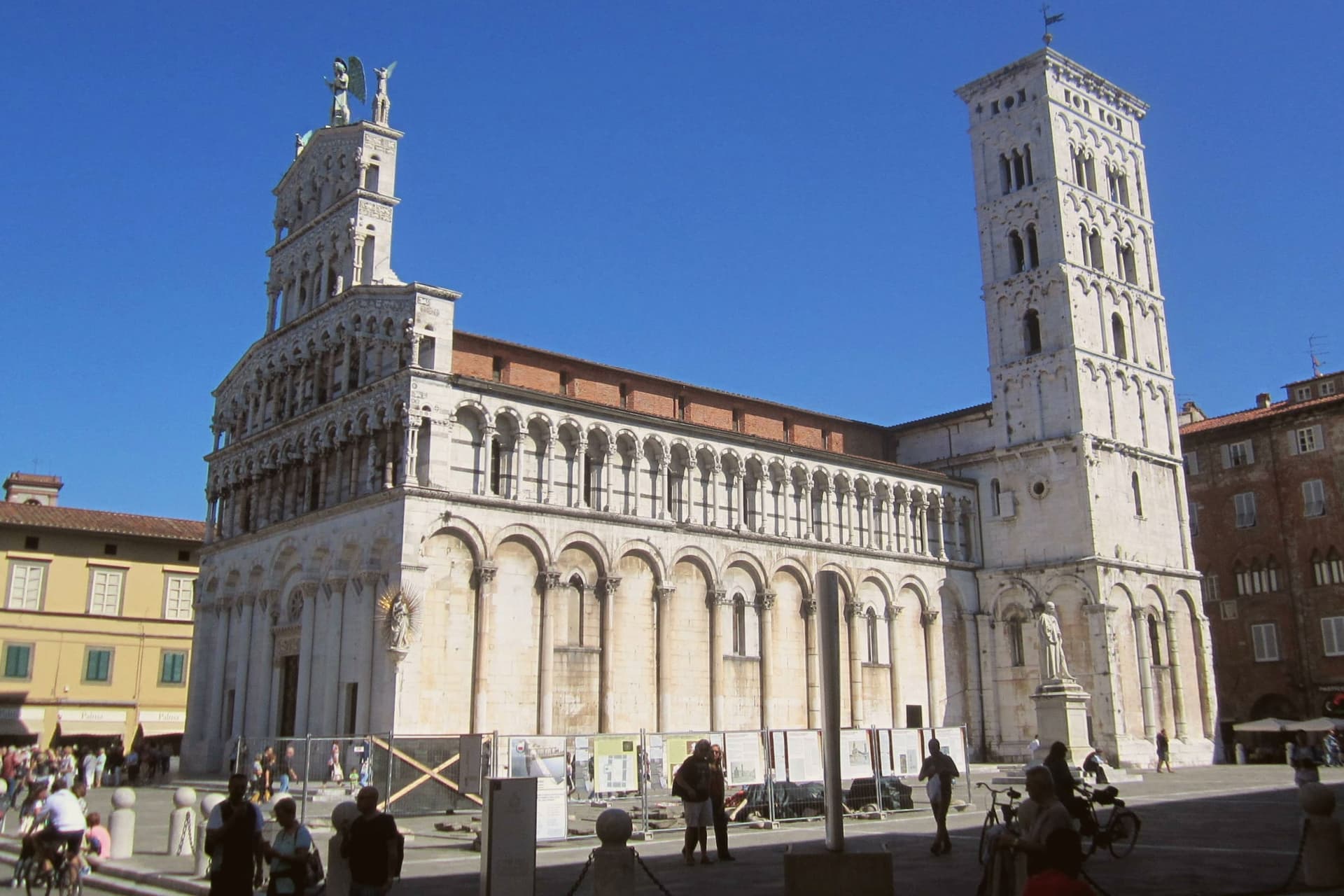
The Cattedrale di San Martino holds the Volto Santo crucifix and Jacopo della Quercia's tomb of Ilaria del Carretto. Giacomo Puccini was born here in 1858.
The town gets the Lucca Comics & Games festival every October-November, the largest comics convention in Europe at 300,000 attendees.
Antica Locanda di Sesto, Nida, All'Olivo and 8 more have been named by a guide.
What to see in Lucca
- Mura di Lucca. Four kilometers of intact sixteenth-century walls, 12 meters high and 30 meters wide, built 1513-1645, now an elevated tree-lined promenade.
- Piazza dell'Anfiteatro. Elliptical square preserving the footprint of a second-century Roman amphitheater that once seated ten thousand.
- Cattedrale di San Martino. Eleventh-century cathedral with a Romanesque-Gothic façade, the Volto Santo crucifix and Jacopo della Quercia's tomb of Ilaria del Carretto from 1406.
How to get to Lucca
There is a railway station in the town, so you can arrive without a car and never need one while you are here. Pisa is roughly 34 minutes away by road.
✷ We have written about Lucca
“We came in through Porta Santa Maria on a Tuesday afternoon in February, with the sun low and the wind off the Apuane sharp enough to flatten Sophia's coat against her, and there was nobody there. A man in a green trench was walking a dog. Two old women were having a conversation on a bench inside the wall, slowly, in dialect, with long pauses.”
Read our piece on Lucca →Lucca | The City You Cannot Photograph
Our tip
April through June and September through October bracket the year. May is the Lucca Classica music festival and the Lucca Biennale Cartasia in even years. October-November brings Lucca Comics & Games and the centro storico fills with around 300,000 attendees; book a year ahead. Rievocando Lucca falls in May.
More from Anywhere Italy
- The 8 best towns you can reach by train in the province of Lucca
 The best towns you can reach by train that have a serious restaurant within 90 minutes of Pisa
 The best towns with a serious restaurant that sit on a walking route within 90 minutes of Pisa
- The best beach towns within 90 minutes of Pisa
 The best coastal towns that eat well within 90 minutes of Pisa
- The best coastal towns within 90 minutes of Florence