
The best wine towns in the province of Perugia
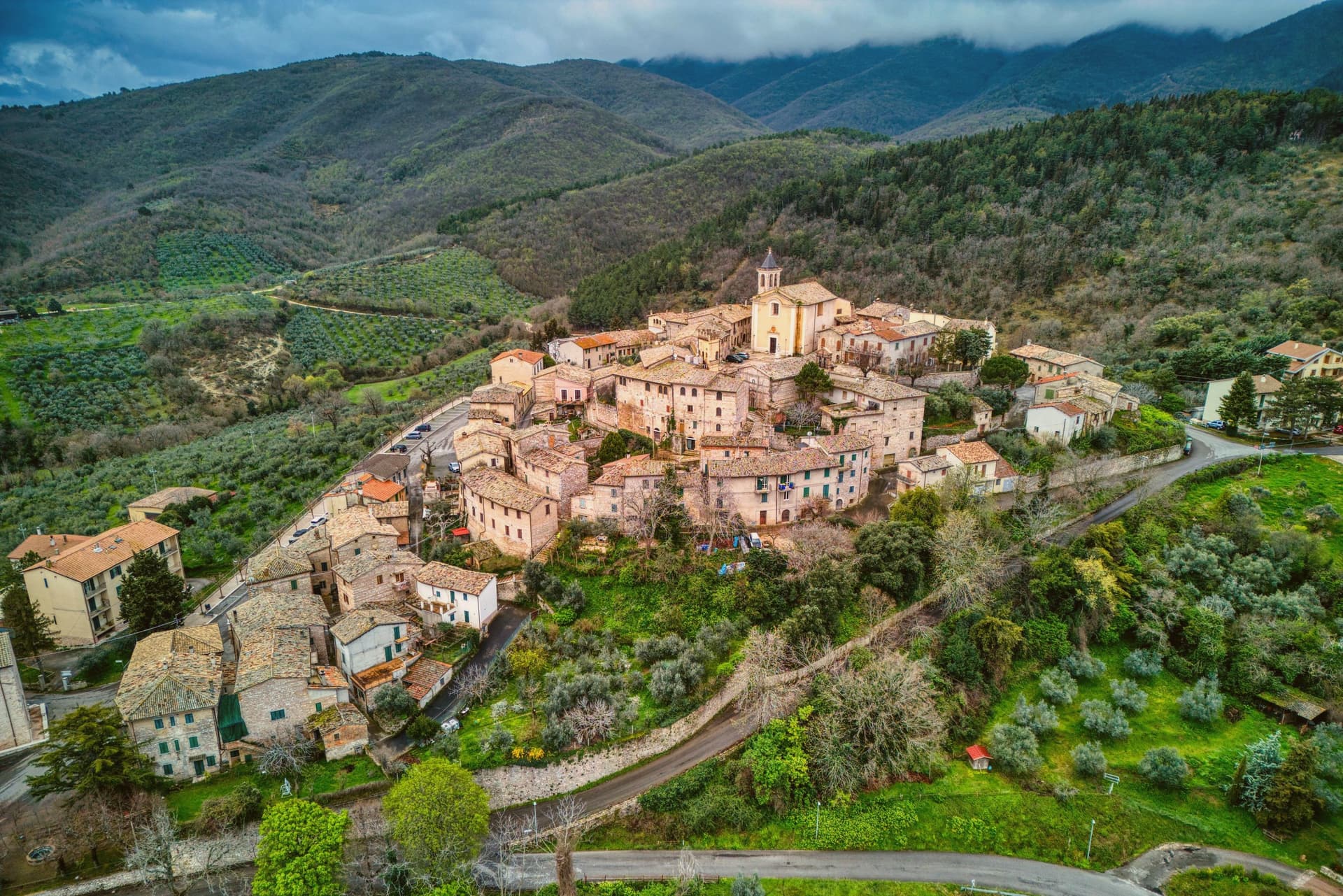
Central Umbria grows its wine on low clay hills between the Martani range and the Tiber valley, and the landscape reads as vine, olive, oak, then stone. Sagrantino is the grape that made the region's name, tannic and dark, drunk young and dry now more often than sweet, and it wants roast pigeon or a plate of strangozzi with black truffle. The towns above the vineyards are built from the same pale limestone and pink Assisi stone, with steep lanes, walls you can circle on foot, and Roman gates still doing their job. Autumn is the season most people come for, when the harvest and the olive pressing overlap and the frantoi open, but the clear cold light of February over bare vines is arguably better for looking at the hills.
Most visitors to Umbria go to Assisi and Perugia, and the reasons are good ones: the Basilica of San Francesco, the Giotto cycle, the escalators up through the medieval city to Corso Vannucci. Both are on every coach itinerary out of Rome and Florence, which means the upper town of Assisi in high summer moves at the pace of the group in front of you. Wine, in that version of Umbria, arrives as a glass on a restaurant terrace with a view, and the hills it came from stay scenery.
The vineyards are what everything looks out at, and they carry on south and east of the famous names, along the edge of the old Lacus Umber marsh and up into the Martani foothills. That is where these towns are: walled hill towns and valley-floor towns with working cantine, wine museums, and cellars you can enter without a coach in the car park. Fewer people go, and the tasting rooms are calmer for it.
Of the 37 communes we have mapped in the province of Perugia, 7 qualify as wine towns: each belongs to the national association of wine-producing towns. The smallest, Giano dell'Umbria, has 3,648 residents.
Elsewhere in the catalogue: The best olive oil towns that eat well in the province of Perugia and The 9 best wine towns that eat well within 90 minutes of Perugia.
Giano dell'Umbria
Why visit Giano dell'Umbria
Giano dell'Umbria sits at 547 meters on the eastern slope of a mountain range, inside the triangle between Foligno, Spoleto and Todi. The territory is dotted with small medieval castles, Montecchio and Morcicchia the most intact, and small Romanesque churches scattered between the olive groves.
The abbey stands just outside the walls of the capoluogo, while Montecchio, the castle, the frazione and the Antiquarium together, sits apart on its own ridge above Bastardo, closer to the Via Flaminia than to the main town. The commune is also the seat of the DOC Spoleto wine, with the Trebbiano Spoletino grape reborn here in the last decade, and the olive groves around Bastardo supply the Frantoi Aperti weekends every November.
Abbey, castle and grove read as three settlements on one slope: a religious center below the walls, a fortified outpost on the ridge, and an agricultural economy spread through the land between them.
The comune belongs to the national association of wine-producing towns.
What to see in Giano dell'Umbria
- Abbazia di San Felice. The crypt below the church is the part worth the stop, a Romanesque space set beneath the rebuilt monastery, holding the ground plan of the oratory that came before it.
- Castello di Montecchio. Fortified on the Monti Martani slope along the Via Flaminia, held by the lords of Giano from the 12th century; the walls and position over the road are still legible.
- Villa Rufione. A rural villa site between Montecchio and Bastardo, on the Via Flaminia Vetus. Nothing remains to visit on the ground; the finds are what survive, held in the Antiquarium of Montecchio.
How to get to Giano dell'Umbria
Terni is roughly 50 minutes away by road.
Our tip
April through June and September into October are the working months on the Martani slopes. The olive groves and the abbey grounds hold light well into the evening. November is the new-oil month: the Frantoi Aperti weekends open the mills, and the town fills for tastings of the just-pressed Martani oil.
Bevagna
Why visit Bevagna
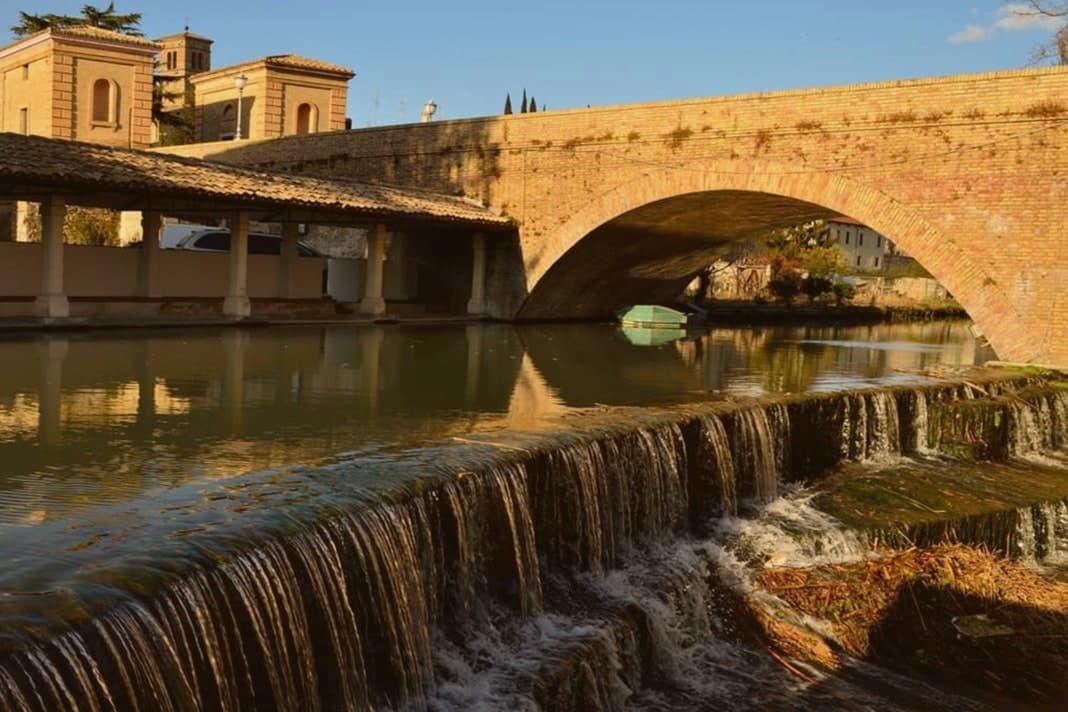
Bevagna sits on the floor of the Umbrian valley at 225 meters, where the Clitunno meets the Timia. Ancient Mevania, the name means she who stands in the middle, was a Roman mansio on the Via Flaminia, listed in the Antonine Itinerary.
A black-and-white mosaic of the 2nd century AD survives almost intact in the frigidarium of the Roman baths, twelve meters by seven, octopuses and dolphins in the center, tritons and sea-horses on the short sides. Piazza Silvestri at the heart of the centro storico holds two Romanesque churches that face each other at odd angles, San Michele Arcangelo and San Silvestro, built within years of each other in the late 12th century.
The Mercato delle Gaite each June turns the town into the year 1300 for ten days, four quarters competing on medieval trades and tavern menus, no anachronisms allowed. The Sagrantino slopes of Montefalco are nine kilometers up the road.
The comune belongs to the national association of wine-producing towns.
What to see in Bevagna
- Piazza Silvestri. Twelfth-century civic square ringed by the Palazzo dei Consoli, the churches of San Silvestro and San Michele, and the fountain of 1896.
- Chiesa di San Michele Arcangelo. Romanesque collegiate church built by Binello and Rodolfo at the end of the 12th century, on the main square.
- Chiesa di San Silvestro. Romanesque parish church across the piazza, signed and dated 1195 by Binello, the same builder as San Michele.
How to get to Bevagna
Perugia is roughly 39 minutes away by road.
Our tip
April through June and September into October are the months for Bevagna. The valley fills with green, the Sagrantino vines run on the slopes above town, and the rose festival fills the gardens around the walls in May. The Mercato delle Gaite runs the second half of June and is the single most concentrated weekend on the Umbrian medieval calendar. Sagra della Lumaca falls in August.
Montefalco
Why visit Montefalco
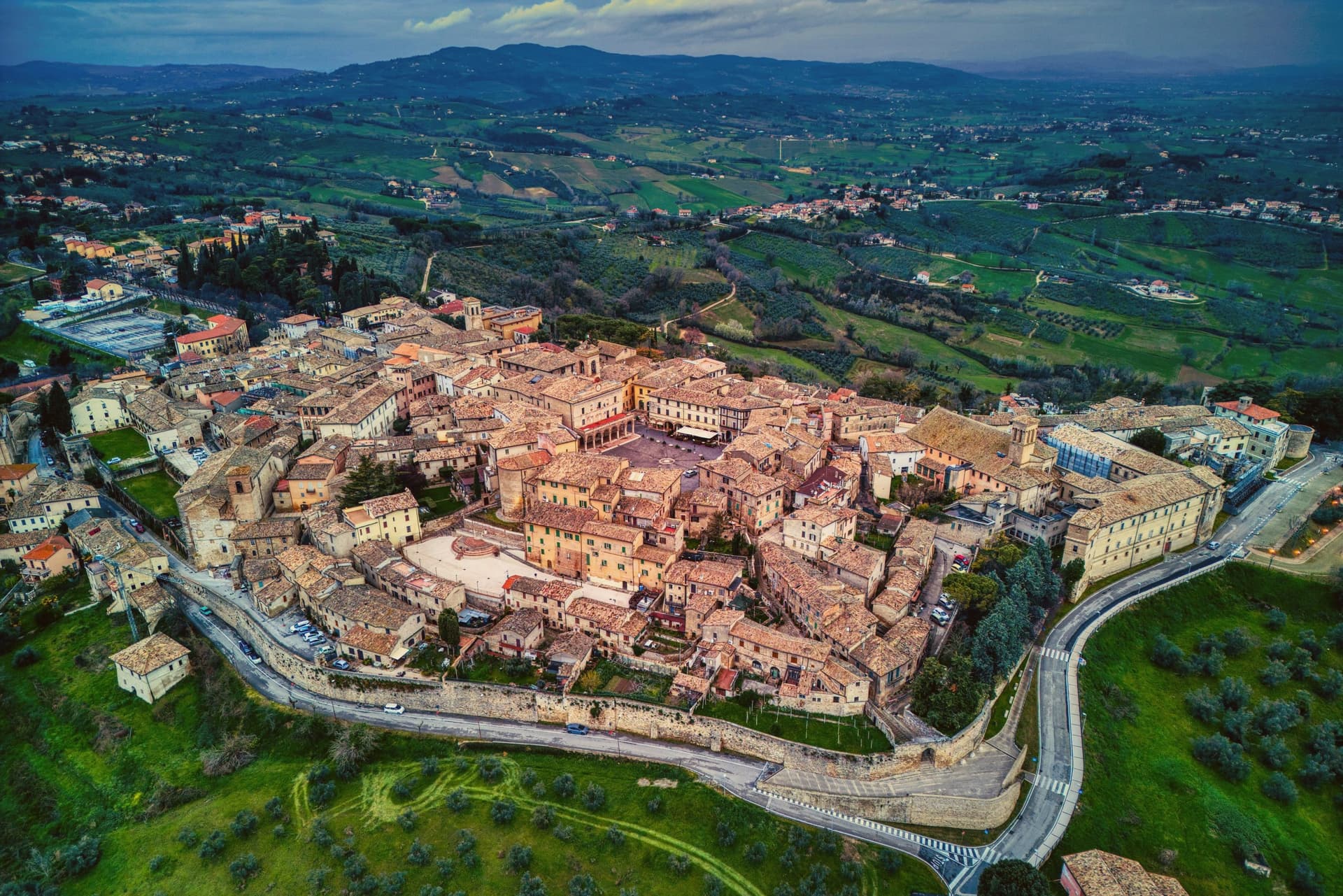
Montefalco sits on a hill above the Umbrian valley, its walls laid out in two concentric medieval circuits with five gates, the inner ring still complete and the outer ring added in the 14th century by the Trinci. At the top, the circular Piazza del Comune gathers four converging streets around the Palazzo Comunale, the high point from which the rest of the town falls away toward the walls and the vineyards beyond them.
The name Sagrantino belongs to the slopes right around those walls, where the grape has been traced back to the 1st century AD, and three of the largest producers, Caprai, Antonelli and Adanti, keep cellars within four kilometers of the centro storico. The harvest runs late September into October.
The fresco cycle Gozzoli painted in the apse of the former church of San Francesco is counted among his most complete surviving works, and the town's own name for itself, the railing of Umbria, describes the same eastern walls where the belvedere gathers seven hill towns into one view. Wine on the slopes, frescoes in the old church, a view of the valley from the walls: a hill town whose economy, art and setting all sit within walking distance of each other.
The comune belongs to the national association of wine-producing towns.
What to see in Montefalco
- Museo Civico di San Francesco. Former Franciscan church holding Benozzo Gozzoli's fresco cycle, plus works of the Umbrian school, in a building that has stood as the town's museum since deconsecration.
- Piazza del Comune. Circular medieval square at the top of the hill, ringed by the Palazzo Comunale, the Oratorio di Santa Maria di Piazza and four converging streets.
- Belvedere of Umbria. Panoramic walk on the eastern walls that takes in Perugia, Assisi, Spello, Foligno, Trevi, Spoleto and Todi from a single viewpoint.
How to get to Montefalco
Perugia is roughly 54 minutes away by road.
Our tip
April through June and September into October are the months for Montefalco. The vineyards run their full work cycle, the harvest of Sagrantino starts in the last week of September, and the railing belvedere holds the long Umbrian light. Settimana Enologica in mid-September brings producers from across the territory onto Piazza del Comune. Enologica Montefalco falls in September.
Torgiano
Why visit Torgiano
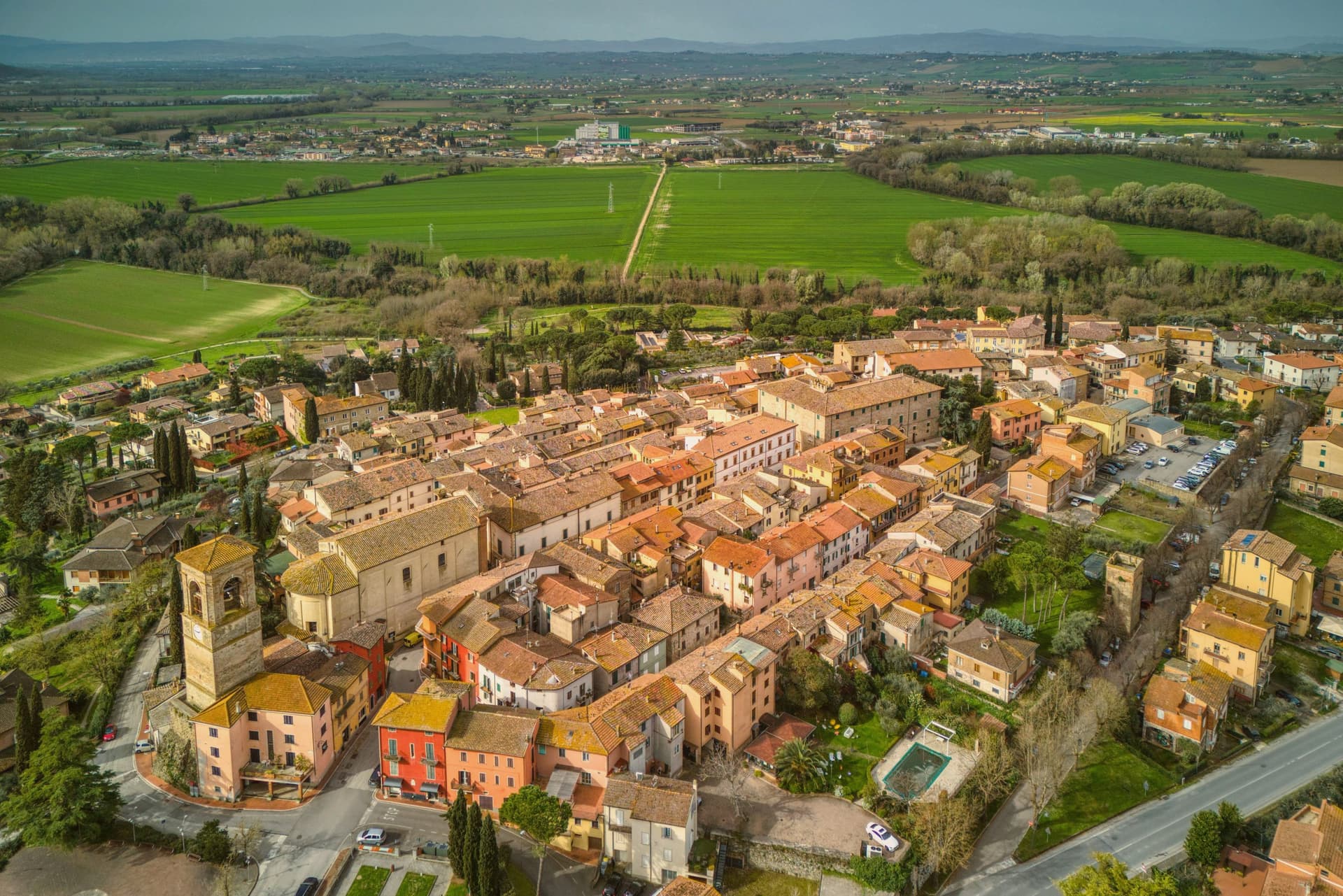
Torgiano sits at 219 meters at the point where the Chiascio joins the Tiber, ten kilometers south of Perugia. The Torre della Guardia, also called Torre Baglioni, was raised in 1274 to control the river customs traffic that moved up toward Rome from the Tiber valley.
Torgiano was the first Umbrian wine area to receive the DOC mark in 1968 and to be elevated to DOCG in 1990. Giorgio and Maria Grazia Lungarotti turned the wine economy of the town into a cultural project: the MUVIT, opened in 1974 inside the seventeenth-century Palazzo Graziani-Baglioni, holds three thousand pieces across twenty rooms documenting five thousand years of wine history.
The companion MOO, on the olive and oil, is inside a small medieval cluster within the castle walls. Both are managed by the Lungarotti Foundation.
The cantina itself, on the edge of the centro storico, has been the largest single Umbrian producer for half a century.
The comune belongs to the national association of wine-producing towns.
What to see in Torgiano
- MUVIT Museo del Vino. Wine museum opened 1974 in 17th-century Palazzo Graziani-Baglioni, with 3,000 pieces across 20 rooms covering 5,000 years of wine history.
- MOO Museo dell'Olivo e dell'Olio. Olive and oil museum in a medieval cluster within the castle walls, managed alongside MUVIT by the Lungarotti Foundation.
- Torre della Guardia (Torre Baglioni). Defensive tower raised 1274 to control the Tiber-Chiascio customs traffic, the only standing element of the original river fortifications.
How to get to Torgiano
Perugia is roughly 26 minutes away by road.
Our tip
April through June and September into October are the working months. The vineyards run their full cycle on the slopes around the confluence, and MUVIT and MOO keep regular hours. The Banco di Assaggio dei Vini d'Italia is the historical late-summer tasting that put Torgiano on the wider Italian wine map. Vinarelli - Agosto Torgianese falls in August.
Trevi
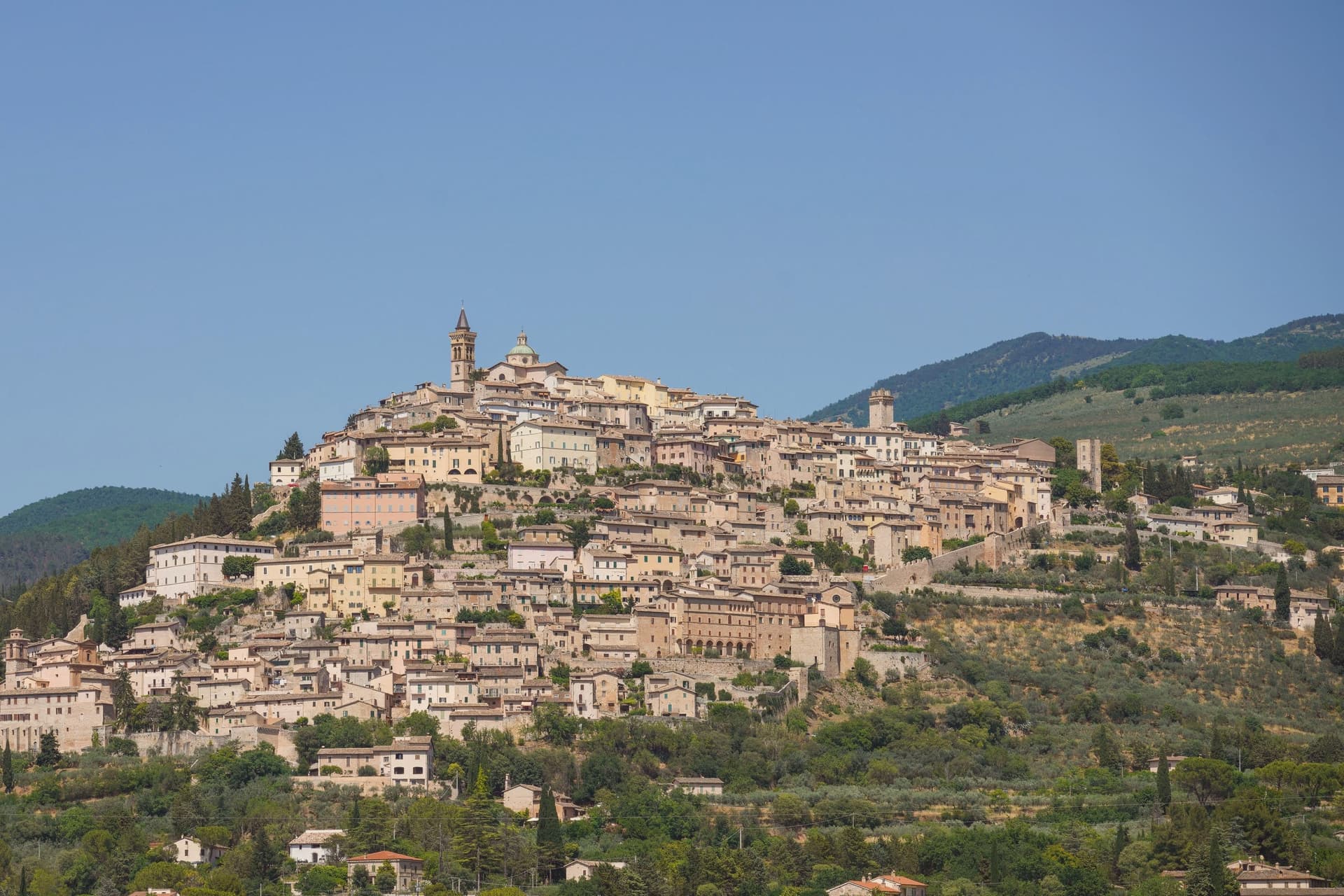
Why visit Trevi
Trevi sits at 412 meters on a conical hill above the Spoleto valley, the centro storico still inside the Roman walls of the 1st century BC. The town stood on the Via Flaminia, the consular road from Rome to the Adriatic, and grew into a Guelph commune by the 12th century.
Olive oil is what people come for. Over 200,000 trees blanket the slopes below the walls on near-ideal calcareous, well-drained soils, and the Olivo di Sant'Emiliano near the abbey of the same name is about 1,700 years old, identified with the tree the bishop of Trevi was tied to in 304 before his martyrdom.
The Santuario della Madonna delle Lacrime, built in 1487 to mark a miracle, holds a fresco by Pietro Perugino. The centro storico runs in concentric rings up the hill, each ring older than the last, with the Palazzo Comunale and the Pinacoteca holding works by Lo Spagna at the top.
The comune belongs to the national association of wine-producing towns.
What to see in Trevi
- Santuario della Madonna delle Lacrime. Built in 1487 after a Marian apparition wept tears of blood in 1485, with a fresco by Perugino in the Cappella dell'Adorazione.
- Chiesa di Sant'Emiliano. Romanesque parish church at the top of the centro storico, dedicated to the bishop martyred in 304, the patron saint of the town.
- Olivo di Sant'Emiliano. About 1,700-year-old olive tree near the eponymous church, nine meters tall, traditionally the tree to which the bishop was tied before martyrdom.
How to get to Trevi
There is a railway station in the town, so you can arrive without a car and never need one while you are here. Perugia is roughly 47 minutes away by road.
Our tip
April through June and September into October are the months for Trevi. The olive groves are in leaf or in harvest, the hill is green or silver-gold depending on the half, and the valley below holds the morning light. The Festa di Sant'Emiliano runs the last week of January with the Palio dei Terzieri, when the three quarters of the town compete.
Todi
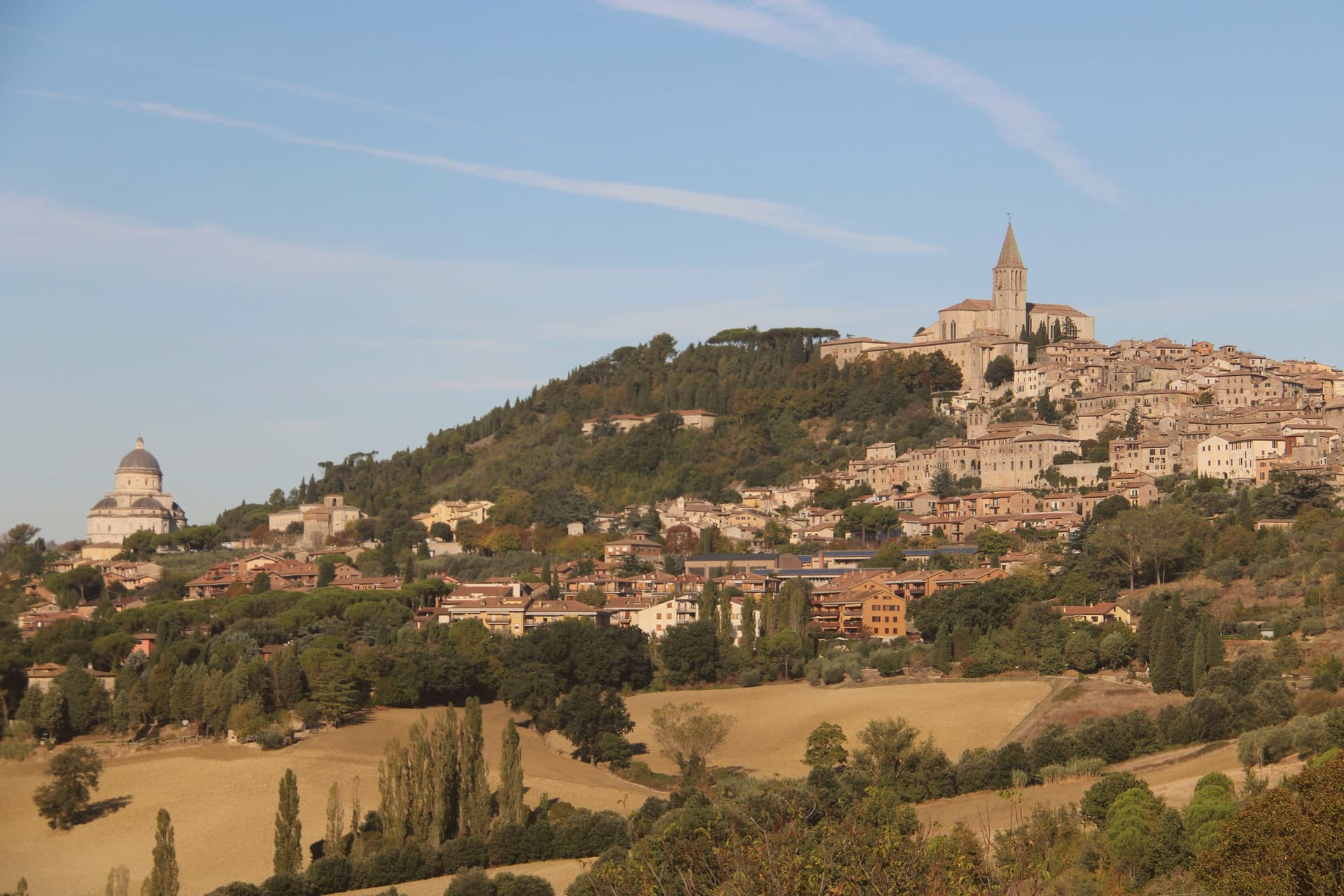
Why visit Todi
The hill the town occupies, Colle Nidoli, rises above the middle Tiber, and the settlement is built as three concentric ring walls rather than one: Etruscan and Roman courses at the base, a medieval circuit at the summit, the whole sequence readable from the hills around it. The square at the top sits directly over a Roman forum, and the cisterns cut beneath that forum still carry water and drainage for the town today, so the working infrastructure underfoot is as old as anything visible above ground.
The building on the square with the triple window keeps that window from the thirteenth century. The lower ground beyond the medieval walls holds the Roman niches, the surviving wall of a first-century BC public building, set at the foot of the town rather than within its defended core, a reminder that the settlement's Roman life extended past what the medieval walls later enclosed.
Outside the walls in the other direction stands the Renaissance temple, built over a century between 1508 and 1607, deliberately separated from the dense center it complements. Todi's layout is less a single town than a stack of settlements, Etruscan, Roman, medieval, Renaissance, each occupying its own ring or its own ground beyond the walls, none erasing what came before it.
The comune belongs to the national association of wine-producing towns.
What to see in Todi
- Piazza del Popolo. Square on the highest point of Colle Nidoli, built over Roman cisterns still in use, ringed by cathedral, Palazzo dei Priori, and Palazzo del Capitano.
- Cattedrale della Santissima Annunziata. Twelfth-century cathedral on the site of a Roman temple, north end of Piazza del Popolo, Gothic rose window and a fresco of the Last Judgment by Faenzone inside.
- Tempio di Santa Maria della Consolazione. Outside the walls rather than within the medieval fabric of the center, its dome fifty meters high, a solitary geometric mass against the surrounding hillside.
How to get to Todi
There is a railway station in the town, so you can arrive without a car and never need one while you are here. Terni is roughly 37 minutes away by road.
Our tip
April through June and September into October are the months locals prefer. The Tiber valley below stays green or gold depending on the half, and the upper terraces hold light into the evening. Todi Festival runs in late August with concerts and theater in the centro storico.
Spoleto
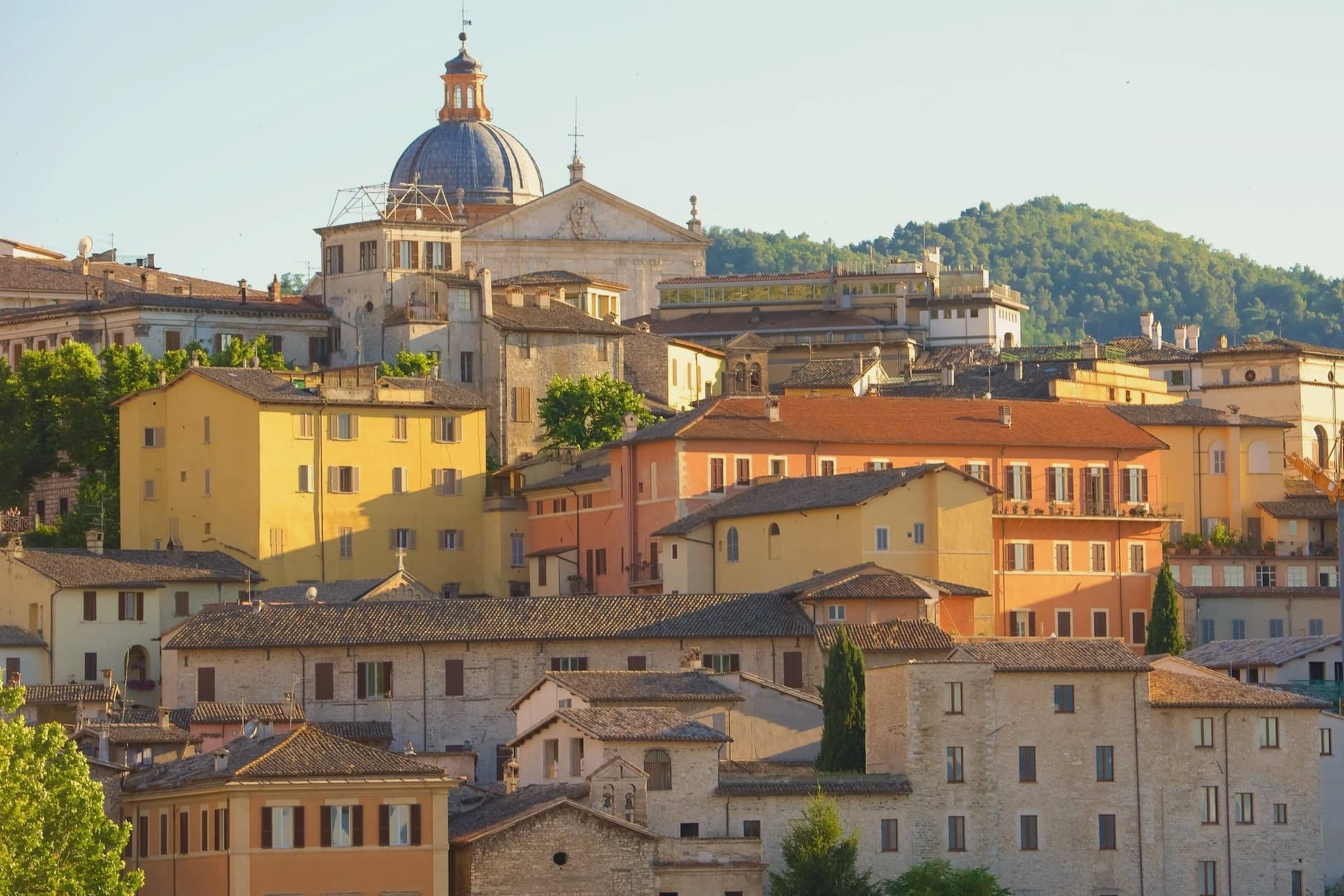
Why visit Spoleto
Spoleto sits at 396 meters at the southern edge of the Valle Umbra, the Apennines rising behind it toward Monteluco. The town was Roman Spoletium from 241 BC, then capital of one of the two great Lombard duchies of Italy from 576, controlling Umbria, Sabina, Picenum and the Pescara valley for more than five centuries.
The Rocca Albornoziana on the Colle Sant'Elia was built between 1363 and 1367 by Matteo Gattapone for Cardinal Albornoz, both a papal fortress and a residence, now the Museo Nazionale del Ducato. From the Rocca the Ponte delle Torri, 230 meters long and 80 meters high, crosses the Tessino gorge to Monteluco, an aqueduct of the 13th century built over Roman foundations.
The Duomo holds a Byzantine mosaic of 1207 across its façade and Filippo Lippi's last fresco cycle in the apse. Gian Carlo Menotti founded the Festival dei Due Mondi in 1958; the Roman theater, the Rocca courtyard and Piazza del Duomo still carry the program each year from late June into mid-July.
The comune belongs to the national association of wine-producing towns.
What to see in Spoleto
- Rocca Albornoziana. Papal fortress built 1363-1367 by Matteo Gattapone for Cardinal Albornoz, now the Museo Nazionale del Ducato di Spoleto.
- Ponte delle Torri. Aqueduct bridge 230 meters long and 80 meters high, crossing the Tessino gorge to Monteluco, 13th-14th century on Roman foundations.
- Duomo di Santa Maria Assunta. Twelfth-century Romanesque cathedral with Byzantine mosaic of 1207 on the façade, Renaissance portico, and Filippo Lippi frescoes in the apse.
How to get to Spoleto
There is a railway station in the town, so you can arrive without a car and never need one while you are here. Terni is roughly 41 minutes away by road.
Our tip
April through June and September into October are the months for Spoleto. The town opens its gardens, the Rocca courtyard fills with sun, and the long walks along the Giro dei Condotti above the Ponte delle Torri become bearable again. The Festival dei Due Mondi runs from late June into mid-July, when Spoleto doubles in population and the Roman theater carries opera into the small hours. Sagra dell'Anguilla e del Gambero di Fiume falls in August.
More from Anywhere Italy
- The best olive oil towns that eat well in the province of Perugia
 The 9 best wine towns that eat well within 90 minutes of Perugia
 The best hill towns with a serious restaurant in the province of Perugia
 The best hidden olive oil towns that eat well in Umbria
 The best hidden towns with a food festival in the province of Perugia
- The best hill towns with a food festival in the province of Perugia