
The best towns with a World Heritage site within 90 minutes of Florence
The country around Florence is stacked with the kind of building that outlasts the family that paid for it. Medici villas in pale render with hunting parks behind them, walls of golden tufo and pietra serena, hill towns whose towers were raised as a competition between neighbours and never taken down. Vineyards run up to the walls at Carmignano, olive terraces hold the slopes above the Mugello, and the thermal water in Valdinievole still comes up warm under Liberty-style pavilions. Late spring and October are the good months, when the light is long and the new oil arrives on grilled bread with salt.
The default is to stay in Florence and see the Duomo, the Uffizi and the Ponte Vecchio, then treat everything else as an afternoon coach trip. It works, and it is why the historic centre now moves at the pace of a queue. Ticket slots go weeks ahead, the bridges are shoulder to shoulder from mid-morning, and the surrounding province becomes a blur seen through a bus window on the way back.
The listing does not stop at the city boundary. The same Renaissance patronage, the same stone, the same landscape of vines and thermal springs continues out along the Arno, north into the Mugello and west towards the sea, and the towns holding those sites are small enough to walk in an hour. Fewer people go, trains and regional roads reach most of them, and lunch costs what lunch should cost.
Of the 42 communes we have mapped in a 90-minute drive of Florence, 6 qualify as towns with a World Heritage site: each holds a site UNESCO has listed. The smallest, San Gimignano, has 7,480 residents.
Two more lists worth reading alongside this one: The best towns with a World Heritage site within 90 minutes of Pisa and The best towns that eat well within an hour of Florence.
Cerreto Guidi
Why visit Cerreto Guidi
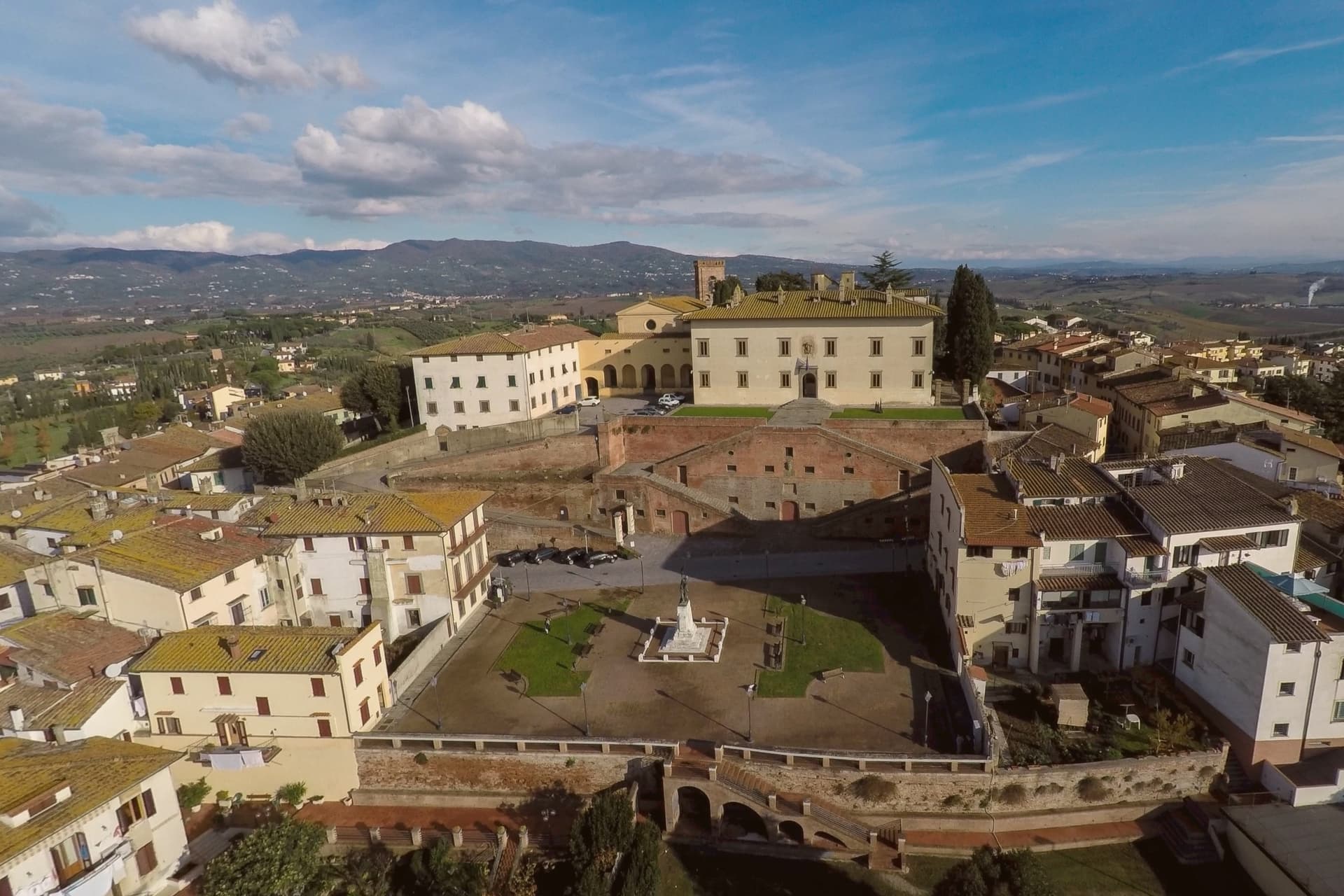
Cerreto Guidi sits at 123 meters above the Padule di Fucecchio, thirty kilometers west of Florence, on the old hunting grounds of the Counts Guidi and later the Medici. Cosimo I commissioned the Villa Medicea here between 1564 and 1567 as a hunting lodge and territorial outpost over the marsh.
The villa is mounted on a scenographic base of four symmetrical ramps of stairs, the ponti medicei, traditionally attributed to Bernardo Buontalenti, designed to raise the perspective plane and the level of the entrance. In 2013 the villa entered the UNESCO list of Medici Villas and Gardens of Tuscany along with twelve others, and it remains one of the few permanently open as a museum, housing the Museo Storico della Caccia e del Territorio since 2002.
The Via Francigena passes a few kilometers south. Isabella de' Medici, daughter of Cosimo I, was strangled in this villa by her husband Paolo Giordano Orsini in July 1576.
What to see in Cerreto Guidi
- Villa Medicea di Cerreto Guidi. Hunting villa built for Cosimo I de' Medici between 1564 and 1567, UNESCO World Heritage since 2013, holding the Museo Storico della Caccia.
- Ponti Medicei. Four symmetric ramps of stairs attributed to Buontalenti, supporting the villa above the village and forming its scenographic base.
- Museo Storico della Caccia e del Territorio. Hunting and local history museum housed in the villa since 2002, with weapons, prints and documents from the Medici hunting grounds.
How to get to Cerreto Guidi
Firenze is roughly 50 minutes away by road.
Our tip
April through June is the easiest time to walk the village and the villa garden, with the Padule di Fucecchio at its greenest. September and October dry the marsh, the harvest in the surrounding Chianti Montalbano vineyards runs through late September. July and August are hot in the lower Arno plain and the villa is the cool place to be; visitor numbers peak around mid-August. Palio del Cerro falls in September.
Barberino di Mugello
Why visit Barberino di Mugello
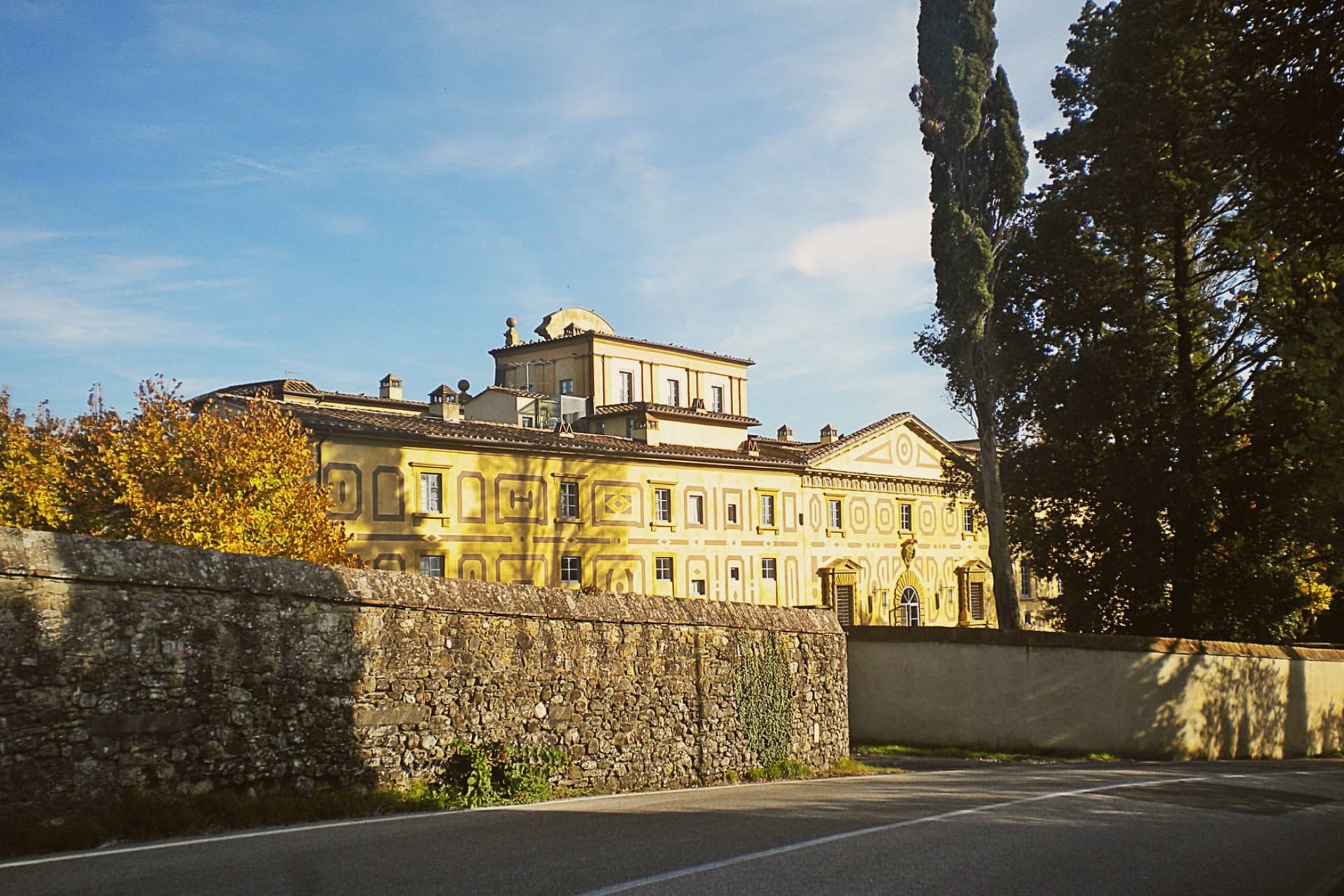
Barberino di Mugello sits at 272 meters in the upper Sieve valley, twenty-five kilometers north of Florence, the road and rail gateway from the city to the Mugello and onward to Bologna across the Apennines. The Medici family had its roots in this territory: Cosimo the Elder commissioned Michelozzo around 1451 to transform the medieval castle at Cafaggiolo into a country villa, the first in the Medici building campaign that would later run through Poggio a Caiano and Cerreto Guidi.
In 2013 Villa di Cafaggiolo and the nearby Villa del Trebbio joined eleven other Medici properties on the UNESCO list. Michelozzo's hand also shows on the fourteenth-century loggia in the main piazza of Barberino.
South of the town lies the Lago di Bilancino, an artificial reservoir completed in 1999, the largest in Tuscany at five square kilometers, built to feed the water supply of Florence, Prato and Pistoia, and now used for sailing, windsurfing and birdwatching.
What to see in Barberino di Mugello
- Villa Medicea di Cafaggiolo. Medieval castle transformed into a country villa by Michelozzo around 1451 for Cosimo the Elder, UNESCO World Heritage since 2013.
- Villa Medicea del Trebbio. Smaller medieval Medici castle on a wooded hilltop near San Piero a Sieve, also inscribed on the UNESCO list of Medici Villas in 2013.
- Lago di Bilancino. Artificial reservoir completed in 1999, five square kilometers, the largest in Tuscany, built to supply Florence, Prato and Pistoia.
How to get to Barberino di Mugello
Prato is roughly 33 minutes away by road.
Our tip
April through June brings the Mugello hills into clear green and the lake of Bilancino into its season for windsurfing and small-boat sailing. September and October are dry and gold, the harvest in the upper Sieve and the chestnut woods on the higher ridges. July and August are hot enough in the valley to drive most weekenders to the lake; the two Medici villas are cool inside year-round.
Carmignano
Why visit Carmignano
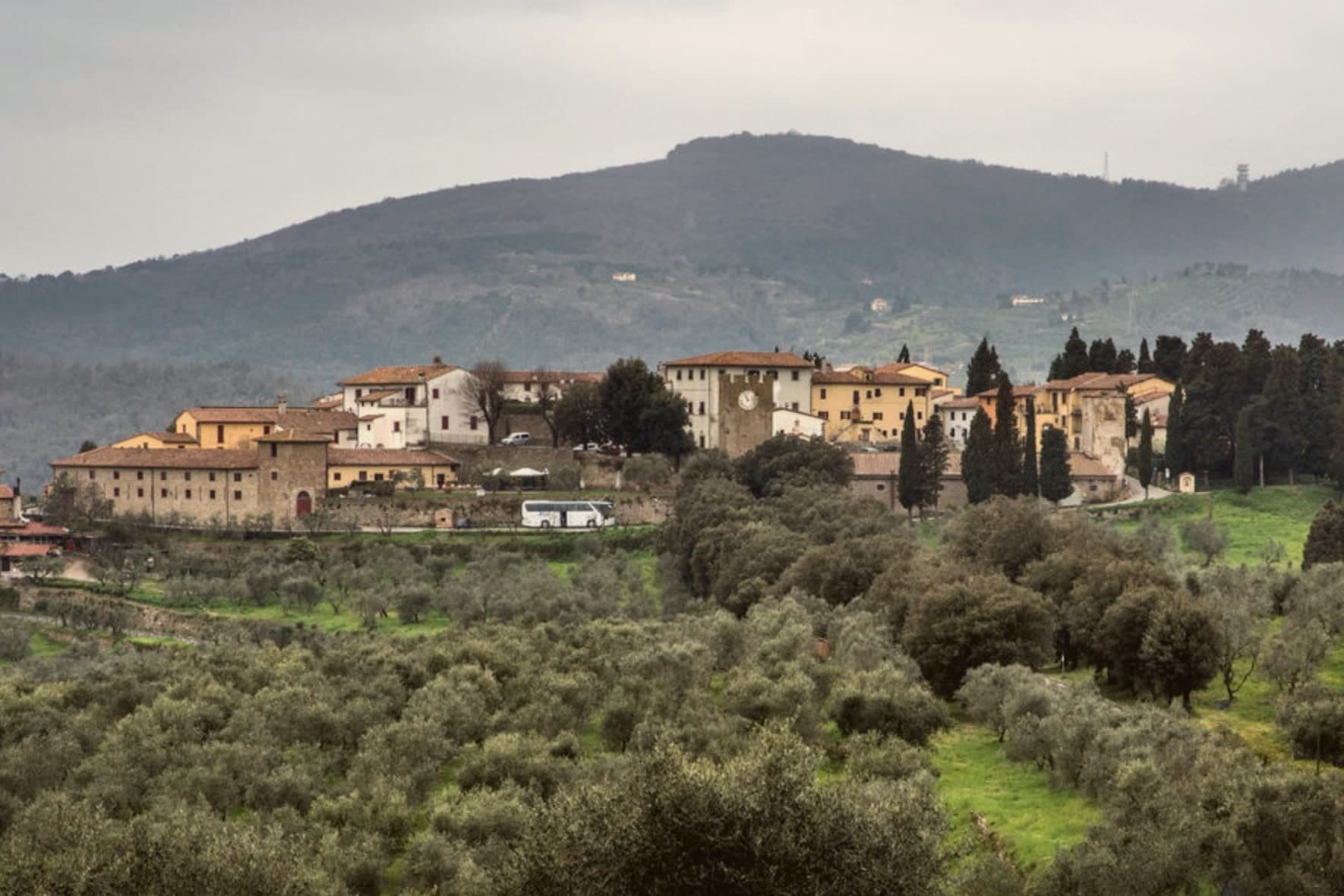
Carmignano sits at 189 meters on the Montalbano hills, twenty kilometers west of Florence and ten southwest of Prato. The commune is built from separate frazioni rather than a single center: Artimino occupies the ridge above, Comeana lies apart with its own tombs, and the town itself holds the parish church at the lower elevation.
This layout puts a Renaissance villa, a pair of seventh-century BC tombs and a working wine appellation within the same small commune without any of them sitting next to each other. The vines of the Carmignano DOCG cover the same Montalbano slopes that were occupied first by the people who built the tombs at Comeana and later by the Medici, so the landscape reads as continuous use of one hillside across the centuries rather than as separate attractions laid on top of it.
Few communes this size hold a Medici villa, a seventh-century BC necropolis and a wine appellation across three distinct frazioni, each still doing what it was built or planted for.
What to see in Carmignano
- Visitazione di Pontormo. Painted for the Pinadori family and still in place in the parish church of San Michele e San Francesco, the panel hangs where it was installed, a late Mannerist work seen in the setting it was made for rather than in a museum.
- Villa Medicea La Ferdinanda. The villa sits on the ridge above Artimino, its roofline broken by the chimneys that give it its nickname, looking out over the same slopes planted with vines below.
- Tumulo di Montefortini. Monumental Etruscan tomb at Comeana from the seventh century BC, 11 meters high and 60 in diameter, with two intact chambers visited through a corridor.
How to get to Carmignano
Prato is roughly 25 minutes away by road.
Our tip
April through June and September into October are the working months on the Montalbano: vine work in the surrounding hills, mild days, evening light over the Arno plain. Harvest runs from mid-September through October. July and August push into the low thirties and Florence twenty kilometers east bakes harder than the ridges here. Festa di San Michele a Carmignano falls in September.
San Gimignano
Why visit San Gimignano
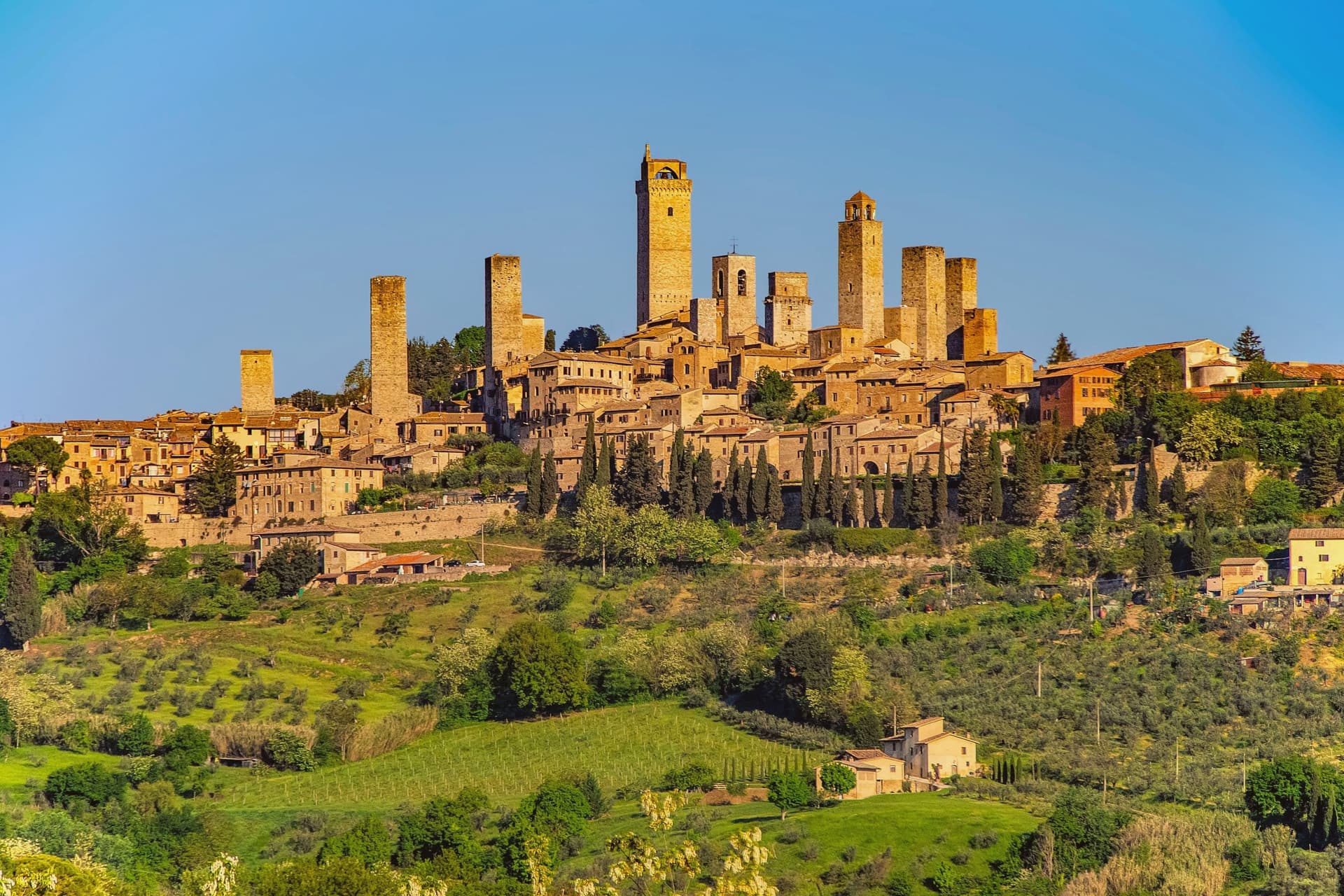
San Gimignano sits at 334 meters in the Val d'Elsa, halfway between Firenze and Siena on the medieval pilgrim road to Rome. Patrician families built 72 tower-houses in the twelfth and thirteenth centuries as proofs of wealth and platforms for vendettas; 14 still stand, the tallest being the Torre Grossa at 54 meters.
The town declared independence from the bishops of Volterra in 1199 and grew rich on saffron and Vernaccia, the white wine grown on the surrounding hills and praised since Dante. The Black Death of 1348 broke the boom; San Gimignano lost more than half its population and submitted to Florence.
That collapse is the reason the medieval skyline survived. UNESCO listed the historic centre in 1990 as a complete record of feudal architecture.
Roughly three million visitors come each year, more than 400 times the resident population, and the centro storico empties into the surrounding olive groves once the day-trippers leave.
What to see in San Gimignano
- Torre Grossa. Fifty-four meter civic tower attached to the Palazzo Comunale, the tallest of the surviving 14, open for the climb to the panoramic terrace.
- Piazza della Cisterna. Triangular medieval square paved in brick around an octagonal well of 1287, lined by tower houses and Romanesque palaces.
- Collegiata di Santa Maria Assunta. Romanesque parish church on Piazza Duomo, walls covered by Bartolo di Fredi and Lippo Memmi frescoes of Old and New Testament scenes.
How to get to San Gimignano
Firenze is roughly 61 minutes away by road.
✷ We have written about San Gimignano
“We arrived in the afternoon, into the second half of the day’s crowd. Off-season meant it was groups and guides rather than a flood, but the shops were open and doing their worst, the same garbage souvenirs, the same pasta no one local would eat, and we walked through it the way you walk through a thing you have decided not to let ruin your evening. The towers stood over all of it, indifferent, which is their whole talent.”
Read our piece on San Gimignano →San Gimignano | The Town After Seven
Our tip
April through June and September into October are the months the town is worth a full day rather than three hours. The buses still come, but late afternoon empties the piazzas and lets the towers take their light. July and August push temperatures past thirty and the centro storico becomes uncomfortable between two and six, when the stone radiates heat. Fiere delle Messi di San Gimignano falls in June.
Montecatini-Terme
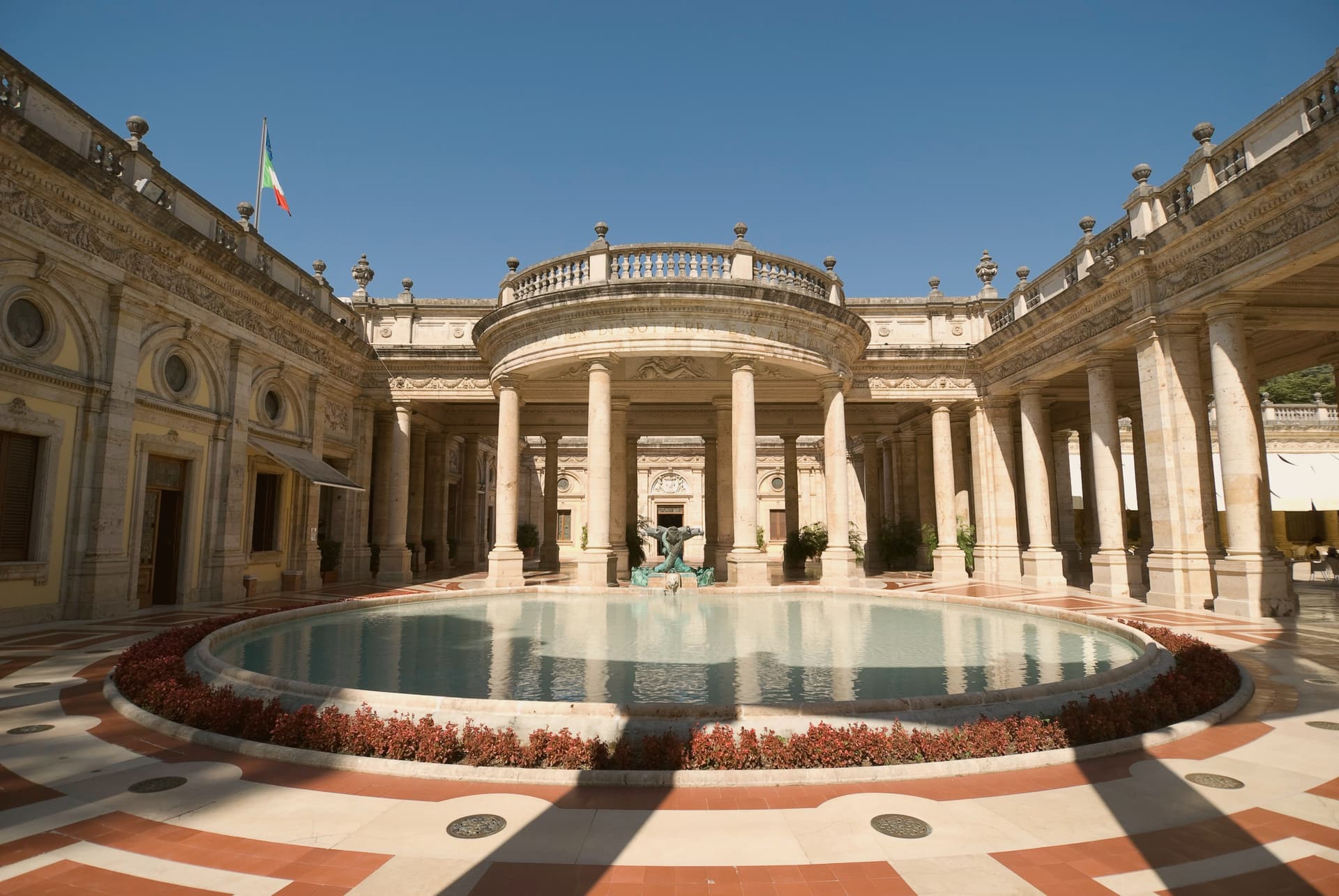
Why visit Montecatini-Terme
The spa town sits at 27 meters in the Valdinievole, forty kilometers west of Florence, at the foot of the hills that hold its older twin on the height above. That older settlement predates the town below it: the springs were exploited later, and the modern spa grew up on the flat ground beneath the hill village rather than around it.
The two remain connected by the red funicular, so a visitor moves between them in minutes rather than by road. Each of the four named waters treats a different complaint, drawn from the same eleven springs but separated by mineral content once they reach the surface.
The Thermal Park gathers the pavilions that were built to house this water cure, Liberty and neo-Renaissance architecture arranged as a single walled enclave rather than scattered through the town. In 2021 the UNESCO listing grouped the town with other spa towns built for the same purpose, Bath, Vichy, Baden-Baden and Karlovy Vary among them, recognition of a model of spa town that produced this particular layout: springs, park, pavilions, and a hill town kept deliberately apart from the cure below.
What to see in Montecatini-Terme
- Terme Tettuccio. The most famous of the thermal establishments, designed by Ugo Giovannozzi, with Liberty interiors built on the concept of the Roman baths.
- Parco Termale. Walled thermal park holding the major spa pavilions, laid out around the eleven springs that surface in the lower town.
- Funicolare di Montecatini. The two red cars carry passengers up the hill on rails laid in 1898, the ride lasting eight and a half minutes.
How to get to Montecatini-Terme
There is a railway station in the town, so you can arrive without a car and never need one while you are here. Prato is roughly 31 minutes away by road.
✷ We have written about Montecatini-Terme
“I grew up around water that smells. In Budapest, you do not think of this as a flaw. The thermal water comes up out of the ground carrying its minerals with it, iron and sulfur, and whatever else the limestone has been holding for ten thousand years, and it announces itself before you see it.”
Read our piece on Montecatini-Terme →Montecatini Terme | The Bath Without People
Our tip
The thermal park works as a year-round destination, but the seasons feel different. April through June and September through October are the comfortable months: pavilions open, hotels staffed, walking the park or the funicular pleasant. July and August are hot in the Valdinievole and busy with package tourism.
Pisa
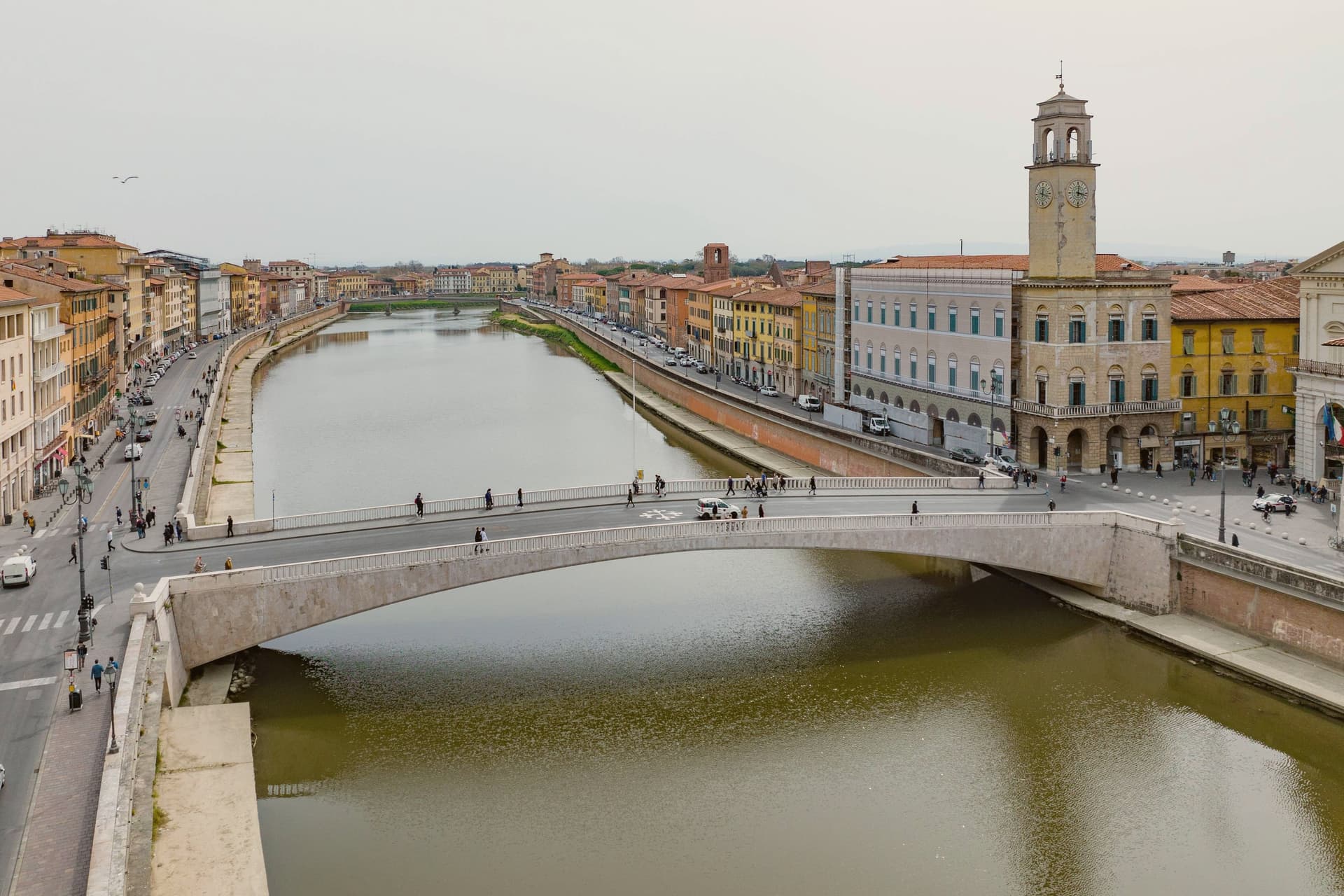
Why visit Pisa
The Arno reaches the Ligurian Sea twelve kilometers past the city, and the river is what built it: an Arsenal on its banks built galleys for the Crusades, and Mediterranean trade paid for the walled compound northwest of the centro. That compound, inscribed by UNESCO as one of the first Italian sites in 1987, gathers four buildings of the same Pisan Romanesque school in one field, the cathedral, the baptistery, the cemetery cloister and the bell tower, close enough to read as a single composition rather than a set of monuments visited separately.
The city has a second center away from that field. Piazza dei Cavalieri became the Medici political seat after the republic fell, and the university founded in 1343 keeps both squares populated with people who live and work there rather than pass through.
The Lungarni tie the two halves together physically, two quays following the river on both banks, lined with palazzi spanning the twelfth to the nineteenth century. What this adds up to is a town built in two unequal pieces: a religious and civic compound frozen at its medieval peak, and a working river city around it that never stopped adding centuries to its banks.
What to see in Pisa
- Torre Pendente. Finished 1372, two centuries after it began, the lean is visible from ground level without needing to climb it, south of vertical against the other three white buildings of the square.
- Duomo di Pisa. Pisan Romanesque cathedral begun 1064 by Buscheto, financed from the Mediterranean trade, with bronze doors by Bonanno Pisano and a pulpit by Giovanni Pisano.
- Battistero di San Giovanni. Largest baptistery in Italy at 54.86 meters tall, begun 1152, Romanesque base and Gothic upper level, with a pulpit by Nicola Pisano.
How to get to Pisa
There is a railway station in the town, so you can arrive without a car and never need one while you are here. Pisa is roughly 16 minutes away by road.
✷ We have written about Pisa
“It was a Tuesday in January, ten degrees, the kind of soft grey Tuscan winter rain that does not quite commit to being rain, and what we wanted, in a way that surprised both of us, was a bowl of Japanese noodle soup. The nearest place to get one was Pisa.”
Read our piece on Pisa →Pisa | Beyond the Tower
Our tip
May, June, September and October are the months when the Lungarni are at their best, the temperature stays in the twenties, and the lines at Piazza dei Miracoli compress by mid-afternoon. The Luminara di San Ranieri, on 16 June, lights the riverbank with eighty thousand candles and is the night the city sees most. July and August are hot and humid, with the day-tripper waves from cruise ships at Livorno filling the compound from morning. Gioco del Ponte falls in June.
More from Anywhere Italy
- The best towns with a World Heritage site within 90 minutes of Pisa
 The best towns that eat well within an hour of Florence
- The best towns with a medieval festival that hold a World Heritage site in Toscana
- The best hill towns within an hour of Florence
- The best towns with a World Heritage site within 90 minutes of Bologna
- The best wine towns within 90 minutes of Florence