
The best towns with a serious restaurant in the province of Pisa
The province of Pisa runs from a flat river plain up into hills of clay and sandstone, and the cooking follows the ground. Autumn is the season that matters most: white truffle from the woods around the Arno and the Egola, chestnut flour, wild boar cooked long with red wine, olive oil pressed in November and served on bread with nothing else. On the coastal side the vineyards of the Val di Cecina turn out reds that restaurants here pour by the glass. The towns are built of pale stone and brick, with brick towers, arcaded market halls and hillside terraces of olive trees, and the good tables are often on a side street rather than the main square.
Most people who eat well in Tuscany do it in Florence, where the guide-listed kitchens cluster and the booking window opens months ahead. There is a reason for that, and the reason is quality, but it also means set menus at high pressure, dining rooms full of people who flew in for the weekend, and prices set by a city that knows what it is worth. Chianti absorbs the overflow, with its winery restaurants and its long lunches on gravel terraces. The result is a corridor of very good food that runs on tourist rhythm rather than local ones.
The same soil, the same truffles and the same oil carry on west of that corridor, into hills that fewer people drive through. This list gathers the towns of the Pisan province where a kitchen listed by the strictest of the dining guides works close to where its ingredients come from, from the truffle market town on the Arno to the alabaster ridge above the Val di Cecina, with a thermal village and a walled hill town on the way. They are small enough that lunch and the afternoon walk belong to the same afternoon.
Of the 10 communes we have mapped in the province of Pisa, 6 qualify as towns with a serious restaurant: each holds a restaurant listed by the most demanding of the dining guides. The smallest, Montescudaio, has 2,144 residents.
Elsewhere in the catalogue: The best towns you can reach by train that have a serious restaurant within 90 minutes of Pisa and The best hill towns in the province of Pisa.
Montescudaio
Why visit Montescudaio
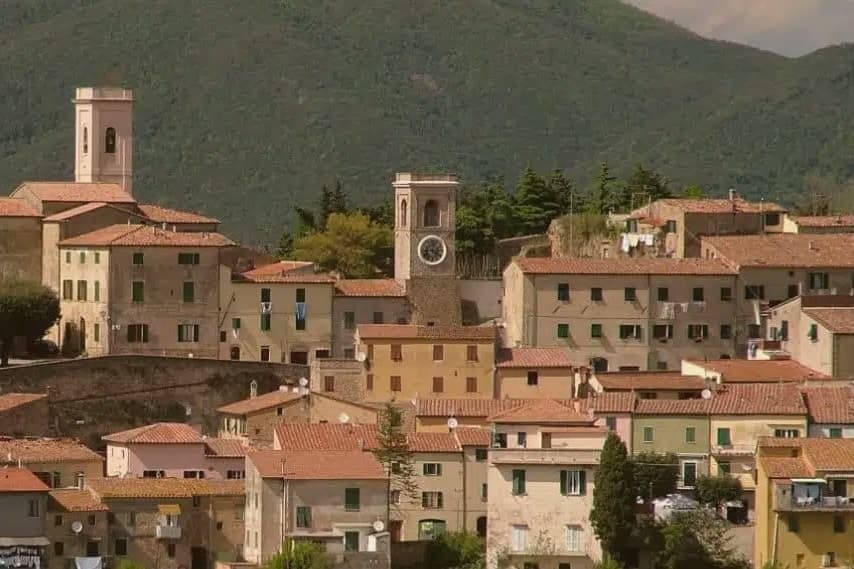
Montescudaio sits fifteen kilometers inland from the Tyrrhenian coast, on a hill above the valley the Cecina river cuts toward the sea. Fewer than 2,200 people live in the commune, and most of them are outside the centro storico, which is left as a tight knot of stone houses ringed by its old walls: a single church, the clock tower, and the terrace where the vines drop downhill toward the Val di Cecina and the water beyond.
The town carries four institutional signals at once, an unusual density for its size: a registered wine appellation, a bread-network membership rare in this part of Tuscany, a name that predates the medieval walls, and the walls themselves built around an eleventh-century abbey. Wine and bread are both grown and baked around the same hilltop that once needed fortifying.
The fortress, the loaf, and the vineyard are not three separate stories here but three uses of the same ground, worked over centuries after the shields it was named for stopped being necessary.
SaQua - Ristorante in Collina have been named by a guide.
What to see in Montescudaio
- Centro storico. Walled medieval village, a tight ring of stone houses on the hilltop, built around the abbey that gave the settlement its first walls and structure.
- Torre Civica. Clock tower at the entrance to the borgo, the tallest visible structure and former civic landmark of the fortified village.
- Chiesa di Santa Maria Assunta. Eleventh-century parish church on the site of the medieval abbey, the anchor around which the walled village took shape.
How to get to Montescudaio
Livorno is roughly 44 minutes away by road.
Our tip
May through September is the season on the Cecina hills: dry days, vine work, harvest from late August through September. The coast lies fifteen kilometers west and the sea breeze keeps evening temperatures lower than the inland Maremma. July and August bring crowds to the beaches at Cecina and Marina di Bibbona, but the borgo on the hill stays quieter. Festa del Vino di Montescudaio falls in October.
Vicopisano
Why visit Vicopisano
Vicopisano sits at the foot of Monte Pisano where the plain of the Arno meets the hills, twenty kilometers east of Pisa. The town was a Pisan river port on the old course of the Arno until the river shifted south in the sixteenth century, leaving the walls inland.
Florence captured the town in 1407, which is what brought Brunelleschi and his engineering to a place that had until then belonged to Pisa's river trade rather than to Florentine territory. The fortress and its covered passage sit above the older watchtower and the parish church, all reachable by the lanes that climb from the walls toward the ridge of Monte Pisano.
The hills above carry the olive groves that earned the town its Città dell'Olio listing, so the same slope that gave Brunelleschi high ground to defend also gives the town its oil. What the plain lost when the Arno shifted, the hillside above supplied instead: first a port town, then a fortified inland one, and finally an agricultural one.
Osteria Vecchia Noce have been named by a guide.
What to see in Vicopisano
- Rocca del Brunelleschi. Restored fortress open to visitors, built on the slope where the walls back onto Monte Pisano.
- Torre delle Quattro Porte. Twelfth-century watchtower with four arched gates, reinforced rather than built during the Brunelleschi works, the architectural symbol of the medieval town.
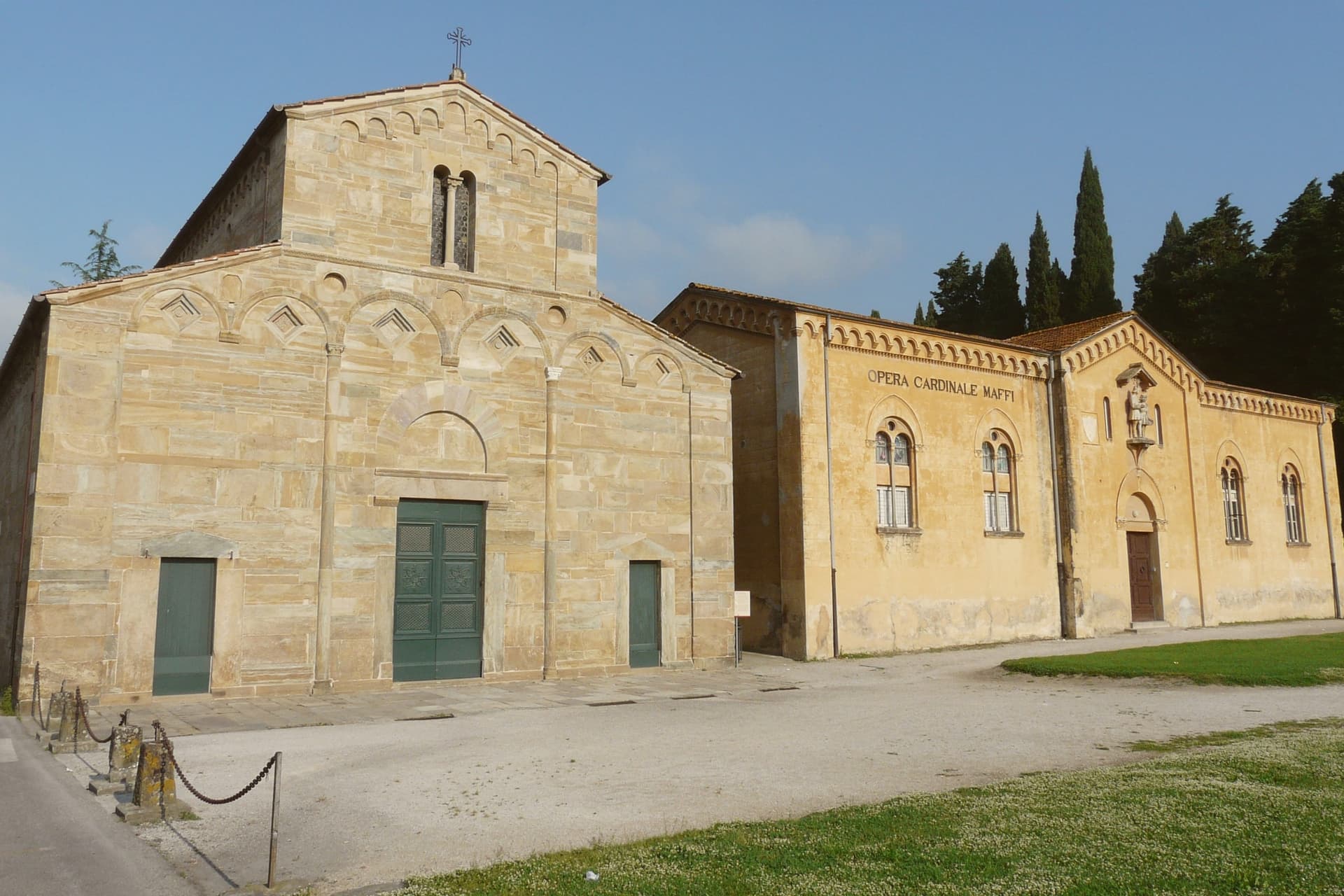
- Pieve di Santa Maria. Eleventh-century Romanesque parish church holding a wooden Deposition group carved around 1200, the second oldest such carving in Italy.
How to get to Vicopisano
There is a railway station in the town, so you can arrive without a car and never need one while you are here. Pisa is roughly 33 minutes away by road.
Our tip
April through June is dry and green, with the Monte Pisano olive groves at their best. September and October are the second window, cool mornings and the start of the harvest. The Festa Medievale runs the first weekend of September, three days of jousts and costumed processions inside the Brunelleschi walls. Festa Medievale falls in September.
Volterra
Why visit Volterra
Volterra sits at 531 meters on a long ridge between the Era and Cecina valleys, one of the twelve cities of the Etruscan dodecapolis and the only one still occupied on its original ground. The Etruscans called it Velathri, the Romans Volaterrae; the Porta all'Arco, with three blackened tufa heads of unknown deities, has been the western gate of the town since the fourth century BC.
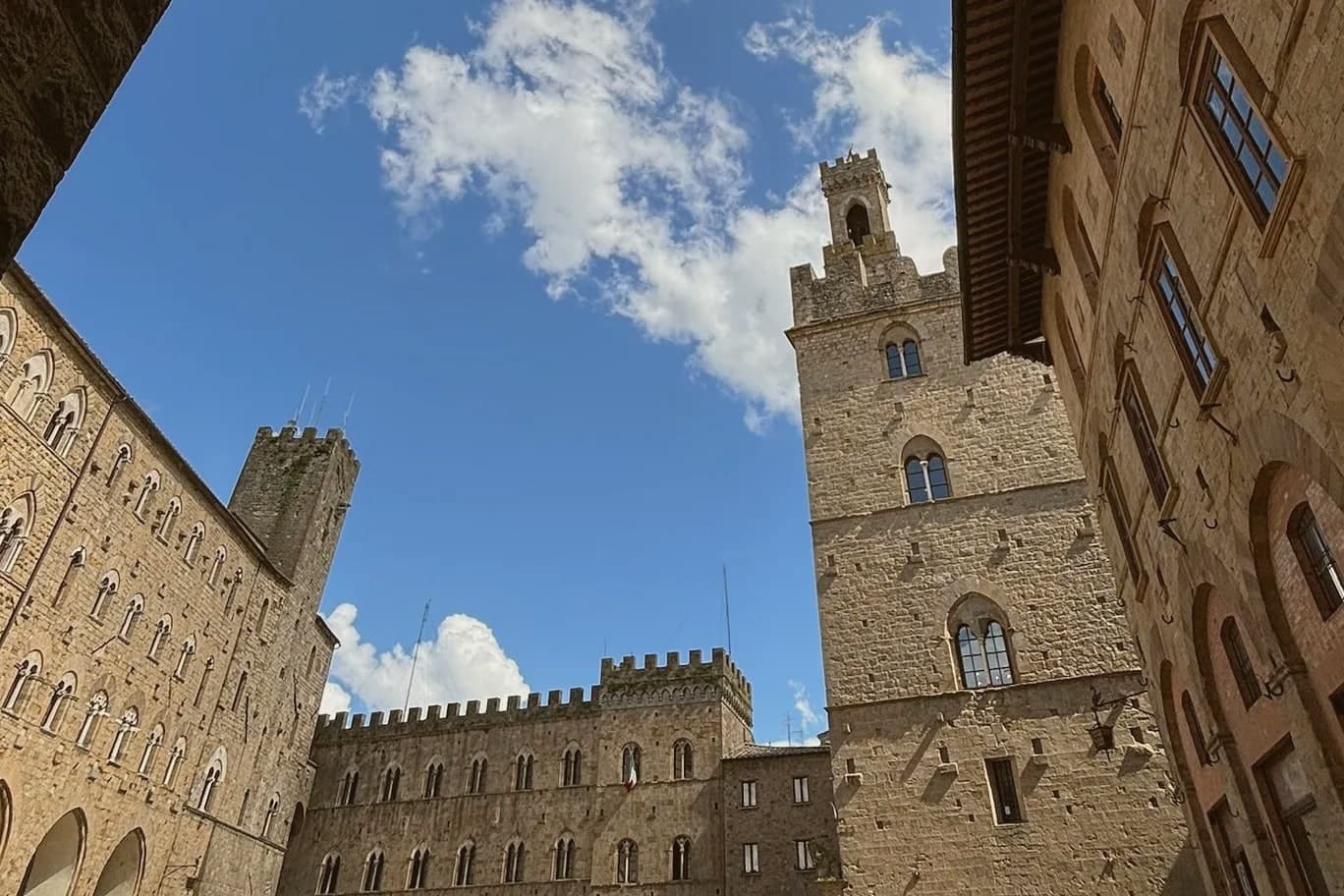
The Roman theater below the walls, excavated in the 1950s, holds two complete rows of columns and the bath complex behind the stage. Above stands the Palazzo dei Priori, begun in 1208 and the oldest town hall in Tuscany, the model for Florence's Palazzo Vecchio.
The town has been carving alabaster since the Etruscans, who used it for funerary urns; the same workshops on Via Porta all'Arco still cut and polish the soft white stone today. Le Balze, the eroded clay cliffs west of town, swallow a few meters of churchyard every century.
Villa Pignano, Enoteca Del Duca have been named by a guide.
What to see in Volterra
- Porta all'Arco. Etruscan city gate from the fourth century BC, with three eroded tufa heads of unknown deities set above the arch.
- Teatro Romano. First-century BC Roman theater excavated in the 1950s, with two complete rows of columns and the bath complex behind the stage.
- Palazzo dei Priori. Begun in 1208, the oldest town hall in Tuscany, the architectural model for Florence's Palazzo Vecchio.
How to get to Volterra
Livorno is roughly 83 minutes away by road.
Our tip
April through June brings the surrounding clay hills green and the temperatures bearable on the exposed ridge. September and October are the second window, with the white truffle harvest peaking at Volterragusto in late October. July and August are hot and bright at altitude; the town fills with Italian and foreign visitors, and the Etruscan urns at the Guarnacci feel cool by comparison. Mostra Mercato del Tartufo Marzuolo falls in April.
San Miniato
Why visit San Miniato
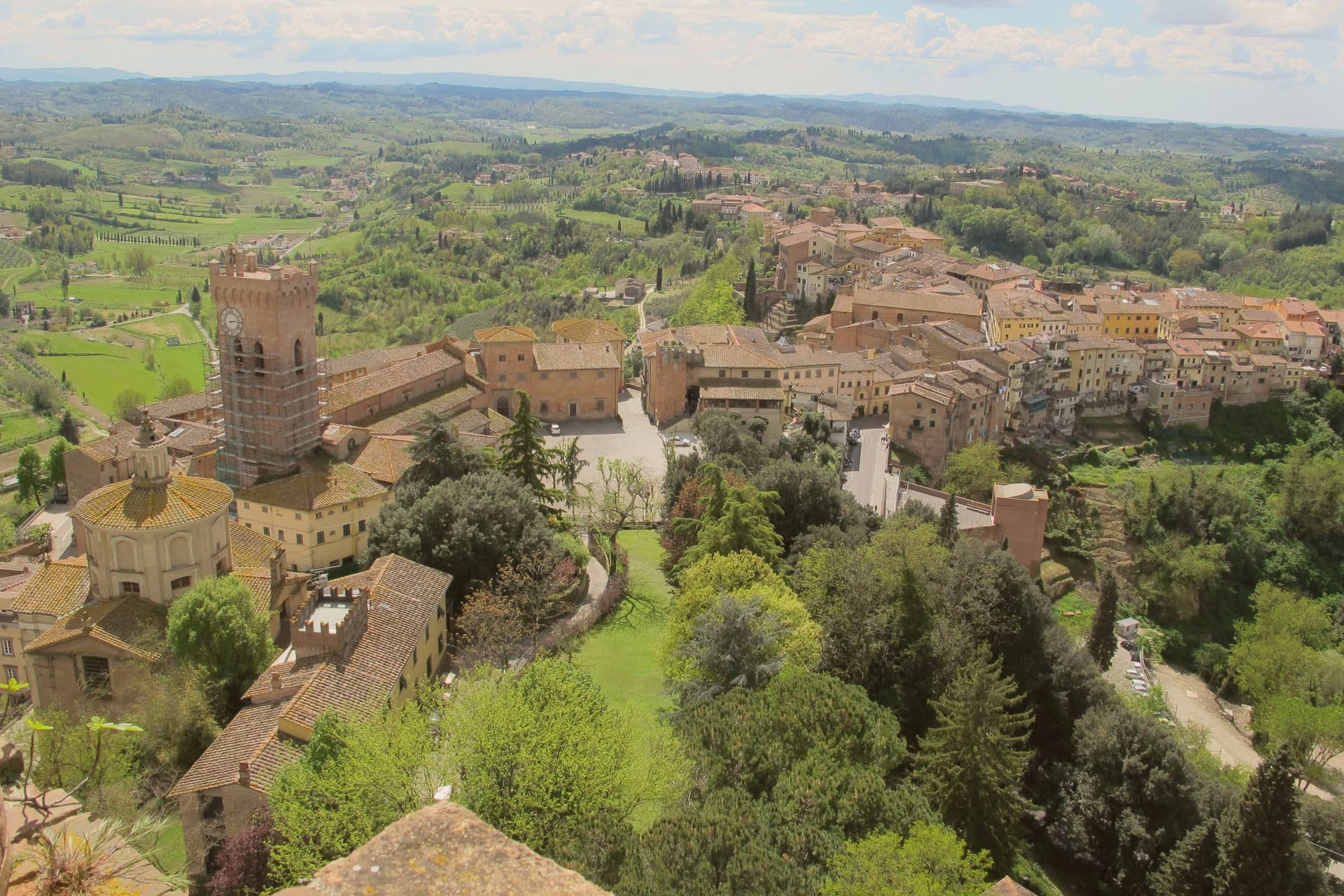
San Miniato runs along three hills at 150 meters above the lower Arno, halfway between Pisa and Florence. In 962, Otto I of Saxony made it one of the seats of imperial administration in central Italy; in 1218 Frederick II turned it into a tax collection point, and the brick tower he built between 1217 and 1223 still rises above the town, rebuilt in 1958 after the retreating Germans mined it in 1944.
The Via Francigena passes through. The Duomo, dedicated to Sant'Assunta and Santo Genesio, holds the asymmetrical clock tower called the Matilde.
What the town is mainly known for today comes from the woods around it. San Miniato produces roughly a quarter of Tuscany's white truffles, including a tuber of over two kilos found in 1954.
The National White Truffle Exhibition, running through the last three weekends of November, has been held in Piazza del Duomo since 1969.
Papaveri e Papere, Pepenero, Antico Ristoro Le Colombaie and 1 more have been named by a guide.
What to see in San Miniato
- Rocca di Federico II. Thirty-meter brick tower built by Frederick II between 1217 and 1223, destroyed by retreating Germans in 1944 and rebuilt in 1958.
- Duomo di Santa Maria Assunta e San Genesio. Originally Romanesque cathedral with Gothic and Renaissance additions, dedicated to two patrons, with the asymmetrical Matilde clock tower as campanile.
- Palazzo dei Vicari dell'Imperatore. Medieval palace of the imperial vicars who governed San Miniato when it was an imperial administrative seat.
How to get to San Miniato
There is a railway station in the town, so you can arrive without a car and never need one while you are here. Pisa is roughly 49 minutes away by road.
✷ We have written about San Miniato
“And then time passed, which is the part the town doesn’t tell you about, because the town only sees you on the day. The jars sat in the cupboard. We are not people who keep proper white truffle at home; almost nobody is. But we do buy black truffle now and then, and we don’t buy it on a hill behind a closed road. We buy it from a man named Marco who runs a food truck in a supermarket parking lot down on the Marina near us. He digs some of it himself and sells the rest for the farmers around him, and there is no shuttle bus.”
Read our piece on San Miniato →San Miniato | The Truffle I Couldn’t Taste
Our tip
April through June brings the long Tuscan spring, mild on the ridge with views clear to the Apennines. September and October are dry and gold, the same colors painters come for. November is the truffle month: the National White Truffle Exhibition fills Piazza del Duomo across three weekends, hotel rates double, restaurants book out weeks ahead. Fiera Mercato del Tartufo Bianco di Corazzano falls in the season.
San Giuliano Terme
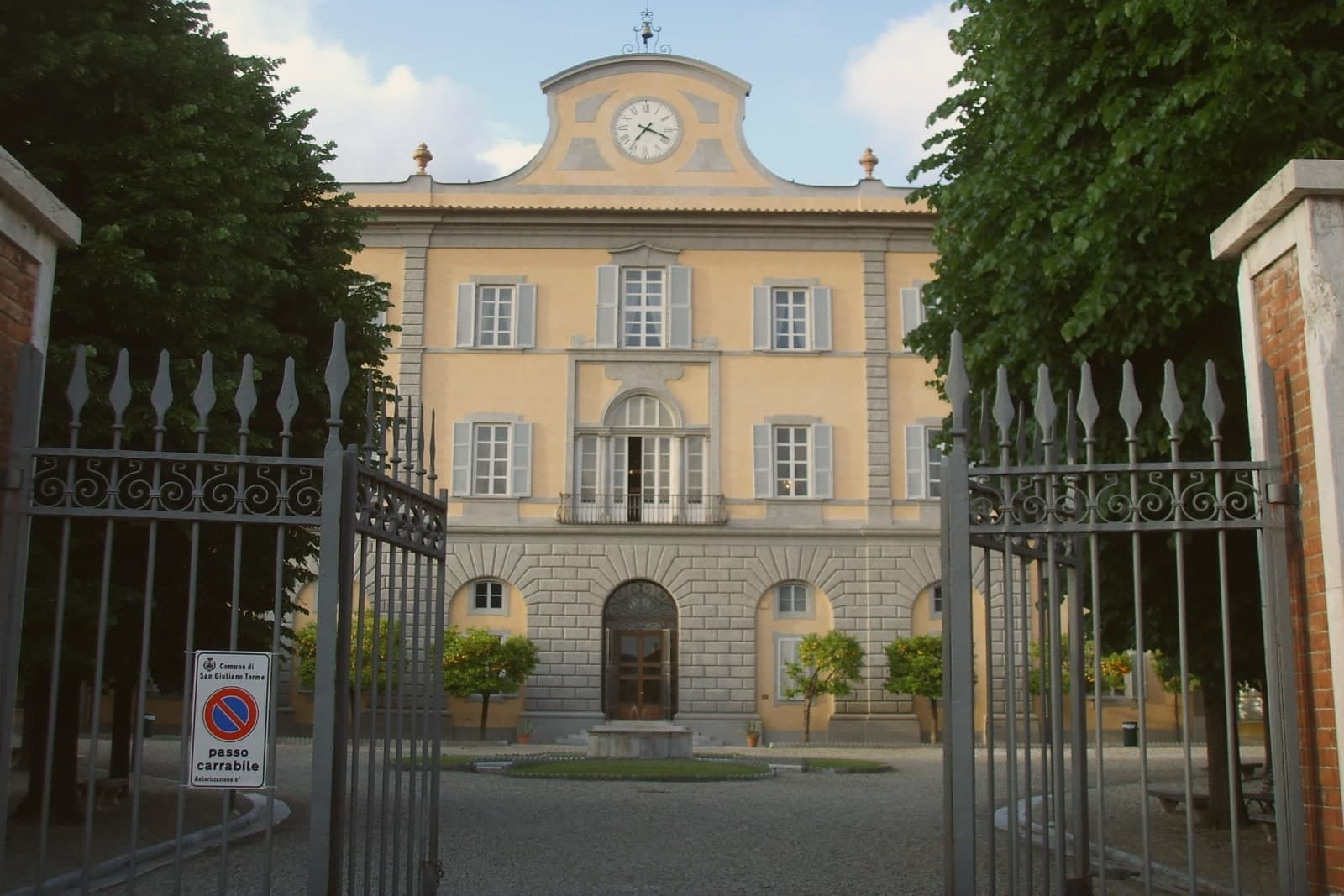
Why visit San Giuliano Terme
San Giuliano Terme sits at 10 meters at the southern foot of Monte Pisano, ten kilometers north of Pisa. The name Aquae Pisanae was the ancient one for the springs that rise here, and the town's own name records the later dedication to San Giuliano rather than to Pisa, though the waters remain tied to the city below by the aqueduct that still carries them there.
The frazioni climb the slope of Monte Pisano itself, olive groves stepping up the lower ground while the plain beneath opens into the pine forests and dunes of the Parco di Migliarino-San Rossore-Massaciuccoli, so the comune runs in one line from mountain ridge to coastal flat with the spa town fixed at the hinge between them. What holds the place together is water moving downhill: from the spring, through the baths where the waters were taken, along the arches to Pisa, and out across the plain toward the sea.
Locanda Sant'Agata have been named by a guide.
What to see in San Giuliano Terme
- Bagni di Pisa. The restored complex occupies the eighteenth-century Lorena baths, its rooms the ones where Byron, Shelley and Leopardi lodged while taking the waters.
- Acquedotto Mediceo. The line of arches runs from the springs of Asciano down to Pisa, parallel to the modern road, still legible as a single continuous structure across the plain.
- Monte Pisano. The granite ridge above the town, with olive groves on the lower slopes and trails leading to Rocca della Verruca.
How to get to San Giuliano Terme
There is a railway station in the town, so you can arrive without a car and never need one while you are here. Pisa is roughly 8 minutes away by road.
✷ We have written about San Giuliano Terme
“By the sea, cold hits differently. When that flat grey sky arrives, it means two things in our house: a big pot of bollito, and a thermal bath. The problem is finding one, the whole apparatus, multiple pools, the salt pool, sauna, steam room, mud, the entire game. For us, that means San Giuliano Terme, at the foot of Monte Pisano, and the Bagni di Pisa.”
Read our piece on San Giuliano Terme →Bagni di Pisa | The Tuesday Cure
Our tip
The thermal town runs year-round. Winter is the original spa season, with the warm pools welcome against the cold air off the Monte Pisano. April through June and September into October are the dry mild months for combining a spa stay with walks on Monte Pisano and the Parco di San Rossore. Sagra del Pesce falls in the season.
Pisa
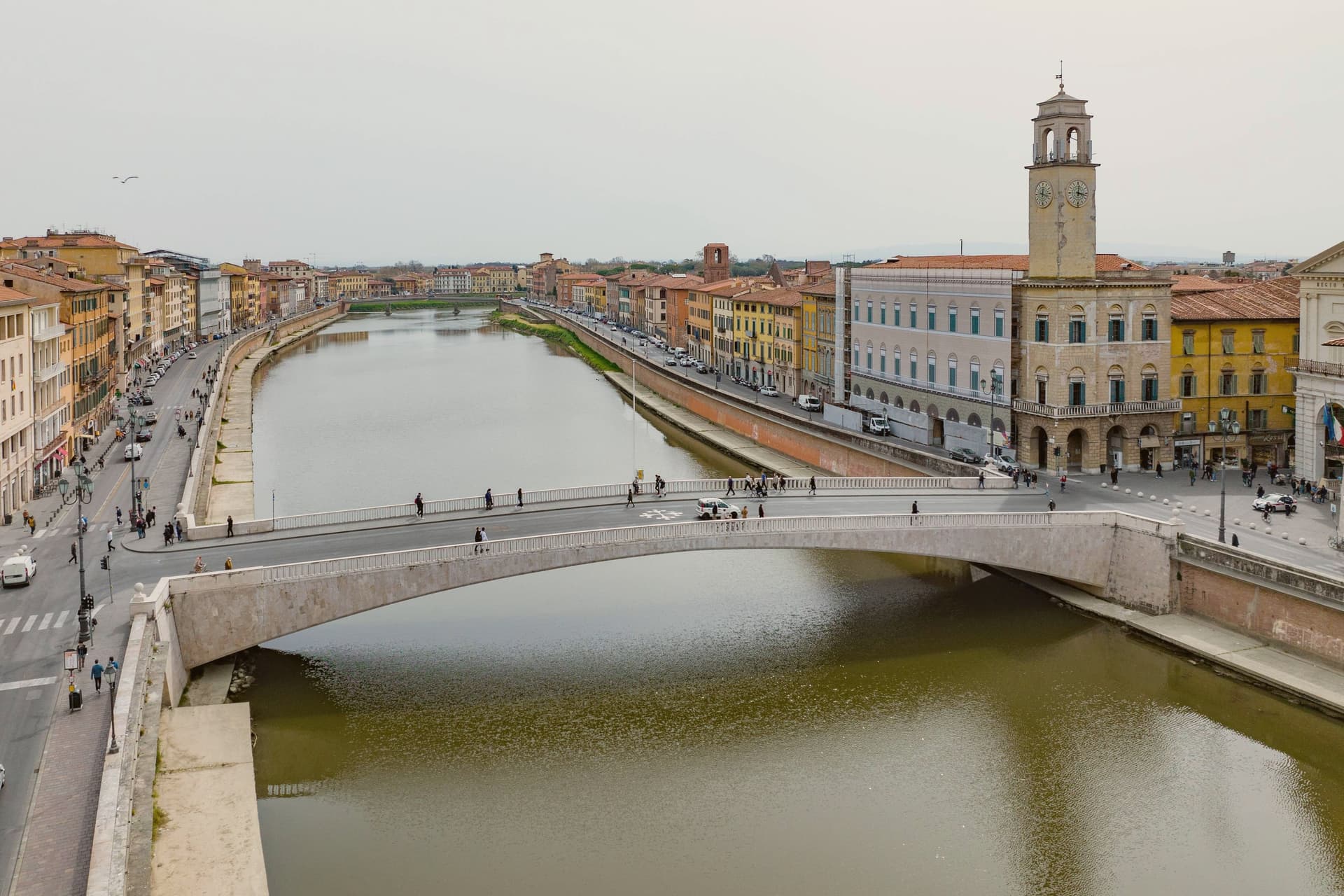
Why visit Pisa
The Arno reaches the Ligurian Sea twelve kilometers past the city, and the river is what built it: an Arsenal on its banks built galleys for the Crusades, and Mediterranean trade paid for the walled compound northwest of the centro. That compound, inscribed by UNESCO as one of the first Italian sites in 1987, gathers four buildings of the same Pisan Romanesque school in one field, the cathedral, the baptistery, the cemetery cloister and the bell tower, close enough to read as a single composition rather than a set of monuments visited separately.
The city has a second center away from that field. Piazza dei Cavalieri became the Medici political seat after the republic fell, and the university founded in 1343 keeps both squares populated with people who live and work there rather than pass through.
The Lungarni tie the two halves together physically, two quays following the river on both banks, lined with palazzi spanning the twelfth to the nineteenth century. What this adds up to is a town built in two unequal pieces: a religious and civic compound frozen at its medieval peak, and a working river city around it that never stopped adding centuries to its banks.
Ristorante Poldino, Caffè dell'Ussero, Erbaluigia and 1 more have been named by a guide.
What to see in Pisa
- Torre Pendente. Finished 1372, two centuries after it began, the lean is visible from ground level without needing to climb it, south of vertical against the other three white buildings of the square.
- Duomo di Pisa. Pisan Romanesque cathedral begun 1064 by Buscheto, financed from the Mediterranean trade, with bronze doors by Bonanno Pisano and a pulpit by Giovanni Pisano.
- Battistero di San Giovanni. Largest baptistery in Italy at 54.86 meters tall, begun 1152, Romanesque base and Gothic upper level, with a pulpit by Nicola Pisano.
How to get to Pisa
There is a railway station in the town, so you can arrive without a car and never need one while you are here. Pisa is roughly 16 minutes away by road.
✷ We have written about Pisa
“It was a Tuesday in January, ten degrees, the kind of soft grey Tuscan winter rain that does not quite commit to being rain, and what we wanted, in a way that surprised both of us, was a bowl of Japanese noodle soup. The nearest place to get one was Pisa.”
Read our piece on Pisa →Pisa | Beyond the Tower
Our tip
May, June, September and October are the months when the Lungarni are at their best, the temperature stays in the twenties, and the lines at Piazza dei Miracoli compress by mid-afternoon. The Luminara di San Ranieri, on 16 June, lights the riverbank with eighty thousand candles and is the night the city sees most. July and August are hot and humid, with the day-tripper waves from cruise ships at Livorno filling the compound from morning. Gioco del Ponte falls in June.
More from Anywhere Italy
- The best towns you can reach by train that have a serious restaurant within 90 minutes of Pisa
 The best hill towns in the province of Pisa
 The best hidden towns with a food festival that have a serious restaurant in Toscana
 The 7 best towns inside a nature park that have a serious restaurant in Toscana
- The best towns with a serious restaurant that eat well within 90 minutes of Livorno
 The best towns with a serious restaurant that sit on a walking route within 90 minutes of Pisa