
The best hill towns you can reach by train within 90 minutes of Firenze
Tuscany's inland hills reward the slow approach. The train out of Firenze runs past vineyards and olive terraces towards towns built of pietra serena and warm brick, where the streets climb, the main square tilts, and the butcher still sells finocchiona cut thick. Autumn is the strongest season, with porcini, chestnut flour, new oil that tastes of cut grass, and the first cold evenings that justify a bowl of ribollita. Spring brings the wisteria over stone walls and the long light that photographers chase.
People arrive in Firenze, queue for the Uffizi and the Duomo, then book a coach to San Gimignano because the towers photograph well. The result is a single street of souvenir shops moving at shuffle pace from late morning until the buses leave. It is a beautiful place, and it absorbs a very large share of everyone who wants to see a Tuscan hill town in a day.
The same hills carry on well past that one skyline, and the regional railways go with them, up the Arno towards the Casentino, south through the Val d'Elsa, into the Chianti and the Crete. The towns here have their own upper quarters, frescoed churches, weekly markets and trattorie that fill with locals at one o'clock. Fewer visitors make the trip, largely because it means reading a timetable rather than boarding a coach. These are the ones worth the detour.
Of the 12 communes we have mapped within 90 minutes of Firenze, 6 qualify as hill towns you can reach by train: each is an inland hill settlement, and we have confirmed each is reachable without a car. The smallest, Poppi, has 5,823 residents.
Two more lists worth reading alongside this one: The 9 best towns with a serious restaurant that eat well within 90 minutes of Firenze and The best hill towns worth staying overnight within 90 minutes of Firenze.
Poppi
Why visit Poppi
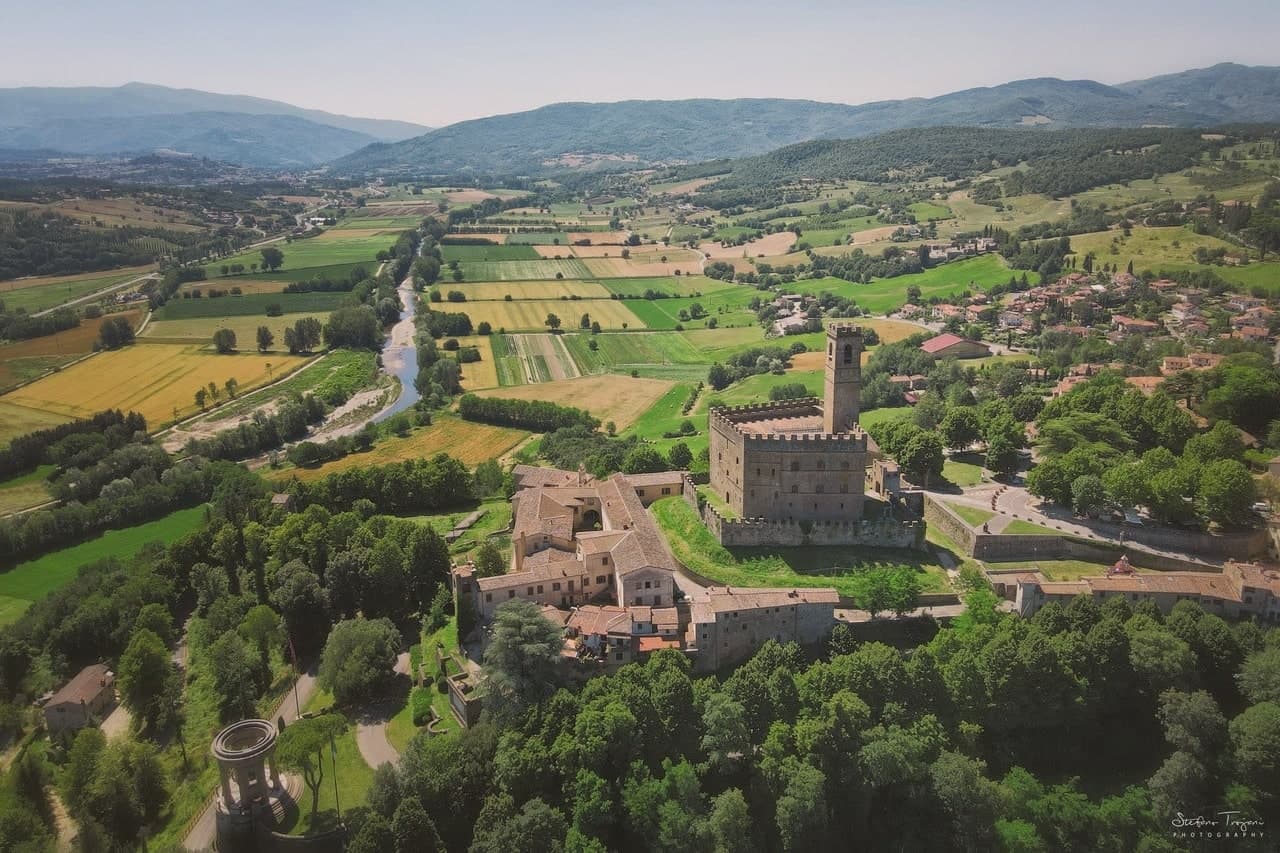
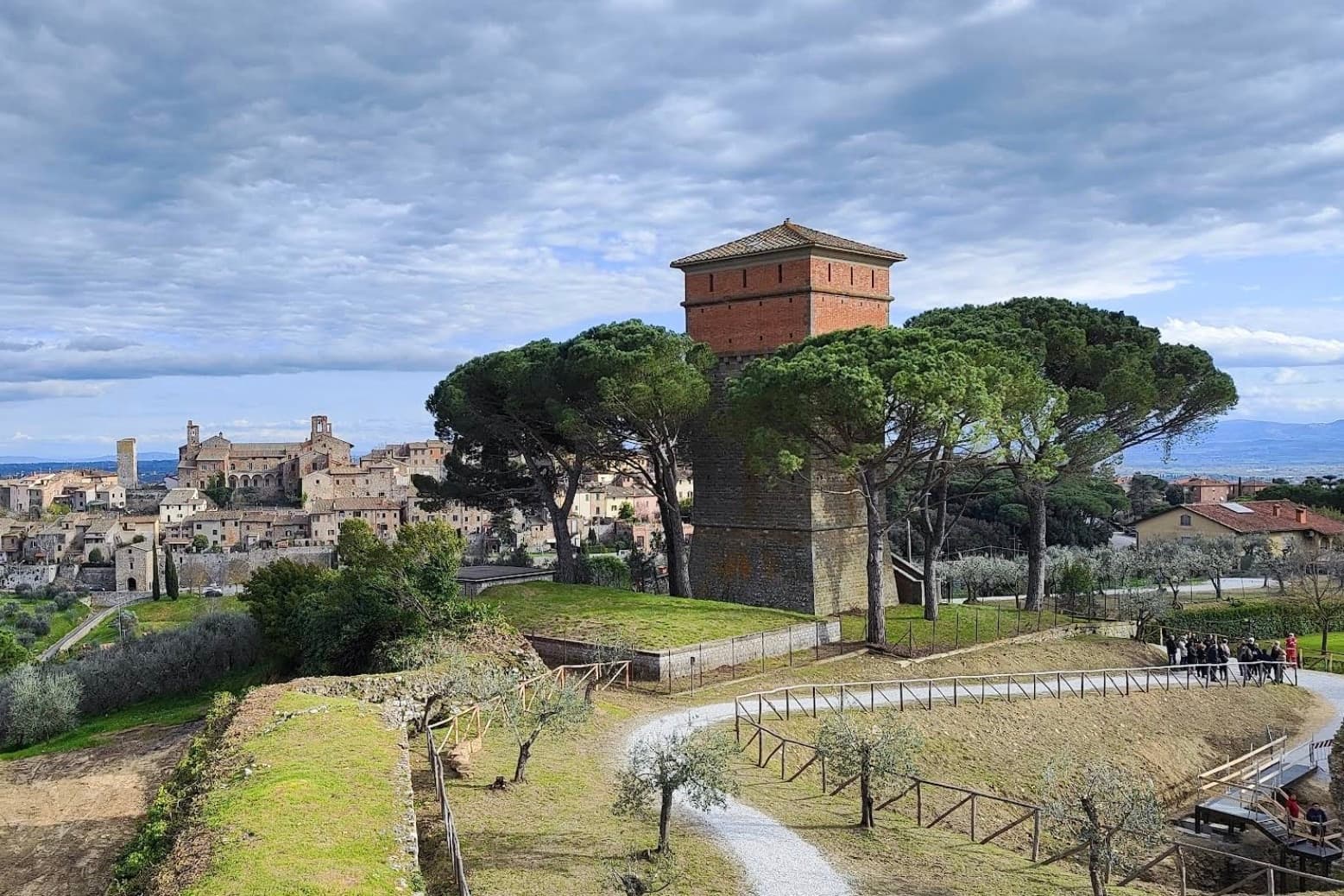
Poppi rises above the upper Arno in the Casentino, the wooded valley set between Pratovecchio and Bibbiena. The Counts Guidi held this hill from at least 1169, and the castle they raised across the late twelfth and thirteenth centuries is attributed in its older part to Lapo di Cambio and in the later upper section to Arnolfo di Cambio.
Dante Alighieri, who fought below the hill as a young man, returned to it later as a guest of the Guidi during his exile, so the borgo held him twice, once as a soldier and once as a household guest. The town itself sits above the battle plain, the abbey church inside the walls, the castle over both.
A further Romanesque pieve stands a short distance off, and the forested ridges of the Apennine watershed rise to the east, the same terrain the Guidi once ruled from their hill. What the place adds up to is a single family's hold on a valley, visible still in the line from castle to plain to church, with the forest marking where their lordship ran out.
We confirmed you can reach this one by train.
What to see in Poppi
- Castello dei Conti Guidi. The castle keeps a working library and a fourteenth-century chapel frescoed by the school of Giotto, along with a hand-painted model of the battle below, more than four thousand tin soldiers set out on the table.
- Piano di Campaldino. The plain sits directly beneath the castle walls, open ground still readable as a battlefield, with nothing built across it since.
- Abbazia di San Fedele. Romanesque abbey church inside the borgo, with single nave and stone façade, dating from the early twelfth century.
How to get to Poppi
There is a railway station in the town, so you can arrive without a car and never need one while you are here. Firenze is roughly 64 minutes away by road.
Our tip
April through June brings the Casentino into clear sun, the beech forests in their first leaf and the upper Arno full from spring rain. July and August are pleasant at 437 meters, never coastal-hot, with the castle and library full of weekend visitors from Florence. September and October are the harvest and chestnut months: the Foreste Casentinesi turn orange in the high cuts above Pratovecchio. Il Casentino nel piatto falls in June.
Fiesole
Why visit Fiesole
Fiesole was Viesul to the Etruscans and Faesulae to the Romans, who took it in 283 BC. Florence claimed it in 1125 and never let it go, which is the reverse of the usual order: the hill town came first, the valley city second, and the ridge has watched its own successor grow across the centuries since.
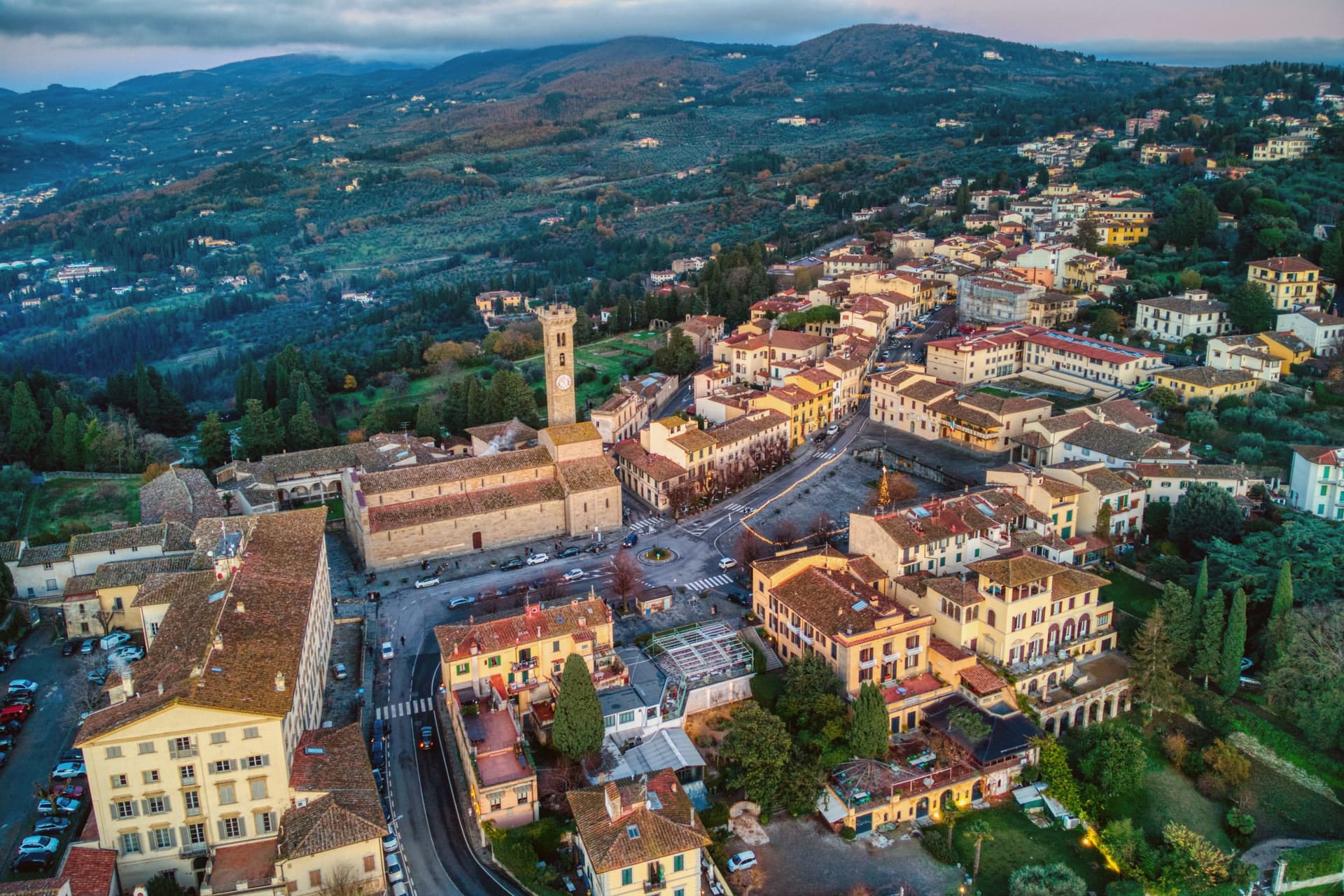
The convent that crowns the highest point, at 345 meters, sits at the same height Boccaccio gave the brigata in the Decameron's frame story, a detail that ties the summit to the plague-fleeing storytellers rather than to any building fact already given. Today the town functions as the hill seat of Florentine villas, the Villa Medici among them, so the relationship between Fiesole and Florence is not just historical but residential: those with means built upward, toward the older settlement, to look down on the newer one.
The panorama from the piazza is the view that supplies the standard image of Florence from above, which means the town that Rome conquered has ended up owning the picture of the city that conquered it back.
We confirmed you can reach this one by train.
What to see in Fiesole
- Teatro Romano. Stone tiers set into the hillside below the cathedral, still used each summer for the Estate Fiesolana, so the seats fill for performances the way they once did in antiquity.
- Cattedrale di San Romolo. Romanesque cathedral founded in 1028, flanked by a 42-meter bell tower, with a marble altar from 1273 and two Pietro Perugino frescoes.
- Convento di San Francesco. Romanesque-Gothic Franciscan convent at the ridge's highest point, 345 meters, with cloisters and a panoramic view back over Florence.
How to get to Fiesole
There is a railway station in the town, so you can arrive without a car and never need one while you are here. Firenze is roughly 24 minutes away by road.
Our tip
April through June and September through October are the months Fiesole was built for: the air cooler than Florence by three to five degrees, the cypress alleys clean of haze, and the Roman theatre season runs through July and early August with concerts under the open sky. July and August push the day temperature high enough that even the hilltop feels heavy at midday, though the evenings come back. November through March is quiet, light hits the cathedral late and low, and the wood-burning trattorias around Piazza Mino do their best work. Sagra del Tartufo falls in September.
Certaldo
Why visit Certaldo
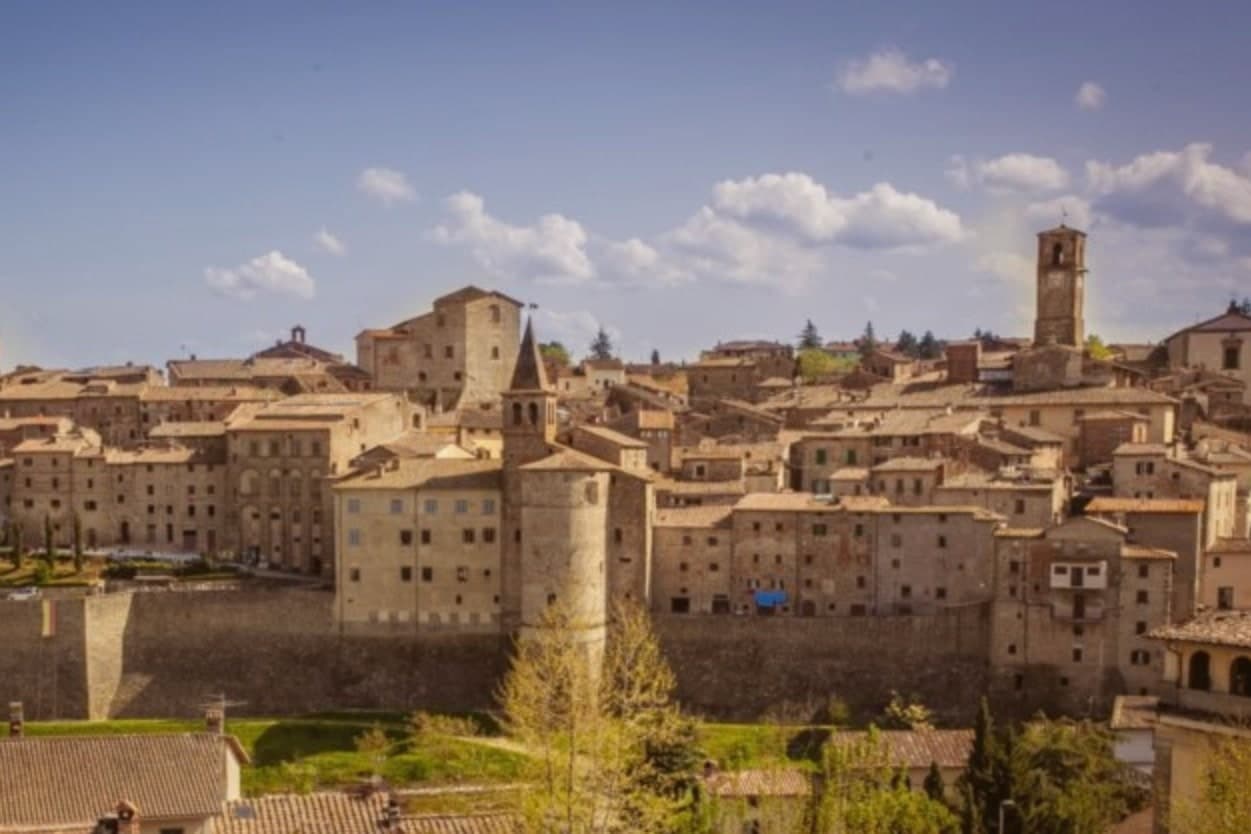
Certaldo sits in the Valdelsa twenty-five kilometers southwest of Florence, with a lower town on the plain at 67 meters and the medieval Certaldo Alto on the hill above, reached by a funicular. The upper town is built almost entirely of red brick rather than the usual Tuscan stone, an unusual visual signature for the region.
Giovanni Boccaccio lived his last years here, dying in 1375 in the house on Via Boccaccio that is now the Casa Boccaccio museum and study center. He is buried in the Chiesa dei Santi Michele e Jacopo across the street.
The Palazzo Pretorio, fifteenth-century seat of the Florentine vicar, holds frescoes by Pier Francesco Fiorentino and the courtyard coats of arms of seventy-four podestà. Mercantia, the street-theater festival that fills Certaldo Alto every July, has run since 1988 and turns the brick streets into stages for European companies.
The local plate is cipolla rossa di Certaldo, a sweet red onion grown on the Valdelsa hills since the fifteenth century.
We confirmed you can reach this one by train.
What to see in Certaldo
- Certaldo Alto. Medieval brick-built upper town on the hill above the plain, reached by funicular from the modern lower town.
- Casa Boccaccio. The house on Via Boccaccio where the poet lived his last years and died in 1375, now a museum and study center.
- Palazzo Pretorio. Fifteenth-century seat of the Florentine vicar, with frescoes by Pier Francesco Fiorentino and seventy-four podestà coats of arms in the courtyard.
How to get to Certaldo
There is a railway station in the town, so you can arrive without a car and never need one while you are here. Firenze is roughly 46 minutes away by road.
Our tip
April through June brings the Valdelsa hills green and the lower temperatures bearable. Mercantia runs five nights in mid-July, and the upper town becomes a single open-air theater between dusk and one in the morning. September and October are the second window, with the new oil from the surrounding hills and the start of the cipolla rossa season. Boccaccesca falls in October.
Castelnuovo Berardenga
Why visit Castelnuovo Berardenga
The commune sits east of Siena, where the hills give way to the clay swells of the Crete Senesi. The name comes from the Terra Berardinga, the area controlled in the tenth century by a Frankish nobleman named Berardo, and the borgo grew up around the castle walls the Sienese Republic raised against Florence.
The centro storico, the villa and gardens at its heart, and the surrounding zone of vineyards form one continuous pattern rather than separate parts: fortress town above, wine country falling away below it toward the clay hills. Across the wider territory, 13 castles, 70 churches and 200 farms record the medieval pattern of the Sienese contado, a scatter of small fortified points and parish churches administering land rather than one dominant center.
The place reads as a border post that outlived its military purpose and settled into agriculture and the arts, its castle now a clock tower, its noble villa now a music foundation, its walls now overlooking rows of Sangiovese.
We confirmed you can reach this one by train.
What to see in Castelnuovo Berardenga
- Villa Chigi Saracini. Eighteenth-century villa and Italian garden inside the centro storico, its park designed by the Sienese composer Guido Chigi Saracini, whose family foundation still runs the Accademia Musicale Chigiana in Siena.
- Torre dell'Orologio. Surviving tower of the fortress, now bearing the civic clock, the highest visible point of the centro storico.
- Chiesa dei Santi Giusto e Clemente. Eighteenth-century parish church with a neoclassical façade, built on the site of an earlier Romanesque pieve.
How to get to Castelnuovo Berardenga
There is a railway station in the town, so you can arrive without a car and never need one while you are here. Firenze is roughly 77 minutes away by road.
✷ We have written about Castelnuovo Berardenga
“The wine is the whole economy of these hills, every village with its own, the region’s name stamped on the most famous red in Italy. Tuscan food runs to cured and roasted meat, so the wine ran red to meet it, lighter than you expect, almost fruity, easy, made to sit beside a steak and not to be lectured about. Here is the only wine knowledge you need on this road: it is all good.”
Read our piece on Castelnuovo Berardenga →Road to Siena | The Long Way Is the Better Way
Our tip
April through June and September into October are the months Chianti Classico shows best, the green hills moving toward the gold of harvest. The Sagra del Vino runs the second weekend of September. July and August push past thirty and the centro storico empties between two and six; the cellars on the surrounding hills offer cool tastings and longer rentals.
Siena
Why visit Siena
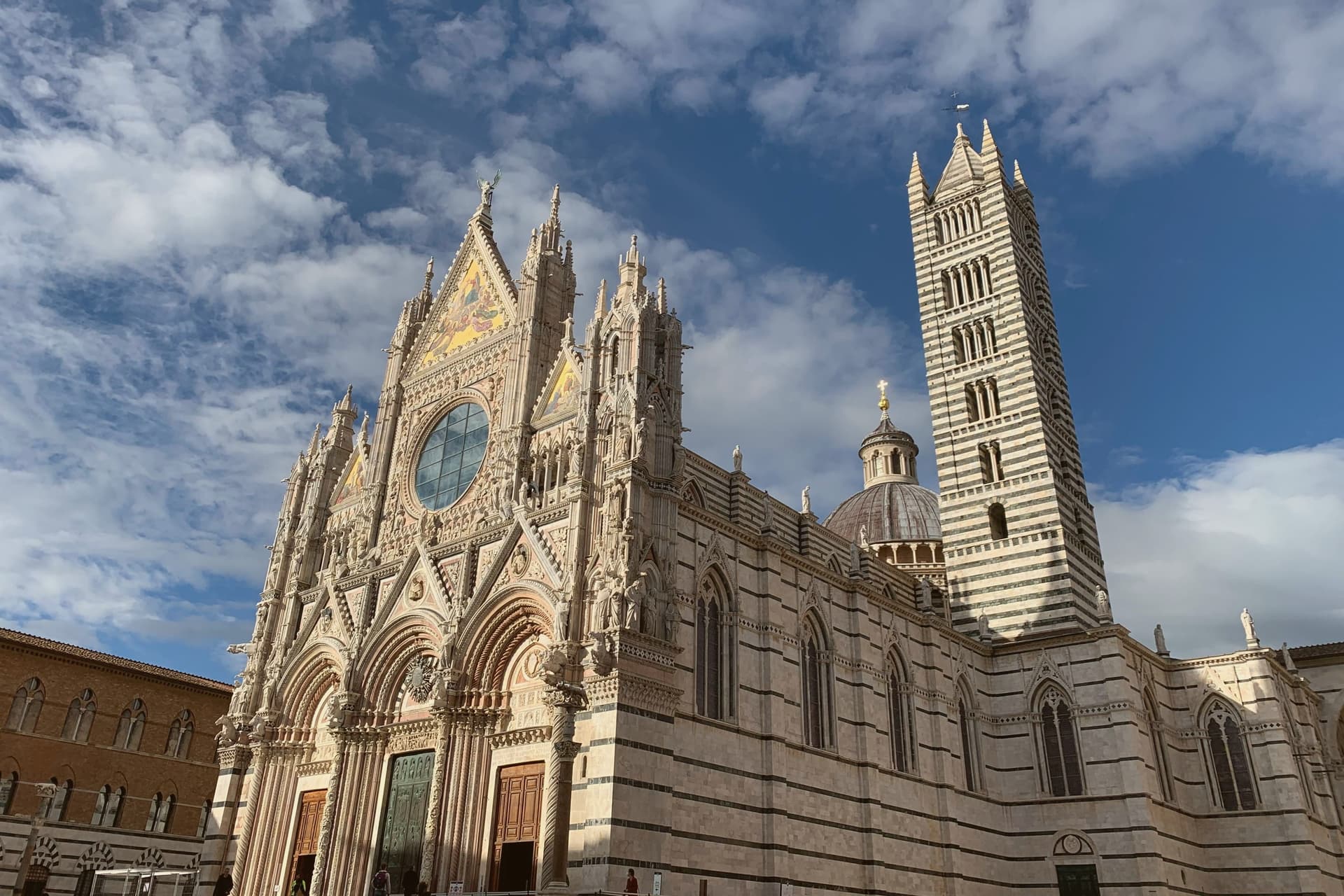
Siena sits at 322 meters on three hills fifty kilometers south of Florence, with which it fought a defining rivalry through the thirteenth and fourteenth centuries. The historic center has been UNESCO World Heritage since 1995, preserved as a medieval city that worked deliberately to differ from Florentine urban planning.
Piazza del Campo, the shell-shaped square at the meeting point of the three original hills, fans out toward the Palazzo Pubblico, whose construction began in 1297. The Torre del Mangia next to it, built between 1338 and 1348, stands 87 meters tall, the exact height of the Duomo, a deliberate equality between church and state.
The Duomo itself, marble-clad in horizontal black and white bands, holds the inlaid mosaic floor that Vasari called the most beautiful ever made, and sculptures by Donatello, the Pisano family and Michelangelo. The Palio runs twice a year, on 2 July and 16 August: bareback riders representing seventeen contrade circle the Campo three times in roughly ninety seconds.
We confirmed you can reach this one by train.
What to see in Siena
- Piazza del Campo. Shell-shaped medieval square at the meeting point of Siena's three hills, paved in 1349 in red brick divided into nine sectors for the Council of Nine.
- Palazzo Pubblico. Town hall begun in 1297, with the Sala dei Nove holding Lorenzetti's Allegory of Good and Bad Government from 1338-1339.
- Torre del Mangia. Brick tower built 1338-1348 next to the Palazzo Pubblico, 87 meters tall, set deliberately to match the height of the Duomo.
How to get to Siena
There is a railway station in the town, so you can arrive without a car and never need one while you are here. Firenze is roughly 73 minutes away by road.
✷ We have written about Siena
“Before Florence was the banking capital of the known world, the bench belonged to Siena. The word itself comes from the bench, the banco, where the money changers sat, and in the twelfth century, the Sienese ran some of the largest banking houses in Europe, moving the money of popes and kings while Florence was still finding its feet.”
Read our piece on Siena →Siena | What you are really here for
Our tip
April through June and September into October are the dry months in central Tuscany: mild days, full openings at the museums, the Campo busy but not packed. The Palio runs on 2 July and 16 August: the city stops for the four days around each race, the trial races fill the piazza twice a day, and accommodation books out a year ahead. July and August are otherwise hot and crowded with day-trippers from Florence. Palio della Madonna di Provenzano falls in July.
Arezzo
Why visit Arezzo
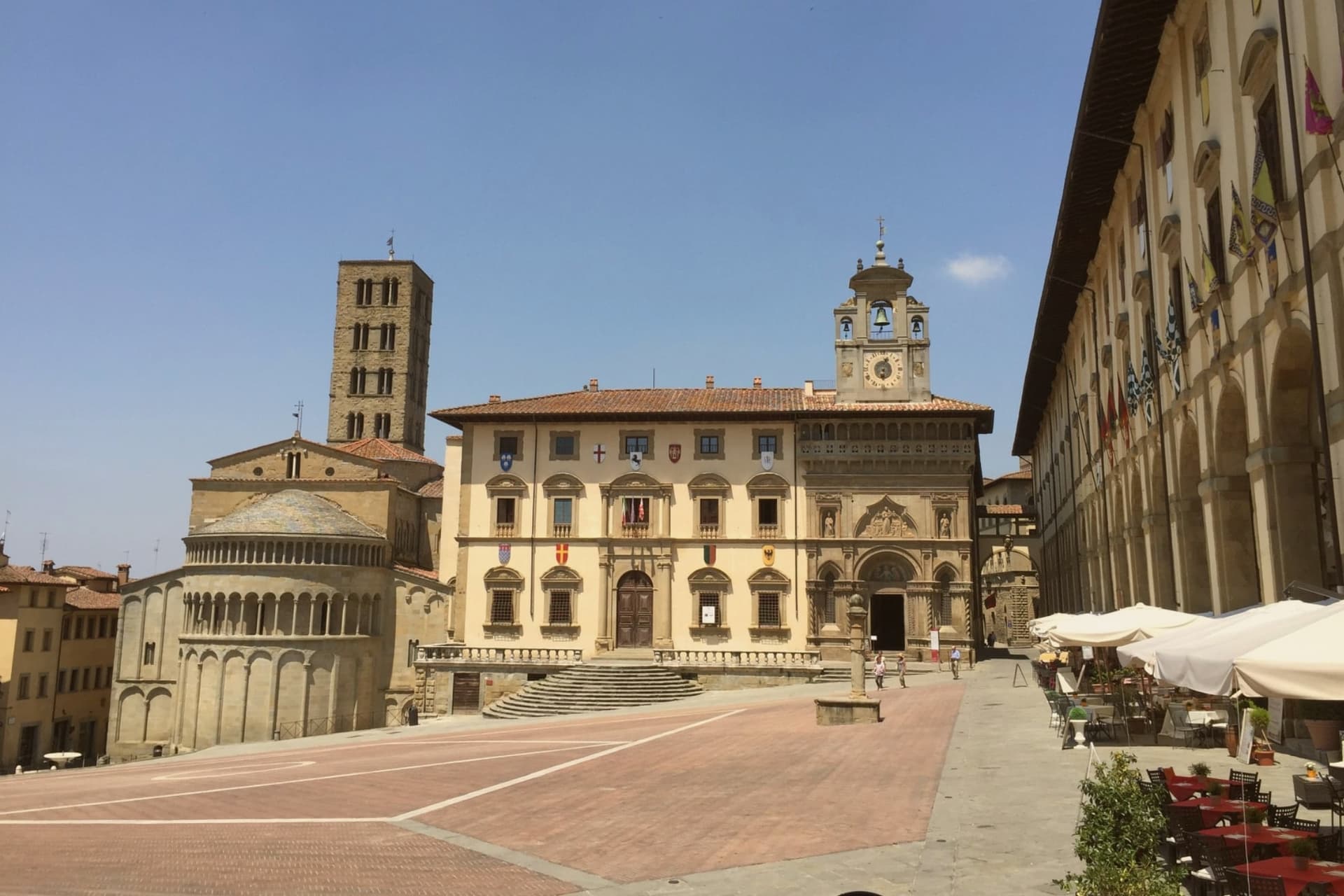
The city sits on a Tuscan hilltop 80 km southeast of Florence, and the ground beneath it holds one of the densest layers of Etruscan, Roman, medieval and early-Renaissance building anywhere in the region, without the tour-bus crush of its more famous siblings. The lower streets and the upper square pull the town's whole history together: the Pieve di Santa Maria's Romanesque exterior and five-tier facade were widely copied across central Italy, the Cattedrale di San Donato is Gothic with stained glass by Guillaume de Marcillat, and the Casa Vasari is the painter-architect's own house, frescoed by himself.
Giorgio Vasari was Arezzo's other native son, and beyond his own house his Loggia still frames one side of the sloped trapezoidal square, alongside the 14th-century facade of the Palazzo della Fraternita dei Laici and the Romanesque apse of the Pieve. The Museo Archeologico Nazionale stands on the site of the Roman Amphitheatre, where the Vasi corallini, coral-red glazed Roman pottery, were made as a manufacturing centre for the empire.
The fresco cycle narrates the journey of the Cross from Adam's grave through Solomon to Constantine to Heraclius in 10 panels of geometric serenity and silver-grey light, and the film that made the square famous used its slope as a stage set, the same slope the antique dealers now fill every first weekend of the month with more than 500 stalls drawing buyers from across Europe. Twice a year, in June and September, the four city quartieri, Porta Crucifera, Porta del Foro, Porta Sant'Andrea and Porta Santo Spirito, meet in the jousting tournament, riders charging the wooden target on horseback in a contest that has run since the 13th century.
The food is Tuscan: pici with hare ragù, ribollita, bistecca chianina from the Val di Chiana below the city, Pecorino Toscano, with Vino Nobile, Brunello and Chianti Classico all within an hour's drive south. Together the fresco, the square, the joust and the antique trade give the city a working civic life built on Renaissance art and medieval ritual rather than a museum piece preserved around it.
We confirmed you can reach this one by train.
What to see in Arezzo
- Piero della Francesca's Leggenda della Vera Croce. 10-panel fresco cycle in the Cappella Bacci of San Francesco. Timed entry: 25 people, 30 min, book 2-3 weeks ahead.
- Piazza Grande + Pieve di Santa Maria. Sloped trapezoidal square lined by the Palazzo della Fraternita, Vasari's Loggia, and the 12th-c Lombard-Romanesque apse of Santa Maria.
- Fiera Antiquaria (every first weekend). 500+ dealers fill the square and surrounding streets, drawing dealers and buyers from across Europe.
How to get to Arezzo
There is a railway station in the town, so you can arrive without a car and never need one while you are here. Firenze is roughly 62 minutes away by road.
✷ We have written about Arezzo
“Arezzo is the last of this region’s losers, the cousin of Siena, beaten and absorbed and left behind, and like all of them, it kept what the winners spent. The same edge that cost it an empire is the moat that keeps the tour buses in Florence. It does not perform. It does not sell you a lie about itself. It works its gold, runs its schools, and lets the heat sit on the great empty square, and it will not notice whether you stay a day or a life.”
Read our piece on Arezzo →Arezzo | The City That Ignores You
Our tip
Arezzo is best April–June and September–October. The Fiera Antiquaria's first weekend of the month is the year-round draw (book hotels 2 weeks ahead). The Giostra del Saracino (third Saturday June + first Sunday September) is the year's two civic highlights. Giostra del Saracino di Arezzo (Giugno) falls in June.
More from Anywhere Italy
- The 9 best towns with a serious restaurant that eat well within 90 minutes of Firenze
 The best hill towns worth staying overnight within 90 minutes of Firenze
- The best hidden hill towns within 90 minutes of Firenze
- The best olive oil towns within 90 minutes of Firenze
 The best towns you can reach by train within an hour of Florence
 The best hill towns in the province of Arezzo