
The 6 best towns on a walking route that eat well in the province of Siena
Southern Tuscany is built for walking and for eating afterwards. The Via Francigena crosses the province of Siena on white gravel roads between wheat and vines, past travertine farmhouses and brick towers the colour of terracotta, and each stage ends somewhere with a kitchen. Pici rolled by hand, pappa al pomodoro, pecorino aged in ash or walnut leaves, cinta senese cured into salami, Brunello and Vernaccia and the sharp young reds nobody exports. Spring and October are the walking seasons, when the crete senesi turn green or the vines go copper and the midday heat lets you keep moving.
The famous version of this landscape is photographed from a car window. Coach parties run out of Florence to the same cypress avenue, stop for an hour in Pienza to buy pecorino, and are back in the city by dinner, which means the good tables in the Val d'Orcia are busy at lunch and empty at night. The Chianti wine road carries the same traffic further north. It is a real landscape and the crowds are there for good reason, but a walker moving through it at four kilometres an hour sees a different set of towns entirely.
The route does not stop where the photographs do. The same hills, the same pecorino and the same rolled pasta continue along the pilgrim road and the ridge paths, into towns that keep a dining room open for people who arrive on foot and hungry, some of them with thermal water to sit in afterwards. These are the stages worth building a walk around, chosen because a dining guide has named a table in each and because you can reach the next one before dark.
Of the 20 communes we have mapped in the province of Siena, 6 qualify as towns on a walking route that eat well: each is a stage on one of the long historic walking routes, and a dining guide has named a table in each. The smallest, San Casciano dei Bagni, has 1,500 residents.
If you are still choosing, we have also written The best towns on a walking route in the province of Siena and The best hidden towns with a medieval festival in the province of Siena.
San Casciano dei Bagni
Why visit San Casciano dei Bagni
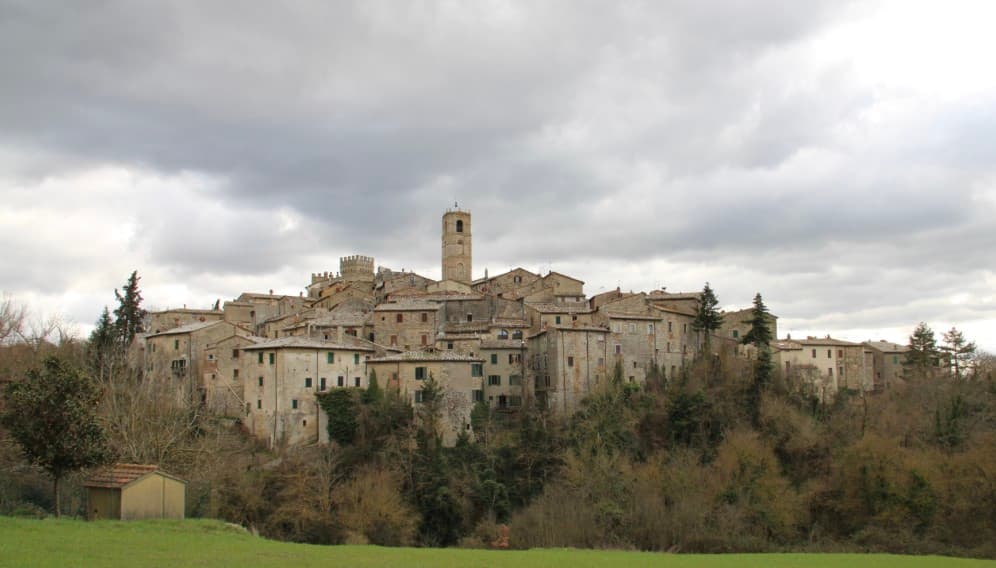
San Casciano dei Bagni sits at 582 meters at the southern edge of the province of Siena, above 42 hot springs that average 42 degrees Celsius. The baths were used continuously from Etruscan through Roman times and again from the Renaissance, when visitors came from across Europe.
In 2022, an excavation that began in 2019 at the ancient sanctuary turned up 24 bronze votive statues protected by mud, with around 6,000 coins in gold, silver and bronze. The find was the largest of its kind in fifty years; most surviving Etruscan votive material is terracotta.
The 1,500 residents live on a basalt outcrop above the Roman thermal complex, in a centro storico of stone houses and three small churches. The borgo joined the Borghi più belli network in 2014 and remains one of the smallest communes in Toscana to carry both that label and Bandiera Arancione.
Daniela, Castello di Fighine have been named by a guide.
What to see in San Casciano dei Bagni
- Santuario Ritrovato. Etruscan-Roman thermal sanctuary excavated since 2019, where 24 bronze votives and around 6,000 coins were recovered in 2022.
- Bagno Grande. The principal natural pool of the 42 hot springs, used from the second century BC through the Renaissance and reopened to the public.
- Collegiata di San Leonardo. Romanesque parish church in the centro storico, restored in the seventeenth century, with a baptismal font carved from local travertine.
How to get to San Casciano dei Bagni
Perugia is roughly 68 minutes away by road.
Our tip
The thermal pools make the calendar different here. Winter is the season many visitors prefer, when the 42-degree water steams against cold air and snow occasionally dusts the basalt outcrop. April through June and September into October are the most balanced months: warm hill light, the dry-stone walls of the borgo at their best, the sanctuary excavations open to guided tours. Sagra del Ciaffagnone di San Casciano dei Bagni falls in June.
San Quirico d'Orcia
Why visit San Quirico d'Orcia
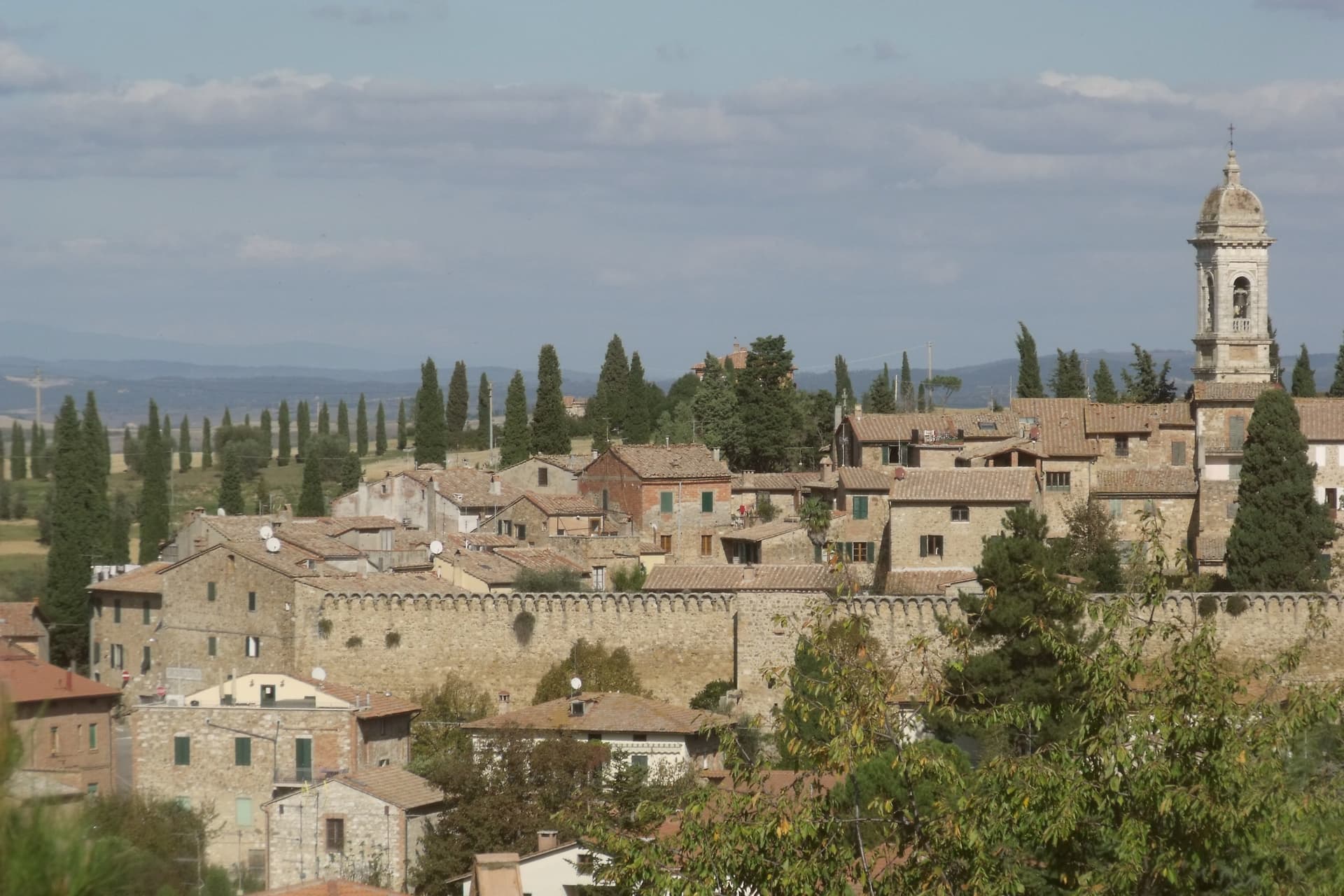
San Quirico d'Orcia sits at 409 meters on a low rise in the Val d'Orcia, the rolling clay-and-tufa landscape inscribed by UNESCO in 2004 as a cultural landscape shaped by fourteenth and fifteenth-century Sienese governance. The town was a stage on Sigeric the Serious's tenth-century Via Francigena from Canterbury to Rome and has remained a working stop on the route ever since.
The Collegiata dei Santi Quirico e Giulitta was built at the end of the twelfth century over an eighth-century baptistery; the lateral portal added in 1288 is attributed to Giovanni Pisano, then working on the Siena cathedral. The Horti Leonini, the geometric boxwood garden laid out by Diomede Leoni around 1580 inside the town walls, hosts the Forme nel Verde sculpture exhibition every summer since 1971.
Bagno Vignoni, the frazione five kilometers down the road, has a thermal pool at the center of its piazza, used since Etruscan times. Few comuni this small carry UNESCO, thermal and Francigena signals at once.
Trattoria Toscana al Vecchio Forno, Da Ciacco have been named by a guide.
What to see in San Quirico d'Orcia
- Collegiata dei Santi Quirico e Giulitta. Romanesque parish church built late twelfth century over an eighth-century baptistery, with the 1288 lateral portal attributed to Giovanni Pisano.
- Horti Leonini. Italianate boxwood garden laid out by Diomede Leoni around 1580 inside the town walls, hosting the Forme nel Verde sculpture exhibition since 1971.
- Bagno Vignoni. Frazione five kilometers south, with a sixteenth-century thermal pool at the center of its piazza, fed by springs used since Etruscan times.
How to get to San Quirico d'Orcia
Perugia is roughly 96 minutes away by road.
Our tip
April through June and September into October are the gold months in the Val d'Orcia: green wheat in spring, ochre stubble by autumn, low light that defines the cypress ridges. The Festa del Barbarossa runs the third Sunday of June with archery, jousts and crossbow contests between the town quarters. July and August are hot and busy; the centro storico fills with day-trippers from Pienza and Montalcino. Festa del Barbarossa a San Quirico d'Orcia falls in June.
Montalcino
Why visit Montalcino
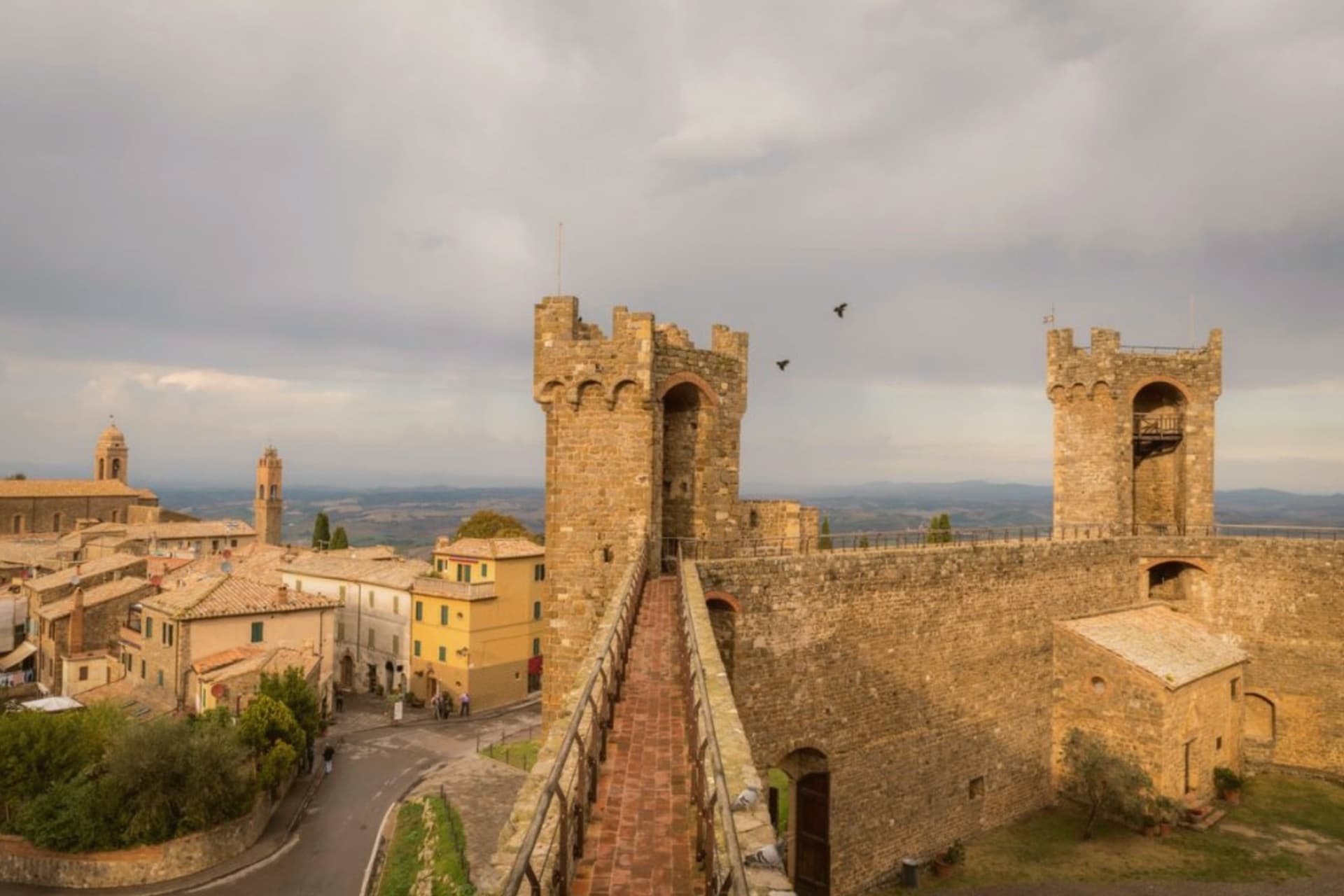
Montalcino sits at 564 meters on a hill south of Siena, the centro storico ringed by walls and crowned by a pentagonal fortress built in 1361. When Florence took Siena in 1555, the Sienese exiles regrouped here and held out for almost four years; the Rocca itself never fell.
That date matters less to most visitors than 1980, when Brunello di Montalcino was named one of the first four Italian wines to receive DOCG status. The vineyards run from the town at 600 meters down to plots at 200, on stony galestro soils that ripen Sangiovese Grosso into a wine that ages for decades.
The Abbey of Sant'Antimo, ten kilometers south, is a Romanesque church first documented in 814 and tied by local legend to a vow by Charlemagne. The town also produces miele, olio, and the white truffles of the surrounding woods.
It carries seven institutional signals at once, more than any other commune in this batch.
Caffè Fiaschetteria Italiana, Campo del Drago, La Sala dei Grappoli and 13 more have been named by a guide.
What to see in Montalcino
- Rocca di Montalcino. Pentagonal fortress built in 1361 by Sienese architects Mino Foresi and Domenico di Feo, refuge of the Sienese Republic after 1555.
- Abbazia di Sant'Antimo. Romanesque abbey ten kilometers south, first documented in 814, set among olive groves below the town with Gregorian chant still sung.
- Palazzo dei Priori. Thirteenth-century town hall on Piazza del Popolo, slender tower attached, civic seat of the medieval commune.
How to get to Montalcino
There is a railway station in the town, so you can arrive without a car and never need one while you are here. Perugia is roughly 105 minutes away by road.
Our tip
April through June and September into October are the months locals prefer. The hills are green or gold depending on the half, and the vineyards run their full work cycle. The Sagra del Tordo, a medieval archery contest between the four quarters of the town, takes place the last Sunday of October. Sagra del Cinghiale di Montalcino falls in the season.
San Gimignano
Why visit San Gimignano
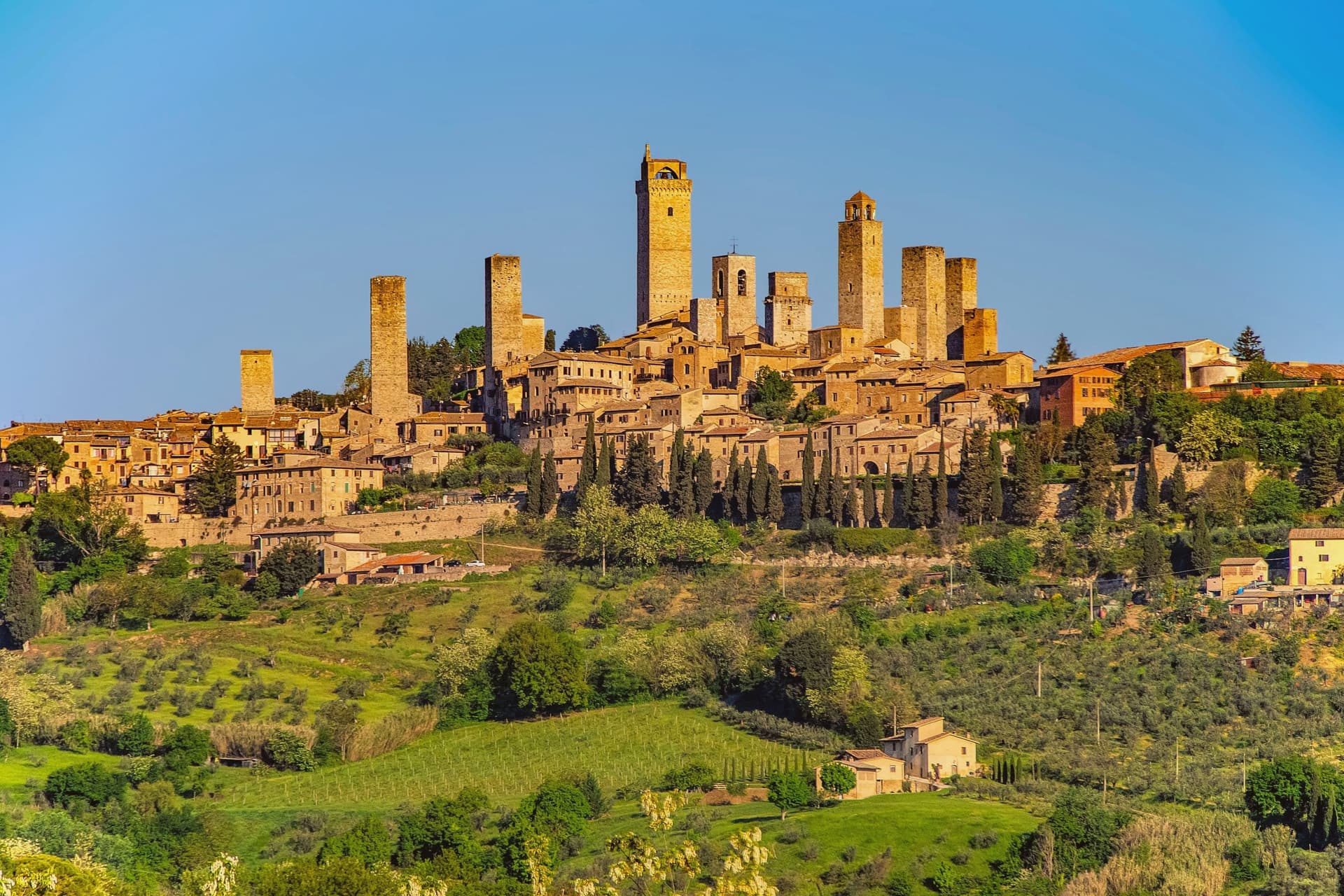
San Gimignano sits at 334 meters in the Val d'Elsa, halfway between Firenze and Siena on the medieval pilgrim road to Rome. Patrician families built 72 tower-houses in the twelfth and thirteenth centuries as proofs of wealth and platforms for vendettas; 14 still stand, the tallest being the Torre Grossa at 54 meters.
The town declared independence from the bishops of Volterra in 1199 and grew rich on saffron and Vernaccia, the white wine grown on the surrounding hills and praised since Dante. The Black Death of 1348 broke the boom; San Gimignano lost more than half its population and submitted to Florence.
That collapse is the reason the medieval skyline survived. UNESCO listed the historic centre in 1990 as a complete record of feudal architecture.
Roughly three million visitors come each year, more than 400 times the resident population, and the centro storico empties into the surrounding olive groves once the day-trippers leave.
Linfa, Da Pode, San Martino 26 have been named by a guide.
What to see in San Gimignano
- Torre Grossa. Fifty-four meter civic tower attached to the Palazzo Comunale, the tallest of the surviving 14, open for the climb to the panoramic terrace.
- Piazza della Cisterna. Triangular medieval square paved in brick around an octagonal well of 1287, lined by tower houses and Romanesque palaces.
- Collegiata di Santa Maria Assunta. Romanesque parish church on Piazza Duomo, walls covered by Bartolo di Fredi and Lippo Memmi frescoes of Old and New Testament scenes.
How to get to San Gimignano
Firenze is roughly 61 minutes away by road.
✷ We have written about San Gimignano
“We arrived in the afternoon, into the second half of the day’s crowd. Off-season meant it was groups and guides rather than a flood, but the shops were open and doing their worst, the same garbage souvenirs, the same pasta no one local would eat, and we walked through it the way you walk through a thing you have decided not to let ruin your evening. The towers stood over all of it, indifferent, which is their whole talent.”
Read our piece on San Gimignano →San Gimignano | The Town After Seven
Our tip
April through June and September into October are the months the town is worth a full day rather than three hours. The buses still come, but late afternoon empties the piazzas and lets the towers take their light. July and August push temperatures past thirty and the centro storico becomes uncomfortable between two and six, when the stone radiates heat. Fiere delle Messi di San Gimignano falls in June.
Monteriggioni
Why visit Monteriggioni
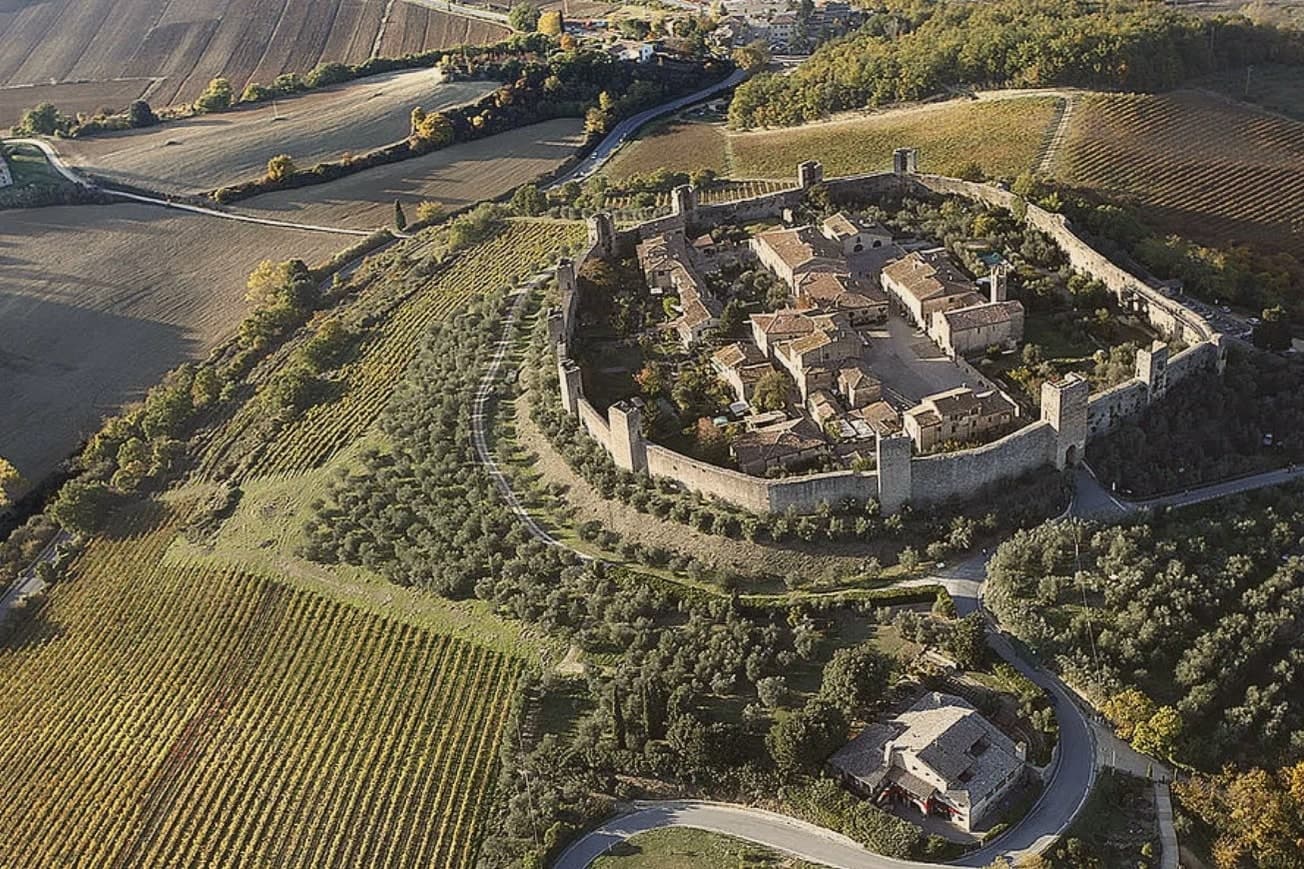
Monteriggioni sits at 274 meters on a natural hillock between Firenze and Siena, eleven kilometers from the Sienese gates. The walls were built between 1213 and 1219, when Siena ran them up as a frontline garrison facing Florentine expansion north.
They are still there. Fourteen square towers, 570 meters of curtain wall, ten meters tall, two gates: Porta Fiorentina to the north, Porta Romana to the south.
Dante used the towers in Inferno XXXI as the image for the giants ringing the central pit of Hell. The fortress was never breached by storm.
Inside, the village is a single irregular Piazza Roma, a Romanesque parish church of Santa Maria Assunta, a few streets that take fifteen minutes to walk end to end. The Via Francigena runs past the southern wall.
The town hosts a medieval festival in early July, when the population inside the walls multiplies for a weekend. The rest of the year, the silence inside the gates is the point.
Futura Osteria, Osteria Bottega dell'Abate have been named by a guide.
What to see in Monteriggioni
- Mura di Monteriggioni. Circular 570-meter wall built 1213-1219 by the Sienese, fourteen square towers on equidistant bases, ten meters high, intact.
- Piazza Roma. Single main square inside the walls, ringed by stone houses, with the Romanesque parish church on the north side.
- Chiesa di Santa Maria Assunta. Romanesque parish church on Piazza Roma, plain stone façade, single nave, the only significant religious building inside the walls.
How to get to Monteriggioni
There is a railway station in the town, so you can arrive without a car and never need one while you are here. Firenze is roughly 96 minutes away by road.
✷ We have written about Monteriggioni
“The wine is the whole economy of these hills, every village with its own, the region’s name stamped on the most famous red in Italy. Tuscan food runs to cured and roasted meat, so the wine ran red to meet it, lighter than you expect, almost fruity, easy, made to sit beside a steak and not to be lectured about. Here is the only wine knowledge you need on this road: it is all good.”
Read our piece on Monteriggioni →Road to Siena | The Long Way Is the Better Way
Our tip
April through June and September into October are the months when the walls and the Chianti ridge behind them sit at their best, before the heat closes in. The Festa Medievale takes the second weekend in July, three days of costumed reenactment and feasting inside Piazza Roma, when the village population multiplies. July and August are hot and the day-tripper buses from Firenze and Siena fill the gates between ten and four. Monteriggioni di torri si colora falls in July.
Siena
Why visit Siena
Siena sits at 322 meters on three hills fifty kilometers south of Florence, with which it fought a defining rivalry through the thirteenth and fourteenth centuries. The historic center has been UNESCO World Heritage since 1995, preserved as a medieval city that worked deliberately to differ from Florentine urban planning.
Piazza del Campo, the shell-shaped square at the meeting point of the three original hills, fans out toward the Palazzo Pubblico, whose construction began in 1297. The Torre del Mangia next to it, built between 1338 and 1348, stands 87 meters tall, the exact height of the Duomo, a deliberate equality between church and state.
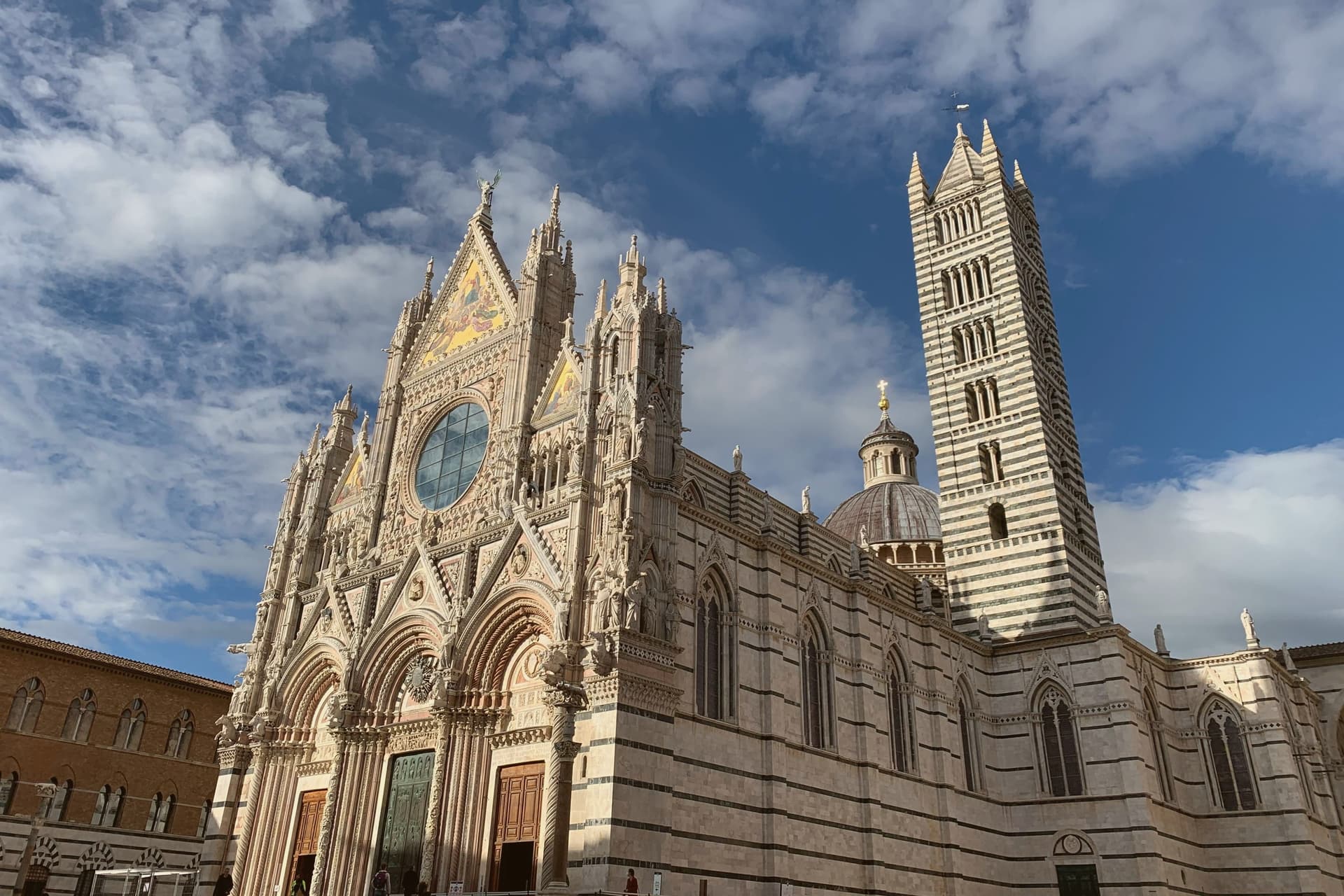
The Duomo itself, marble-clad in horizontal black and white bands, holds the inlaid mosaic floor that Vasari called the most beautiful ever made, and sculptures by Donatello, the Pisano family and Michelangelo. The Palio runs twice a year, on 2 July and 16 August: bareback riders representing seventeen contrade circle the Campo three times in roughly ninety seconds.
Ristorante Al Mangia, Osteria le Logge, Campo Cedro and 3 more have been named by a guide.
What to see in Siena
- Piazza del Campo. Shell-shaped medieval square at the meeting point of Siena's three hills, paved in 1349 in red brick divided into nine sectors for the Council of Nine.
- Palazzo Pubblico. Town hall begun in 1297, with the Sala dei Nove holding Lorenzetti's Allegory of Good and Bad Government from 1338-1339.
- Torre del Mangia. Brick tower built 1338-1348 next to the Palazzo Pubblico, 87 meters tall, set deliberately to match the height of the Duomo.
How to get to Siena
There is a railway station in the town, so you can arrive without a car and never need one while you are here. Firenze is roughly 73 minutes away by road.
✷ We have written about Siena
“Before Florence was the banking capital of the known world, the bench belonged to Siena. The word itself comes from the bench, the banco, where the money changers sat, and in the twelfth century, the Sienese ran some of the largest banking houses in Europe, moving the money of popes and kings while Florence was still finding its feet.”
Read our piece on Siena →Siena | What you are really here for
Our tip
April through June and September into October are the dry months in central Tuscany: mild days, full openings at the museums, the Campo busy but not packed. The Palio runs on 2 July and 16 August: the city stops for the four days around each race, the trial races fill the piazza twice a day, and accommodation books out a year ahead. July and August are otherwise hot and crowded with day-trippers from Florence. Palio della Madonna di Provenzano falls in July.
More from Anywhere Italy
- The best towns on a walking route in the province of Siena
- The best hidden towns with a medieval festival in the province of Siena
 The 9 best hidden hill towns on a walking route in Toscana
- The best small towns on a walking route in the province of Siena
- The best towns with a food festival in the province of Siena
 The best towns with a World Heritage site in the province of Siena