
The best towns you can reach by train that eat well in Basilicata
Basilicata cooks with very little and makes a lot of it: dried sweet peppers fried until they shatter, chickpeas and hand-cut lagane, lucanica sausage, caciocavallo aged in the cool of a cellar, bread with a crust the colour of tile. The wine is Aglianico grown on black volcanic soil under Monte Vulture, tannic when young and worth the wait. The towns are built from tufa and local sandstone, honey-coloured in the late afternoon, and many of them stack down a ridge rather than spread out. Autumn is the season everything lines up, with the grape and olive harvest, chestnuts, and the first cold evenings that justify the region's heavier dishes.
Most people who come to the south by rail are heading somewhere else. Puglia takes the bulk of it, Alberobello and Polignano a Mare and the coast road that empties Bari's station every summer morning, and further west the Amalfi Coast absorbs whatever is left. Basilicata gets crossed rather than stopped in, usually on the way between the two. The result is a region with real cooking and comparatively little competition for a table in it.
The hills and the food do not stop at the provincial border. The Vulture vineyards, the tufa towns, the Tyrrhenian cliffs at the region's narrow window on the sea, all of it continues past the places the coaches use, and a surprising amount of it is served by rail, the state line through the Basento valley and the narrow-gauge Appulo Lucane running up into the interior. The towns here are ones we have confirmed you can reach without a car, and where a dining guide has named a table worth sitting down at. Fewer people go, and the booking is usually easier.
Of the 31 communes we have mapped in Basilicata, 6 qualify as towns you can reach by train that eat well: we have confirmed each is reachable without a car, and a dining guide has named a table in each. The smallest, Acerenza, has 2,090 residents.
Two more lists worth reading alongside this one: The best hidden towns you can reach by train in Basilicata and The best towns that eat well in the province of Potenza.
Acerenza
Why visit Acerenza
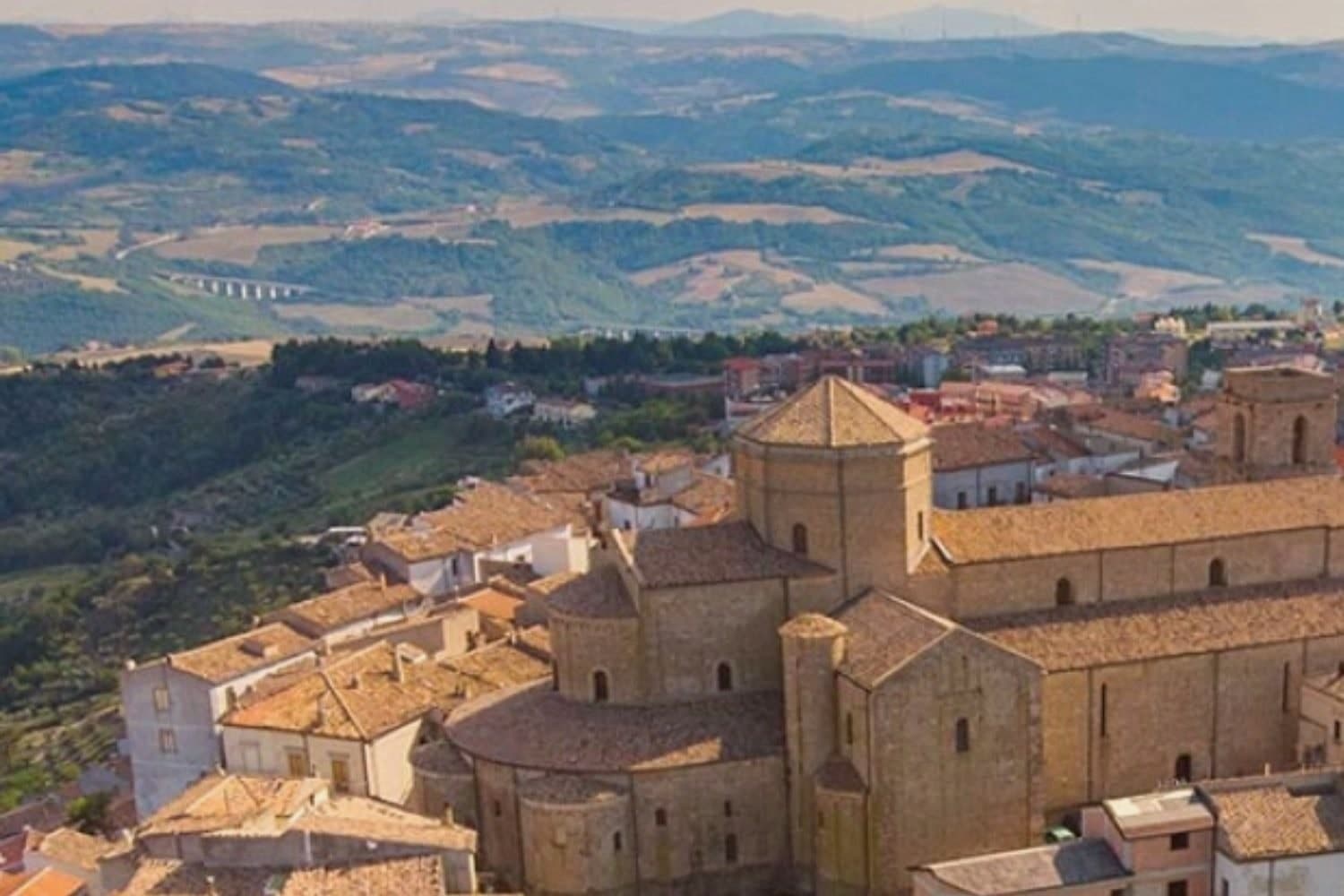
Acerenza stands on a sandstone ridge in the north of the Potenza province, a hundred kilometers inland from Salerno and twenty-two from Venosa. The Romans took it from the Lucanians in 318 BC as Aceruntia; the Ostrogoths and then the Lombards fortified it in turn.
It has been a bishop's seat since at least 499, long before the archbishopric that followed, which places the cathedral at the end of a much longer line of settlement rather than at its start. The town's medieval plan still reads clearly from the square at its summit down to the walls and gates that ring the ridge, the same fortifications raised against the invasions that repeatedly sacked the place.
Vineyards on the slopes below feed the Aglianico produced across the wider area, and the comune holds Città dell'Olio designation alongside its Borghi più belli membership, a working landscape wrapped around a fortified one. The ridge, the walls and the vineyards below them are one continuous piece of geography: a defensible height ringed by the land that has always fed it.
Palazzo Gala have been named by a guide.
What to see in Acerenza
- Cattedrale di Santa Maria Assunta e San Canio. Nave and two aisles under archbishop Arnaldo of Cluny, with sixteenth-century canvases inside and a marble bust identified as Julian the Apostate set among them.
- Centro storico medievale. Concentric plan typical of a fortified borgo, its gates still standing after repeated sackings through the early Middle Ages.
- Cripta del Ferrillo. Frescoes, columns and bas-reliefs beneath the cathedral floor, built as the chapel of the Ferrillo family.
How to get to Acerenza
There is a railway station in the town, so you can arrive without a car and never need one while you are here. Foggia is roughly 101 minutes away by road.
Our tip
May through October is the window when Acerenza's ridge feels right. Spring and autumn bring clear air across the Vulture and long views toward Monte Vulture itself, the extinct volcano whose slopes carry the Aglianico vineyards. July and August push past thirty degrees but the 833-meter elevation keeps the evenings cool; the centro storico empties between two and six. Natale e sapori ad Acerenza falls in December.
Irsina
Why visit Irsina
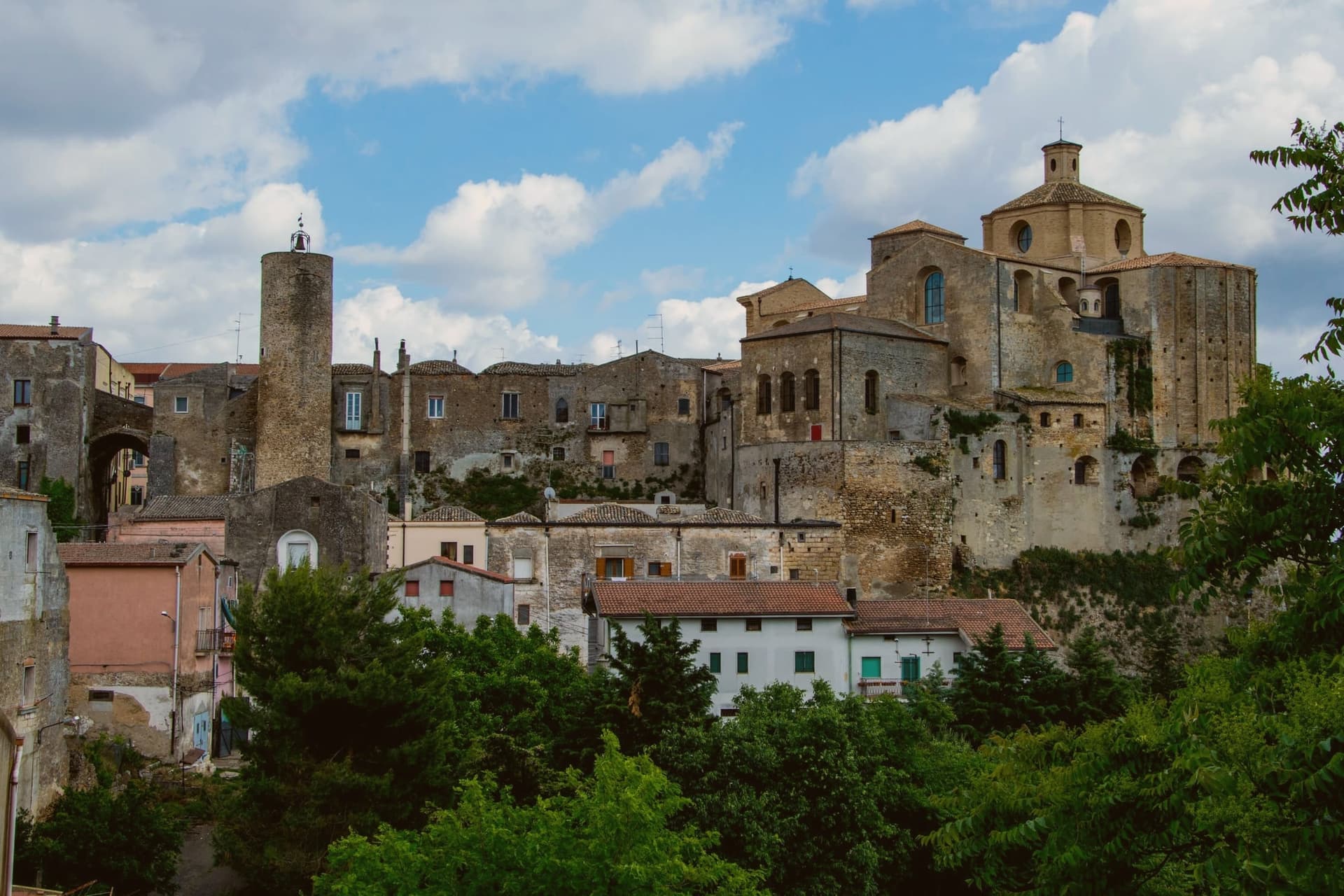
Irsina sits on the border between Basilicata and Puglia, twenty-nine kilometers from Matera, where the Bradano flows below and separates the town from the Murge plateau. The historic centre occupies a tufaceous spur riddled beneath with rupestrian caves and cisterns, a settlement built as much downward as up.
The town's civic and religious history turned on a single commission. Raised to an archbishop's seat in 1452, Montepeloso saw its priest, Roberto de Mabilia, then working as an ecclesiastical notary in Padua, commission a young sculptor from that city to carve a Sant'Eufemia for his home town the following year.
The statue he sent back carries the old town's own coat of arms, the triple mountain and castle, in the saint's hand, binding the imported Renaissance object to the local heraldry it was made to honor. A hill town on a river border ended up holding, by way of a notary's commission to a distant workshop, a devotional statue that ties its Puglia-facing geography to a Veneto hand and its pre-1895 name to the stone the saint holds.
Trattoria Nugent da Mario e Gigia have been named by a guide.
What to see in Irsina
- Cattedrale di Santa Maria Assunta. Thirteenth-century cathedral on the highest point of the borgo. Raised to an archbishop's seat in 1452, it holds the statue as its principal treasure.
- Sant'Eufemia di Mantegna. Carved from Nanto stone of the Veneto, the saint stands with a lion at her side. Identified as Andrea Mantegna's own work in 1996, confirmed by later scholars.
- Ipogei e cantine rupestri. Underground cellars, cisterns and rupestrian rooms cut into the tufaceous spur, reaching beneath the historic centre's alleys and houses.
How to get to Irsina
There is a railway station in the town, so you can arrive without a car and never need one while you are here. Bari is roughly 86 minutes away by road.
Our tip
April through June and September through October are the comfortable months in the Bradano hills, with green wheat fields and dry evenings at 548 meters. July and August touch the mid-thirties on the open spur but stay cool in the rupestrian cellars beneath the centro. November through March is quiet, the cathedral keeps shorter hours and the Mantegna can usually be seen without a queue.
Maratea
Why visit Maratea
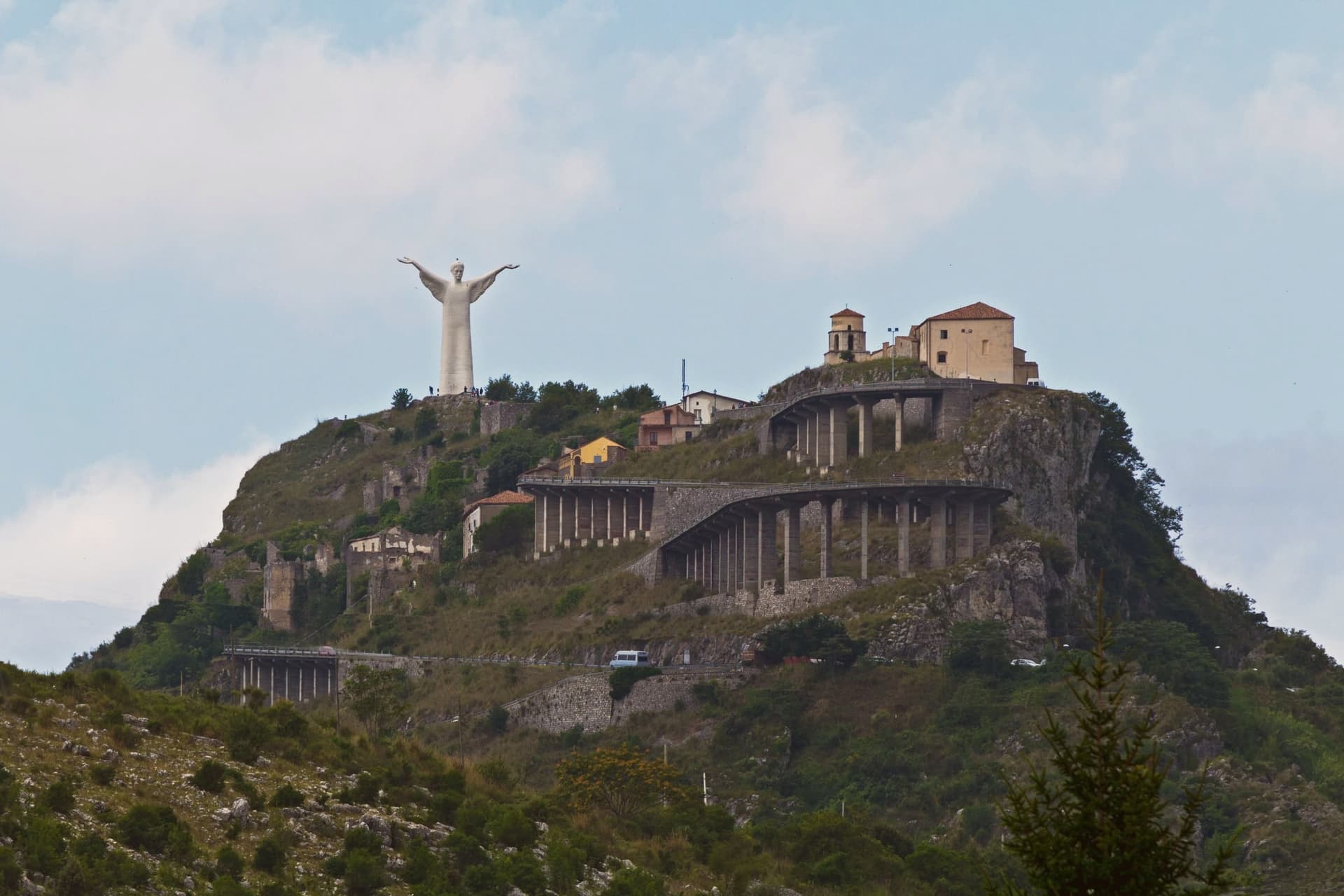
Maratea sits ninety kilometers south of Salerno, on the strip of coast between Campania and Calabria that gives Basilicata its only outlet to the Tyrrhenian. The town is built in layers rather than as a single settlement: the historic centre, Il Borgo, holds the middle ground at three hundred meters on the south slope of the mountain, a few kilometers inland from the water.
Above it, near the summit at 623 meters, the mountain carries both the statue of Christ and, just below it, the sanctuary of the patron saint, the two facing each other rather than out to sea. Higher still, at the very top, are the ruins of Maratea Superiore, the medieval Castello settlement that residents abandoned in favor of the lower borgo.
Below all of this, the comune's thirty-two kilometers of rocky shoreline carry the Bandiera Blu and more than twenty beaches and coves, the only Tyrrhenian coast Basilicata has. The town of forty-four churches is a count that spans not just the borgo but its outlying frazioni, chapels and oratories accumulated over centuries across the whole territory rather than in one place.
What this adds up to is a town stacked vertically from shore to summit, each level, coast, borgo, sanctuary, ruined castello, holding a different age and function of the same settlement rather than a single center with outskirts.
Taverna Rovita, La Cambusa, Cesare and 1 more have been named by a guide.
What to see in Maratea
- Cristo Redentore. Arms outstretched at the summit, the statue faces away from the sea, toward the sanctuary and the inland slopes rather than out over the water it overlooks.
- Basilica di San Biagio. Marian sanctuary at the summit of Monte San Biagio, immediately below the Cristo Redentore, holding relics of the patron saint.
- Il Borgo. Historic centre of Maratea on the south slope of the mountain at 300 meters, with narrow stone lanes and small piazzas typical of an inland coastal town.
How to get to Maratea
There is a railway station in the town, so you can arrive without a car and never need one while you are here. Salerno is roughly 110 minutes away by road.
Our tip
May through September is the season for Maratea. The Tyrrhenian water is swimmable from late May to mid-October. June and September are the strongest months: warm water, lighter crowds, and the kind of clear air that pulls the Calabrian coast into view from the Cristo. Borgo diVino tour falls in September.
Venosa
Why visit Venosa
Venosa sits at 415 meters in the Vulture hills, ninety kilometers east of Salerno. The Romans founded Venusia here in 291 BC as a colony on the Appian Way, and it became the birthplace of Quintus Horatius Flaccus, the poet Horace, in 65 BC.
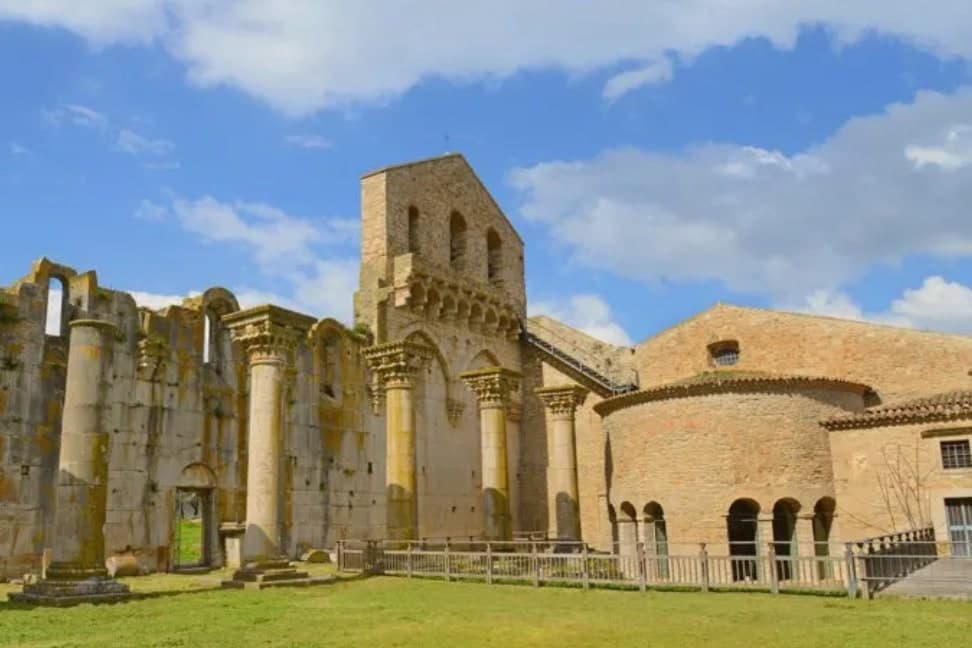
The Parco Archeologico preserves a Roman amphitheater, the baths, and mosaic floors, alongside the so-called Casa di Orazio. Above the ruins stands the Abbazia della Santissima Trinità, an eleventh-century Benedictine complex begun in 1059, with its walls built from blocks salvaged out of the Roman amphitheater next door.
The Incompiuta, the unfinished thirteenth-century cathedral expansion immediately behind the abbey, is roofless and visibly stitched together from Roman fragments. The town centre is dominated by the Castello di Pirro del Balzo, built in 1470 on the foundations of an earlier cathedral and modelled on the Maschio Angioino in Naples.
Venosa is at the heart of the Aglianico del Vulture DOC and DOCG zone, the great red of southern Italy, grown on the volcanic slopes of nearby Monte Vulture.
Al Baliaggio have been named by a guide.
What to see in Venosa
- Abbazia della Santissima Trinità. Benedictine abbey of 1059 with walls built from blocks of the adjacent Roman amphitheater, the spiritual centre of Norman Venosa.
- Incompiuta. Roofless thirteenth-century cathedral expansion behind the abbey of Santissima Trinità, abandoned mid-build, visibly assembled from Roman spolia.
- Castello di Pirro del Balzo. Quadrangular Aragonese castle of 1470 with corner towers, built on the foundations of the earlier cathedral, modelled on Castel Nuovo in Naples.
How to get to Venosa
There is a railway station in the town, so you can arrive without a car and never need one while you are here. Foggia is roughly 70 minutes away by road.
Our tip
April through June is the green window in the Vulture, with cool evenings and the archaeological park empty in the mornings. September and October are dry and gold, the Aglianico harvest runs into November, and the Cantina di Venosa cellars are open for tastings. July and August reach the mid-thirties; visitors retreat to the abbey shade and the wine cellars. Fiera sapori del Sud falls in May.
Melfi
Why visit Melfi
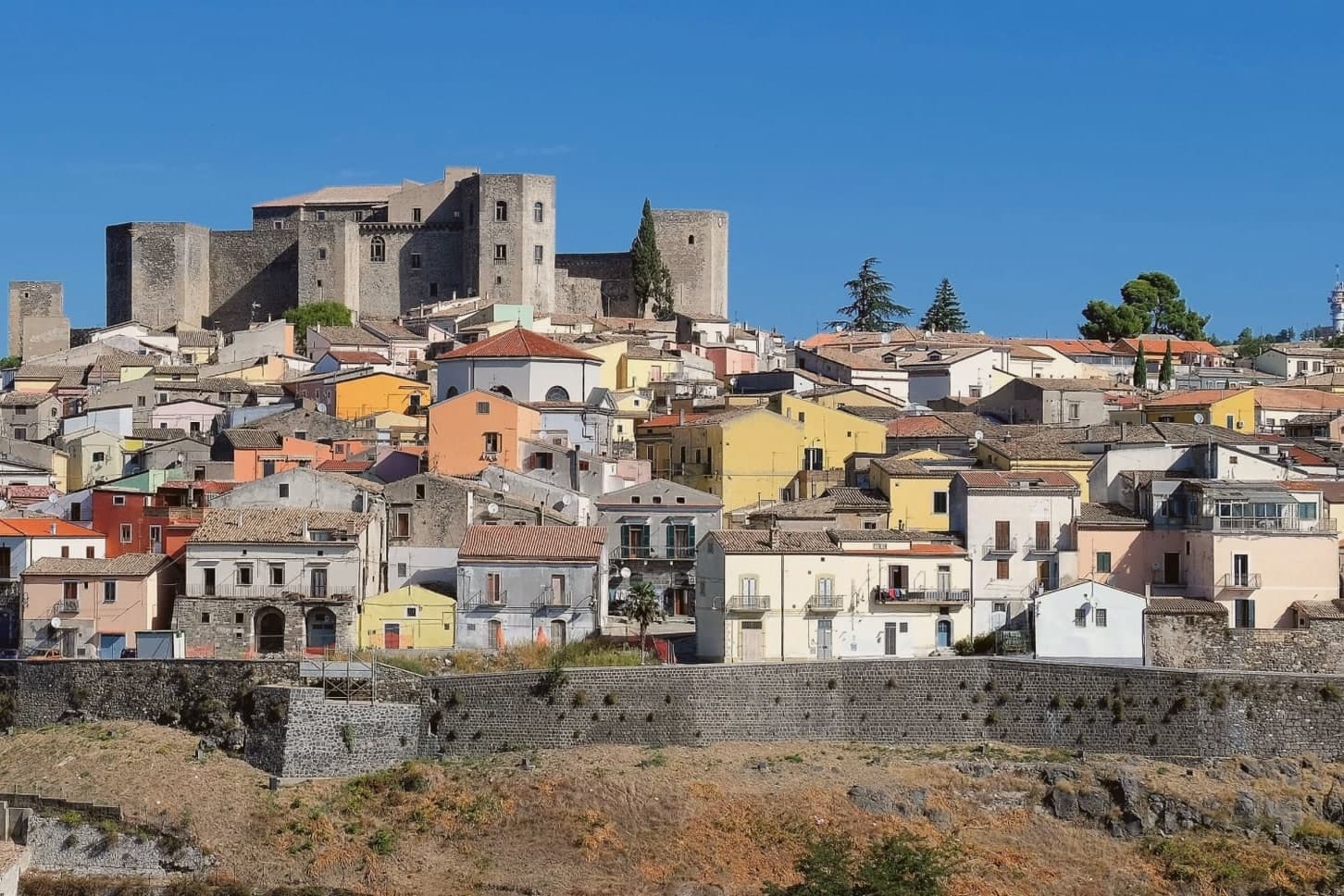
Melfi sits on the slopes of an extinct volcano east of the Apennine spine, the same mass whose crater holds the Laghi di Monticchio and whose soils now define a wine zone. The Hauteville Normans took the town in 1041 and made it the first capital of their southern Italian duchy, a status that explains the density of what followed: a cathedral built within a generation, a castle raised soon after and expanded by an emperor, a legal code drafted within those walls that shaped a kingdom's law.
The walled centro storico spreads below the castle, its gate and noble palazzi still arranged along the lines the Norman-Swabian town laid down. Upper fortress and lower town, volcanic mountain and walled centre: Melfi reads as a place where secular power, church authority and the raw geology of Monte Vulture sat close enough together to shape one small hill town into a seat of empire-level decisions.
La Villa have been named by a guide.
What to see in Melfi
- Castello di Melfi. Late-eleventh-century Norman fortress with ten towers, seven rectangular and three pentagonal. Frederick II expanded it after 1194, and the Constitutions of Melfi were promulgated within its walls.
- Cattedrale di Santa Maria Assunta. Dating from 1056, host of five ecumenical councils between 1059 and 1137. Stands at the heart of the walled centre below the castle.
- Museo Archeologico Nazionale del Vulture-Melfese. Inside the castle, with the second-century Roman sarcophagus of Rapolla and finds from the Daunian, Lucanian and Roman periods.
How to get to Melfi
There is a railway station in the town, so you can arrive without a car and never need one while you are here. Foggia is roughly 55 minutes away by road.
Our tip
April through June and September through October are the best windows in Melfi, with cool evenings and the Aglianico vineyards at their most photogenic. July and August reach the mid-thirties; the castle interiors and the cathedral hold the heat at bay. The Aglianico harvest runs into November and the Cantine and museums stay open. Sagra della castagna Varola falls in October.
Matera
Why visit Matera
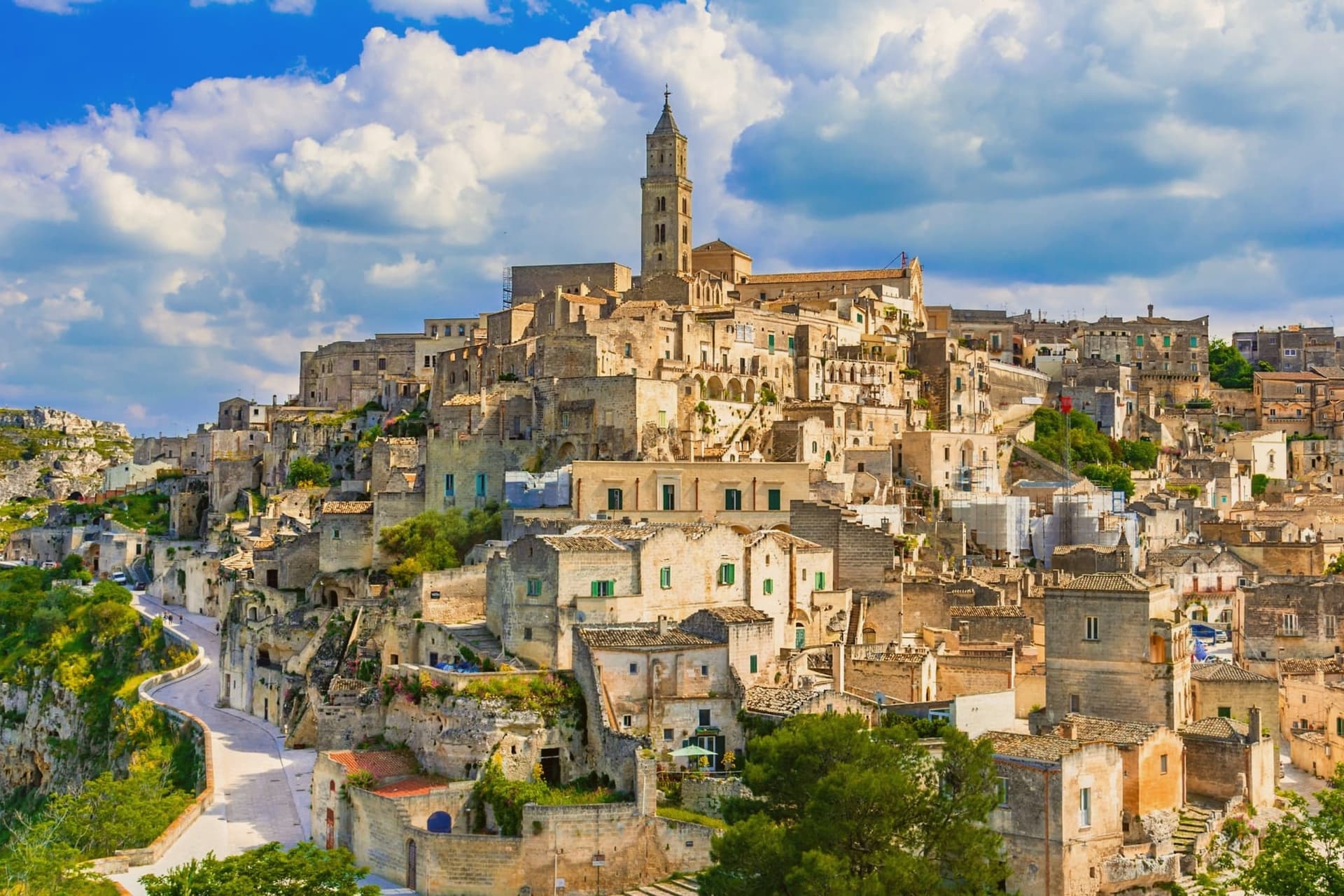
Matera sits at 401 meters on the edge of the Gravina ravine in eastern Basilicata, fifty-five kilometers inland from Bari. The Sassi, two districts of houses, churches and cisterns hollowed from tufa limestone, are among the oldest continuously inhabited settlements on earth, with traces of human presence from the Paleolithic.
Sasso Caveoso and Sasso Barisano dropped down the canyon walls; people lived there with their animals into the 1950s. Carlo Levi's 1945 book and the 1948 photographs that followed turned the Sassi into a national scandal, and a 1952 law moved twenty thousand residents to new housing on the plateau above.
The caves stayed empty for thirty years. UNESCO listed them in 1993.
Mel Gibson shot The Passion of the Christ here in 2004 and the city was European Capital of Culture in 2019; No Time to Die filmed in the Sassi in 2019, bringing twelve million euros into the local economy. Bread, ceramics, and rock churches across the Gravina anchor what is now Basilicata's only mass-tourism destination.
Vitantonio Lombardo, Baccanti, Dimora Ulmo and 9 more have been named by a guide.
What to see in Matera
- Sassi di Matera. Two districts of cave dwellings, Sasso Caveoso and Sasso Barisano, carved from tufa limestone and inhabited continuously from the Paleolithic until the 1950s evictions.
- Cattedrale della Madonna della Bruna e di Sant'Eustachio. Thirteenth-century Apulian Romanesque cathedral on the highest point of the Civita, between the two Sassi, with rose window and bell tower.
- Chiese rupestri del Parco della Murgia. More than 150 rock-cut churches scattered across the Gravina canyon, frescoed between the eighth and thirteenth centuries by Italo-Greek monks.
How to get to Matera
There is a railway station in the town, so you can arrive without a car and never need one while you are here. Bari is roughly 60 minutes away by road.
Our tip
April through June and September into October are the months Matera was built for. The light slants across the tufa façades in the late afternoon and turns the Sassi gold. July and August are punishing: temperatures cross thirty-five degrees and the canyon walls hold the heat past midnight, though hotels stay full because the Bond and Gibson tourism waves have not subsided. Festa della Bruna falls in July.
More from Anywhere Italy
- The best hidden towns you can reach by train in Basilicata
 The best towns that eat well in the province of Potenza
 The best towns you can reach by train that eat well within 90 minutes of Foggia
 The best olive oil towns in Basilicata
 The 8 prettiest small villages in Basilicata
 The best towns with a food festival in Basilicata