
The best hidden towns you can reach by train in Basilicata
Basilicata is built out of what it stands on: sandstone, tufa, limestone the colour of old bread. Hill towns sit on ridges above wheat and clay badlands, with the Ionian coast running flat and sandy below and the Tyrrhenian side falling steeply into water on the far west. The food follows the geology, wheat and peppers and pork, lucanica sausage, bread baked dark and heavy, Aglianico del Vulture grown on volcanic soil around the extinct cone. Late spring and early autumn are the seasons for it, when the interior is green rather than bleached and the beaches are still warm.
The region's fame now runs through Matera, and almost every visitor arrives, photographs the Sassi, sleeps in a cave hotel and leaves. It is worth the crowd, but it is a single day for most people, reached by coach or by the private line from Bari, and the streets above the ravine are dense from morning until the light goes. The rest of Basilicata absorbs a fraction of that traffic, partly because everyone assumes you need a car to see it.
You do not, at least not everywhere. The main Naples to Taranto line, the Ionian coastal railway and the connecting rail buses reach a good number of smaller places, and that is what this list is: Basilicata towns we have confirmed you can get to without hiring anything. The same tufa, the same Aglianico, the same beaches, with fewer people looking at them.
Of the 31 communes we have mapped in Basilicata, 11 qualify as towns you can reach by train: we have confirmed each is reachable without a car. This list is the hidden ones, 7 in all, ordered smallest first. The smallest, Acerenza, has 2,090 residents.
Elsewhere in the catalogue: The best towns you can reach by train that eat well in Basilicata and The 6 best towns you can reach by train in the province of Matera.
Acerenza
Why visit Acerenza
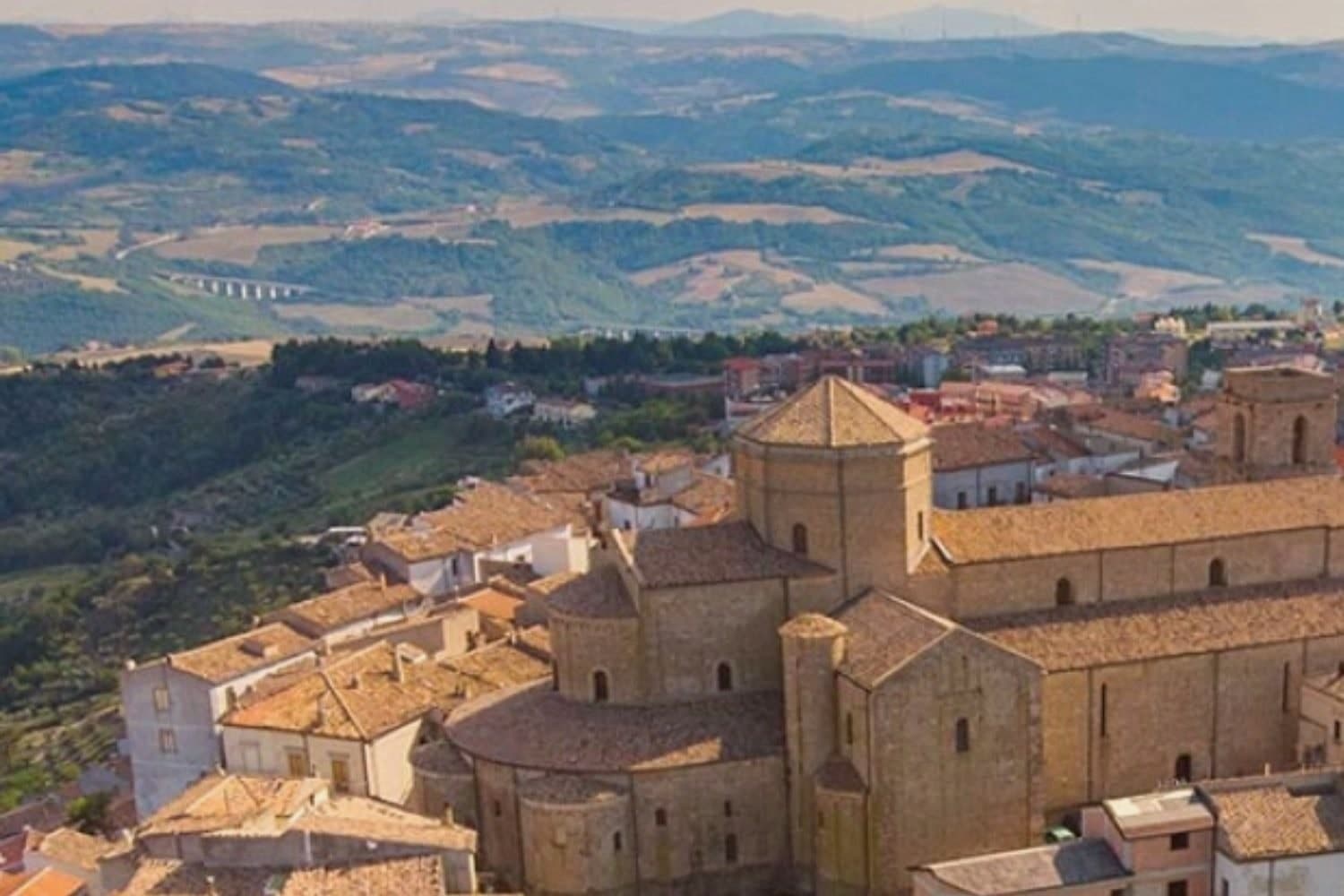
Acerenza stands on a sandstone ridge in the north of the Potenza province, a hundred kilometers inland from Salerno and twenty-two from Venosa. The Romans took it from the Lucanians in 318 BC as Aceruntia; the Ostrogoths and then the Lombards fortified it in turn.
It has been a bishop's seat since at least 499, long before the archbishopric that followed, which places the cathedral at the end of a much longer line of settlement rather than at its start. The town's medieval plan still reads clearly from the square at its summit down to the walls and gates that ring the ridge, the same fortifications raised against the invasions that repeatedly sacked the place.
Vineyards on the slopes below feed the Aglianico produced across the wider area, and the comune holds Città dell'Olio designation alongside its Borghi più belli membership, a working landscape wrapped around a fortified one. The ridge, the walls and the vineyards below them are one continuous piece of geography: a defensible height ringed by the land that has always fed it.
We confirmed you can reach this one by train.
What to see in Acerenza
- Cattedrale di Santa Maria Assunta e San Canio. Nave and two aisles under archbishop Arnaldo of Cluny, with sixteenth-century canvases inside and a marble bust identified as Julian the Apostate set among them.
- Centro storico medievale. Concentric plan typical of a fortified borgo, its gates still standing after repeated sackings through the early Middle Ages.
- Cripta del Ferrillo. Frescoes, columns and bas-reliefs beneath the cathedral floor, built as the chapel of the Ferrillo family.
How to get to Acerenza
There is a railway station in the town, so you can arrive without a car and never need one while you are here. Foggia is roughly 101 minutes away by road.
Our tip
May through October is the window when Acerenza's ridge feels right. Spring and autumn bring clear air across the Vulture and long views toward Monte Vulture itself, the extinct volcano whose slopes carry the Aglianico vineyards. July and August push past thirty degrees but the 833-meter elevation keeps the evenings cool; the centro storico empties between two and six. Natale e sapori ad Acerenza falls in December.
Irsina
Why visit Irsina
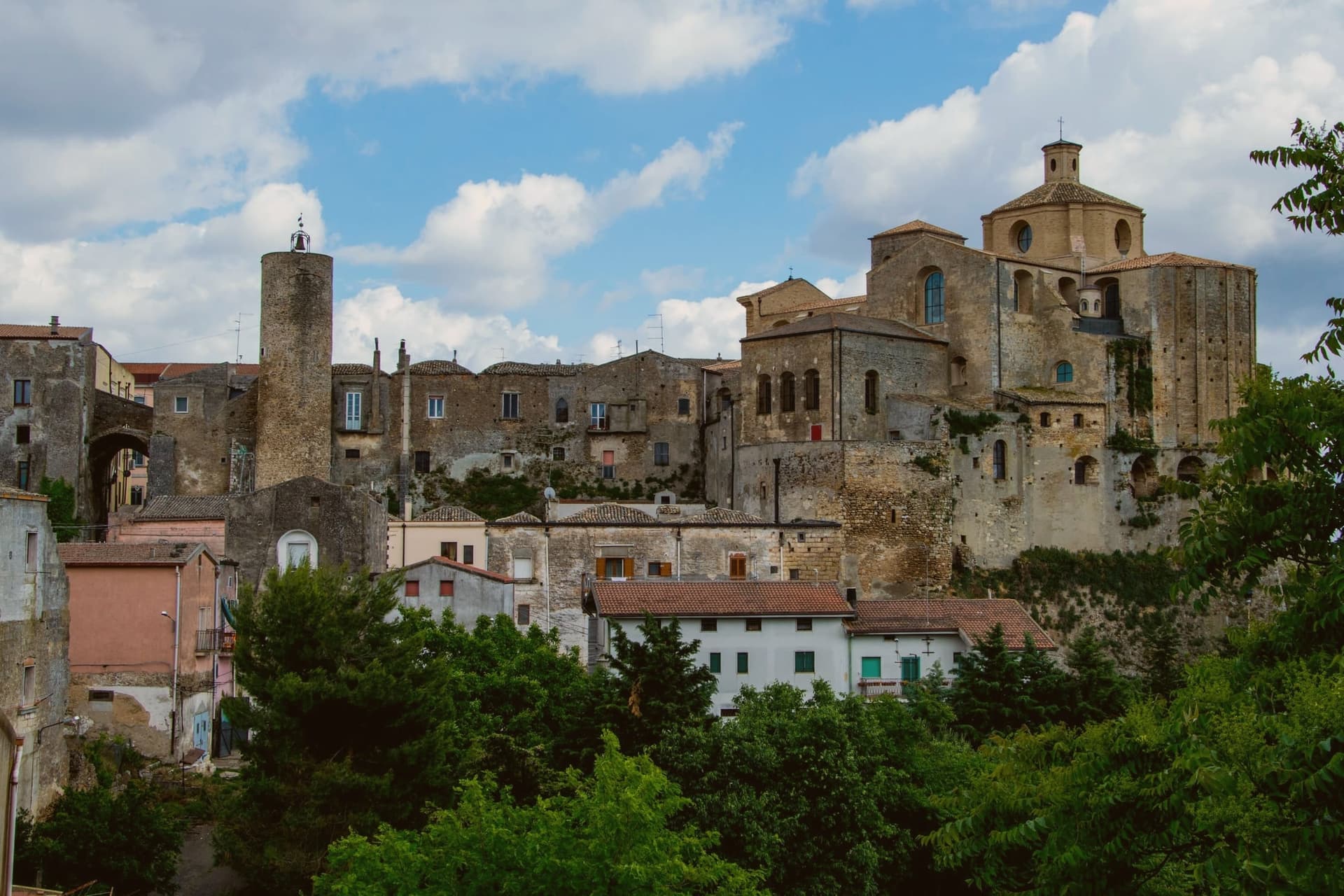
Irsina sits on the border between Basilicata and Puglia, twenty-nine kilometers from Matera, where the Bradano flows below and separates the town from the Murge plateau. The historic centre occupies a tufaceous spur riddled beneath with rupestrian caves and cisterns, a settlement built as much downward as up.
The town's civic and religious history turned on a single commission. Raised to an archbishop's seat in 1452, Montepeloso saw its priest, Roberto de Mabilia, then working as an ecclesiastical notary in Padua, commission a young sculptor from that city to carve a Sant'Eufemia for his home town the following year.
The statue he sent back carries the old town's own coat of arms, the triple mountain and castle, in the saint's hand, binding the imported Renaissance object to the local heraldry it was made to honor. A hill town on a river border ended up holding, by way of a notary's commission to a distant workshop, a devotional statue that ties its Puglia-facing geography to a Veneto hand and its pre-1895 name to the stone the saint holds.
We confirmed you can reach this one by train.
What to see in Irsina
- Cattedrale di Santa Maria Assunta. Thirteenth-century cathedral on the highest point of the borgo. Raised to an archbishop's seat in 1452, it holds the statue as its principal treasure.
- Sant'Eufemia di Mantegna. Carved from Nanto stone of the Veneto, the saint stands with a lion at her side. Identified as Andrea Mantegna's own work in 1996, confirmed by later scholars.
- Ipogei e cantine rupestri. Underground cellars, cisterns and rupestrian rooms cut into the tufaceous spur, reaching beneath the historic centre's alleys and houses.
How to get to Irsina
There is a railway station in the town, so you can arrive without a car and never need one while you are here. Bari is roughly 86 minutes away by road.
Our tip
April through June and September through October are the comfortable months in the Bradano hills, with green wheat fields and dry evenings at 548 meters. July and August touch the mid-thirties on the open spur but stay cool in the rupestrian cellars beneath the centro. November through March is quiet, the cathedral keeps shorter hours and the Mantegna can usually be seen without a queue.
Maratea
Why visit Maratea
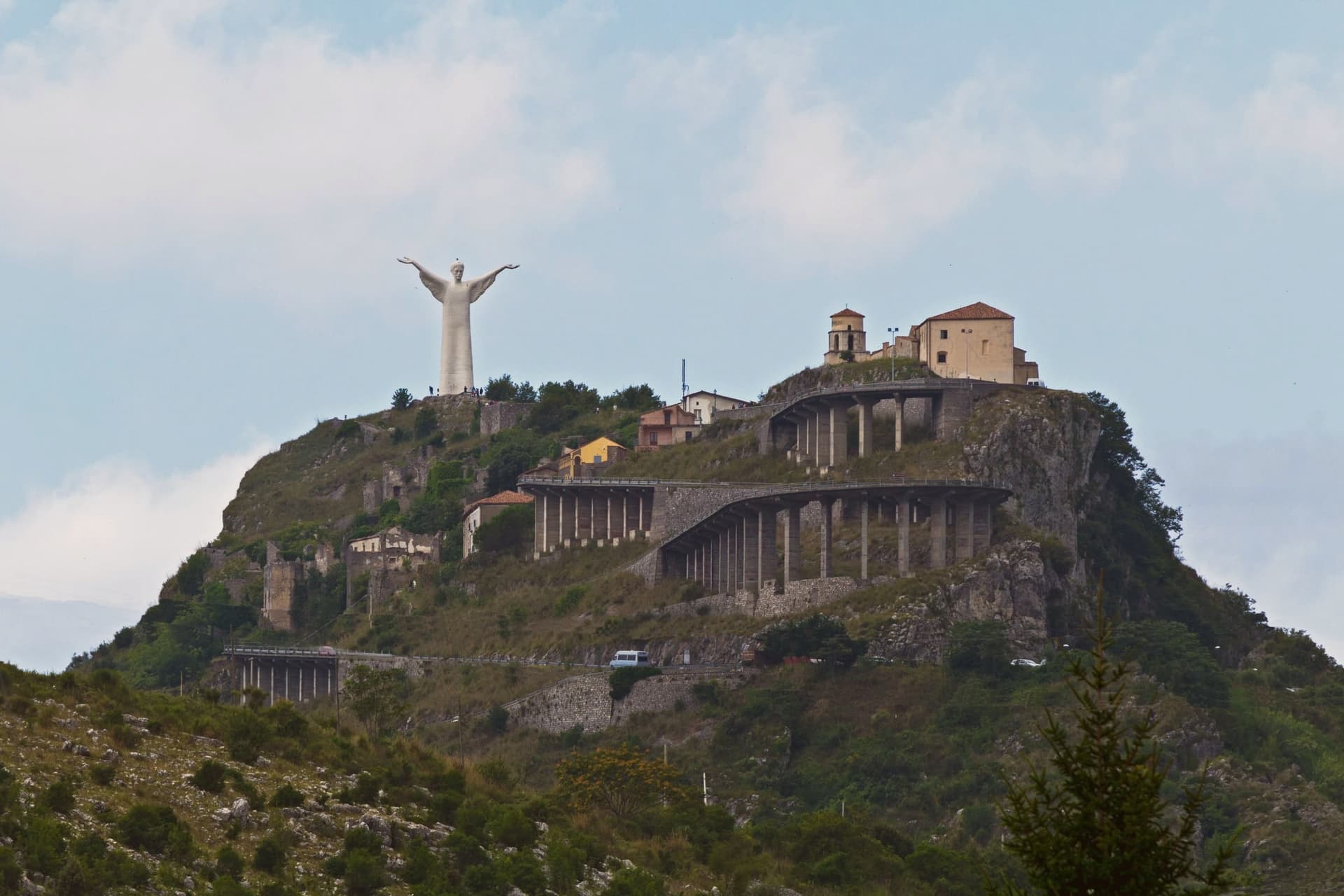
Maratea sits ninety kilometers south of Salerno, on the strip of coast between Campania and Calabria that gives Basilicata its only outlet to the Tyrrhenian. The town is built in layers rather than as a single settlement: the historic centre, Il Borgo, holds the middle ground at three hundred meters on the south slope of the mountain, a few kilometers inland from the water.
Above it, near the summit at 623 meters, the mountain carries both the statue of Christ and, just below it, the sanctuary of the patron saint, the two facing each other rather than out to sea. Higher still, at the very top, are the ruins of Maratea Superiore, the medieval Castello settlement that residents abandoned in favor of the lower borgo.
Below all of this, the comune's thirty-two kilometers of rocky shoreline carry the Bandiera Blu and more than twenty beaches and coves, the only Tyrrhenian coast Basilicata has. The town of forty-four churches is a count that spans not just the borgo but its outlying frazioni, chapels and oratories accumulated over centuries across the whole territory rather than in one place.
What this adds up to is a town stacked vertically from shore to summit, each level, coast, borgo, sanctuary, ruined castello, holding a different age and function of the same settlement rather than a single center with outskirts.
We confirmed you can reach this one by train.
What to see in Maratea
- Cristo Redentore. Arms outstretched at the summit, the statue faces away from the sea, toward the sanctuary and the inland slopes rather than out over the water it overlooks.
- Basilica di San Biagio. Marian sanctuary at the summit of Monte San Biagio, immediately below the Cristo Redentore, holding relics of the patron saint.
- Il Borgo. Historic centre of Maratea on the south slope of the mountain at 300 meters, with narrow stone lanes and small piazzas typical of an inland coastal town.
How to get to Maratea
There is a railway station in the town, so you can arrive without a car and never need one while you are here. Salerno is roughly 110 minutes away by road.
Our tip
May through September is the season for Maratea. The Tyrrhenian water is swimmable from late May to mid-October. June and September are the strongest months: warm water, lighter crowds, and the kind of clear air that pulls the Calabrian coast into view from the Cristo. Borgo diVino tour falls in September.
Lagonegro
Why visit Lagonegro
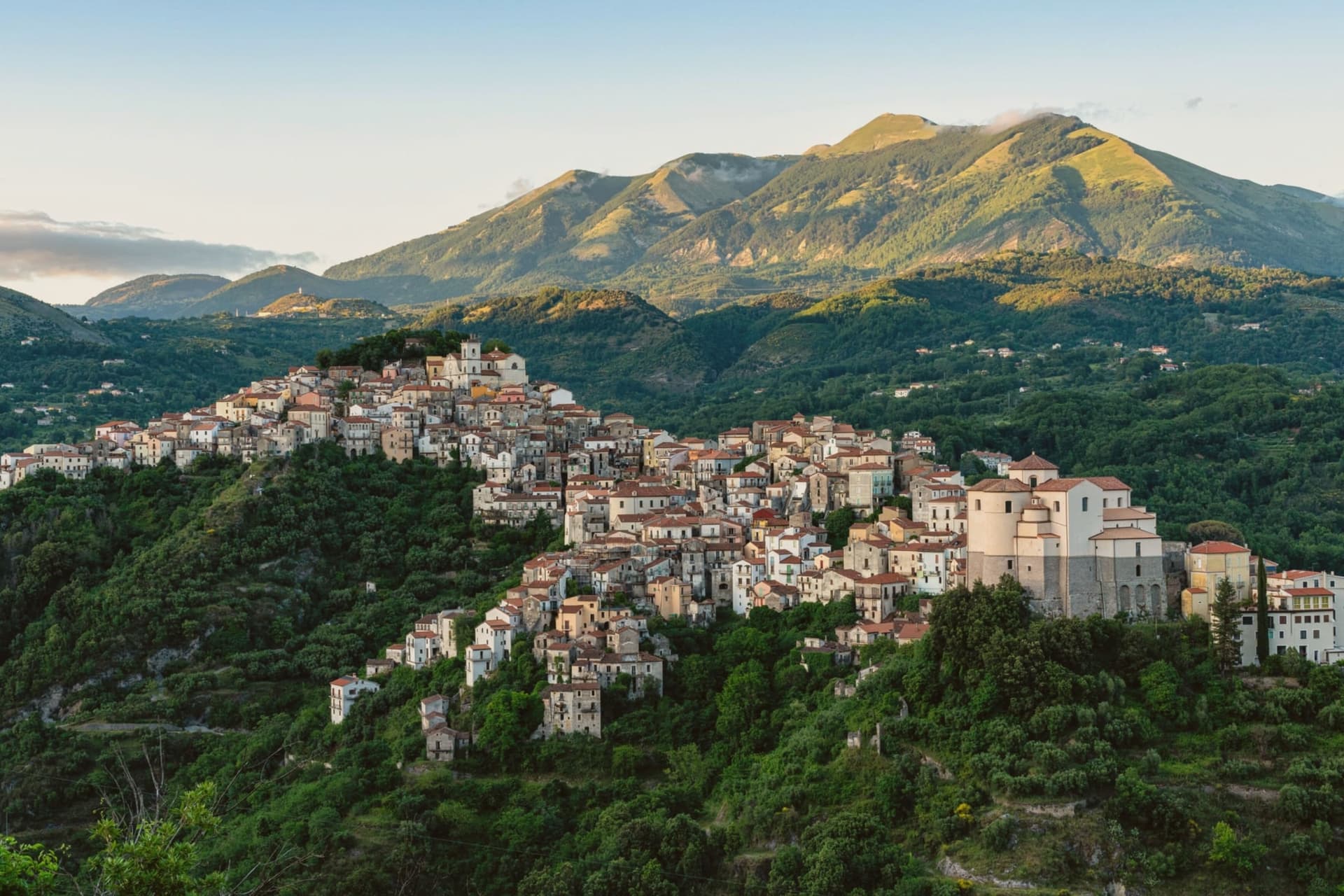
Byzantine monks established the settlement between the ninth and tenth centuries on a defensive promontory between the Noce and Cogliandrino streams, the position that gives the valley its name. The town divides cleanly in two: the old village climbs around the castle ruins and the parish church, while the modern town spreads from the tree-lined Piano square below, the wooded slope between them marking the line where medieval stone gives way to nineteenth-century planning.
The church holds the tomb local tradition assigns to the Florentine model of Leonardo's Mona Lisa, said to have died here in 1506. Lake Sirino at 788 meters and the glacial Lake Laudemio at 1,525 meters both lie within twenty minutes of the town, under the same mountain wall that shelters it.
The town's two halves and the legend it keeps in spite of the evidence against it both point to the same trait: a place defined by what it holds onto, geographically and otherwise.
We confirmed you can reach this one by train.
What to see in Lagonegro
- Chiesa di San Nicola. Tenth-century church in the old village, holds the tomb local tradition assigns to Lisa del Giocondo and two sculptures by Altobello Persio.
- Castello feudale. Ruins of the feudal fortress on the promontory of the old village, the original Byzantine and later Norman defensive anchor of the Valle del Noce.
- Borgo antico. Stone-built medieval core climbing around the castle ruins, separated by the wooded slope from the modern town below.
How to get to Lagonegro
There is a railway station in the town, so you can arrive without a car and never need one while you are here. Salerno is roughly 85 minutes away by road.
Our tip
May through October is the walking and lake season. The Laudemio reserve opens once snow clears from the upper Sirino, usually by late May, and the Cammino di San Nilo passes through Lagonegro for pilgrims working southward. July and August are warm in the lower town but the upper village holds shade; weekends fill with Salerno families on the Sirino trails. Festa lagane e fagioli falls in August.
Nova Siri
Why visit Nova Siri
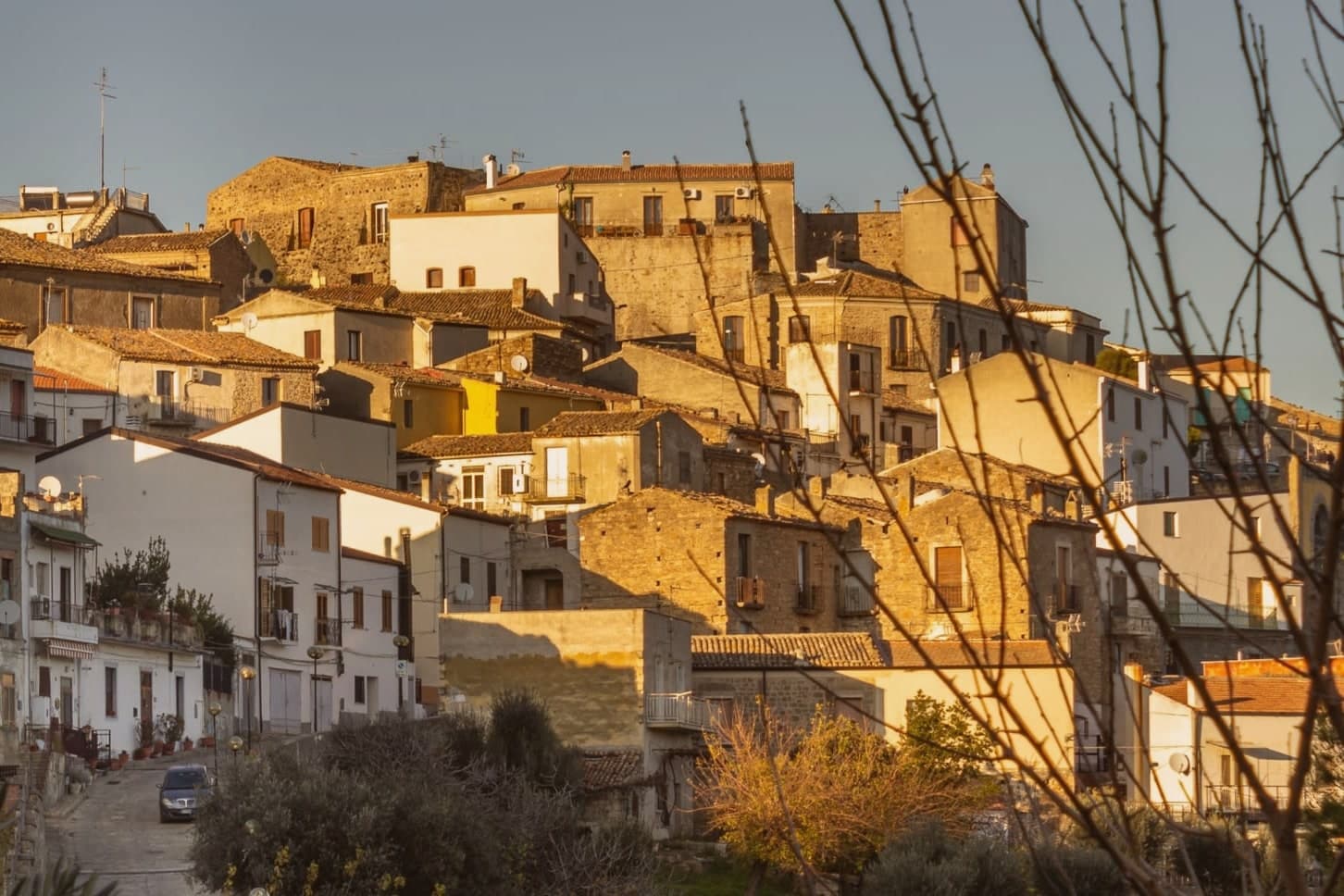
Nova Siri exists in two parts. The old town sits at 350 meters on a hill nine kilometers inland; Marina di Nova Siri lies on the Ionian Sea below, developed from the 1970s onward as a beach town.
The site is on the southern edge of Basilicata where the region meets Calabria, near the ancient Greek colony of Siris, founded by Ionian settlers in the seventh century BC and destroyed in the sixth, whose territory gave the region its name of Siritide and whose river, the modern Sinni, still defines the comune. Byzantine military use followed in the early medieval period.
The Torre Bollita, a semicircular tufo tower inside the medieval walls, is the surviving fortification; in its vicinity, the remains of a Hellenistic necropolis have come to light. The Chiesa Madre dedicated to Santa Maria Assunta dates to the sixteenth century.
The Marina holds the Bandiera Blu since 2018, with wide sandy beaches, dunes and pine forest behind. Spighe Verdi recognises the commune's rural and environmental management.
We confirmed you can reach this one by train.
What to see in Nova Siri
- Marina di Nova Siri. Bandiera Blu beach since 2018, with sandy coast, dunes and a pine-shaded promenade nine kilometers below the old town.
- Torre Bollita. Semicircular tufo defensive tower within the medieval walls, the surviving fortification of the historic centre.
- Chiesa Madre di Santa Maria Assunta. Sixteenth-century mother church in the old town, dedicated to Santa Maria Assunta, the village's patron saint and protectress.
How to get to Nova Siri
There is a railway station in the town, so you can arrive without a car and never need one while you are here. Taranto is roughly 80 minutes away by road.
Our tip
May through September is the Ionian beach season for Nova Siri Marina. Water is swimmable from late May, the Bandiera Blu is in force, and the dune-and-pine strip behind the beach keeps the heat tolerable. July and August reach the mid-thirties; the old town nine kilometers inland is several degrees cooler at 350 meters.
Venosa
Why visit Venosa
Venosa sits at 415 meters in the Vulture hills, ninety kilometers east of Salerno. The Romans founded Venusia here in 291 BC as a colony on the Appian Way, and it became the birthplace of Quintus Horatius Flaccus, the poet Horace, in 65 BC.
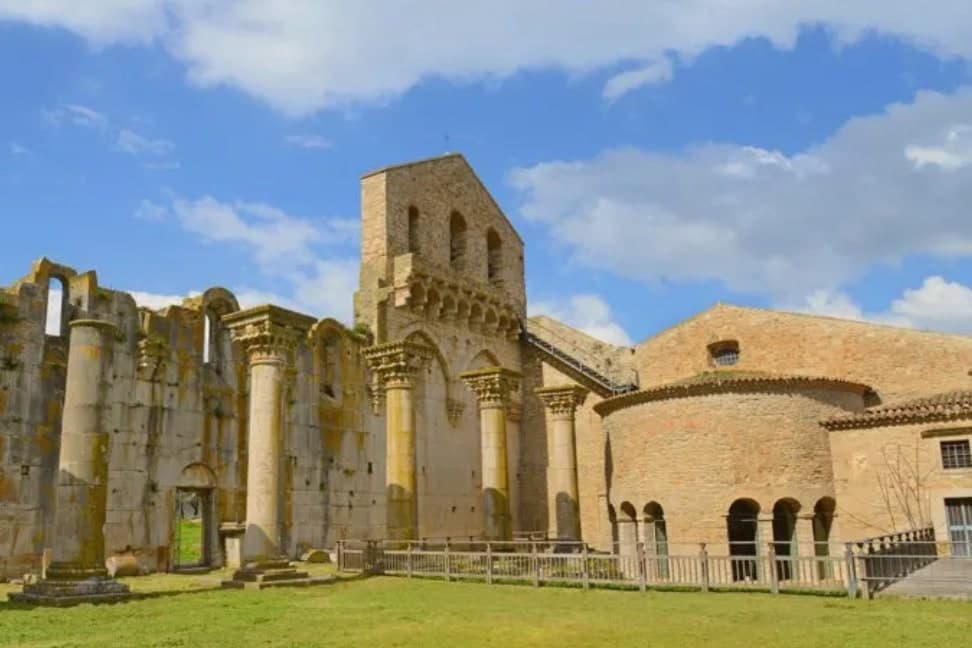
The Parco Archeologico preserves a Roman amphitheater, the baths, and mosaic floors, alongside the so-called Casa di Orazio. Above the ruins stands the Abbazia della Santissima Trinità, an eleventh-century Benedictine complex begun in 1059, with its walls built from blocks salvaged out of the Roman amphitheater next door.
The Incompiuta, the unfinished thirteenth-century cathedral expansion immediately behind the abbey, is roofless and visibly stitched together from Roman fragments. The town centre is dominated by the Castello di Pirro del Balzo, built in 1470 on the foundations of an earlier cathedral and modelled on the Maschio Angioino in Naples.
Venosa is at the heart of the Aglianico del Vulture DOC and DOCG zone, the great red of southern Italy, grown on the volcanic slopes of nearby Monte Vulture.
We confirmed you can reach this one by train.
What to see in Venosa
- Abbazia della Santissima Trinità. Benedictine abbey of 1059 with walls built from blocks of the adjacent Roman amphitheater, the spiritual centre of Norman Venosa.
- Incompiuta. Roofless thirteenth-century cathedral expansion behind the abbey of Santissima Trinità, abandoned mid-build, visibly assembled from Roman spolia.
- Castello di Pirro del Balzo. Quadrangular Aragonese castle of 1470 with corner towers, built on the foundations of the earlier cathedral, modelled on Castel Nuovo in Naples.
How to get to Venosa
There is a railway station in the town, so you can arrive without a car and never need one while you are here. Foggia is roughly 70 minutes away by road.
Our tip
April through June is the green window in the Vulture, with cool evenings and the archaeological park empty in the mornings. September and October are dry and gold, the Aglianico harvest runs into November, and the Cantina di Venosa cellars are open for tastings. July and August reach the mid-thirties; visitors retreat to the abbey shade and the wine cellars. Fiera sapori del Sud falls in May.
Bernalda
Why visit Bernalda
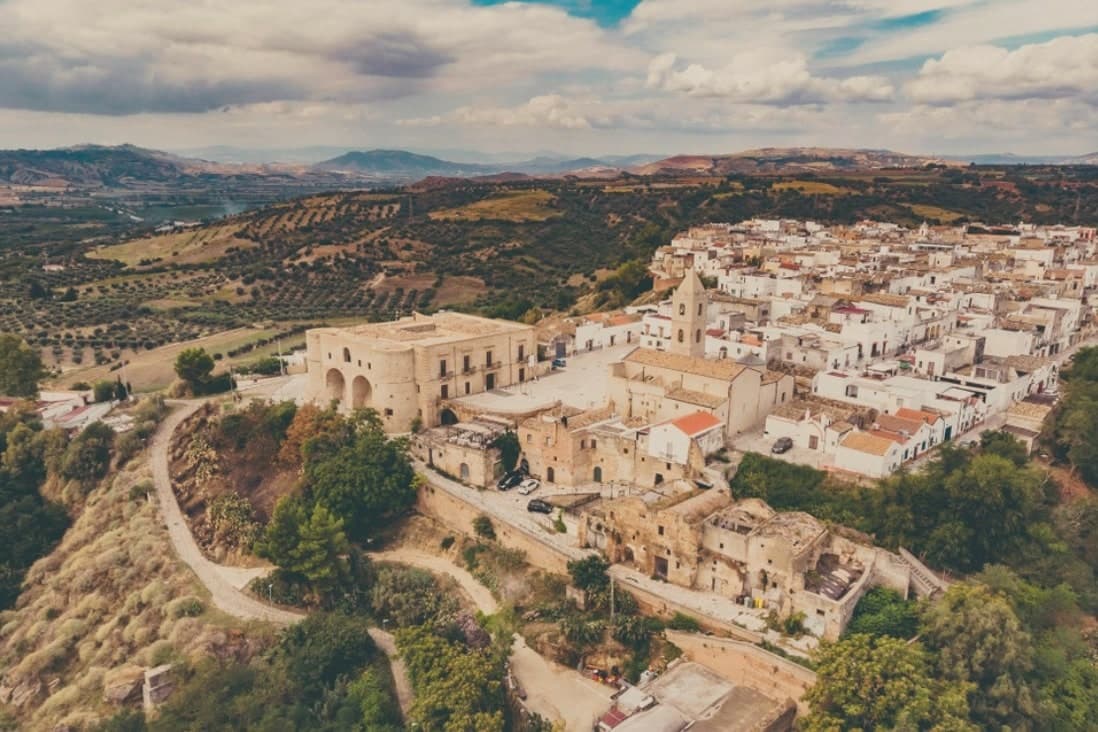
Bernalda sits at 127 meters between the Bradano and Basento rivers, eight kilometers inland from the Ionian coast and the frazione of Metaponto. Almost twelve thousand people live in the town, named for the Aragonese courtier who moved the older Camarda settlement up to the defensible hilltop where the centro still stands.
The corso and the castle anchor the upper town; the coast and its archaeological ground lie a separate world eight kilometers below. Metaponto was founded by Achaean Greeks in the seventh century BC, the plain later home to Pythagoras until his death.
What remains there today spans a wide stretch of time in a small area: temple columns from the sixth century BC, a Greek theater and necropolis, and a beach that draws summer crowds for reasons that have nothing to do with antiquity. Inland, the hill town's own history turns on a single family: an emigration in 1904 and a return a century later that reopened one of its noble houses to visitors.
The town works, then, as two places joined by eight kilometers, one built on Magna Graecia and modern seaside tourism, the other on a hilltop refounding and one family's long departure and return.
We confirmed you can reach this one by train.
What to see in Bernalda
- Castello Aragonese. Hilltop fortress dating to the 1470 refounding by Bernardino de Bernaudo, with medieval origins and Norman, Swabian and Angevin layered additions.
- Palazzo Margherita. Noble palazzo on Corso Umberto, now a nine-room hotel, the family returning most years for the town's patronal feast.
- Tavole Palatine. The columns stand alone on open plain outside Metaponto, no temple walls around them, the ground where Pythagoras founded his school and died.
How to get to Bernalda
There is a railway station in the town, so you can arrive without a car and never need one while you are here. Taranto is roughly 51 minutes away by road.
Our tip
May through September is the coastal season. The Metaponto beach opens reliably by Easter and runs through October, but the heat on the inland hill peaks in July and August. The Festa di San Bernardino in the last week of August brings processions and a fireworks competition that runs three nights.
More from Anywhere Italy
- The best towns you can reach by train that eat well in Basilicata
- The 6 best towns you can reach by train in the province of Matera
 The 8 prettiest small villages in Basilicata
 The best towns with a food festival in Basilicata
 The 10 best hidden hill towns in Basilicata
 The best coastal towns within 90 minutes of Taranto