
Basilicata · Potenza
Maratea
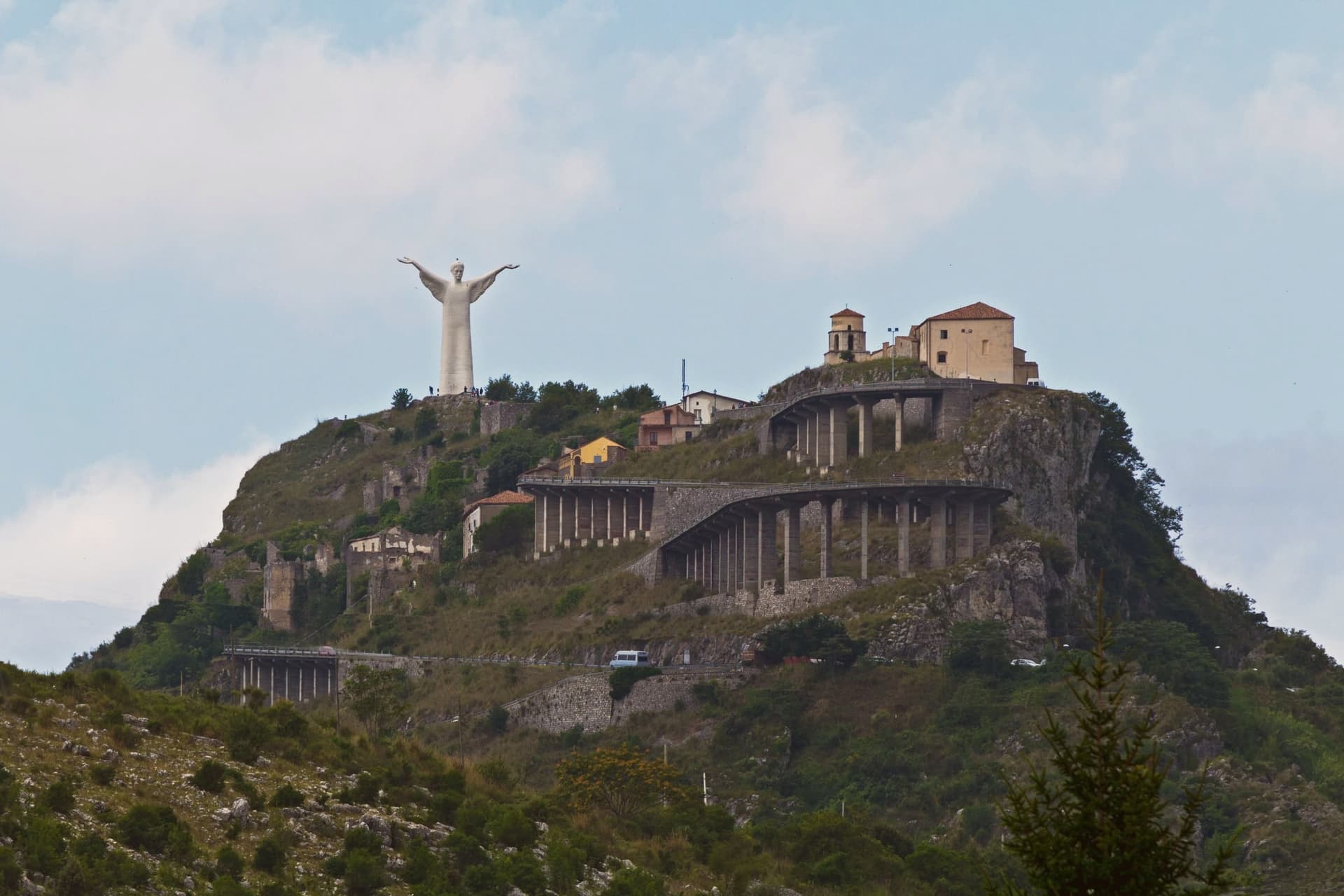
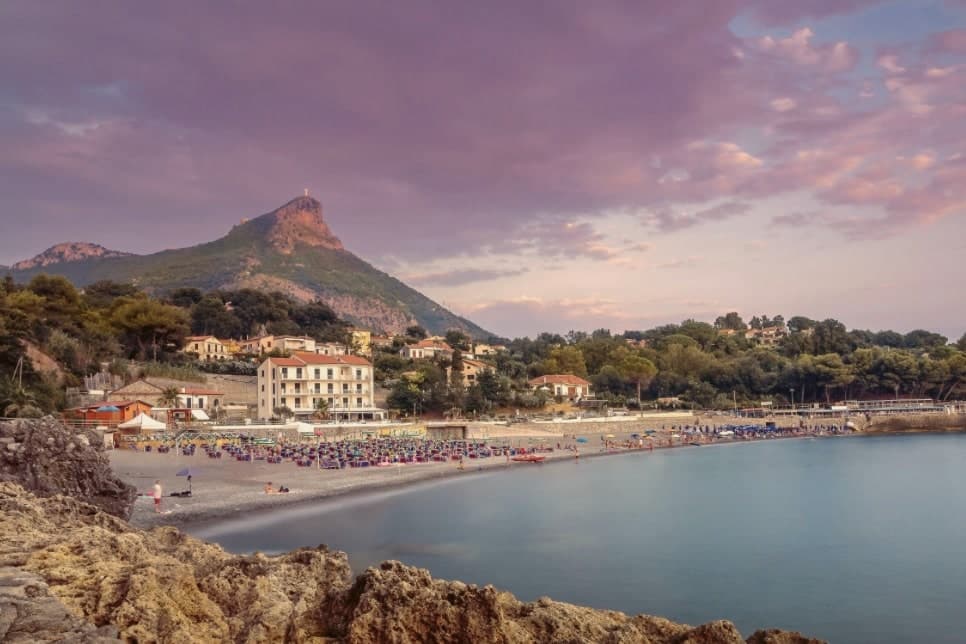
Basilicata's only commune on the Tyrrhenian, thirty-two kilometers of rocky coast overlooked by a marble Christ raised inland in 1965.
- Best time
- May–Sep
- By car
- 1 h 50 min from Salerno
- By train
- Station in the comune
- Population
- 4,725
Known for
CRISTO REDENTORE
Twenty-one meter Carrara marble Christ on Monte San Biagio at 623 meters, sculpted by Bruno Innocenti, inaugurated 1965, facing inland.
TYRRHENIAN COAST
Basilicata's only Tyrrhenian shoreline, about thirty-two kilometers of rock and cove between Campania and Calabria, Bandiera Blu beaches.
44 CHURCHES
Traditional count of chapels and oratories across the borgo and frazioni, the basis of Maratea's nickname as the town of forty-four churches.
When to visit
Best · May–Sep
- J11°
- F12°
- M13°
- A16°
- M20°
- J25°
- J28°
- A28°
- S25°
- O21°
- N17°
- D13°
- Best
- Hot or crowded
- Quiet
- Mostly closed
Daytime averages, 2020–2024. The sea is warmest in August at 29° and coldest in February at 15°. Weather data by Open-Meteo.com.
The festa: Biagio di Sebaste, second Sunday of May
Why come
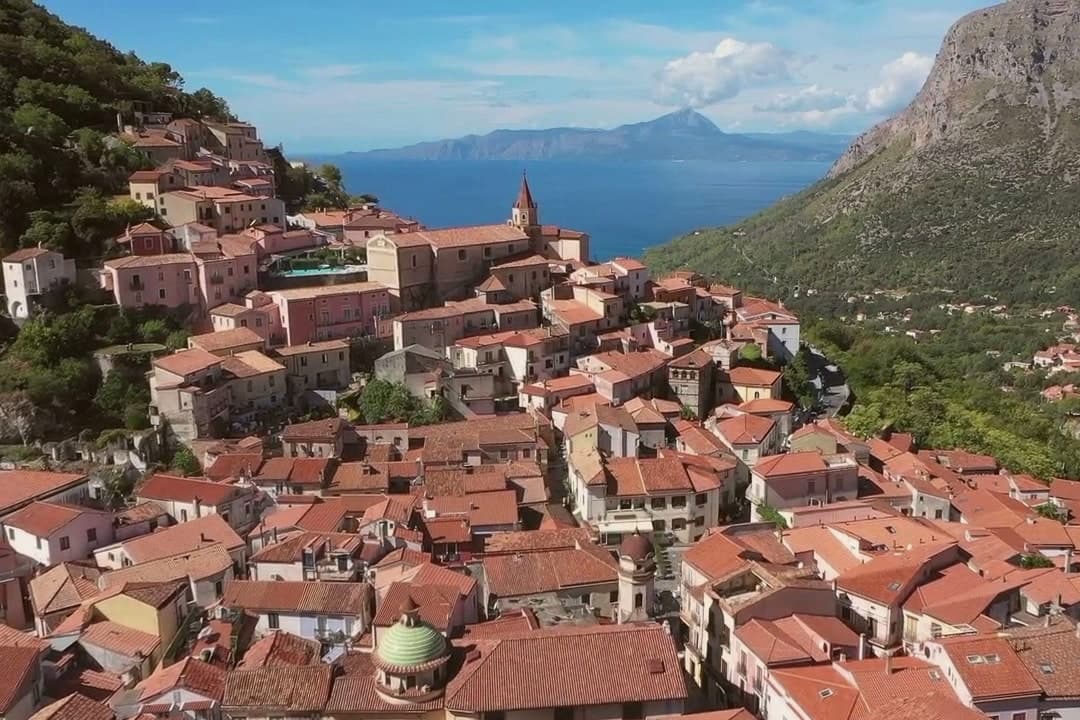
Maratea sits ninety kilometers south of Salerno, on the strip of coast between Campania and Calabria that gives Basilicata its only outlet to the Tyrrhenian. The town is built in layers rather than as a single settlement: the historic centre, Il Borgo, holds the middle ground at three hundred meters on the south slope of the mountain, a few kilometers inland from the water. Above it, near the summit, the mountain carries both the statue of Christ and, just below it, the sanctuary of the patron saint, the two facing each other rather than out to sea.
Higher still, at the very top, are the ruins of Maratea Superiore, the medieval Castello settlement that residents abandoned in favor of the lower borgo. Below all of this, the comune's thirty-two kilometers of rocky shoreline carry the Bandiera Blu and more than twenty beaches and coves, the only Tyrrhenian coast Basilicata has. The town of forty-four churches is a count that spans not just the borgo but its outlying frazioni, chapels and oratories accumulated over centuries across the whole territory rather than in one place. What this adds up to is a town stacked vertically from shore to summit, each level, coast, borgo, sanctuary, ruined castello, holding a different age and function of the same settlement rather than a single center with outskirts.
The Sunday letter
Maratea is on our list. Its letter is still to come.
We are writing about all 1,000 of these towns, one at a time, in a free letter every Sunday: the photo, the food, the festa. That is our mission. Sign up and you will be there when Maratea comes up. By Peter & Sophia, from Pietrasanta.
Read on
Maratea in our articles
 The best towns with a serious restaurant in Basilicata6 towns, Maratea among them.
 The best towns you can reach by train that eat well in Basilicata6 towns, Maratea among them.
 The 7 prettiest villages in the province of Potenza7 towns, Maratea among them.
 The best hidden towns you can reach by train in Basilicata7 towns, Maratea among them.
How to get there
From Naples / Salerno (NAP), about 2h 34m by car.
Lamezia / Reggio (SUF) is about 2h 48m away.
By car from the centre of Salerno 1h 50m, Naples 2h 34m or Bari 3h 41m.
There is a railway station in the comune, so you can arrive without a car.
What to see
Cristo Redentore
Arms outstretched at the summit, the statue faces away from the sea, toward the sanctuary and the inland slopes rather than out over the water it overlooks.
Basilica di San Biagio
Marian sanctuary at the summit of Monte San Biagio, immediately below the Cristo Redentore, holding relics of the patron saint.
Il Borgo
Historic centre of Maratea on the south slope of the mountain at 300 meters, with narrow stone lanes and small piazzas typical of an inland coastal town.
Maratea Superiore (Castello)
Ruins of the medieval upper town on the summit at 633 meters, the original Maratea before residents moved down to the slope below.
Coste di Maratea
More than twenty beaches and coves along the rocky shoreline, each stretch of coast distinct in scale and access, some reached only by boat or path.
Grotta delle Meraviglie
Karst cave near the coast with stalactites and stalagmites, smaller than the famous Apulian caves but a well-preserved Tyrrhenian-side example.
The slow-trip planner
Building a trip? Find where Maratea fits in a slow Italy circuit.
Answer five questions. We will shape a geographically coherent slow trip from the 1,000 Italian towns most travelers skip. Yours to save and share.
We recommend
Where to eat and stay
Not our picks, but places the guides put their name to: a Michelin star, a Gambero Rosso fork, a Slow Food snail, a Michelin Key for the hotels. Worth a table, a counter, or a night when you pass through.
Taverna RovitaRistorante
Taverna Rovita carries a place on Italy's historic-locali register, plus a spot in the Michelin Guide.
CesareRistorante
Cesare has one Gambero Rosso fork (79/100) to its name.
I Sapori di MariannaTrattoria
I Sapori di Marianna holds three Gambero Rosso prawns.
La CambusaRistorante
La Cambusa holds one Gambero Rosso fork (79/100).
SantavenereHotel
Santavenere has a La Liste score of 92 and a Leading Hotels of the World listing.
Through the year
What happens here
Feasts and festivals that come back year after year. We give the month rather than the date, because the date moves and the month rarely does. Check with the source before you plan a journey around one.
Borgo diVino tourfood festival
usually held in September. sagritaly.com
Living here
- Population 4,725
- Very remotei
- Pharmacy in town
- High school within a 30-minute drive
- Train station in the comune
- Nearest airport Naples / Salerno, 2 h 34 min drive
- Regional capital Potenza, 1 h 46 min drive
Common questions
- What is Maratea known for?
- Basilicata's only commune on the Tyrrhenian, thirty-two kilometers of rocky coast overlooked by a marble Christ raised inland in 1965.
- Where is Maratea?
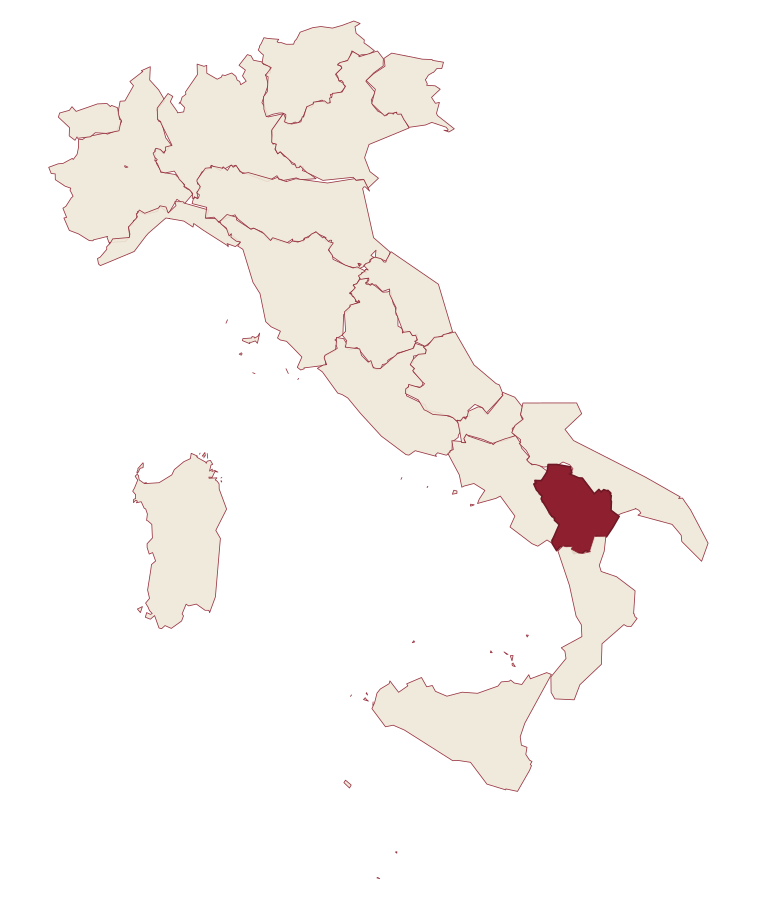
- Maratea is a comune in the province of Potenza, in Basilicata, at 300 meters above sea level.
- What is the nearest airport to Maratea?
- Naples / Salerno (NAP), about 2h 34m by car.
- Can you get to Maratea without a car?
- Yes. There is a railway station in the comune, so you can arrive by train.
- How long is the drive from Salerno to Maratea?
- About 1h 50m by car.
- When is the best time to visit Maratea?
- Best in May–Sep. August is the warmest month, averaging 28 degrees, and November the wettest, with about 14 rain days.
- Is there a sagra or a festival in Maratea?
- Yes. Borgo diVino tour. September is when the first of them falls.
- Which other towns are like Maratea?
- Ascea, Centola and Camerota.
- How many people live in Maratea?
- 4,725 at the 2023 count.
Tags & datadesignations · numbers · sources
Recognised as
The numbers
- Elevation: 300 m
- Population: 4,725
- Surface area: 67.84 km²
These figures were compiled from public directories: ISTAT, OpenStreetMap and Wikidata, and from the official listings of the guides named on this page. Town details change; verify with official sources before you travel.
Similar
Towns like Maratea
Ascea
Province: Salerno
both on the Tyrrhenian coast · both between 3,000 and 10,000 people
Centola
Province: Salerno
both on the Tyrrhenian coast · both between 3,000 and 10,000 people
Camerota
Province: Salerno
both on the Tyrrhenian coast · both between 3,000 and 10,000 people
Capalbio
Province: Grosseto
both on the Tyrrhenian coast · both between 3,000 and 10,000 people
Praia a Mare
Province: Cosenza
both on the Tyrrhenian coast · both between 3,000 and 10,000 people
Tramonti
Province: Salerno
both on the Tyrrhenian coast · both between 3,000 and 10,000 people
🎨 Borghi più belli d'Italia
More Borghi più belli d'Italia towns in Basilicata
Acerenza
Province: Potenza
A walled ridge town at 833 meters in the north Lucanian hills, archbishopric since 1068 under a Romanesque cathedral begun in 1080.
Castelmezzano
Province: Potenza
A medieval village wedged into sandstone teeth at 750 meters, linked to Pietrapertosa by a 1,452-meter zipline since 2007.
Guardia Perticara
Province: Potenza
The stone village at 678 meters above the Sauro valley, rebuilt block by block in Gorgoglione sandstone after the 1980 earthquake.
Irsina
Province: Matera
A 548-meter Bradano-valley hill town, called Montepeloso until 1895, whose cathedral holds a Renaissance rarity.
Miglionico
Province: Matera
A hilltop borgo at 461 meters above the Bradano, the seven-tower castle that gave the 1485 Conspiracy of the Barons its hall.