
The best towns you can reach by train in the province of Terni
The province of Terni is the southern end of Umbria, where the Tiber and the Nera come down out of the hills towards Lazio, and it is unusually well served by rail. The main line from Rome to Ancona runs up the Nera valley, a branch climbs north towards Perugia past the Martani hills, and a slow line heads east over the mountains to L'Aquila. The stations were built for mills, quarries and steelworks rather than for visitors, which is why so many of them sit close to the old centers: a short walk uphill, or a local bus, and you are inside the walls.
Most people who come this way by train are going somewhere else. The fast trains between Rome and Florence never enter the valley, the day trips from Rome aim at Assisi and Perugia, and the Cascata delle Marmore, the reason many people stop at all, is reached by bus from the station rather than by rail. Spoleto, a little further up the line, fills with festival crowds every summer. The towns in this list sit on the same tracks and are rarely the point of anyone's journey.
What they share is how easy they are to reach without a car. There is a hill town above a gorge with a Roman bridge below it, a village of stone lanes above olive terraces, a spa town known for its mineral water, a quiet center near the ruins of a Roman town on the Via Flaminia, a cathedral city on a cliff of volcanic rock, and the steel city itself, home of Saint Valentine. Between them they cover most of what southern Umbria holds, from Etruscan tombs to Romanesque churches, and each can fill a whole day or a stop on the way somewhere else.
Of the 11 communes we have mapped in the province of Terni, 6 qualify as towns you can reach by train: we have confirmed each is reachable without a car. The smallest, Acquasparta, has 4,407 residents.
Two more lists worth reading alongside this one: The best hill towns in the province of Terni and The 10 best hidden hill towns you can reach by train within 90 minutes of Terni.
Acquasparta
Why visit Acquasparta
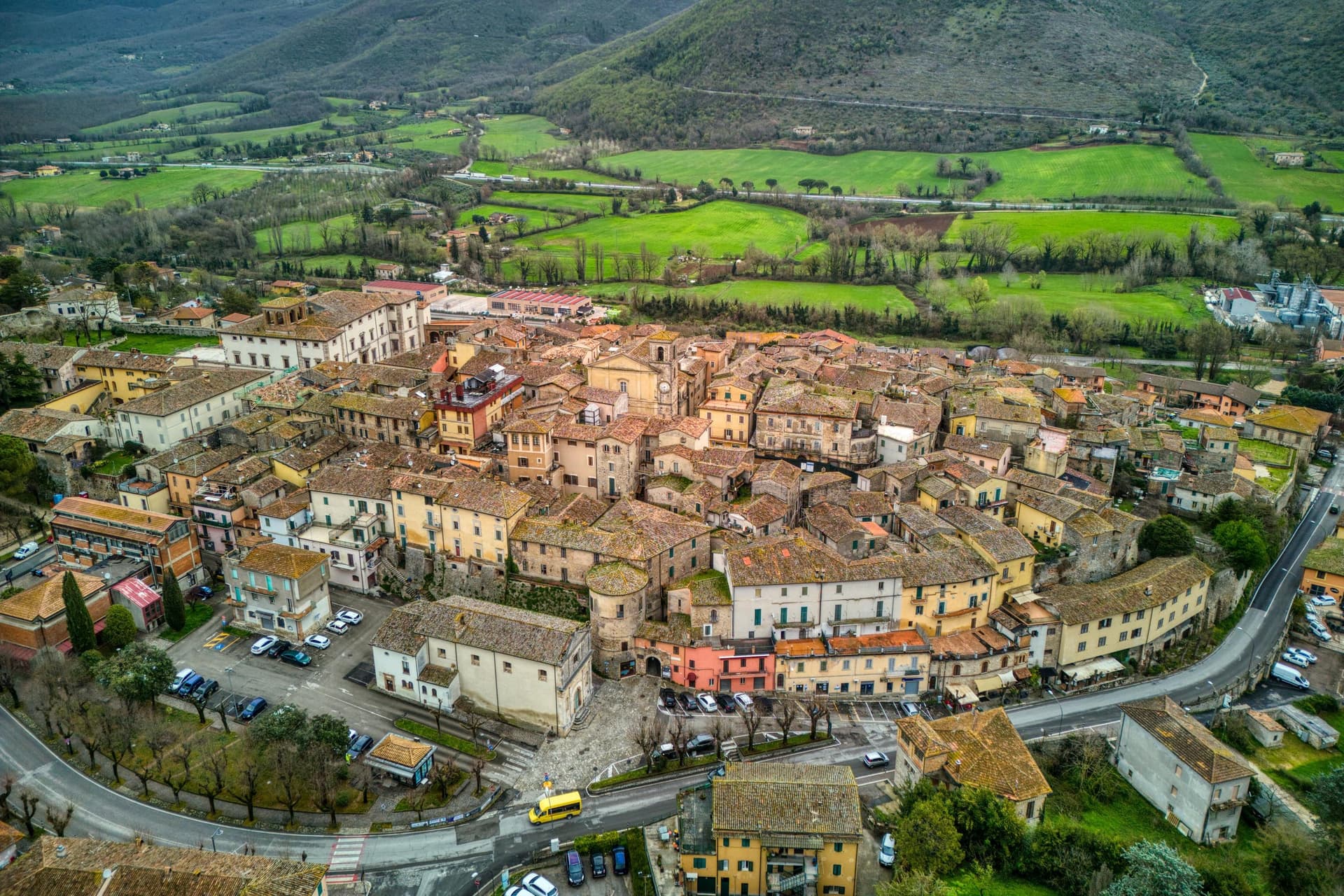
Acquasparta sits at 350 meters on a hill above the Naia valley, fifty kilometers south of Perugia and thirteen north of the UNESCO town of Spoleto. The medieval upper town is walled around the palace at its center, its lanes climbing toward the piazza named for Federico Cesi.
In 1588 Pope Sixtus V raised the territory to a duchy under the Cesi family, and it was Federico Cesi, the cardinal's descendant, who brought his young Accademia dei Lincei here from Rome in the early seventeenth century to convene around his cabinet of natural specimens: Galileo Galilei was among those who came, staying at the palace in 1624 to demonstrate his microscope. Outside the walls, the Furapane and Amerino springs draw on a different history, met by the Roman censor Flaminio in the second century BC and still bottled commercially now.
The town holds both threads at once, a duchy's palace turned briefly into a meeting place for the new science, and a valley whose waters were already known to antiquity. Together with the medieval upper town, they earned Acquasparta its listing among the Borghi più belli.
We confirmed you can reach this one by train.
What to see in Acquasparta
- Palazzo Cesi. The architectural anchor of the centro storico, where the cabinet of natural specimens once gathered by Federico Cesi drew the Accademia dei Lincei into session.
- Centro storico. Medieval upper town walled around the palace, with narrow stepped lanes climbing toward Piazza Federico Cesi.
- Chiesa di Santa Cecilia. Main parish church near the palace, with a Renaissance interior and altarpieces from the Umbrian school.
How to get to Acquasparta
There is a railway station in the town, so you can arrive without a car and never need one while you are here. Terni is roughly 21 minutes away by road.
Our tip
April through June and September into October are the dependable months. The Stagione Lincea, a summer programme of conferences and concerts in Palazzo Cesi, runs through July and August around the legacy of Federico Cesi and Galileo. July and August are warm in the Naia valley but the palace and the centro storico hold shade well.
Stroncone
Why visit Stroncone
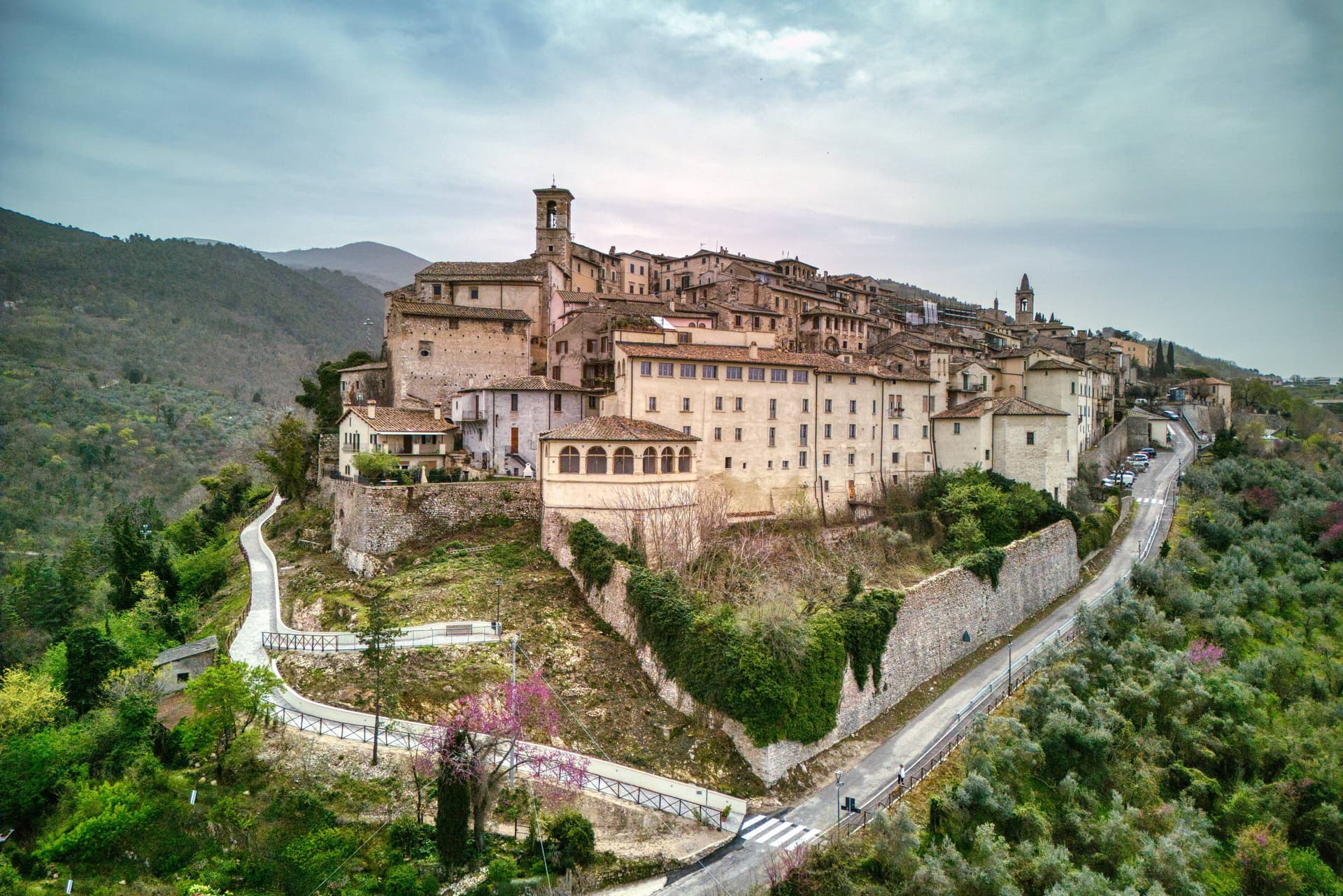
Stroncone sits at 451 meters on an olive-covered hill eight kilometers south of Terni, in the Conca Ternana on the western slope of the Apennine. The name traces to Duke Ugone of Spoleto, whose castrum Hugonis evolved through Castrugone and Strungone to the present form.
A group settled here around the tenth century and built a castle; Stroncone first appears in documents in 1012, when Giovanni di Pietro made a donation to the monastery of San Simeone. Pope Innocent III granted municipal self-rule in 1215.
The Convento di San Francesco, south of the walls, is one of the older Franciscan foundations in Umbria, founded by tradition by Francis himself in 1213, two years before papal recognition of the order. The medieval circuit walls remain almost complete, with the original gates framing a network of stepped lanes that climb to the small main square.
The Cammino di San Francesco passes through, picking up walkers between Rieti and Assisi.
We confirmed you can reach this one by train.
What to see in Stroncone
- Convento di San Francesco. Franciscan convent south of the walls, founded by tradition by Saint Francis in 1213, two years before papal recognition of the order.
- Centro storico. Walled medieval core with original gates intact, climbing through stepped lanes to the small main square at the top of the hill.
- Chiesa di San Giovanni Decollato. Main parish church at the heart of the borgo, with frescoed interior and a Renaissance baptismal font.
How to get to Stroncone
There is a railway station in the town, so you can arrive without a car and never need one while you are here. Terni is roughly 18 minutes away by road.
Our tip
April through June and September into October are the months for Stroncone. Olive harvest carries the autumn rhythm into late November, and the frantoi work into the evening through October and November. July and August are warm in the Conca Ternana but the hill is high enough that nights cool quickly. Sagra De u Cecu Maritu falls in July.
San Gemini
Why visit San Gemini
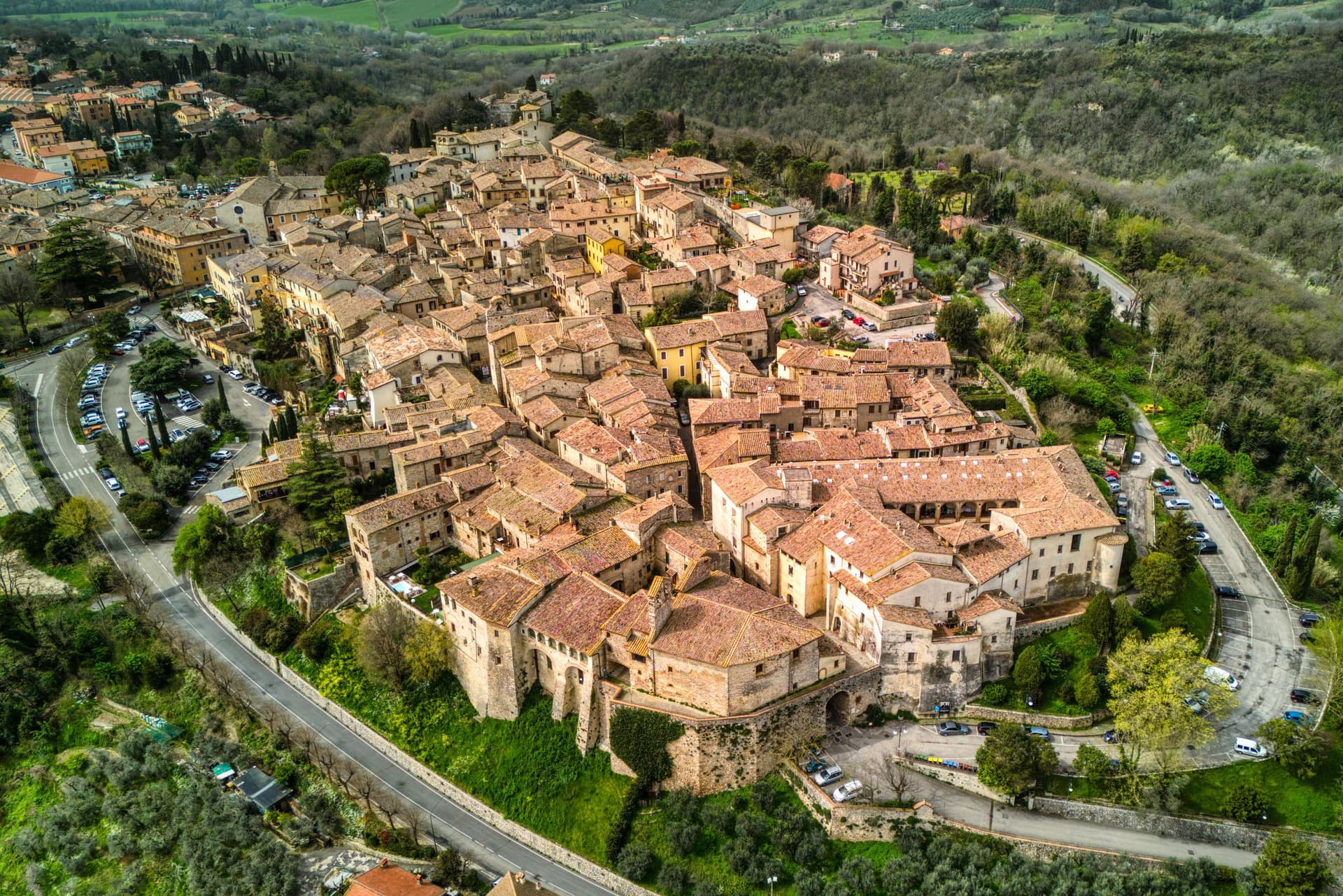
San Gemini sits at 337 meters on the southern slope of the Monti Martani, ten kilometers northwest of Terni. The archaeological park to the north preserves a stretch of polygonal Roman paving, a gate or honorary arch, an amphitheater, mosaic floors and the remains of an aqueduct, all part of a municipium abandoned probably after an earthquake.
The mineral springs rise just outside the populated centre, close enough that the town and the water source share the same ground without sharing a single street. The walled core steps down the slope in two halves that still define the town's rhythm: the district built around the old fortified height and the district gathered around the main square, each fielding its own team when the joust between them runs its course every year.
The cathedral, rebuilt in the nineteenth century but keeping a portal a great deal older, and the Gothic church on the square, each anchor their own end of the settlement. The Corpus Domini Infiorata blankets the procession route with petal mosaics nine weeks after Easter.
A hill town this size holding a Roman ruin, a bottled spring and a rivalry that still stages a joust suggests a place where the past was never cleared away to make room for the present, only built alongside it.
We confirmed you can reach this one by train.
What to see in San Gemini
- Parco Archeologico di Carsulae. Roman municipium four kilometers north of San Gemini, with the Via Flaminia paving, the Arco di San Damiano, amphitheater and aqueduct remains.
- Chiesa di San Francesco. Thirteenth-century Gothic church on the main square, single nave with pointed arches, alongside Palazzo Canova.
- Duomo di San Gemine. Originally twelfth-century late Gothic cathedral, rebuilt in the nineteenth century by Livoni with consultation from Antonio Canova, keeping a fifteenth-century portal.
How to get to San Gemini
There is a railway station in the town, so you can arrive without a car and never need one while you are here. Terni is roughly 16 minutes away by road.
Our tip
April through June and September into October are the dependable months. The Infiorata di Corpus Domini covers the procession route with petal mosaics nine weeks after Easter, usually early June. The Giostra dell'Arme runs over two weeks at the end of September into early October, the rioni in fifteenth-century costume, the joust in the main piazza. Giostra dell'Arme falls in September.
Narni
Why visit Narni
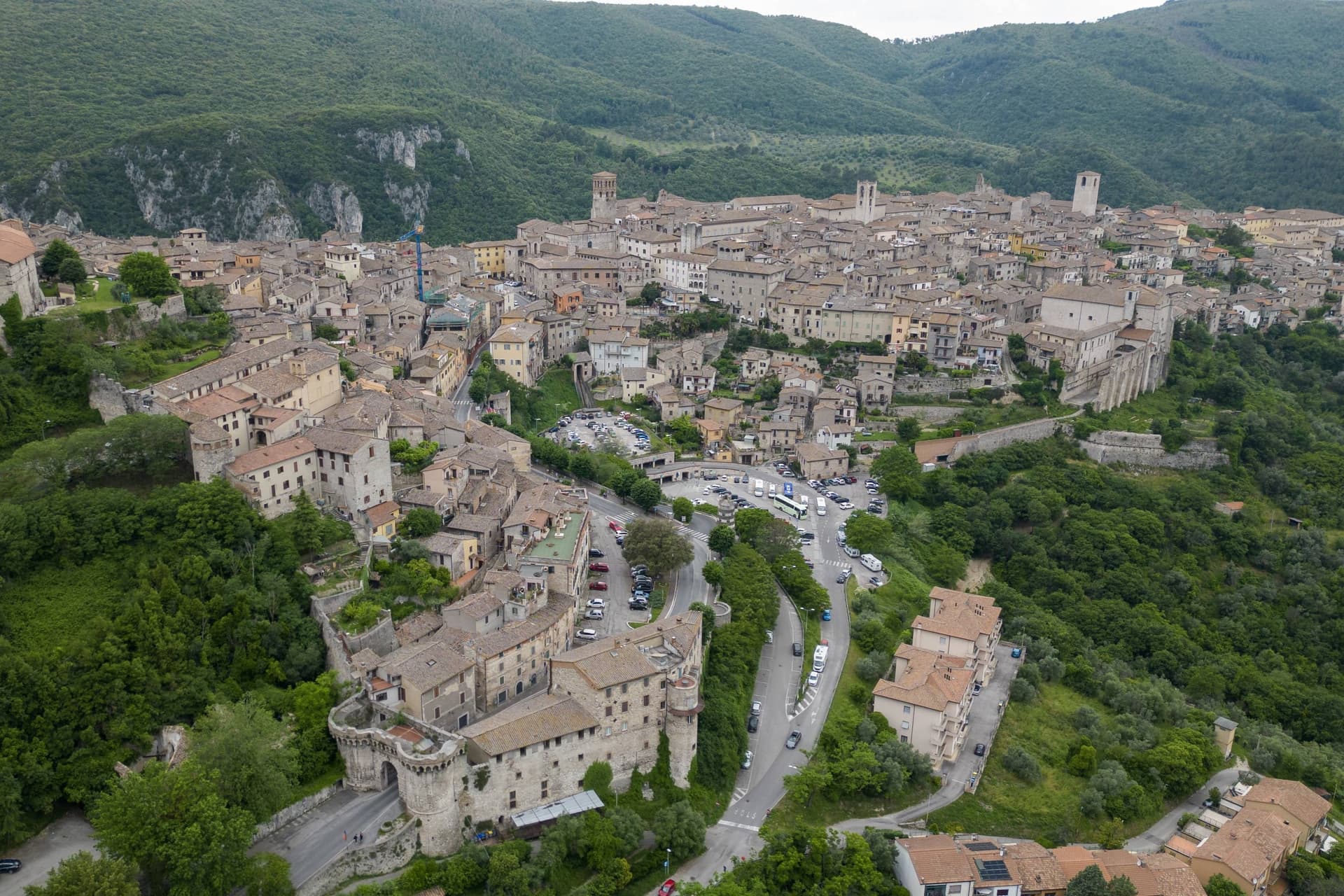
The old town sits on a travertine outcrop 240m above the Nera valley, and its Roman name came from the Nar, the river's older name before it became the Nera. Lewis read the word in an atlas as a boy and kept it for thirty years before it resurfaced in his fiction; he never visited, and the resemblance stops at the name, though the comune now runs an annual 'Le notti di Narnia' summer festival and a small themed museum around the connection.
The marker for the geographical centre sits at the foot of the old town, on the side of the road below the centro, a fact of surveying rather than of history, and it sits oddly alongside the older Roman and medieval claims the town makes on the visitor. The town itself reads in layers.
At the summit is the Piazza dei Priori, a medieval set-piece anchored by the 13th-c Palazzo dei Priori, and near it the Cattedrale di San Giovenale, 12th-c Romanesque with a 14th-c Gothic façade added later. Also at the high point stands the papal fortress built for a cardinal in 1370, square in plan with four corner towers, looking down over the valley where the Nera meets the Tiber.
Below the centro, where the ground drops toward the river, is where the Roman bridge crossed at height before losing all but one arch, a crossing later painted by both Corot and Turner. The horse-jousting pageant between the town's three terzieri, Mezule, Fraporta, and Santa Maria, runs on the second Sunday of May and has done, in its current form, since 1371, older than the fortress above it.
Underneath the town, reached through an ordinary-looking church, is a sealed underground world of cells and a former torture chamber that has nothing to do with any of the above except that it was carved into the same hill, found again only by accident in the twentieth century. The food follows the same logic as the setting: strangozzi with truffle, since Narni sits on the edge of the Valnerina truffle zone, along with porchetta, pecorino, and the local Ciliegiolo and Sangiovese.
What holds it together is verticality: a town built up along a ridge and then, unknown to most who walk through it, dug down, so that the fortress at the top, the bridge at the base, and the cells beneath are all separated by the same hill that gives the valley its view.
We confirmed you can reach this one by train.
What to see in Narni
- Narni Sotterranea. The complex sits under the Chiesa di San Domenico: church, cells, and torture chamber, found by accident by local cavers. The graffiti on the cell walls includes a complete personal-symbology code left by a Freemason inmate that took decades to work out.
- Rocca Albornoz. The fortress occupies the high point of the town: square plan, four corner towers, and a view across the valley where the Nera meets the Tiber.
- Ponte d'Augusto. What remains is one arch of a bridge that once crossed the Nera at 60 metres height. Corot painted it in 1826, Turner in 1819.
How to get to Narni
There is a railway station in the town, so you can arrive without a car and never need one while you are here. Terni is roughly 17 minutes away by road.
Our tip
Narni is best April–June and September–October. The Corsa all'Anello on the second Sunday of May is the year's headline event — book accommodation 2 months ahead. Summer is hot in the Tiber valley but the 240m elevation gives some relief. Sagra della Pizza al Forno falls in July.
Orvieto
Why visit Orvieto
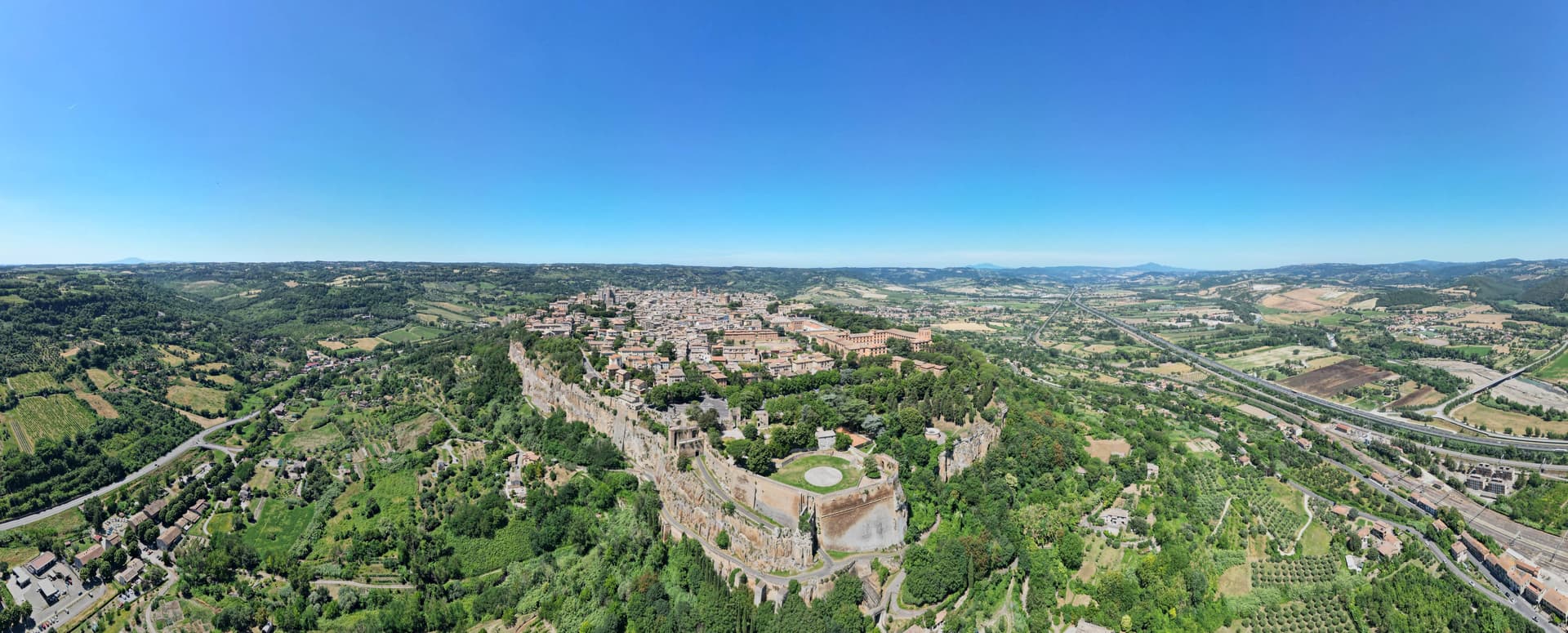
Orvieto sits on a flat-topped butte of volcanic tuff at 325 meters, the cliffs 195 meters above the surrounding plain. The town began as Velzna, a flourishing Etruscan metropolis, and the Romans destroyed it in 264 BC.
The medieval town that replaced it on the same plateau became a papal refuge in the 13th century, when popes left Rome for the safety of the height. The town's layers sit one below the other rather than side by side: the cliff face is honeycombed with Etruscan and medieval cavities, cisterns and pigeon roosts cut into the same tuff that the necropolis at its foot was carved into during the 6th century BC, while the cathedral and its chapel occupy the surface above, and the well descends back down through the rock to reach water.
What looks from a distance like a single stone crown is in fact three towns stacked in the same column of tuff: the dead below, the popes and their cathedral on top, and a passage cut straight through the middle to keep the town supplied.
We confirmed you can reach this one by train.
What to see in Orvieto
- Duomo di Orvieto. The polychrome marble façade rises in tiers of mosaic and sculpture, the decorative Gothic worked into bands of color rather than left plain stone.
- Cappella di San Brizio. The Last Judgment fills the chapel wall to wall, figures twisting and falling across the vault and lunettes inside the cathedral.
- Pozzo di San Patrizio. Sunk for Pope Clement VII, the shaft drops 53 meters, lit by windows cut into the walls of the two ramps so the descent is never dark. Antonio da Sangallo the Younger designed it to move water and mules at once, without either crossing the other's path.
How to get to Orvieto
There is a railway station in the town, so you can arrive without a car and never need one while you are here. Terni is roughly 56 minutes away by road.
Our tip
April through June and September into October are the months for Orvieto. The plateau holds the long light, the Paglia valley below is green or gold, and the white wine of the surrounding vineyards is poured at every osteria. Umbria Jazz Winter runs around New Year and fills the Teatro Mancinelli; the Corpus Domini procession on the second Sunday after Pentecost is the most concentrated religious event of the year. Sagra del Bosco falls in September.
Terni
Why visit Terni
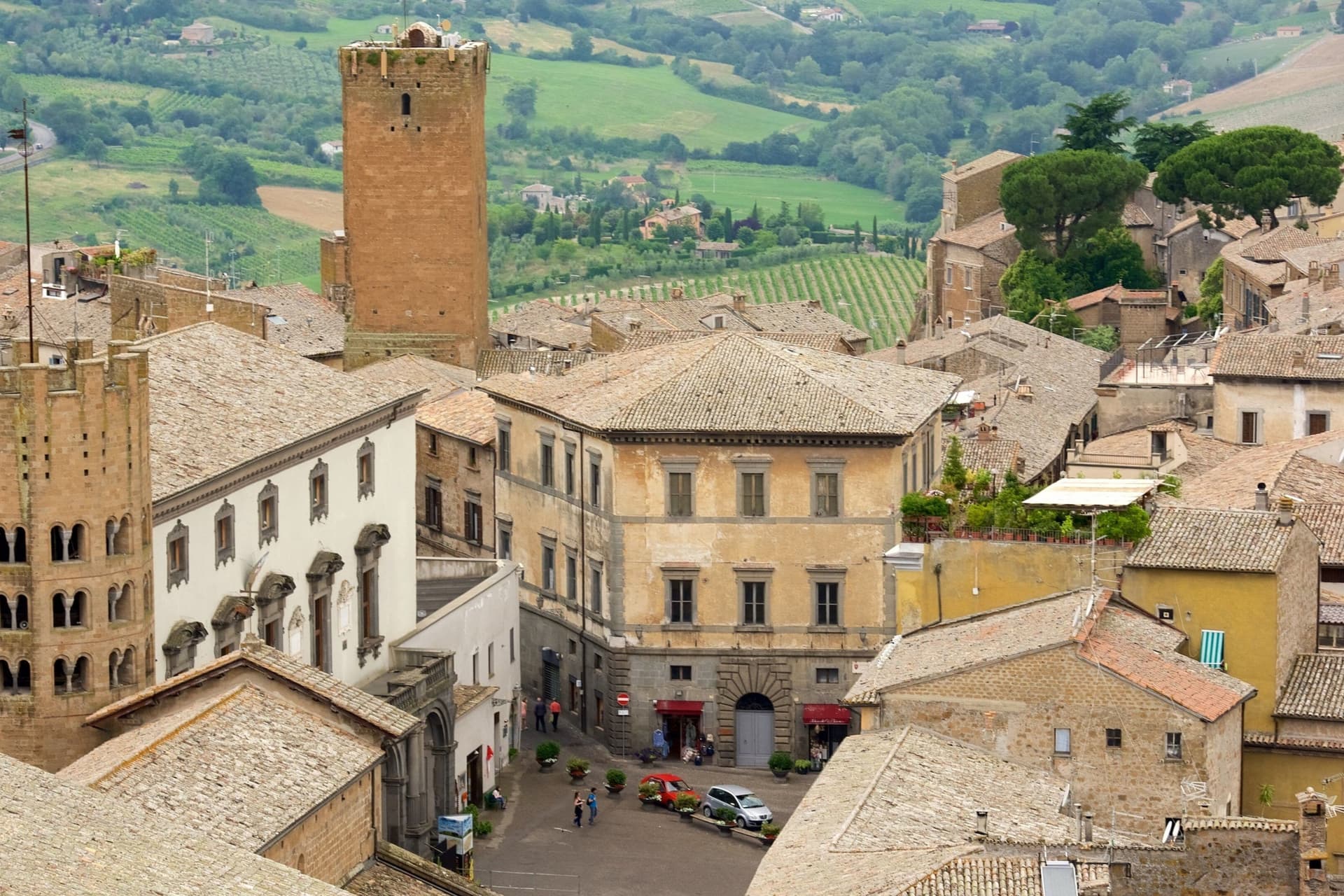
Terni is the Roman Interamna, the town between two rivers, and it shows its history in layers. The Anfiteatro Fausto of 32 AD sits in the city park, the Duomo keeps a sixth-century crypt, and Palazzo Spada, the town hall, may be the last work of Antonio da Sangallo the Younger.
From the nineteenth century the water of the Nera drove steelworks, arms factories and jute mills, and that made Terni a target: Allied raids from August 1943 destroyed or damaged 40 percent of its buildings. The 12,000-ton steel press in Piazza Dante is the city's own monument to that past.
Terni is also the city of Saint Valentine, its third-century bishop, whose basilica on the edge of town holds his remains. Seven kilometers up the Valnerina, the Romans cut a channel through the cliff at Marmore in the third century BC and made a waterfall of 165 meters.
Lake Piediluco lies just beyond it, and the ruins of Carsulae sit on the Via Flaminia to the north.
We confirmed you can reach this one by train.
What to see in Terni
- Cascata delle Marmore. Falls of 165 meters made by the Romans to drain the Rieti plain. The water is released on a timetable, so check the opening hours before going.
- Basilica di San Valentino. Built on the hill where followers buried the town's bishop after his martyrdom in 273; the present church dates from 1618 and keeps his remains.
- Anfiteatro Fausto. Roman amphitheater of 32 AD in the park of La Passeggiata, with walls of two-tone reticulated stonework.
How to get to Terni
There is a railway station in the town, so you can arrive without a car and never need one while you are here. Perugia is roughly 69 minutes away by road.
Our tip
Terni works in any season. February is the city's month: the feast of San Valentino on the 14th fills the basilica and the streets around it. Spring and summer are when the Cascata delle Marmore runs most often, since the water is released on a timetable, and on 1 May the Cantamaggio parades decorated floats through the center to welcome the season.
More from Anywhere Italy
 The best hill towns in the province of Terni
 The 10 best hidden hill towns you can reach by train within 90 minutes of Terni
- The prettiest villages you can reach by train within 90 minutes of Terni
 The best towns you can reach by train that eat well within 90 minutes of Terni
- The 7 best small towns you can reach by train in Umbria
 The best hill towns with a food festival within 90 minutes of Terni