
The best hill towns with a food festival within 90 minutes of Terni
The country between Terni, the Sabina and the Tuscia is built from what the volcanoes and the river valleys left behind: peperino stone the colour of ash, tufa cut straight out of the ridge, olive terraces holding the slope above the Nera and the Tiber. The food follows the ground. Black truffle from the Valnerina, chestnuts from the Amerini woods, hazelnuts from the Cimini soil, and new oil pressed while the mornings are still foggy. Autumn is when this becomes public, when a town of a few narrow streets sets out trestle tables under the arches and cooks one thing properly for a weekend. Spring brings the artichoke and the wild asparagus, and the same tables come out again.
Most people passing through this part of Italy are heading for Assisi, or making the standard loop of Perugia and Todi with a stop at the Marmore falls. Those places earn their crowds, and the Eurochocolate weekends in Perugia fill every bed within an hour's drive. The result is that the food events with the biggest names are the ones already handled by coach parties, and the queue for a plate of truffled strangozzi runs the length of the piazza.
The hills do not stop at the ring road of the famous towns. The same tufa ridges, the same oil, the same woods full of chestnut and truffle continue north into Lazio and east into the Valnerina, and the towns along them hold their own festivals for their own neighbours first. These are the smaller places within an easy drive of Terni, each with a sagra tied to one product and a date it returns to every year. Fewer people go, and the tables are longer for it.
Of the 36 communes we have mapped within 90 minutes of Terni, 11 qualify as hill towns with a food festival: each is an inland hill settlement, and each holds a recurring food festival built around one local ingredient. This list is 10 of them. The smallest, Casperia, has 1,178 residents.
Elsewhere in the catalogue: The 9 best olive oil towns within 90 minutes of Terni and The best hill towns with a food festival in Lazio.
Why visit Casperia
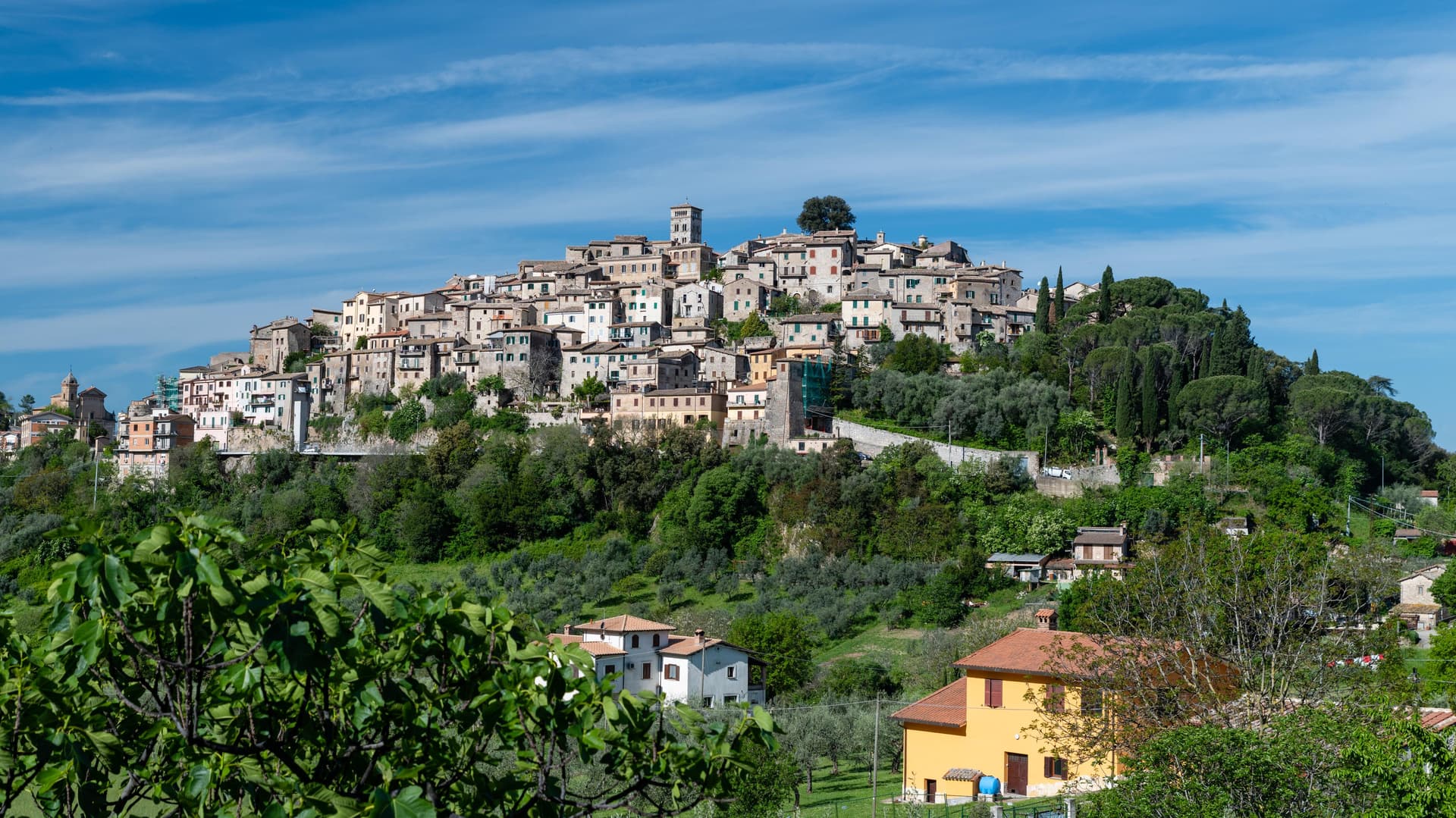
Casperia sits at 397 meters on the western slope of the Monti Sabini, fifty kilometers northeast of Rome. Its two gates face opposite directions on the hillside, one toward the lower road on the west, the other toward the valley on the east, and both feed into the same climbing street pattern that rings the hill in concentric bands up to the church at the summit.
No vehicles pass the gates, so the interior keeps its medieval scale intact, lane by lane, without the intrusions that have altered plenty of comparable towns. Below the walls the slope opens into olive country, part of a protected-origin appellation, in the localities of Paranzano, Santa Maria in Legarano and San Vito.
The relationship between the two levels, hilltop settlement above and working groves below, is the shape of the place: a defended village that never spread past its walls, sitting over land that has been worked continuously and given a name and a boundary of its own.
What to see in Casperia
- Centro storico. Concentric lanes climb from the gates to the parish church at the summit, laid out with no space for vehicles, a compact plan that reads clearly from any of the approaches below.
- Chiesa di San Giovanni Battista. Parish church on the highest point of the village, baroque interior on medieval foundations, with works by Vincenzo Manenti.
- Porta Romana. Western gate of the wall circuit, the main entry point on foot from the lower road.
How to get to Casperia
Terni is roughly 43 minutes away by road.
Our tip
April through June and September through October are the best months in the Sabina hills. The olive harvest runs from mid-October into November; the new oil is pressed in the cooperatives around the village and the town fills on autumn weekends for tastings. July and August are hot in the lower valley; the village at 397 meters is several degrees cooler and the lanes hold shade. Sagra dei Stringozzi Aspresi falls in July.
Why visit Montecchio
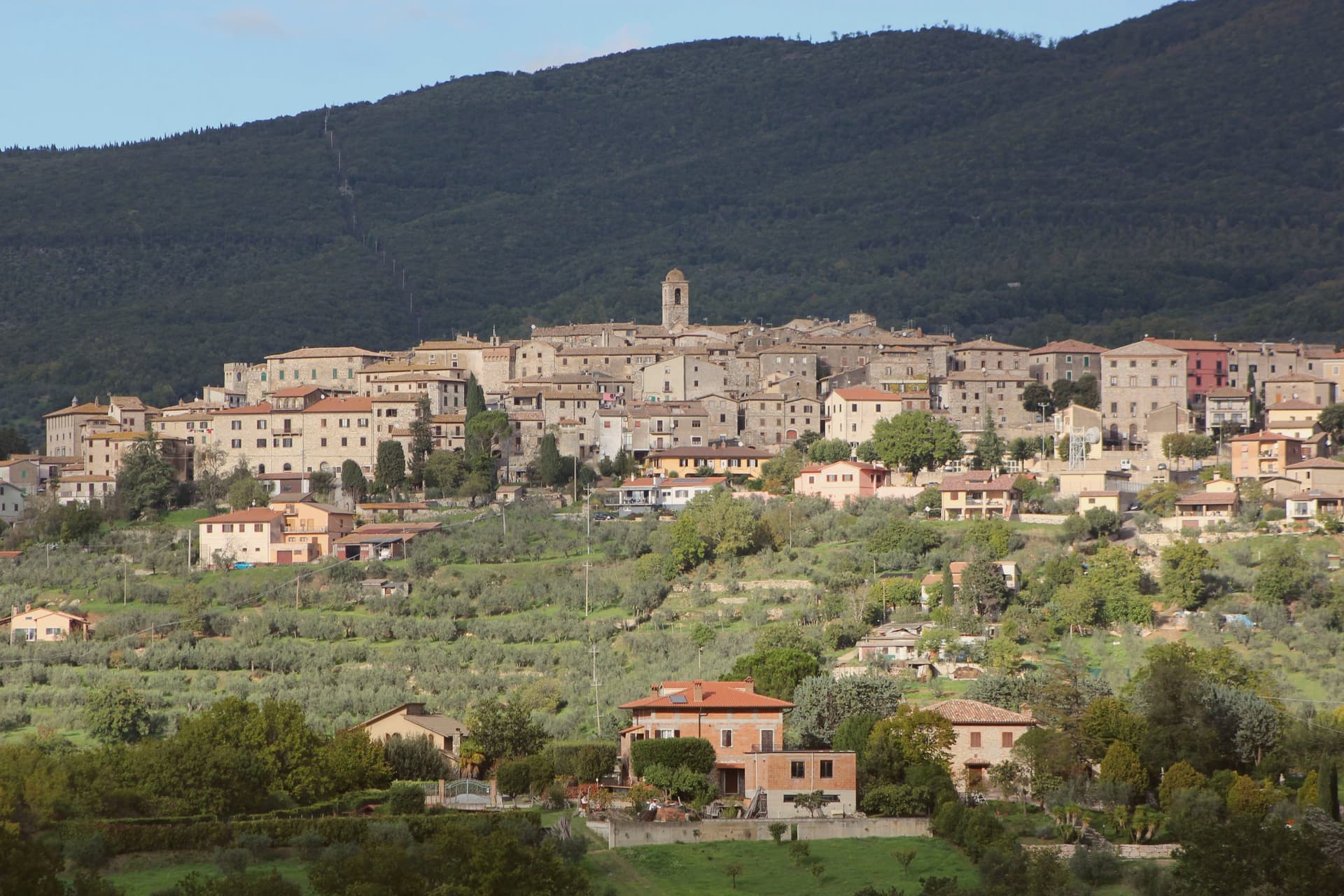
Montecchio sits at 377 meters on a ridge above the Tiber valley, fifty kilometers south of Perugia and thirty northwest of Terni. The territory was inhabited well before Rome: the Vallone di San Lorenzo, about five kilometers below the borgo, holds fifty chamber tombs carved into the soft calcarenite locally called matile, with strong ties to Etruscan Orvieto at its sixth-to-fifth-century BC peak.
The recovered artifacts, now in the Antiquarium of Tenaglie, document a wealthy pre-Roman community. The settlement of Montecchio is first documented in 1154; the castle was raised around 1165 by the Chiaravalle family and passed through the Alviano, Baschi, Colonna and Atti before becoming independent of Baschi in 1948.
Tenaglie, on the opposite ridge, is dominated by Palazzo Ancajani, built in the early 1700s on the foundations of an earlier fortification. The territory holds Borghi più belli, Città dell'Olio and Comuni Virtuosi standing together.
What to see in Montecchio
- Necropoli del Vallone di San Lorenzo. Pre-Roman necropolis 5 km below the borgo, 50 chamber tombs carved in matile rock with klinai-shaped benches, peak 6th-5th century BC.
- AMAT Antiquarium di Tenaglie. Archaeological museum in the Tenaglie frazione displaying the necropolis finds, with strong evidence of Etruscan Orvieto influence.
- Palazzo Ancajani (Tenaglie). Early 18th-century palace on a rocky ridge facing Montecchio, built by Filippo Ancajani over an earlier fortification.
How to get to Montecchio
Terni is roughly 57 minutes away by road.
Our tip
April through June and September into October are the months locals prefer. The necropolis trail through holm oak and juniper is at its best in spring, and the slopes above the Tiber stay golden into late autumn. July and August push temperatures past thirty-five degrees in the valley; the upper borgo holds the breeze and the tomb chambers stay cool year-round. Fiera della Castagna falls in the season.
Why visit Campello sul Clitunno
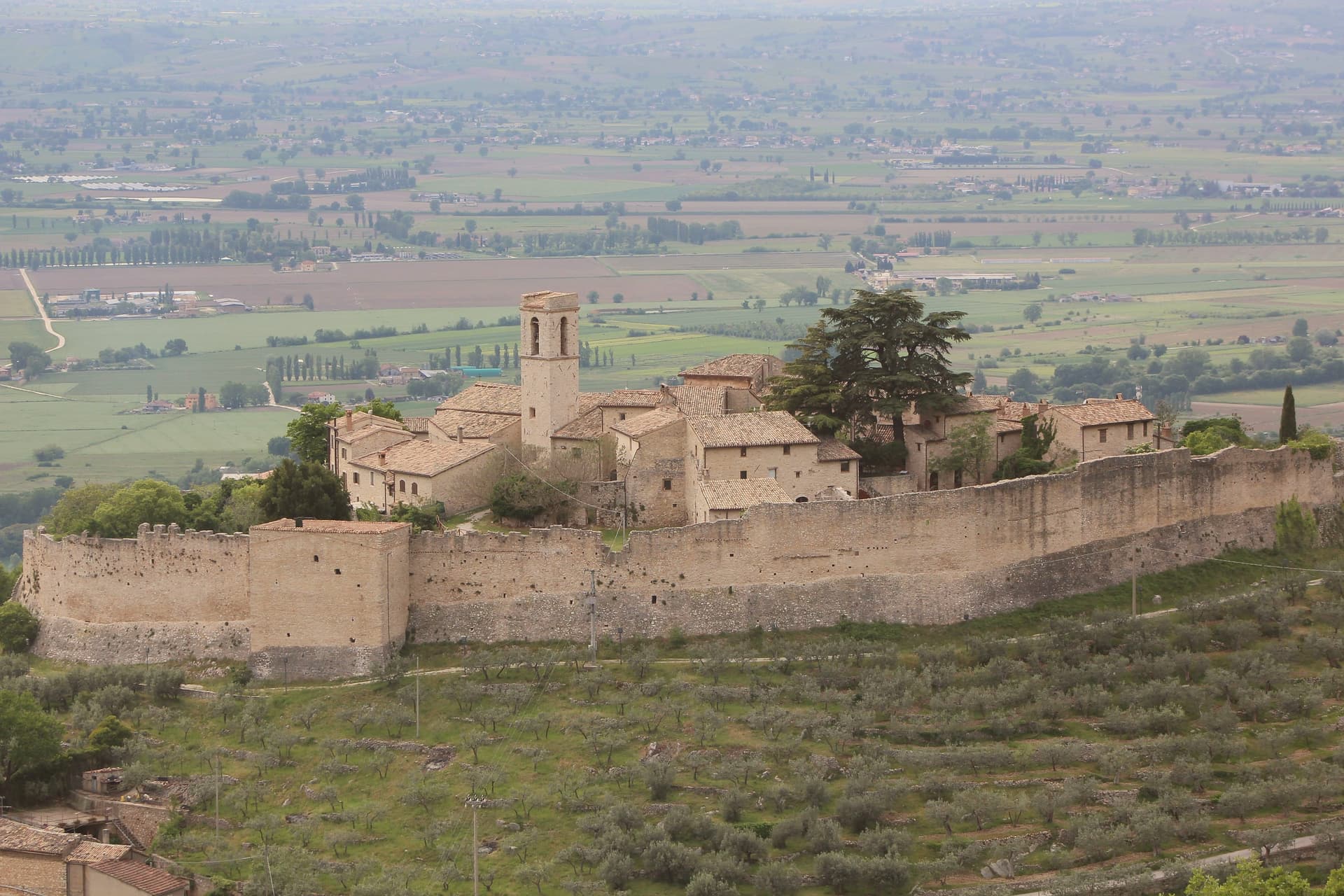
Campello sul Clitunno sits at 290 meters along the Clitunno river, a few kilometers north of Spoleto. The name comes from the Counts Campello, originally Champeaux of Reims, who founded the hilltop nucleus of Campello Alto in the mid-10th century under the Burgundian noble Rovero.
The Fonti del Clitunno, the springs that form the river, produce 1,300 to 1,500 liters of water per second; Pliny the Younger wrote about them, and Lord Byron and Giosuè Carducci returned to the place in poems centuries later, the latter with the ode Le fonti del Clitumno. A kilometer downstream from the springs, in the frazione of Pissignano, the Tempietto del Clitunno is a 4th- or 5th-century pagan sacellum reworked by the Lombards in the 7th and 8th centuries; the interior frescoes have parallels with Santa Maria Antiqua in Rome.
The Tempietto entered the UNESCO World Heritage List in June 2011 as part of the serial site The Lombards in Italy: Places of Power. The Castello di Pissignano above the temple covers the medieval layer.
What to see in Campello sul Clitunno
- Tempietto del Clitunno. Small temple-shaped chapel of the 4th-5th century reworked by the Lombards in the 7th-8th, with frescoes of the Saviour, Peter and Paul; UNESCO World Heritage.
- Fonti del Clitunno. Springs producing 1,300-1,500 liters per second, forming the source of the Clitunno; visited by Pliny, Byron and Carducci.
- Castello di Pissignano. Eleventh-twelfth century hilltop castle just above the Tempietto, founded by Benedictine monks who enclosed the settlement with walls.
How to get to Campello sul Clitunno
There is a railway station in the town, so you can arrive without a car and never need one while you are here. Terni is roughly 86 minutes away by road.
Our tip
April through June and September into October are the months for Campello sul Clitunno. The springs run cold and full, the willows along the lake at the source hold the morning light, and the trails between the Tempietto and Campello Alto are walkable in shade. July and August touch the mid-thirties in the Spoleto valley; the Fonti basin runs a few degrees cooler at the water's edge. Festa dei Frantoi e dei Castelli falls in October.
Why visit Caprarola
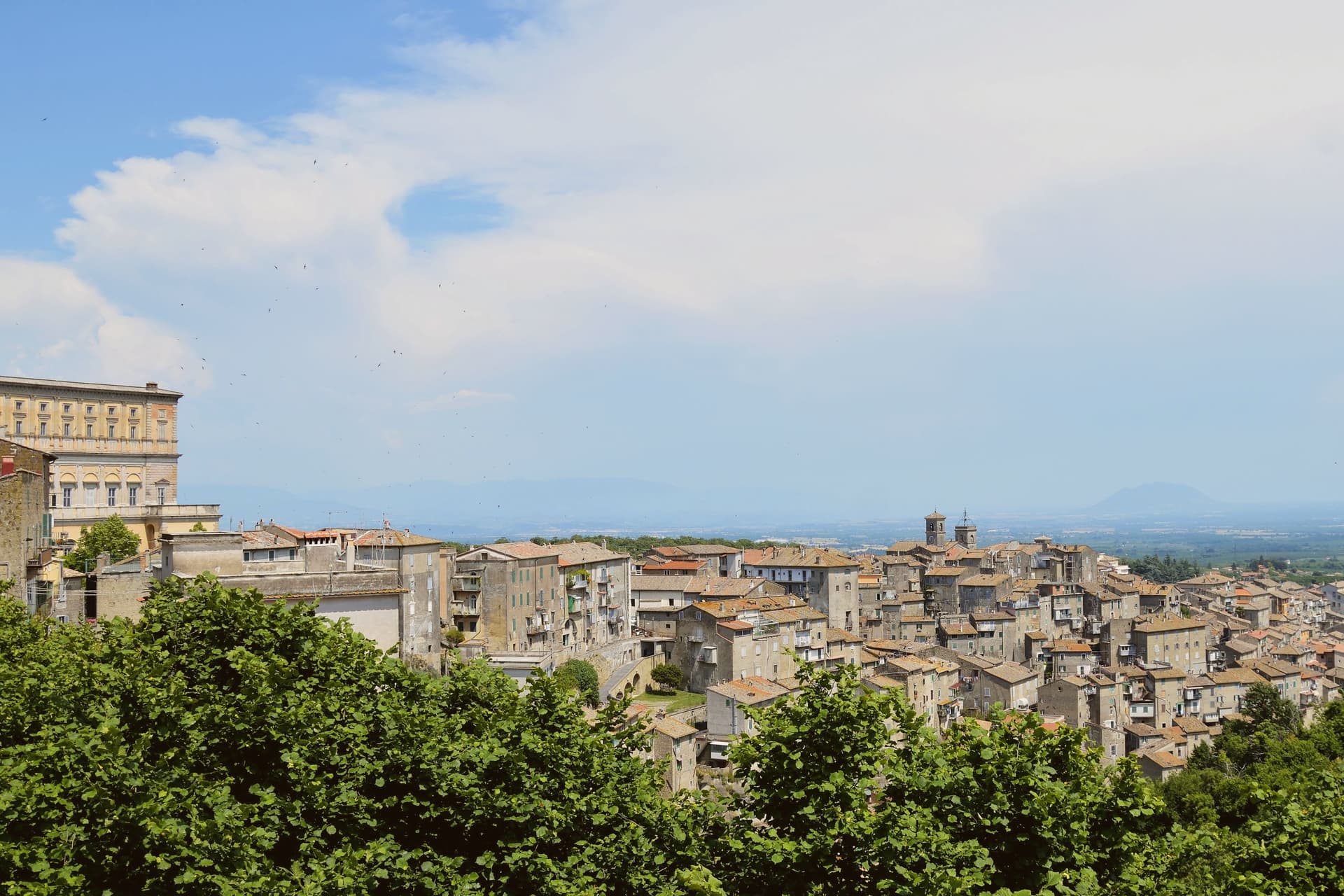
Caprarola stands at about 510 meters on the volcanic slopes of the Cimini, six kilometers east of Lago di Vico. The town is built on a single axis that climbs from the lower village to the Villa Farnese, the pentagonal Renaissance palace that organises everything below it.
Antonio da Sangallo the Younger designed the original fortress in 1530; after Sangallo's death the work was suspended, and Cardinal Alessandro Farnese the Younger reassigned it to Vignola in 1559. Vignola kept the pentagonal plan but turned it from a fortress into a Mannerist residence, with a circular colonnaded courtyard at its center, a scala regia spiraling between floors and the fresco cycles of the Zuccari brothers.
The plan was the model later copied for the Pentagon in Washington. Behind the villa, the Giardini Farnese climb into the chestnut and beech woods of the Cimini.
Caprarola is part of the Città della Nocciola and Città del Castagno networks, a recognition of the volcanic soils that produce both.
What to see in Caprarola
- Villa Farnese. Pentagonal Mannerist palace by Vignola, built 1559-1573 on Sangallo's earlier fortress plan, with a circular colonnaded courtyard.
- Giardini Farnese. Sixteenth-century formal garden and casino di caccia behind the villa, climbing into the chestnut woods of the Cimini.
- Lago di Vico. Volcanic crater lake at 510 meters, one of the highest of the major Italian lakes, shared with Ronciglione.
How to get to Caprarola
Terni is roughly 67 minutes away by road.
✷ We have written about Caprarola
“We went there on a Saturday in July, straight from Ronciglione, since it is about a 15-minute drive. We expected hordes. I don’t remember exactly, but I’m sure there were no more than 10 people there, including us two. Literally no one was there. The garden, which is huge and worth a trip alone, was completely empty and only for us.”
Read our piece on Caprarola →Caprarola | The town that became a driveway
Our tip
April through June and September into October are the months for the villa and the Cimini woods, when the chestnut canopy holds shade and Lago di Vico is at its clearest. July and August push the lower town into the low thirties; the high ceilings of the Villa Farnese keep visitors cool through the heat. The hazelnut harvest runs late August and September, the chestnut harvest follows in October, and both fill the surrounding sagre. Hazelnut Festival falls in August.
Why visit Bagnoregio
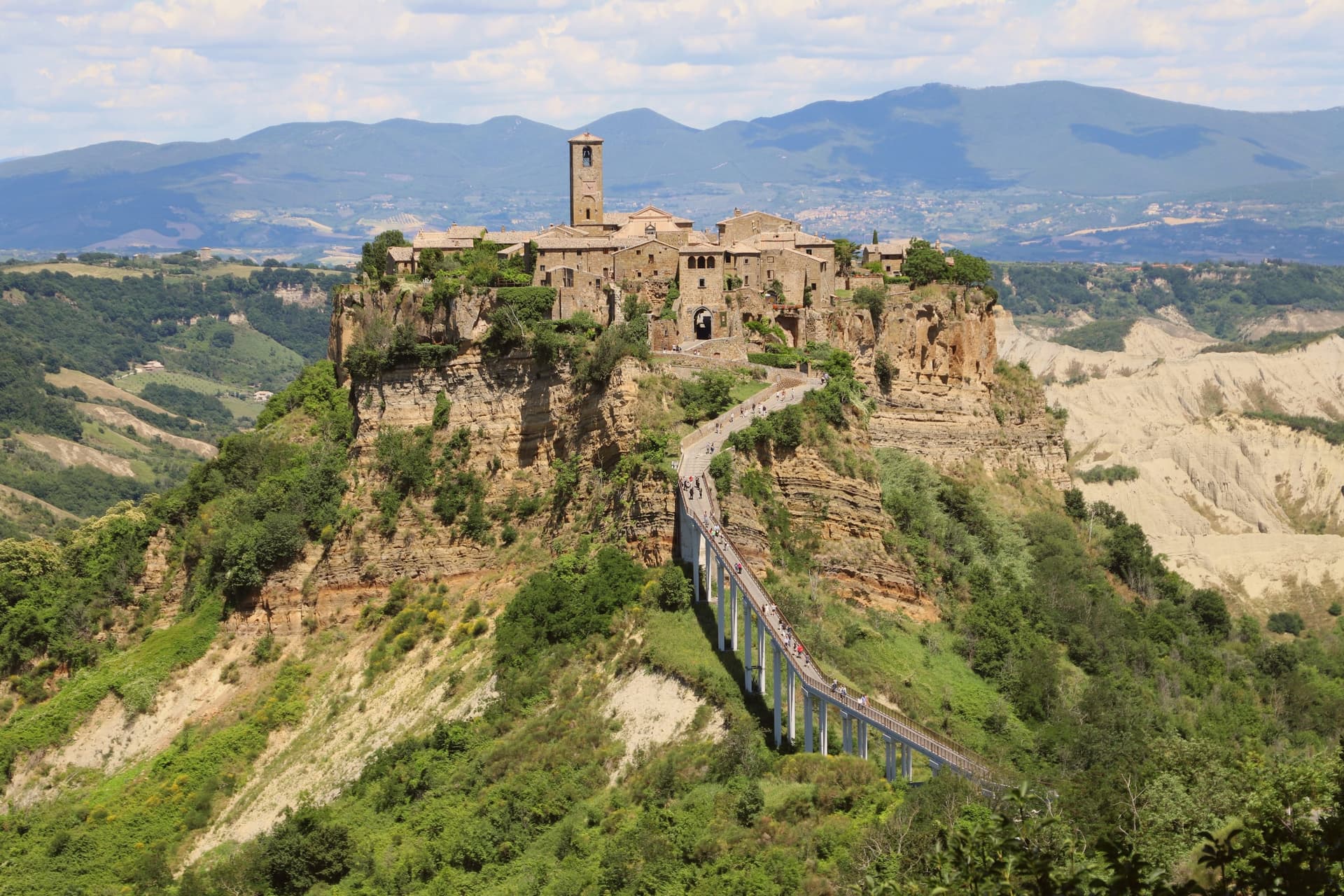
Bagnoregio sits at 484 meters on a tuff ridge in northern Lazio, sixty kilometers from Perugia and a hundred north of Rome. The town itself is small and quiet, but it is famous for what comes next to it: Civita di Bagnoregio, the frazione one kilometer east, a separate Etruscan-founded village stranded on a tuff plateau that erodes a few centimeters every year.
After the 1695 earthquake split Civita from the rest of the commune, the population emptied; today sixteen people live there year-round. A reinforced pedestrian bridge built in 1965 is the only access.
Civita is on the Borghi più belli d'Italia list and on most northern Lazio itineraries, and Bagnoregio, the larger and older town it grew out of, is where the bridge starts. Saint Bonaventure, the medieval Franciscan theologian and biographer of Saint Francis, was born here in 1221.
What to see in Bagnoregio
- Ponte pedonale di Civita. Reinforced concrete pedestrian bridge built in 1965, replacing the donkey path that connected Civita to Bagnoregio after the 1695 earthquake.
- Civita di Bagnoregio. Etruscan-founded frazione on an eroding tuff plateau, sixteen permanent residents, accessible only by the 1965 footbridge.
- Cattedrale di San Donato (Bagnoregio). Episcopal cathedral in the larger town, with works tied to the cult of Saint Bonaventure, born in Bagnoregio in 1221.
How to get to Bagnoregio
Terni is roughly 69 minutes away by road.
Our tip
April through June and September through October are when Civita is at its best. The light is low, the hill mist rises off the calanchi at dawn, and the path across the bridge is bearable in temperature. July and August reach the low thirties; the open bridge has no shade, and the small piazza of Civita can hold no more than a few hundred visitors at a time. Festa delle Cantine - Profumi d'Autunno falls in October.
Why visit Giano dell'Umbria
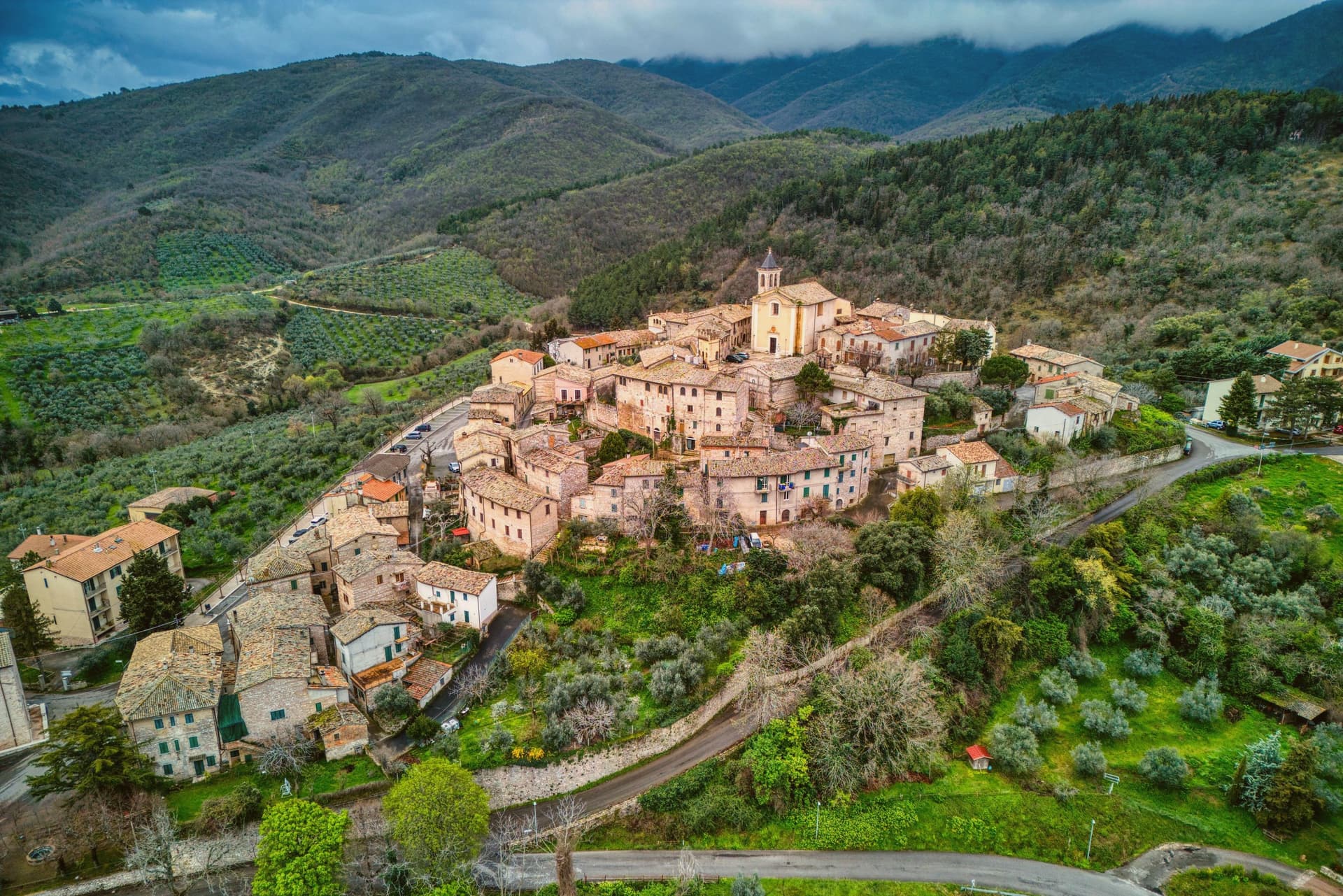
Giano dell'Umbria sits at 547 meters on the eastern slope of a mountain range, inside the triangle between Foligno, Spoleto and Todi. The territory is dotted with small medieval castles, Montecchio and Morcicchia the most intact, and small Romanesque churches scattered between the olive groves.
The abbey stands just outside the walls of the capoluogo, while Montecchio, the castle, the frazione and the Antiquarium together, sits apart on its own ridge above Bastardo, closer to the Via Flaminia than to the main town. The commune is also the seat of the DOC Spoleto wine, with the Trebbiano Spoletino grape reborn here in the last decade, and the olive groves around Bastardo supply the Frantoi Aperti weekends every November.
Abbey, castle and grove read as three settlements on one slope: a religious center below the walls, a fortified outpost on the ridge, and an agricultural economy spread through the land between them.
What to see in Giano dell'Umbria
- Abbazia di San Felice. The crypt below the church is the part worth the stop, a Romanesque space set beneath the rebuilt monastery, holding the ground plan of the oratory that came before it.
- Castello di Montecchio. Fortified on the Monti Martani slope along the Via Flaminia, held by the lords of Giano from the 12th century; the walls and position over the road are still legible.
- Villa Rufione. A rural villa site between Montecchio and Bastardo, on the Via Flaminia Vetus. Nothing remains to visit on the ground; the finds are what survive, held in the Antiquarium of Montecchio.
How to get to Giano dell'Umbria
Terni is roughly 50 minutes away by road.
Our tip
April through June and September into October are the working months on the Martani slopes. The olive groves and the abbey grounds hold light well into the evening. November is the new-oil month: the Frantoi Aperti weekends open the mills, and the town fills for tastings of the just-pressed Martani oil. La Mangiaunta falls in October.
Why visit Stroncone
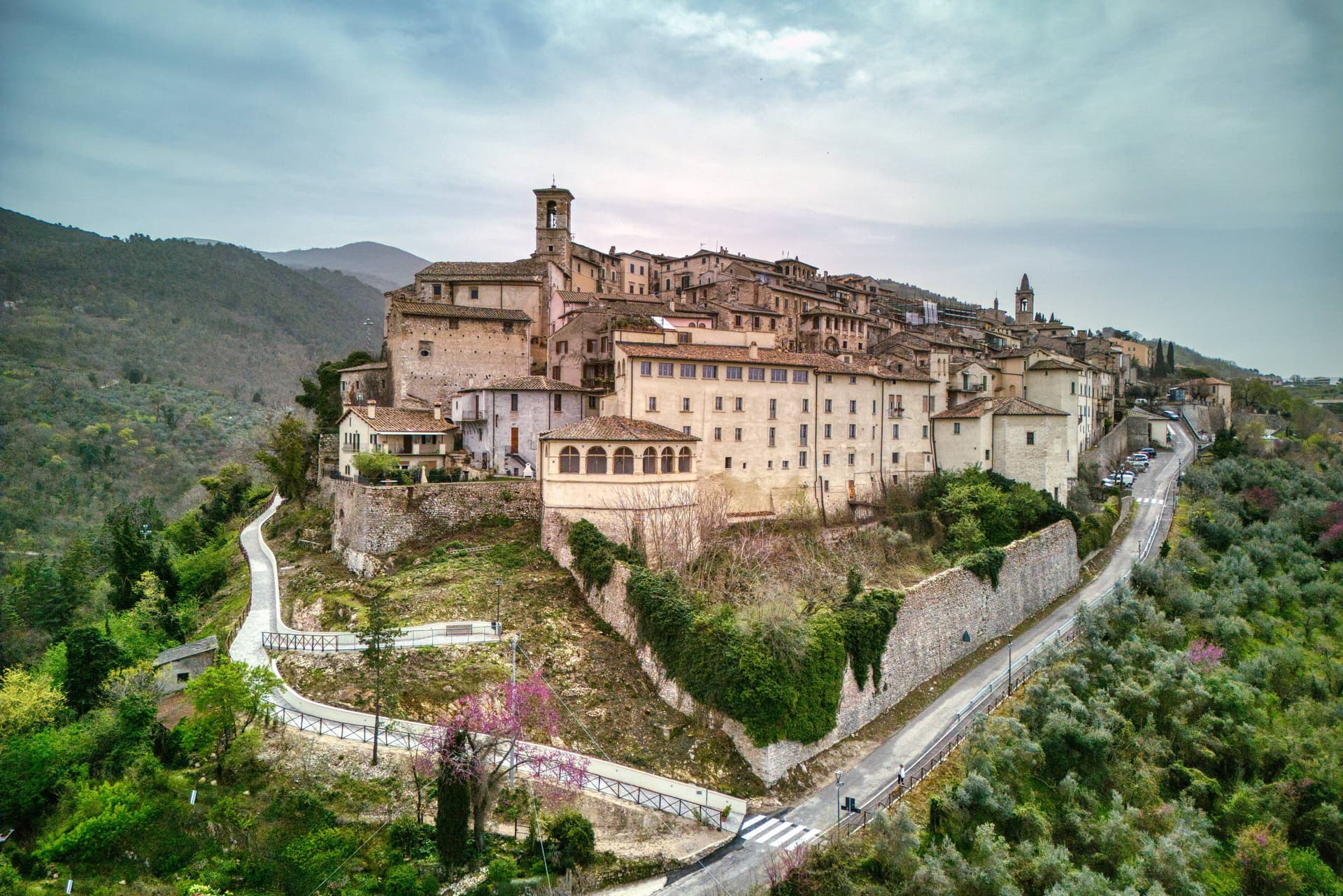
Stroncone sits at 451 meters on an olive-covered hill eight kilometers south of Terni, in the Conca Ternana on the western slope of the Apennine. The name traces to Duke Ugone of Spoleto, whose castrum Hugonis evolved through Castrugone and Strungone to the present form.
A group settled here around the tenth century and built a castle; Stroncone first appears in documents in 1012, when Giovanni di Pietro made a donation to the monastery of San Simeone. Pope Innocent III granted municipal self-rule in 1215.
The Convento di San Francesco, south of the walls, is one of the older Franciscan foundations in Umbria, founded by tradition by Francis himself in 1213, two years before papal recognition of the order. The medieval circuit walls remain almost complete, with the original gates framing a network of stepped lanes that climb to the small main square.
The Cammino di San Francesco passes through, picking up walkers between Rieti and Assisi.
What to see in Stroncone
- Convento di San Francesco. Franciscan convent south of the walls, founded by tradition by Saint Francis in 1213, two years before papal recognition of the order.
- Centro storico. Walled medieval core with original gates intact, climbing through stepped lanes to the small main square at the top of the hill.
- Chiesa di San Giovanni Decollato. Main parish church at the heart of the borgo, with frescoed interior and a Renaissance baptismal font.
How to get to Stroncone
There is a railway station in the town, so you can arrive without a car and never need one while you are here. Terni is roughly 18 minutes away by road.
Our tip
April through June and September into October are the months for Stroncone. Olive harvest carries the autumn rhythm into late November, and the frantoi work into the evening through October and November. July and August are warm in the Conca Ternana but the hill is high enough that nights cool quickly. Sagra De u Cecu Maritu falls in July.
Why visit Vitorchiano
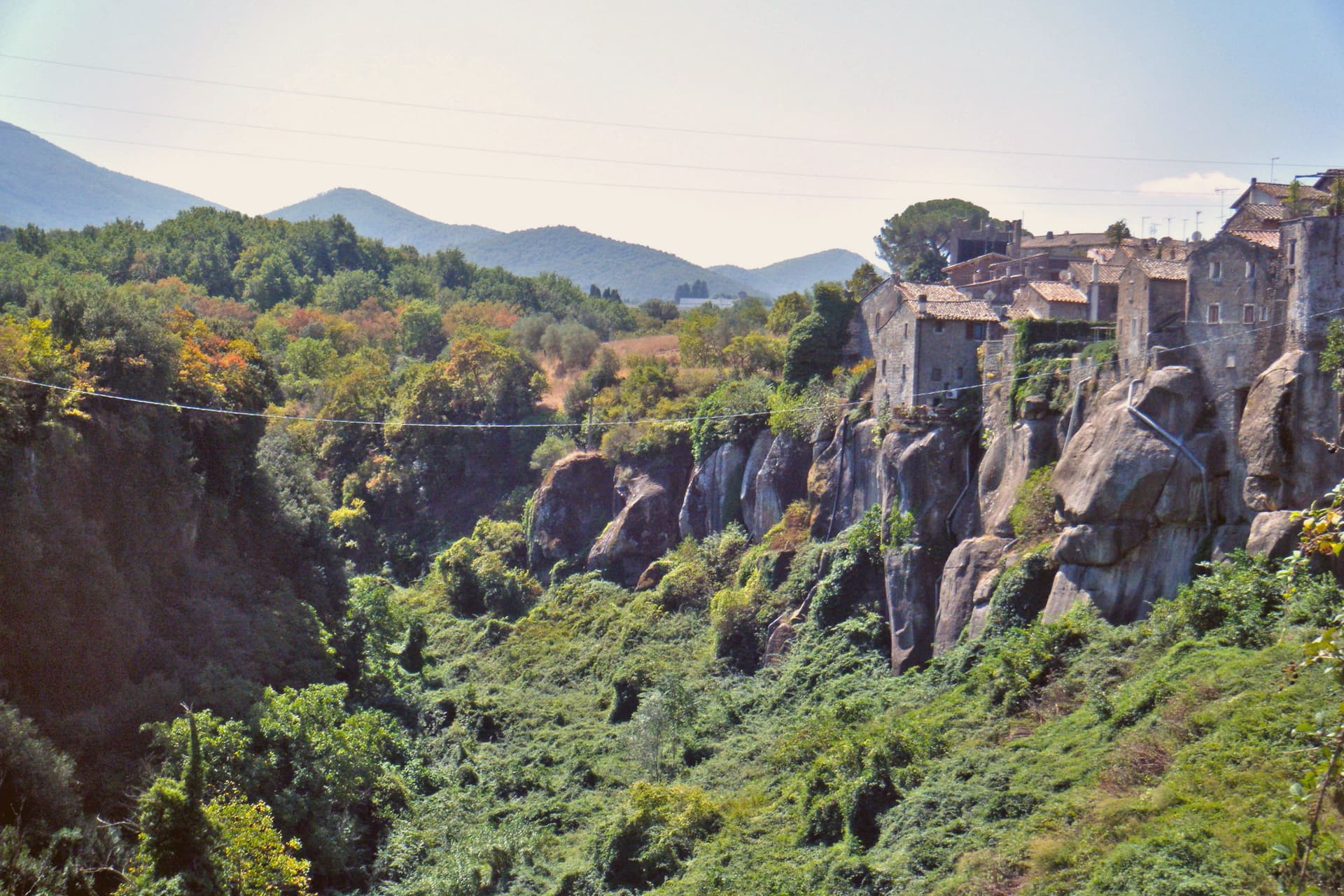
Vitorchiano sits at 285 meters on a single bank of peperino. Two ravines flank the town and meet at the Vezza torrent below, which is why the old center reads as an island of dark stone with the land falling away on both sides.
The quarries below the town are still working, and Vitorchiano peperino now ships to Canada, Japan and the Middle East, so the same rock that holds up the walls and staircases overhead also travels out from underneath the town in the other direction. The statue on the ridge was carved from a single block of that local stone by sculptors who came from the other side of the world to work it, which is its own kind of trade: peperino leaving Vitorchiano to be known abroad, and a foreign hand arriving to shape what stayed.
Above the rooftops, the Belvedere gives the wider frame the streets below cannot, the Cimini hills and the Tiber valley spread out past the ravine. Vitorchiano holds three institutional signals at once: Borghi più belli, Bandiera Arancione TCI, Città della Nocciola.
A small town, then, defined less by any one of its parts than by how completely the stone underneath it accounts for all of them.
What to see in Vitorchiano
- Centro storico in peperino. Medieval old town cut from a single volcanic boulder, walls and houses built in dark Vitorchiano peperino quarried below.
- Moai di Vitorchiano. Six-meter peperino statue carved in 1990 by eleven sculptors of the Atan family from Easter Island, the only true Moai outside Rapa Nui.
- Belvedere. Cliff-edge terrace at the eastern end of the borgo, view across the Vezza ravine to the Cimini hills and the Tiber valley.
How to get to Vitorchiano
There is a railway station in the town, so you can arrive without a car and never need one while you are here. Terni is roughly 53 minutes away by road.
Our tip
April through June brings the Cimini hills into green and Vitorchiano into clear light, the peperino dark against new leaves. September and October are the harvest months for hazelnuts and the calmest period in the borgo. July and August touch the mid-thirties; the centro storico empties between two and five in the afternoon. Sagra del Cavatello falls in July.
Why visit Orvieto
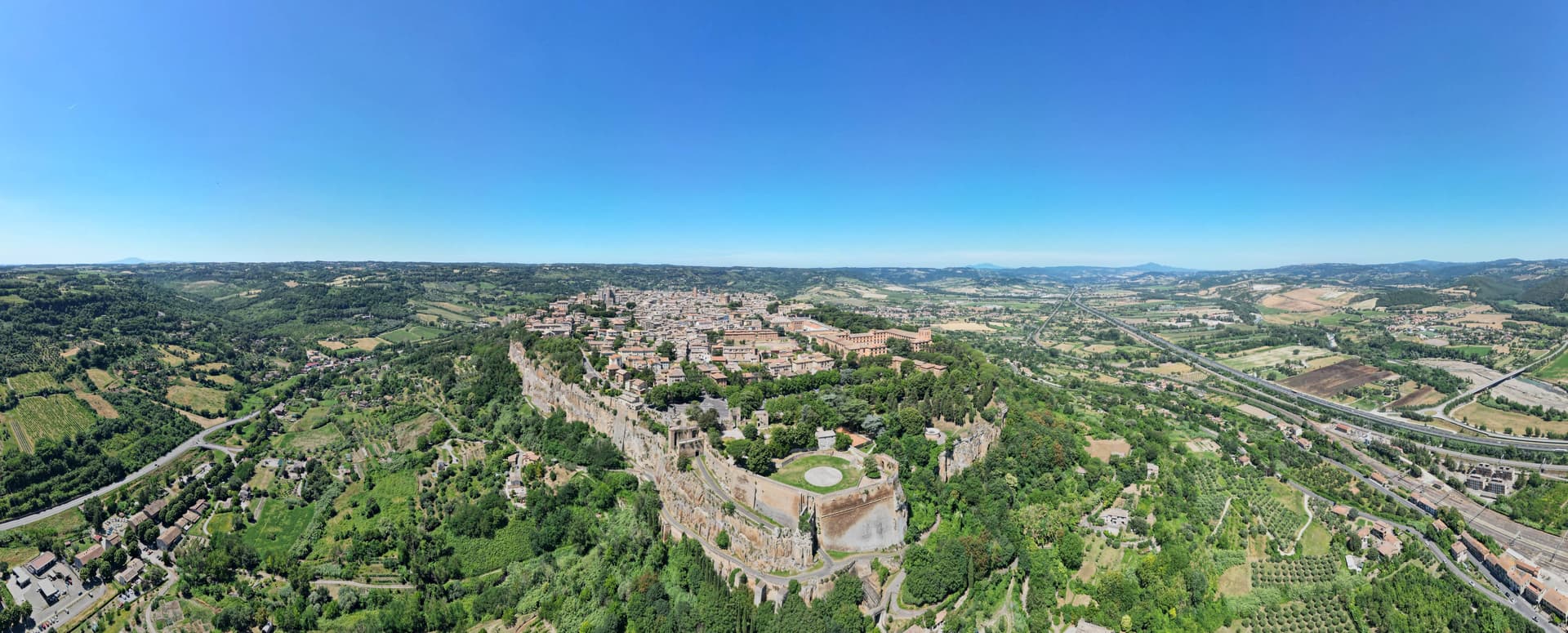
Orvieto sits on a flat-topped butte of volcanic tuff at 325 meters, the cliffs 195 meters above the surrounding plain. The town began as Velzna, a flourishing Etruscan metropolis, and the Romans destroyed it in 264 BC.
The medieval town that replaced it on the same plateau became a papal refuge in the 13th century, when popes left Rome for the safety of the height. The town's layers sit one below the other rather than side by side: the cliff face is honeycombed with Etruscan and medieval cavities, cisterns and pigeon roosts cut into the same tuff that the necropolis at its foot was carved into during the 6th century BC, while the cathedral and its chapel occupy the surface above, and the well descends back down through the rock to reach water.
What looks from a distance like a single stone crown is in fact three towns stacked in the same column of tuff: the dead below, the popes and their cathedral on top, and a passage cut straight through the middle to keep the town supplied.
What to see in Orvieto
- Duomo di Orvieto. The polychrome marble façade rises in tiers of mosaic and sculpture, the decorative Gothic worked into bands of color rather than left plain stone.
- Cappella di San Brizio. The Last Judgment fills the chapel wall to wall, figures twisting and falling across the vault and lunettes inside the cathedral.
- Pozzo di San Patrizio. Sunk for Pope Clement VII, the shaft drops 53 meters, lit by windows cut into the walls of the two ramps so the descent is never dark. Antonio da Sangallo the Younger designed it to move water and mules at once, without either crossing the other's path.
How to get to Orvieto
There is a railway station in the town, so you can arrive without a car and never need one while you are here. Terni is roughly 56 minutes away by road.
Our tip
April through June and September into October are the months for Orvieto. The plateau holds the long light, the Paglia valley below is green or gold, and the white wine of the surrounding vineyards is poured at every osteria. Umbria Jazz Winter runs around New Year and fills the Teatro Mancinelli; the Corpus Domini procession on the second Sunday after Pentecost is the most concentrated religious event of the year. Anticamente a Orvieto falls in the season.
Why visit Spoleto
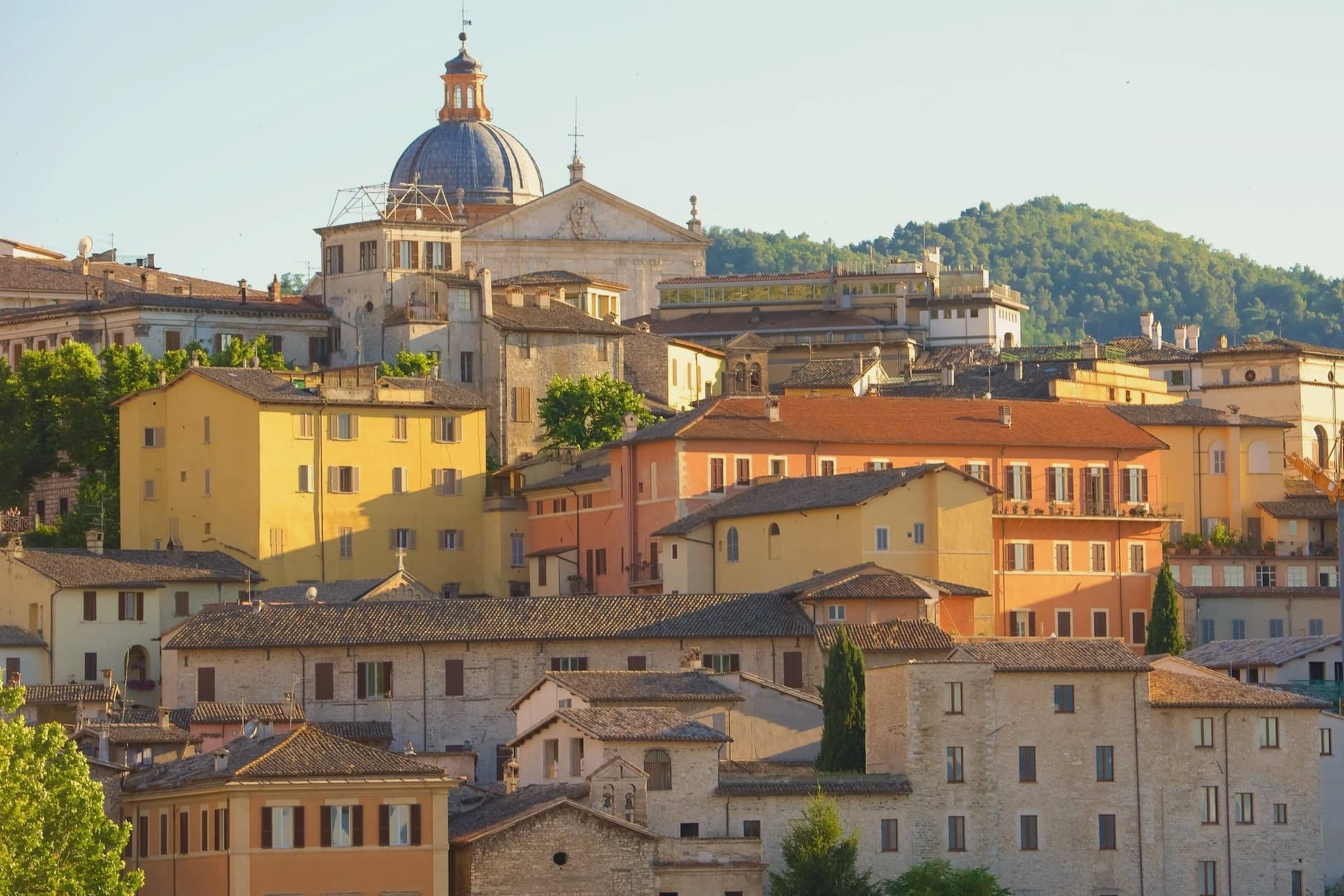
Spoleto sits at 396 meters at the southern edge of the Valle Umbra, the Apennines rising behind it toward Monteluco. The town was Roman Spoletium from 241 BC, then capital of one of the two great Lombard duchies of Italy from 576, controlling Umbria, Sabina, Picenum and the Pescara valley for more than five centuries.
The Rocca Albornoziana on the Colle Sant'Elia was built between 1363 and 1367 by Matteo Gattapone for Cardinal Albornoz, both a papal fortress and a residence, now the Museo Nazionale del Ducato. From the Rocca the Ponte delle Torri, 230 meters long and 80 meters high, crosses the Tessino gorge to Monteluco, an aqueduct of the 13th century built over Roman foundations.
The Duomo holds a Byzantine mosaic of 1207 across its façade and Filippo Lippi's last fresco cycle in the apse. Gian Carlo Menotti founded the Festival dei Due Mondi in 1958; the Roman theater, the Rocca courtyard and Piazza del Duomo still carry the program each year from late June into mid-July.
What to see in Spoleto
- Rocca Albornoziana. Papal fortress built 1363-1367 by Matteo Gattapone for Cardinal Albornoz, now the Museo Nazionale del Ducato di Spoleto.
- Ponte delle Torri. Aqueduct bridge 230 meters long and 80 meters high, crossing the Tessino gorge to Monteluco, 13th-14th century on Roman foundations.
- Duomo di Santa Maria Assunta. Twelfth-century Romanesque cathedral with Byzantine mosaic of 1207 on the façade, Renaissance portico, and Filippo Lippi frescoes in the apse.
How to get to Spoleto
There is a railway station in the town, so you can arrive without a car and never need one while you are here. Terni is roughly 41 minutes away by road.
Our tip
April through June and September into October are the months for Spoleto. The town opens its gardens, the Rocca courtyard fills with sun, and the long walks along the Giro dei Condotti above the Ponte delle Torri become bearable again. The Festival dei Due Mondi runs from late June into mid-July, when Spoleto doubles in population and the Roman theater carries opera into the small hours. Sagra degli gnocchi, suino e... del buon vino falls in June.
More from Anywhere Italy
 The 9 best olive oil towns within 90 minutes of Terni
- The best hill towns with a food festival in Lazio
- The 10 best hidden hill towns you can reach by train within 90 minutes of Terni
 The 8 best hill towns on a walking route within 90 minutes of Terni
 The best hill towns with a serious restaurant within 90 minutes of Terni
 The best hill towns in the province of Terni