
The prettiest villages you can reach by train in Puglia
Puglia is built out of pale stone, and it shows in every village where the tufa and limestone reflect the light back at you until the walls go blue at dusk. The food follows the same logic of plain materials done well: orecchiette with turnip tops, burrata eaten the day it was made, focaccia heavy with tomato and oregano, primitivo and negroamaro from vines pruned low against the wind. Spring brings the fava fields and the almond blossom, autumn brings the olive harvest and cooler air in the trulli country, and high summer belongs to the sea. The regional railways, both the state line and the private one running up through the Valle d'Itria and the Murgia, reach a surprising number of these places.
The obvious route is Bari to Alberobello, where the trulli district draws coach parties from the ports and the cruise terminals and the lanes fill by mid-morning. It is a genuine piece of vernacular architecture and worth seeing, but its whole economy has bent towards the visitor, and the same conical roofs continue for miles into countryside where nobody stops. Polignano a Mare gets the same treatment on the coast, its cliff terrace queued for a photograph.
The stone, the sea and the olive groves do not end where the tour buses turn around. Villages across the Gargano, the Valle d'Itria, the Alta Murgia and the deep Salento carry the same whitewash and the same kitchens, and a good number of them sit within walking distance of a working station. These are the ones on that list, smaller, quieter, and reachable with a ticket rather than a hire car.
Of the 59 communes we have mapped in Puglia, 8 qualify as prettiest villages you can reach by train: each has passed the national assessment of Italy's most beautiful villages, and we have confirmed each is reachable without a car. The smallest, Bovino, has 2,973 residents.
Elsewhere in the catalogue: The best hidden olive oil towns you can reach by train in Puglia and The 9 best hidden towns you can reach by train that eat well in Puglia.
Bovino
Why visit Bovino
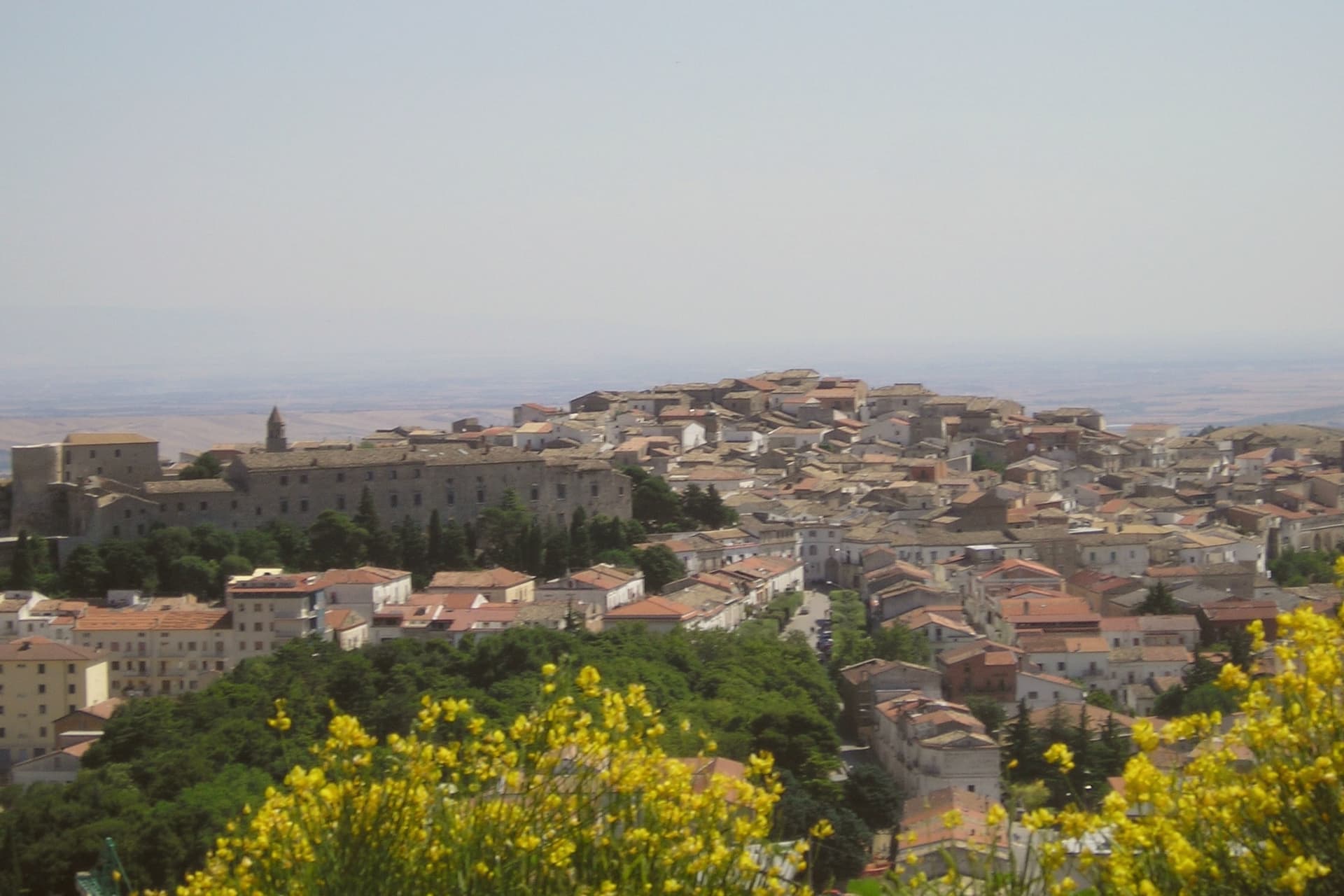
Bovino sits at 646 meters on a terrace of the Monti Dauni above the Cervaro valley, thirty-five kilometers southwest of Foggia. The Roman name Vibinum is recorded by Pliny and Polybius; in 323 BC the town fought the Samnite Wars on the Roman side.
The Norman count Drogo built the castle in the eleventh century, Frederick II expanded it in the thirteenth, and the Guevara dukes turned it into a residential palace in the seventeenth century, inhabited by the family until 1961. The coffered ceilings and the hanging garden hosted Torquato Tasso, Giovan Battista Marino, Maria Theresa of Austria, and Pope Benedict XIII.
The concattedrale of Santa Maria Assunta, originally built in 1231 in Apulian Romanesque style, was destroyed by the 1930 Irpinia earthquake and reconsecrated in 1936. Eight hundred sculpted stone portals across the centro storico are the work of local masters; the town carries both Borghi più belli and Bandiera Arancione signals.
We confirmed you can reach this one by train.
What to see in Bovino
- Castello Ducale (Palazzo dei Guevara). Norman castle built by Count Drogo, expanded by Frederick II, turned into a Guevara ducal palace in the seventeenth century and inhabited until 1961.
- Concattedrale di Santa Maria Assunta. Romanesque cathedral of 1231, destroyed by the 1930 Irpinia earthquake and reconsecrated in 1936, co-cathedral of the Archdiocese of Foggia-Bovino.
- Centro storico. Medieval hilltop village with eight hundred sculpted stone portals carved by local masters, ringed by the surviving walls of the castrum.
How to get to Bovino
There is a railway station in the town, so you can arrive without a car and never need one while you are here. Foggia is roughly 34 minutes away by road.
Our tip
May through October is the workable season at 646 meters. June through August stay around twenty-six to twenty-eight degrees on the ridge while Foggia bakes thirty kilometers below. September is the start of the chestnut and olive work.
Specchia
Why visit Specchia
Specchia sits on the Serra Magnone at 130 meters, one of the higher points in lower Salento, forty-five kilometers south of Lecce and ten kilometers from the Ionian coast. The name comes from the specchie, conical piles of dry stones the Messapians built across the peninsula as defensive lookouts.
The medieval nucleus formed in the ninth century when Saracen raids pushed coastal villagers inland and onto the hill. The fifteenth-century street plan survives intact: a tight grid of alleys, courtyards and Baroque portals enclosed by what remains of the walls.
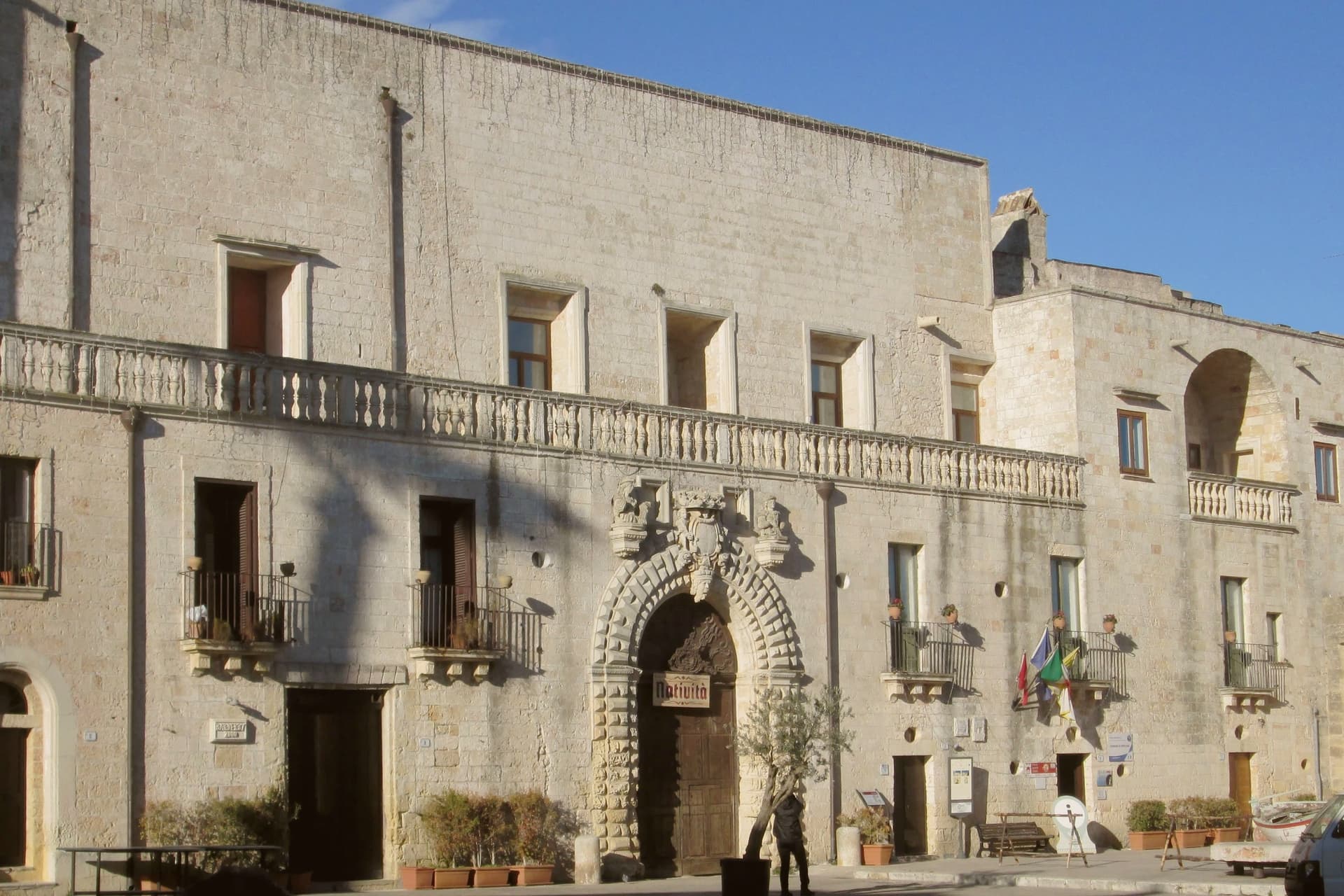
Castello Risolo dominates the center, a sixteenth-century block enlarged in the seventeenth century by the Trane and Protonobilissimo families as their residence. The Convento dei Francescani Neri dates to 1531.
Specchia entered the Borghi più belli d'Italia network in 2004 and the Ministry of Tourism named it Gioiello d'Italia in 2012. Walking the lanes after dusk, the village reads as one continuous courtyard.
We confirmed you can reach this one by train.
What to see in Specchia
- Castello Risolo. Sixteenth-century castle in the heart of the centro storico, enlarged between 1600 and 1700 by the Trane and Protonobilissimo families as their noble residence.
- Convento dei Francescani Neri. Franciscan church and convent of the Black Friars, documented from 1531, with harmonious lines that anchor the upper edge of the old town.
- Centro storico medievale. Fifteenth-century street plan of narrow lanes, stone staircases, courtyards and Baroque portals, preserved nearly intact within the line of the old walls.
How to get to Specchia
There is a railway station in the town, so you can arrive without a car and never need one while you are here. Taranto is roughly 145 minutes away by road.
Our tip
April through June and September through October are the months to come: warm afternoons, cool evenings on the ridge, the countryside green or in olive harvest. July and August push past thirty-five degrees and the old town empties between two and five in the afternoon, then refills after sunset for the passeggiata. The Ionian beaches at Torre Vado and Pescoluse sit ten to fifteen kilometers away and absorb most of the August crowd.
Otranto
Why visit Otranto
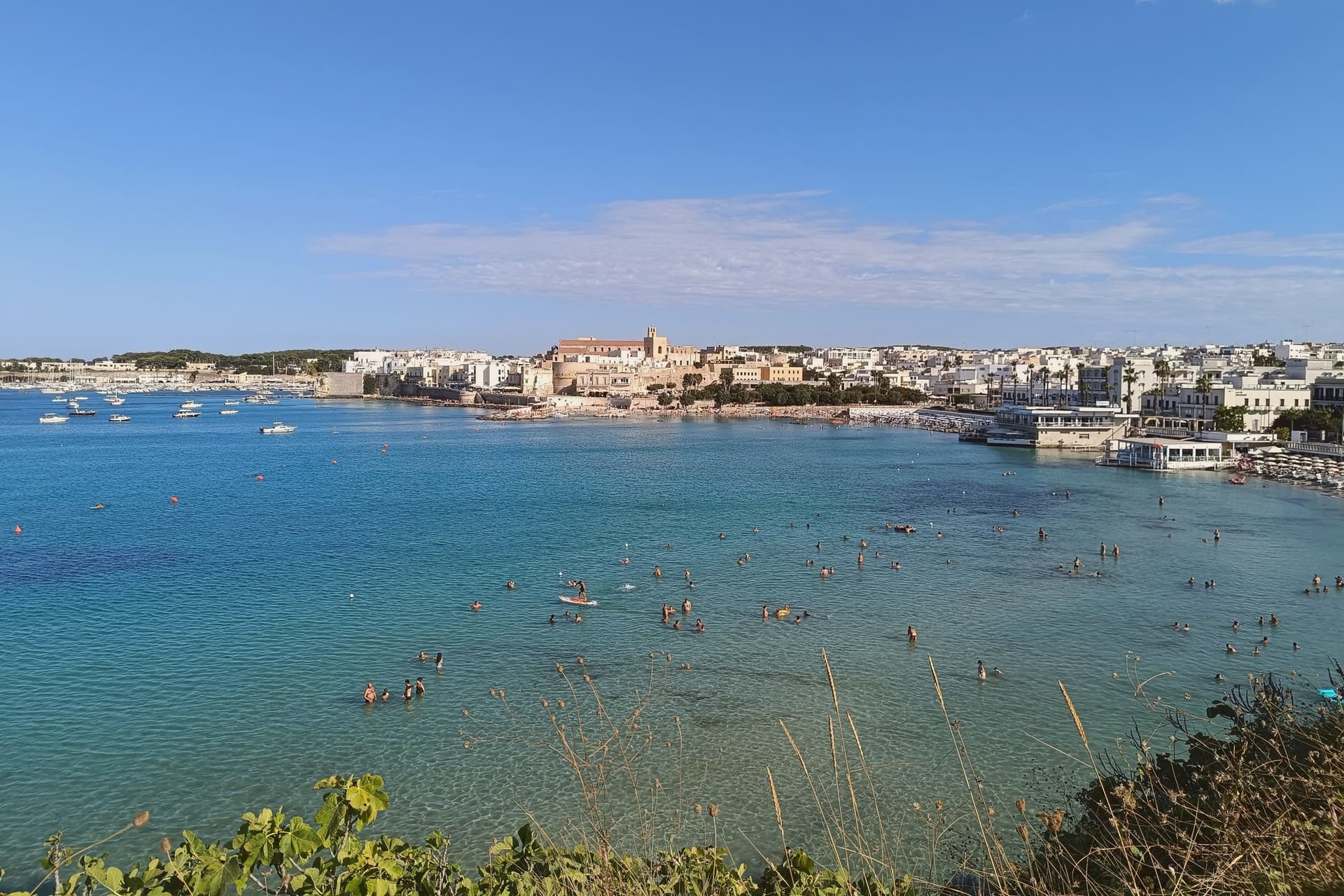
Otranto sits at sea level on a small promontory thirty kilometers southeast of Lecce, the easternmost city of Italy and the closest mainland point to Albania across the eighty-kilometer Strait of Otranto. The Cattedrale di Santa Maria Annunziata, consecrated in 1088, holds a mosaic floor laid between 1163 and 1165 by the monk Pantaleone for Archbishop Gionata.
About 800,000 tesserae across the three naves depict Adam and Eve, Noah, the Tower of Babel and a Tree of Life with biblical, classical and chivalric figures: Alexander the Great, Arthur, the months of the year. On 14 August 1480 an Ottoman force under Gedik Ahmed Pasha took the city; 813 inhabitants who refused to convert were beheaded on the Colle della Minerva and their bones are now in the cathedral, in seven glass-fronted recesses.
Pope Francis canonized them in 2013. The Castello Aragonese, raised by Ferdinand I of Aragon between 1485 and 1498, is the response: a five-sided fortress with a moat, built specifically to prevent a second sack.
We confirmed you can reach this one by train.
What to see in Otranto
- Cattedrale di Santa Maria Annunziata. Norman cathedral consecrated in 1088, with Pantaleone's mosaic floor of 1163-1165 and the relics of the 813 martyrs of 1480 in seven glass recesses.
- Castello Aragonese. Five-sided Aragonese fortress raised 1485-1498 by Ferdinand I after the Ottoman sack, irregular plan with moat running the full perimeter.
- Chiesa di San Pietro. Byzantine cross-plan church in the centro storico, ninth-tenth century, with three apses and frescoes from the tenth through fifteenth centuries.
How to get to Otranto
There is a railway station in the town, so you can arrive without a car and never need one while you are here. Taranto is roughly 137 minutes away by road.
Our tip
May through September is the working coastal season, Adriatic water warm enough to swim by mid-May and the centro storico operational into the evening. July and August fill the small headland with day-trippers from across Salento and beyond; weekends in August are shoulder to shoulder along the Lungomare and the cathedral fills with queues. June and September are the sane choices, mild evenings and the same water without the crush.
Sammichele di Bari
Why visit Sammichele di Bari
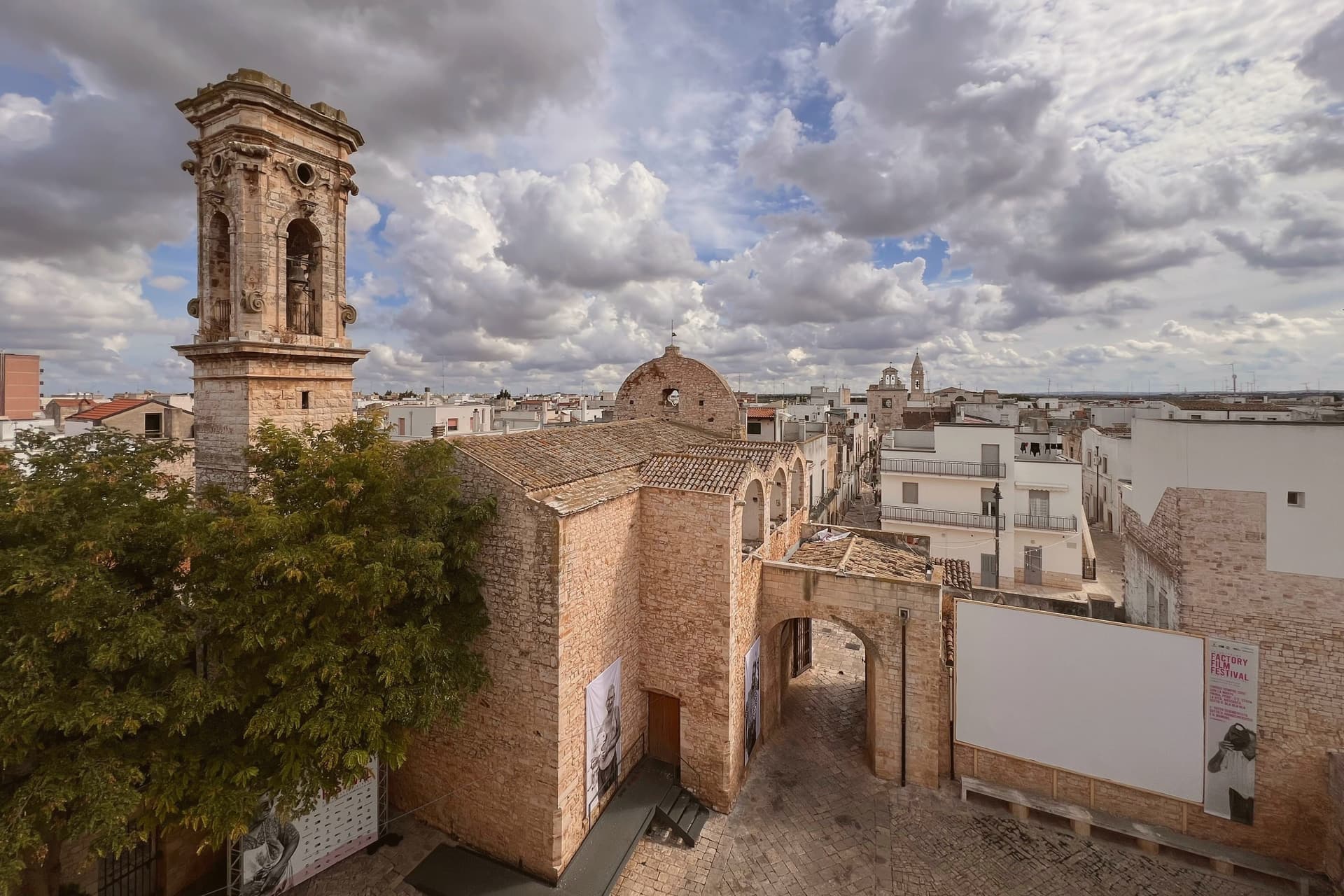
Sammichele di Bari sits at 280 meters on the Murge plateau, thirty kilometers south of Bari. The settlement was founded as a fief in 1609 when the wealthy Genoese banker Michele Vaaz bought the territory from the Centurione family and named the new town after his patron saint.
The Castello Caracciolo at the centre of the village began as a Norman outpost, passed through Centurione and Vaaz ownership, and was bought by the Caracciolo dukes in 1797 who hired the architect Amenduni to redo the eastern façade in rusticated stone with neo-Gothic bifora windows. Since 1974 the castle has held the Museo della Civiltà Contadina Dino Bianco, one of the oldest and largest ethnographic museums in Italy, with over five thousand objects of nineteenth-century peasant life arranged over four floors.
The annual Sagra della Zampina on the last weekend of September celebrates the spiced spit-roasted pork sausage that the town claims as its own.
We confirmed you can reach this one by train.
What to see in Sammichele di Bari
- Castello Caracciolo. Norman-origin castle bought by Michele Vaaz in 1609 and remodelled by the Caracciolo dukes in the nineteenth century with neo-Gothic windows.
- Museo della Civiltà Contadina Dino Bianco. Ethnographic museum inside the castle, founded by professor Dino Bianco in 1968, over five thousand objects of nineteenth-century rural life.
- Centro storico. Walled old town on the Murge plateau, laid out by Michele Vaaz from 1609 around the castle and the parish church of San Michele Arcangelo.
How to get to Sammichele di Bari
There is a railway station in the town, so you can arrive without a car and never need one while you are here. Bari is roughly 30 minutes away by road.
Our tip
April through June and September through October are the workable months on the Murge. July and August push past thirty-five degrees on the plateau and the centro storico empties between two and five. The late-September Sagra della Zampina falls at the edge of the heat and pulls a crowd from the metropolitan area.
Vico del Gargano
Why visit Vico del Gargano
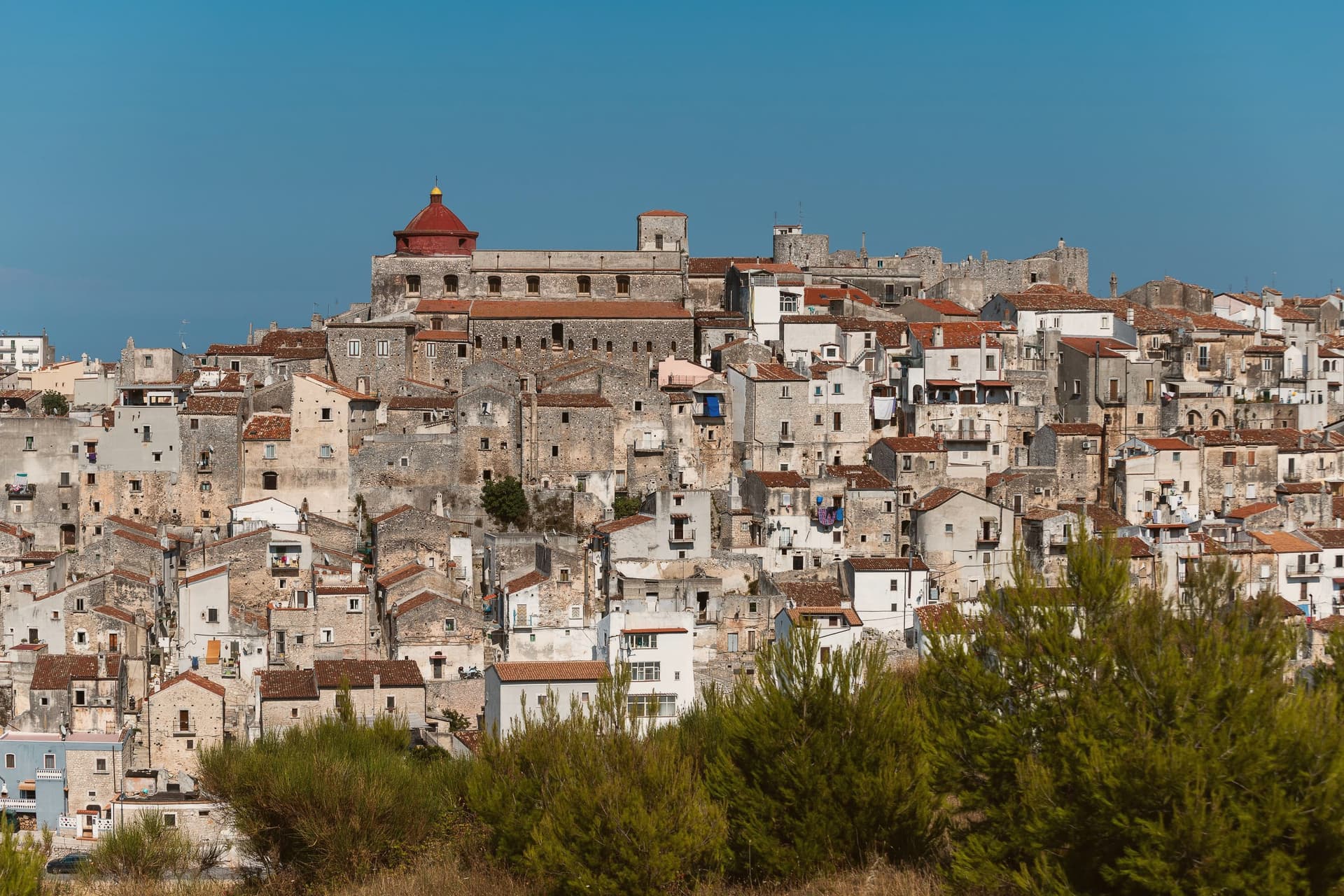
The town sits at 445 meters on a rocky promontory, with the territory falling from the 782-meter heights of the forest above to the beaches of the coastal frazioni below. The first urban core, called Vicus, was founded around 970 by Sueripolo of the Slavonians on land granted by Byzantine authorities, the seed from which the hill town and its later defenses grew.
The upper town, walled and towered, holds the historic center and its churches close around the castle, while the citrus terraces step down from that core toward the sea, and the coastal frazioni mark where the descent ends at the Adriatic. Inland forest, hill town, and coast form one continuous drop in elevation rather than three separate places.
What holds this together is the shape of the ground itself: a settlement founded on a promontory has simply grown downward over the centuries, from Byzantine grant to Norman wall to citrus terrace to shoreline, each layer sitting on the one before it.
We confirmed you can reach this one by train.
What to see in Vico del Gargano
- Castello Normanno-Svevo. Eleventh-century Norman castle enlarged in 1240 by Frederick II and again in 1292, the anchor of the medieval defensive system of twenty towers and walls.
- Centro storico e Vicolo del Bacio. Medieval old town of about thirteen churches and chapels, with the Kiss Alley, a passage so narrow that walking it touching is the local prescription for lasting love. The survival of this core and the density of the olive mills below it earned the town a place among the Borghi più belli d'Italia.
- Foresta Umbra. Beech and oak ancient forest of Gargano National Park, reaching 830 meters within the municipal territory, with trails to centuries-old turkey oaks.
How to get to Vico del Gargano
There is a railway station in the town, so you can arrive without a car and never need one while you are here. Foggia is roughly 99 minutes away by road.
Our tip
April through June and September through October are the months Vico is at its best: the citrus groves in flower or in fruit, the Foresta Umbra in green or autumn rust, and the centro storico mild at 445 meters while the coast below stays swimmable. July and August are hot on the coast and busy at San Menaio; the centro keeps a few degrees cooler than the beach. The Saint Valentine feast on February 14 turns the village into a pilgrimage and a wedding stage.
Cisternino
Why visit Cisternino
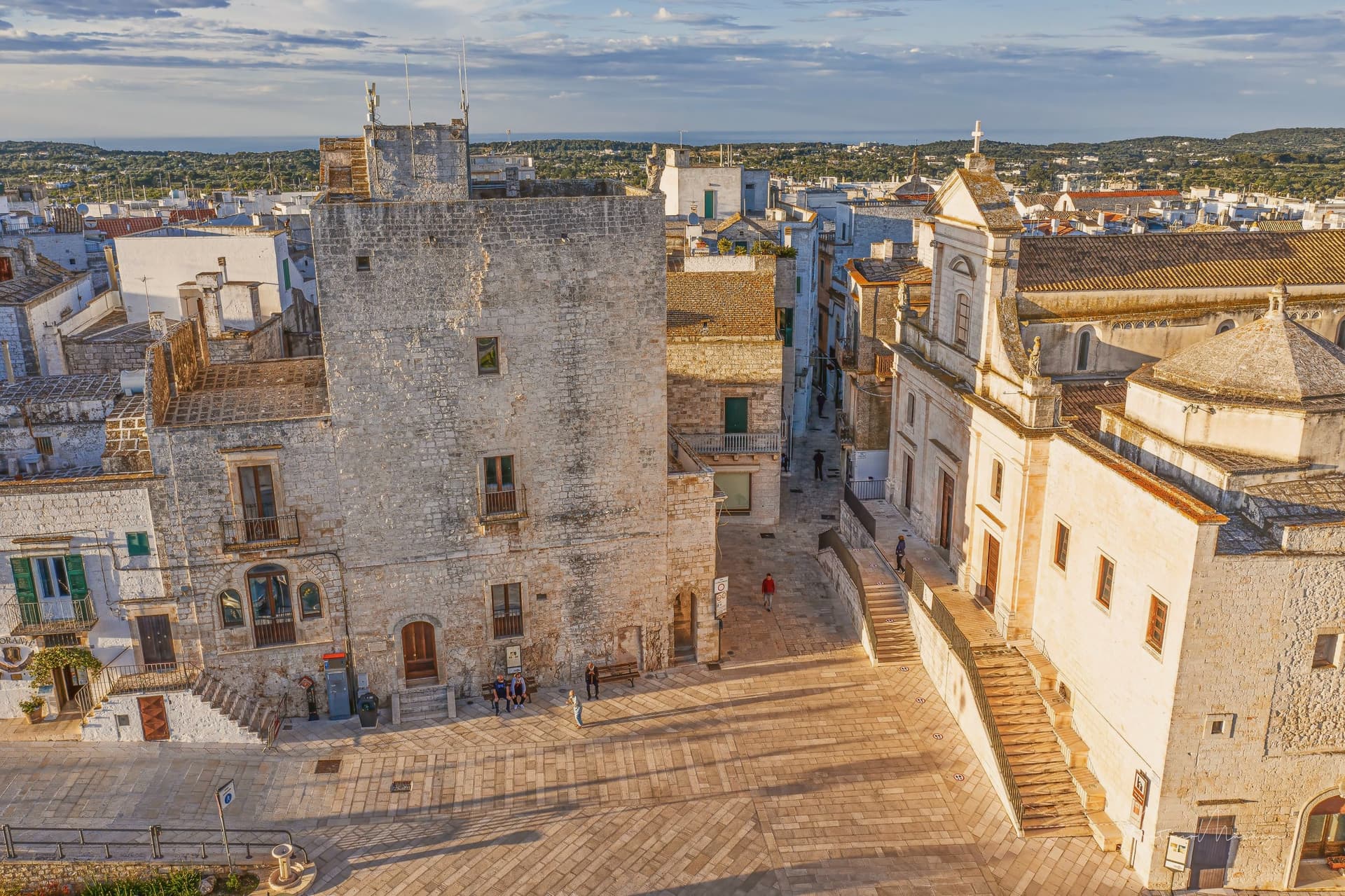
Cisternino occupies the last rise of the southern Murgia, its whitewashed houses looking down over drystone walls, vineyards and trulli in the Valle d'Itria. The town sits within the Itria Valley DOC wine zone, and the older quarter is built as a tight knot against the edge of the plateau, its stone alleys and courtyards folded close enough together that the comparison to a North African medina has stuck.
The civic tower in the main square marks where the newer town gives way to that older core, a single threshold between the two. Cisternino, a Cittaslow member since 2003, was named Cittaslow City of the Year in 2014, a designation that formalizes what the town already does at the butcher-restaurants of the old quarter: meat grilled to order and eaten at a counter or a side table, nothing rushed.
Between the drystone valley below, the huddled white quarter above, and a civic identity built on not hurrying, the town reads as a place organized around slowness at every scale, from its walls to its kitchens.
We confirmed you can reach this one by train.
What to see in Cisternino
- Chiesa Madre di San Nicola di Patara. The neoclassical facade dates from around 1848, standing over a floor where excavations between 1999 and 2000 uncovered thirteen burials, Byzantine fresco fragments and coins.
- Centro storico. Stone alleys, low arches and small courtyards on the Murgia edge, close enough in plan and whitewash to draw comparison to a North African medina.
- Torre Civica. Civic clock tower in the main square at the entrance to the centro storico, the gateway between the modern town and the white labyrinth.
How to get to Cisternino
There is a railway station in the town, so you can arrive without a car and never need one while you are here. Taranto is roughly 50 minutes away by road.
Our tip
April through June and September through October are the months the Itria valley is green and the centro storico is walkable without sweat. July and August reach the mid-thirties on the plateau and the white alleys fill with day-trippers; by ten in the morning the main passages can be shoulder to shoulder. Late afternoon and dusk are the times to walk, when the limestone catches the sun and the crowds thin. Fiera della Bomminella falls in September.
Locorotondo
Why visit Locorotondo
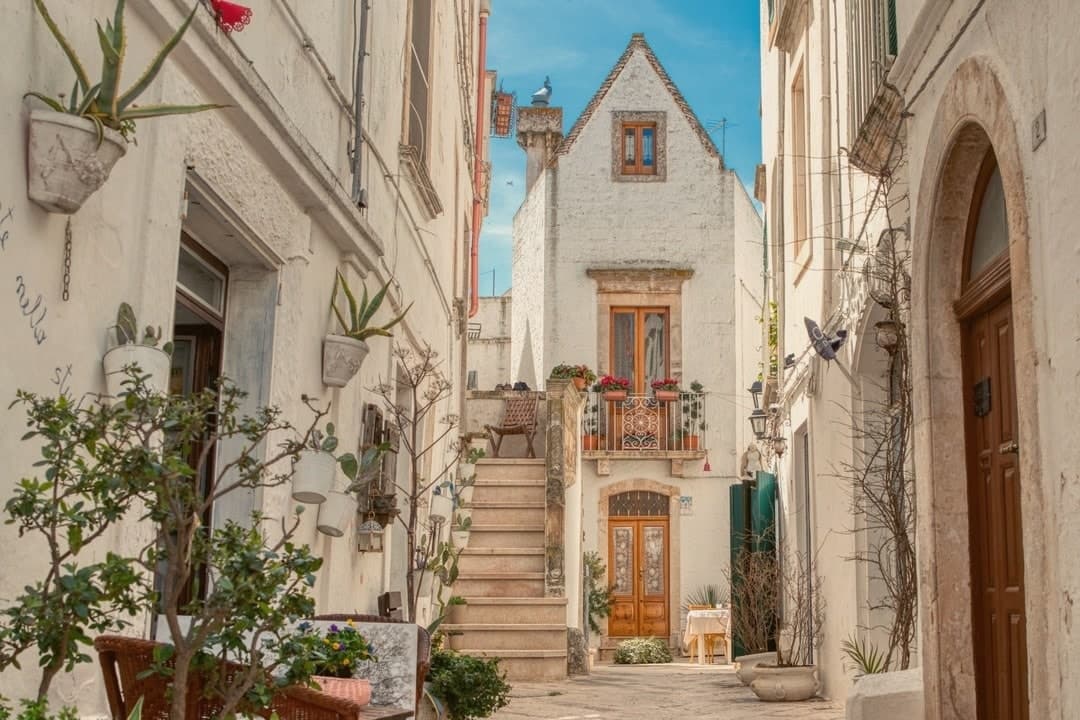
Locorotondo sits on a natural terrace at 410 meters, the high edge of the Valle d'Itria looking south over the trulli countryside between Alberobello, Cisternino and Martina Franca. The name means round place: the centro storico is a perfect circle of whitewashed houses, and the architecture is unique to this town.
The cummerse are stone houses with steep pitched roofs covered in two thin layers of limestone slabs, a profile that exists nowhere else in Puglia. The streets between them run in concentric arcs and are narrow enough to lose the sun by mid-afternoon.
Both the Borghi più belli d'Italia and the Touring Club's Bandiera Arancione recognize the place. The town also makes a white DOC wine from Verdeca and Bianco d'Alessano grapes, grown on 1,650 hectares of vineyards across the surrounding plateau, plus a Città dell'Olio membership for the oil that comes off the same hills.
We confirmed you can reach this one by train.
What to see in Locorotondo
- Centro storico. Circular old town of whitewashed cummerse, an architectural type with double-pitch limestone-slab roofs found only here.
- Villa Garibaldi. Public garden on the ridge with the widest panoramic view over the Itria valley and its trulli countryside.
- Chiesa Madre di San Giorgio. Eighteenth-century parish church on the highest point of the historic center, with a neoclassical façade and a tall central nave.
How to get to Locorotondo
There is a railway station in the town, so you can arrive without a car and never need one while you are here. Taranto is roughly 48 minutes away by road.
Our tip
April through June and September through October are the best months on the Itria plateau. Mornings are clear, the surrounding vineyards green up, and the wind off the Murge keeps evenings cool even in summer. July and August push past thirty degrees, the centro storico fills with day-trippers from Alberobello, and the narrow streets get crowded between ten and one.
Gravina in Puglia
Why visit Gravina in Puglia
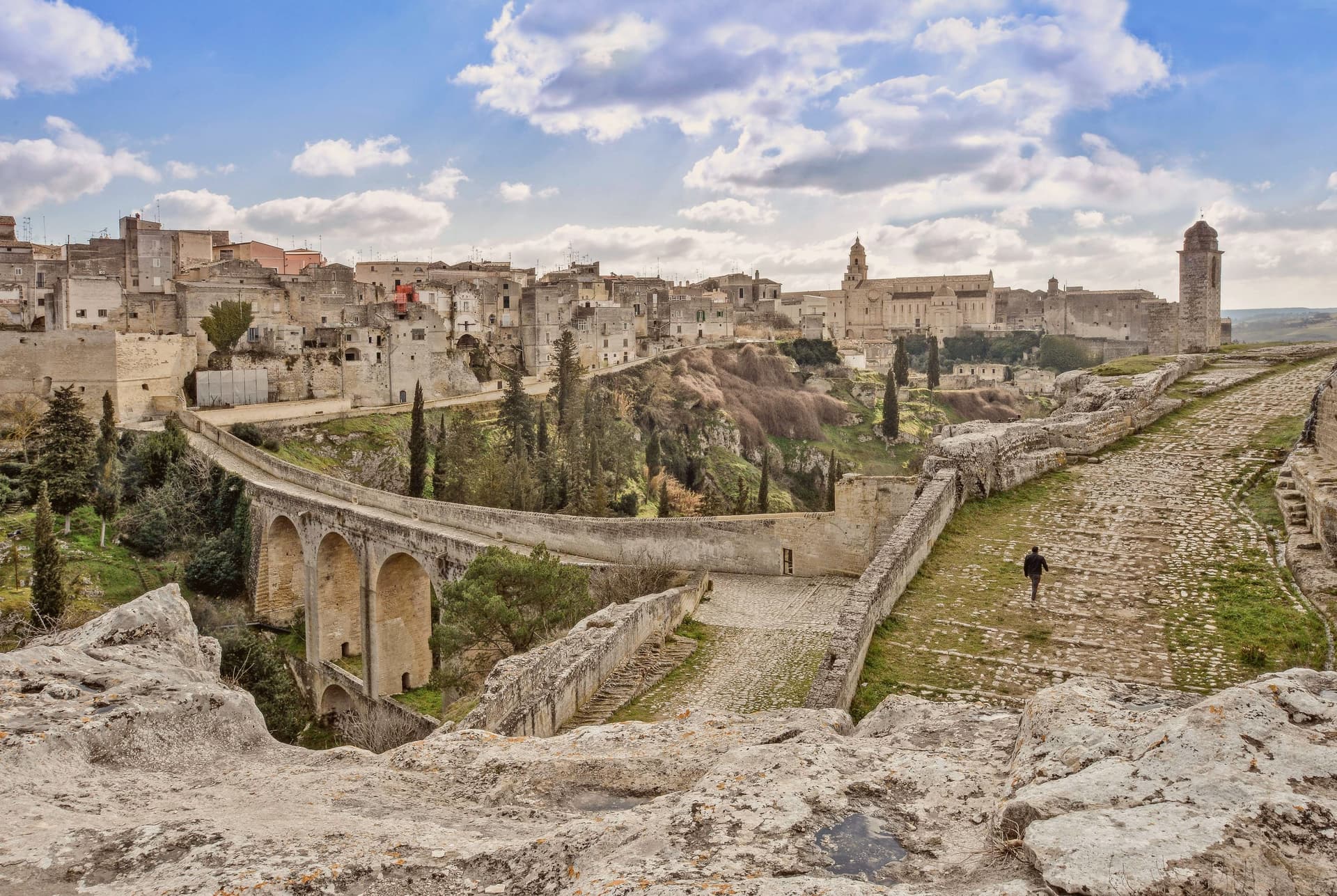
Gravina sits within the gravine, the network of limestone canyons cut across the Bari-Matera-Taranto karst plateau, the same geological system that produced Matera's Sassi 30 km west. This canyon is the deepest of them: 100m down, 350m wide at its narrowest, running straight through the centre of the modern town.
The plateau above holds the current population of 42,703; the old town clings to the cliff edge, its houses stacked against the same rock that the canyon walls below carry as a run of rupestrian churches and sanctuaries hollowed straight from the stone. The defining crossing of the two halves is the aqueduct bridge, built in the 18th century to bring water from the Murgia springs into the city and still walkable as a pedestrian route at 37m above the gorge floor.
On the canyon walls below it: a sanctuary carved into the rock, a church reached by a vertical stair and cut entirely into the cliff face, and a crypt complex holding frescoes from the 10th to 12th centuries, Byzantine work surviving in the dark of the rupestrian chambers. Above, on the plateau, the medieval centro takes over: the Cattedrale di Santa Maria Assunta, Romanesque and founded in 1092, holding its own Byzantine icon of the Madonna delle Grazie; the Castello Svevo rebuilt by Federico II; the Fondazione Ettore Pomarici Santomasi with its archaeological and Renaissance collections.
Gravina holds the Borghi più belli d'Italia designation together with Cittaslow, and lies on the Via Francigena, the branch tracing the old Via Appia route south, as well as bordering the Parco Nazionale dell'Alta Murgia, the karst plateau protected as national park immediately to the north. The food follows the same Murgia-Puglian line as the landscape: focaccia barese, orecchiette with cime di rapa, capocollo di Martina Franca, Primitivo di Manduria and the local Murgia DOC reds, built around the Festa di San Michele Arcangelo each September and the Carnevale Gravinese in late winter.
What Gravina adds up to is a town whose deepest cut in the earth doubles as its main street: canyon below carrying the sacred and the ancient, plateau above carrying the civic and the everyday, the two halves joined by a bridge built for water and now crossed for its own sake.
We confirmed you can reach this one by train.
What to see in Gravina in Puglia
- Ponte Acquedotto (Bond's bridge). Crosses the gorge at 37m height on 18th-c stonework, a walkable pedestrian route today. This is the crossing James Bond takes by motorbike in the Matera chase sequence of No Time to Die.
- Chiesa di San Michele delle Grotte. A church carved entirely into the rock cliff of the gravina, reached by a vertical stair. The most striking of the canyon's rupestrian churches.
- Castello Svevo + Cattedrale. The castle sits on the plateau beside the Romanesque cathedral, founded 1092, which holds the Byzantine Madonna delle Grazie icon.
How to get to Gravina in Puglia
There is a railway station in the town, so you can arrive without a car and never need one while you are here. Bari is roughly 68 minutes away by road.
Our tip
Gravina in Puglia is best March–June and September–October — the Murgia summer is brutally hot (38°C+ inland) and the gorge becomes an oven. The Festa di San Michele Arcangelo 28-29 September is the year's headline. February-March brings the Carnevale Gravinese. Historia falls in September.
More from Anywhere Italy
- The best hidden olive oil towns you can reach by train in Puglia
 The 9 best hidden towns you can reach by train that eat well in Puglia
 The best hidden olive oil towns in Puglia
- The 9 best hill towns you can reach by train in the province of Bari
 The best hill towns inside a national park in Puglia
- The best hill towns worth staying overnight in Puglia